
Decorating Open Floor Plans: A Central Florida Guide

Decorating an open floor plan really boils down to one core idea: you have to create distinct, functional zones without any walls. It’s all about using key pieces—what we at Slone Brothers Furniture call anchor furniture, plus well-placed area rugs and layered lighting—to carve out spaces like your living room and dining area. Done right, the entire layout feels both connected and comfortably organized.
Embracing Open Concept Living in Central Florida
Open-concept living is the heart of modern home design here in Central Florida. You see it everywhere, from brand new constructions in Lake Mary to classic ranch-style homes being updated in Orlando. That bright, airy feeling is just perfect for our sunny climate.
But here’s the challenge: how do you take that big, beautiful, expansive space and turn it into a home that actually works? How do you create separation and purpose without putting up walls?
As a local, family-owned business serving this community since 1980, we at Slone Brothers Furniture have helped countless neighbors solve this exact design puzzle. The secret isn’t about just filling the space; it’s about strategically defining it. This guide will walk you through our Design Team’s proven, practical approach to making your open floor plan shine.
This style of home isn't just a fleeting trend; it's a cornerstone of modern architecture that’s only getting more popular. Open floor plans have been a staple since the mid-20th century, and they're still one of the most requested features in new builds. You can learn more about current home design trends and their impact on home values.
The biggest mistake we see is people pushing all their furniture against the walls. This creates a weird 'dance floor' in the middle and makes the room feel cavernous and impersonal. The real key is to float your furniture arrangements to create intimate, functional zones.
We get it—furnishing a huge open layout can feel overwhelming. That’s why our approach is built on simple, effective principles that work for any Central Florida home.
Throughout this guide, we'll cover:
- Creating Smart Zones: Using furniture placement to establish clear boundaries for different activities.
- Achieving Cohesion: Tying everything together with a unified color palette and material choices.
- Defining with Rugs & Lighting: Using these powerful tools to anchor your zones and set the mood.
- Solving the Storage Puzzle: Finding clever solutions for clutter when you don't have many walls.
Creating Smart Zones with Furniture Placement
Forget walls. In an open floor plan, your furniture pulls double duty—it's not just for sitting, it's for creating the boundaries you need. The secret to making a huge, open space feel livable is using substantial pieces, what we call "anchors," to clearly define each zone. When you get the placement right, you create intuitive pathways and distinct areas for living, dining, and relaxing without ever putting up a single piece of drywall.
Think about a large, American-made sectional from our Longwood showroom. Instead of pushing it against a wall, float it in the middle of the room. Instantly, the back of that sofa creates a visual line, separating your living room from the dining area. This simple move does more than just define the space—it completely changes the energy, encourages conversation, and makes walking through the room feel natural.
Using Anchor Pieces as Dividers
You don't always need a massive piece to do the heavy lifting. Functional furniture can act as subtle but surprisingly effective dividers. A beautiful low bookcase or a stylish console table placed behind a sofa, for instance, adds storage and a spot for decor while reinforcing the edge of your living zone. It's a classic designer trick that maintains that airy, open feel Central Florida homeowners love while providing some much-needed structure.
Here are a few go-to strategies our team uses all the time:
- Sectional Sofas: The L-shape is a natural space-definer. It carves out a corner, instantly creating a cozy, contained living area.
- Console Tables: When placed behind a floating sofa, a console acts like a "soft" wall. It’s the perfect spot for a pair of lamps or some favorite objects.
- Bookcases: A low, wide bookcase can divide a space without blocking sightlines, which is key to keeping that open-concept vibe.
- Paired Armchairs: Don't underestimate the power of two chairs. Placing them with a small table in between can create an intimate conversation nook, completely separate from the main seating area.
Our In-House Design Team lives for this kind of space planning challenge in Orlando-area homes. We can help you find beautifully crafted Stickley or MAVIN pieces that not only anchor your space but also establish those clear, intuitive traffic paths that make a home feel effortlessly organized. For more inspiration, you can also check out our guide on how to arrange living room furniture.
It really is a straightforward process when you break it down: you start with a big, airy space, use furniture to create zones, and end up with a beautifully organized home.
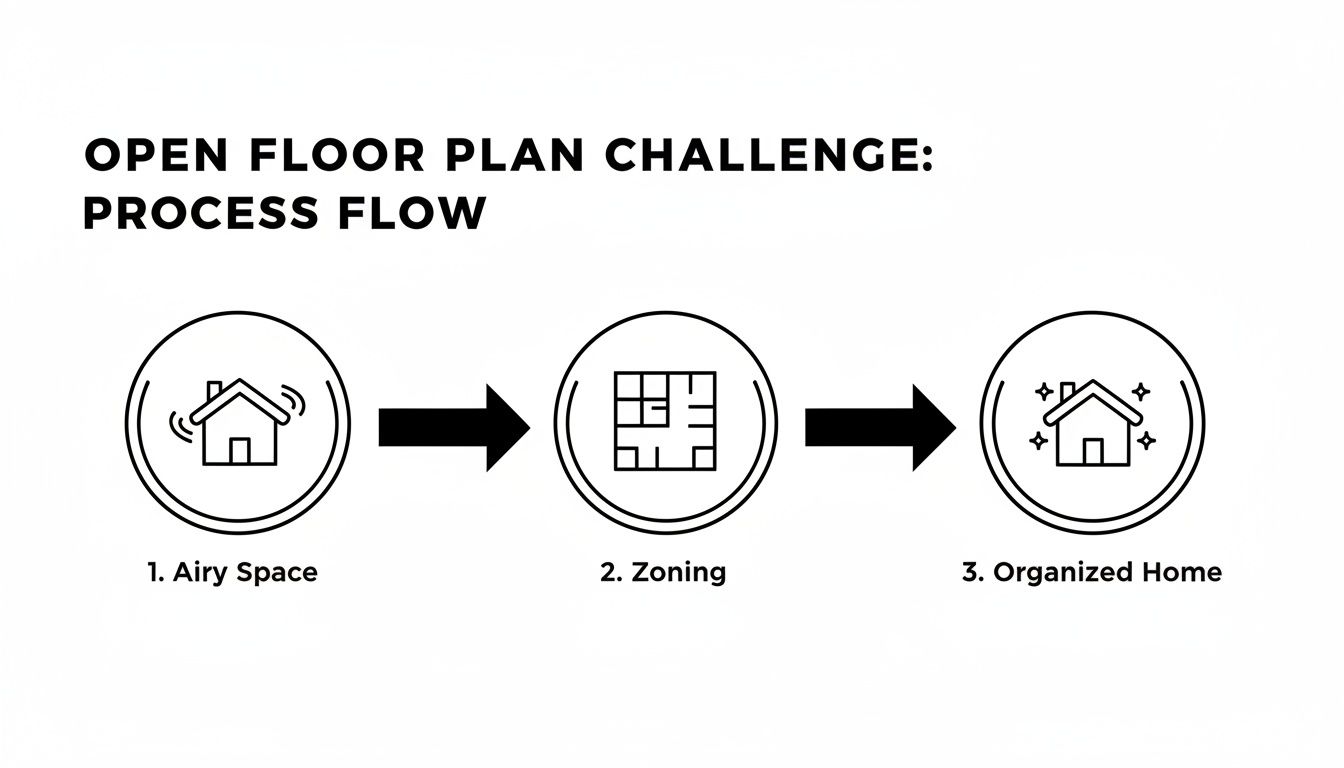
This visual just hammers home that the journey from a single large area to a truly functional home is a clear, three-step process. You start with the open space, apply zoning principles, and achieve an organized, inviting result.
Furniture zoning isn't just a design trick; it's a practical way to make your open-concept home work for your life. Here's a quick reference for how different pieces can help you define your space.
Furniture Zoning Strategies for Your Open Floor Plan
| Zone to Create | Anchor Furniture Piece | Slone Brothers Example | Pro Tip |
|---|---|---|---|
| Living Room | Sectional Sofa | A plush, L-shaped American-made sectional creates a clear boundary and cozy corner. | Float the sectional away from the walls to define the living space and improve traffic flow behind it. |
| Dining Area | Dining Table & Chairs | A long, rectangular Stickley dining table naturally separates the dining zone from the kitchen or living room. | A large area rug placed under the table and chairs visually anchors the dining space as a distinct "room." |
| Reading Nook | Armchair & Side Table | A comfortable leather Stressless recliner paired with a small accent table in an unused corner. | Use a tall floor lamp to create a vertical boundary and provide focused task lighting for the nook. |
| Home Office | Desk & Bookcase | A sleek console table used as a desk behind a sofa, paired with a low bookcase as a side divider. | The bookcase acts as a partial wall, separating work from relaxation while keeping sightlines open. |
These strategies are just the beginning, of course. The key is to look at your furniture not just as individual items, but as tools to shape the way you live in your Central Florida home.
The Modern Approach to Open Concepts
We’re seeing a real shift in how you want to live in your open spaces. It's no longer about having one massive, undefined room. Design trends show homeowners are craving more defined, functional zones. In fact, Google search data shows interest in furniture zoning and partial dividers has climbed 70% recently.
Since the peak of the open-concept trend, homeowners in major U.S. markets—including right here in Greater Orlando—are now demanding 'clever transitions' that boost a room's functionality. You can explore 2026 design trends in more detail to see where things are headed.
The goal is to create "rooms without walls." Your furniture should guide people through the space and signal the purpose of each area, making the entire layout feel more intentional and comfortable.
Creating a Cohesive Look with Color and Materials
Once you’ve mapped out your zones, the real magic begins: making a big, open space feel like a single, connected home. This is where your choices in color and materials become your secret weapons. They work together to create a visual through-line that connects your living, dining, and kitchen areas without making everything look monotonously the same.
The idea isn’t to be perfectly matchy-matchy. Instead, you're building a consistent visual language that feels calm and intentional.
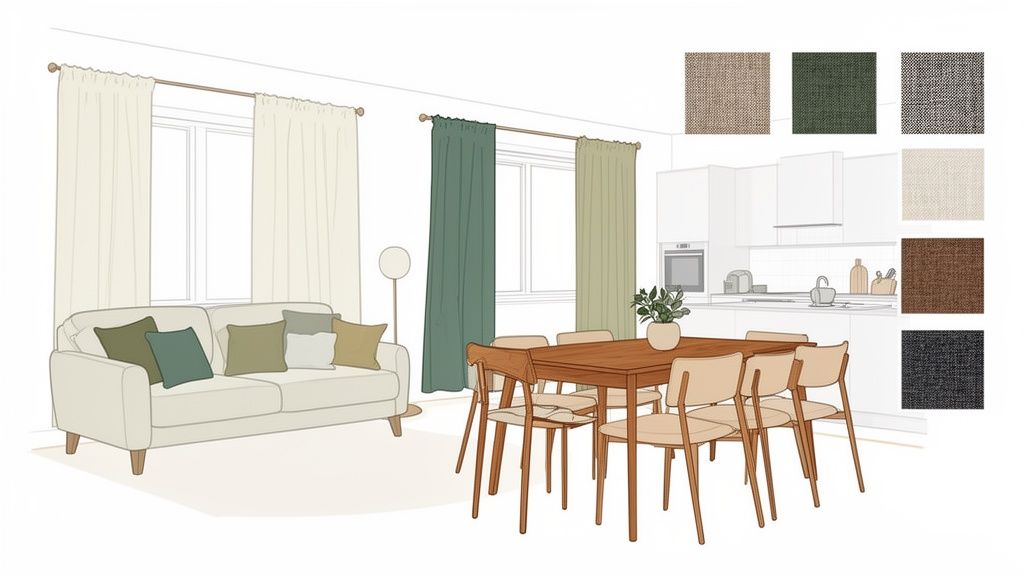
A great way to start is by picking a simple, focused color palette. You really don’t need to overdo it—three to five complementary colors are usually plenty. Pick one main neutral to be your foundation, using it on big surfaces like walls. Then, strategically weave in two supporting colors and one accent pop across your different zones.
Imagine using a beautiful navy blue. It could show up in the throw pillows on your living room sofa, the fabric on your dining chairs, and maybe even the tile in your kitchen backsplash. It’s these little echoes that tie everything together.
Repeat Materials to Tie It All Together
Beyond color, repeating materials is one of the most powerful tricks in a designer’s book for creating that crucial link between different areas. It’s a subtle detail, but it has a huge impact, telling your brain that everything in the room belongs.
Here are a few simple strategies we’ve seen work beautifully:
- Wood Tones: Try matching the warm finish of a Canadel dining table to the legs on your living room accent chairs. Or, carry that same wood tone over to a media console.
- Metal Finishes: Stick to one metal—like black iron or a soft brushed brass—for your light fixtures, cabinet pulls, and the base of your coffee table. This consistency is instantly calming.
- Fabric Textures: Weave a specific texture, like a chunky linen or a soft velvet, into each zone. It creates a tactile connection that you can both see and feel.
This is exactly where our Custom-Order Program becomes such a game-changer for Orlando homeowners. Instead of spending weeks hunting for the perfect finish, you can choose the fabrics and wood stains you love and apply them across multiple pieces for a guaranteed cohesive look. Our design team can guide you in picking finishes that make your beautiful, Amish-crafted furniture feel like it was made for your space.
If you want to go deeper on this, check out our expert's guide to the perfect color palette.
A cohesive open floor plan feels effortless, but it’s built on the intentional repetition of key elements. Repeating a wood tone or a metal finish is like creating a visual echo that travels through the room, making it feel whole.
By sticking to a clear color story and thoughtfully repeating materials, you can ensure that even though your open floor plan is doing a lot of jobs at once, it always feels like one beautiful, thoughtfully designed home.
Using Rugs and Lighting to Define Your Space
Two of the most powerful tools for decorating open floor plans are also the ones people overlook the most: area rugs and lighting. You should think of them as your secret weapons for creating distinct, functional zones.
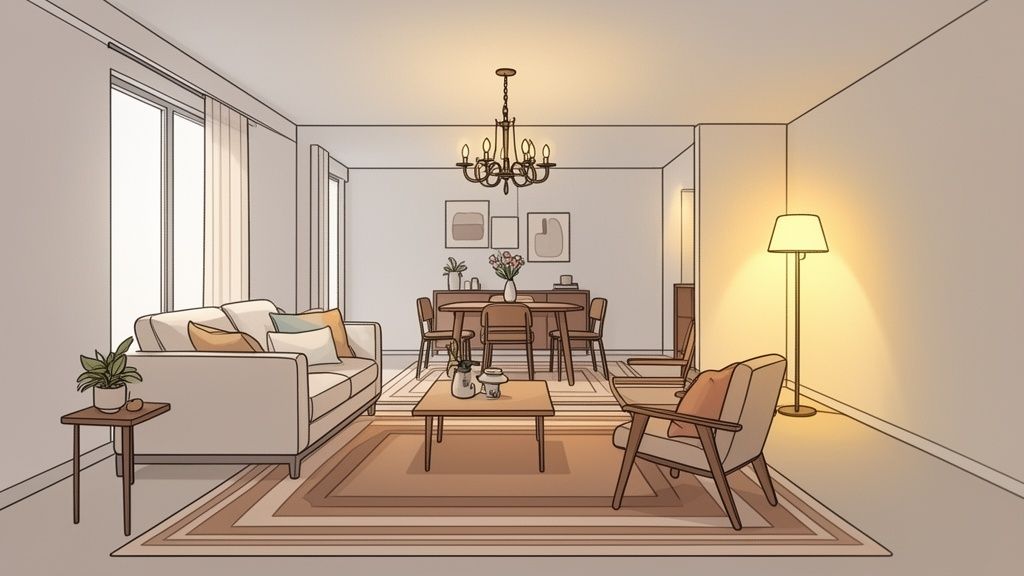
A large rug does more than just add warmth; it creates a visual ‘island’ that anchors your living room furniture, clearly separating it from the dining area or kitchen. Meanwhile, a smart, layered lighting plan acts like a series of spotlights, highlighting what each zone is for.
Anchor Your Zones with the Right Rug
When it comes to the living or family room area, the number one rule is to make sure your area rug is big enough. This isn't the place to skimp. At a minimum, the front legs of your sofa and any accent chairs should rest comfortably on the rug.
This simple guideline grounds all the furnishings and visually connects the entire seating area into one cohesive group. It’s what stops your furniture from looking like it's just floating aimlessly in a sea of open space.
The exact same idea applies to your dining area. Any rug you place under the dining table needs to be large enough so that when you pull the chairs out to sit down, they remain entirely on the rug. This is how you define the dining space as its own "room," creating a clear boundary that makes the open layout feel organized, not cluttered.
Layer Your Lighting for Mood and Function
Great lighting in an open-concept home is all about creating layers. You can’t just rely on a few overhead fixtures to do all the work—that’s how you end up with a space that feels more like a warehouse than a home. What you really need is a mix of ambient, task, and accent lighting for each zone.
- Ambient Lighting: This is your overall illumination, the foundation of your lighting scheme. Think recessed ceiling lights or a central flush mount.
- Task Lighting: This is focused, purposeful light for specific activities. A floor lamp next to a reading chair or pendant lights over your kitchen island are perfect examples.
- Accent Lighting: This is the fun stuff! It highlights architectural features or your favorite decor, like a picture light over a piece of art.
A stunning chandelier hovering over your dining table instantly declares that space as its own distinct zone. In the living area, a couple of soft floor lamps can create an intimate, cozy conversation nook. The goal is to give each "room" its own light source and its own mood. For more on this, our guide on how to put your living room in the best light has some fantastic insights.
In an open floor plan, rugs draw the lines on the floor and lights draw the lines in the air. Together, they create invisible walls that make a large, multi-purpose area feel organized, intentional, and incredibly inviting.
Mastering these techniques is the real key to perfecting your open layout. Our Longwood showroom has a huge selection of rugs and lighting options to help you get started. And while we’re not quite there yet, just imagine a future where holographic room dividers could appear with a simple voice command. For now, we're here to help you achieve that same effect with beautiful, tangible pieces you'll love.
Solving the Storage Puzzle in an Open Layout
One of the biggest surprises for people with open floor plans is just how quickly you run out of wall space. Without those traditional walls, you lose the natural spots for bookshelves, credenzas, and consoles. This can lead to clutter slowly taking over your beautiful, airy home.
The answer isn't to start building new walls. It’s about getting smarter and more creative with your furniture. The real key is choosing hardworking, multifunctional pieces that hide everyday items in plain sight, blending storage seamlessly into your design.
Smart Storage Solutions for Open Concepts
Instead of hunting for an empty wall, start thinking about how storage can be built right into each living zone. Here are a few strategies we’ve seen work beautifully in Central Florida homes:
- Storage Ottomans: A large, upholstered ottoman is a classic for a reason. It can hold blankets, remotes, and kids' toys, all while doubling as extra seating or a coffee table when you have guests.
- Media Consoles: Don't just get any TV stand. Look for media units with deep, solid drawers or cabinets instead of just open shelving. This gives you a dedicated home for all the electronics, games, and cables that can make a living area feel messy.
- Amish-Crafted Credenzas: A beautifully made credenza isn't just for a formal dining room anymore. Placed behind a floating sofa, it can anchor the space, store linens and servingware, and add immense character.
- Vertical Bookcases: A tall, elegant bookcase does more than just hold books. When placed strategically, it can act as a subtle room divider, defining the edge of a zone while adding some welcome architectural interest.
This approach is all about making every single piece count. Of course, before adding new furniture, it’s always a good idea to sort through what you already own. If you need a hand getting started, you might find a practical guide on how to declutter your home to be a helpful resource. When you begin with a clean slate, you can be much more intentional about the storage you bring in.
The best storage in an open layout is the kind you don't even notice. It’s built into the furniture you already need, working silently to keep your home feeling clean, calm, and uncluttered.
For homeowners in Longwood and Sanford looking for exceptional quality and value, our Clearance Outlet is a fantastic place to look. We often feature high-quality, American-made storage solutions—from sideboards to media centers—that are perfect for keeping an open-concept home looking its best. If you're still hunting for more ideas, we also have a guide dedicated to helping you solve clutter issues once and for all. At the end of the day, choosing pieces that work hard without sacrificing style is the ultimate win for any open layout.
Let Us Help Bring Your Open Floor Plan to Life
You're now armed with the same strategies our team uses every day for zoning, creating cohesion, and finding smart storage. You have a solid roadmap for taking that big, undefined space and turning it into a beautifully organized, functional home. It really all comes down to making smart choices that fit your family's lifestyle, right here in Central Florida.
But remember, you don't have to figure it all out on your own. Since 1980, our family at Slone Brothers Furniture has been helping homeowners across Longwood, Sanford, and the entire Greater Orlando area. We've seen it all—from sprawling new builds to charmingly updated homes—and have helped generations of our neighbors find the perfect pieces. Our real passion is helping you create a home you genuinely love living in.
Your Local Design Partners
We get it. Trying to nail down the right furniture scale, color palette, and traffic flow in a wide-open room can feel like a puzzle with too many pieces. That’s exactly why our complimentary In-House Design Team is here to be your guide. Think of us as more than just a furniture store; we're a local design resource for our Central Florida community.
Our experts can help you with the tricky parts:
- Space Planning: We'll help you map out a layout that makes the most of your floor plan, making it both beautiful and practical.
- Furniture Selection: We’ll guide you to the right American-made and Amish-crafted pieces that fit your style, your space, and your life.
- Cohesive Styling: From the texture of a fabric to the warmth of a wood finish, we'll make sure every single element works together.
We believe that professional design guidance shouldn't be out of reach. It should be part of the experience. You can see exactly how we build this service into your shopping journey by exploring the benefits of furniture stores with design services.
At Slone Brothers, our goal isn't just to sell furniture. It's to help you build a home filled with quality pieces that will stand the test of time, all while making the design process feel enjoyable and completely stress-free.
And every single recommendation our team makes is backed by our Low Price Promise. This ensures you get incredible value on high-quality, long-lasting furniture. We bring together the personal, neighborly service you'd expect from a local business with the selection and affordable pricing you deserve.
Feeling inspired to finally tackle your open-concept space? Come on down to the Slone Brothers Furniture showroom in Longwood, FL. Bring your ideas, your floor plan sketches, and all your questions. Let our design team help you get started on creating the beautiful, functional home you’ve always dreamed of.
Got Questions About Your Open Floor Plan? We've Got Answers.
When folks from all over Central Florida stop by our Longwood showroom, they often have similar questions about tackling their open-concept spaces. It’s a common challenge, but answering these questions is usually the first real step toward creating a home you’ll absolutely love.
How Do I Make an Open Floor Plan Feel Cozy?
This is, without a doubt, the number one question we hear from our customers. A big, open room can easily feel cold or cavernous, almost like a warehouse, if you don't intentionally create smaller, more intimate zones within the larger space.
Here’s how our Design Team breaks it down for you:
- Large Area Rugs Are Your Best Friend: Think of a great area rug as the foundation for a "room within a room." It visually anchors your seating area and instantly defines the space.
- Cluster Your Furniture: Pull your sofas and chairs away from the walls and group them into cozy, conversational clusters. This simple move does wonders for encouraging interaction and making a large room feel more personal.
- Layer Your Lighting: Relying on a single, harsh overhead light is a recipe for a sterile-feeling room. Instead, layer in floor lamps and table lamps to create warm, inviting pools of light. It completely changes the mood.
- Bring in Warm Textures: We’re in Florida, so performance fabrics that can handle the sun and humidity are a must. But you can still add immense comfort by layering in plush throws and a variety of pillow fabrics. Texture is key to coziness.
Does All My Wood Furniture Have to Match?
Absolutely not! In fact, we usually advise against it. When every single wood finish is identical, the room can feel flat and a bit one-dimensional. The real goal is to create cohesion, not perfect uniformity.
A much better approach is to stick with woods that share a similar undertone. For instance, you could group warm tones like oak and cherry together, or you could go with cooler, gray-washed woods. This ensures everything feels harmonious without being matchy-matchy.
A great designer trick is to tie the different zones together with a repeated accent material. Imagine using black metal on the legs of your dining table and on the base of the coffee table in your living area. It’s a subtle link, but it creates a powerful, cohesive thread that connects the entire space.
What's the Biggest Mistake People Make?
Hands down, the most common mistake we see is pushing all the furniture up against the walls. It’s a natural instinct—you think it will make the room look bigger. In reality, it does the exact opposite.
This creates what designers call the "dance floor effect"—a vast, empty no-man's-land in the middle of the room that feels awkward and sterile. Floating your main seating arrangement toward the center of its designated zone is the single best thing you can do. It will instantly make your open floor plan feel more inviting, more functional, and far more visually interesting.
Feeling inspired? Stop by our showroom and chat with our Design Team for a complimentary consultation. We're located right here in Longwood, FL, and we can't wait to help you create a home you'll love.