
Difference Between Memory Foam and Hybrid Mattress Guide


A lot of people in Central Florida start mattress shopping the same way. You wake up tired, your shoulder feels sore, your partner moved half the night, and now you are deep into tabs comparing foam, coils, cooling claims, and firmness charts.
That is usually the moment the main question shows up. What is the difference between memory foam and hybrid mattress options, and which one will feel better in your home, not just on a spec sheet?
We have helped Greater Orlando families sort through that decision for decades. Some shoppers come in from Longwood wanting pressure relief. Others drive over from Lake Mary or Sanford because one sleeper runs hot and the other wakes up at every movement. The right answer is rarely about hype. It is about how a mattress is built, how it feels under your body, and how to test it in person so you can choose with confidence.
Choosing Your Best Night's Sleep in Central Florida
A mattress can look perfect online and still feel completely wrong after a full night of sleep.
That is why this choice matters so much. The difference between memory foam and hybrid mattress models affects how your back feels in the morning, how much movement you notice at night, and whether you feel cradled or lifted when you lie down.
For many Central Florida shoppers, the confusion starts because both mattress types can sound similar in product descriptions. They may both mention comfort layers, support, cooling materials, or pressure relief. But they do not feel the same once you are on them.
A simple way to think about it is this:
| Feature | Memory foam mattress | Hybrid mattress |
|---|---|---|
| Core build | All foam | Foam over coils |
| Main feel | Closer contouring, more body hug | More bounce, more lift |
| Common appeal | Pressure relief and reduced motion | Balanced comfort and support |
| Good fit for | Couples, side sleepers, people who like a quieter feel | Hot sleepers, combination sleepers, people who want responsiveness |
Shoppers often tell us they are stuck between two goals. They want cushioning for sore joints, but they do not want to feel trapped in bed. Or they want bounce and airflow, but they do not want every toss and turn to travel across the mattress.
Those are smart concerns.
If you want a useful starting point before you visit a showroom, our guide on how to choose a mattress helps narrow down what matters most based on how you sleep.
Where people get mixed up
The biggest misunderstanding is assuming memory foam means soft and hybrid means firm.
That is not always true. Both categories come in different comfort levels. The bigger distinction is how the support is created. Memory foam relies on layered foams. A hybrid uses comfort layers on top, but the base support comes from a coil system.
A mattress category tells you the construction. It does not automatically tell you the exact firmness.
Why local shoppers should test before deciding
Central Florida homes, sleep habits, and comfort preferences vary a lot. Someone with an active lifestyle may want easier movement across the bed. A side sleeper may need deeper pressure relief at the shoulder and hip. A couple may care most about one partner not waking the other.
That is why an in-person buying guide matters. Once you understand the construction, you can test each type with a clear purpose instead of just lying down for a few seconds and guessing.
Understanding the All-Foam Embrace of Memory Foam
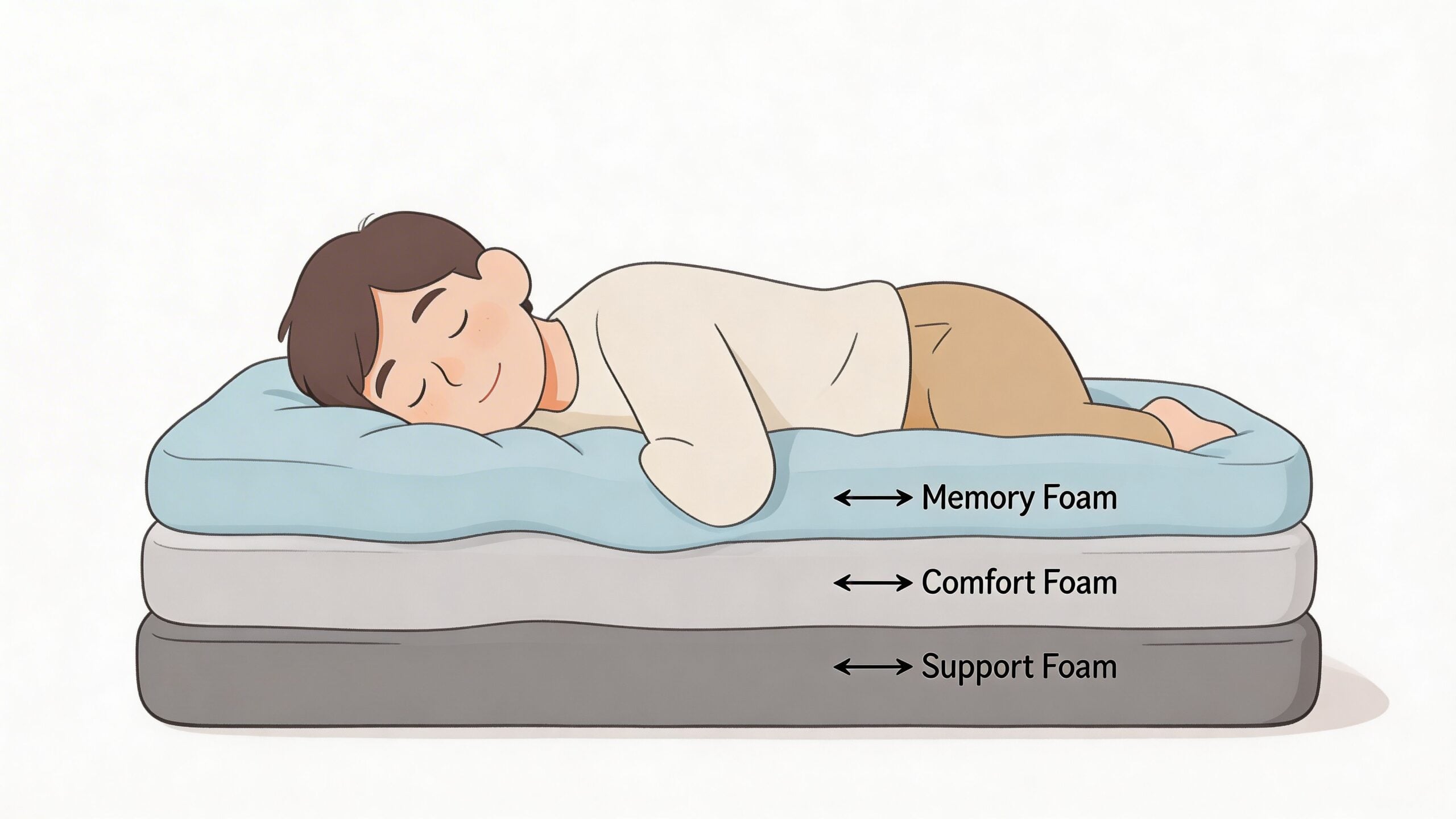
A memory foam mattress is built entirely from foam layers. No coils underneath. No spring core in the center.
That all-foam construction is what gives memory foam its familiar close-contouring feel.
How the layers work together
A typical memory foam mattress uses a few distinct layers, each with a job to do.
- Top comfort layer gives you the pressure-relieving, contouring feel. This is usually the memory foam layer that responds to weight and warmth.
- Transition layer eases your body into the mattress so you do not drop too quickly into the support core.
- Support base is made from denser polyfoam that provides structure and helps the mattress keep its shape.
The result is a surface that molds more closely around the body than most hybrids do. Many side sleepers notice this first at the shoulders and hips, where a firmer mattress can create pressure.
What memory foam feels like
People often describe memory foam in one of two ways. They call it a hug or a cradle.
That is useful language, but it can also be misleading if you are shopping for the first time. A quality memory foam mattress should contour to you. It should not feel like you are falling into a pit. The sensation is more about even weight distribution than dramatic sinking.
If you lie on your side, the foam tends to cushion the curves of your body. If you lie on your back, it tends to fill in the space around your lower back and hips. That close contact is why many shoppers seek it out for pressure relief.
Why people choose it
Memory foam appeals to shoppers who want a quieter, more absorbed feel.
This type of mattress often works well for:
- Couples who do not want every movement to ripple across the bed
- Side sleepers who prefer more contouring at pressure points
- Light sleepers who notice small shifts in the mattress surface
- Anyone who likes a cocooned feel rather than a lifted, springy one
If you enjoy learning how mattress materials evolved over time, our article on the history of mattresses from straw mats to memory foam gives helpful context.
If your current bed feels hard at the shoulder or hip, memory foam is often the category worth testing first.
One common concern
Some shoppers in Orlando and Longwood worry that memory foam will feel too enveloping.
That can happen if you prefer quick movement or a more buoyant surface. It does not mean memory foam is wrong for you. It just means you should pay attention to how easy it feels to roll, shift positions, and get in and out of bed when you test one in person.
Exploring the Best of Both Worlds with a Hybrid Mattress
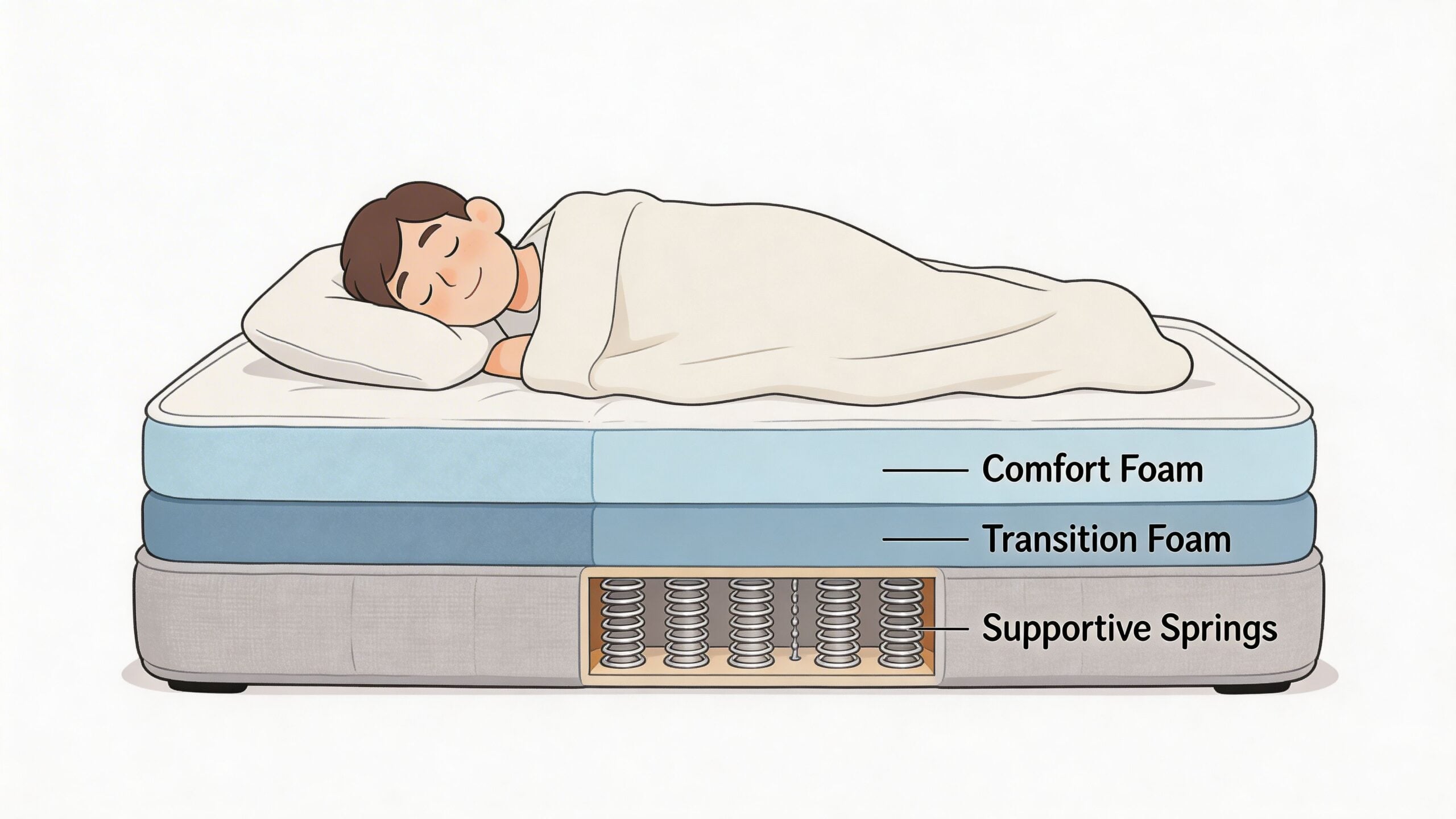
A hybrid mattress combines foam comfort layers with a coil support system.
That combination is the whole point. You get some cushioning near the surface, but the support underneath comes from springs rather than an all-foam core.
What makes a hybrid different
The key structural difference is in the center of the mattress.
Instead of relying only on dense foam for support, a hybrid uses a coil core. Those coils are usually individually wrapped, which allows them to respond with more independence than older, connected spring systems.
On top of the coils, you will typically find comfort layers that may include memory foam or other foams. That upper section softens the surface and adds pressure relief, while the spring layer underneath creates a more responsive foundation.
How it feels in real life
Shoppers often notice the feel of a hybrid immediately.
A hybrid usually feels:
- More responsive when you change positions
- More lifted rather than closely hugged
- Easier to move on if you toss and turn
- More familiar to shoppers who grew up with innerspring beds but want improved comfort
This does not mean every hybrid feels firm. Some are plush on top. The difference is that the coil support creates a little more pushback from below.
Why some sleepers prefer hybrids
A hybrid can be appealing if you want a middle ground. You like some contouring, but you do not want the slower, closer embrace of all-foam construction.
That can make hybrids a strong option for:
- Combination sleepers who move throughout the night
- Back or stomach sleepers who want a more supportive sensation
- Hot sleepers who generally prefer a less enclosed feel
- Shoppers replacing an innerspring who want more comfort without losing responsiveness
If you want a deeper primer on this mattress category, our article on what is a hybrid mattress is a good next read.
The tradeoff to watch for
A hybrid can feel more active under the body.
For some sleepers, that is a benefit. It makes the bed easier to use and more comfortable for repositioning. For others, especially light sleepers who share a bed, that same responsiveness may be less appealing than the more absorbed feel of memory foam.
Comparing the Difference Between Memory Foam and Hybrid Mattress
A lot of Central Florida shoppers walk into our showroom after reading reviews online and still feel stuck. On paper, both mattress types can sound comfortable. In person, the difference usually becomes clear within the first few minutes of lying down.
Once you strip away brand language, the difference between memory foam and hybrid mattress models comes down to a few practical questions. Do you want a closer cradle or more lift? Do you share the bed with a light sleeper? Does your bedroom tend to feel warm and humid? Those are the questions that help narrow the choice.
Construction and feel
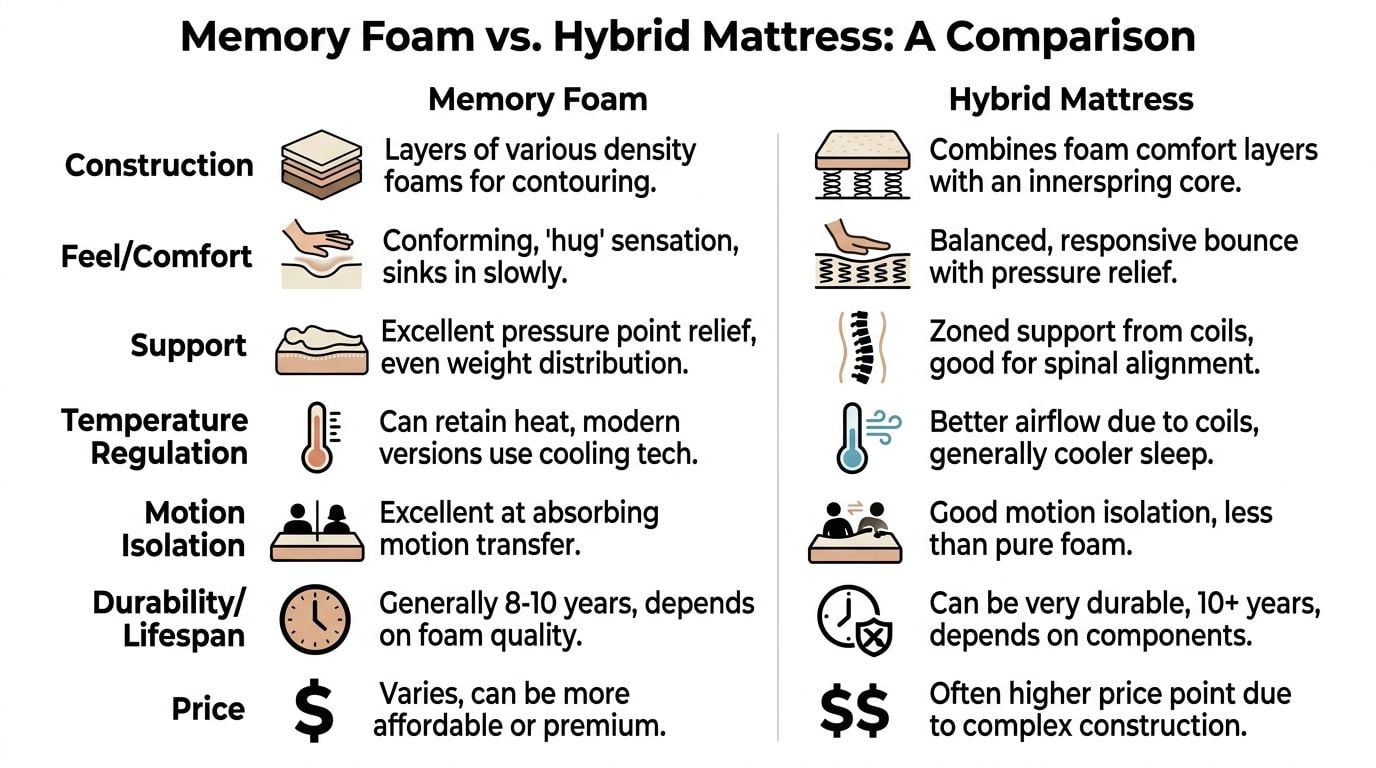
Memory foam uses layered foams from top to bottom. That all-foam build creates a more uniform surface response, so the mattress tends to contour in a steady, body-following way.
A hybrid adds a coil unit under the comfort layers. The easiest way to feel that difference in a showroom is to lie still for 30 seconds, then roll from your side to your back. Memory foam often gives you a slower, deeper settling sensation. A hybrid usually feels more lifted and spring-assisted as you change position.
Many shoppers describe it like this. Memory foam shapes itself around you more closely. A hybrid supports you with comfort on top and structure underneath.
Support and pressure relief
Both categories can support healthy alignment, but they spread weight differently.
Memory foam is often a strong starting point for shoppers with sore shoulders, tender hips, or pressure points from a mattress that feels too firm. Because the material contours closely, it can cushion those sharper contact areas in a gentler way.
A hybrid usually creates a more balanced feel between contouring and pushback. For some sleepers, especially those who do not like feeling hugged by the mattress, that balance feels easier to live with night after night.
Motion, airflow, and movement
In-store testing is essential to evaluate these aspects.
Analysts at The Sleep Loft’s comparison of hybrid and memory foam mattresses found that memory foam reduced motion transfer more effectively than hybrids in their testing, while hybrids tended to use taller coil support systems and slightly higher starting price points. Those construction differences help explain what couples often notice on the sales floor. Memory foam usually does a better job of absorbing a partner’s movement, while hybrids often feel easier to move across and less enclosed.
That tradeoff matters in Florida homes. If you sleep warm, deal with humidity for much of the year, or come home physically tired after golf, gym sessions, long shifts, or time outdoors, a hybrid’s more open structure may feel more comfortable. If your bigger problem is being woken up when your partner turns over at 5 a.m., memory foam may solve the more urgent issue.
Durability and value
Shoppers often ask which type lasts longer. The more accurate question is which mattress is built well and fits your body well.
Category alone does not guarantee better long-term value. A well-made memory foam mattress can outlast a cheaply built hybrid. A high-quality hybrid can hold its comfort better than an all-foam model made with lower-grade materials. In the showroom, this is why we encourage families to look past the label and pay attention to edge support, recovery speed, comfort consistency, and how their spine feels after several minutes in their usual sleep position.
Price matters, too, but value shows up later. A mattress that keeps you comfortable through sticky Florida summers, supports recovery after active days, and still feels right after the break-in period is usually the smarter purchase.
A quick side-by-side summary
| Category | Memory foam | Hybrid |
|---|---|---|
| Overall feel | Closer contouring, slower response | More lift, quicker response |
| Pressure relief | Often stronger at shoulders and hips | Often more balanced between cushion and pushback |
| Motion isolation | Usually better for couples | Usually more movement carries across the bed |
| Airflow | Can feel more enclosed | Often feels airier because of the coil core |
| Ease of movement | Slower to respond | Easier to reposition on |
| Best fit for many shoppers | Those who want cushioning and less partner disturbance | Those who want responsiveness and a less hugged feel |
If you want another outside perspective that includes a third category, this comparison of Latex Vs Memory Foam Vs Hybrid can help sharpen your thinking before you test beds in person.
For a broader overview of mattress materials and how they compare before you visit the showroom, our guide to different mattress types explained is a useful next step.
Matching the Right Mattress to Your Florida Lifestyle
The right mattress is not just about materials. It has to fit how you sleep in your home.
That is why two shoppers can test the same bed in Longwood and leave with completely different opinions. One feels supported. The other feels pressure at the shoulder. One likes a floating sensation. The other wants that deeper contour.

If you are a side sleeper
Side sleepers often need a mattress that reduces pressure where the body meets the bed most sharply.
Memory foam is often the first category to try if your shoulder or hip feels compressed on firmer surfaces. The closer contouring can create a more cushioned feel at those contact points.
If you are a side sleeper who still wants more ease of movement, a softer hybrid may also be worth testing. The deciding factor is whether you prefer deeper body shaping or a little more lift.
If you sleep on your back or stomach
Back and stomach sleepers often pay closer attention to support and alignment.
Many of these shoppers like the steadier pushback a hybrid can provide. If your current bed makes your midsection feel like it is dipping too much, a hybrid may feel more supportive.
That said, comfort level still matters. Some back sleepers prefer memory foam because it fills in the lower back comfortably. In such cases, testing position by position matters more than labels.
If you share a bed
Couples in Central Florida often walk in with one issue above all others. One person sleeps lightly, and the other moves a lot.
In that situation, memory foam deserves a close look because reduced motion transfer can make the bed feel calmer through the night. If movement wakes you more than temperature does, that factor may outweigh everything else.
If you sleep warm in Florida
This is one of the most common local concerns we hear.
Many Orlando-area shoppers want a mattress that feels less stuffy and less closed-in, especially during warmer months. A hybrid often appeals here because the overall feel is usually more open and breathable.
That does not mean every hot sleeper should skip memory foam. It means you should pay attention to how quickly the bed warms up beneath you during a proper in-store test.
In Central Florida, “cooling” is not a buzzword issue. It is a daily comfort issue.
If you change positions all night
Combination sleepers usually notice responsiveness faster than anything else.
If you roll often or do not like the feeling of sinking into one spot, a hybrid may be easier to live with night after night. The mattress tends to react faster when you move.
Use firmness as a second filter
After you choose between memory foam and hybrid, then narrow by firmness.
That order helps many shoppers avoid confusion. First pick the construction style you like. Then fine-tune the comfort level. Our mattress firmness guide can help with that second step.
Your In-Store Guide to Finding the Perfect Mattress
Online research helps you ask better questions. It does not replace lying on a mattress long enough to feel what your body thinks.
That is where showroom testing changes everything.
Do not test a mattress for only a minute
Many people sit on the edge, bounce once, lie down for a few seconds, and move on.
That is not enough. Spend real time on any model you are seriously considering. Stay in your usual sleep position. Roll once or twice. Notice what happens at your shoulders, hips, and lower back.
If you share a bed, test together. Have one person turn or get up while the other stays still. That simple test can tell you more than a paragraph of online copy.
Compare with a purpose
Try not to bounce randomly from one mattress to another.
Use a simple comparison method:
- Start with your current complaint. Is it pressure, heat, movement, or lack of support?
- Test one memory foam and one hybrid back to back so the feel difference stays fresh.
- Stay in position long enough for your body to settle.
- Pay attention to movement when changing sides or sitting up.
- Notice your first instinct. Some mattresses feel impressive at first touch but less comfortable after a few minutes.
Bring your real-life context into the showroom
The best mattress choice usually becomes clearer when you think about your actual routine.
Ask yourself:
- Do you sleep warm most nights?
- Does your partner wake you up by moving?
- Do you read or watch TV in bed and need strong support when sitting up?
- Are you replacing an older innerspring and worried that foam might feel too different?
Those answers guide the test.
A lot of shoppers also like to compare what different stores carry before visiting. If you want to preview a broader range of online options first, you can browse our complete mattress collection as a reference point, then use that research to sharpen what you want to feel in person.
Ask the right questions while you test
You do not need technical jargon. Simple questions work best.
Ask about:
- How the mattress is supported
- Whether it feels more contouring or more responsive
- Which sleepers usually prefer that build
- What foundation works with it
- How to compare similar models without getting overwhelmed
At our Longwood showroom, Slone Brothers Furniture offers mattresses alongside guidance from a design team that can help match mattress feel to the rest of your bedroom setup, including frame and foundation choices. If you want to learn more about that support before your visit, our Design Services page explains how the process works.
The best in-store test is not “Do I like this?” It is “Would I want to sleep on this every night?”
Your Mattress Questions Answered
A few practical questions come up in almost every showroom conversation. These are the ones worth sorting out before you buy.
Do I need a box spring or a different foundation
Most modern mattresses do best on a stable, supportive surface.
A traditional old-style box spring is not always the right match, especially for newer all-foam and hybrid constructions. Many shoppers do better with a platform bed, a solid foundation, or a slatted base designed to support the mattress evenly. If you are unsure, ask before you check out. The support underneath affects comfort and long-term wear.
How does Central Florida humidity factor in
Humidity changes how bedding and sleep surfaces feel, even if it does not change the category that is right for you.
Many local shoppers prefer a mattress that feels breathable, especially if the room tends to stay warm. Good airflow, a breathable protector, and sheets that do not trap heat can matter almost as much as the mattress itself. In Florida homes, the full sleep setup works as a system.
What is off-gassing
That “new mattress” smell is what many people call off-gassing.
It usually fades with time. If smell sensitivity is a concern in your household, ask about the materials used and let the mattress air out as recommended after delivery. Keeping the room ventilated can also help the process feel less noticeable.
Should I choose based on reviews alone
Reviews are useful for spotting patterns, but they cannot tell you how your body will react.
One person’s perfect mattress can feel wrong to someone else with a different sleep position, body type, or temperature preference. Reviews are best used to build a shortlist. Your final decision should come from testing.
How can I avoid buyer’s remorse
Keep your decision anchored to your top two sleep priorities.
If your biggest issue is partner disturbance, focus on that first. If your biggest issue is sleeping warm, start there. Shoppers get overwhelmed when they try to solve every possible mattress concern at once.
Bring the list with you. Test with intention. Trust what your body notices after a few minutes, not just the first impression.
Ready to find the right mattress for your home? Visit Slone Brothers Furniture in Longwood, FL, and let our design experts help you compare memory foam and hybrid options in person.