
The Essential Dining Room Rug Size Guide For Florida Homes

Picking the right dining room rug for your Orlando home can feel surprisingly tricky, but let me tell you, getting the size right is the single most important decision you'll make. The golden rule is simple: all four chair legs must stay comfortably on the rug, even when people pull them out to sit down. As your local furniture experts since 1980, this is the detail we know separates a well-designed room from one that just feels… off. It prevents wobbly chairs, eliminates a tripping hazard, and makes your entire dining set look intentional and complete.
Why The Right Rug Size Is A Game Changer
A dining room rug does so much more than just add a splash of color or protect your beautiful floors. It’s the visual anchor for the entire space—the one element that pulls your table, chairs, and other decor into a single, cohesive design. For homeowners here in Longwood and across Central Florida, a well-chosen rug is essential for defining the dining area, especially in the open-concept floor plans we see so often. It creates a sense of place, signaling that this is where family gathers and memories are made.

Think of it like framing a beautiful piece of art. A frame that’s too small makes the art look awkward and insignificant. In the same way, a rug that's too small for your dining set will throw off the balance of the whole room, making it feel poorly planned.
The Foundation Of Function And Style
Since we first opened our doors in 1980, we’ve helped our Central Florida neighbors create functional, beautiful homes, and this principle has never changed. The right-sized rug achieves several key goals all at once:
- Defines the Zone: It clearly marks the dining space, creating a distinct "room within a room."
- Protects Your Flooring: It guards your hardwood or tile against the constant scraping of chair legs.
- Enhances Comfort: A rug adds warmth, softens the room's acoustics, and feels so much better underfoot.
- Completes the Look: It ties all your design elements together, making the space feel finished and professionally styled. You can see how rugs and other pieces work together in our guide to 7 dining room styles to fit every home.
The importance of this foundational piece is something we see reflected across the entire home furnishings market. The global carpet and rug market was valued at a staggering USD 51.7 billion in 2024 and is projected to keep growing. That shows just how much homeowners are investing in creating well-appointed spaces. As families continue to prioritize making their dining rooms both beautiful and functional, the demand for quality options has led to an incredible selection of styles and materials. You can read the full research on the carpet market to see just how big this trend is.
This guide will walk you through everything you need to know, from measuring your space to choosing materials that fit the Florida lifestyle. By following this expert dining room rug size guide, you'll find a piece that not only looks stunning but actually makes your daily life better.
The Unbreakable Rule For Measuring Your Rug
Forget the guesswork. Over decades of helping Central Florida families create beautiful, functional homes, our in-house design team has landed on a simple, foolproof method for getting the rug fit right every single time. This is the absolute foundation of any good dining room rug size guide, and it’s the one thing that can take your space from awkward to amazing.
The process itself is surprisingly straightforward. First, just measure the length and width of your dining tabletop. It doesn’t matter if you have a grand Stickley Mission-style table or a sleek, modern Canadel set—this number is your starting point.
Now for the critical part, the step that most people miss. Pull a dining chair away from the table, just like you would if you were about to sit down for a meal. This simple action reveals the true functional footprint of your entire dining set.
The 24-Inch Buffer Zone
With your chair pulled out, grab your tape measure. Measure from the edge of the tabletop straight back to the back legs of the chair. You'll likely find this distance is around 24 inches, though it can sometimes stretch closer to 30 inches depending on the chair’s scale and design. This is your magic number.
You need to add at least 24 inches of rug space to every side of your table's measurement. This isn't just a friendly suggestion; it's the non-negotiable rule for creating a dining area that feels right and works perfectly.
Think of this buffer as a comfortable "landing pad" for your chairs. It guarantees that when you or your guests slide chairs in and out, the legs never, ever catch on the edge of the rug. This prevents that annoying wobble, protects your rug's edges from fraying, and gets rid of a frustrating tripping hazard.
Let's walk through a quick example. Say your dining table measures 40 inches wide by 72 inches long. Here’s how you’d figure out the minimum rug size:
- Width Calculation: 40" (table) + 24" (left side) + 24" (right side) = 88 inches
- Length Calculation: 72" (table) + 24" (front side) + 24" (back side) = 120 inches
So, your absolute minimum rug size is 88" x 120". That translates perfectly to a standard 8' x 10' rug (which is 96" x 120"). If you have the space and want a more generous, high-end feel, a 9' x 12' rug would be an even better choice.
Why This Measurement Is Non-Negotiable
Ignoring this 24-inch rule is the number one reason dining rooms end up feeling cramped and poorly planned. When a rug is too small, chair legs are constantly getting snagged on the edge.
You know the feeling—half the chair is on the rug, half is on the floor, creating an unstable and irritating dining experience. It completely breaks the visual flow of the room and puts unnecessary wear and tear on both your chairs and your rug.
This principle is universal, whether you're in a cozy Lake Mary bungalow or a spacious Orlando estate. Making sure there's plenty of room for chairs to move freely is the real secret to achieving that polished, designer look. For more tips on getting your room's dimensions just right, check out our guide on how to measure a room for furniture. This simple measurement technique guarantees your dining room will feel as practical for daily family meals as it does elegant for hosting your next dinner party.
Matching Rug Size To Your Table Shape
Think of your dining table as the star of the show and the rug as its perfect supporting actor. The simplest, most effective design rule we share with our clients at our Longwood showroom is to let the shape of your rug follow the shape of your table. It’s a small detail that creates instant visual harmony, making the entire room feel intentional and pulled together.
For most homes, this means pairing like with like. If you have a classic rectangular table—maybe a beautiful, American-made Bassett or a solid wood Simply Amish piece—a rectangular rug is your best bet. It perfectly mirrors the table's long lines, creating a balanced foundation. The same logic applies to elegant oval tables; a rectangular rug still works best to frame their elongated shape.
Aligning Rug and Table Geometry
Getting this visual alignment right is the secret to a polished, professional look. When the shapes echo each other, it reinforces the geometry of the room instead of creating visual chaos. This principle is just as important for Central Florida homeowners with round or square tables.
- Round Tables: Placing a round rug under a round table creates a gorgeous, unified focal point. It's an ideal combination for breakfast nooks or smaller dining areas, enhancing that intimate, conversational vibe.
- Square Tables: In the same way, a square rug under a square table reinforces its clean, modern lines for a look that feels perfectly symmetrical and balanced.
This idea of matching shapes isn’t just some fussy designer rule; it's about creating a visual language that your eye naturally understands. When the rug and table are in sync, the room feels calmer and more organized, which allows your beautiful furniture to truly shine.
It's no surprise that the demand for these foundational pieces is booming. The area rugs market was valued at a massive USD 12.5 billion in 2023 and is projected to climb to USD 20.8 billion by 2033. This incredible growth means more choices in materials, styles, and sizes for homeowners than ever before. You can discover more insights about area rug market growth to see just how dynamic the industry is.
This quick diagram shows the core measuring principle we always start with: adding at least 24 inches from the table's edge to give chairs enough room to slide out.
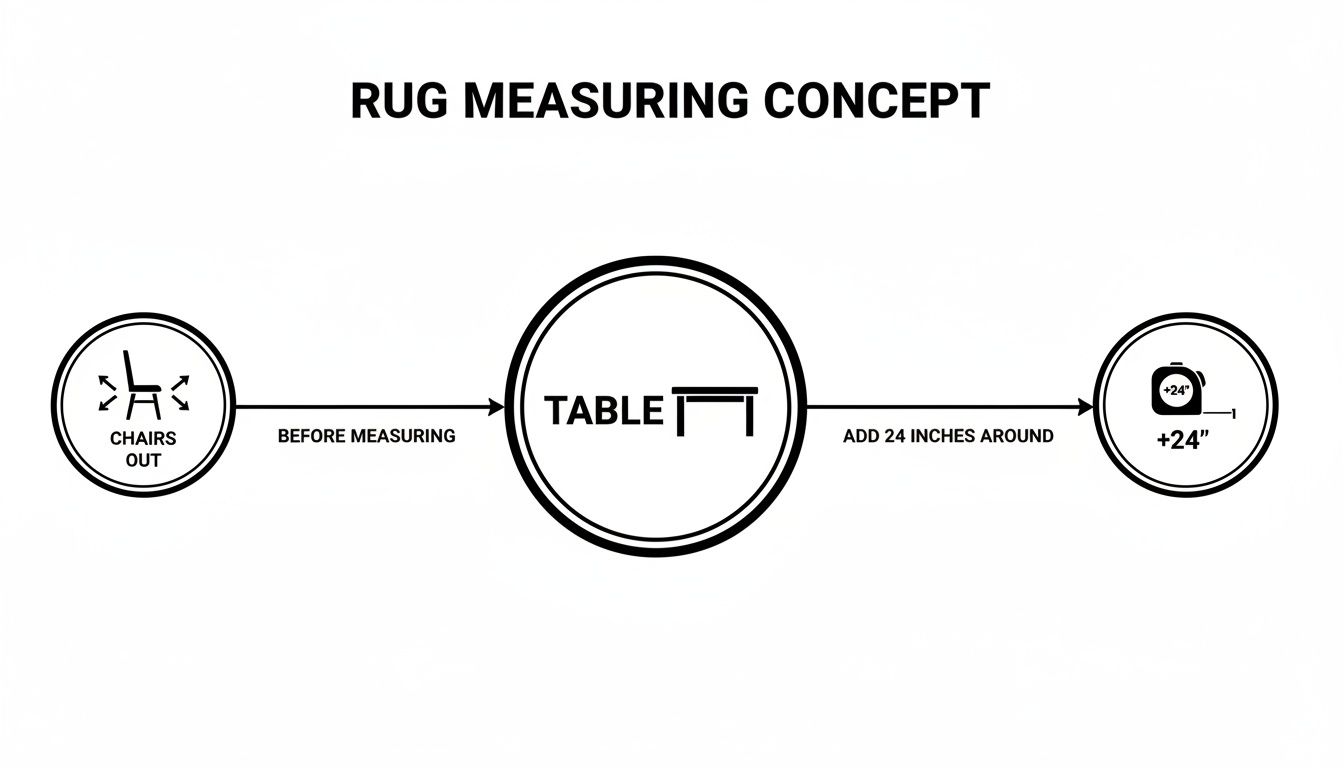
It’s a simple visual, but it drives home the point that your rug needs to accommodate the functional space your dining set uses, not just the tabletop itself.
A Quick Reference For Common Sizes
To make things even easier, our design team put together this quick-reference guide. Think of it as a cheat sheet for your dining room rug size guide, mapping common table sizes to standard rug dimensions. It's the perfect starting point for your search.
Quick Rug Size Guide By Dining Table
Use this table to find the recommended standard rug size based on the shape and seating capacity of your dining table.
| Table Shape & Seating | Table Dimensions (Approx.) | Minimum Recommended Rug Size | Ideal Rug Size |
|---|---|---|---|
| Round (4-person) | 42" – 48" Diameter | 6' Round or 7' Square | 8' Round or 8' Square |
| Round (6-person) | 60" Diameter | 8' Round or 8' Square | 9' Round or 9' Square |
| Rectangular (6-person) | 36" x 60" | 6' x 9' | 8' x 10' |
| Rectangular (8-person) | 40" x 78" | 8' x 10' | 9' x 12' |
| Square (4-person) | 36" x 36" | 6' Square | 7' Square |
| Square (8-person) | 60" x 60" | 9' Square | 10' Square |
While this table is a fantastic tool, remember that every Orlando-area home is unique. Your room’s dimensions, the scale of your chairs, and other furniture like a sideboard all come into play. Our guide on maximizing your dining space offers more great advice on how table shapes affect a room's overall layout.
When Standard Sizes Don't Work
So, what happens if your room has odd dimensions or you’ve fallen for a grand, oversized table? This is where our commitment to finding the perfect solution for our customers really makes a difference. Standard rugs are made for standard rooms, but let's be honest—many Central Florida homes are anything but.
That's why we've partnered with industry-leading brands known for their customization. Our custom-order program is the answer for those tricky situations. With brands like Canadel and Amisco, we can help you specify the exact dimensions you need, ensuring a flawless fit that an off-the-shelf rug could never provide. Pair that with the expertise of our in-house design team, and you never have to compromise. You get the perfect size, shape, and style to complete your dining set, right here in Longwood.
Sizing Your Rug For The Entire Room
A perfectly sized rug does more than just anchor your dining table—it has to feel right for the entire room. This is a crucial step that so many people miss. One of the most common mistakes we see is a rug that’s simply too big for the space, which instantly makes an otherwise beautiful room feel cramped and unbalanced.
Luckily, the fix is much simpler than you might think. The idea is to create a visual border of bare floor around your rug, almost like a mat around a picture frame. This little detail makes the whole room breathe and feel more intentional and professionally designed.
The 18-Inch Rule for Room Proportion
As a reliable rule of thumb, our design team always recommends leaving about 18 inches of bare floor between the edges of your rug and the walls. This visual breathing room is the secret to maintaining a sense of openness and balance.
This guideline is especially important for the open-concept homes so popular across Central Florida. In these layouts, a rug’s main job is to define the dining area without visually walling it off. That 18-inch border of flooring creates a graceful transition between different zones, really enhancing the natural flow of your home. If you want to dive deeper into arranging your space, you can learn more about how to plan a room layout in our detailed guide.
Placing Other Furniture on Your Rug
So, what about those other essential pieces, like a buffet, sideboard, or a stunning Amish-crafted hutch from Mavin or Simply Amish? When it comes to placing them, consistency is everything if you want a clean, uncluttered look. You really have two great options—the most important thing is to pick one and stick with it.
- All Legs On: Place the entire piece, all four legs, completely on the rug. This creates a very cohesive, layered look and works best in larger rooms where you have plenty of rug to spare beyond the dining set.
- All Legs Off: Keep the entire piece completely off the rug, with its legs resting on the bare floor inside that 18-inch border. This is often the go-to method because it clearly defines the dining table as the centerpiece and makes the room feel larger.
The one placement you absolutely want to avoid is having a piece of furniture "perched" with only its front two legs on the rug. This just looks awkward. It can make the furniture seem unstable and creates a weird visual line that completely disrupts the harmony of the room.
By following this simple rule—all on or all off—you ensure every piece in your dining room looks grounded, stable, and thoughtfully placed. It’s these little details that take a room’s design from good to truly great. If you’re having trouble picturing how your pieces will work together, our in-house design team in Longwood is always here to help you map out the perfect arrangement for your Central Florida home.
Choosing Rug Materials For The Florida Lifestyle
Here in Central Florida, a rug has to do a lot more than just look pretty—it has to perform. Between the year-round sunshine, the humidity, and our active family lifestyles, you need materials that are durable, fade-resistant, and easy to maintain. Picking the right fiber is just as important as getting the size right; it’s what ensures your beautiful new rug will stay beautiful for years to come.

At Slone Brothers, we’ve spent years helping our neighbors from Orlando to Lake Mary find materials that are a perfect match for our unique environment. It’s all about striking that perfect balance between everyday practicality and the style you absolutely love.
Durable Materials Suited For Sunshine And Spills
When it comes to durability, especially in a high-traffic area like the dining room, a few materials consistently rise to the top of our recommendation list.
Wool: This natural fiber is a fantastic all-around workhorse. Wool is incredibly durable, bounces back beautifully from the weight of chair legs, and even has a natural ability to repel stains. That little bit of liquid resistance gives you a crucial window to clean up spills before they set.
Polypropylene: For dining rooms that get a lot of direct Central Florida sun, synthetic fibers like polypropylene are a smart, value-driven choice. This material is highly resistant to fading and is exceptionally easy to clean, making it a truly worry-free option for busy families.
Natural Fibers (Jute & Sisal): If you're going for that coastal or natural vibe that so many Florida homes capture beautifully, fibers like jute and sisal offer gorgeous, organic texture. Just keep in mind they require a bit more careful maintenance. Before you commit, it's wise to get familiar with their upkeep, like understanding the unique care requirements of jute rugs.
Quality You Can Feel
The quality of a rug really comes down to its construction and the integrity of the materials. We hand-pick our collection from brands known for their craftsmanship, ensuring your investment stands up to the demands of Florida living. From the American-made quality of Bassett or Craftmaster to the heritage of Stickley, our focus is always on long-term value.
For more ideas on creating a look that lasts, check out our guide on decorating a Florida home.
A high-quality rug isn't just a purchase; it's a long-term investment in your home's comfort and style. By choosing the right material from the start, you ensure it can handle everything from sunny afternoons to family holiday dinners.
Fortunately, we have access to some of the best products right here. North America is a major player in the global carpets and rugs market, holding a massive 37.89% of the market share. The United States market alone was valued at USD 12.7 billion in 2024.
This regional leadership means that residents in Longwood have access to the latest innovations in rug styles and durable materials from trusted local retailers like us. Our design team can walk you through the options in our showroom to find that perfect blend of style and performance for your home.
Find Your Perfect Rug In Our Longwood Showroom
Now that you're armed with all the rules for picking the right dining room rug, the next step is the fun part: seeing it all in person. A guide is a fantastic starting point, but nothing beats actually feeling the texture and seeing the true colors of a rug with your own eyes.
Bringing these ideas to life is simpler than you think. Our expansive Longwood showroom is your local hub for exploring high-quality rugs that are a perfect fit for the Florida lifestyle. Here, you can feel the difference between materials, appreciate the richness of the colors, and get hands-on help from an expert.
Your Local Design Partners
We know every home in Central Florida has its own unique character. That's why our in-house design team is always here to help you with measurements and space planning—a complimentary service we’re proud to offer our neighbors in Lake Mary, Sanford, and across the Orlando area.
Think of us as your helpful neighbor who just happens to be a design authority. Since 1980, we’ve helped countless families avoid common mistakes and make confident choices that last a lifetime. Let us help you find a rug that’s not just the right size, but the right fit for your family.
To quickly recap the essentials you've learned:
- Measure your table first, then add that crucial 24-inch buffer on all sides.
- Match the rug's shape to your table's shape to keep things looking harmonious.
- Leave about 18 inches of bare floor visible around the rug to frame the space.
Putting these rules into practice is a breeze when you have a partner to help. At Slone Brothers, our goal is to make the process enjoyable and ensure you walk away with a piece that truly completes your dining room. We carry a fantastic selection of brands and styles, and with our Low Price Promise, you can rest easy knowing you’re getting exceptional value.
Ready to find the perfect piece for your home? Visit the Slone Brothers Furniture showroom in Longwood, FL, and let our design experts help you get started!
Common Questions About Dining Room Rugs
Here in our Longwood showroom, our design team gets some really great questions from Central Florida homeowners trying to nail down the perfect dining room rug. To help you feel completely confident in your final choice, we’ve put together answers to some of the most common ones we hear.
Can My Dining Room Rug Touch The Walls?
Ideally, no. A rug should really be there to anchor your dining set, not swallow the entire room. We always suggest leaving at least 18 inches of bare floor between the rug's edge and the walls. This creates a beautiful visual frame that makes the room feel bigger and more professionally put together.
If you're working with a smaller dining room or an apartment here in the Orlando area, you can definitely shrink that buffer down to about 8-12 inches. The key is that some visible floor is always the way to go.
What If My Chairs Slip Off The Edge Of The Rug?
This is the classic sign that your rug is too small and a dead giveaway that the crucial 24-inch rule hasn't been met. When chair legs are constantly snagging on the edge of a rug, it’s not just annoying for guests—it’s a real tripping hazard.
The only solution is to go up a size. You need a rug that allows every single chair leg to stay firmly on the rug, even when the chairs are pulled all the way out for someone to sit down.
Should The Rug Match My Curtains Or Wall Art?
It should complement them, but it doesn't need to be a perfect match. Think of your rug as the foundation of the room's entire color story. It should share a similar palette or style with your other decor to create a cohesive, layered look that feels intentional.
A room where everything matches perfectly can end up feeling a bit flat and one-dimensional. A rug that coordinates with your art and textiles, on the other hand, creates a far more interesting and designer-curated space. For more general advice beyond just sizing, you can learn more about how to choose the perfect area rug for any room.
Is A Round Rug Under A Round Table Necessary?
It’s not strictly mandatory, but a round rug is definitely the best choice for creating visual harmony. It just works, perfectly mirroring the table's shape for a look that feels balanced and deliberate.
That said, a large square rug can also work beautifully, creating a really pleasing geometric contrast. The one combination our designers usually recommend steering clear of is a rectangular rug under a round table—the conflicting shapes can often look awkward and throw off the room's entire balance.