

How Is Furniture Measured: A Practical Guide for Your Central Florida Home

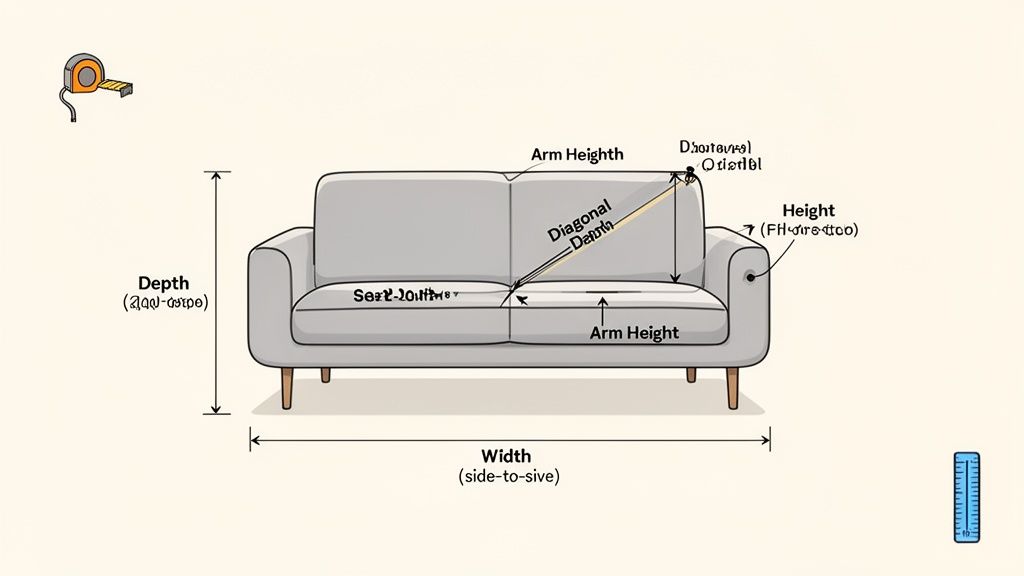
Before you fall in love with a stunning Smith Brothers sofa in our Longwood showroom, you need to speak its language. The language of furniture is all about the numbers that guarantee it will actually fit in your home. It really comes down to three core dimensions: Width (side-to-side), Depth (front-to-back), and Height (floor-to-top). Getting these basics down is the first step to making a smart purchase you'll love for years.
Why Measurements Are Your Best Friend
Here in Central Florida, we’ve been helping families find that perfect fit since 1980. We’ve seen it all, and trust us, a beautiful piece of furniture only truly works if it fits your space and your lifestyle.
Thinking about measurements ahead of time prevents the all-too-common headache of a sofa that completely swallows your Orlando living room or a dining table that leaves no room to walk around. It’s about creating harmony, flow, and function in your home—not just filling a space.
But this is so much more than a numbers game; it’s about day-to-day comfort and usability. While the main dimensions are the starting point, a few other crucial measurements determine how a piece will feel and function for you and your family.
To make things easier, here’s a quick rundown of the essential terms you'll encounter. Think of this as your cheat sheet for confident shopping.
Key Furniture Measurement Terms at a Glance
| Measurement Term | What It Means | Why It Matters for Your Home |
|---|---|---|
| Width | The measurement from one side of the piece to the other at its widest point. | This is the main number you'll use to see if an item fits against a specific wall or in a nook. |
| Depth | The measurement from the very front of the piece to the very back. | Determines how much floor space the furniture will occupy and affects room traffic flow. |
| Height | The measurement from the floor to the highest point of the piece. | Crucial for placing items under windows, artwork, or on walls with architectural details. |
| Seat Depth | The distance from the front edge of the seat to the back cushion. | A major comfort factor. Deeper seats are for lounging; shallower seats support more upright sitting. |
| Seat Height | The measurement from the floor to the top of the seat cushion. | This impacts how easily you can get in and out of a chair and if it fits under a table. |
| Arm Height | The distance from the floor to the top of the armrest. | Important for comfort and for knowing if a chair's arms will slide under a desk or table. |
| Diagonal Depth | The measurement from the top back corner to the bottom front corner. | This is the secret to getting furniture through doorways. It must be less than your door's height. |
With these terms under your belt, you’re already ahead of the game. Now you can walk into our showroom and know exactly what you’re looking at.
Pro Tip from Our Design Team: Don't just measure the furniture—measure your lifestyle. How do you really plan to use the piece? A low, deep Craftmaster sectional is perfect for sprawling out on family movie nights, while a more upright Bassett chair might be better for your reading corner.
In the world of furniture, industry-standard measurements have been a backbone since the late 19th century. Generally, standard sofa depths range from 33 to 38 inches, while three-seaters are often 70 to 96 inches wide. These are the kinds of numbers our expert Design Team uses during complimentary space planning to head off common problems before they start.
With 61.34% of furniture demand being residential, avoiding mismeasurements is more important than ever, especially when they can lead to a significant number of returns. If you want to dive deeper into the furniture market, you can read the full research from GrandViewResearch.com. And for more specific guidance on tables, you might find our guide on choosing the right dining table heights helpful.
How Is Furniture Measured for Sofas, Tables, and Beds?
So, you've found the perfect Bassett sectional for your living room. The next step is making sure it actually fits. Getting the placement right is about more than just numbers; it's about how the piece lives in your space. One of the best tricks we recommend to Orlando homeowners is to use painter's tape to outline the furniture’s exact footprint on your floor. This simple step gives you a real-world visual of how much room that new sectional will take up.
Measuring before you start shopping saves a world of headaches. Our Design Team here in Longwood has been helping families with this since 1980, and we've seen it all. By taping out the dimensions on the floor, you can immediately see how the sofa will affect traffic flow, where it sits in relation to windows and lighting, and whether you still have room for that coffee table you love.
Visualizing with Painter’s Tape
Painter's tape is your best friend for a low-cost, high-impact reality check. Just stick it on the floor to match the width and depth of the sofa or sectional you're considering. Then, live with it for a day. Walk around the taped-off area as you normally would. Do you find yourself squeezing past a wall or bumping into a chair? If it feels cramped, you might need to look at a smaller configuration or maybe a sectional with a moveable chaise.
- Tape the outline on the floor to simulate the furniture's footprint.
- Walk the natural traffic paths around the outline.
- Check for clearance near doorways, windows, and existing furniture.
"Seeing the outline in your actual room is the single best way to prevent a costly return," says our in-house designer. It’s a crucial step to ensure your new furniture settles in comfortably.
Planning Dining and Traffic Clearance
When it comes to a beautiful Simply Amish dining table, you need to think about more than just the table itself. A good rule of thumb is to leave at least 36 inches of clearance on all sides. This gives your guests enough room to comfortably pull out their chairs and allows others to walk behind them without asking anyone to scoot in. In many of our open-concept Central Florida homes, aiming for 42 inches is even better if you have the space.
Don't forget to factor in:
- The distance from the table's edge to the nearest wall or piece of furniture.
- How far back a chair extends when someone is seated.
- Clear pathways to the kitchen, living room, or other high-traffic areas.
Once you’ve got your physical measurements down, you can take it a step further. Tools like software for space planning can help you create a digital layout to fine-tune everything.
Testing Layouts with Scaled Templates
For rooms with tricky spots like angled walls or a bay window, a simple tape outline might not tell the whole story. This is where cutting out templates from kraft paper or cardboard can be a lifesaver. Our design team often creates small 1:20 scale mockups for clients to play with, helping them visualize proportions and arrangements before making a final decision.
Hard corners near built-ins or a fireplace mantel require special attention. Try running a piece of tape diagonally from the corner of your outline to the nearest obstruction. This quick check ensures a new lounge chair or the edge of a sofa won't block a heating vent or make it impossible to open a cabinet.
- Use templates to simulate curves and non-standard shapes.
- Run diagonal checks to confirm clearance for doors and fireplaces.
- Consider sightlines for the TV and views from the windows.
Measuring Bedrooms Precisely
Bedrooms have their own unique set of measurement challenges, especially concerning headboards and nightstands. Start with the basics: wall height, window sill height, and any crown molding. You want to make sure the height of your chosen bed works with your window placement, not against it by blocking natural light.
A few key steps to remember:
- Measure from the floor to the highest point of the headboard.
- Plan for 2 to 3 inches of space between the bed and each nightstand.
- Double-check that your bedroom door can swing open fully without hitting the bed frame or dresser.
- Look up! Make sure there’s enough head clearance if you have a ceiling fan.
"A tiny miscalculation can lead to a big frustration, like your nightstand drawer being blocked by your duvet," warns our delivery coordinator. These small details make all the difference on installation day.
If you find that standard sizes just aren't working for your space, don't worry. Our custom-order programs with incredible brands like American Leather and Simply Amish allow us to tailor dimensions to your room's exact needs. Come visit our Longwood showroom, and we can explore the possibilities together.
For a deeper dive, check out our guide on room measurement for furniture, where we break down how to handle even the most irregularly shaped rooms.
Mapping the Delivery Path Through Your Home
That beautiful Stickley mission-style sofa you’ve fallen in love with is only perfect if you can actually get it through the front door. This is the single biggest step our Central Florida customers forget, and it's where our delivery teams see the most heartbreak.
Mapping the path from the truck to the final room is every bit as crucial as measuring the space where the furniture will live. It's a process we've mastered over decades, navigating everything from historic Sanford homes with tight, winding hallways to modern Lake Mary condos with specific elevator dimensions.
A successful delivery isn’t just about the width of your door; it’s about anticipating every twist, turn, and low-hanging obstacle along the way.
From the Driveway to the Doorstep
Before you even think about the inside of your home, take a look at the path leading up to it. Are there tight corners on the walkway? Low-hanging tree branches? Is there a narrow gate that our truck needs to clear? Note any potential bottlenecks outside, as this is the very first checkpoint for a smooth delivery.
Next, focus on your primary entry point. Measure the width and height of the front door opening itself, but don't stop there. You have to account for the door swing clearance—how far the door can open without hitting a wall or another object. Sometimes, just temporarily removing the door from its hinges can give you those precious few inches you need.
This simple visual breaks down the core process for getting your space ready.
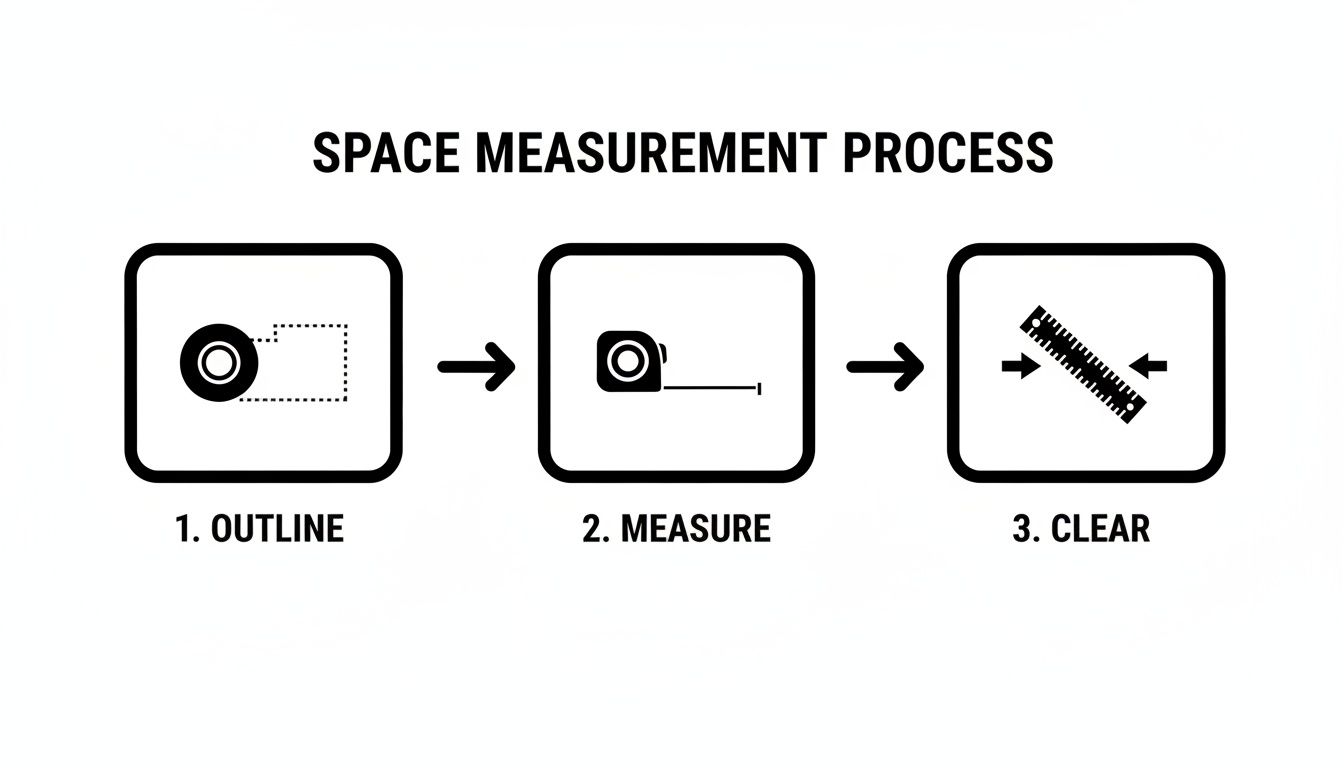
This three-step method of outlining, measuring, and clearing is truly the foundation for a stress-free delivery day.
Navigating Interior Obstacles
Once you're inside, the real challenge often begins. Grab your tape measure and walk the exact path the furniture will take from the door to its final spot, keeping an eye out for the narrowest points.
- Hallways and Corners: Measure the width of every hallway on the path. For those tricky corners, the diagonal space is everything. Can a long sofa be tilted and pivoted around the bend? This is where that diagonal depth measurement we talked about earlier becomes absolutely critical.
- Stairwells: Stairs bring a whole new set of variables into play. You’ll need to measure the width of the staircase, of course, but also the ceiling clearance at both the top and bottom landings, especially where the ceiling might slope downward. A low-hanging chandelier can become a major—and costly—obstacle.
- Elevators: If you live in a condo or apartment building, measuring the elevator is a must. Get the interior height, width, and depth. Don’t forget to measure the height and width of the elevator door opening, too, as it’s often the tightest squeeze of all.
A tip from our delivery team: "Take a short video of the entire delivery path on your phone. It's incredibly helpful to pull up and reference when you're back in our Longwood showroom trying to remember if a piece will clear that tricky corner."
By meticulously planning the route, you eliminate nearly all potential for day-of surprises. This preparation ensures that when your new, American-made Craftmaster sofa arrives, its journey into your home is as seamless as its craftsmanship.
To learn more about how we handle this crucial final step, read about our white-glove home delivery service.
Overcoming Tricky Spaces with Custom Furniture
What happens when that perfect sofa is just a few inches too wide for its intended spot? Or when your dining area has an awkward nook that no off-the-shelf table seems to fit? We see it all the time in Central Florida homes, from historic properties in Sanford to modern condos in Lake Mary. Unique architectural quirks are just part of the local charm.
This is exactly where our custom-order furniture program becomes your best friend. Instead of settling for a piece that's "close enough," you can create something that feels like it was truly made for your home. We've built relationships with industry-leading brands that specialize in this kind of flexibility, turning a measurement headache into a one-of-a-kind solution.
Tailored Solutions from Top Brands
Imagine a sleeper sofa that fits perfectly into a compact home office without giving up an inch of comfort. That’s the kind of smart design brands like American Leather bring to the table. Their pieces are engineered to maximize function in tight spaces, giving you fantastic options where you thought you had none.
For dining rooms, Canadel essentially lets you become the designer. You can specify the exact dimensions, the finish, and even the chair style to build a dining set that perfectly complements your room's proportions and your family’s needs. This level of control means you never have to compromise.
Our in-house design team works directly with you and these incredible brands. We help you fine-tune every detail—from the size and fabric to the wood finish—making sure the final piece not only fits your space but also fits your personal style.
The demand for this kind of personalization has grown like crazy. With the global furniture market hitting $666.5 billion in 2024, custom orders now make up a huge part of U.S. sales. This shift is driven by homeowners who want a precise fit, because even a one-inch mistake can throw off a room’s entire feel. Getting it right the first time also helps reduce returns by an estimated 35%—a massive benefit when you're investing in quality furniture.
Your Vision, Brought to Life
Our goal is to make this whole process feel simple and inspiring, not overwhelming. When you work with our team, you’re tapping into decades of experience solving the unique spatial challenges we see every day in Orlando-area homes. We'll guide you through every measurement and material choice to ensure the final product is flawless.
For those who enjoy planning digitally, advanced tools like Decor8.ai's custom furniture placement solutions can offer precise modeling for truly unique spaces.
Ultimately, custom furniture is about getting exactly what you want. It's about getting that incredible, American-made quality from a brand like Smith Brothers, but in a size that works perfectly for your home. To see how we make it happen, check out our guide on making custom furniture simple.
Common Measuring Mistakes to Avoid
After four decades of helping families furnish their homes in the Greater Orlando area, we've seen it all. A simple oversight in measurement can quickly turn the excitement of buying new furniture into a logistical nightmare. Knowing how to measure correctly means knowing what not to do, ensuring that beautiful new piece fits perfectly the first time.
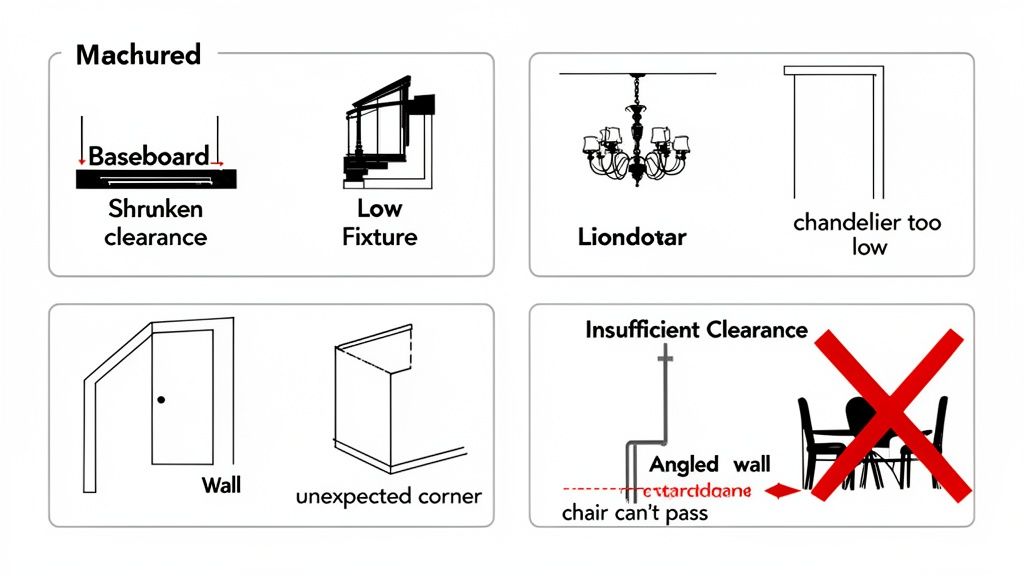
We want your experience to be seamless, whether you're selecting a custom-order Smith Brothers sofa or finding a gem in our Clearance Outlet. Let's walk through the mistakes we see most often so you can measure with the confidence of a pro.
Forgetting the "Small" Obstacles
It’s easy to get a clean measurement of the open space between two walls, but the real space is almost always smaller. So many people forget to account for the little things that steal precious inches from your clearance.
These are the usual suspects:
- Baseboards and Trim: These decorative elements stick out from the wall, sometimes by an inch or more. Always measure from the baseboard, not the wall itself, to get the true floor-level dimension.
- Door Trim and Hinges: Just like baseboards, the trim around your doorways narrows the actual opening. Don’t forget about the doorknob, either! Always measure the narrowest point to be safe.
- Light Fixtures and Outlets: A low-hanging chandelier in a hallway or an awkwardly placed light switch can absolutely block a tall piece of furniture from making a tight turn.
Misjudging Human Space
Furniture doesn't exist in a vacuum; people need to live around it. One of the most common mistakes is focusing only on whether a piece fits without considering if it functions in the space. You need room to move.
For instance, a dining table might technically squeeze into a room, but if you don't leave at least 36 inches of clearance around it, guests won't be able to pull out their chairs or walk behind someone who is already seated. Always plan for comfortable traffic flow.
Our Design Team's Golden Rule: Don't just furnish the room, design the experience. You have to leave "breathing room" around each piece for your home to feel open and inviting, not cramped and cluttered.
Ignoring Vertical and Angled Space
Many of the beautiful homes here in Central Florida have unique architectural details like angled walls, sloped ceilings, or recessed nooks. These features are stunning, but they demand extra attention when you're measuring.
Taking a simple floor footprint measurement just isn't enough. You have to check the height at various points along the entire delivery path, especially in stairwells or rooms with slanted ceilings. An angled wall can also make a standard rectangular sofa look awkward, which is a perfect time to consider a custom-order program for a piece with just the right proportions.
To help you keep these points top of mind, here's a quick cheat sheet our team put together.
Quick Guide to Avoiding Measurement Mishaps
This simple checklist covers the most frequent slip-ups we see and how to easily sidestep them.
| Common Mistake | The Pro Solution |
|---|---|
| Forgetting Baseboards | Always measure from baseboard to baseboard for the most accurate floor dimension, not wall to wall. |
| Ignoring Traffic Flow | Leave at least 36 inches around key pieces like dining tables and sofas for comfortable movement. |
| Only Measuring the Room | Measure every doorway, hallway, and stairwell on the delivery path—including height and turns. |
| Eyeballing It | Never guess. Use a proper tape measure and write down every dimension, even if it seems obvious. |
| Forgetting Height | Check for low-hanging light fixtures, ceiling fans, or sloped ceilings along the entire path. |
By keeping these common errors in mind, you’re already well on your way to a stress-free furniture shopping journey. For even more guidance, check out our complete article on the dos and don'ts of furniture shopping.
Your Furniture Measurement Questions Answered
Even with the best plan, you’re bound to have a few questions. Trust us, here in our Longwood showroom, our design team has truly heard them all. To help you button up your project with total confidence, we’ve put together the most common questions we get from our Central Florida neighbors.
What Tools Do I Absolutely Need to Measure for Furniture?
You don't need a professional's entire toolkit to get the job done right. A few simple, effective essentials are all it takes.
- A Retractable Metal Tape Measure: Go for one that’s at least 25 feet long. It’ll come in handy for more than just furniture.
- A Notepad or a Phone App: Whatever you use, just don't rely on memory. Jot down every single measurement as you take it.
- Your Phone's Camera: A quick snapshot of a tight corner with the tape measure in view can be a lifesaver when you're back at the showroom trying to remember the details.
- Painter's Tape (Optional but Recommended): This is, without a doubt, the best way to visualize how a piece will fit. Taping out the footprint on your floor makes the dimensions feel real.
How Is Measuring a Sectional Different From a Standard Sofa?
This is a big one, and it trips a lot of people up. A standard sofa is pretty straightforward—you measure its overall width, depth, and height. A sectional, on the other hand, is a different beast. You need to measure each individual component—the chaise, the loveseat piece, the corner wedge—and then add them up to get the total footprint.
You'll also run into terms like "Left-Arm Facing" (LAF) or "Right-Arm Facing" (RAF). Here’s the key: this describes the arm's position as you face the piece, not when you're sitting on it. It can get confusing, but our design team can help you map out the perfect configuration for your room in minutes.
My Doorway Seems Too Small for the Sofa I Want. What Are My Options?
Don't panic just yet! This happens more often than you'd think. Many high-quality sofas, especially from American-made brands like Smith Brothers or American Leather, are built with removable legs. That little detail can give you a few crucial inches of extra clearance.
The real secret, though, is measuring the sofa's diagonal depth. Compare that number to your doorway's width. If the diagonal depth is smaller, a skilled delivery team can often stand the sofa on its end and pivot it right through a tight spot. If it’s still no-go, this is the perfect time to explore our custom-order program to find a piece that’s guaranteed to fit.
How Much Space Should I Leave Around My Dining Table?
This is probably one of the most important measurements for creating a dining room that actually feels comfortable and functional. You want people to be able to get in and out of their chairs without bumping into a wall or another piece of furniture.
Our rule of thumb, which we've used for countless Central Florida homes, is to allow at least 36 inches of clear space between the edge of your dining table and the nearest wall or piece of furniture. This gives guests plenty of room to pull out their chairs and lets others walk behind someone who is seated.
If your dining area is part of a major traffic path, we’d even suggest bumping that up to 42-48 inches of clearance. It's a key factor our designers consider when helping families choose the right Canadel or Mavin dining set for their lifestyle.
Ready to find the perfect piece for your home? Visit the Slone Brothers Furniture showroom in Longwood, FL, and let our design experts help you get started.

