
Coffee Table Marble: Style & Care Guide

You’re standing in your living room in Longwood, looking at the sofa you already like, the rug you just bought, and the empty space in the middle that still doesn’t feel finished. That’s where coffee table marble tends to enter the conversation. It has presence. It reflects light. It can make a room feel collected instead of temporary.
For Central Florida homeowners, though, the choice isn’t only about looks. A marble table that works beautifully in a staged photo can become frustrating in a real Orlando-area home if you don’t think through humidity, daily use, weight, and surface care. Families with kids, pet owners, and new homeowners furnishing several rooms at once usually need more than a style suggestion. They need a practical plan.
That’s where this guide helps. If you’ve been comparing polished white tops, darker stone, mixed-material bases, or custom options for a fresh living room in Longwood, Lake Mary, Sanford, or greater Orlando, you’ll want to know what marble does well, where it needs protection, and which construction choices make the most sense for your space.
Understanding coffee table marble
A marble coffee table feels current, but the idea behind it is much older. The modern coffee table evolved in 17th-century Europe after the opening of London’s first coffee house in 1652, which helped create low tables around 27 inches high for resting beverages, as noted in this history of the coffee table. That long history is part of why marble still feels at home in both traditional and modern rooms.
Why homeowners keep coming back to marble
In a Central Florida living room, marble does two things at once. It gives you a strong focal point, and it stays visually calm. Wood grain can feel rustic. Glass can disappear. Marble lands somewhere in the middle, bold enough to anchor the room, quiet enough to work with a lot of styles.
You see that especially in bright homes with large windows. Natural light catches the veining and soft color changes in the stone, which makes the top feel decorative even before you add books, a tray, or a vase.
For readers who enjoy older forms and want more historical context, a thoughtful collector's guide to the antique cocktail table helps connect today’s low tables to antique design traditions.
Where people get confused
The most common misunderstanding is simple. People say “marble table” as if every version is the same.
It isn’t.
A thick slab table behaves differently from a table that uses a marble top with a wood or metal base. Engineered alternatives are different again. Some homeowners are shopping for heirloom character. Others mainly want the look of stone with easier handling.
Another point of confusion is care. In Central Florida, moisture in the air and condensation from cold drinks can create more day-to-day maintenance than many buyers expect. Marble is beautiful, but it isn’t a “set it and forget it” surface.
Practical rule: If you love the look of marble, ask two questions before you ask about color. How is it built, and how will you care for it in a humid home?
What to look for first
Before you narrow down veining or shape, focus on these basics:
- Construction: Is it a full marble piece, a marble top on another base, or an engineered material?
- Lifestyle fit: Will this table sit in a formal sitting room or the main family room?
- Room conditions: Does the room get heavy sun, frequent cold drinks, or lots of traffic?
- Scale: Will the table feel grounded, or will it overpower the seating?
If you’re pairing pieces across a living room, it also helps to see how marble works in smaller accents such as marble top end tables for living room spaces, where the material can echo the coffee table without making the room feel too heavy.
Coffee table marble construction types
The build matters as much as the stone itself. Two tables can look similar online and behave very differently once they’re in your home. Weight, stability, maintenance, and even how “light” the room feels all come back to construction.
Solid marble slab tables
A solid marble slab table gives you the strongest stone presence. The visual impact is hard to match because the top and structure feel substantial and architectural.
That same quality creates the first trade-off. Marble is dense. Carrara marble has a density of approximately 2.7 g/cm³ and resists heat up to 300–400 °C, which is why it handles hot beverages well, according to Rove Concepts’ marble material details. In real terms, that means you’re dealing with a table that can be heavy to move and needs a base design that keeps it stable.
Solid marble often works best when you want the table to be the room’s visual anchor and you don’t plan to rearrange furniture often. In an upstairs room or a home where you like to rework layouts often, that heft can feel less convenient.
Marble top with wood or metal base
This is often the most balanced option for everyday use.
You still get a real stone surface, but the base can reduce visual bulk and make the piece easier to integrate with the rest of the room. A matte black metal base tends to lean modern. A wood base softens the look and often fits transitional, farmhouse, or coastal spaces more naturally.
This type also gives you more flexibility with surrounding materials. If your room already has wood flooring, woven textures, and upholstered seating, a mixed-material marble table can tie those elements together without making the center of the room feel too cold or formal.
For homeowners comparing stone to warmer materials, this is also where it’s useful to contrast marble against wood options such as those discussed in why an acacia wood coffee table is your best choice in Orlando. Some rooms need the cool elegance of stone. Others need the warmth of wood. Many work best with both.
Engineered marble alternatives
Engineered options appeal to buyers who want the marble look but need a little more flexibility in handling, price, or maintenance expectations.
These can be a smart fit in busy households where appearance matters but the room has heavy daily use. They can also work well in homes where you want a cleaner, thinner profile without the same structural demands as a thick natural slab.
The key is honesty about what you’re buying. If your goal is natural variation, collector appeal, and the character of genuine stone, engineered options won’t feel the same. If your goal is a stylish, practical table for a high-use family room, they may be exactly right.
Comparison of marble coffee table constructions
| Construction type | Benefits | Considerations |
|---|---|---|
| Solid marble slab | Strong visual impact, rich natural character, substantial feel | Very heavy, harder to move, needs careful planning for stability and placement |
| Marble top with wood or metal base | Balanced look, more style flexibility, often easier to place in mixed-material rooms | Still needs care on the stone surface, quality varies by base design |
| Engineered marble alternative | Marble-inspired look, often easier to handle, practical for busy spaces | Doesn’t offer the same natural individuality as genuine marble |
How to decide which build fits your room
A simple way to decide is to match the table to the way you live.
- Choose solid marble if you want a statement piece and don’t expect frequent rearranging.
- Choose a marble top with another base material if you want real stone with more visual balance.
- Choose an engineered option if the room sees constant use and you want easier day-to-day ownership.
A coffee table isn’t only a surface. It’s a weight, a shape, and a daily-use object. Construction tells you how it will live in the room.
For many Central Florida homeowners, the middle option ends up being the sweet spot. It gives you the elegance people want from coffee table marble, without forcing the whole room to work around one extremely heavy object.
Pros and cons of coffee table marble
Marble has a well-earned reputation. It looks elegant, it feels substantial, and it has a permanence that many other surfaces don’t. But it also asks more from the homeowner than wood-look laminates or forgiving composites.
What marble does especially well
One of marble’s biggest strengths is its ability to combine beauty with real structural performance. Calacatta marble offers 90–95% reflectivity with 0.5–1.5% porosity when sealed, and withstands compressive strengths of 500–1000 kg/cm², according to this Calacatta marble guide. For homeowners, that translates into a surface that can look bright, polished, and impressively substantial when properly protected.
In design terms, marble also solves a common living room problem. It gives a room contrast without needing loud color. A white or light marble top can sharpen a soft neutral room. A darker stone can ground airy upholstery and lighter rugs.
Other practical strengths include:
- Heat resistance: Helpful for day-to-day coffee and tea use.
- Timeless style: Marble doesn’t feel tied to one short-lived trend.
- Natural variation: Veining gives each piece its own identity.
- Long-term appeal: Many buyers still view natural stone as a premium material.
Where marble asks more from you
The first drawback is maintenance. Marble is not casual about spills. If you leave acidic liquids or staining messes too long, the surface can etch or discolor.
The second drawback is weight. Even homeowners who love marble sometimes underestimate how much planning goes into delivery, placement, and rug alignment. Once a heavy table is set in the room, you may not want to shift it often.
Then there’s the issue of daily habits. If your household regularly puts down iced drinks without coasters, eats in the living room, or lets kids use the coffee table as a work surface, marble may require more vigilance than you want.
The Florida factor
Central Florida changes the conversation.
Humidity, cold drink condensation, and strong natural light all influence how a marble top ages in a real home. A surface that looks perfect in a showroom or in online photos can show wear faster if it isn’t sealed and cared for consistently.
That doesn’t mean marble is a bad choice here. It means you need to buy it with your eyes open.
Marble rewards careful owners. It doesn’t punish normal living, but it does notice neglect faster than many other tabletop materials.
A balanced way to think about it
Marble makes the most sense when you value these three things:
- Visual presence
- Material authenticity
- Long-term style over easy upkeep
It makes less sense if your top priorities are zero-maintenance living, constant furniture rearranging, or a surface that can absorb rough use without any visible consequences.
For some Orlando-area homeowners, that trade-off is absolutely worth it. For others, a marble-top table with a more forgiving finish, or even an engineered version, ends up being the smarter compromise.
The right answer isn’t whether marble is “good” or “bad.” It’s whether your home routines support what marble needs.
How to choose coffee table marble size shape and finish
A beautiful stone top can still be the wrong table if the size is off, the corners interrupt traffic, or the finish fights your daily habits. These scenarios often cause many living rooms to go sideways. The table looks great on its own, then feels awkward once it’s placed between the seating.
Start with the room, not the stone
Measure the seating area first. Don’t begin by choosing veining or a favorite slab photo.
Look at how people move through the room. In many Central Florida homes, the living room connects openly to the kitchen or dining area, which means the coffee table often sits in a real traffic path rather than a formal, untouched seating zone.
Use this checklist before you shop:
- Measure the open area between sofa and chairs.
- Notice walkways used every day, not just what looks symmetrical.
- Think about who uses the room most often. Adults only, kids, pets, guests, or all of the above.
- Decide whether the table should disappear a bit or make a statement.
If you want a broader framework for proportion before you choose a stone top, how to choose a coffee table is a helpful companion read.
Picking the right shape
Different shapes solve different problems.
Rectangular tables
These work well with standard sofas and longer seating arrangements. They give you more usable surface and usually feel the most traditional.
They also create stronger lines in the room. If your living room already has sharp angles from sectionals, media cabinets, and square rugs, a rectangle can make the space feel more structured, or more rigid, depending on the rest of the design.
Round and oval tables
These soften a room quickly. They’re often the easiest shapes for homes with kids because there are no sharp corners at the main traffic point.
In many Orlando-area family rooms, oval shapes can feel especially practical because they keep circulation smoother while still offering enough usable surface.
Square tables
Square marble coffee tables can look excellent in larger seating groupings or sectionals. They feel centered and balanced.
Their main risk is visual heaviness. Marble already has presence, so a square shape in the wrong room can make the middle of the space feel too dense.
For readers exploring darker, more graphic looks, this guide to styling a black square coffee table offers useful ideas on how shape and finish change the mood of a room.
Edge profile matters more than people think
The edge changes both safety and style.
- Soft eased edges feel clean and modern.
- Rounded profiles feel friendlier in busy family rooms.
- More pronounced edges can look formal or traditional.
If your coffee table marble will sit in a home with children or frequent entertaining, softer edges often make everyday living easier.
Choosing the finish
Finish affects both appearance and maintenance experience.
Polished
Polished marble reflects more light and looks more formal. It can be stunning in bright Central Florida homes because it bounces daylight around the room.
The trade-off is that it may show smudges, water marks, and surface activity more clearly.
Honed
Honed marble has a softer, more muted look. Many homeowners like it because it feels relaxed and less glossy.
It often works well in coastal, farmhouse, and transitional spaces where you want stone without too much shine.
Textured or leathered looks
Some buyers prefer a surface with a little more tactile character. These can reduce the ultra-formal feel of marble and help the table blend with wood, woven, and natural-fiber elements.
If your room gets strong daylight all afternoon, polished marble will look brighter. If you want a quieter, more forgiving look, honed finishes usually feel easier to live with.
A simple decision formula
If you want a practical shortcut, use this:
- Busy family room: Oval or round, softer edge, lower-gloss finish
- Modern open-plan room: Rectangular or square, clean edge, polished top
- Coastal or relaxed transitional room: Rounded form, honed finish, warm mixed-material base
A good coffee table marble choice should look intentional from the doorway and feel comfortable once real life starts happening around it.
Styling coffee table marble for popular decor styles
Marble adapts better than many people expect. The same material can look sleek and urban in one room, relaxed and coastal in another, and warm and layered in a farmhouse-inspired setting. The trick is pairing the stone with the right textures around it.
A visual comparison helps show how flexible the material can be.
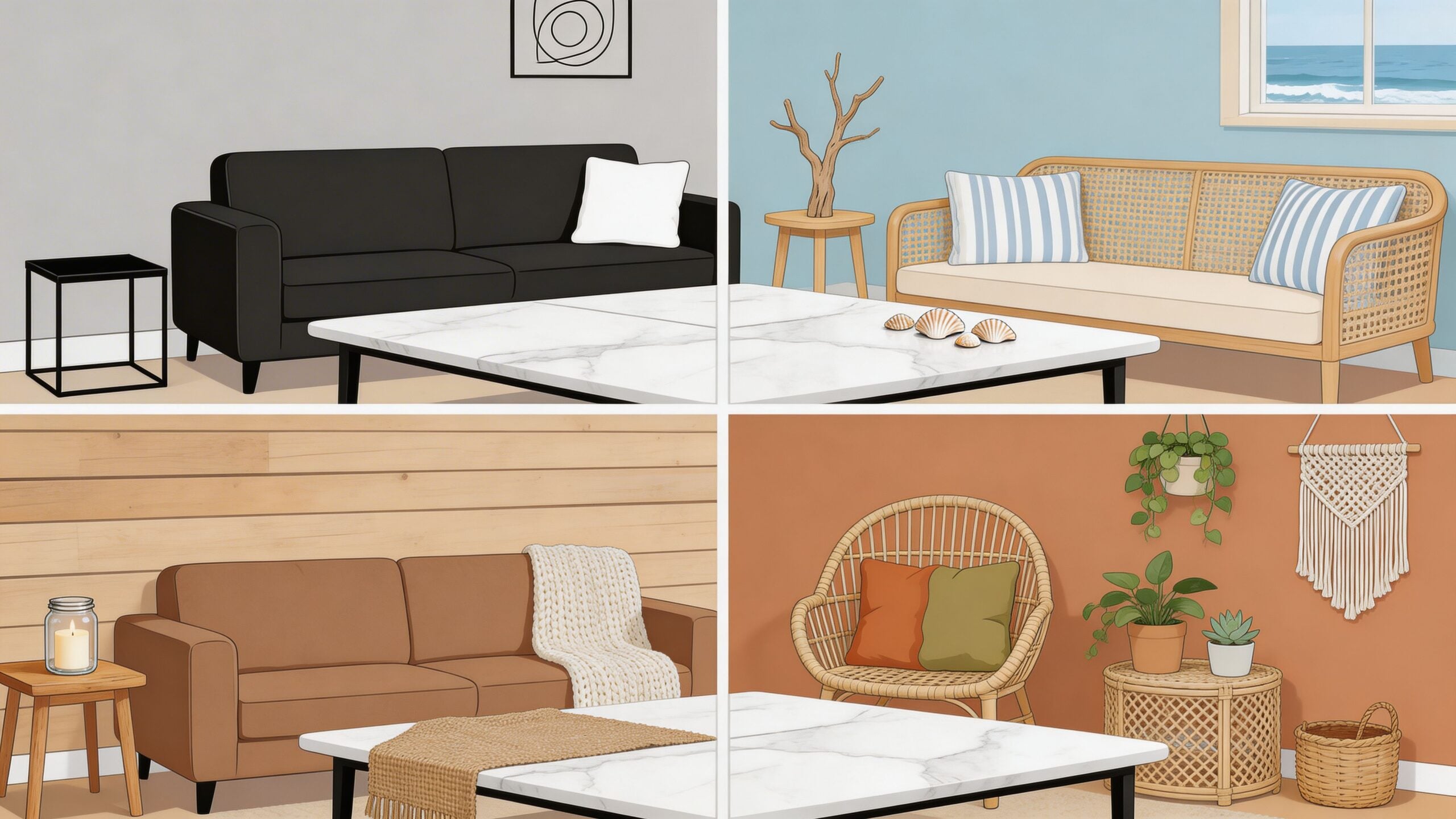
Modern and minimal
Modern rooms often benefit from marble because the surface already has visual interest. You don’t need much on top.
A light marble top with a dark metal base works especially well here. The contrast gives the room structure, while the stone keeps the look from feeling flat.
Try pairing it with:
- Low-profile seating
- Black accents
- One or two sculptural objects
- A rug with subtle texture instead of strong pattern
In this style, less is usually better. Let the veining stay visible.
Coastal for Central Florida homes
Coastal style in Longwood or greater Orlando usually works best when it feels relaxed, not themed. Marble helps because it brings in a light, breezy quality without leaning too beachy.
Use a marble table with:
- Woven baskets
- Natural linen or performance upholstery
- Pale wood tones
- Soft blue, sand, or off-white accents
Honed marble often fits especially well in this look because the softer finish feels easy and lived-in.
Farmhouse and warm transitional
Marble can absolutely work in rooms that lean warmer and more classic. The key is balance.
If you pair a cool stone top with rustic wood, greenery, and softer textiles, the room feels layered rather than stark. A marble top on a wood base often shines here because it bridges old and new.
Good companions include:
- Warm oak or medium wood finishes
- Ceramic accessories
- Textured throws
- Classic upholstery with clean silhouettes
A marble top doesn’t have to make a room feel formal. The base, rug, and accessories decide whether it reads polished, relaxed, or somewhere in between.
Bold contrast and eclectic rooms
Some homeowners want the coffee table to cut through a room with personality. Marble can do that too, especially when you choose stronger veining or a darker stone.
In a more eclectic room, marble benefits from contrast. Pair it with curved upholstery, mixed metals, art books, and one or two objects that bring in shape rather than clutter.
A useful rule is to avoid hiding too much of the surface. Marble is already decorative. Covering it with too many accessories usually weakens the effect.
For more ideas on arranging objects once your table is in place, the ultimate guide how to decorate a coffee table like a pro offers practical styling direction that works across multiple room types.
Matching marble to well-known furniture styles
If your room includes recognizable furniture looks, marble can still fit naturally.
- Stickley-inspired spaces often benefit from marble used as contrast against rich wood.
- Stressless seating pairs well with simpler, cleaner table forms that don’t compete with the chair’s shape.
- Smith Brothers upholstery can handle a substantial marble table well because the tailoring has enough presence to balance the stone.
- Canadel and Mavin-adjacent wood tones often pair best with marble that isn’t overly glossy.
The wider point is simple. Marble isn’t one style. It’s a material that changes character depending on what surrounds it.
Maintenance and stain repair for coffee table marble
Florida homes require more specific advice. A marble table in a dry climate faces one set of issues. A marble table in Central Florida deals with humidity, condensation from iced drinks, and long stretches of warm weather that keep moisture in the air.
Industry standards recommend sealing marble every 6–12 months to help prevent humidity-induced staining and etching in Central Florida’s 70–80% average humidity, as noted in this marble retail and maintenance context.
Here’s the care routine most homeowners need.
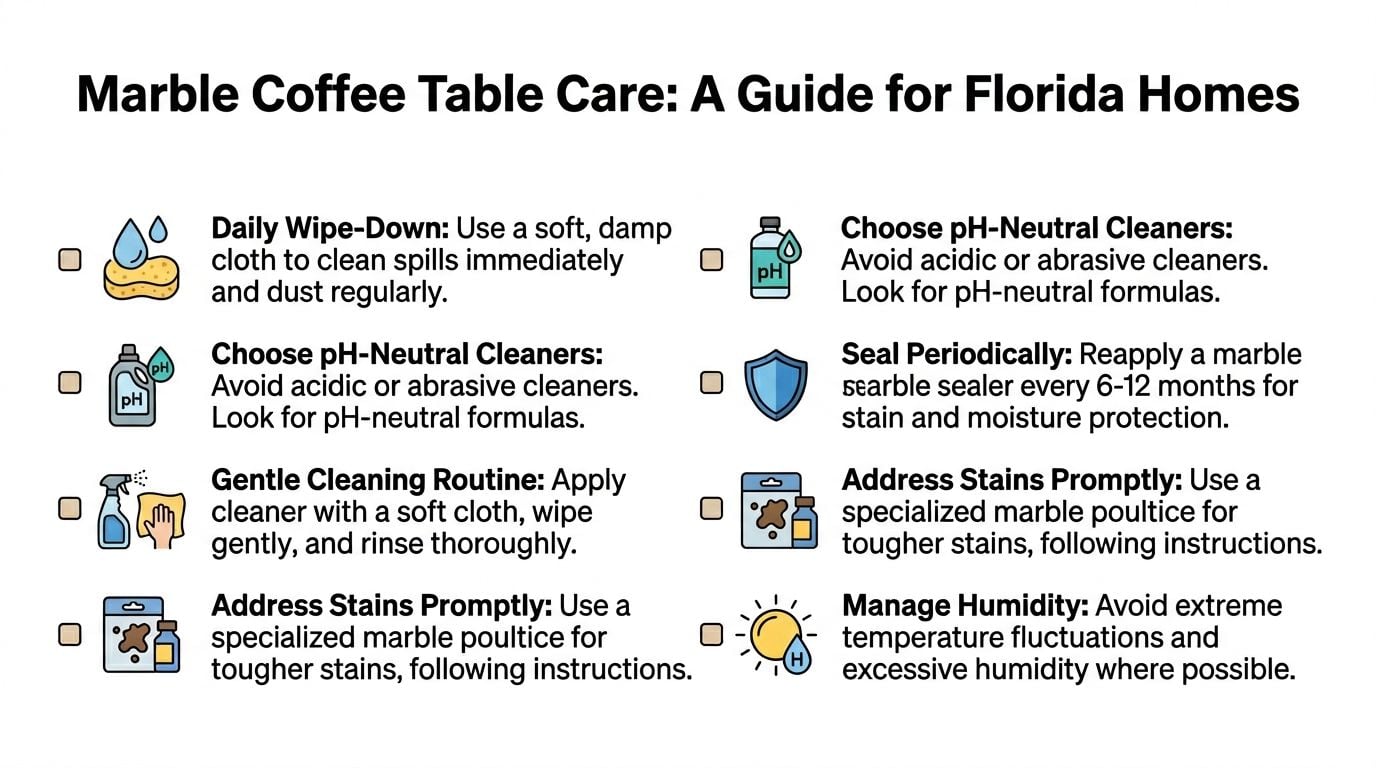
Daily care that keeps problems small
Most marble maintenance is simple if you stay consistent.
- Wipe spills quickly. Coffee, juice, and wine are easier to address right away than later.
- Use a soft cloth. Rough scrubbing tools can create avoidable wear.
- Keep coasters nearby. In Florida, cold drinks leave condensation fast.
- Dust often. Fine grit can act like an abrasive if it gets rubbed around the surface.
This isn’t complicated, but it does require attention.
What to use and what to avoid
Use cleaners made for stone or pH-neutral formulas. Marble doesn’t respond well to harsh household shortcuts.
Avoid acidic cleaners, abrasive powders, and rough pads. Even if they don’t cause immediate visible damage, they can wear down the finish or compromise the protective sealer over time.
Sealing routine
Sealing is one of those tasks homeowners postpone because the table still “looks fine.” That’s usually the mistake.
A good sealing routine helps the marble resist moisture intrusion and everyday staining. If your table sits in a highly used family room, sealing on the earlier side of that recommended window often makes more sense than waiting.
A simple sealing schedule
- Clean the surface fully
- Make sure the stone is dry
- Apply the recommended sealer as directed
- Allow proper cure time before regular use returns
If you’re already careful with wood furniture elsewhere in the room, some of the same protective habits discussed in the ultimate guide protecting wood furniture scratches stains carry over well for coasters, pads, and routine prevention.
Handling common stains and marks
Not every problem on marble is the same.
Water rings and condensation marks
These are common in Orlando-area homes. Start with a soft cloth and a stone-safe cleaner. If the mark remains, it may be affecting the finish rather than sitting on top of it.
Coffee or darker spill residue
Blot first. Don’t grind the spill into the surface.
If a stain remains after gentle cleaning, a marble poultice product may help lift it. Follow product instructions carefully and test in an inconspicuous area when possible.
Etching
Etching isn’t always a stain. It can look like a dull area where the finish changed.
That’s why some homeowners get frustrated. They keep cleaning the spot, but the issue isn’t residue. It’s surface damage to the polish or finish. Minor etching may improve with stone-specific polishing products, but deeper etching often needs professional attention.
If a mark feels smooth but looks cloudy, you may be dealing with etching rather than a spill stain.
When to call a pro
Call a restoration specialist if:
- The stain doesn’t respond to marble-safe cleaning
- The surface looks dull in one specific spot
- You see repeated moisture issues
- The table has older damage you want corrected properly
Marble ages well when owners stay ahead of maintenance. In Central Florida, that usually means prevention matters more than repair.
Local buying guide for coffee table marble in Longwood Orlando
Buying marble online can be frustrating because screens flatten the details that matter most. Veining, tone shifts, finish sheen, edge feel, and base proportions all read differently in person. That’s one reason local shopping matters more with coffee table marble than with many other furniture categories.
Another reason is sourcing. Eighty-five percent of U.S. marble slabs are imported, which makes American-made marble coffee tables from ethical sources relatively rare, according to this market context on genuine marble coffee tables. If local buyers care about domestic craftsmanship, origin, and how a piece is put together, they usually need to ask more questions than a product listing answers.
Why local shopping helps
When you visit a showroom, you can compare:
- Polished versus softer finishes
- Light marble against darker upholstery
- Metal bases versus wood bases
- How substantial the table feels at full scale
You can also ask practical questions that matter in Florida homes. How will this finish handle condensation? Is this top easy to reseal? Does this base make the table easier to place on a rug in an open-plan room?
Those aren’t small details. They affect whether you still love the piece a year from now.
What thoughtful buyers should ask
A good shopping conversation should include more than “What colors does it come in?”
Ask things like:
- Is the top natural marble or an engineered alternative?
- How does the finish change maintenance needs?
- Will the base style suit a busy family room or a formal living room better?
- Can I customize the dimensions or materials?
- What happens if I want the marble look with warmer wood around it?
That’s especially useful if you’re furnishing a full room and trying to coordinate with brands known for specific strengths. A marble table might need to sit comfortably alongside the wood character of Stickley, the ergonomic presence of Stressless seating, the custom comfort focus of Smith Brothers, or the American-made quality associated with Bassett, Craftmaster, American Leather, Amish furniture, Canadel, Amisco, Palasar, and Mavin.
A practical local path
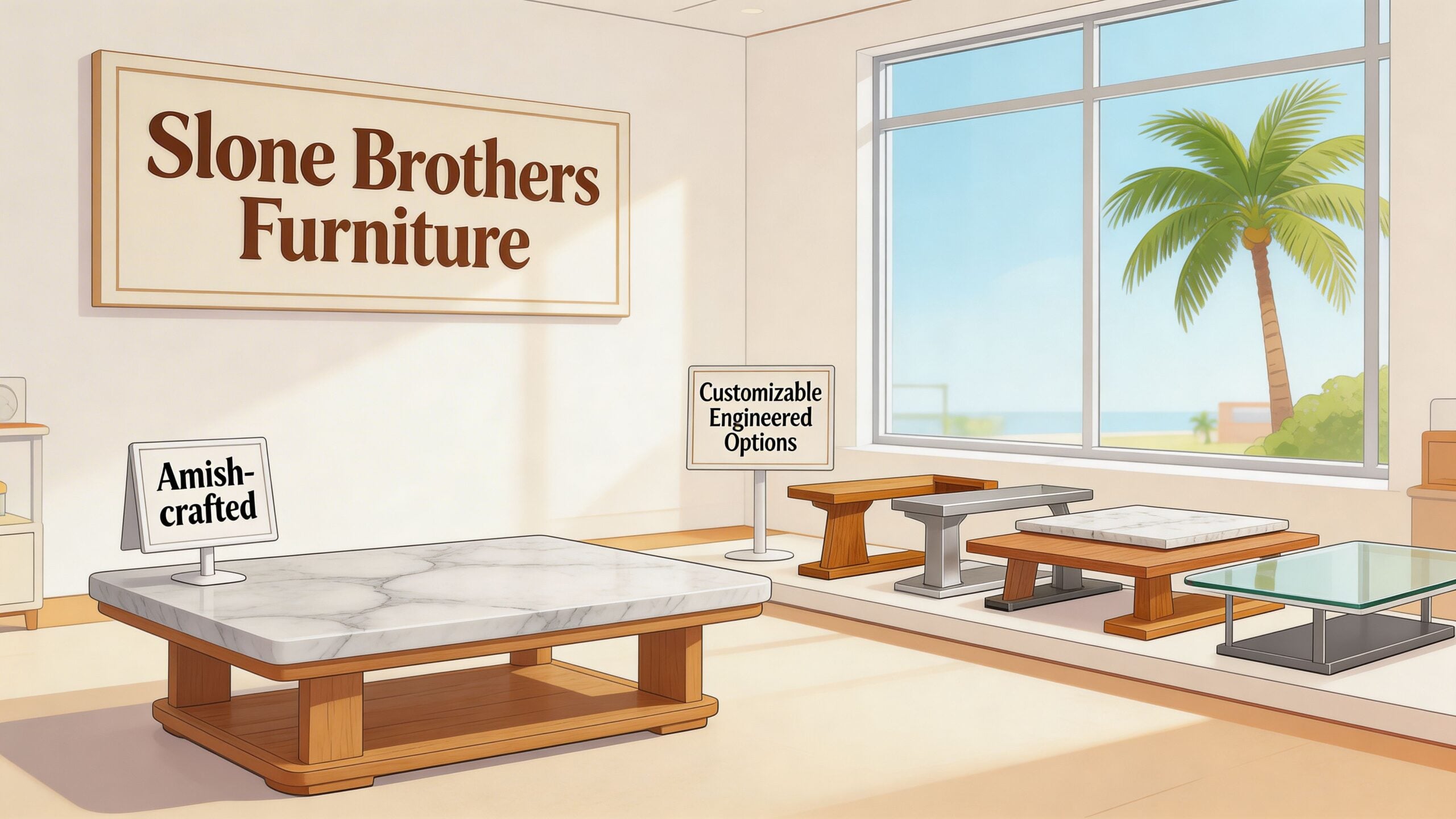
For Central Florida shoppers, one option is Slone Brothers Furniture, a family-owned Longwood showroom serving the Greater Orlando area since 1980, with a custom-order program, in-house design help, home delivery, and a clearance outlet. Those services matter when you’re trying to compare marble looks, tailor a base or finish, or find value in a room project that includes more than one piece.
Custom ordering can be especially useful with marble because homeowners often know what they don’t want before they know exactly what they do want. Maybe the stone should feel lighter. Maybe the base needs to warm it up. Maybe the room needs something with the look of marble but a less formal profile.
Don’t overlook clearance and in-person comparison
A lot of buyers assume marble always means a long lead time or special order only. Sometimes that’s true. But in-store shopping can reveal floor samples, discontinued pieces, or clearance opportunities that don’t show up in generic searches for “furniture stores near me.”
That matters for new homeowners in Longwood, Lake Mary, Sanford, and Orlando who are furnishing several rooms at once. If you can compare stone, upholstery, rugs, and accent pieces in one visit, the decision usually gets easier.
The strongest reason to shop locally is simple. Coffee table marble is tactile. You want to see the sheen, trace the veining, and judge the scale in person before you commit.
Conclusion and next steps
A marble coffee table can be one of the most rewarding pieces in a living room when the choice is grounded in real-life use. The right table balances construction, shape, finish, styling, and maintenance, not just color or trend appeal.
For Central Florida homes, the extra layer is climate. Humidity, condensation, and everyday traffic all shape how coffee table marble performs over time. That’s why the smartest purchase usually starts with practical questions. How is it built? How will it live in your room? How much care are you comfortable giving it?
If you’re furnishing a new home, upgrading a family room, or trying to create a more finished look in an Orlando-area space, seeing marble options in person makes a big difference. Veining, finish, weight, and proportion are much easier to judge when you can compare them side by side.
The best outcome isn’t just owning a marble table. It’s choosing one that fits the way your home works.
Ready to find the perfect piece for your home? Visit the Slone Brothers Furniture showroom in Longwood, FL, and let our design experts help you get started!