

Corner Kitchen Table: A Buyer’s Guide for Orlando Homes


Your kitchen may already have everything you need, except one thing. A place for people to comfortably gather without blocking the path to the fridge, crowding the island, or turning every quick breakfast into a shuffle.
That’s where a corner kitchen table starts to make sense. In a lot of Central Florida homes, especially in Longwood, Lake Mary, Sanford, and older Orlando neighborhoods, the kitchen has an awkward corner that ends up wasted. It collects a plant, a stack of mail, or a chair that never quite belongs there. Meanwhile, the “main” table feels too large, too boxy, or just in the way.
If that sounds familiar, you’re not alone. Many homeowners start looking for a better layout before they start looking for better furniture. If you're still shaping the whole room, these best kitchen remodel ideas can help you think through flow, storage, and seating together. And if your main goal is fitting the right dining piece into a tighter footprint, this guide to the best dining table for small spaces is useful background.
A good corner setup can turn a neglected spot into the part of the kitchen everyone uses. Morning coffee feels calmer. Homework has a landing place. Casual dinners feel tucked in instead of squeezed in.
Your Kitchen Corner Reimagined
A corner kitchen table works best when it solves a daily problem, not when it just fills a blank spot.
I’ve seen this in all kinds of homes around Central Florida. In one kitchen, the family had a standard table pushed against a wall, with chairs scraping in and out and one side never used because it backed into the traffic path. In another, the corner near a set of windows looked charming, but no one sat there because the furniture was the wrong scale. The room wasn’t small. It just wasn’t planned around how the family moved through it.
Why this setup feels so different
A corner arrangement changes the way a kitchen behaves. It frees up the center of the room, gives seating a natural boundary, and makes meals feel more relaxed because people aren’t constantly shifting to let someone pass.
That’s especially helpful in homes where the kitchen does double duty. A lot of families use that space for eating, laptop time, school papers, and catching up on their day. A corner nook can support all of that without making the room feel overfurnished.
Practical rule: The best corner kitchen table doesn’t just fit the corner. It fits your routine.
What homeowners usually want
Those inquiring about this style are typically trying to solve one of these issues:
- A crowded layout: The current table interrupts traffic flow.
- An unused corner: The room has square footage, but not in the middle.
- More seating comfort: They want bench seating, especially for kids or casual meals.
- A cozier look: The kitchen feels hard and open, and they want warmth.
- A better long-term choice: They’re tired of replacing furniture that never fit quite right.
That last point matters. If you choose carefully, a corner kitchen table can become one of the hardest-working pieces in the house. It’s a spot for breakfast, conversation, and those everyday moments that don’t need a formal dining room to feel special.
Understanding the Corner Kitchen Table
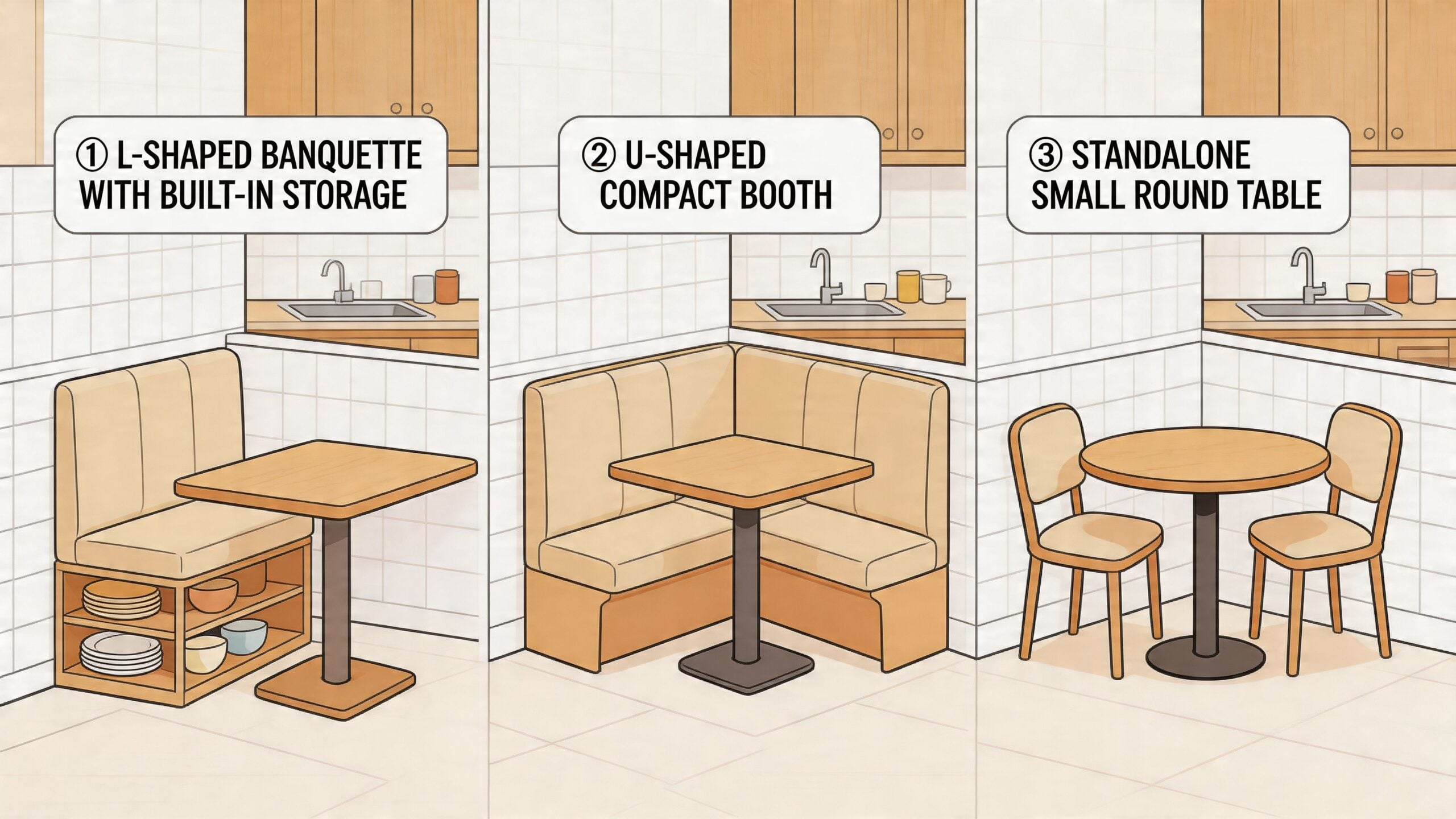
A corner kitchen table is a dining setup designed to use the angle where two walls meet. Sometimes that means a table with an L-shaped bench. Sometimes it means a tighter booth arrangement. Sometimes it’s a small standalone table paired with corner seating that creates the same effect.
What matters is the purpose. It turns an underused edge of the room into a functional dining area.
The main types you’ll see
Shoppers often use different words for similar setups, so it helps to sort them out.
| Style | What it looks like | Best for |
|---|---|---|
| L-shaped banquette | Bench seating wraps two walls with a table in front | Tight corners, family seating, cozy breakfast nooks |
| Booth-style nook | More enclosed seating, often with a stronger back and fuller frame | Traditional kitchens, casual dining areas, defined seating zones |
| Corner bench with freestanding table | Bench uses the corner, but the table and other chairs stay more flexible | Homes that need easier reconfiguration |
The L-shaped style is the one often pictured first. It’s efficient and softens the room because it removes some of the chair clutter. A booth feels more anchored. A freestanding table with a corner bench gives you the easiest path if you want the look without committing to a heavier built-in feel.
Why it isn’t a passing trend
This furniture idea has been around for a long time for a simple reason. It works.
The Colonial Williamsburg record of a documented corner table notes that the corner kitchen table originated in early 18th-century Britain as a practical solution for homes without dedicated dining rooms. Those homes used one room for cooking, eating, sleeping, and entertaining, so furniture had to earn its space. By the mid-1700s, these tables often featured sturdy joinery and were commonly made in walnut or mahogany.
That history still makes sense today. Many Orlando-area homeowners aren’t dealing with colonial floor plans, of course, but they are dealing with rooms that need to multitask. Open-concept homes need visual definition. Older homes need space-saving solutions. Newer homes sometimes have breakfast areas that look generous on paper but don’t suit a standard dining set.
Good design lasts when it answers a real problem. The corner kitchen table has lasted because it does exactly that.
Where it fits in modern Central Florida homes
In Longwood bungalows, Lake Mary breakfast rooms, and family kitchens throughout Greater Orlando, a corner setup often works where a regular table doesn’t. It can create a natural eating zone near windows, help a kitchen feel more welcoming, and make daily use easier.
If you love furniture that combines practicality with permanence, this style has a lot going for it. It isn’t just cute. It’s one of the smartest ways to make a kitchen corner useful.
The Ultimate Measurement Checklist for a Perfect Fit
Most corner kitchen table mistakes happen before anyone talks about style. The finish can be beautiful and the cushions can feel great, but if the footprint is wrong, the whole room feels off.
That’s why I always tell people to start with the room, not the furniture photo. A corner nook has to fit your walls, your walkway, your windows, and the way your kitchen functions on a Tuesday morning.
A helpful starting point is this room-planning guide on how to measure a room for furniture. For corner seating, though, you’ll want to go one layer deeper.
Start with the walls and obstacles
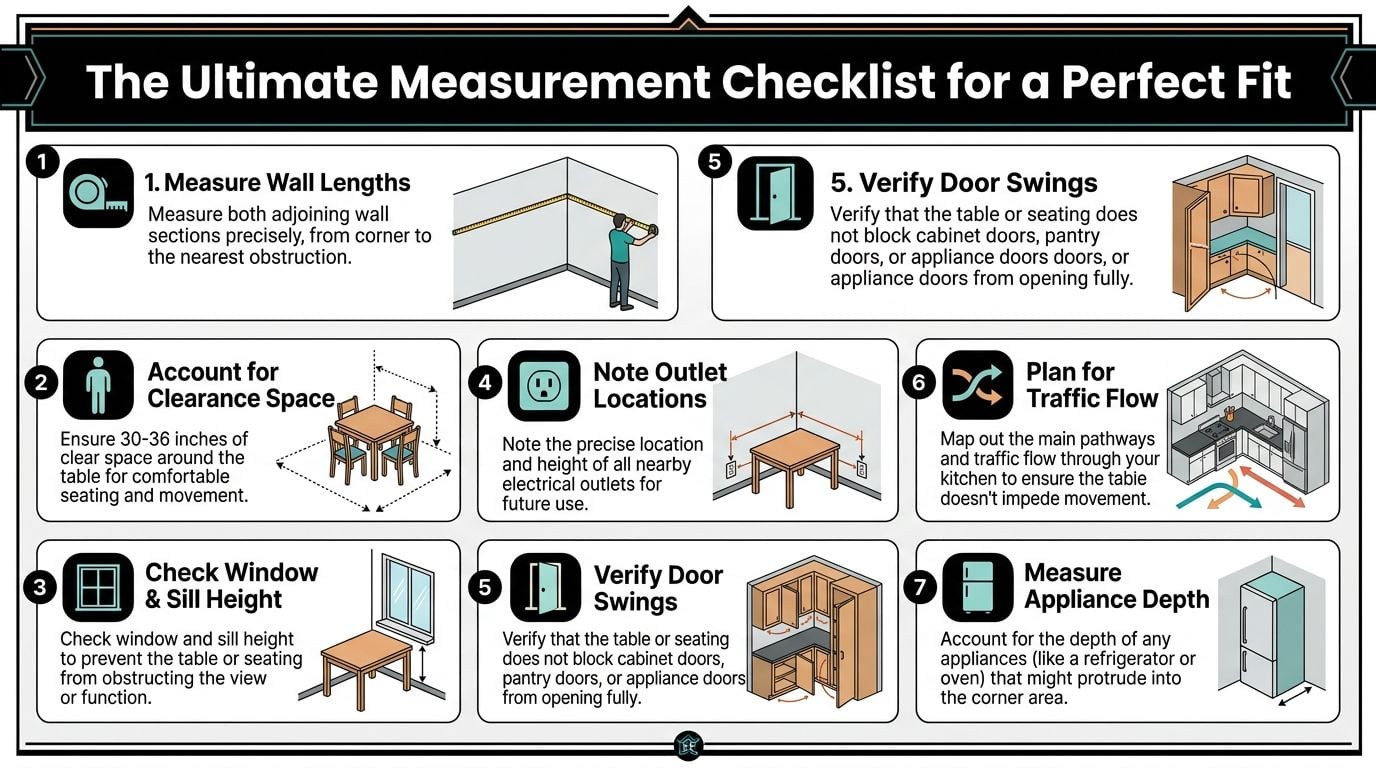
Measure both walls that form the corner, and measure to the nearest thing that matters. That could be a door trim, a window casing, a cabinet run, or an appliance edge.
Write those measurements down clearly. Don’t trust memory. And don’t measure only the open floor area. You need the dimensions that show where the furniture can begin and end.
Here’s what to note first:
- Wall lengths: Measure each adjoining wall from the corner outward to the first obstruction.
- Window height: Check whether a bench back or table height will hit the sill.
- Outlet placement: Mark electrical outlets so you don’t hide one you use often.
- Door swing: Open nearby doors and appliances fully before you decide a corner is “free.”
Map the footprint on the floor
Painter’s tape is one of the easiest tools you can use. Tape off the shape of the bench and the table directly on the floor. Then walk around it as if it’s already there.
You’ll spot problems fast. The pantry door may clip the corner. The fridge may feel tighter than expected. The path from sink to stove may suddenly feel awkward.
This is also where you judge general clearance. The planning notes for this article call for 30 to 36 inches of open space around the table area for comfortable movement, and that’s a useful practical range to test in a real kitchen. If the taped outline makes the room feel pinched, listen to that instinct.
Measurement tip: If you have to turn sideways to pass the taped layout, the finished furniture will feel even bigger.
Check the seating comfort zone
This is the part many people miss. They measure the corner, but not the actual sitting experience.
According to the breakfast nook clearance guidance from Dimensions.com, the bench zone, meaning the space between the bench backrest and table edge, should be 18 to 20 inches for ergonomic comfort. The same guidance notes a standard bench seat height of 16 to 18 inches.
Those numbers matter because they affect posture. Too little space and everyone sits stiffly forward. Too much and the table feels too far away for comfortable dining.
A quick reference helps:
| Measurement area | What to look for |
|---|---|
| Bench zone | 18 to 20 inches between bench back and table edge |
| Seat height | 16 to 18 inches for comfortable dining posture |
| Visual fit | Bench and table should feel scaled to the room, not pressed into it |
Think through movement, not just fit
A corner kitchen table can technically fit and still be wrong for the room. The better question is whether people can live around it comfortably.
Walk these routes in your mind and in your kitchen:
- From the fridge to the prep area
- From the sink to the dishwasher
- From the main doorway through the kitchen
- From the table to any nearby cabinets or drawers
If any one of those routes feels blocked, revisit the layout. This is especially important in busy family kitchens where multiple people move through the space at once.
Bring in the room’s fixed features
One of the biggest surprises for homeowners is how much fixed architecture influences furniture choice. A pretty corner on a floor plan might have a deep window sill, a baseboard heater, or a cabinet return that changes everything.
Make sure you account for:
- Appliance depth: Fridges and ranges often project farther than expected.
- Trim and baseboards: These can affect how flush a bench sits.
- Wall outlets and light switches: They need to stay usable.
- Floor vents or returns: Don’t bury them under a bench base.
When to ask for help
If your kitchen has unusual angles, a tight breakfast area, or several nearby obstacles, it helps to get a second set of trained eyes on the plan. A good design team can catch problems before you order anything, and that’s often the difference between “close enough” and “fits like it belongs.”
The right measurements make every later decision easier. Once the size is settled, style becomes the fun part.
Choosing Shapes Materials and Finishes
After the measurements are right, the next decision is character. Your corner kitchen table then begins to feel like it belongs in your home instead of squeezed into it.
Shape, material, and finish all work together. The wrong combination can make a nook feel bulky or fussy. The right one makes the kitchen look more settled, more usable, and much more intentional.
If you’re comparing wood species and want a better sense of how they differ in grain, tone, and durability, this guide to types of wood for dining tables is worth reading alongside your shopping process.
Picking the right table shape
The shape affects both mood and function.
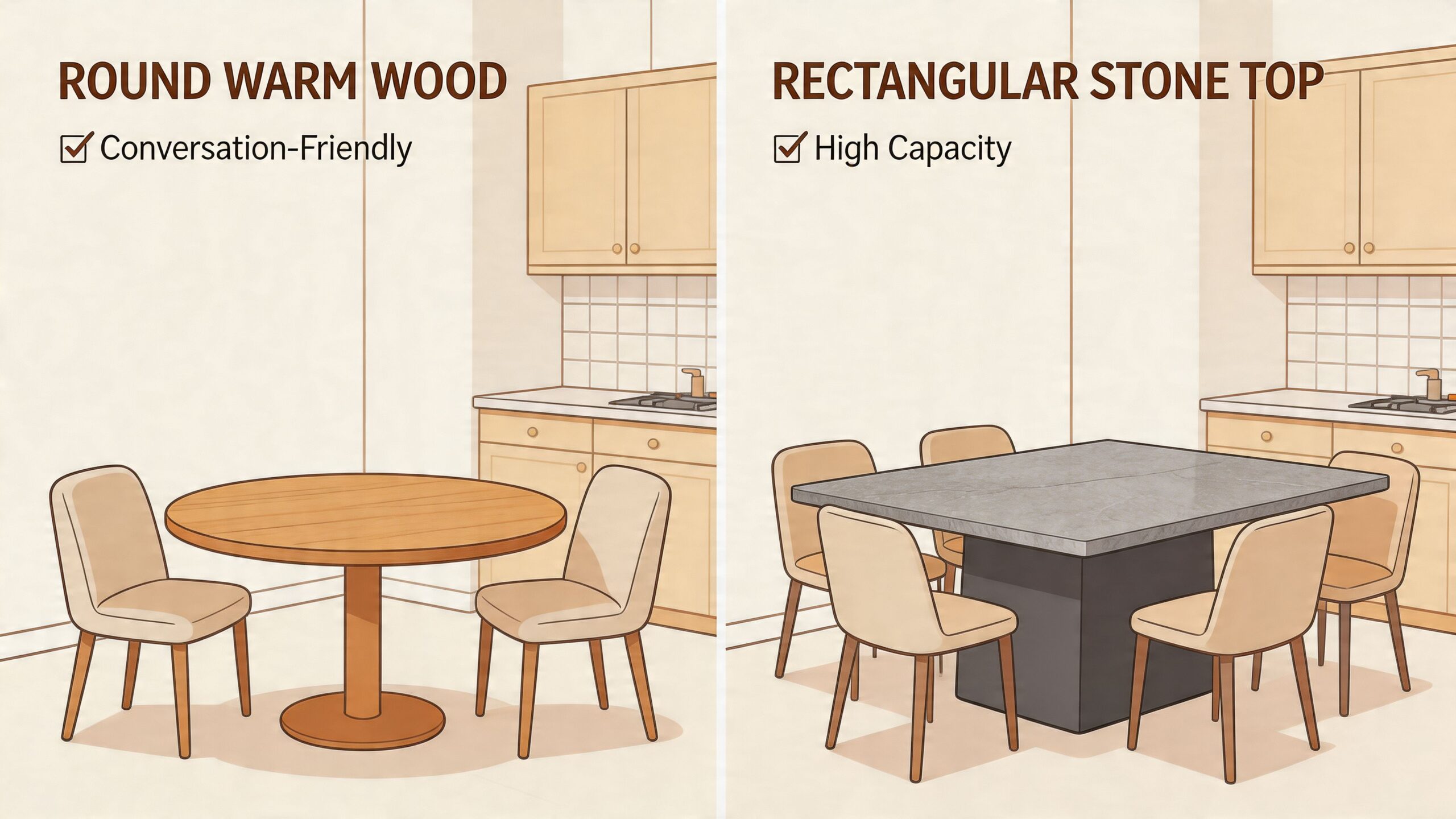
A round table usually feels softer and more social. It’s great when you want easier conversation and gentler traffic flow around the edges. In a smaller breakfast nook, a round top can keep the corner from feeling too rigid.
A rectangular or square table looks more structured. It often gives you a stronger visual match with an L-shaped bench and may suit kitchens with straighter lines, shaker cabinetry, or a more architectural style.
Here’s a simple comparison:
| Shape | Strength | Watch for |
|---|---|---|
| Round | Easier circulation, softer look, good for conversation | May leave unused corners if the bench is very angular |
| Rectangular | Clean fit with benches, efficient use of edge space | Can feel heavy in a tight room |
| Square | Balanced look in compact spaces | Needs careful scaling to avoid crowding knees and walkways |
Why material matters more in Florida
This is one place where local conditions matter. A furniture choice that works fine in a dry climate may not age the same way in Central Florida.
The verified guidance for this article states that in humid climates like Central Florida, where average humidity is 70 to 80%, solid hardwood construction is critical because MDF can sag or peel, while high-quality American-made and Amish-crafted solid woods are better for resisting warping and supporting long-term durability, as noted in this corner table material overview.
That doesn’t mean every solid wood table is equal. Construction quality still matters. But in general, this is why many homeowners eventually move away from lighter mass-market nooks made from engineered materials. They may look fine at first, but kitchens are hardworking spaces. Steam, spills, air conditioning cycles, sunlight, and daily use all add up.
Local insight: In Central Florida, the smartest dining furniture choices usually start with how the material will age, not just how it looks on day one.
A practical material hierarchy
If you want a piece that lasts, here’s what to consider:
- Solid hardwood: Best for longevity, refinishing potential, and a more substantial feel.
- Quality mixed-material construction: Can work well if the table top and structural parts are still strong and stable.
- MDF-heavy construction: Usually the weakest long-term choice in a humid kitchen environment.
This is one reason Amish-crafted and American-made dining furniture continues to appeal to homeowners who want value over time. Brands known for better wood furniture often focus on joinery, finish quality, and customization rather than just fast delivery.
Finishes and fabrics that work in real kitchens
A finish has two jobs. It should fit your design style, and it should be forgiving in everyday life.
For a lighter Florida look, many homeowners choose medium or light wood tones that keep the nook airy. In traditional kitchens, deeper stains can add more contrast and visual weight. Painted finishes can also work beautifully, especially if you want the bench to blend with cabinetry while the table top adds warmth.
For upholstered seating, performance-minded fabric choices matter. You want something that can handle family use, sunlight, and casual spills without making the nook feel overly formal.
A few strong combinations:
- Warm oak with textured neutral upholstery: Relaxed and versatile
- Painted bench with stained wood top: Great if you want contrast
- Dark wood with easy-clean fabric: Better for traditional kitchens or homes with heavier trim
- Mixed finish options: Useful when you want the nook to coordinate with nearby cabinetry without matching exactly
Match the furniture to the room’s visual weight
Design gets subtle. A heavy trestle table with thick benches may overwhelm a compact breakfast corner. On the other hand, a very delicate table can look lost in a large open-concept kitchen.
Ask yourself whether your room needs the nook to do one of these things:
- Blend in quietly
- Create a visual destination
- Warm up a hard kitchen
- Anchor a large open area
That answer should guide your finish and silhouette. The best choice isn’t always the one with the most detail. It’s the one that balances the room.
Styling and Placement in Your Kitchen
Once the table is chosen, placement and styling make the nook feel complete. The practical seating solution thereby becomes part of the room’s personality.
A corner kitchen table should look connected to the kitchen around it. Not dropped in at the last minute. Not floating awkwardly in a breakfast area. Just settled, comfortable, and natural.
In a smaller kitchen
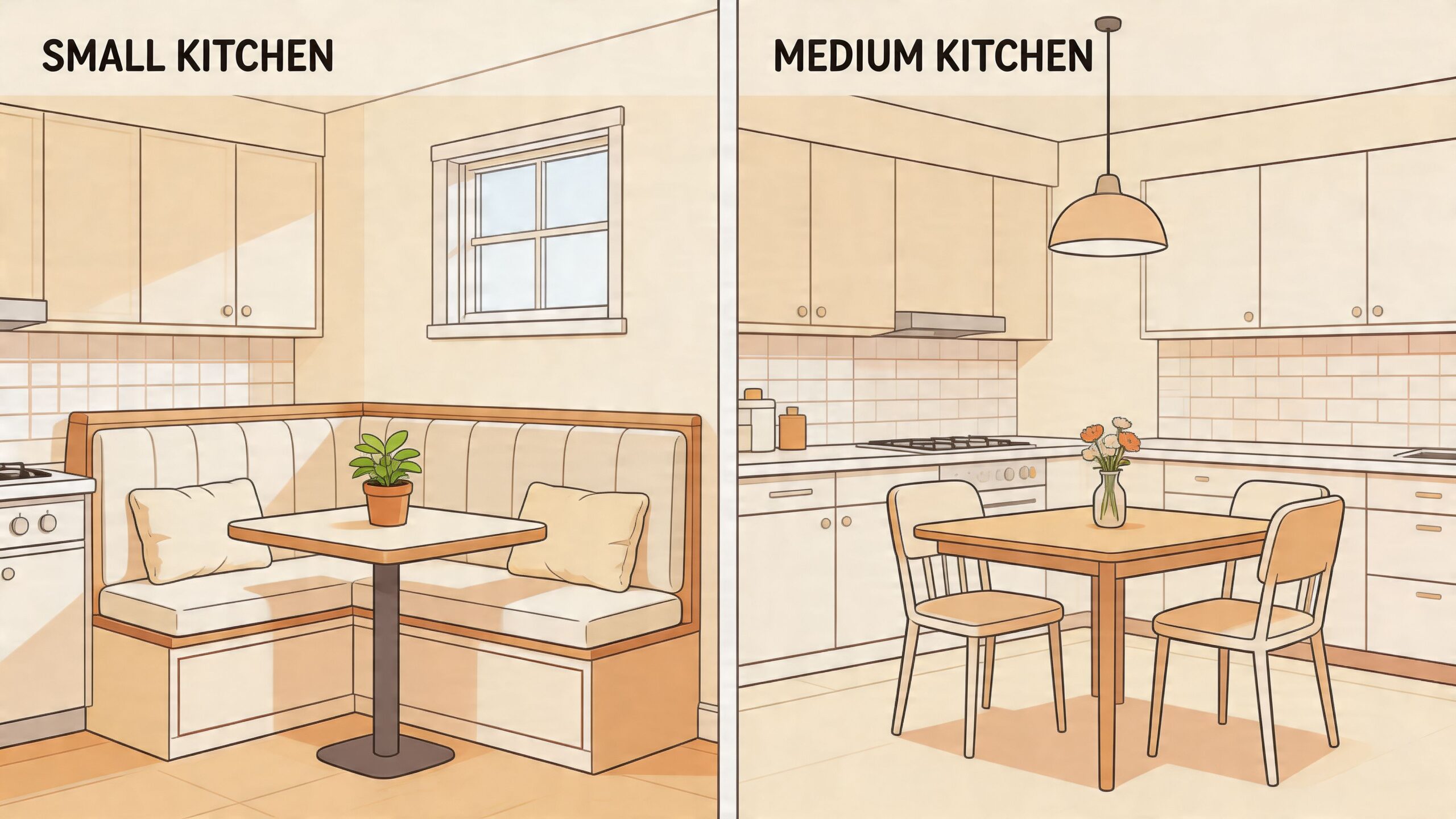
In an older Orlando bungalow or a compact Longwood kitchen, the goal is usually to make the nook feel light. Keep the bench profile visually clean. Let window light do some work. Avoid overdecorating the wall behind it.
In spaces like that, I like a simple pendant above the table and a small cushion or two for softness. If the room already has a lot of visual detail, the corner should be the calm part.
In an open-concept home
A corner nook can also help define space in a larger kitchen that opens to the family room. In those homes, the challenge isn’t fitting the table. It’s making the nook feel intentional.
A rug usually isn’t ideal in many kitchen settings, so use other tools instead. A pendant fixture, a strong bench fabric, or a distinct wall color can gently mark the dining zone without closing it off.
A nook feels finished when the lighting, wall treatment, and furniture all agree on where the space begins.
Design details that pull it together
A few finishing choices go a long way:
- Lighting: Choose a pendant scaled to the table, not the whole kitchen.
- Cushions: Add comfort, but keep them compact so the nook still feels easy to use.
- Wall art: One larger piece often works better than several small ones in a compact corner.
- Window treatment: Keep it simple if the bench sits near glass.
If you're coordinating surrounding surfaces too, this overview of kitchen tiling design is a useful way to think about color, texture, and how the nook will relate to the backsplash or nearby flooring transitions.
Choosing a style direction
A corner kitchen table can work with a surprising range of looks.
| Style | What helps it feel right |
|---|---|
| Coastal | Lighter woods, soft blues or sandy neutrals, casual textures |
| Modern farmhouse | Clean wood grain, black accents, simple bench lines |
| Traditional | Fuller bench backs, richer finishes, classic upholstery |
| Contemporary | Streamlined shapes, lower contrast, crisp materials |
If you want a softer, more polished look, an upholstered corner bench shows how fabric can make the space feel warmer and more finished.
Don’t crowd the corner
This is the most common styling mistake. Once people create a cozy nook, they want to keep adding to it. Extra baskets, oversized centerpieces, too many pillows, large wall signs. Suddenly the cozy corner feels cramped again.
Use restraint. Let the furniture do the work. A corner kitchen table already creates atmosphere because of its shape and placement. It doesn’t need much help.
Why Custom-Order Your Table from Slone Brothers
A lot of corner kitchen table frustration comes from trying to force a standard product into a non-standard kitchen.
That’s the problem with many mass-market options. They’re designed around common dimensions, broad appeal, and quick shipment. But real kitchens don’t always cooperate. One home has a window that sits lower than expected. Another has an odd wall length. Another needs the bench reversed because of traffic flow. Those details make all the difference.
Why standard-size options often fall short
The verified research for this article notes that while major retailers tend to focus on standard-sized MDF nooks, there is growing demand from new homeowners in Longwood and Greater Orlando for custom solutions, and that a custom-order approach can tailor configurations to specific layouts in ways broad online results often don’t address, as discussed in this look at the dining nook category.
That rings true in everyday design work. Corners are rarely as simple as they seem. Even when the width works, the height, proportions, or bench direction may not.
What custom ordering actually solves
When people hear “custom,” they sometimes assume it only means expensive or overly complicated. In practice, it often means practical.
A custom-order corner kitchen table can help you fine-tune things like:
- Configuration: Left-facing or right-facing bench layout
- Scale: Better proportions for a narrow breakfast area or larger eat-in kitchen
- Material choice: A stronger fit for climate and wear
- Finish selection: Coordination with cabinets, flooring, or nearby furniture
- Seating style: Wood seat, upholstered bench, or mixed arrangement
That flexibility matters more in a corner than it does with many other furniture pieces. You don’t have as much room to “make it work” after the fact.
Why local guidance helps
A local showroom experience provides significant value for Central Florida homeowners. You can talk through actual room conditions instead of guessing from photos. You can compare wood tones in person. You can sit in different bench depths and feel the difference.
For shoppers who want to explore made-to-order options, custom furniture ordering gives you a clearer sense of how specific dimensions, finishes, and configurations can come together.
A local team also understands the design patterns common in this area. The breakfast spaces in Lake Mary don’t always behave like the kitchens in older Sanford homes. Newer Orlando-area builds can have wide-open layouts but still awkward corners. Experience with those floor plans helps.
The best custom piece doesn’t feel custom because it’s unusual. It feels custom because it solves the room so cleanly that nothing seems forced.
The long-term value of getting it right
A corner kitchen table usually becomes part of daily life fast. That’s why it’s worth slowing down for the right dimensions and construction.
A better fit means fewer compromises. A better material means less worry over time. A finish you love means the nook won’t feel temporary or “good enough” a year from now.
That’s especially true if you care about quality and want furniture that reflects more than a catalog default. American-made and Amish-crafted options often appeal to homeowners for exactly that reason. They offer more control, more substance, and a more lasting result than the quick-ship alternatives that dominate search results.
For many families, custom isn’t the luxury version of a corner table. It’s the version that finally fits.
Frequently Asked Questions About Corner Nooks
A few questions come up almost every time someone starts seriously considering a corner kitchen table. Here are the ones I hear most often.
How many people can a standard corner kitchen nook seat
It depends on the table shape, the bench length, and whether you’re mixing in side chairs. The most honest answer is to judge by usable elbow room and entry space, not by a product label.
If you’re shopping in person, sit the way your family sits. If children, teens, or adults will all use the nook, test it with that in mind. A setup that feels cozy for coffee can feel crowded at dinner if the table top is too small or the bench corners are too tight.
Are storage benches worth it
They can be, especially in kitchens that need a little extra hidden storage. Bench storage is handy for placemats, seasonal linens, small serving pieces, or items you want close by but out of sight.
The key is not letting storage drive the whole decision. If the seat feels too bulky or the proportions become awkward, the tradeoff may not be worth it. Good comfort and good fit should still come first.
What’s the best way to care for an Amish-crafted solid wood table
Keep the care routine simple and consistent. Wipe up spills promptly, use placemats or trivets for daily protection, and clean with products that are appropriate for finished wood surfaces.
Solid wood furniture tends to reward regular, gentle maintenance. Don’t drench it, don’t use harsh cleaners, and don’t assume a kitchen table can go years without attention. If you stay ahead of wear, a well-made wood piece can serve a home beautifully for a very long time.
Can I find affordable high-quality corner kitchen tables in a clearance outlet
Sometimes, yes. Clearance shopping can be a smart route if you’re flexible on exact dimensions, finish, or fabric.
The important part is staying focused on quality and fit. A good value isn’t just a lower price. It’s finding a well-made piece that suits your room and won’t need replacing because it was the wrong compromise.
Is bench seating comfortable for everyday use
It can be very comfortable when the proportions are right. The biggest factors are seat height, the relationship to the table, and back support. As covered earlier, that ergonomic relationship matters more than decorative details.
If comfort is a priority, spend extra time on bench design, cushion choice, and table placement. A beautiful nook only succeeds if people want to stay there.
Should the nook match the kitchen cabinets exactly
Usually, no. Coordination tends to look better than a perfect match.
A wood tone that complements the cabinets often feels warmer and more collected than trying to duplicate the same finish. The nook should look like it belongs in the room, but it doesn’t have to disappear into it.
Ready to find the perfect piece for your home? Visit Slone Brothers Furniture in Longwood, FL, and let our design experts help you get started. Since 1980, we’ve helped Central Florida families furnish their homes with lasting quality, custom-order options, and a great selection of dining furniture built for real life.