
Decorate Wall Behind TV: Stylish Home Ideas

You know the feeling. The sofa is in place, the rug is down, the TV is mounted or sitting on the console, and the room still looks unfinished.
Often, the problem is not the television itself. It is the wall behind it. That large dark rectangle can pull all the attention in the room, especially when everything around it feels blank. If you have been trying to decorate wall behind tv areas in a way that feels polished but still livable, you are in very good company here in Central Florida.
In Longwood, Lake Mary, Sanford, and across the Orlando area, we see this often. A homeowner moves into a new place, hangs the TV, then pauses. The wall feels too empty if left alone, too busy if overdecorated, and too permanent if every idea involves construction. The good news is that there is a middle path. You can make the TV wall look intentional, balanced, and warm without turning your living room into a jobsite.
Beyond the Black Box Turning Your TV Wall into a Centerpiece
A TV wall works best when you stop treating the screen like a problem to hide and start treating it like one piece of the room’s composition.
That shift matters because TV walls have changed a lot over time. Large flat-screen televisions became common in American homes, and the wall behind them became a bigger design issue. One cited overview notes that flat-screen ownership grew from 45% of U.S. households in 2010 to over 96% by 2020, and interest in TV wall ideas also climbed sharply, with a 150% increase in searches for "TV wall ideas" on Pinterest between 2015 and 2023 according to the same referenced summary at Artfully Walls.
In real homes, this usually looks like one of three situations:
- The blank wall problem where the TV floats by itself and feels disconnected.
- The clutter problem where small decor pieces are scattered around the screen with no structure.
- The scale problem where a large television visually outweighs the rest of the room.
A better approach is to give the wall a job. Maybe it becomes a gallery wall. Maybe it becomes a quiet textured backdrop. Maybe it becomes an anchored furniture vignette with art, lighting, and storage working together.
In Central Florida homes, I usually tell neighbors to aim for a look that feels airy, grounded, and easy to live with. Strong sunlight, open living areas, and casual family traffic all push us toward solutions that are attractive without feeling stiff. If you want inspiration for that broader balance, our thoughts on creating an eye-catching room fit beautifully with a TV wall project.
Tip: Your TV wall should not scream for attention. It should help the whole room feel finished.
The Foundation Planning Your TV Wall Layout
Before you choose paint, wallpaper, or shelving, the layout has to make sense. A pretty TV wall that sits too high, feels off-center, or is mounted unsafely will bother you every day.
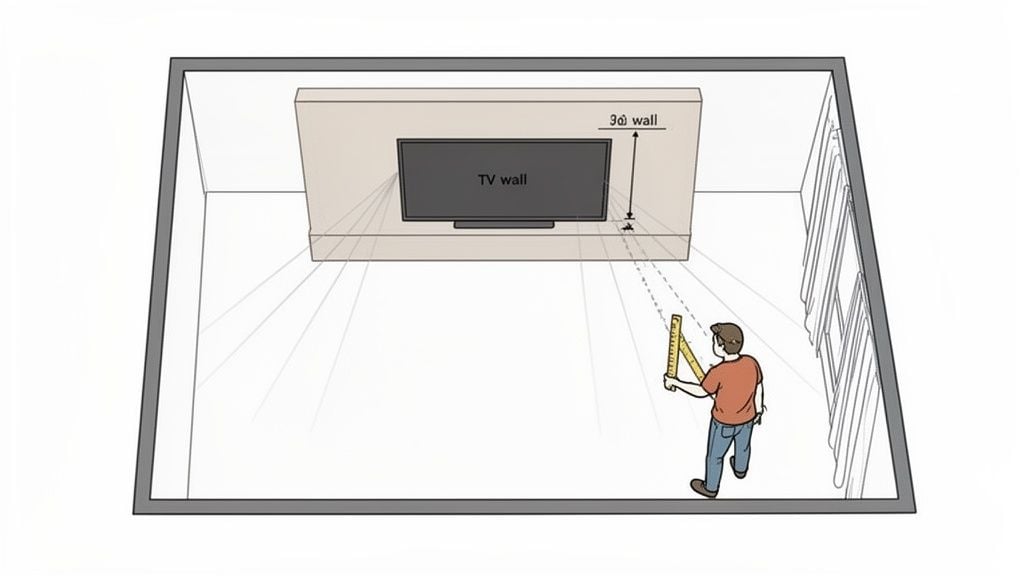
Start with the viewing experience
Stand in the room and look at the wall from the seats you use most. Your TV should feel connected to the furniture, not stranded halfway to the ceiling.
If the television sits above a console, keep the relationship close enough that the two pieces read as one unit. Too much empty space between the console and screen makes the entire wall feel awkward.
A few practical checks help:
- Sit before you measure. Your main sofa or sectional should guide the height.
- Mark the screen outline with painter’s tape. This lets you test size and placement before committing.
- Check nearby architecture. Windows, doors, fireplaces, and air vents can make a centered TV look visually off if you ignore the full wall.
For more placement guidance, this Slone Brothers article on finding optimal TV positioning is a useful companion.
Mounting safety comes before styling
Many people rush past this part. Do not.
A cited media wall guide states that professional installation requires solid wood backing installed between wall studs directly behind the TV mount location so the weight is distributed correctly, and that the mount should use lag bolts anchored into studs or wood backing, never drywall anchors alone. The same source calls this backing detail "the whole secret sauce" of media wall construction and notes that it is often missed by DIY installers in this Stewart Milne Homes guide.
That matters for both safety and appearance. If the mount shifts, sags, or ends up even slightly crooked, the room will always feel off.
A simple planning sequence
When clients feel overwhelmed, I break the job into this order:
- Place the TV first: Decide where the screen belongs based on seating and wall architecture.
- Confirm support: Verify studs or proper wood backing before any mount goes up.
- Add the console or base piece: Even a wall-mounted TV usually looks better with furniture beneath it.
- Only then plan decor: Art, paneling, paint, and shelves should respond to the TV’s final location.
Key takeaway: The most successful TV walls look calm because the measurements were handled carefully first.
Common layout mistakes
Some mistakes show up again and again in Orlando-area homes:
- Mounting too high: This often happens when people copy a showroom display or try to clear a tall piece of furniture.
- Using tiny decor beside a large screen: The wall ends up looking timid instead of balanced.
- Ignoring asymmetry: If the room architecture is uneven, a mathematically centered TV can still look wrong. Visual balance wins.
When you handle the structure and spacing first, every decorating decision gets easier.
Choosing Your Focal Treatment From Built-Ins to Bold Wallpaper
The wall begins to take on personality at this stage. The right treatment depends on how permanent you want the project to be, how much storage you need, and whether you want the TV to blend in or stand out.
One cited roundup notes a 150% increase in searches for "TV wall ideas" on Pinterest, points to the gallery wall as a strategy that can reduce the TV’s dominance by 70% in perceived room clutter, and says dark wood panelling can provide a sound-absorbing layer equivalent to 15-20% noise reduction in open-plan spaces, according to House Beautiful’s TV wall ideas feature. That mix of beauty and function is exactly why so many homeowners are paying attention to this wall now.
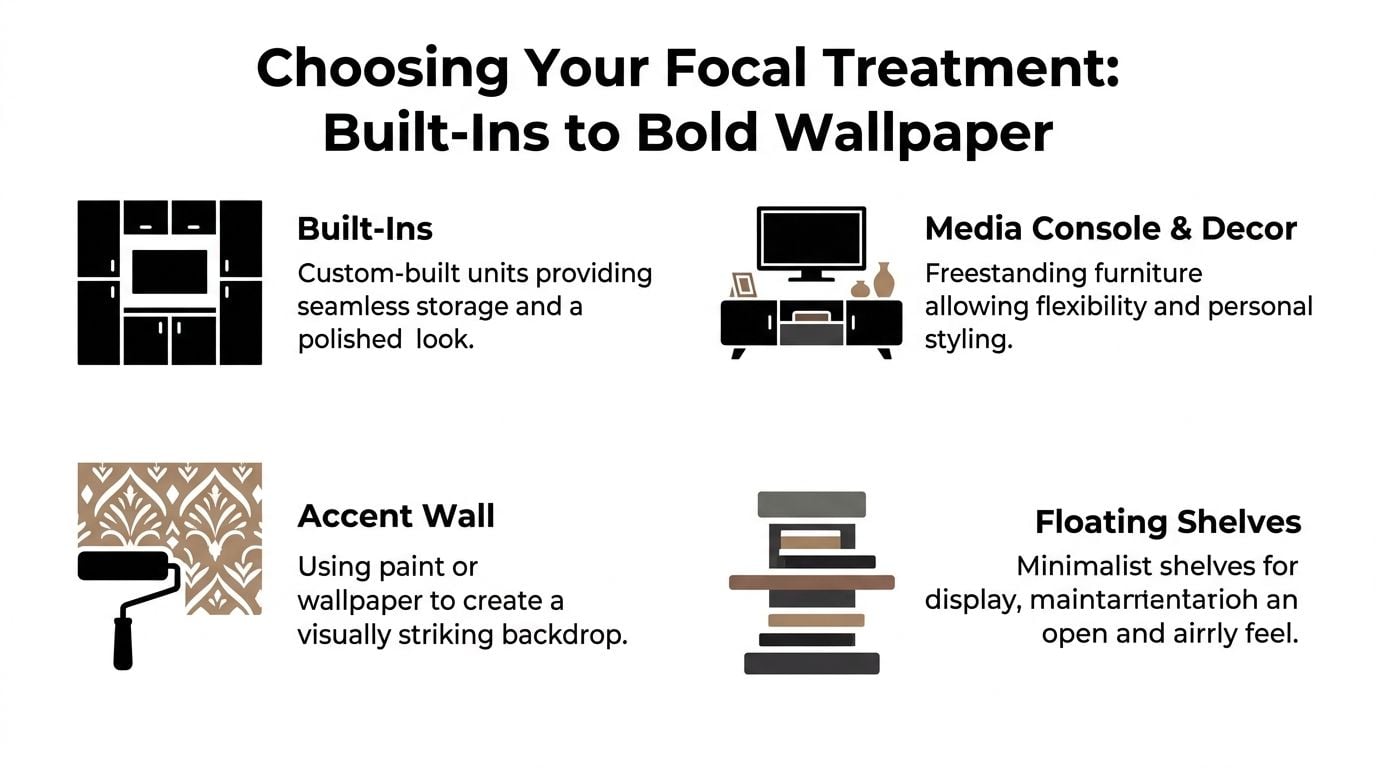
Gallery wall
A gallery wall works because it spreads visual attention across the whole composition. The TV becomes one rectangle among several shapes and textures instead of the only dark object on the wall.
This option suits:
- collected, personal spaces
- transitional and eclectic rooms
- homeowners who already have framed art or family photos
Keep the arrangement intentional. Similar frame finishes help. So does repeating one or two colors across the art.
If you are nervous about clutter, choose larger pieces with breathing room instead of many small ones.
Wood paneling or slatted texture
Wood paneling adds warmth fast. In many Central Florida homes, especially open living areas, it also brings welcome visual depth to walls that can otherwise feel flat and bright.
Darker paneling can help the screen recede. It is especially effective in family rooms where you want the TV wall to feel cozy at night but still handsome during the day.
This treatment leans more permanent. It is a strong choice for homeowners who want an architectural look without filling the wall with objects.
Paint or wallpaper accent wall
Sometimes the cleanest answer is the best one. A darker paint color behind the television can visually quiet the screen and define the media zone without adding bulk.
Wallpaper does something similar, but with more personality. Grasscloth-inspired patterns, soft geometrics, or botanical prints can all work if the palette stays controlled.
For Florida homes, I often prefer patterns that feel relaxed rather than overly formal. The room should still feel easy on a sunny afternoon.
Built-ins and substantial furniture
Built-ins create a finished, integrated look. They also solve a practical problem by adding concealed storage for media gear, games, and all the little items that collect around the TV.
If you prefer the warmth of furniture rather than full construction, a substantial media console can achieve much of the same grounding effect. Quality materials matter here. Woods with visible grain and well-made cabinetry give the TV wall presence even before you add decor.
A single mention here is appropriate: if you want freestanding pieces, wall decor, or custom-order options to support a TV wall plan, Slone Brothers Furniture carries home decor and furniture categories that can help tie the arrangement together.
Floating shelves
Floating shelves sit between minimal and styled. They give you room for books, pottery, baskets, and framed objects without fully boxing in the TV.
They work best when restraint leads. If every inch is filled, the wall feels busy. If the shelves hold a few meaningful pieces with variation in height and texture, they read as designed.
TV Wall Treatment Comparison
| Treatment | Style Fit | Installation Difficulty | Cost | Permanence |
|---|---|---|---|---|
| Gallery wall | Eclectic, transitional, collected | Moderate | Varies | Low to moderate |
| Wood paneling | Warm, modern, architectural | Higher | Higher | High |
| Paint accent wall | Modern, classic, minimalist | Lower | Lower | Moderate |
| Wallpaper | Coastal, refined, playful, layered | Moderate | Varies | Moderate |
| Built-ins | Traditional, custom, polished | Higher | Higher | High |
| Floating shelves | Casual, modern, airy | Moderate | Varies | Moderate |
| Large media console with decor | Flexible, grounded, furniture-led | Lower to moderate | Varies | Low |
Tip: If you are stuck between two options, choose the one that solves the most practical problems. Storage, sound softness, and cable concealment matter just as much as style.
Smart Solutions for Renters and Remodel-Averse Homeowners
Not every good TV wall starts with construction. In fact, a lot of people should not renovate this wall at all.
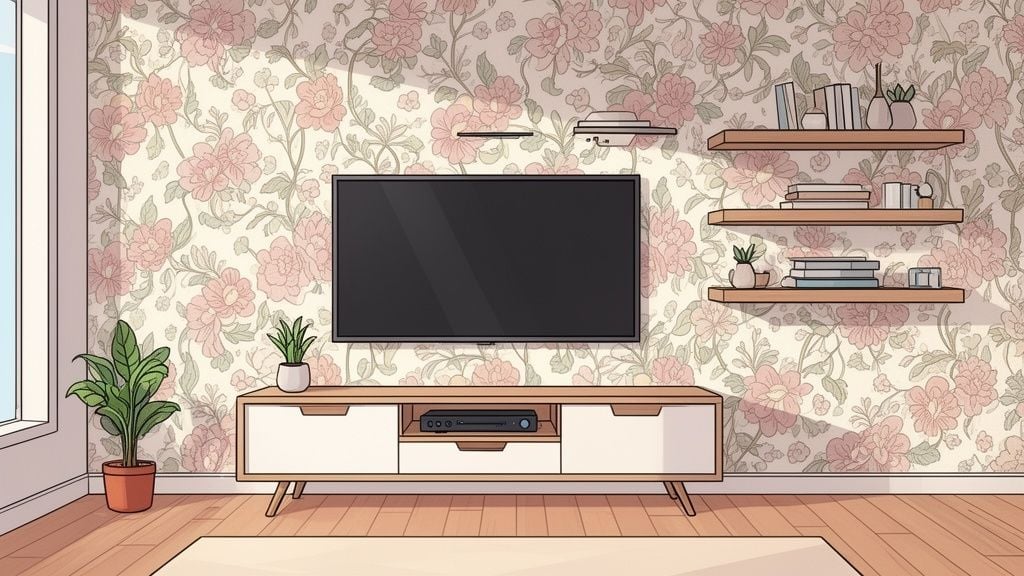
That is especially true for renters and for homeowners who do not want to commit to built-ins, paneling, or heavy wall changes. One cited source points out that current advice often skips this group, even though 30-40% of U.S. households are renters, and highlights fully reversible ideas like removable wallpaper, modular shelving that requires no anchors, and strategic furniture placement in Decorilla’s guide to decorating around a TV.
Why non-permanent can still look finished
People often assume temporary means flimsy. It does not have to.
A renter-friendly TV wall can look layered and intentional if you build it from larger, steadier elements. Think in terms of backdrops, framing pieces, and movable decor. That creates presence without putting your lease at risk.
Strong options that can move with you
Try a combination like this:
- Removable wallpaper: Use it behind the TV zone only, so the feature feels contained and manageable.
- A wide media console: This anchors the screen and adds storage without requiring wall work.
- Tall freestanding shelves or étagères: Place one or two beside the TV area to create height.
- Large art leaning on the console: Leaned frames soften the setup and avoid extra holes.
- Floor plants or sculptural branches: These help break up the hard edges of the screen.
This approach works especially well for first apartments, condos, and newer moves around Orlando where you want the space to feel established quickly. If that sounds familiar, our piece on furniture for a first apartment offers ideas that pair naturally with a flexible TV setup.
A simple renter-friendly formula
Here is one arrangement I recommend often:
- Start with a console that is wider than the TV.
- Add removable wallpaper or a painted panel substitute if your lease allows it.
- Place one tall object on each side. A lamp, shelf, or plant works.
- Style the console with a stack of books, a tray, and one lower decorative object.
- Stop before the wall feels crowded.
The result is balanced, but still easy to undo when life changes.
Key takeaway: If you cannot alter the wall itself, build the design outward from the floor up.
Taming the Wires and Adding a Glow-Up with Lighting
A decorated TV wall can fall apart instantly if cords are visible. Lighting has the opposite effect. It makes the whole setup feel intentional.
Hide the wires you can see
There are two common routes.
The first is a paintable cord cover on the wall. This is usually the easiest answer for homeowners who want a cleaner look without opening the wall.
The second is an in-wall cable management solution installed correctly. This creates a more seamless result, but it needs more planning and may not suit renters.
Good cable control usually includes:
- Power cords: Keep them grouped and directed in the shortest clean path possible.
- Device cords: Consolidate streaming boxes, soundbar cables, and gaming wires near the console.
- Access planning: Leave enough slack and organization so you can still swap devices later.
Messy wires pull your eye down and create visual noise. Tidy wires let the decor and furniture do their job.
Add soft layers of light
Lighting changes the mood of the wall more than often anticipated.
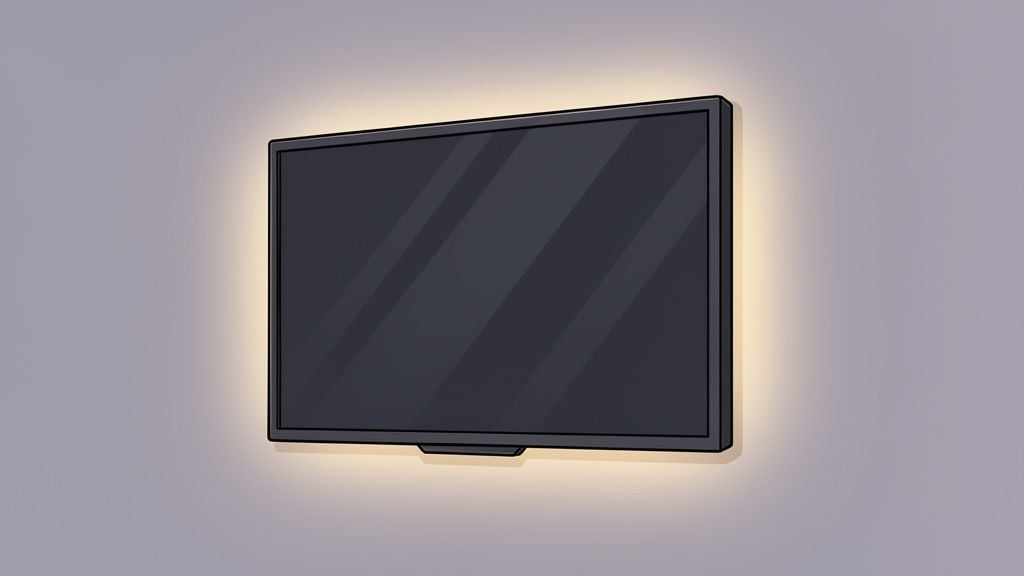
LED backlighting behind the TV adds a gentle glow and can make evening viewing feel easier on the eyes. Wall sconces or a picture light above the setup can warm up the entire composition, especially if your room feels flat after sunset.
If you want more ideas for ambient lighting throughout the room, this article on putting your living room in the best light is worth a look.
Keep the lighting balanced
Use warm, soft light around the media zone. Harsh bulbs can bounce off the screen and fight the restful atmosphere often desired in a living room.
A few smart choices go a long way:
- Bias lighting behind the TV for a subtle halo effect
- A table lamp on the console if there is room
- Sconces flanking the wall when you want symmetry
- Nearby floor lighting to help the TV wall feel connected to the seating area
Tying It All Together With Coordinated Furniture and Decor
The TV wall should relate to the rest of the room. If it feels like a separate project, the space will still seem unfinished.
Start with the anchor piece below the screen. A media console, cabinet, or sideboard should echo the style of your larger furniture. If your room leans relaxed and coastal, choose lighter finishes and simpler silhouettes. If the space has a more refined aesthetic, richer wood tones and stronger lines may fit better.
Match the room’s visual weight
A large television needs furniture with enough presence to hold the wall visually. That does not mean bulky. It means proportional.
If the sofa is low and modern, a chunky traditional cabinet may feel out of place. If your seating is plush and classic, an ultra-thin console can look underdressed. Brand-specific strengths are helpful for guiding choices:
- Stickley often suits rooms that need timeless wood craftsmanship.
- Stressless seating works well when comfort and TV viewing are both priorities.
- Smith Brothers can help with custom comfort and upholstery scale.
- Canadel and Mavin are useful when you want finish coordination and durable craftsmanship.
- Amish furniture, Bassett, Craftmaster, American Leather, Amisco, and Palasar all fit different style and function needs depending on the room.
Repeat materials and color cues
A room feels cohesive when finishes repeat in small, quiet ways.
You might carry a wood tone from the console into a side table. You might repeat black from the TV frame in lamp bases, picture frames, or chair legs. You might pull one wallpaper or art color into pillows or an area rug.
That repetition keeps the TV wall from feeling pasted on.
Keep decor edited
You do not need many accessories. You need the right ones.
Choose decor that brings contrast in height, texture, and shape. A stack of books, a ceramic piece, a woven basket, and one organic element often do more than a dozen small accents.
Central Florida rooms usually feel best when they breathe a little. Leave space between objects. Let sunlight move through the room. The TV wall should support that ease, not crowd it.
Ready to find the perfect piece for your home? Visit the Slone Brothers Furniture showroom in Longwood, FL, and let our design experts help you get started!