
Custom Made Office Furniture: A Central Florida Guide

You measured the wall twice. The desk you liked online still sticks out too far. The filing cabinet blocks the window trim. The chair looks good in the photo, but after one afternoon your shoulders are letting you know it wasn't built for real work.
That's a common spot for people in Longwood, Lake Mary, Sanford, and across Greater Orlando. Homeowners are turning guest rooms into offices. Business owners are trying to make every square foot count. In both cases, the problem is usually the same. Standard office furniture asks you to adjust to it.
Custom made office furniture flips that around. It's built around your room, your work habits, your storage needs, and your style. That can mean a desk sized for a tight alcove, a credenza that lines up with existing trim, or a full office setup planned around how your team works.
Your Search for the Perfect Office Ends Here
A lot of people start the same way. They visit a few big-box stores around Orlando, scroll through page after page online, save screenshots, compare dimensions, and try to convince themselves that “close enough” will work.
Sometimes it does. Often, it doesn't.
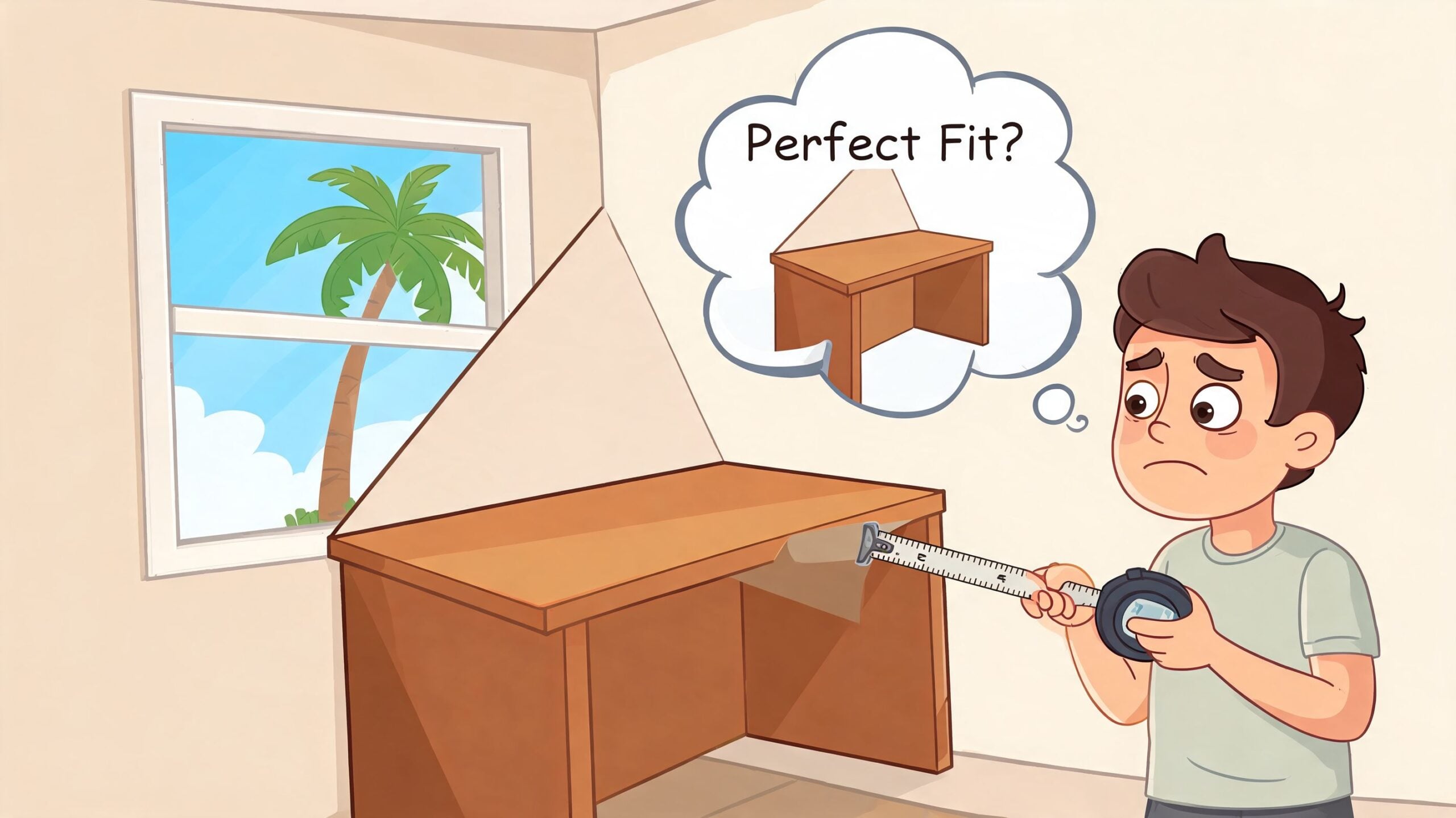
A Central Florida homeowner might need a desk shallow enough for a spare bedroom but wide enough for two monitors. A small business may need storage that fits an odd corner without wasting valuable floor space. A remote worker may want a setup that feels polished on video calls, not like leftover furniture borrowed from another room.
That's where custom made office furniture starts making sense. It isn't only for large corporate projects or formal executive suites. It's also a practical answer for everyday spaces that need better function.
Why more people are choosing custom
Demand for personalized furniture has grown with hybrid work and home office use. The custom furniture market, including office solutions, is valued at USD 38.78 billion in 2026 and projected to reach USD 66.49 billion by 2033, with the residential segment expected to hold a 52.5% market share in 2026 as more people optimize living spaces for work, according to custom furniture market projections from Coherent Market Insights.
That lines up with what many families and business owners already feel. They don't want furniture that almost fits. They want furniture that works.
Practical rule: If you're already compromising on size, storage, comfort, and appearance, custom usually stops being a luxury and starts becoming a planning decision.
If organization is part of your challenge, a resource like this Blu Monaco office organization guide can help you think through the small add-ons that make a desk work better day to day.
Comfort matters too. Before you finalize a desk, it helps to understand how seating affects the whole setup. Our guide to ergonomic office chairs can help you avoid building a beautiful office around the wrong chair.
We've served Central Florida since 1980, and one thing hasn't changed. When furniture fits your life properly, the room gets easier to use every single day.
What Exactly Is Custom Made Office Furniture
“Custom” gets used loosely in furniture. That's why many shoppers feel confused before they even start.
Some pieces are made-to-order. Some are semi-custom. A few are fully custom. Those are not the same thing.
Made-to-order, semi-custom, and fully custom
It is similar to ordering a meal.
A made-to-order piece is like choosing from the menu with a few options. You pick the finish, maybe the hardware, maybe the size from a short list. Many customizable collections work this way.
A semi-custom piece gives you more room to adjust. You may alter dimensions, swap features, or combine elements from a broader program. That works well when you like the basic design but need a better fit.
A fully custom piece is different. It starts with your space and your requirements, then gets built from the ground up around them.
A desk with a standard top and three stain choices is customizable. A desk designed to fit a wall between two windows, hide cords, match existing cabinetry, and support your exact workflow is custom made office furniture.
What can actually be customized
The answer is more than color.
Custom office furniture can include:
- Dimensions that fit the room. Width, depth, height, knee space, and storage proportions.
- Material choices. Solid wood, metal, select veneers, or durable surfaces chosen for the look and use of the piece.
- Function built into the design. File drawers, printer storage, keyboard trays, cable routing, modesty panels, and standing-height options.
- Layout choices. L-shaped desks, U-shaped workstations, wall units, shared work tables, and corner solutions.
- Style details. Edge profiles, leg shapes, drawer fronts, hardware, stain colors, and finish sheen.
That applies whether you're furnishing a home office in Lake Mary or planning commercial furnishings for a business near downtown Orlando.
Where brands fit in
Some brands offer strong customization within a structured collection. For example, lines from Canadel can give you finish and configuration flexibility, while other programs focus on comfort or upholstery choices in adjacent office seating. That's a great fit when you want guidance and a polished result without designing every inch from scratch.
If you're curious how the process works in real life, our overview of getting started with custom order furniture walks through the early decisions in plain language.
The key is knowing what problem you're solving. If your issue is mostly style and finish, a customizable program may be perfect. If your issue is size, workflow, and exact fit, fully custom is often the better route.
The Long-Term Value of a Custom Solution
The strongest argument for custom isn't that it looks special. It's that it keeps solving the problem long after the purchase is over.
A desk that fits the room correctly clears walkways. Storage placed where you use it saves steps. Proper working height reduces the little posture adjustments that wear on you over time. Those things matter more on day one hundred than they do on day one.
Better fit changes how the room works
In Central Florida homes, office spaces often end up in rooms that weren't originally planned as offices. That may mean a bonus room, a guest room, a loft, or a section of the living area.
Generic furniture leaves dead zones. Custom furniture can use those zones.
A shallow return in a narrow room, a built-in storage wall under a window, or a desk designed around a door swing can make the space feel calm instead of cramped.
Ergonomics are easier when the furniture matches the user
Many individuals think about office comfort only after they're uncomfortable.
A custom setup lets you plan around your body and your daily tasks. If you write by hand, your work surface needs differ from someone using dual monitors all day. If you meet with clients in your office, guest seating and tabletop height matter. If you need ADA-compliant adjustability, specifications matter even more.
Good office furniture should support the way you work. You shouldn't spend years adapting to the furniture instead.
Durability often changes the real cost
Value becomes concrete, according to private office furnishing standards from the University of New Mexico reference document, as custom-made office furniture often lasts more than 20 to 30 years because it uses solid hardwoods kiln-dried to prevent warping and joinery that can resist forces up to 1,500 lbs. That same source notes custom construction can reduce replacement costs by 40% to 60% over a decade compared with mass-produced particleboard pieces that often fail in 5 to 7 years.
That difference matters in Florida, where humidity can punish lower-grade materials.
If you've ever had veneer lift, drawer bottoms sag, or a desk top swell near an edge, you already know that a lower opening price doesn't always mean lower cost over time. Our article on why furniture can cost more than expected breaks down the craftsmanship and material side of that equation.
For many buyers, custom becomes easier to justify once they stop comparing sticker prices and start comparing years of use.
Exploring Materials and American Craftsmanship
A custom desk can look beautiful on day one and still be the wrong choice for a Central Florida office.
The full test comes later. It shows up after a wet summer, months of daily drawer use, and long workdays with laptops, cords, coffee cups, and paperwork all sharing the same surface. Materials and construction decide whether the piece keeps doing its job or starts showing stress in the places you use most.
What to watch for in Florida homes and offices
Central Florida puts furniture through a different kind of trial than a dry climate does. Humidity changes how wood behaves, and strong sun through office windows can be just as hard on finishes over time.
That does not mean wood is a poor choice. It means the wood has to be selected, dried, assembled, and finished with care. A well-built hardwood desk works like a properly framed house. If the structure is sound, seasonal conditions are much easier to handle. If shortcuts were taken early, problems tend to show up fast through swelling, sticking drawers, separated joints, or lifted veneer.
Metal, laminate, and veneer each have a place too. Metal works well for modern bases and shared workstations that need stability and simple upkeep. High-quality laminate makes sense for busy offices where easy cleaning matters every day. Veneer over a quality core can give you a refined wood appearance while keeping the project within a more controlled budget.
The best material is the one that fits the room, the workload, and the level of wear you expect.
Comparing common custom office furniture materials
| Material | Best For | Durability | Florida Climate Suitability |
|---|---|---|---|
| Solid hardwood | Executive desks, bookcases, credenzas, statement home offices | High when properly built and finished | Strong choice when well-dried and well-finished |
| Metal | Desk bases, modern frames, commercial workstations | High | Strong choice for stability and low maintenance |
| High-quality laminate | Busy shared offices, practical work surfaces, easy-clean settings | Good for daily wear | Good choice for consistency and easy upkeep |
| Wood veneer over quality core | Refined commercial looks with controlled cost | Varies by construction quality | Works well when the core and finish are well made |
Craftsmanship shows up where buyers often forget to look
Good craftsmanship is easiest to spot in the parts that are not trying to get attention.
Open a drawer. Run your hand under the top. Look at the back panel. Check whether the finish is even on the edges and whether the grain pattern was chosen with intention instead of speed. Those small checks tell you more than a polished showroom photo ever will.
Amish-crafted and American-made furniture often stands apart here because the builder pays attention to joinery, wood movement, sanding, finish work, and hardware selection. Brands such as Mavin and Amish are known for that tradition. The goal is furniture that performs for years, not furniture that only looks good from across the room.
A few signs usually point to stronger construction:
- Solid joinery instead of lightly fastened panels
- Smooth drawer movement without wobble or side-to-side racking
- Even finish work on tops, edges, and inside-facing surfaces
- Careful grain matching on visible wood areas
- Hardware with weight and consistency in daily use
Why American-made matters in a custom project
American-made furniture is not just about pride of origin. It changes the buying process in practical ways.
If you are ordering a desk, wall unit, or conference piece for a Central Florida office, local and domestic production usually makes sample review, finish approval, revisions, and follow-up communication much easier. That matters when you are trying to match existing wood tones, fit an unusual room, or make sure a piece is built for Florida conditions instead of a generic national template.
For many families and business owners, that clarity is part of the value. You are closer to the people making the piece, and questions are easier to answer before the furniture reaches your door. If you want a broader look at that idea, our article on why American-made furniture is a smart investment for your Central Florida home explains the long-term case in more detail.
Our Transparent Custom Order Process
You finally decide to replace the desk that never fit the room quite right. Then a new question shows up right away. What happens after you say yes to a custom piece?
For many Central Florida homeowners and business owners, that is the part that feels fuzzy. A good custom process should clear that up early. You should know who measures, how choices are approved, what can change the price, and when the piece is expected to arrive.
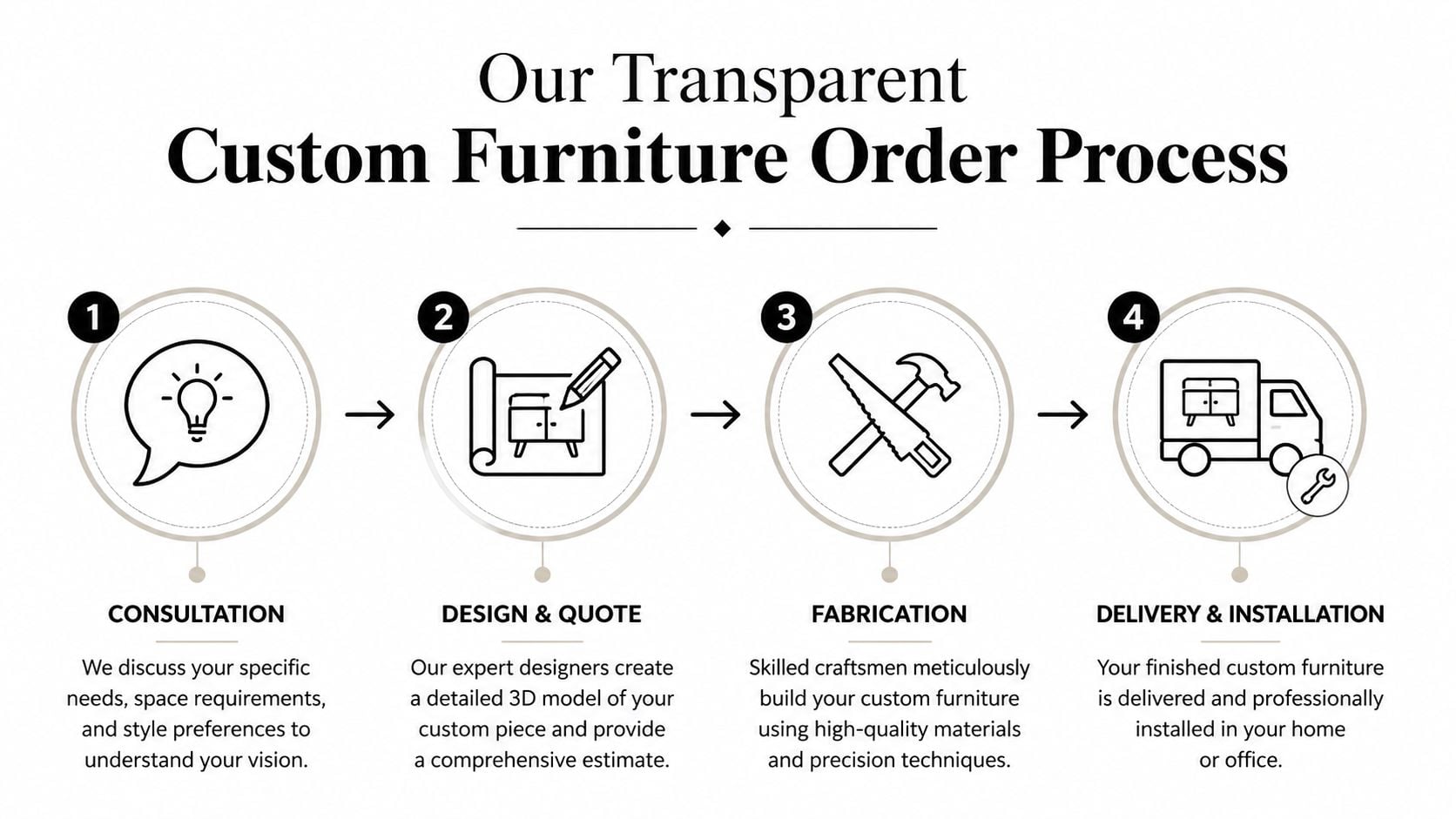
Step 1 starts with the way you actually use the room
The first meeting is part discovery, part problem-solving.
A seasoned designer will usually ask about daily habits before discussing style. Do you spread out paperwork? Need a printer hidden but easy to reach? Share the workspace with a spouse or team member? Want a cleaner backdrop for video calls? In a commercial office, the conversation often includes guest seating, traffic flow, wire access, and how multiple people use the same work area.
You do not need polished plans. A few phone photos, rough room measurements, and saved inspiration images are usually enough to begin. If you are still sorting out the room itself, this guide on planning a home office layout that works in real life can help you gather the right information before the first appointment.
Step 2 turns your ideas into a buildable design
This is the point where the project becomes concrete.
Drawings, finish samples, and measured layouts help you see whether the desk is too deep, whether the return blocks a walkway, or whether the storage belongs on the left instead of the right. It works a lot like reviewing a set of house plans before construction starts. Small corrections on paper are far easier than changes after the piece is built.
At this stage, the plan usually covers:
- Exact dimensions for the room, door swings, chair clearance, and equipment
- Materials and finish choices that suit your style and Florida conditions
- Function details such as drawers, shelving, file storage, cable management, and power access
For some business clients comparing office setup options, it also helps to understand what workplace packages commonly include. Premium features for BPO startups offers a useful example of how operational needs shape furniture and workspace decisions.
Step 3 gives you pricing that makes sense
A custom quote should read clearly enough that you can explain it back to someone else.
That means the major cost drivers are spelled out in plain language. Size matters. Wood species matters. Finish work, storage complexity, hardware selections, delivery conditions, and installation needs matter too. If a revision after approval would add time or cost, that should be discussed before production begins, not after.
One local example is the custom-order program at Slone Brothers Furniture, where clients work through materials, finishes, and configurations with an in-house design team for home and office projects.
Ask two simple questions before approving any order. What is included in this price? What changes would affect the final total?
Step 4 moves from approved plan to final placement
Once the design is signed off, the piece goes into production according to the agreed measurements and specifications. That is one of the biggest differences between custom and stock furniture. The furniture is built for your room, instead of asking your room to adjust to a standard size.
Delivery finishes the job, but it is not a minor detail. A large desk, wall unit, or conference table still has to get through the entry, sit level on the floor, clear the baseboards, and land in the exact position planned weeks earlier. In Central Florida, that practical side matters just as much as appearance, especially in homes with tight hallways, upstairs offices, or mixed-use rooms that need every inch to count.
The best custom projects feel calm because the steps are documented, the measurements are confirmed, and the communication stays clear from first sketch to final delivery.
Tips for Planning Your Custom Office
The best custom office projects usually start before anyone chooses a stain color. They start with a little homework.
You don't need formal design training. You just need to know how the room will be used, what frustrates you now, and what needs to work better.
Start with the body, not the desk style
A desk can be gorgeous and still be wrong.
Think first about your seated posture, elbow height, screen placement, and how long you stay at the workstation. If you switch between laptop work, paperwork, and video meetings, your layout should support all three without constant rearranging.
A useful starting point is to sketch your daily routine:
- Primary task. Typing, writing, meetings, design work, or administration
- Main equipment. Laptop, dual monitors, printer, files, headset, charging dock
- Comfort concerns. Back support, wrist angle, legroom, glare, or reach distance
If you want a more complete planning checklist for residential workspaces, our guide on how to design a home office will help you organize your ideas.
Measure the whole room, not just the wall
People often measure the desk location and forget everything around it.
Measure windows, baseboards, outlet placement, door swings, and walking paths. Think about whether drawers can open fully. Check whether a chair can move back comfortably. In a business setting, also account for guest seating and shared circulation.
For companies building out a practical office from the ground up, outside planning resources can be useful too. This overview of premium features for BPO startups is a helpful example of thinking beyond desks alone and considering how office features support daily operations.
Make a needs list before you choose finishes
Style is important. Function comes first.
Write down what the office must include and what would be nice to have. That sounds simple, but it prevents expensive indecision later.
A strong list usually covers:
- Storage needs. Paper files, office supplies, equipment, display items
- Technology needs. Cord control, charging access, monitor support
- Flexibility needs. Space to grow, reconfigure, or add seating later
- Visual goals. Warm wood tones, clean contemporary lines, or a look that matches the rest of the home
If you can name the problem in one sentence, the furniture plan gets much easier. “I need one desk that fits this wall and hides all my cords” is a strong starting brief.
In Central Florida, the smartest office plans balance appearance, comfort, and durability. When those three line up, the finished room feels settled. It doesn't feel temporary.
Ready to find the perfect piece for your home? Visit the Slone Brothers Furniture showroom in Longwood, FL, and let our design experts help you get started!