

Fitted Bedspreads Queen: A Practical Buyer Guide


A Central Florida couple finishing a guest room can choose the right bed frame, a supportive mattress, and beautiful nightstands, then discover that the bedding still looks wrong. One spread pulls upward at the corners; another hides the furniture beneath excess fabric. For homeowners searching for fitted bedspreads queen, the core decision isn't which pattern looks best. It's how the covering works with the mattress, the bedroom furniture, and the way the room will be used.
Why the Queen Label Is Only the Starting Point
The queen label identifies a mattress footprint, not a complete fit specification. A successful fitted bedspread must also suit the mattress assembly, its corner construction, and the amount of coverage the homeowner wants.
Consider a hypothetical Lake Mary couple comparing a softly draping floral spread with a more structured blue design. Both packages say queen, yet neither label alone explains how the covering will behave on their guest bed.

What the size label actually establishes
A standard U.S. queen mattress measures 60 inches wide by 80 inches long, but finished bedding dimensions can vary by manufacturer, as explained in this mattress size and dimensions guide. That distinction separates the size of the sleeping surface from the size of the textile covering it.
The modern queen format was introduced in 1958, establishing a middle position between full and king, according to this history of queen bed dimensions. Standardization gave bedding manufacturers a common starting footprint, not a universal answer for every mattress configuration.
- Mattress depth: The covering must accommodate the actual sleeping surface, not an assumed profile.
- Construction: Elasticized pockets and fitted corners aren't interchangeable descriptions.
- Coverage: A neatly exposed bed rail requires a different finish from a concealed foundation.
Practical rule: Queen identifies the starting size. The product specifications determine whether the spread belongs on a particular bed.
Separate layers deserve separate decisions, too. Homeowners considering an optional blanket can find pure cashmere blankets through Cashmere Boutique while keeping blanket selection distinct from the fitted outer covering.
For the hypothetical couple, the better purchase isn't automatically the softer fabric or the sharper silhouette. It's the spread whose specifications match the bed they own.
How to Measure a Queen Mattress Before You Shop
Accurate measurements begin with the bed assembled exactly as it will be used. The worksheet should distinguish the mattress assembly, the desired decorative drop, and any fabric needed to secure the covering underneath.
A flexible tape measure and a simple sketch are more useful than a photograph alone. Measurements should be taken without compressing the mattress edges or leaving out a protector that will remain in place.
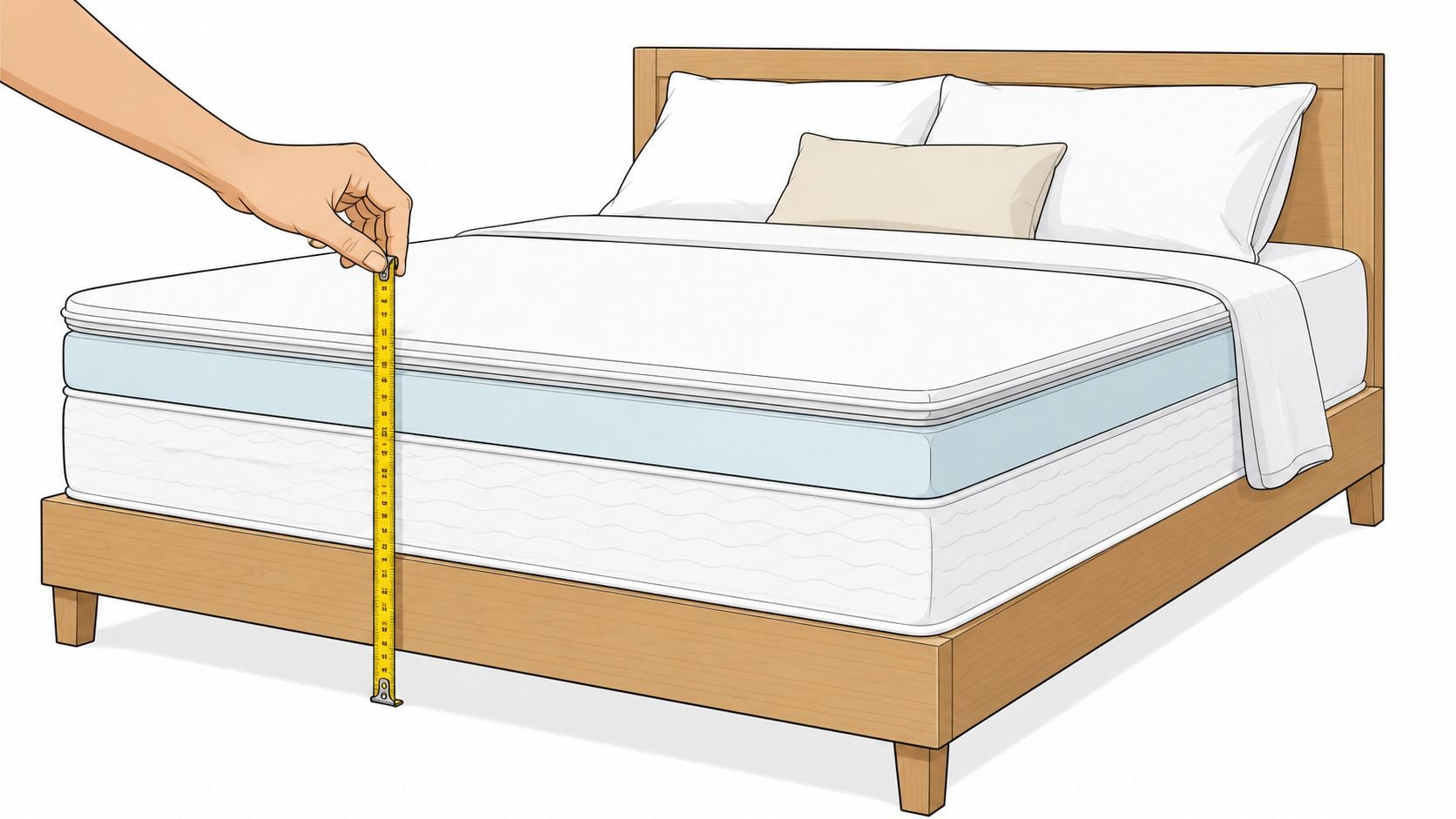
Build a usable measurement worksheet
- Sleeping surface: Record width and length across the mattress.
- Complete assembly: Measure from the mattress's bottom edge to the top of the installed topper, pad, and protector.
- Desired endpoint: Mark where the finished spread should stop at each side and the foot.
- Bed construction: Note projecting rails, a footboard, an adjustable base, and any planned pillow tuck.
Mattress depth isn't total bed height. A measurement from the floor includes the frame and foundation, which matters for a floor-reaching finish but doesn't describe the fitted pocket.
The practical equations are finished width = mattress width + left drop + right drop and finished length = mattress length + foot drop. A coverlet may use an 8–10-inch drop, while box-spring coverage commonly needs 14–18 inches; a 60-inch mattress with 16-inch side drops requires 92 inches of finished width, and adding 3 inches of depth adds 6 inches across both sides, as illustrated in this fitted bedspread sizing explanation.
Separate pocket depth from decorative drop
Fitted-sheet terminology offers a useful reference: standard pockets are approximately 7–12 inches, deep pockets 13–17 inches, and extra-deep pockets 18–24 inches, according to this pocket-depth selection guide. These categories shouldn't be treated as universal bedspread specifications.
Another fitted bedding sizing guide recommends pockets approximately 1–3 inches deeper than the mattress so fabric can grip underneath. For a fitted bedspread, the manufacturer's intended mattress-depth range should govern the final choice.
A homeowner still choosing the bed itself can consult this guide to selecting a bed and mattress size before ordering textiles. For a separate quilted layer, On Pins & Needles Quilting Co.’s discussion of queen quilt sizing for minky backing provides additional project context, not a substitute for fitted-pocket measurements.
Choosing Materials That Suit a Florida Bedroom
Florida bedding should be selected for its intended warmth, airflow, and maintenance requirements, not fiber name alone. The most useful comparison considers the entire construction, including the face fabric, backing, fill, and finish.
Summer sleep guidance recommends breathable bedding and moisture-managing materials to help limit overheating, as discussed in Teladoc Health's summer sleep advice. For an Orlando bedroom, air-conditioning preferences and the sleeper's comfort should guide the material discussion.

Compare complete constructions, not labels
| Material family | What deserves attention | Useful showroom question |
|---|---|---|
| Cotton | Weave, weight, finish, and care requirements | Does the finished fabric feel comfortable for overnight contact? |
| Linen | Texture, drape, and the desired degree of formality | Does its surface suit the homeowner's preference for relaxed or crisp bedding? |
| Quilted cotton | Face fabric, backing, fill, and stitching | Is the layered construction appropriate for the room's temperature? |
| Synthetic blends | Fiber proportions, backing, and claimed performance | What supports any cooling or moisture-management claim? |
Cotton is a sensible starting point for a washable bedding discussion, but a tightly finished cotton spread shouldn't be judged by fiber content alone. The homeowner should handle the finished sample, examine its reverse side, and read the complete care label.
Linen deserves consideration when its texture supports the room's design. Rather than assuming every linen product will soften or launder identically, a consultant should check the particular weave, finish, and manufacturer's instructions.
Quilted cotton calls for closer inspection of the interior construction. A cotton face doesn't explain the filling beneath it, and decorative stitching doesn't establish whether the finished cover will feel right in a heavily air-conditioned Winter Park bedroom.
Synthetic blends require the same scrutiny. Neither a soft hand nor a cooling label establishes performance on its own; the buyer should ask what the construction is intended to do and whether supporting specifications are available.
Match the textile to the room
A useful consultation considers whether the bedroom stays cool overnight, whether guests prefer adjustable layers, and how much texture the homeowner enjoys. The Lewis and Sheron bedding guide offers additional bedding-selection context without replacing a hands-on fabric assessment.
For seasonal planning, this guidance on adjusting bedding and the mattress setup as seasons change helps connect textile choices to the room's broader comfort plan.
Decorative Cover or Nightly Sleep Layer
A decorative cover finishes the room when the bed isn't occupied. A nightly sleep layer must also feel comfortable during use and suit the household's laundering routine.
These are different jobs, even when the same product could perform either one. A Sanford guest room may benefit from an outer spread that guests remove, while a primary bedroom may call for a covering that stays on throughout the night.
Matching Fitted Bedspread Construction to Its Role
| Priority | Decorative Daytime Cover | Nightly Sleep Layer |
|---|---|---|
| Main purpose | A composed, finished appearance | Comfortable overnight coverage |
| Material weight | Selected primarily for the intended silhouette | Selected around sleeper comfort |
| Surface details | Texture and ornament can take priority | Skin-contact comfort deserves close attention |
| Edge construction | Tailored appearance during bed-making | Secure fit without restrictive tension |
| Care planning | Based on handling, exposure, and household use | Compatible with the expected wash routine |
| Layering | Coordinates with the bedding underneath | Works with sheets and any additional blanket |
A decorative spread can carry a more architectural shape because it doesn't have to satisfy every overnight preference. That freedom allows the homeowner to choose a pronounced texture or a stronger visual pattern without making it the main sleep surface.
A nightly covering needs a more practical assessment. Raised stitching, stiff edging, and bulky corners should be handled as they would be during use, not evaluated only from across the showroom.
A beautiful daytime bed and a comfortable nighttime bed don't have to depend on the same layer.
Let the household determine the routine
There's no universal washing schedule for a decorative spread. Pets, direct skin contact, visiting children, and how the cover is stored all affect the appropriate care routine.
A vacation property presents another decision: whoever prepares the room must be able to identify the correct orientation, remake the corners, and follow the care instructions consistently. An elaborate arrangement may be attractive but unsuitable if maintaining it becomes difficult.
For a primary suite, the homeowner's preferred evening routine matters just as much. A covering that must be removed and stored every night should have an intentional storage place rather than becoming a permanent pile on a chair.
The principles in designing a relaxing bedroom help connect that daily routine with lighting, furniture placement, and visual calm.
Care and Maintenance That Protects the Investment
The right care plan preserves both the textile and its fitted shape. Before purchase, the homeowner should understand how the finished covering is expected to behave after cleaning, not merely how it looks when new.
The ASTM textile standards directory identifies D4037 for woven, knitted, or flocked bedspread fabrics and D4721 for evaluating machine-washable and dry-cleanable bedcoverings and accessories. These references provide a useful framework for questions, but their existence doesn't mean a particular product has been tested.
Ask about performance before purchase
- Dimensional stability: Are post-cleaning dimensions or shrinkage expectations available?
- Seam and edge integrity: Are fitted corners, bindings, and attachment points neatly secured?
- Fabric strength: Is the construction appropriate for the intended handling and cleaning?
- Surface wear: What should the owner expect from the finish during regular use?
For fitted bedding, dimensional change has a practical consequence: the original match between the textile and the mattress can be lost. A beautiful fabric isn't sufficient if the finished cover can't retain a usable shape under its specified care routine.
Use the label as the controlling instruction
A published cotton bedding care guide recommends washing at 30°C with similar colors, line-drying or tumble-drying at a maximum of 60°C, ironing at medium heat, and avoiding bleach and dry-cleaning; it also warns that bleach can weaken fibers and discolor fabric, while washing darker fabrics above 30°C can reduce vibrancy.
That schedule is a reference for basic cotton bedding, not permission to override a bedspread's sewn-in label. Quilting, blends, elastic, decorative trim, and finishes may require different treatment.
Care checkpoint: If the required cleaning method doesn't fit the household, a different textile is usually a better investment.
Before the first cleaning, the owner should retain the product specifications and record the finished fit. At delivery, a practical inspection includes:
- Corners: Confirm that shaping aligns with the mattress without distortion.
- Retention: Check that elastic or other fastenings hold without excessive tension.
- Dimensions: Compare the delivered covering with the approved worksheet.
- Finish: Examine seams, edges, and visible surfaces before removing labels.
The discussion of how often bedding should be changed can help frame a household routine, while the individual bedspread's care requirements remain decisive.
Styling the Bedspread With the Rest of the Bedroom
A fitted bedspread should reinforce the proportions and character of the bedroom furniture. Its drop, texture, and color need to be considered alongside the headboard, exposed rails, nightstands, and existing finishes.
A fitted bedspread can be an effective choice for a modern platform bed when the homeowner wants the frame to remain visible. A longer silhouette may better support a traditional composition, provided it doesn't interfere with the footboard or conceal details selected for their craftsmanship.
Choose what the textile should reveal
The first design question isn't color. It's which parts of the bed should remain visible.
- Headboard: Leave enough visual space for its shape, upholstery, or woodwork to read clearly.
- Platform and rails: Decide whether these are features to display or elements to conceal.
- Nightstands: Consider whether substantial furniture calls for a quieter textile or a stronger balancing pattern.
- Footboard: Check the actual clearance rather than assuming fabric will fall freely behind it.
In a coastal Altamonte Springs bedroom, a restrained palette and tactile surface can support an airy composition. A transitional room might pair a fitted spread with an upholstered headboard, while a modern farmhouse scheme could use a simple pattern against a clearly expressed wood frame.
These are design options, not rules attached to a postal code. Existing furniture and the homeowner's preferences should lead.
Finish the composition without overcrowding it
Pillows and shams should support the headboard rather than obscure it. Repeating a color from artwork or an accent chair can connect the bed to the room without making every textile identical.
This guide to accessorizing a thoughtfully designed bed provides a useful starting point for those finishing decisions. Custom-order discussions can then address available fabrics, finishes, and configurations, with any textile dimension changes confirmed separately.
A coordinated bedroom isn't a collection of individually attractive purchases. It's a room in which the furniture, bedding, and daily routine work together.
Questions Buyers Ask After the Main Decision
The remaining questions usually concern construction, troubleshooting, and purchase terms. Written specifications are more dependable than assumptions based on a product photograph.
How can a buyer confirm that a spread is genuinely fitted?
The seller should identify the retention method and explain whether the design grips beneath the mattress or has shaped corners. Either construction may suit a room, but they shouldn't be represented as equivalent.
What if the corners pull upward after washing?
The owner should compare the current dimensions with the original record and review the cleaning method used. Stretching the fabric harder isn't a reliable remedy; photographs and measurements give the seller a clearer basis for assessing the problem.
Which return terms deserve attention?
Before ordering, the buyer should confirm:
- Approval conditions: Whether samples or measurements require written sign-off.
- Return eligibility: Whether opening, laundering, or altering the item affects eligibility.
- Custom-order terms: Which changes become final and how discrepancies are handled.
Can a custom order solve an unusual fit?
Possibly, but customization shouldn't be assumed to include every requested dimension or construction change. The order should specify the approved fabric, color, finished measurements, corner treatment, and care requirements before production begins.
Visit the Longwood Showroom to See the Options in Person
A showroom consultation connects the textile decision with the rest of the bedroom project. Mattress comfort, furniture proportions, fabric selection, and practical maintenance can be considered together rather than purchased in isolation.
For homeowners traveling from Orlando, Lake Mary, Sanford, or Winter Park, a productive visit starts with the measurement worksheet, room photographs, and any existing finish samples. Those details give an experienced design consultant something concrete to work from.
Bring the full bedroom project into the conversation
- Design support: Complimentary in-home design services can help coordinate the room.
- Customization: The custom-order program provides a basis for discussing available materials, finishes, and configurations.
- Purchase planning: The Low Price Promise and reliable home delivery can be discussed alongside the proposed furnishings.
The family-owned Longwood showroom emphasizes human guidance and an enduring furnishing plan, not a rushed transaction. A face-to-face conversation also gives the homeowner an opportunity to clarify which bedding options are available, which details can be customized, and how the completed bedroom will come together.
Slone Brothers Furniture offers bedroom furniture, mattresses, custom décor guidance, and complimentary design services to help coordinate a fitted bedspread with the complete room. Homeowners planning a more comfortable, considered bedroom are invited to visit Slone Brothers Furniture in Longwood, FL, with measurements and room photographs for a face-to-face consultation with an experienced design consultant.


