
How to Choose Decorative Pillow Covers 24×24


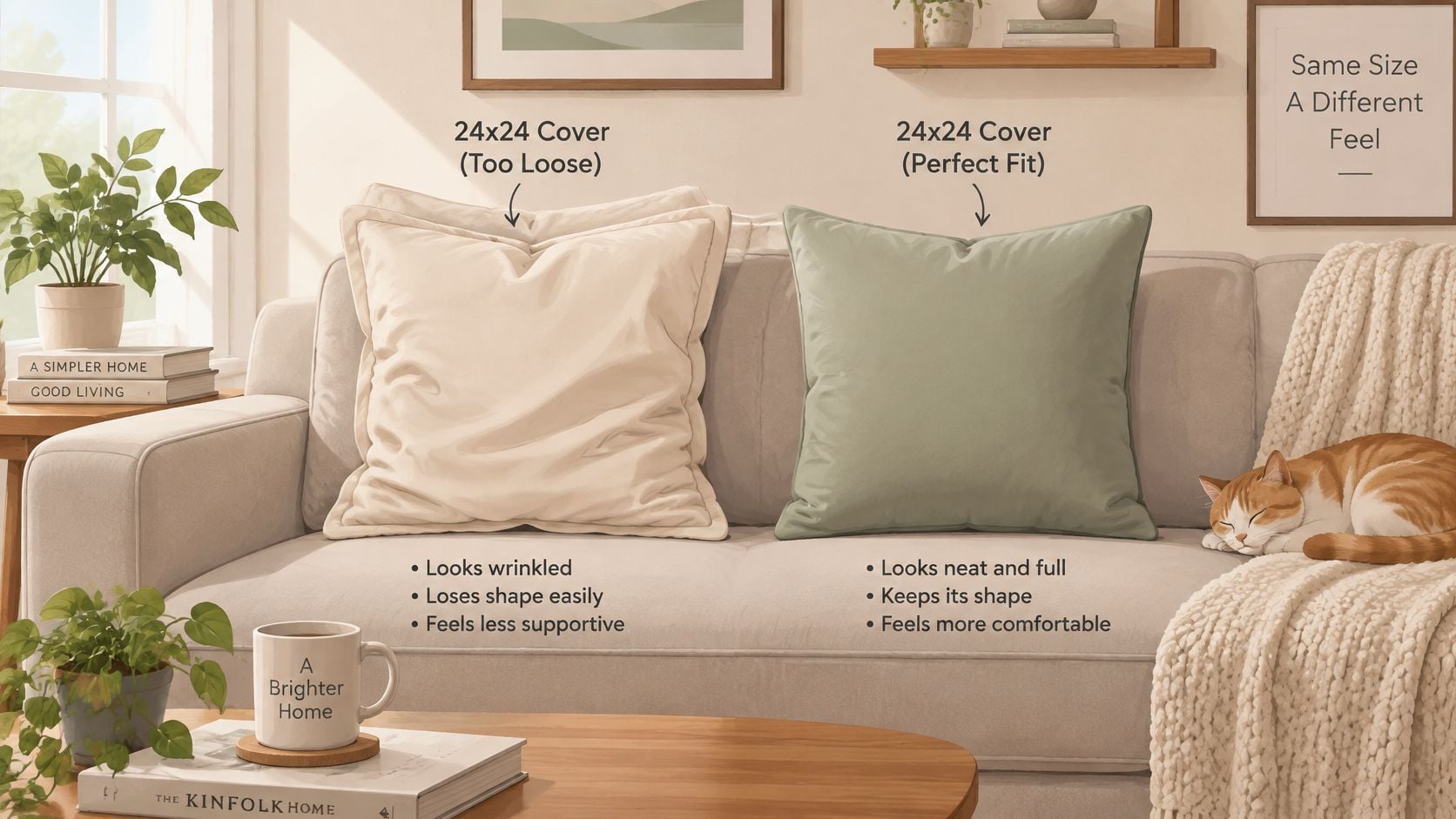
A homeowner in Lake Mary finds two beautiful covers online, orders both, and discovers that one looks plump and fitted on the sectional while the other sags at the corners and pulls at the zipper. Both labels read the same size. That mismatch is exactly why decorative pillow covers 24×24 deserve more attention than a quick color choice. Fit, fill, fabric, and furniture scale decide whether the finished pillow looks intentional or improvised.
Why 24×24 Covers Need a Careful Fit
A Longwood homeowner recently compared two attractive covers for a deep sofa. Both were labeled 24×24, both photographed beautifully, and both promised the same generous scale. Once filled, one sat upright with full corners, while the other looked strained across the face and left the pattern slightly distorted. The difference wasn't taste. It was construction.
A 24×24 decorative pillow cover is designed for a large square accent pillow measuring approximately 24 inches by 24 inches, or 61 by 61 centimeters, with a face area of 576 square inches. That's substantially larger than common 18×18-inch or 20×20-inch accents, which is why the format works so well on sectional sofas, deep sofas, upholstered beds, benches, and oversized lounge chairs. One pillow can fill broad furniture proportions without a cluster of smaller cushions competing for space.
The Label Is Only the Starting Point
The nominal size doesn't tell the whole story. Finished seam-to-seam dimensions, interior capacity, fabric thickness, closure width, and corner construction all affect how much insert the cover can hold. Thick piping or bulky upholstery cloth can reduce usable space even when the outside measurement looks correct. A fuller insert creates a rounded appearance, while a flatter insert produces a relaxed look, and neither result is visible from a product photo alone.
Homeowners browsing cushion cover options for sofas can compare colors and patterns easily enough. Judging loft, seam strength, and how a cover will behave after months of use is harder without handling the textile. Because the cover is removable, it can refresh a room seasonally or coordinate with custom-order furniture and American-made pieces without replacing the underlying pillow or upholstery, but only if the fit is right from the start.
A beautiful cover only succeeds when its dimensions, insert, fabric, and furniture proportions work together.
Slone Brothers Furniture has served Central Florida since 1980, and that local experience shapes a simple piece of advice. Choosing a cover and choosing an insert are related decisions, but they're not the same decision. Treat them separately, measure both, and the finished pillow will look deliberate rather than approximately right.
How to Measure Before You Choose
Accurate measuring takes a few minutes and prevents the most common disappointment with large accent pillows. The goal isn't precision for its own sake. It's knowing the cover's true capacity before money goes toward an insert that doesn't fit.
A Repeatable Measuring Routine
- Lay the empty cover flat: Measure seam to seam in both directions without stretching the fabric, since pulling the textile inflates the number and leads to an oversized insert choice.
- Check the interior, not just the face: Turn the cover partially inside out where possible and note seam allowances, piping bulk, and lining, all of which reduce usable space.
- Open the closure fully: Measure the zipper or envelope opening. A narrow opening limits how large an insert can pass through, regardless of interior room.
- Note the fabric behavior: Record whether the textile is tightly woven, loosely woven, thick, or directional, because nap and pattern repeat affect both fit and appearance.
- Compare against the furniture: Measure seat depth and back height on the sofa, bed, or chair so the pillow scale can be judged against the piece it'll decorate.
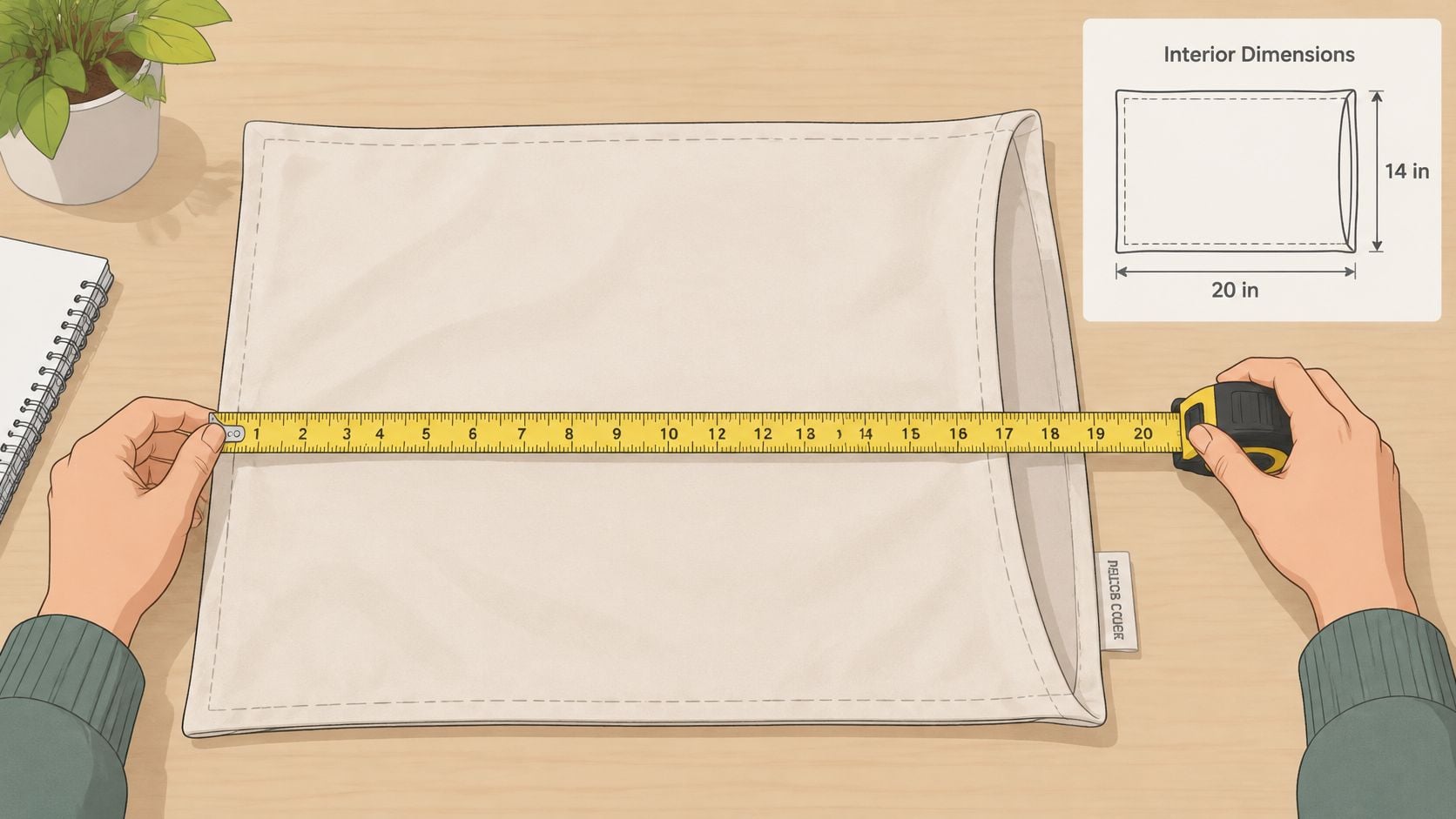
Manufacturers may round dimensions, and cotton or linen can shrink after washing, so the stated 24×24 size can mislead. Guidance on verifying finished seam-to-seam dimensions before choosing an insert makes the same point, confirm the actual measurement rather than trusting the label. For custom production, each panel is cut at the finished dimension plus twice the seam allowance, so a 24-inch finished panel with a conventional 1/2-inch allowance requires a 25×25-inch cut panel before zipper construction, based on that same sizing guidance. Homeowners ordering textiles for a custom project can review how to order fabric cut to size before committing yardage.
Pillow Scale Versus Furniture Scale
A single 24-inch pillow can look sculptural on a deep sectional corner, yet the same pillow may overwhelm a slim bench. On an upholstered bed, a balanced pair often reads more finished than one oversized square floating off center. The principles in this guide to scale and proportion in room design apply directly. Measure the furniture first, then let the pillow earn its place within those proportions.
Choose the Right Insert and Fill
The insert does the structural work. The cover provides color, texture, and pattern, but the fill decides whether corners stand up, the face stays smooth, and the pillow feels supportive or slumped when someone leans back.
Sizing Up With Judgment
A 26×26-inch insert is the practical baseline for a 24×24 cover because it adds approximately 2 inches in both dimensions, creating a full appearance without excessive stress on seams or the closure, a recommendation detailed in the insert sizing guidance for measuring actual cover dimensions. A 27×27 option suits thicker upholstery-style fabrics when a firmer profile is wanted. A 28×28 insert should be reserved for an intentionally overfilled look, and only when the fabric is tightly woven and the zipper opening is sufficiently wide.
Bigger isn't always better. Forcing an oversized insert can distort corners, warp pattern alignment, and damage zipper seams. Tightly woven fabrics with little give, narrow openings, delicate seams, thick piping, or rigid inserts all argue against sizing up aggressively. A larger insert can improve loft while reducing durability and ease of maintenance, so the trade-off deserves honest consideration.
24×24 Cover and Insert Decision Guide
| Insert Choice | Best-Fit Use | Appearance | Key Caution |
|---|---|---|---|
| 24×24 | Soft, casual accents | Relaxed, slightly broken-in | Corners may look empty |
| 26×26 | Most sofas and beds | Full, rounded, tailored | Confirm actual cover measurement first |
| 27×27 | Thicker upholstery fabrics | Firmer, more structured | Needs a wide, sturdy closure |
| 28×28 | Deliberately overfilled styling | Very plump, high loft | Can strain seams and distort patterns |
Fill Changes Feel and Upkeep
Down feels soft and moldable, and it takes a gentle crease beautifully, but it asks for regular fluffing and careful cleaning. Down alternative offers a similar loft with simpler care, which suits busy family rooms and guest spaces. Polyester holds a firmer, springier shape and tolerates frequent use well, though lower-quality fills can clump over time. Foam gives the most structured, architectural profile, yet it doesn't soften into a relaxed slouch, and rigid foam limits how much sizing up is possible.
For a fitted sofa look, a 26×26 down-alternative insert delivers fullness without fuss. For an easy-care family room, polyester at the same size handles daily leaning and straightening. For a softer bedroom accent, down in a 24×24 or 26×26 size creates that settled, inviting profile. The right pairing depends on the room's daily reality, not on a single universal rule.
Select Fabrics for Beauty and Longevity
A decorative cover on a frequently used sofa is upholstery, and it should be judged like upholstery. Appearance matters, but weave, abrasion resistance, pilling behavior, colorfastness, and cleaning compatibility decide how the pillow looks after a year of evenings, guests, and Central Florida sunlight.
Read the Specification, Not the Label
Vague claims such as heavy duty mean little without a test method. One industry indicator places decorative cushions around 10,000 to 15,000 Martindale cycles or approximately 15,000 to 20,000 Wyzenbeek double rubs, with a pilling grade of 4 to 5 preferable where the cover receives repeated contact, according to documented fabric performance indicators for upholstery textiles. Pilling ratings generally run from 1, meaning severe pilling, to 5, meaning no visible pilling, based on those same performance indicators. These figures are benchmarks, not guarantees, because equipment, loading, weave, and interpretation vary, so results should only be compared under the same method.
The Wyzenbeek method pulls fabric taut and rubs it in warp and filling directions with cotton duck, and the Association for Contract Textiles identifies 15,000 double rubs as a guideline for low-traffic private spaces and 30,000 for high-traffic public spaces, as summarized in textile quality standards describing the Wyzenbeek abrasion method. Abrasion results don't predict a precise lifespan. Fading, snagging, seam failure, laundering, pets, and sunlight affect real-world performance separately.
Specification rule: An abrasion number without a named test method isn't useful information. Ask which method produced it.
Match the Textile to the Room
- Linen: Artisanal and relaxed, lovely in bedrooms and quiet sitting areas, but it wrinkles willingly and can shrink if washed carelessly.
- Cotton: Versatile for woven patterns and stripes, comfortable in most rooms, and worth checking for colorfastness before pairing with light upholstery.
- Velvet: Deep color and formal polish, ideal for a traditional Winter Park sitting room, though directional nap must be checked before cutting.
- Performance textiles: The sensible choice for active family rooms with children, pets, and frequent cleaning.
- Leather: Classic and traditional, pairing well with wood tones and classic upholstery, with conditioning needs that shouldn't be ignored.
Florida sunlight and humidity make color and cleaning decisions especially important, and no material is maintenance-free. Shoppers should request documented specifications, examine seam reinforcement and zipper quality in person, and review the guidance on choosing upholstery fabric for long-term performance before a custom order.
Insert and Style Your Pillow Correctly
Good materials still need careful assembly. Rushing an insert into a large cover is how zippers get strained and corners end up twisted, so a calm sequence protects both pieces.
A Careful Assembly Sequence
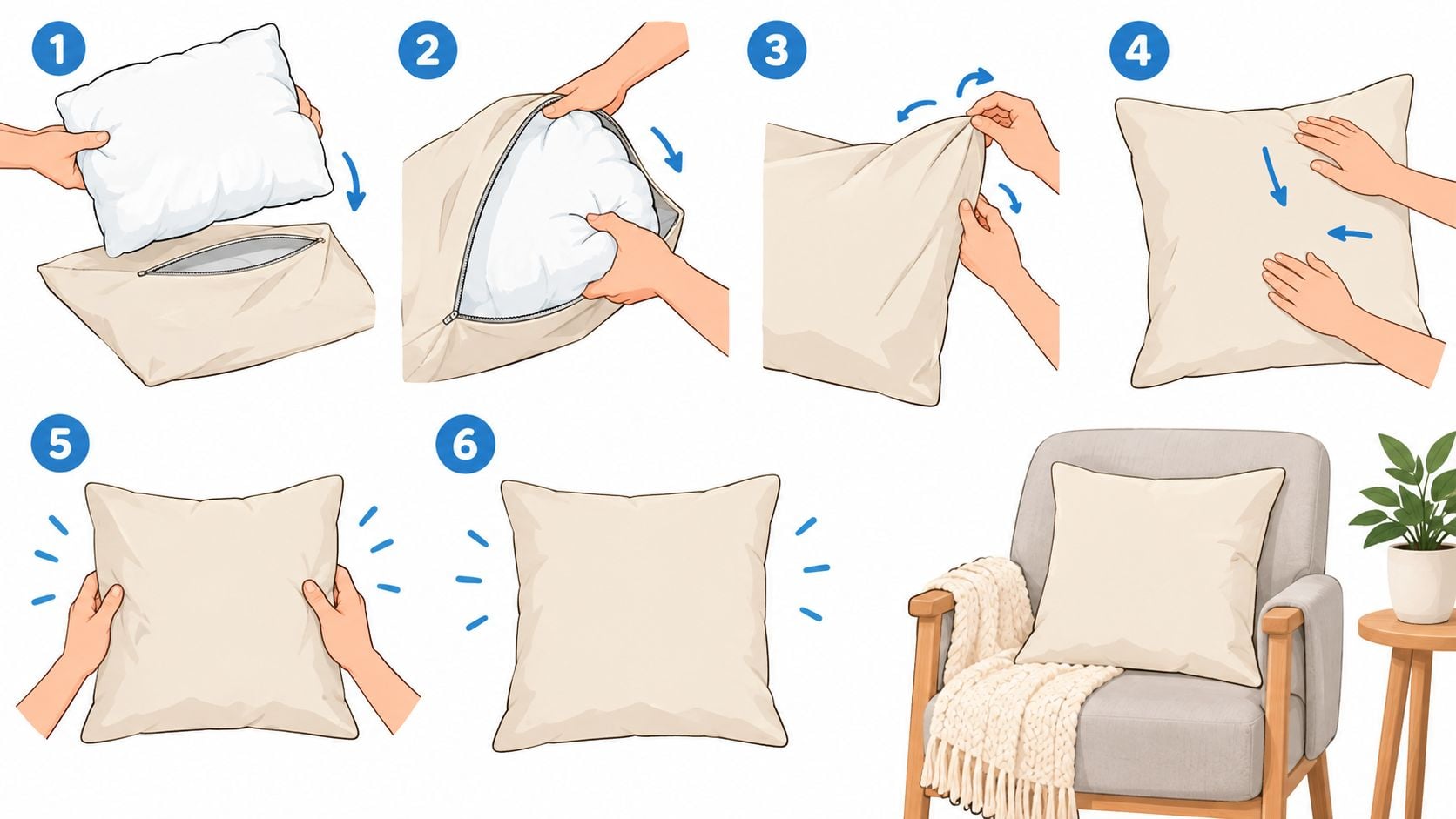
- Fluff the insert first: Shake and knead it so fill distributes evenly toward all four corners before it enters the cover.
- Fold, don't force: Compress the insert gently, guide it through the opening, and unfold it inside rather than pushing against the zipper.
- Seat each corner: Reach inside and work fill into every corner so the cover's corners and the insert's corners align.
- Close slowly: Zip while holding fabric edges together, stopping if resistance builds instead of pulling harder.
- Shape and inspect: Smooth the face or relax it deliberately, then step back and check loft, symmetry, and pattern alignment on the actual furniture.
Troubleshooting Common Fit Problems
Corners that won't fill usually mean the insert is too small or the fill has clumped toward the center, so redistribution comes before replacement. Visible zipper stress signals the opposite problem, and the insert should come down a size. A cover that looks too flat may need a loftier fill rather than a larger one, while a distorted pattern points to overfilling or a twisted insert. A lumpy result often improves after thorough fluffing, but persistent lumps suggest the fill itself has broken down.
Never force the fit. If the closure resists, change the insert, not the amount of pressure.
One 24×24 pillow reads as a bold anchor, while a balanced pair creates symmetry and calm. The layering principles in this resource on layering furniture and decor for a complete room help homeowners judge which approach suits the piece. Covers are also reversible decisions. A worn or outdated textile can often be replaced while retaining a sound insert and the coordinating furniture, provided sizing and construction remain compatible.
Style 24×24 Covers in Real Rooms
Construction decisions become visible the moment a pillow lands on furniture. Three common Central Florida rooms show how scale, color, texture, and restraint change the result.
The Deep Sectional
On a generous sectional in a Lake Mary family room, one oversized pillow anchors the corner where two seating spans meet. Placing a single 24×24 in a textured solid at that junction gives the eye a resting point, and two smaller accents placed along each arm create symmetry without crowding seat space. If the sectional upholstery is plain, the large pillow can carry the room's pattern. If the upholstery already has visual texture, the big square should stay quiet and let smaller pillows introduce contrast.
The Uphstered Bed
An upholstered bed in a Sanford primary suite rewards a different approach. A centered pair of 24×24 pillows, set upright against sleeping pillows, frames the headboard and gives a made bed its finished appearance. Layering a smaller accent in front adds depth, but piling too many shapes in front of the large pair obscures the bed's clean lines. Soft, low-contrast textiles keep the arrangement restful. A single oversized pillow on a wide bed, by contrast, tends to look lost rather than minimalist.
The Traditional Sitting Room
In a Winter Park sitting room with classic wood tones and crisp upholstery, one patterned 24×24 cover paired with a coordinated solid or textured companion strikes the right balance. The pattern should borrow a color from the rug, a lamp shade, or a piece of art so it belongs to the room rather than visiting it. The advice in this guide to working with patterns when designing a room explains how pattern scale keeps combinations calm.
- Start with permanent pieces: Upholstery, rugs, wood finishes, and architecture set the palette, and removable textiles update within it.
- Use texture for contrast: A woven solid against smooth leather, or velvet against linen, adds interest without visual noise.
- Limit competing patterns: One clear pattern per seating group usually suffices, supported by solids and textures.
Homes across Altamonte Springs and Orlando share the same principle. The room's architecture and lasting furnishings lead, and a well-fitted cover becomes the flexible layer that can evolve with seasons and taste.
Buy Locally and Care for the Long Term
A showroom visit works best with a little preparation. Homeowners who arrive with measurements and a clear sense of use get specific, useful guidance instead of educated guesses.
What to Bring to Longwood
- Room and furniture measurements: Seat depth, back height, and bed width determine whether 24×24 is the right scale at all.
- The empty cover or its measurements: Finished seam-to-seam dimensions and closure width make insert recommendations accurate.
- A visual reference: A phone photo of the sofa, rug, and wall color helps consultants coordinate textiles with confidence.
- Intended use: Daily family seating, a guest room, and a formal sitting room call for different fabrics and fills.
Experienced design consultants who aren't commission-driven order takers can compare materials side by side, inspect construction, and coordinate living room and bedroom pieces in person. The showroom's custom-order program and complimentary in-house design services support personalized choices, and availability for any specific cover is best treated as a conversation rather than an assumption. The broader case for that approach appears in this overview of the benefits of shopping locally for furniture.
Care That Preserves Fit
Removable-cover care differs from complete-pillow care, and manufacturer instructions govern both. Fiber content, washing temperature, drying method, and whether the insert itself can be washed all matter, as outlined in guidance on how laundering changes cover dimensions and insert fit. Frequent hot washing can accelerate fading, shrinkage, and seam stress, so a washable cover isn't automatically the most durable choice. After laundering, homeowners should measure again before ordering a replacement insert, because a shrunken cover can turn a comfortable fit into a strained one. Rotating pillows away from intense direct sunlight, choosing stain-conscious colors for busy rooms, and keeping tightly finished seams intact all extend usable life. Careful upkeep protects the investment in craftsmanship that made the pillow worth choosing.
Ready to invest in furniture that lasts a lifetime? Skip the online guesswork and visit Slone Brothers Furniture at the Longwood showroom, where experienced design consultants can compare fabrics, inserts, and custom-order options for decorative pillow covers 24×24 face-to-face. A short, low-pressure conversation in person can prevent sizing mistakes and help transform a house into a beautifully curated Central Florida home.