

Genuine Leather Reclining Sofa: The Complete Buying Guide


A homeowner in Orlando can spend an afternoon comparing reclining sofas and still leave the showroom unsure what “genuine leather” means. One model may feel supple and natural, another may have a more protected surface, and a third may use real leather only on the seats while matching materials cover the exterior. Add motors, footrests, adjustable headrests, and the demands of Central Florida's climate, and the purchase becomes a construction decision rather than a simple style choice.
A genuine leather reclining sofa deserves evaluation through three separate lenses: the leather specification, the mechanism's tested durability, and the room's environmental conditions. A beautiful hide won't compensate for a weak reclining system, and a well-engineered mechanism can't prevent premature leather wear if the sofa sits in direct Florida sun. The right approach gives each element equal attention.
Understanding What Genuine Leather Actually Means
A couple furnishing a new living room in Lake Mary might begin with a straightforward request: a genuine leather reclining sofa in a warm brown finish. Then the labels appear. One sofa is described as full-grain, another as top-grain, and a third just says genuine leather. The surfaces may look similar under showroom lighting, but the hide layer, finish, and panel coverage can differ substantially.
That distinction matters because “genuine leather” confirms that real hide is present, but it doesn't identify the quality of the hide or explain where it appears on the sofa. It doesn't reveal whether the material is full-grain, top-grain, corrected-grain, split leather, or bonded leather. A buyer who treats the phrase as a complete grade may pay for an expectation the specification doesn't support.
What the hide terms reveal
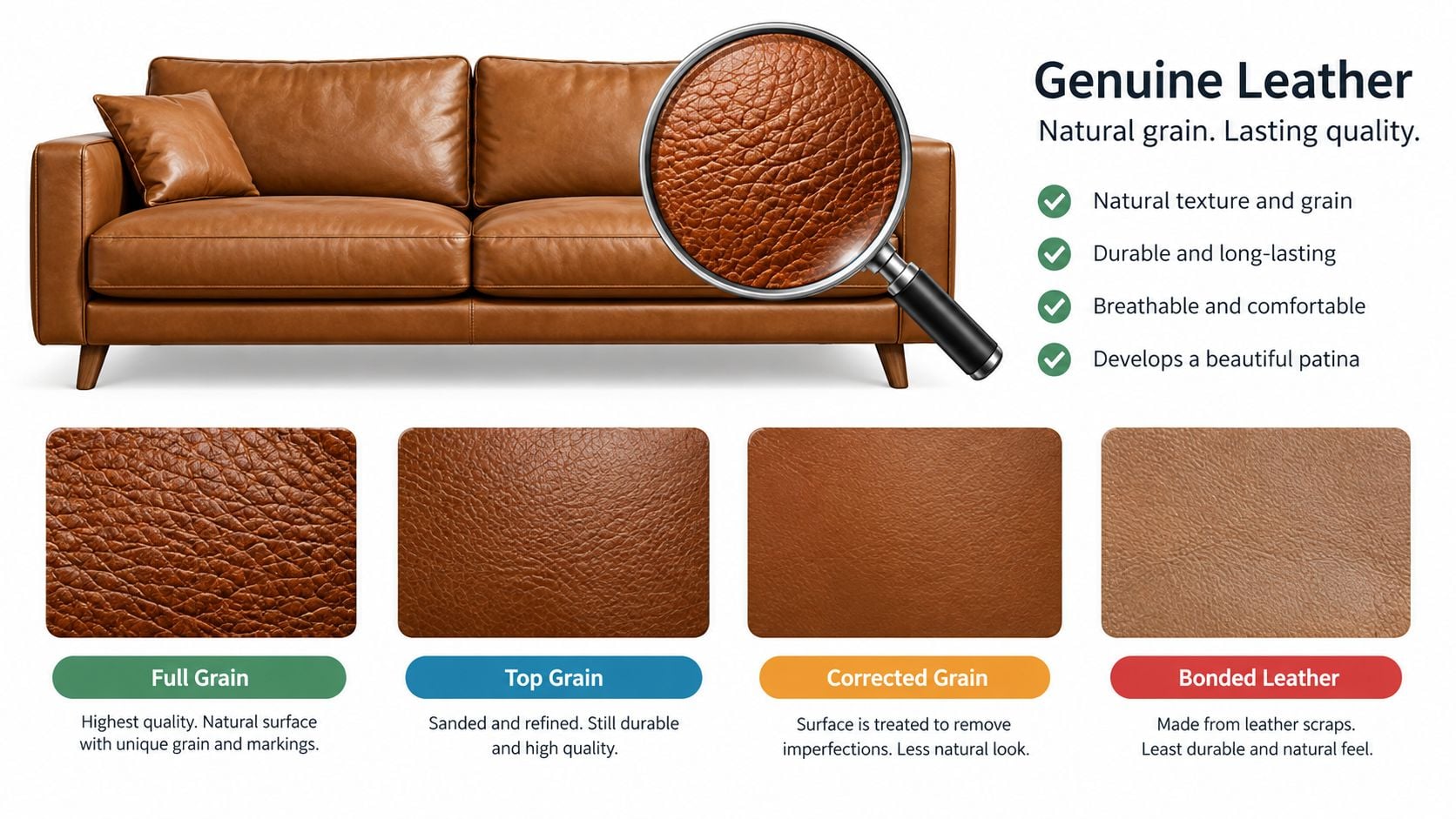
Full-grain leather preserves more of the hide's natural grain and surface character. It can develop a visible patina, but natural marks and variation remain part of the material's identity. Top-grain leather comes from the upper portion of the hide and may receive surface treatment for a more consistent appearance and practical protection.
Corrected-grain leather has been treated to create a more uniform surface. It can suit a homeowner who prefers even color and fewer visible markings, while split leather comes from a lower layer of the hide and should be evaluated carefully for the intended level of use. Bonded leather is a different construction altogether. It combines leather fibers with a backing and surface coating, so it shouldn't be presented as equivalent to a substantial hide upholstery.
The finish changes the daily experience as much as the grade. Aniline leather preserves a soft, natural hand but has less surface protection. Protected or pigmented leather uses a finish that generally improves resistance to household rubbing and soiling, making it a practical consideration for a frequently used family room.
Showroom question: “Which leather grade and finish cover the seats, arms, sides, back, and footrest?”
How to inspect a reclining sofa in person
A product description should identify whether the sofa uses leather across all visible surfaces, all contact surfaces, or only selected seating panels. If the sides and back use a matching synthetic material, that arrangement should be disclosed clearly, particularly when the sofa will sit in the center of an open-plan room.
A practical inspection includes three steps:
- Request the material specification: Ask for the exact leather grade, finish, and leather-to-match details.
- Study the surface: Look for natural grain, uniform correction, coating, and how the color changes across panels.
- Inspect edges and seams: Examine how the upholstery wraps around the arm, seat front, footrest, and moving sections.
The global leather economy shows why upholstery is a significant material category rather than a niche furnishing choice. During 1999–2001, the Food and Agriculture Organization recorded approximately 1.5 billion cattle worldwide and about 5.7 million tonnes of raw hides annually, with an average bovine hide weighing roughly 18.1 kilograms. After processing, production included about 10,999 million square feet of light leather, a category that includes material used in furniture upholstery, and approximately 44% of light bovine leather went to products other than footwear, including furniture, garments, and travel goods (FAO leather production analysis).
For minor surface marks, careful homeowners may also benefit from a practical scratch repair guide for furniture, while still following the sofa manufacturer's approved care instructions. The larger lesson is simple: a label starts the conversation, but it doesn't finish it. A detailed comparison of genuine and bonded leather helps clarify why material composition deserves the same scrutiny as the reclining mechanism.
Evaluating Durability Through Testing Standards
A genuine leather reclining sofa has two systems that wear differently. The upholstery experiences rubbing, flexing, perspiration, sunlight, and cleaning. The reclining mechanism experiences repeated movement, concentrated loads, and stress around joints, motors, linkages, and footrests. Leather testing and mechanism testing answer different questions, so one cannot substitute for the other.
The first useful question concerns the leather surface. Martindale abrasion testing rubs a material sample against standard wool felt under a controlled 12-kilopascal load and records the cycles before the first thread breaks. The cited upholstery guidance gives a broad comparison of approximately 50,000 to 100,000 cycles for genuine leather, while silicone leather may reach 200,000 cycles or more. It also recommends at least 100,000 cycles for commercial furniture applications (Martindale upholstery guidance).
Those figures aren't a complete quality verdict. Leather is a hide rather than a woven textile, and results should be considered alongside thickness, finish, seam construction, cushion design, and expected residential use. A high cycle count won't correct poor stitching or an unsuitable finish, just as a luxurious texture won't prove abrasion resistance.
What the tests actually measure
The relevant upholstery specification should address more than abrasion. A technical upholstery-leather specification identifies tests related to rub fastness, stitch-tear resistance, flex resistance, cracking, bleeding, perspiration, colorfastness, and cleanability. Finished upholstery leather should be rub-fast and cleanable with a damp cloth, but the exact test method and sample coverage still matter (technical upholstery leather specification).
The mechanism requires a separate benchmark. The U.S. General Services Administration defines a recliner cycle as moving from closed to TV position, then full recline, and back to fully closed. Its protocol calls for cycling the recliner 25,000 times or until failure. European EN 13759 also provides durability tests for manual and power reclining mechanisms and bases its methods on users weighing up to 110 kilograms (GSA upholstered-furniture test method).
Leather and mechanism durability benchmarks
The following comparison places the relevant figures side by side. The testing methods measure different forms of stress, so the results should be used as a purchasing framework rather than a promise of identical household service life.
| Test Category | Minimum Cycles | What It Measures | Residential Suitability |
|---|---|---|---|
| Genuine leather abrasion | Approximately 50,000 to 100,000 cycles | Resistance to repeated rubbing | A useful comparison point for frequently used residential seating |
| Silicone leather abrasion | 200,000 cycles or more | Resistance to controlled surface abrasion | A higher abrasion result, but not a complete measure of hide quality or comfort |
| Commercial furniture abrasion reference | At least 100,000 cycles | A demanding abrasion target | Helpful when comparing heavily used rooms, though residential use differs |
| Reclining mechanism cycle test | 25,000 cycles or until failure | Repeated closed, TV, full recline, and closed movement | A meaningful manufacturer benchmark, not a household guarantee |
Before ordering, a homeowner should ask whether the reported result covers the complete assembled mechanism, whether testing included the heaviest reclined position, and whether the power unit has a stated duty cycle. A warranty covering the frame, motor, controls, and upholstery separately is more informative than a broad promise attached to the sofa as a whole.
How Central Florida Climate Affects Leather Furniture
Central Florida's indoor climate creates a different care environment from a dry northern home. Heat, humidity, perspiration, strong sunlight, and frequent rubbing can work together around the same seat, especially on a reclining sofa where the body repeatedly contacts the seat front, arm, headrest, and footrest.
Leather conservation guidance recommends a well-ventilated room, temperatures no higher than about 25°C, and relative humidity around 45–65% (leather care and environmental guidance). Those conditions aren't always easy to maintain in an Orlando-area home, but they explain why placement and air circulation deserve attention. Damp conditions increase mold risk, while prolonged heat can reduce moisture and leave leather harder and more vulnerable to cracking.
Placement matters more than occasional conditioning
A sofa pressed tightly against an exterior wall may have less airflow around its back, particularly in a room with higher moisture. The safest arrangement allows air to move around the furniture and keeps the upholstery away from direct contact with damp surfaces. A sunny Florida room can also be a poor location if sunlight falls on the same leather panels for long periods each day.
Direct ultraviolet exposure can change color and accelerate surface aging. Window treatments, thoughtful orientation, and a position outside the strongest sun can protect the sofa more effectively than trying to restore damage after it appears.
A Central Florida homeowner should consider these placement questions before selecting a configuration:
- Exterior walls: Can the sofa maintain airflow rather than sit tightly against a potentially warm or damp surface?
- Windows: Will direct sunlight fall on the arms, seat cushions, or back for extended periods?
- Air conditioning: Does the room maintain stable indoor conditions, or does it swing between humid and very dry?
- Traffic and perspiration: Will the same seat receive heavy daily contact from family members or guests?
Care should match the finish
Protected leather generally provides a stronger barrier against routine household rubbing and spills than an unprotected aniline surface. That doesn't make it maintenance-free. Spills should be blotted promptly with a soft damp cloth, and the homeowner should avoid household solvents, silicone products, and unapproved conditioners.
Conditioning frequency shouldn't be chosen by a generic calendar alone. The manufacturer's instructions, the finish, room exposure, and the sofa's actual use should guide the routine. A media room with daily reclining and strong afternoon sun needs closer observation than a formal sitting room used occasionally.
Florida placement rule: A leather sofa should be protected from direct sun, given room to breathe, and monitored for changes in surface feel before cracking or discoloration becomes obvious.
A local design consultation can make those environmental decisions more practical. The leather furniture protection guide from Slone Brothers offers a useful reference for homeowners planning care around Central Florida conditions. The climate doesn't disqualify genuine leather. It rewards thoughtful placement, stable indoor conditions, and a finish selected for the room's actual demands.
Selecting the Right Size and Configuration for Your Space
A reclining sofa must fit the body and the room at the same time. A generous-looking seat can feel supportive to a tall homeowner and leave a shorter sitter slumped forward. A sofa that fits the wall in its closed position may still block a walkway when the footrest extends. The correct measurement is personal and dynamic, not just the width listed on a product card.
Start with seat depth. Seating guidance recommends measuring from the back of the buttocks to the back of the knee, known as the buttock-to-popliteal length, then subtracting approximately 2–3 inches of clearance (seat-depth guidance). That gap helps prevent the cushion edge from pressing behind the knees while allowing the sitter to remain against the lumbar support.
A shorter homeowner may perch forward on an overly deep sofa, while a taller homeowner may lose thigh support on a shallow one. Reclining changes the relationship between the seat, backrest, footrest, and lumbar curve, so the sofa should be tested in both upright and reclined positions.
Examine support through the full motion
A reclining sofa shouldn't merely tip the torso backward. It should support the pelvis, lumbar area, back, and legs as the position changes. Ergonomic guidance identifies supported backrest angles of approximately 110°–130° as associated with lower intervertebral-disc pressure and lower spinal-muscle electrical activity when adequate lumbar support is present.
That range isn't a universal prescription. Body size, cushion compression, footrest position, and individual orthopedic needs affect the result. During a showroom test, the sitter should check whether the lower back stays in contact with the backrest, whether the pelvis remains supported, and whether the headrest meets the head without forcing the neck forward.
Measure the room in two positions
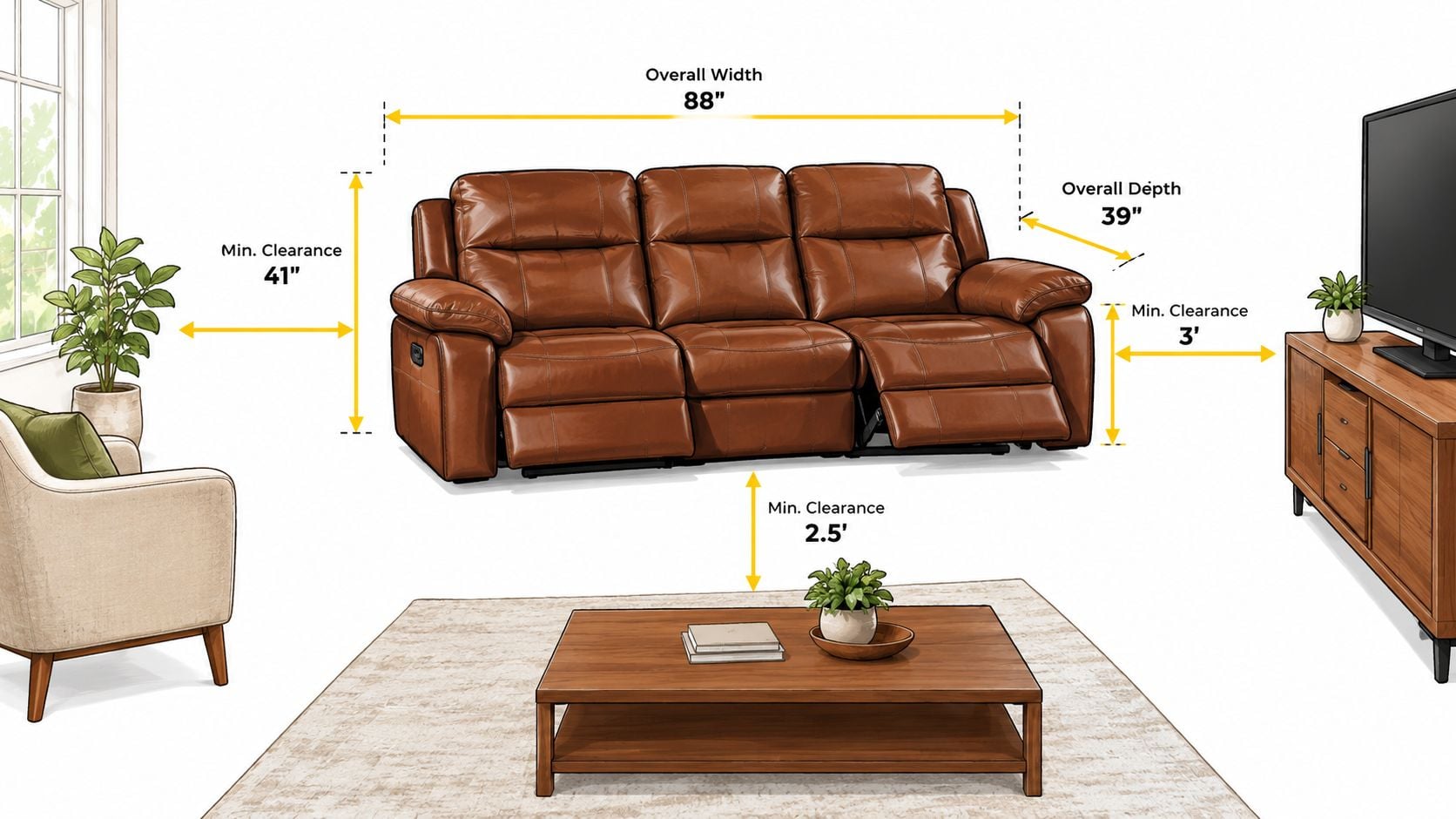
A proper floor plan includes the sofa closed and fully reclined. It also accounts for the footrest path, side tables, walking routes, doors, windows, outlets, and nearby furniture. A wall-hugging design may reduce rear clearance, but the mechanism still needs adequate space to move without striking a wall or trapping a walkway.
A useful checklist for a Longwood, Winter Park, or Altamonte Springs living room includes:
- Closed footprint: Record the sofa's full width, depth, and height.
- Extended footprint: Measure the furthest reach of the footrest and back.
- Wall relationship: Confirm the manufacturer's required clearance for the specific mechanism.
- Traffic path: Preserve a comfortable route between the seating area and adjoining rooms.
- Delivery access: Measure doors, turns, hallways, stairways, and elevator openings.
- Electrical access: Plan where a power recliner can connect without pinched or exposed cords.
Delivery planning also deserves attention when a large motion sofa must pass through a narrow entry. Homeowners comparing logistics can review this practical resource on how to compare couch delivery costs, while recognizing that local delivery policies and furniture construction vary.
The room-measuring guide from Slone Brothers can help translate a floor plan into a configuration that works in daily life. A reclining sofa should support movement, not force the room to function around an unexpected obstruction.
Customizing Your Leather Reclining Sofa with Expert Guidance
A custom-order genuine leather reclining sofa gives a homeowner more control than choosing a fixed display model. The meaningful choices include the hide grade, surface finish, leather coverage, seat proportions, reclining format, headrest, lumbar support, cushion feel, and configuration. Each decision affects both the way the sofa looks and the way it performs.
The process works best when the room and the sitter are evaluated together. A design consultant can compare leather samples in the context of flooring, lighting, rugs, cabinetry, and wall color rather than treating the upholstery as an isolated swatch. That in-person comparison matters in Florida, where natural and artificial light can make the same finish appear noticeably different throughout the day.
A practical showroom sequence
Begin with the body. The homeowner should sit upright, place the feet on the floor, and check seat depth, knee clearance, lumbar contact, and arm height. The same person should then operate the footrest and headrest to determine whether support improves or disappears as the sofa reclines.
Then evaluate the leather. The consultant should identify whether the sample is aniline, protected, top-grain, corrected-grain, split, or another specified material. The discussion should include which panels receive genuine hide, how the surface should be cleaned, and what care products could void the warranty.
Test the mechanism repeatedly. The footrest should open and return smoothly, without hesitation, scraping, unusual noise, or pressure against nearby furniture. The shopper should ask whether the mechanism is manual or powered, whether headrest and lumbar adjustments operate independently, and what the warranty covers for motors, controls, frames, and moving components.
Finish with the room plan. The consultant should verify the closed and extended dimensions, outlet placement, side clearances, delivery path, and relationship to doors and walkways. A well-selected configuration can feel custom-fitted without becoming visually overbuilt.
The custom-order process at Slone Brothers Furniture gives Central Florida homeowners a way to coordinate materials, finishes, and configurations with professional guidance. Slone Brothers Furniture has served the region as a family-owned showroom since 1980, and its in-house design services include complimentary space planning. The value is not just a larger menu of options. It's the ability to connect the leather, mechanism, room, and body before the order is placed.
A discerning homeowner should leave the consultation with written answers to these questions:
- Which surfaces are genuine leather?
- What grade and finish are specified?
- Which seats recline?
- What testing and warranty documentation is available?
- What are the closed and fully reclined dimensions?
- What care routine does the manufacturer approve?
- How will delivery reach the intended room?
Why Shopping Local in Longwood Outperforms Online Purchases
Photographs can show color, but they can't communicate the difference between a natural and heavily protected leather surface. A product description may list power recline, but it can't show whether the footrest opens smoothly, whether the lumbar support remains useful, or whether the seat depth suits a particular body.
A visit to a Longwood showroom allows a homeowner from Orlando, Sanford, or Lake Mary to assess the sofa with the senses that matter most: touch, sight, movement, and posture. The shopper can compare leather samples, test the mechanism, sit through the full range of motion, and discuss how the piece will enter the home.
The local advantage also continues after selection. A family-owned showroom can coordinate custom ordering, complimentary in-home design guidance, white-glove delivery, and post-purchase service as parts of one furniture relationship. That service matters when a reclining sofa has to be positioned correctly, connected safely, and cared for according to its actual finish.
Slone Brothers Furniture's broader showroom approach supports homeowners furnishing living rooms and other spaces as a coordinated home rather than purchasing isolated pieces. The benefits of shopping local become especially clear when the purchase involves upholstery specifications, motion engineering, room planning, and long-term care.
A genuine leather reclining sofa is an investment in daily comfort and lasting design. The best choice comes from transparent material information, credible durability testing, climate-aware placement, and a showroom experience where experienced consultants can evaluate the entire setting rather than one product photograph.
Ready to invest in furniture that lasts a lifetime? Visit Slone Brothers Furniture in Longwood, FL to compare genuine leather finishes, test reclining mechanisms, and receive complimentary guidance from experienced design consultants. The team can help Central Florida homeowners plan a carefully fitted living room with custom-order options, white-glove delivery, and attentive service from selection through installation.