

Discount Furniture Couches: What Really Makes Them Last


How much will a couch cost you for every year you own it? Most buying advice stops at the ticket price, which is exactly where the useful math begins. A discounted couch is a bundle of decisions: the delivered price, the realistic years of service, and what happens in year four when the cushions flatten and the frame still has a decade left in it.
Central Florida homeowners meet the same handful of routes to a lower price, and every route trades something away. Reading those trades clearly is what turns a markdown into a real deal on discount furniture couches instead of a slow, expensive mistake.
Where can you find discount furniture couches, and what does each route trade away?
A discounted couch comes from five routes: clearance floor samples, open-box or returned pieces, in-stock promotional sales, custom orders placed during a promotional event, and the used market. Each trades a different piece of price for a different piece of risk. None is automatically the smart buy, and what separates them is what you can verify before money changes hands.
Couches are not a niche purchase, which is why every route stays stocked. Sofas and couches made up 21.8% of the global furniture market in 2025, the largest product segment ahead of beds and chairs, and the segment is projected to grow at 5.6% a year through 2034, according to Straits Research's furniture market analysis. That volume is why markdowns, closeouts, and returned pieces show up year-round rather than only during sale weekends.
Five routes to a discounted couch and what to verify
| Route | Typical price pattern | What to verify | Warranty or returns | Timing |
|---|---|---|---|---|
| Clearance floor sample | Deep markdown on a fixed configuration | Frame stability, cushion sag, stains, fabric wear | Often limited, confirm in writing | Immediate or scheduled delivery |
| Open-box or returned | Lower than new, priced by the reason for return | Packaging damage, missing hardware, cushion condition | Set by the seller, confirm in writing | Days to weeks |
| In-stock sale on new | Promotional markdown | Seat-foam specification, suspension, safety label | Manufacturer warranty plus store terms | Immediate or scheduled delivery |
| Custom order during a promotion | Discount tied to event dates | Fabric yardage, finish, cushion options | Manufacturer warranty | Longer lead time, get dates in writing |
| Used or resale | Lowest listed price, widest range | Frame, odor, fabric wear, safety label | Usually none | Pickup or hauling |
Clearance floor samples carry wear the markdown is paying you for: every visitor since arrival has sat on that seat. Configurations are fixed, so confirm the exact piece and not a similar model in the same fabric family. Open-box and returned pieces are the route most likely to hide a missing leg or a hardware bag someone kept, so open everything before you sign.
In-stock promotional sales are the safest route for most buyers because the piece is new and the markdown follows a calendar rather than a condition problem. The work is verifying what's inside the frame instead of trusting the word sale. Custom orders placed during a promotion trade a lower price for a longer wait, which makes written delivery dates and confirmed fabric yardage the two things that protect you. Used and resale offer the lowest listed price and the widest range of quality, from a decade-old workhorse to a two-year-old regret, usually with no warranty behind it.
In the Longwood showroom, a buyer can sit on the piece for ten minutes and lift one front corner to watch the frame react. No listing photo does that. Browsing closeout and clearance furniture in person lets you put your hands on the actual piece you'd take home.
Apply one rule to all five routes: compare delivered total, warranty terms, and expected service life. The sticker price is the least informative number on the tag.
Which Construction Details Predict How Long a Couch Lasts
The frame decides whether the couch stays square, the suspension decides whether the seat keeps its shape, and the foam density decides how long the cushions feel new. Fabric is the visible layer, and the least predictive of the three. Start underneath and work up.
Start with the frame, because it sets everything above it
Kiln-dried hardwood or solid wood, joined and reinforced with corner blocks, holds screws tight and stays square through years of daily loading. Particle board and stapled joints are the first things to loosen, and Central Florida humidity accelerates that. Solid wood also weighs more, which is a useful clue in a showroom: a surprisingly light couch is telling you something about what's inside.
A simple test works better than a spec sheet. Lift one front corner a few inches off the floor and watch the opposite corner. A sound frame answers as a unit, with the far corner rising roughly in step. A frame that twists, creaks, or leaves the far side planted is already flexing at its joints.
Suspension is the next layer. Sinuous or zigzag springs clipped to the frame hold their shape longer than webbing alone, and eight-way hand-tied springs sit above both in cost and longevity. Sit hard on the front edge and watch the deck. A sharp, localized dip means the suspension is working alone down there, and that's where sagging starts.
What the seat foam density numbers actually mean
Cushions are where the two most-confused words in furniture get swapped. Density measures how much material is in the foam, by weight per cubic foot. Firmness describes how it feels on the first sit. A technical upholstery analysis of foam specification treats density as a primary durability factor and separates it from hardness, which is why a rock-hard cushion can still collapse in three years.
| Seat foam density | Reference band | Best fit |
|---|---|---|
| Below 1.8 lb per cubic foot | Short-lived range for daily seating | Occasional seating or a guest room |
| 1.8 to 2.0 lb per cubic foot | Serviceable middle range | Moderate daily use |
| 2.0 lb per cubic foot or higher, high-resiliency | Associated with longer-term daily and contract use | Families, pets and daily lounging |
A firm cushion and a durable cushion are two different things, and only one of them shows up on a spec sheet.
Down-wrapped cushions are a comfort layer over that core, not a replacement for it. Down feels wonderful and needs fluffing, and a down wrap around low-density foam still bottoms out on the frame. For Central Florida homes with pets, sun through the sliders, and humidity that never really leaves, a tight-weave performance fabric that wipes clean earns its keep faster than a decorative weave that stains.
Four questions sort any seller, in a showroom or over the phone. What is the seat-foam density in pounds per cubic foot? Is it high-resiliency foam? What suspension type is under the deck? Can the cushions be replaced or professionally re-foamed later? The answers tell you more about upholstery materials and construction than any brochure photograph.
Which Safety Label a Discount Couch Should Carry
A low price doesn't imply a non-compliant piece, but it does mean the label is worth checking. Upholstered furniture manufactured, imported, or reupholstered on or after June 25, 2021 must comply with 16 C.F.R. Part 1640, which incorporates California Technical Bulletin 117-2013, per the Consumer Product Safety Commission announcement. Compliant furniture carries a permanent label reading "Complies with U.S. CPSC requirements for upholstered furniture."
The rule covers indoor furniture with an upholstered seat, back, or arm intended for homes and consumer settings. TB 117-2013 runs four test methods across the cover fabric, resilient filling material, barrier material, and decking material, evaluating char length, smoldering, and transition to open flaming. That matters most when you're looking at custom upholstery, reupholstered pieces, or anything with a history.
Three checks settle it before you pay:
- Find the permanent label on the frame or under a seat cushion, and read the wording rather than glancing at a tag.
- Ask the seller what the piece is. New, reupholstered, or exempt under a different category are three different answers with three different obligations.
- Request documentation on a used or reupholstered couch before money changes hands, since the label may have gone with the original cover.
A sofa bed splits the question. A detachable mattress is generally governed by separate mattress flammability standards, while the upholstered frame around it falls under the furniture rule. Treat the label as a floor, not a certificate: it confirms the piece meets a federal minimum and says nothing about whether the foam will hold up or the frame will stay tight. That's what the construction checks are for.
What does a discounted couch really cost per year?
The number that matters is the delivered price divided by the years the couch will serve. Not the tag, and not the monthly payment. Three steps get you there.
- Add the delivered total. Sofa price, delivery charge, and any setup fee belong in one number, since a bargain priced without delivery isn't a price.
- Divide by realistic years of service. Use the honest figure for your household, not the best-case one. Kids, pets, and a couch that doubles as a dining bench shorten it.
- Compare against a 15-year benchmark. Consumer research reported by IMM Cologne's study of what furniture buyers care about found 78% of sofa shoppers expect a couch to last approximately 15 years, and 84% expect a warranty. A couch you expect to replace in five years should score worse per year than one built for fifteen.
The math is simple enough to run on a phone in the showroom.

A $1,000 sofa with $150 delivery that serves eight years costs about $144 a year. A $650 sofa with the same delivery that loses its shape in three years costs about $267 a year. The cheaper couch runs nearly twice as much per year of use.
Practical rule: if replacement cushions cost more than a third of what you paid for the sofa, the discount was a delay, not a saving.
Then add the replacement factors that shift the result. Can the cushions be replaced or re-foamed, or is a sagging seat a disposal event? Can a local upholsterer repair the frame, or is it glued and stapled shut? What would a second delivery cost if the piece has to come back?
Read the warranty in writing and answer three questions. How long does it run? Are the frame and cushions covered separately? What's excluded? A warranty covers defects, not normal wear, so a ten-year frame warranty tells you nothing about the foam you'll be sitting on every night. Read together, these numbers explain why a higher-priced couch with serviceable parts is often the lower-cost choice over a decade.
How do you compare prices and finance a discounted couch?
Compare two discounted couches only when the configuration, fabric grade, and seat-foam specification match, and compare them on the delivered total. Otherwise you're pricing two different products and calling it a discount. Four steps keep the comparison honest.
- Write down the exact specification for each candidate: dimensions, cushion configuration, fabric name and grade, foam density, suspension type.
- Ask for the delivered total including delivery, setup, and removal of the old piece. Anything quoted separately gets added back in.
- Put warranty and return terms side by side, including who pays return freight and whether a restocking fee applies.
- Ask for the Low Price Promise terms in writing and confirm what the promise covers, since a price match on the tag doesn't always cover delivery or setup.
Financing changes the shape of the payment, never the size of the bill. Ask what the total repaid comes to including any interest or fees, whether the monthly figure fits the household budget without squeezing everything else, and whether delivery and setup are included in the financed amount. Compare that total against the per-year cost from the earlier math, because spreading a purchase over 24 months doesn't lower it.
If a store card is part of the plan, compare offers before applying rather than at the register. A guide to store cards with easier approval explains what issuers weigh, which matters more than a promotional headline. Buyers comparing couches in the $800 to $1,499 range, where 37% of respondents in a 2025 Consumer Insights Now survey reported planning their fabric sofa spend, should treat financing as a budgeting tool rather than a way to reach a higher price bracket, according to Home News Now's report on the survey.
The Longwood showroom offers furniture financing options that can match payments to a household budget, which is the only defensible reason to finance furniture: timing, not upgrading.
When do discounted couches go on sale, and what should you check?
The best markdowns follow the retail calendar and inventory turnover rather than one magic date. Demand for couches stays high all year, with 41% of furniture shoppers reporting they had purchased a sofa during the year, making it the most-purchased furniture category, according to Consumer Insights Now data reported by Home News Now. Retailers keep clearing stock to feed that demand, and U.S. furniture and home-furnishings stores recorded $11.645 billion in adjusted brick-and-mortar sales in August 2025, up 5.2% from a year earlier, per Home Textiles Today's report on Commerce Department estimates.
| Period | What's being cleared | What to check before paying |
|---|---|---|
| Early January | Holiday inventory and floor models | Cushion firmness, fabric wear, whether replacement cushions are available |
| Memorial Day and Labor Day events | New stock promoted on a schedule | Total delivered price and a delivery date in writing |
| Late summer into early fall | Older collections as new ones arrive | A confirmed reorder path for matching fabric or finish |
| Year-round clearance | Whatever stock is turning over | The exact configuration confirmed in stock, not a similar model |
Floor models need the closest inspection, because the fabric has already met every hand and handbag in the store. Press the seat cushions where people sit, check the arms for soiled patches, and confirm whether replacement cushions can be ordered for that frame. A retired line is a different risk: the markdown is real, but matching fabric or finish may be gone, so ask whether a reorder path exists before you commit to a second piece later.
Measure the path before you fall in love with the piece.
Custom orders on promotion carry the longest lead times, so get the date range in writing and build slack around a move-in date. In Central Florida, storm season from June through November can shift delivery windows without warning, which makes a week of buffer worth more than an extra discount. The guide to furniture sale timing covers how the calendar interacts with stock.
One rule outranks the calendar. Buy when the piece fits the room, not when the month fits the sale.
Will the couch fit your room, and what should you confirm before buying in Longwood?
A discounted couch fits when it clears every entry path, suits the room layout and your body, and arrives with delivery that includes setup. Get those three right and the markdown holds its value. Get them wrong and the piece becomes a return, a storage problem, or a couch nobody sits on.
Before visiting a showroom, measure the width and height of each doorway, the hallway turn, the stair landing, and the elevator if there is one. Add inches for packaging on a sectional, since a boxed chaise is wider than the chaise.
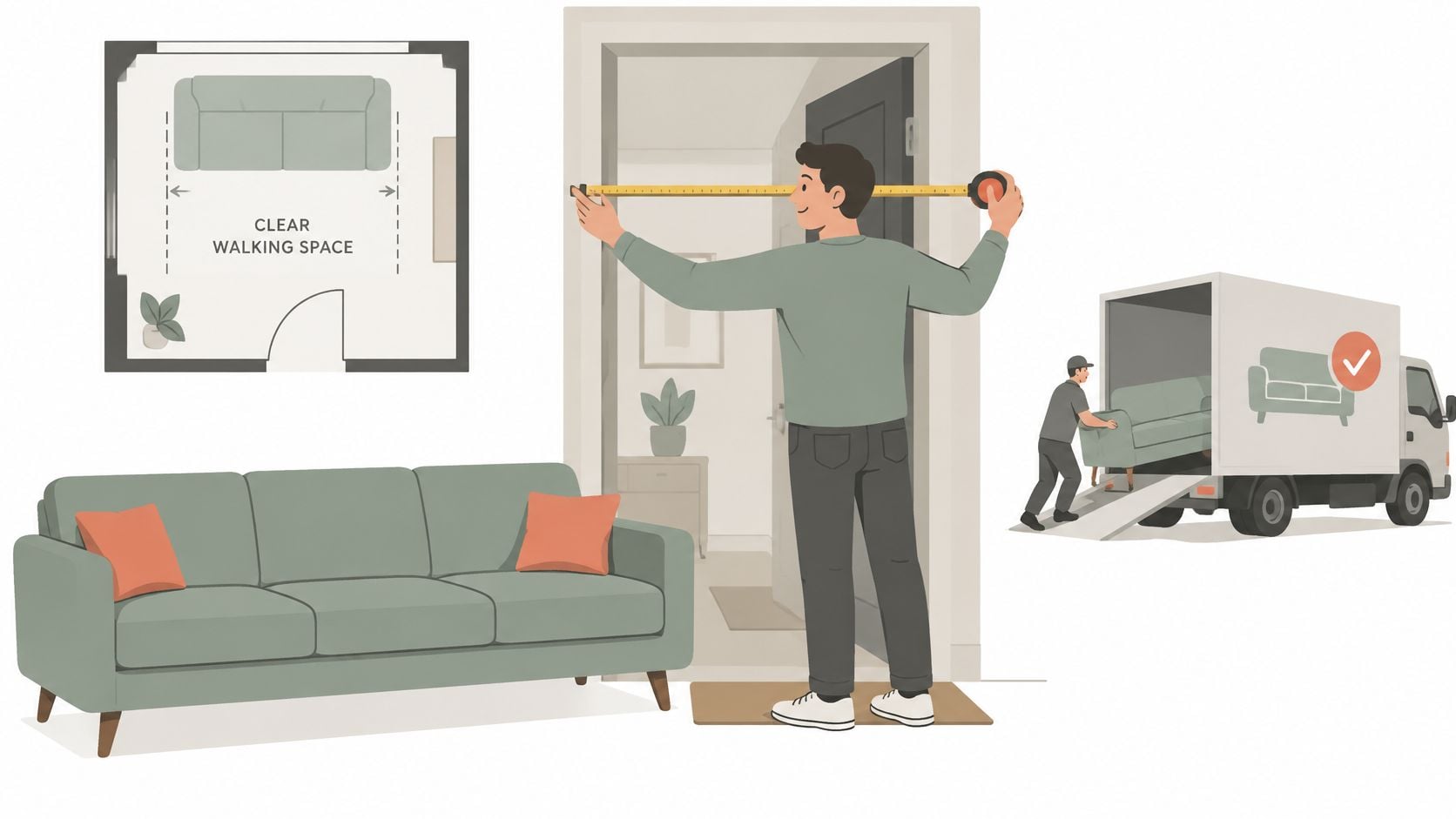
Confirm sectional orientation, meaning which side the chaise or corner sits on, because sectionals are built by side and the wrong hand is a permanent layout problem. Then sit for at least ten minutes. Seat depth decides whether a shorter adult's feet rest on the floor or dangle, and a deep seat that photographs beautifully can be uncomfortable for an hour of conversation.
Tape the couch footprint on the floor for a day and walk around it. That single step catches more mistakes than any measurement sheet. For layout help, room measuring guidance for furniture walks through the dimensions that matter, and complimentary space planning at Slone Brothers Furniture can confirm placement before you commit.
Expectations run high on the delivery side. Survey data reported by Home News Now's consumer insights coverage shows 87% of sofa shoppers expect free delivery, 80% want to sit on the sofa before buying, and 69% expect in-home setup. Confirm in writing whether setup and removal of the old piece are included, because hauling a couch out of a Winter Park bungalow is a different job from dropping one at a Lake Mary doorstep.
Movers and new homeowners in Sanford, Altamonte Springs, and the surrounding areas often furnish several rooms at once through tight entry paths, so bring every measurement together in one place. At the Longwood showroom, the design team can check fit against the actual room, compare floor models and clearance pieces side by side, and explain white glove delivery within 50 miles of the showroom, available for a nominal $199.00 fee.
Ready to stop guessing at measurements? Visit Slone Brothers Furniture in Longwood, where our design consultants will check the fit against your actual room, walk you through frame and cushion construction side by side, and help you choose a couch that earns its price every year you own it. This family-owned Central Florida showroom has served Greater Orlando since 1980, and there's a real person here to answer the questions a product page never will.