

White Glove Delivery Furniture: Costs and Checklist


By 2023, industry summaries counted more than 150 million specialized white glove shipments worldwide. Furniture made up about 49% of those applications, or roughly 74 million shipments that included in-home placement or assembly, according to histories of how the service developed. That volume reframes the choice for a Central Florida homeowner. White glove delivery furniture planning is a damage-prevention and access decision, not a luxury add-on.
The service grew out of careful handling for fine art, antiques, medical equipment, and bespoke pieces. It still fits a dining table, case piece, or sofa that should never be dragged across a floor in Longwood, Winter Park, or Lake Mary. The truck gets the furniture to the street. The route through the house, and the condition of the piece when the crew leaves, decide whether the purchase was protected.
What Does White Glove Furniture Delivery Include?
White glove furniture delivery is the highest tier of home delivery. The crew carries the piece past the entrance into the room the customer chose, sets it in place, assembles it, and removes the packaging and debris.
It is broader than threshold service or room-of-choice service. As the Warematch encyclopedia entry on white glove service explains, threshold delivery generally ends inside the first dry area, such as a lobby or garage, while room-of-choice delivery moves the item to a designated room but may not include assembly. Full white glove service can include in-home placement, complete assembly or installation, functional testing, a customer demonstration, and removal of packaging and debris.
| Service level | Where delivery ends | Assembly | Packaging and debris |
|---|---|---|---|
| Threshold | First dry area, such as a lobby or garage | Not included | Left with the customer |
| Room of choice | The designated room | May not include assembly | Not removed as part of the service |
| White glove | Inside the home, in the chosen room | Full assembly or installation, with testing and demonstration | Removed by the crew |
What the higher tier adds
Placement alone doesn't finish a bed, a sectional, or a case piece with doors. White glove work adds complete assembly or installation, a check that the piece functions, and a short demonstration when the mechanism needs one. A sleeper, a reclining chair, or a table with leaves is usable the same day because the crew, not the household, completes that setup.
The same logic shows up in careful handling of heavy medical equipment. The DME Superstore white glove delivery guide is a useful parallel for why trained crews, a planned path, and debris removal matter when a bulky item has to arrive intact.
At Slone Brothers Furniture, delivery and set-up covers assembly and placement of only the items purchased, plus a one-time leveling of case pieces and doors at the original delivery. All delivered items are assembled and set up, and packaging materials are removed. Details of that home service are on the delivery page. Room placement can also be planned with the design services on the Slone Brothers site before the order is placed.
Ask before you accept a quote: Which delivery level is listed, and are assembly and packaging removal written on that quote?
Is White Glove Delivery Worth the Extra Cost?
A scratched apron on a solid-wood table shows the math. One damaged joint can erase the value that made quality construction worth buying, a point explained in this look at why quality furniture costs what it does. The delivery fee is small next to a second build, a second finish schedule, and weeks without the piece.
Distance from the Longwood showroom, floors and stairs, amount of assembly, and size and weight all change the work. For Longwood-area addresses, Slone Brothers Furniture offers white glove delivery within 50 miles of the showroom for a nominal fee of $199.00. A design consultant confirms the final amount when the quote is prepared.
A replacement is rarely a same-week fix. Typical lead time for special-ordered furniture runs 6 to 8 weeks, and that span may not include delays when a fabric or a component is out of stock.
| Benchmark | Reported rate | Caveat |
|---|---|---|
| Ordinary furniture freight | 5-10% damaged, with one estimate at 7.6% | Broad industry range |
| Well-run white glove programs | About 30% fewer damage and return rates than standard shipping (published furniture logistics figures) | Industry summary figure, not a guarantee |
| Customers affected by furniture damage | 51% would not buy from the same retailer again (published furniture logistics figures) | Industry figure on customer trust |
Ordinary freight damage sits broadly between 5% and 10%, with one estimate at 7.6% (published furniture logistics figures). Well-run white glove programs are summarized at about 30% fewer damage and return rates than standard shipping (published furniture logistics figures). That is an industry summary, not a promise for every route. Among customers hit by furniture damage, 51% reportedly would not repurchase from the same retailer (published furniture logistics figures).
Shoppers already rank the service above speed. A 2024 Florida International University study of 221 big-and-bulky-item shoppers found that white-glove service accounted for 63% of delivery-choice importance, compared with 25% for the delivery window and 12% for speed, as reported by FIU Business.
Protection explains the price. The Home Removals Sydney premium moving guide walks through why careful handling, planned access, and a trained crew cost more than curbside drop-off. Measure first. Buy the handling that fits the route.
How do I confirm my furniture will fit the route into my home?
White glove service removes the heavy lifting. It doesn't remove the need for a clear path. Measuring is the customer's first step, and it has to happen before the order, not on delivery morning.
Slone Brothers Furniture holds customers responsible for making sure new furniture fits the room, including access through doors and hallways. A design consultant can check a tape-measure list against the piece. The household still has to record the route.
Work in this order, with a steel tape, and write each number down:
- Entry door. Record clear height, clear width, and diagonal clearance. A tilted sofa can pass a door that looks too short on a flat measurement.
- Hallways and turns. Measure width at every corner. A long table fails at the turn, not at the front door.
- Stairs and landings. Record stair width and landing depth. Narrow stairs force the piece onto an angle.
- Elevator. Record interior width, depth, and height. The piece has to fit inside the car, padding included.
- Ceiling height. Measure the final room. A tall headboard or cabinet needs that clearance once it is stood up.
- Final room doorway. Record clear width and height. This is the last point where a piece can fail.
| Route point | What to record | Why it matters |
|---|---|---|
| Entry door | Clear height, clear width and diagonal clearance | Decides whether the piece can be tilted through |
| Hallways and turns | Width at every turn | Tight corners stop long sofas and tables |
| Stairs and landings | Stair width and landing depth | Narrow stairs often force the piece to be angled |
| Elevator | Interior width, depth and height | Bulky pieces must fit inside the car |
| Ceiling height | Height in the final room | Tall headboards and cabinets need clearance |
| Final room doorway | Clear width and height | The last point where a piece can fail to fit |
Diagonal clearance matters because a sofa or table that is rotated can pass where a flat reading says it won't. Packaging, padding, and hardware add bulk, so the route also needs room to tilt and turn. The Pottery Barn furniture delivery guide makes the same point: measure every doorway, hallway, stair, elevator, and turn, and allow for protective materials. How those furniture dimensions are taken is explained in how furniture is measured.
Older houses in Longwood and Sanford often keep narrow original doors. Two-story townhomes in Winter Park or Altamonte Springs often have a tight stair turn. A sofa can clear the front door and still stop at the last corner into the living room.
Send the full measurement list to a design consultant before the order is placed, so the piece can be checked against the route rather than discovered on the truck.
Commercial buyers face the same choke points in a suite. Teams that prepare an office furniture inventory before a move already know which pieces must clear elevators and corridors, and a home deserves that same list.
What should I do at home before the crew arrives?
The delivery itself is short. The preparation around it decides whether the piece arrives cleanly, and most of that work happens before the truck reaches the curb. Treat the route like a stage set: anything a dolly wheel, a sofa corner, or a work boot can catch should be gone before the crew knocks.
Confirm the plan with customer service. Recheck the delivery date, the access notes, and the destination room so the crew knows exactly where the piece goes. A wrong room means a second carry through the house, and a second carry is where minor damage tends to happen.
Clear the route. Move sliding rugs, loose stair runners, and wall art near corners. Anything that blocks a turn becomes a scratch or a delay. The crew needs a clean path from the door to the final spot, not a path that tightens at the last corner.
Protect floors and corners. Lay runners or cardboard at pinch points. A bare corner is where a leg catches, and a loose rug can slide under a dolly. Floor protection for new pieces is covered in how to protect floors from furniture.
Keep the interior stable. Run the air conditioning as usual before and after delivery. Don't stage solid wood in a garage, on a covered patio, or against a damp exterior wall, and keep it off a strong HVAC vent. Wood exchanges moisture with the air, and that movement can open a panel gap or stress a finish. The Decorative Hardwoods Association technical brief recommends about 30 to 55% relative humidity under moderate outdoor conditions for comparable cabinetry, plus time to acclimate. A conditioned Orlando house is the right handoff.
Empty the target spot. Leave room for the piece and for packaging to come off. A crowded bedroom forces the crew to set the furniture in the hall. Clear a second zone where wrapping, foam, and cartons can stack without blocking the exit.
Have an adult ready to decide. Someone with authority to sign and to inspect should be home. A neighbor who can't approve placement can't close the delivery, and a phone call to the homeowner slows every decision.
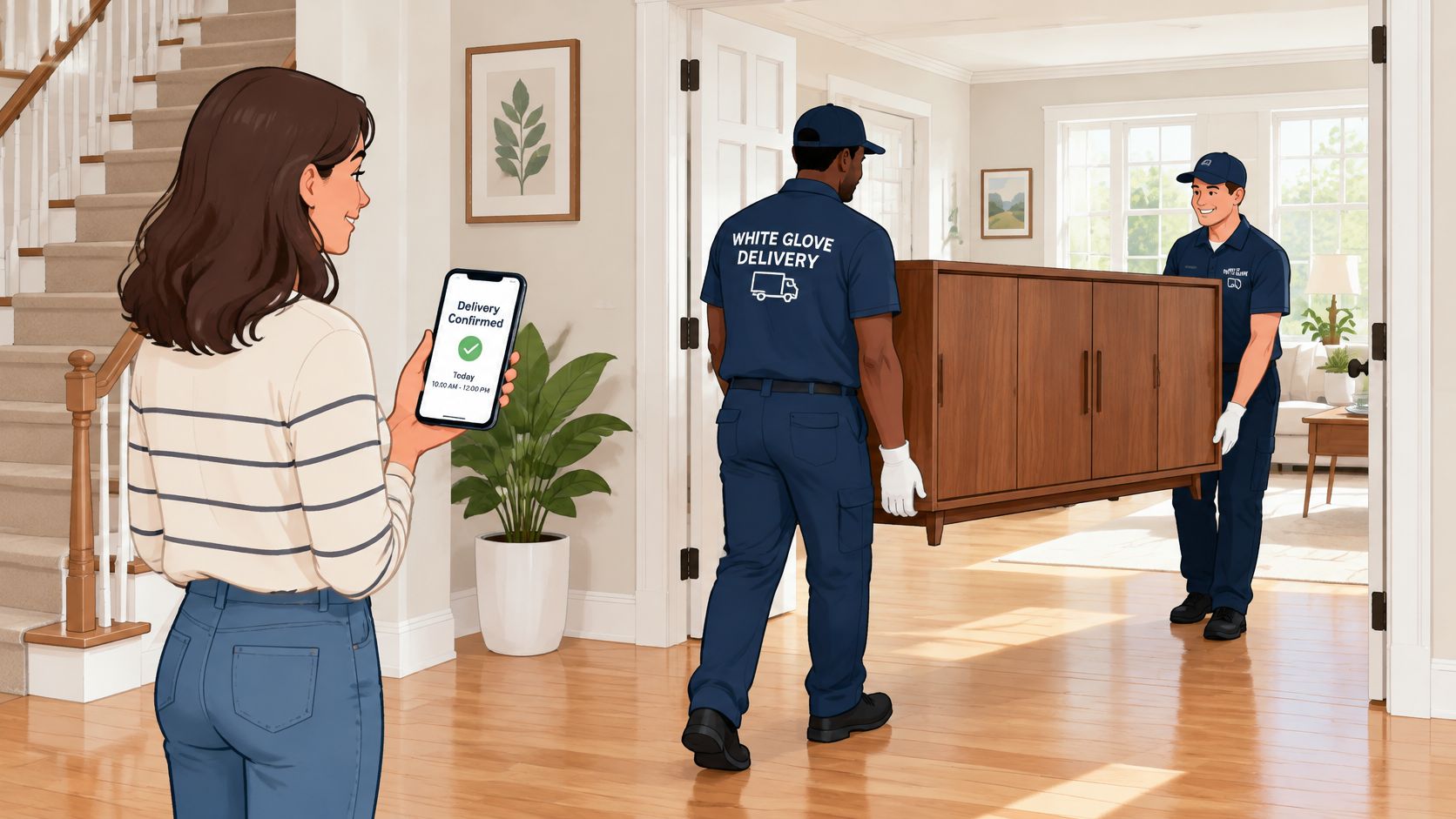
A blocked turn, a scratched floor, a panel that moves after a humid garage night, or a missed inspection each trace back to one skipped step. Collecting from the warehouse? Book the complimentary pick-up with 48 hours notice, inspect the piece on arrival, and bring your own blankets and tie-downs.
What should I check at arrival, and what if something is wrong?
The signed delivery paperwork is the record that decides who pays for a problem. Once the truck pulls away, a scratch has to be traced back to a visit nobody documented. That makes the ten minutes of inspection worth more than the piece's warranty.
The arrival checklist
Start before the wrapping comes off. Compare the piece against the order for finish, fabric, and configuration, and photograph the item and its packaging while it is still in the doorway. Visible damage at the door is easiest to attribute to transit when the picture shows the box intact around it.
After placement, open drawers and doors, check joints and cushions, and confirm the case piece was leveled at delivery. Then confirm the piece sits where it should live, since shifting it later can undo the access planning that got it there.
Judge what you see by manufacturer tolerance rather than by perfection. Grain and finish vary naturally from piece to piece, and that variation is expected within those tolerances. A crack, a tear, a deep rub, or a drawer that won't operate is a defect to note. Slone Brothers Furniture can't guarantee satisfaction with a selection; its obligation is to deliver a product within the tolerances the manufacturer allows. How those checks line up with the store's quality assurance processes is worth reading before delivery day.
Warehouse collection runs on a different rule. Customers should inspect the entire purchase at pick-up, and the store can't be responsible for damage discovered after that warehouse pick-up.
If something is wrong
Note the problem on the delivery paperwork before the crew leaves. The delivery team forwards those notes to customer service, so the written exception does the work of the phone call. Holding onto the cartons and padding until the item is confirmed intact is standard practice for any large purchase, and it makes a later conversation easier to settle.
Then call customer service with the order details and a description of what you wrote. If you are not completely satisfied with the furniture or its installation, contact customer service before the delivery installers leave the home. Damage found after the crew is gone should be reported within 72 hours, because minor in-home repairs on merchandise the store delivered are made at no charge inside that window.
| Situation | Deadline | What to do |
|---|---|---|
| Visible damage at delivery | Before the crew leaves | Note it on the delivery paperwork; the crew forwards it to customer service |
| Hidden damage or a defect found later | Within 72 hours of delivery | Notify the business; minor in-home repairs on delivered merchandise are free |
| Not satisfied with the furniture or installation | Before the installers leave | Contact customer service before the crew leaves |
| Warehouse pick-up order | At pick-up, before leaving | Inspect the entire purchase; the store can't be responsible for damage found afterward |
A clean signature with no note reads as acceptance. Write the exception on the paperwork while the crew is still in the room.
Fix small things early. A door that rubs or a drawer that sticks is often a short adjustment, and the 72-hour window exists so the piece leaves the delivery phase in the condition the manufacturer intended.
Should I book white glove delivery for my next piece?
A solid-wood dresser that has to turn a stair landing is usually the piece that decides the question. Book white glove delivery for furniture that is heavy, premium, or custom-built, and especially for heirloom pieces such as a Stickley case piece or table. A crushed corner on that kind of furniture is a lasting loss. The service controls two risks that decide whether the piece arrives intact: the route into the room and the handling after it leaves the truck. The route through a house is a sequence of fixed openings, turns, and stair landings, and a tape measure at the showroom is not the same as a tape measure at the door.
The practical sequence:
- Measure the route with the access list before anyone discusses a delivery date.
- Match the service level to the piece and the house. A light accessory is a different job from a solid-wood bedroom set going to a second floor.
- Confirm the white glove fee for the address. Slone Brothers Furniture charges $199.00 for white glove delivery within 50 miles of its Longwood showroom, with assembly, placement, and packaging removal included.
- Book complimentary space planning. Slone Brothers Furniture offers it so customers can confirm fit and placement with the in-house design team.
- Ask what to bring to the showroom appointment, and confirm the delivery window when the order is placed.
Certain items can go home on approval for 48 hours, so a finish can be seen in the room's actual light before it stays. That option is useful when the uncertainty is color rather than fit.
The delivery fee covers the handling steps that protect the piece: assembly, placement of the purchased items, a one-time leveling of case pieces and doors at the original delivery, and removal of packaging. Slone Brothers Furniture has been family owned in Longwood since 1980 and serves Greater Orlando. The showroom visit is where the route, the service level, and the placement plan can be settled together before the truck is scheduled.
Slone Brothers Furniture helps Central Florida homeowners plan the route, the placement, and the white glove delivery of heirloom and custom furniture from its Longwood showroom. The in-house design team can confirm access, the service level, and how the piece should live in the room before the truck is scheduled. Visit Slone Brothers Furniture in Longwood to walk the plan in person and furnish the house with a crew that finishes the job inside the room.