

Sofa with Wood Trim: A Buyer’s Guide for Central Florida


A sofa's exposed wood can catch the afternoon light beautifully, but it also changes how the piece will wear, fit, and be repaired. For Central Florida homeowners comparing a sofa with wood trim, the choice is more than a style decision: the wood species, finish, upholstery, and construction all affect how well the sofa suits the room and holds up over time.
In Longwood, Orlando, Lake Mary, and surrounding communities, a sofa may sit in a bright room with changing indoor humidity and regular family use. Looking closely at the wood and upholstery together helps distinguish lasting craftsmanship from a decorative surface that may be difficult to maintain.
What Sets a Sofa With Wood Trim Apart?
A sofa with wood trim is an upholstered sofa where visible wood is part of the design, not just a hidden support. Look for exposed arm caps, a wood rail across the front of the seat, turned or tapered legs, or a framed and carved back. These details give the sofa a more defined outline than a fully upholstered design.
The wood has two jobs. It contributes to the sofa's structure, and it frames the fabric as a finished border. In a light Central Florida interior, warm wood tones can bring depth to pale upholstery without making the room feel heavy.
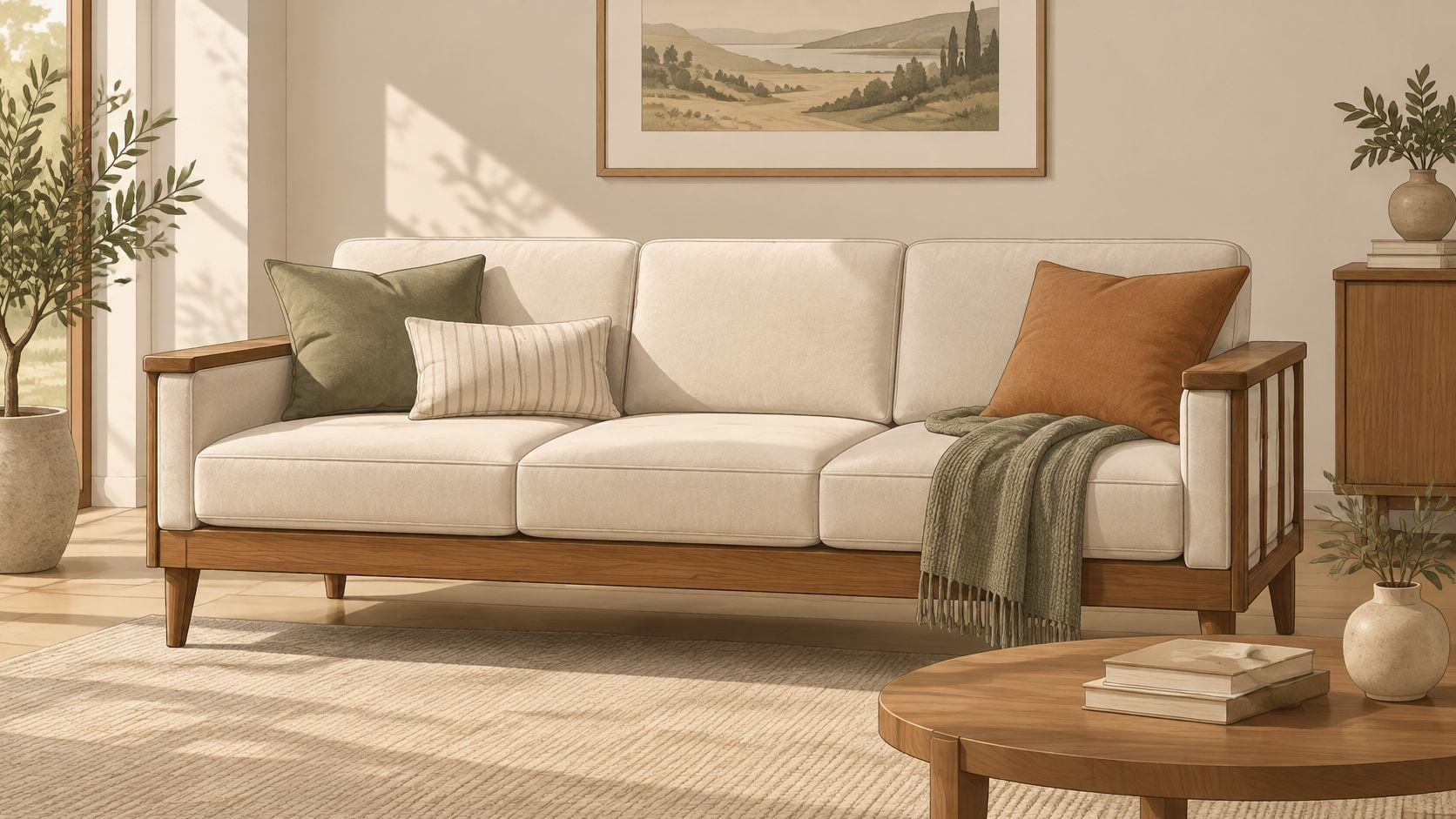
Treat the trim and frame as one piece
Historic furniture offers a useful example of how visible wood can shape a sofa's character. A Federal-period Philadelphia sofa acquired by Historic Odessa had exposed mahogany strips outlining its frame. When conservators removed its later upholstery, they found evidence of earlier brass-tack placement along the front rail. The Historic Odessa account of the sofa's conservation shows that wood could serve as an intentional decorative border, not merely an unseen frame.
That history also points to a practical buying question: can the sofa be maintained without compromising the wood or upholstery? Repeated reupholstery can leave nail holes and weaken the places where tacks are set. A well-built frame, carefully finished trim, and upholstery that can be maintained or replaced help preserve the piece's appearance.
When comparing sofas, inspect how the trim meets the upholstered panels. Check that edges look even, joints feel secure, and the finish is consistent on visible surfaces. A decorative rail may draw the eye, but it still depends on the frame beneath it to stay aligned.
A useful showroom exercise is to compare three sofas in person. Identify each trim zone, then ask which components are solid wood and which use veneer or an engineered core. Seeing the pieces side by side in Longwood makes it easier to judge how the details affect the sofa's overall character.
Which Woods and Finishes Work Best for Trim?
Wood remains a substantial part of furniture construction. One industry analysis estimated that wooden furniture represented 39.26% of the U.S. furniture market by material in 2025, a figure covering furniture broadly rather than sofas alone, according to the U.S. furniture market analysis. Traditional furniture frames have used species including oak, sweet gum, and yellow poplar, while manufacturers may also use plywood or other engineered materials.
The wood at the arms, rails, or legs may be solid lumber, veneer, or an engineered component. Those choices influence the look, movement, repair options, and cost. Ask which material is used for each visible piece instead of relying on a general label such as “wood trim.”
Compare common trim species
| Trim wood species | Grain and color | Relative dent resistance | Best trim use |
|---|---|---|---|
| Black walnut | Dark chocolate tones with straight to wavy grain | Moderate | Refined arms and rails |
| Cherry | Warm reddish tones that deepen with age | Moderate | Classic rails and turned details |
| White oak | Open grain with honey to gray tones | High | Transitional or Arts and Crafts frames |
| Red oak | Pronounced grain with pinkish tones | High | Traditional trim with bold grain |
| Hard maple | Light, fine grain with creamy white tones | High | Clean-lined trim and high-contact arms |
| Mahogany (Honduran) | Reddish-brown with fine, uniform grain | Moderate | Formal, traditional trim |
| Ash | Pale, open grain with strong contrast | High | Durable, lightweight accents |
A harder species generally resists dents better, which can matter on an arm cap that gets frequent contact. Grain and color matter just as much: walnut and cherry can give a sculpted rail a quieter, richer look, while oak makes the grain itself more prominent. These are general comparisons, not a substitute for asking the maker about the specific wood and finish used on a sofa.
Understand the finish and substrate
An oil finish tends to leave a natural-looking surface and can be easier to refresh, but it may offer less surface protection than a harder coating. Hand-rubbed finishes can emphasize grain and produce a soft sheen. Lacquer and conversion varnish create a more protective film, while stain changes color without, by itself, telling the buyer how resistant the final surface will be to wear. Ask what protects the stained wood, not just what color it is.
For a better sense of how preparation affects a painted or refinished surface, Tony Painting's furniture preparation advice offers a useful overview. For choosing a species based on appearance and use, compare the guide to the best wood for furniture.
A veneer over a stable core can provide an attractive, consistent surface, but it offers different repair options than solid wood. Engineered substrates can also be appropriate when they're well made and correctly finished. Ask which species is used for each visible trim piece and whether the finish covers every exposed surface. In a Longwood showroom, real finish samples can be compared side by side in natural light.
Does Wood Trim Affect Your Indoor Air Quality?
The visible trim doesn't tell the whole material story. A sofa may combine solid hardwood on its arms with veneer, plywood, MDF, or particleboard in less visible panels. Adhesives and coatings, including lacquers and paints, can also contribute to indoor emissions.
The U.S. Environmental Protection Agency identifies pressed-wood products made with urea-formaldehyde resins as significant household formaldehyde sources. Under federal composite-wood standards, the emission limits are 0.05 parts per million for hardwood plywood, 0.11 ppm for MDF, 0.13 ppm for thin MDF, and 0.09 ppm for particleboard, according to the EPA's consumer guidance on formaldehyde standards. Laminated products are generally treated as hardwood plywood beginning March 22, 2024, unless an exemption applies, as explained in the EPA's guidance for regulated stakeholders.
Ask for materials and certification details
A material schedule is more informative than a broad description such as “wood frame.” Ask which parts are solid hardwood, veneer, or composite, and request certification information for composite panels. EPA guidance recommends third-party-certified composite materials that meet emission standards, along with sealing exposed edges and drilled holes where applicable. A clear-looking finish is not proof that a product has low emissions.
After delivery, ventilate the room as practical, particularly during the first days. Central Florida homes often rely on air conditioning and keep windows closed, so ventilation and steady indoor conditions are useful considerations. Wood trim is neither automatically healthier nor problematic. The material beneath the finish, adhesive chemistry, coatings, and certifications are what matter.
How Do You Size a Wood-Trim Sofa for Your Room?
Start with the space the sofa will occupy, then confirm the actual dimensions of the model under consideration. Use the guide below as a layout framework, not as a substitute for the manufacturer's measurements. The exposed arms and legs can make a sofa appear visually larger than a fully upholstered piece with a similar footprint.
| Sofa type | Typical length and depth | Room-fit guideline |
|---|---|---|
| Two-seat sofa | Measure the specific model; check both overall width and seat depth | Can suit a compact room, including a 10-by-12-foot layout |
| Three-seat sofa | Measure the full arm-to-arm width and front-to-back depth | Needs a clear wall and circulation space around it |
| Sectional | Measure each leg of the configuration and the chaise projection | Plan the full L-shaped footprint before choosing a wall |
| Walkway behind sofa | At least 30 inches | Allow 36 inches where traffic is heavy |
Measure before visiting
- Measure the wall and usable floor area. Record the length of the wall, then account for door swings, windows, and the routes people use to cross the room.
- Mark the sofa footprint. Use painter's tape to outline the proposed length and depth. Include the full projection of exposed arms, legs, or a chaise, rather than marking only the seat.
- Check the delivery path. Measure entry doors, hallways, turns, staircases, and elevator interiors. A sofa that fits the room may still be difficult to bring inside.
- Test the seat, not just the length. Seat depth affects how a sofa feels more directly than overall width. Sit on the model in the showroom and check whether the support suits the people who'll use it.
For example, a Lake Mary family room around 14 by 18 feet might accommodate a three-seat sofa with space for a clear walkway, while a smaller Sanford condo may call for a compact two-seat sofa with slimmer exposed arms. Treat those as layout scenarios, not guaranteed fits. Measure the actual room and model before ordering.
A wide wood arm cap can change the way a sofa reads against a wall and make a room feel tighter than the tape outline suggests. Bring room measurements, doorway widths, staircase or elevator dimensions, and a clear photo of the room. The room-measuring guide for furniture can help organize those details before a showroom visit.
Which Upholstery Protects Exposed Wood Best?
A fabric's abrasion rating and a sofa's wood-trim craftsmanship answer different questions. The upholstery affects how well the seating surface resists visible wear; the trim affects the exposed structure and the fabric-to-wood transition, where contact can concentrate. Choose both deliberately.
The Wyzenbeek method measures abrasion in double rubs. One double rub represents a controlled back-and-forth abrasion cycle, and the result indicates resistance to visible wear, not a guaranteed service life. Textile guidance places approximately 15,000 Wyzenbeek double rubs in the low-traffic range and 30,000 in the high-traffic range, with corresponding Martindale benchmarks of 20,000 and 40,000 cycles, respectively, according to the textile durability reference.
| Upholstery | Durability benchmark | Best for | Florida note |
|---|---|---|---|
| Performance woven fabric | Around 30,000 double rubs for a high-traffic target | Family rooms with children and pets | Check lightfastness in sun-exposed rooms |
| Linen blend | Around 15,000 double rubs for a low-traffic setting | Formal rooms with limited daily use | Breathable, but shows wrinkles; keep out of direct sun |
| Tightly woven microfiber | Check the manufacturer's abrasion rating | Homes where spills and pets are a concern | Often easy to wipe clean; confirm the cleaning code |
| Full-grain leather | Ask for the maker's stated durability information | Long-term seating where a natural patina is welcome | Keep indoor conditions steady to help prevent drying |
| Top-grain leather | Ask for the maker's stated durability information | Moderate-use rooms that call for a smoother surface | Verify the grade and protective topcoat |
Specify the contact points
When someone leans on an exposed arm or brushes against a wood rail, the fabric edge may receive repeated contact. For a busy family room, a tightly woven performance fabric rated near the high-traffic benchmark is a stronger starting point than choosing by color alone. Abrasion results don't measure pilling, staining, seam strength, fading, or resistance to pet claws.
A homeowner weighing pet-related wear can also consult a guide to pet-friendly upholstery for practical considerations. Then confirm the details with the sofa maker: the rub rating, cleaning code, lightfastness information, cushion-cover construction, and warranty terms. The guide to choosing upholstery fabric can help narrow options around household use and appearance.
Color should work with both the room and the wood. Warm walnut or cherry often pairs naturally with warm neutrals, while white oak can sit comfortably with cooler greige tones. An in-house design team can help compare fabric samples against wood finishes before a custom selection is finalized.
What Are the Real Pros and Cons of Wood Trim?
Wood trim makes sense for homeowners who value visible craftsmanship and intend to keep a sofa for the long term. It brings more exposed surface to maintain than a fully upholstered design, so the right choice depends on how the room is used and whether the construction can be repaired.
Advantages
- Visual warmth: Exposed grain gives the sofa a clear outline and a more furniture-like presence.
- Refinish potential: Solid wood can sometimes be refreshed when the finish wears, depending on its construction and coating.
- Repair options: Replaceable trim or components can make a damaged piece easier to restore.
- Aging character: A well-maintained wood finish can develop a softer, lived-in appearance over time.
Trade-offs
- Seasonal movement: Changes in indoor moisture can affect fit at joints and upholstery transitions.
- Visible marks: Scratches and dents stand out on exposed arms, rails, and legs.
- Repair expense: Refinishing or replacing a shaped component may require specialist work.
- Moving weight: A substantial wood frame can be harder to maneuver.
- Higher initial investment: Solid materials and careful construction can cost more than mass-produced frames.
A fully upholstered sofa hides more of its frame, but that can make structural wear harder to reach and restore. A wood-trim sofa displays marks sooner, yet solid, replaceable trim can offer a clearer path to repair. The deciding question isn't whether wood trim is always more durable, but whether the specific frame and components can be maintained.
Practical rule: Ask whether the wood can be refinished and whether the maker can supply a replacement part before deciding that visible trim automatically means easier repair.
Wood trim is often a strong fit for a homeowner who expects to keep a sofa for many years and values materials that can be serviced. It may be less suited to a room with harsh direct sun, frequent moves, or pets that repeatedly scratch exposed rails. A candid showroom comparison should account for those conditions, not just the sofa's first impression.
How Do You Care for Wood Trim in Central Florida?
Wood gains and loses moisture as indoor humidity changes, which can cause swelling or shrinkage across the grain. The Composite Panel Association's dimensional-stability bulletin identifies about 28% moisture content as the fiber-saturation point, with normal dimensional movement occurring below it; furniture-grade lumber is commonly conditioned to approximately 6–8% moisture content before fabrication.
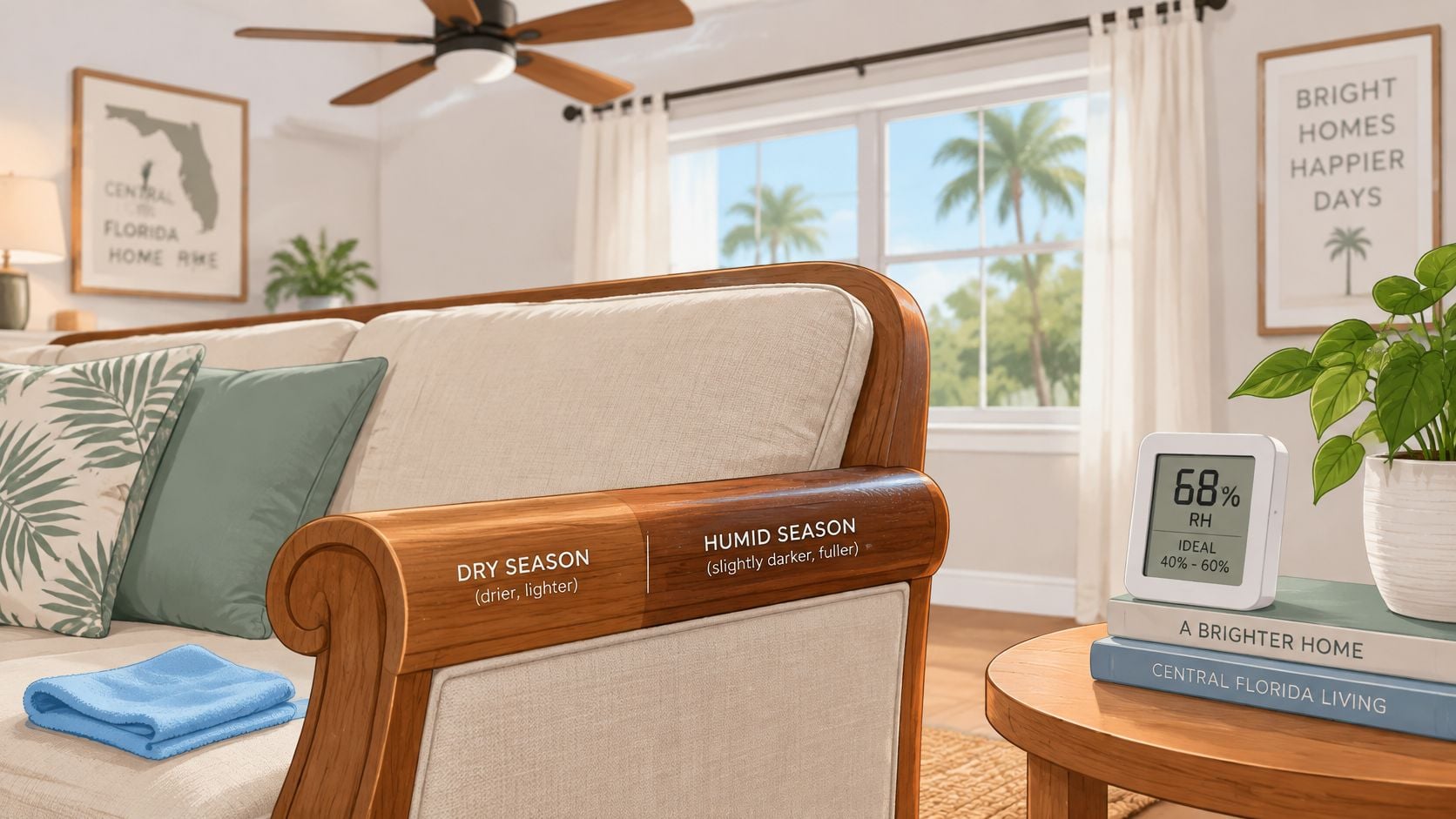
In Central Florida, humid summer conditions and heavily air-conditioned interiors can put wood through changing environments. Those shifts may contribute to open joints, finish checking, loosened fasteners, or misalignment where trim meets upholstery. A steady indoor environment helps protect the wood, the finish, and the fabric.
Follow a simple care routine
- Let the sofa settle after delivery. Position it away from supply vents so the trim isn't exposed to a concentrated stream of conditioned air.
- Keep indoor conditions steady. Use the HVAC system and, when needed, a dehumidifier to manage summer moisture. Avoid repeated large swings rather than chasing a single reading.
- Limit direct sunlight. Move the sofa out of harsh afternoon sun, which can fade upholstery and change the appearance of wood finishes.
- Dust with a soft, dry cloth. Regular gentle dusting removes grit that can scratch the finish during handling.
- Wipe spills promptly. Use a lightly damp cloth, then dry the wood immediately. Don't leave standing moisture on joints or finish edges.
- Use only approved care products. Check the finish maker's guidance and apply polish sparingly. A product intended for one coating may leave residue or damage another.
- Inspect the trim and joints periodically. Look for gaps, lifted finish, shifting trim, or loose fasteners, and address small changes before they worsen.
- Leave refinishing to a professional. Sanding at home can cut through a veneer or alter the shape of a molded component.
Balanced construction matters too. Ask whether the visible wood is solid lumber, veneer, or an engineered substrate, whether exposed surfaces are finished, and whether the joints allow modest movement. For more detailed upkeep, use the guide to caring for wood furniture.
Which Custom and American-Made Trim Options Are Available?
Custom ordering gives buyers more control over the details that matter in a wood-trim sofa: the species, finish, arm profile, upholstery, and configuration. That flexibility is useful when a room has a distinctive palette or the standard catalog options don't suit the space. The right choice is the one that balances the desired appearance with construction and repair needs.
Match the maker to the design
- Stickley suits buyers drawn to Arts and Crafts heritage, solid wood construction, and handcrafted joinery. Its visual language works particularly well when the wood trim should feel integral to the sofa's design.
- Simply Amish is a fit for those who value hand-selected solid hardwoods and traditional joinery in American craftsman furniture.
- Smith Brothers focuses on custom bench-made comfort, premium frame construction, and extensive fabric and leather customization. It can suit a homeowner who has a specific upholstery choice in mind.
- Bassett offers classic American-made quality, personalized upholstery, and an accessible-luxury position for traditional living spaces.
These makers answer different priorities rather than offering interchangeable versions of the same sofa. A buyer focused on a strong solid-wood presence may begin with one set of options, while someone prioritizing fabric selection and upholstered comfort may favor another. The construction details still need to be confirmed model by model.
A design consultant can help coordinate wood tone, upholstery, room scale, and neighboring pieces. Slone Brothers Furniture has served Central Florida from Longwood since 1980, with an in-house design team and complimentary in-home design services to help connect a sofa to the room around it. The American-made furniture selection is a starting point for exploring available makers and styles.
Before ordering, ask for the available finishes and fabric samples, confirm which components are solid wood, and check whether the chosen configuration can be repaired or reupholstered later. Those details turn custom options into a considered investment rather than a cosmetic upgrade.
What Should You Confirm Before Ordering or Visiting Longwood?
Use this checklist to make the conversation specific:
- Material schedule: Ask whether visible and hidden components are solid wood, veneer, or composite, and request emissions or certification information for composite panels. The EPA's formaldehyde and indoor-air-quality guidance recommends lower-emitting materials, ventilation, and attention to exposed composite edges.
- Cushion construction: Confirm whether the seat uses high-density foam or a down-wrapped core, and whether the cushion cover can be replaced separately.
- Fire safety: Upholstered furniture must comply with 16 C.F.R. Part 1640 and the TB 117-2013 framework. The Consumer Product Safety Commission's upholstered-furniture guidance describes assessment of cover fabric, filling, barrier, and decking. Exposed wood doesn't replace upholstery compliance.
- Repair path: Ask whether the trim can be refinished, whether replacement parts are available, and which care products the maker approves.
A Longwood showroom visit lets you handle finish samples, compare wood tones in Florida light, and sit on the sofa to assess seat depth. A face-to-face design conversation can also help resolve questions about dimensions, fabric, and how the piece will work with the rest of the home.
Visit Slone Brothers Furniture in Longwood to compare wood-trim sofa finishes, explore custom-order options, and work with experienced design consultants on a coordinated room plan. The showroom also offers complimentary in-home design services, so Greater Orlando homeowners can discuss how a carefully chosen sofa will fit their home and daily life.