

Wood Upholstered Headboard Guide for Florida Homes


A bed can look beautifully finished in a showroom and still raise practical questions at home: Will its wood frame stay stable through a Florida summer? Will the upholstery tolerate daily reading, pets, or afternoon sun? A wood upholstered headboard combines visible timber with a padded, fabric-covered surface, but its lasting quality depends on what's beneath the finish as much as what catches the eye.
For homeowners in Longwood, Orlando, Lake Mary, Sanford, Winter Park, and across Central Florida, the right choice comes from treating the headboard as a layered piece of furniture. Wood, joinery, padding, fabric, labels, and mounting all play a part. Knowing what to ask before ordering helps turn a handsome bedroom centerpiece into a dependable investment.
What Is a Wood Upholstered Headboard and How Is It Built?
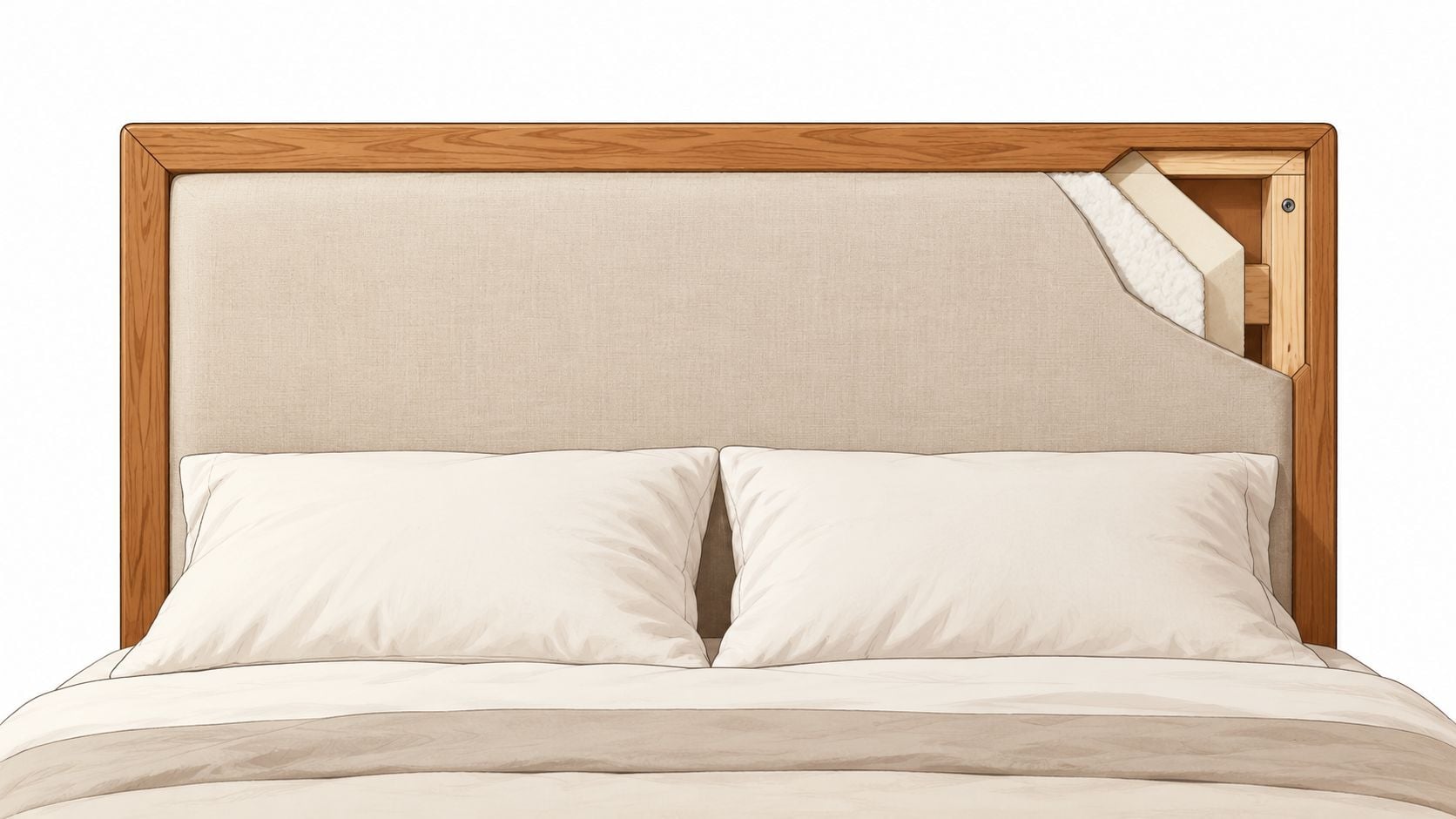
A wood upholstered headboard brings together a wood frame, padding, and a fabric cover. The frame sets the shape and supports the other layers; padding creates a softer surface for reading or resting; the cover provides color, texture, and protection. Quality comes from how these layers work together, from the frame to the cover.
Start with the structure
The frame may be built from solid hardwood rails and stiles, or from a wood perimeter with a plywood or engineered panel behind the upholstery. It gives the headboard its form and provides a base for padding, fabric, and attachment hardware. In a Florida bedroom, ask about the wood's moisture content and how the frame is joined. Wood can change size as humidity shifts, so the construction should allow for ordinary movement without loosening.
Mortise-and-tenon joints, dowels, and corner blocks are examples of ways to connect frame parts. Ask which method is used and how the joints are made. These details sit beneath the upholstery, but they affect whether the frame stays firm over time.
Then consider comfort and finish
Padding may consist of high-density foam, polyester batting, or a down-wrapped core with a softer feel. The upholstery, whether woven fabric, a performance textile, or leather, is stretched over the padding and secured, often with staples. Welting, pleating, channels, and deep button tufting add shape and influence how decorative the finished piece looks. For Florida's warm, humid conditions, ask how the cover holds up to everyday rubbing and whether its labels identify relevant material or compliance details.
The style has a long history. A Portuguese bed made in the second half of the eighteenth century at the Victoria and Albert Museum shows shaped solid-wood headboards were fashionable between 1750 and 1800. The museum notes that its form resembles upholstered British state-bed headboards from the first twenty years of the eighteenth century, when luxury examples were commonly covered in silk damask. The museum's bed record documents that design lineage. By the end of the 1930s, bed makers were producing related shapes, often with pastel fabric and buttoning.
In a traditional or transitional Longwood bedroom, visible wood gives the bed definition, while padded fabric brings color and a comfortable backrest. Before ordering, ask how the maker specifies the materials and construction details for production. This guide to materials and tolerances for production provides background on those specifications.
How Wide and Tall Should Your Headboard Be for Each Bed Size?
A headboard should relate to the mattress, wall, and nearby furniture as one arrangement. Start with the mattress dimensions, then choose a width that leaves a little extra on either side without crowding nightstands or lamps. Mattress sizes can vary by manufacturer, so check the exact measurements before ordering.
| Bed Size | Standard Mattress (in) | Suggested Headboard Width (in) |
|---|---|---|
| Twin | 38 × 75 | 40–46 |
| Full | 54 × 75 | 56–62 |
| Queen | 60 × 80 | 62–68 |
| King | 76 × 80 | 78–84 |
| California King | 72 × 84 | 74–80 |
These are starting ranges, not fixed specifications. The mattress guide explains common mattress sizes and dimensions, but measure your own mattress and bed frame before choosing a headboard. A custom piece can be adjusted when the wall, window placement, or bed size calls for a different proportion.
Measure for proportion and comfort
Check the full wall arrangement before settling on a width. A headboard extending slightly beyond the mattress on each side can frame the bed, much like a picture frame gives a focal point a clear edge. Leave room for nightstands and lamps, and compare their height with the mattress so the pieces sit comfortably together.
Height depends on the room and how you use the bed. Measure from the top of the mattress to the top of the headboard. If you often sit up to read, a taller backrest gives you more support; a lower profile can help a small room feel open. Also account for bedding, since a thick mattress or topper changes where the headboard meets the bed.
For example, on a ten-foot wall, a queen bed with a 66-inch-wide headboard would leave space on either side. Treat that as a hypothetical proportion check, not a ready-made specification. Nightstands, windows, lamps, and the bed frame all affect the final fit.
Confirm how the headboard attaches
Headboards may bolt to the bed frame or hang from wall brackets. The right method depends on the piece's weight and the frame's design. Before ordering, check the frame's attachment points and locate the wall studs if you plan to mount the headboard to the wall. Bring those measurements, along with the wall and mattress dimensions, to the Longwood showroom so a design consultant can help check the fit.
Which Wood Holds Up Best in a Florida Bedroom, and How Do You Keep It Stable?
A headboard can look sound in the showroom and still shift after a humid Florida summer. Judge it as a layered system: the wood frame needs suitable moisture content and joinery, while its finish and upholstery attachments must allow for wood's natural movement.
| Species | Character | Stability considerations | Typical finish | Style fit |
|---|---|---|---|---|
| White oak | Strong, open grain with visible ray flecks | Ask how the lumber was dried and how the frame allows for movement | Oil or lacquer | Traditional and farmhouse |
| Hard maple | Fine, even grain in a pale tone | Dense wood can resist dents, but drying and joinery still matter | Clear lacquer or light stain | Modern and minimal |
| Cherry | Warm tone that deepens with age and light | Seasonal movement depends on the lumber and construction | Clear lacquer or oil | Transitional and heirloom |
| Walnut | Dark color and distinctive grain | Ask about moisture conditioning and joint design | Hand-rubbed oil | Contemporary |
| Birch | Smooth, consistent, economical hardwood | Stability depends on drying and how the frame is built | Stain or paint | Painted coastal and cottage |
| Poplar | Soft, uniform wood that takes paint well | More prone to dents, so it may suit hidden framing and panels | Paint | Painted designs |
Why moisture content matters
Hardwood lumber used for furniture, cabinets, and millwork is commonly dried to 6%–8% moisture content, according to the U.S. Forest Service. That figure is a useful question to ask a maker, not a promise that a finished headboard will stay motionless. Wood that is wetter than the conditions it will live in can shrink as it dries, putting stress on joints and fasteners. Wood that absorbs moisture can expand, pressing against panels or upholstery attachments.
Wood moves most across the growth rings, less across the radius, and very little along its length. The U.S. Forest Service's wood movement reference describes these differences, including typical longitudinal movement of 0.1%–0.2%. In a headboard, the frame meets foam, fabric, staples, and mounting hardware, which respond differently to moisture. Central Florida's seasonal humidity can make those differences show up as rippled fabric, squeaks, loose upholstery, or strain at joints and wall attachments. Ask how the design gives solid wood room to move, rather than relying on an arbitrary movement allowance.
Choose the finish, then care for the frame
Oil leaves a hand-rubbed look, lacquer creates a more uniform sheen, and paint suits coastal or farmhouse styles. Each finish affects the surface, but none prevents the wood from responding to humidity.
- Dust gently: Use a dry microfiber cloth. Apply wood-care products sparingly and keep them off the fabric.
- Mind the location: Avoid placing the headboard against a damp exterior wall, beside a humidifier, or directly in an HVAC discharge.
- Check the connections: Look at fasteners and upholstery attachments as seasons change. Address looseness before it strains the frame.
- Watch afternoon sun: Strong west-facing light can dry wood unevenly. Use window film or reposition the headboard if it gets direct sun.
For routine upkeep, follow this wood furniture care guide. Before ordering custom work, ask what species is used, how its moisture content is checked, what joinery holds the frame together, and how the design accommodates movement.

Which Upholstery Fabric Holds Up to Daily Bedroom Use?
A fabric can look beautiful on a sample and still be poorly suited to the way a headboard is used. Match its abrasion rating to the contact it will receive, especially if someone regularly sits against the headboard or pets and children share the bedroom.
The Association for Contract Textiles describes two separate abrasion tests. Wyzenbeek rubs fabric back and forth and reports double rubs; Martindale uses a figure-eight motion and reports cycles. Their results aren't directly convertible, so compare ratings within the test method used. These benchmarks come from the association's abrasion testing guidance.
| Use Case | Wyzenbeek Double Rubs | Martindale Cycles | Best Fit |
|---|---|---|---|
| Low-traffic, private bedroom | 15,000 | 20,000 | Adults only, occasional leaning |
| High-traffic or heavy-use | 30,000 | 40,000 | Children, pets, daily sitting, hospitality bedrooms |
Read beyond the rub-test result
Performance blends can suit busy family bedrooms, while linen-look weaves bring visible texture. Velvet can crush and change sheen with contact, so its appearance may shift where people lean. Leather is another option, but top-grain hides and bonded leather shouldn't be treated as equivalent materials. For households managing pet fur, the practical benefit of smooth fabrics for easier fur cleanup is worth considering alongside the fabric's construction and care instructions.
Abrasion scores don't tell the whole story. The test doesn't fully assess edge abrasion, seams under compression, snagging, sunlight, cleaning chemicals, or repeated contact with hair and skin oils. Ask for the fabric's lightfastness information and cleaning code, then inspect the sample's seams and welt cords. In Florida, test candidate swatches in the afternoon light of a west-facing window to see how their color and texture look in strong natural light.
A guide to choosing upholstery fabric can help narrow the options. At the Longwood showroom, compare two or three swatches against the actual wood finish before deciding.
- Vacuum regularly: Use an upholstery attachment weekly to remove dust.
- Blot spills promptly: Blot within minutes rather than rubbing, which can spread the stain or disrupt the weave.
- Check the cleaning code: Identify whether the fabric is marked W, S, WS, or X before applying any product, and follow the maker's instructions.
Performance blends generally tolerate skin oils and dust better than linen-look weaves. A removable cover can also be cleaned or replaced without disturbing the wood frame, if the construction is designed for it.
Which Safety and Material Labels Should You Verify Before Ordering?
A wood frame doesn't make a headboard regulation-free. The upholstered portion may be subject to furniture-flammability requirements, and composite wood panels have separate emissions rules, so ask for documentation rather than judging by appearance.
Check the upholstery compliance label
The U.S. Consumer Product Safety Commission explains that upholstered furniture manufactured, imported, or reupholstered on or after June 25, 2021, must comply with the federal upholstered-furniture standard. The standard incorporates California TB 117-2013 testing for cover fabrics, fillings, barrier materials, and decking, and covered furniture must carry a permanent compliance label. See the CPSC upholstered-furniture guidance.
A solid hardwood perimeter may still surround foam, batting, fabric, or a barrier layer. Ask what fillings and barrier materials are used, whether the piece is intended for residential use, and whether its label confirms compliance. If the fabric can be replaced, ask whether reupholstery can preserve the tested construction.
Ask what's inside the frame
A headboard may combine a solid-wood frame with plywood, MDF, or particleboard panels under the fabric. The EPA's consumer guidance to composite wood emission standards lists these limits:
- Hardwood plywood, 0.05 ppm
- MDF, 0.11 ppm
- Thin MDF, 0.13 ppm
- Particleboard, 0.09 ppm
For composite wood products made in or imported into the United States after March 22, 2019, certification and labeling under TSCA Title VI are required. The EPA's composite wood standards overview explains the regulatory framework. Request the relevant label or certification information for panels used in the product. Words such as “natural” or “eco-friendly” aren't substitutes for documented compliance.
A Longwood showroom consultant can review the labels and material questions in person, including what a custom cover change would mean for the finished construction.
Is a Wood Upholstered Headboard Worth the Investment?
A Florida bedroom can put a headboard through different tests: humid air, everyday use, and the occasional move. Whether the investment makes sense depends on how long you expect to keep the bed and how well the frame and upholstery are built for those conditions. A wood frame, padding, and fabric work as a layered system, so compare each part before ordering.
What it offers
- A lasting structure: A sound wood frame with secure joinery can remain useful through years of bedroom use. Ask about the wood's moisture content and how the frame is joined, especially if the room is humid.
- A comfortable backrest: Padding makes sitting up to read more comfortable than leaning against a bare frame.
- A renewable surface: If the construction allows, the cover can be replaced or the headboard reupholstered while keeping the wood structure.
- Range of styles: Exposed timber and upholstery can suit traditional, transitional, or coastal rooms.
What to weigh
- Higher upfront investment: Materials, joinery, and custom choices can cost more than a simpler, lighter piece.
- More involved handling: A wood-framed, padded headboard can be heavy to move or mount.
- Different rates of wear: Fabric may need attention before the wood does. Ask about its abrasion rating and cleaning method.
- Care requirements: Use a cleaner suited to the upholstery, rather than an arbitrary spray.
- Room scale: A substantial headboard can feel oversized in a compact Florida bedroom.
Compare two quotes by looking beyond the purchase price. Check what each includes: frame materials and joinery, padding and fabric, delivery, and any care or reupholstery costs you expect over time. Confirm that the fabric's abrasion rating suits your use, and request applicable compliance labels. In a humid room, also ask how the frame's moisture content was managed. These details help explain why two headboards with similar appearances may have different long-term costs.
For a simple example, a headboard kept for 20 years has a lower cost per year of use than one replaced every five years, before counting the inconvenience and expense of replacing the whole piece. That comparison depends on the headboard staying serviceable: a durable frame offers little value if the fabric wears out quickly and cannot be replaced.
This style can suit homeowners planning to stay in one home and looking for a bedroom centerpiece designed around the room. A lighter option may make more sense when frequent moves, limited wall space, or a short-term furnishing need matter more than a substantial frame. The industry study offers background on furniture materials and industry history, but it does not determine whether a particular headboard is worth its cost. That comes down to construction, materials, expected care, and how long you intend to use it.
How Does Custom Ordering Work at Slone Brothers?
A headboard is a layered system: the frame needs sound wood and joinery, while the upholstered layer needs suitable fabric and clear material documentation. Custom ordering lets you set those choices around the room. A custom furniture order can accommodate a wall, window, or oversized mattress when standard dimensions do not fit.
Work through the choices in order
- Measure the room: Record the wall, bed, mattress, and nightstand dimensions.
- Choose the wood: Compare species and finishes with existing furniture, and ask about the frame's moisture content and joinery.
- Select the upholstery: Check the abrasion rating, cleaning code, and fabric appearance in natural light.
- Request documentation: Ask for the upholstered-furniture compliance label and any composite-panel certification.
- Set custom dimensions: Adjust width or height to suit the wall, window, or mattress.
- Coordinate the bedroom: Compare the headboard with the dresser and nightstands so the finishes and proportions work together.
The order of these decisions matters. A fabric sample helps you judge color, but it does not tell you how the frame was assembled or whether the materials have the documentation you need. Ask those questions before placing the order.
Slone Brothers Furniture offers complimentary in-home design services, custom ordering, home delivery with order tracking, and post-purchase support. At the showroom, bring a fabric swatch, finish samples, or photos of your existing furniture. Those references can make it easier to discuss how the wood and upholstery will sit together in your bedroom.
Which Makers Fit Your Bedroom, and Where Should You Start?
A headboard has two jobs: the wood frame carries the structure, while the upholstered panel adds a softer surface. In a Florida bedroom, ask about both before ordering. For the frame, check the wood species, moisture content, and joinery. For the upholstery, ask about abrasion ratings, cleaning instructions, and applicable compliance labels. These details help you judge how each layer may hold up through humid seasons and daily use.
For a wood-forward look, compare makers by the hardwoods and joinery they offer, then consider how the finish will sit beside your existing furniture. Amish furniture is a place to explore traditional solid-hardwood styles. Browse the Amish furniture collection and ask which frame details are available on a specific headboard.
If you prefer a more upholstered look, ask the retailer to show fabric samples and provide the abrasion rating and cleaning code for each option. A fabric that suits the room's colors still needs to fit the way the bedroom is used. Confirm the frame's construction and the upholstery documentation together, since durability depends on both layers.
A custom order can bring the frame, finish, fabric, and dimensions into one decision. Slone Brothers Furniture offers design services to help homeowners assess those choices. Bring your room measurements and a few photos of nearby furniture to the showroom, then ask which wood and fabric options can be ordered for the headboard.