

Double Mattress with Pillow Top: A Complete Buyer’s Guide


Does a double mattress with pillow top fit a room by its footprint alone? Not necessarily. The mattress may occupy the same floor area as a standard double, yet its added height can change the way a bedroom feels, how sheets fit, how a headboard looks, and how easily sleepers get in and out of bed.
For Central Florida homeowners, those details matter. A bedroom in Longwood, Lake Mary, Sanford, Winter Park, or Altamonte Springs may already have fixed windows, wall art, substantial case goods, or a carefully proportioned bedroom suite. The right mattress must support the body, suit the sleeper's preferred feel, and respect the room's design.
A pillow top can provide inviting pressure relief, but it also introduces a construction and durability decision. The most satisfying choice comes from understanding what lies beneath the plush surface, not from choosing the tallest or softest model on a product page.
What a Pillow Top Really Changes About a Double Mattress
A pillow top isn't a loose topper placed on the bed for appearance. It's a separate comfort layer sewn directly to the mattress cover, commonly made from foam, latex, wool, fiberfill, or similar cushioning materials, while the support core beneath carries the body. This explanation of pillow-top construction clarifies why the mattress feels softer at the surface without becoming a completely different support system.
That distinction solves the first common confusion. A removable topper can be replaced or taken off, but an integrated pillow top is generally part of the mattress. Once its materials soften, the entire mattress may eventually need replacement, even if the underlying core remains usable.
Comfort begins at the surface
The sewn-on layer changes how the body settles. Shoulders and hips meet a more yielding surface before reaching the firmer support system, which can make a double mattress feel more welcoming for side sleepers and for anyone who finds a conventional innerspring surface too abrupt.
The top layer also changes the bed's initial response. A fiber-filled surface may feel airy and cushion-like, memory foam can create a slower contour, latex offers more responsive lift, and wool tends to provide resilient cushioning with a different hand feel. The support underneath still determines the deeper sensation of stability, edge support, motion response, and alignment.
A useful distinction is:
- Surface comfort describes the first impression when the body lies down.
- Support describes how the mattress holds the spine and pelvis through the night.
- Profile describes the finished height, including the sewn pillow-top layer.
The mattress types explained guide offers a useful foundation for separating these terms before comparing specific constructions.
The room has a say in the decision
A pillow top adds loft above the support core, so the bed may look more substantial and sit higher against a headboard. That height can be elegant in a generously scaled bedroom, but it may feel visually dominant in a compact guest room or a smaller master bedroom.
The buyer therefore has two questions to answer. Does the surface provide the desired pressure relief, and does the finished profile work with the room, bedding, frame, and sleeper's mobility? A broader pressure relief bedding guide can also help shoppers think about cushioning as part of a complete sleep setup rather than as a decorative extra.
Sizing and Profile Height for a Double Mattress with Pillow Top
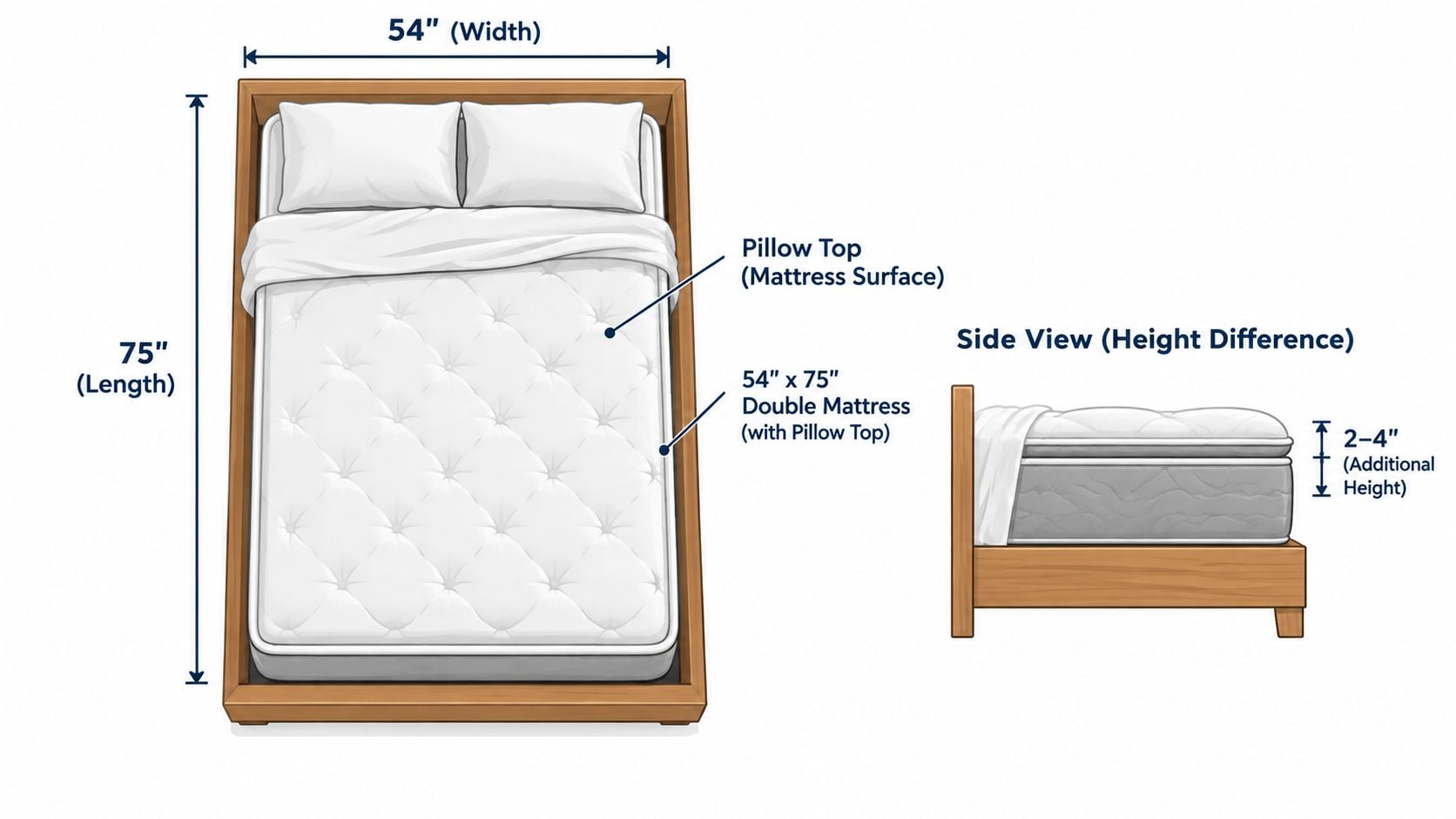
A UK double mattress is commonly defined as 135 by 190 centimetres, or approximately 53 by 75 inches, while the comparable full or standard double format is often described as 54 by 75 inches. A mattress sizing guide helps explain why naming conventions vary, so buyers should measure the existing frame rather than relying on the word “double” alone.
The footprint is compact. Two adults share the width, leaving less personal space than a larger bed, and concentrated pressure can make surface wear more noticeable in the areas where each sleeper rests. A double can work well in a guest room, a smaller master bedroom, or a room where preserving circulation matters, but the choice should be deliberate.
Profile height is separate from mattress size
A mattress can retain the same length and width while becoming much taller. A pillow top commonly contributes roughly 1 to 4 inches of additional loft, and finished profiles often fall around 12 to 16 inches, although lower-profile builds can be about 10 inches. These figures describe common construction ranges, not a guarantee for every model. A detailed construction reference shows why the core and comfort materials must be checked together.
| Construction | Base Height (in.) | Total With Pillow Top (in.) | Recommended Sheet Depth |
|---|---|---|---|
| Lower-profile support core | About 8 to 9 | About 10 to 12 | Standard or moderately deep, based on the finished specification |
| Mid-profile innerspring or hybrid | About 9 to 12 | About 12 to 16 | Deep-pocket sheets selected after measuring the mattress |
| Taller plush build | About 12 to 14 | About 14 to 18 | Extra-deep sheets, confirmed against the manufacturer's measurement |
The table is a planning aid, not a substitute for the actual product specification. Buyers should measure from the foundation to the top of the mattress, including any sewn cushioning, before ordering bedding.
Pillow top versus removable topper
A sewn pillow top is fixed to the mattress. A removable topper sits independently on the surface, can be replaced separately, and may shift unless properly secured. The two solutions can look similar in photographs, but they create different maintenance, sheet-fitting, and replacement decisions.
The safest sequence is simple:
- Measure the bed frame's inside dimensions.
- Confirm the mattress footprint in inches or centimetres.
- Record the complete finished height.
- Check the fitted-sheet pocket depth.
- Measure headboard, footboard, window, and wall-art clearances.
- Confirm the foundation or adjustable-base requirements.
The ultimate guide to mattress sizes can help households in Orlando and surrounding communities verify the terminology before delivery.
How Pillow Tops Are Built and What Each Core Feels Like
A pillow top doesn't have one universal feel. The sewn comfort layer may sit over an innerspring, hybrid, all-foam, or latex core, and that underlying structure controls much of the mattress's long-term behavior.
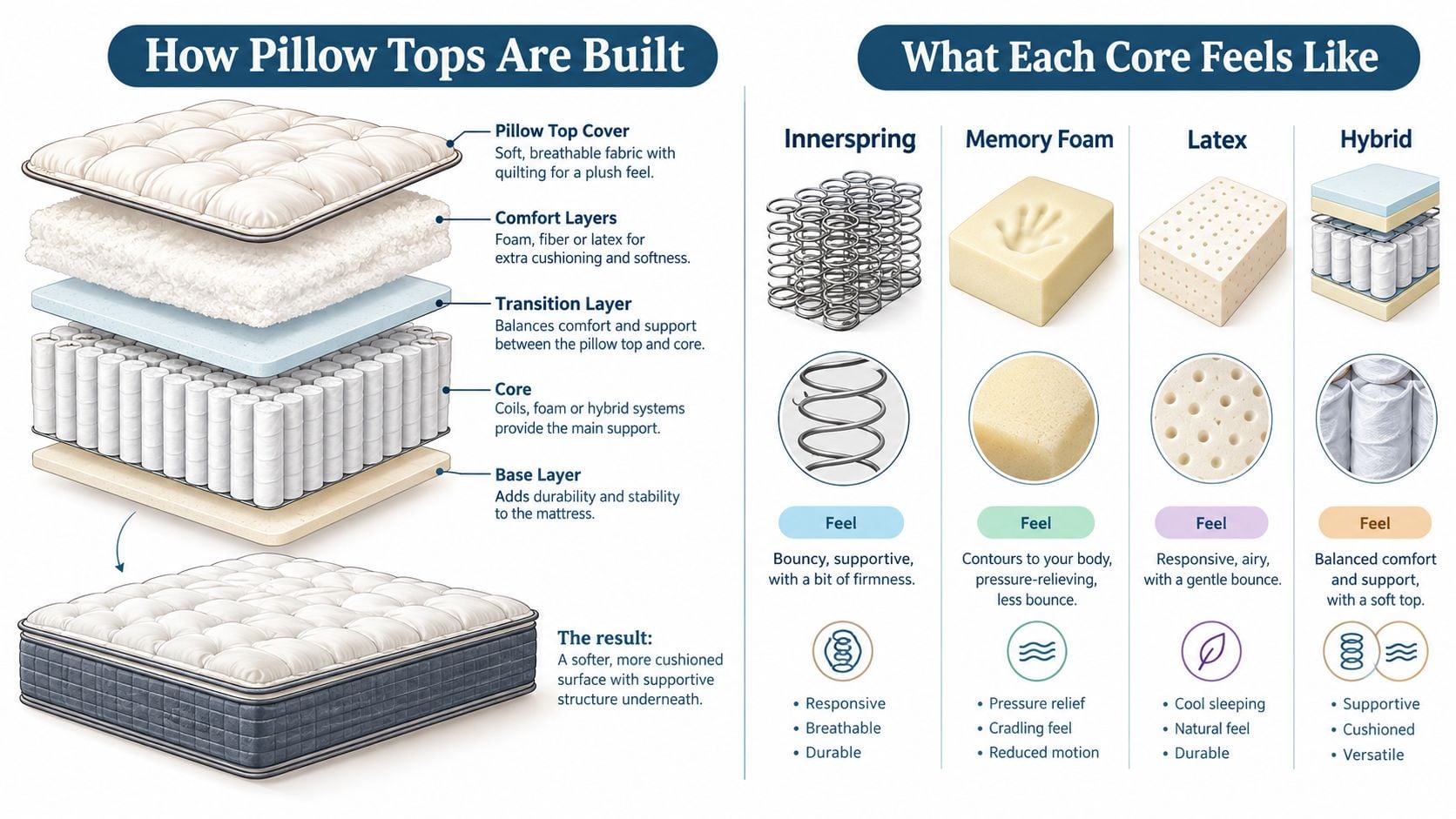
Traditional innerspring with a sewn pillow top
An innerspring base usually gives the familiar qualities of bounce, airflow, and a clearer push-back beneath the cushioning. The pillow top tempers the firmer coil sensation, creating a more accommodating surface while preserving the core's lively response.
This construction can suit sleepers who dislike feeling held in foam. Its longevity depends on the quality of the coil unit, the density and resilience of the top fill, and the stitching that keeps the comfort materials evenly distributed.
Hybrid with pocketed coils
A hybrid combines individually responsive coils with foam, latex, or other cushioning. The pocketed support can offer a more controlled response than a traditional interconnected spring system, while the pillow top softens the first contact.
Hybrid construction is often attractive to couples because the comfort layers can reduce some movement transfer without eliminating the springy feel entirely. The hybrid mattress guide provides useful context for understanding how the support core and comfort layers work as a system.
All-foam pillow-top designs
An all-foam mattress may use memory foam or polyfoam beneath the sewn top. Memory foam typically contours more closely and absorbs movement, while polyfoam can feel quicker and less enveloping. The choice affects ease of movement, temperature perception, and how strongly the surface conforms around the shoulders and hips.
Foam quality matters more than the label alone. Low-density materials can lose loft sooner, while higher-density foams may preserve their shape more effectively, though they can also feel more substantial and less buoyant.
For shoppers comparing a sewn pillow top with a separate layer, a practical guide to choosing the right mattress topper helps distinguish the functions of each arrangement.
Latex topped with wool or foam
Latex tends to provide responsive lift rather than a deep, slow sink. Wool or foam above it can add softness without completely muting the resilient character of the core.
From a durability perspective, latex and higher-density foam generally resist permanent compression better than fiberfill or low-density polyfoam, while the support core remains important in every design. Buyers seeking heirloom-level value should ask about the specific fill materials, not accept “plush” as a construction description.
Matching Pillow Top Firmness to Your Sleep Position
The right firmness depends on the sleeper's position, body shape, movement habits, and tolerance for sinking. A practical starting point is a medium-firm support core with a softer pillow top, because the core can preserve alignment while the upper layer reduces pressure at the shoulders and hips.
Back sleepers often need enough resistance to keep the pelvis from sinking too far. A forgiving pillow top can cushion the lumbar area, but an overly soft surface may allow the midsection to settle farther than the rest of the body.
| Sleep Position | Recommended Firmness | Best Pillow Top Build | Why It Works |
|---|---|---|---|
| Back sleeping | Medium to medium-firm | Foam, wool, or moderate latex comfort layer over a supportive core | Cushions the surface while maintaining even support beneath the torso |
| Side sleeping | Softer surface with a stable core | Resilient foam, latex, or dense cushioning over coils or hybrid support | Reduces shoulder and hip pressure without abandoning structural support |
| Combination sleeping | Medium and responsive | Pocketed coils or latex with a moderate pillow top | Allows easier repositioning and avoids an overly trapped sensation |
Side sleepers should pay close attention to shoulder and hip clearance. On a compact double, the body has less room to shift into a naturally comfortable position, so a surface that feels acceptable for a few minutes may create pressure after extended rest.
Combination sleepers need a balance between contour and mobility. Pocketed coils and latex tend to make movement easier, while a moderate upper layer can provide softness without swallowing the sleeper's momentum.
Firmness perception changes with the sleeper
Body weight influences how far a sleeper travels into the comfort layer. A heavier sleeper may experience a plush top as softer than a lighter sleeper does, while a lighter sleeper may remain closer to the upper quilting and perceive the same model as firmer.
The mattress firmness guide can help organize the decision, but no guide replaces testing. Two sleepers sharing a double should lie in their usual positions, turn naturally, and notice whether the spine remains level and whether movement feels restricted.
Practical rule: A pillow top should soften contact, not erase the support response underneath.
A local showroom makes side-by-side testing particularly valuable. Comparing two firmness levels on the same visit reveals differences that product descriptions rarely communicate, especially when both mattresses carry similar “plush” language.
Durability and Lifespan on a Smaller Sleeping Surface
Durability is the central tradeoff in pillow-top construction. The soft upper material usually compresses before the structural core fails, so visible impressions can appear years earlier than a complete loss of support.
Industry guidance commonly places pillow-top lifespan around 5 to 7 years, while higher-quality designs may extend to roughly 7 to 10 years when the fill is denser and more resilient. A discussion of pillow-top durability explains why fiberfill and low-density polyurethane can flatten faster than latex or higher-density foam.
Why a double can reveal wear sooner
A standard double is a relatively compact sleeping surface. When two adults share it, their shoulders, hips, and midsections occupy narrower recurring zones, which can concentrate compression in the pillow-top fill.
That doesn't mean every double wears prematurely. It means construction quality, sleeper weight, rotation practices, and foundation support deserve closer attention because the surface receives repeated loading in the same areas.
The most useful questions for a discerning buyer include:
- Fill density: What material creates the plush layer, and how resilient is it?
- Core construction: Does the base use coils, foam, latex, or a combination?
- Attachment method: Is the comfort layer permanently sewn into the cover?
- Replacement options: Can the upper comfort component be replaced independently?
- Foundation support: Does the base provide continuous, appropriate support?
Signs of premature wear
Loss of loft, a persistent body impression, uneven quilting, or edge stitching that begins to loosen can indicate that the comfort layer is changing faster than expected. A pronounced hollow where a sleeper rests can also produce a hammocking sensation, in which the body no longer feels evenly supported.
Care cannot transform a weak construction into a durable one, but it can protect the investment. A sound foundation, a breathable protector, careful handling, and periodic rotation when the manufacturer allows it all help distribute wear. Guidance on Dublin mattress hygiene advice also reinforces the value of regular cleanliness and appropriate maintenance.
A buyer should avoid selecting a pillow top solely because it feels luxurious in the first few minutes. The stronger decision weighs immediate comfort against material resilience and the fact that an integrated top usually makes the mattress a single replacement item.
Fitting the Mattress into Your Bedroom, Sheets, and Frame
The floor footprint of a standard double remains approximately 54 by 75 inches, but a pillow top can add several inches of vertical height. That extra profile affects bedding, furniture proportions, window clearances, and the ease of entering and leaving the bed.
Fitted sheets should be chosen after the complete mattress height is known. A sheet that fits the base but doesn't accommodate the sewn comfort layer may pull away from the corners, strain the elastic, or compress the pillow top unevenly.
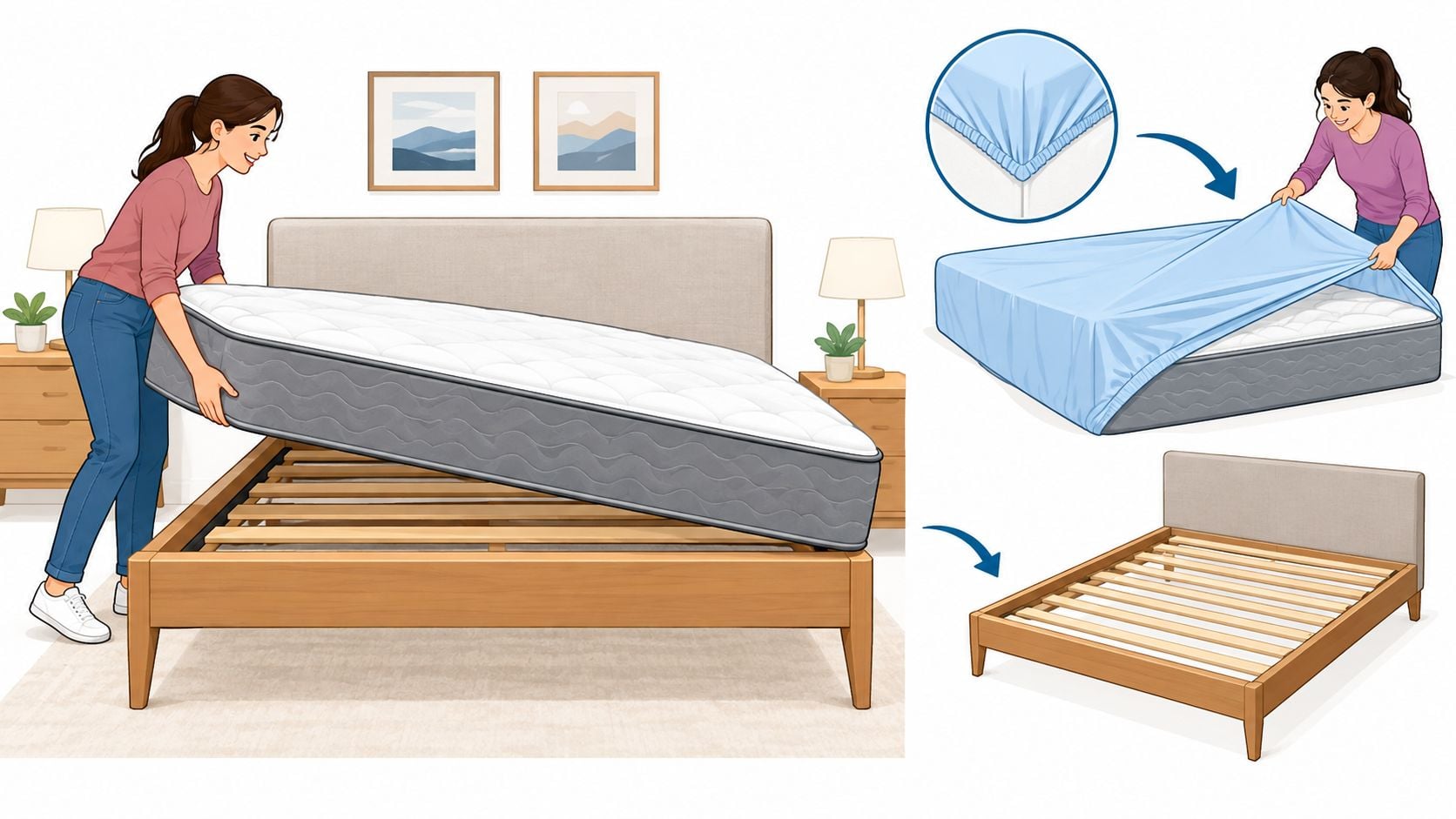
A practical room-fit check
Before ordering, the household should measure the frame, the available floor area, and the vertical relationships around the bed. A tall mattress may cover more of a headboard, sit close to a windowsill, or bring the sleeper's eye level near wall décor.
The check should include:
- Frame opening: Measure the inside length and width, not only the outer frame.
- Finished profile: Add the mattress and foundation heights together.
- Headboard proportion: Confirm that the mattress won't obscure the intended upholstered or wood detail.
- Footboard clearance: Make sure the sleeper can sit and rise without the mattress pressing against the rail.
- Window and artwork position: Check that the taller bed won't crowd a sill or overlap a low-hanging piece.
- Sheet pocket depth: Match the fitted sheet to the complete profile, including any protector.
Foundation and adjustable-base compatibility
A pillow top should rest on a foundation designed for its support system. Slat spacing, center support, box spring condition, and the frame's weight capacity can all affect how the mattress performs.
Adjustable bases require special attention. Some integrated pillow tops bend acceptably, while others resist articulation or place stress on the sewn cover. The retailer or manufacturer should confirm compatibility before delivery rather than leaving the household to discover the limitation after installation.
In a Florida home, delivery planning also deserves care. Narrow stairways, elevators, door turns, and humid conditions can complicate moving a substantial mattress into a finished bedroom, so measurements should include the route from the entry door to the frame.
Why Shopping in Person at a Local Showroom Matters
A product page can identify dimensions and materials, but it can't show how a pillow top responds to a particular shoulder, hip, or lower spine. Two mattresses with similar descriptions may differ noticeably in surface resistance, motion response, edge stability, and the way the sleeper gets out of bed.
That is why an in-person visit remains valuable for a high-intent purchase. A shopper can lie in the usual sleep position, change positions, sit at the edge, and compare the finished height against a headboard or bedroom suite.
The showroom turns specifications into judgment
At the Slone Brothers showroom in Longwood, a design consultant can help connect mattress selection with the rest of the room. The consultation may include the foundation, sheet requirements, bedroom furniture proportions, and the practical route for delivery.
The local setting matters to homeowners across Greater Orlando. Residents of Lake Mary, Sanford, Winter Park, Altamonte Springs, and nearby communities can evaluate several constructions without reducing the decision to photographs or abbreviated specifications.
A visit can also clarify:
- Foundation matching: Which base supports the selected mattress appropriately.
- Comfort comparison: How a softer pillow top differs from a more supportive surface.
- Bedroom coordination: Whether the profile works with existing or custom-order furniture.
- Delivery planning: How the mattress will reach the room and how the old bed will be handled.
- Service questions: How warranty concerns, comfort exchanges, and post-purchase support are managed.
Human guidance has practical value
Financing options through Synchrony and Acima may be available for qualified shoppers, and delivery coordination can extend across Orlando, Daytona Beach, and Kissimmee. The important point is not just convenience. A local consultant can discuss the purchase in the context of the homeowner's room, sleep habits, support needs, and long-term furnishing plans.
Slone Brothers Furniture is a family-owned Central Florida showroom serving the area since 1980, with mattresses, bedroom furnishings, custom-order pieces, complimentary in-home design services, and home delivery. Its local mattress store resource gives shoppers a starting point for arranging an in-person visit rather than making a decision from a screen alone.
A double mattress with pillow top can be an excellent choice when its surface feel, core construction, profile, and foundation all agree with the sleeper and the room. It becomes a poor investment when softness is considered separately from body support, sheet depth, access, and expected wear.
Ready to compare pillow-top constructions in person? Visit Slone Brothers Furniture in Longwood, FL, where experienced design consultants can help Central Florida homeowners evaluate comfort, mattress height, foundations, and bedroom proportions without automated digital chatbots. Schedule a showroom visit to find a mattress and bedroom solution that supports both restful sleep and a beautifully considered home.