

Aniline Leather Sofa: Care, Durability and Buying Tips


The leather swatch looks beautiful beside the rug, but the proposed sofa sits near a bright sliding glass door. An aniline leather sofa can bring exceptional softness and natural character to that room, yet the right decision depends on more than the color. Central Florida sunlight, indoor humidity, household routines, and expectations about aging all deserve a place in the conversation.
For homeowners furnishing a lasting home in Longwood or Greater Orlando, the central question is straightforward: should the leather remain visually consistent, or develop a more personal appearance through use? Slone Brothers Furniture, family-owned and serving Central Florida since 1980, approaches that decision through material education and individual design guidance rather than a premium-sounding label alone.
What is aniline leather and why does its surface show?
A sample that shows pore marks, a healed scar and a deeper tone along one edge is usually the aniline one. Aniline leather is hide colored with transparent, soluble dyes that penetrate the material while leaving its natural grain, pores, and markings visible. A clear wood stain gives the closest showroom comparison: color deepens, grain stays legible, and no opaque film is asked to make every panel match.
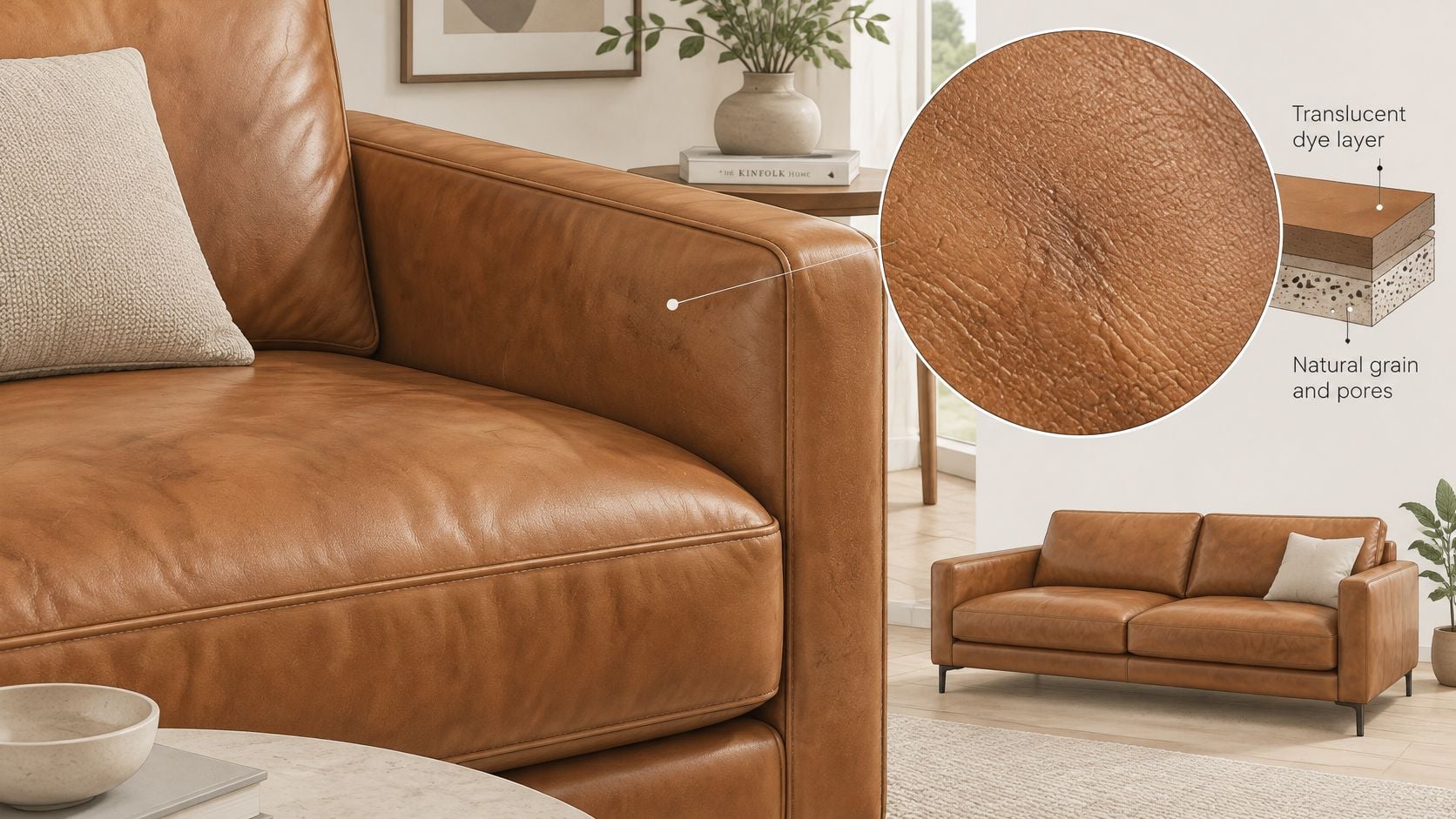
What the term describes
Aniline describes coloration and finishing, not an animal species or proof of vegetable tanning. The Food and Agriculture Organization's environmental review distinguishes beamhouse operations, tanning, and finishing, which explains how a conventionally tanned hide can subsequently receive aniline dyes.
Furniture is also one of several end uses within the broader hide-to-leather supply chain described by the Food and Agriculture Organization's leather-sector review. The word leather therefore identifies a broad material category, so a shopper still needs to ask about finish, cushioning and frame construction separately.
On adjacent panels, expect a smoother area beside a more pronounced grain pattern, then slight tonal drift where the dye took differently. On a good sample, pores, wrinkles and healed marks remain readable as character; in Florida rooms, that same openness is why strong daylight and humid seasons belong in the placement decision.
Practical rule: Aniline is a decision about visible material character before it is a color decision.
Side-by-side samples make the distinction easier to judge. In the Longwood showroom, a design consultant can help separate the appeal of a shade from the feel and appearance of the finish itself.
Which aniline leather grade should you ask for?
| Grade | Surface treatment | Abrasion and stain resistance | Visible grain and character |
|---|---|---|---|
| Pure aniline | Dye only, no protective film | Lowest | Full grain, scars and tonal variation visible |
| Full or protected aniline | Wax, oil or light protective coating added | Above pure aniline | Natural grain largely visible |
| Semi-aniline | Light pigment layer with topcoat | Above protected aniline | Grain partly visible, more even tone |
| Pigmented leather | Opaque pigment and coating | Highest | Uniform surface, grain largely masked |
The right choice is the finish that matches the household, not the label that sounds most exclusive. These are relative finish comparisons, not universal laboratory ratings or a ranking of complete sofa quality.
Pure aniline suits a calm sitting room where tactile luxury matters and visible change is welcome. It's less convincing for someone who wants the surface to look untouched despite everyday snacks, pets, and frequent entertaining.
Protected aniline offers a compromise. The Colourwise leather material guide describes protective oils, waxes, or coatings that retain natural character while improving resistance above pure aniline, but below semi-aniline.
Match the finish to the household
For an active family room in Sanford, semi-aniline may be the more comfortable ownership decision. It adds protection without completely giving up the appearance of natural leather. Pigmented leather is worth considering when consistent color and straightforward upkeep matter more than pronounced hide variation.
Names need careful handling. Some manufacturers use full aniline differently, so the combined table category shouldn't substitute for the maker's written specification. The quote should identify the actual treatment rather than relying on a verbal description such as premium leather.
- For visible character: Start with pure or protected aniline samples.
- For frequent family use: Compare semi-aniline alongside the preferred natural finish.
- For visual consistency: Examine pigmented leather without assuming that a more uniform surface means inferior workmanship.
The guide to upholstery materials provides broader context for comparing leather with other upholstery choices. For smaller leather accessories stored alongside furniture-care supplies, leather storage advice from Quote My Wall is a supplementary resource, not a substitute for the sofa manufacturer's instructions.
How does aniline leather feel and age over time?
Aniline leather feels soft and natural, with differences between panels that stay visible rather than concealed. Through use, its color and surface develop into patina, though some changes signal wear instead of character.
A Winter Park sitting room used daily for reading and conversation shows the pattern clearly. Within two to three years, the preferred seat turns smoother and slightly darker, the arms deepen in tone where hands rest, and the whole piece settles into a lived-in surface. An owner who enjoys natural materials tends to prefer that direction. Someone who wants furniture to look exactly as it did at delivery will not.
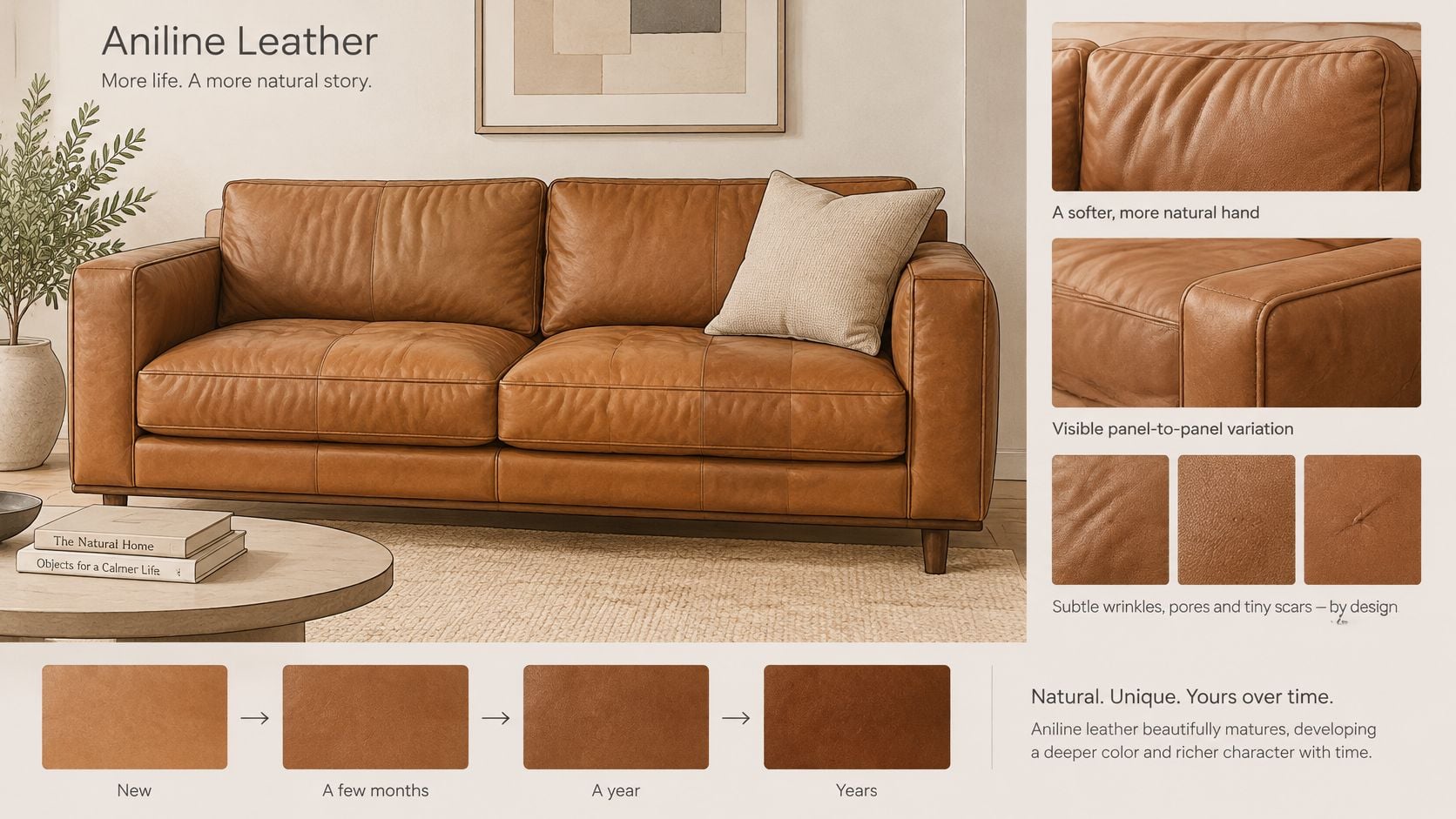
Separate character from deterioration
At Slone Brothers Furniture, inherent markings in leather are considered natural character and aren't considered defects. That standard covers what the hide arrived with: pores, wrinkles, healed markings, and tonal differences. What develops after delivery takes a separate judgment.
An even deepening of tone on a supple, intact surface points to healthy aging. Cracking, a torn seam, color transferring onto clothing, or a dark patch that stays tacky after a spill points to a problem worth having assessed.
- Expected character: Pores, wrinkles, healed markings, and natural tonal differences.
- Expected patina: Smoother contact areas and gradual color development without surface breakdown.
- Reason for assessment: Splitting, persistent tackiness, seam failure, or dye transfer.
Two hands-on checks separate welcome age from real damage. Bend the leather gently and watch whether the grain flexes or flakes, then run a fingertip along a scuff to feel whether the surface has merely shifted or broken. The Bridle Up Hope Shop resource on checking old leather boots for damage describes this same flex-and-feel approach, though footwear treatments shouldn't be transferred to upholstery.
Light scuffs often fade as oils and color redistribute across the panel. The useful question before buying is whether gradual change will read as welcome character or as an ongoing frustration.
Is an aniline leather sofa durable enough for daily family life?
An aniline leather sofa can suit daily use, but surface vulnerability and structural longevity are different questions. A visible mark doesn't automatically mean poor construction, and a beautiful hide doesn't guarantee a well-built sofa.
The leather upholstery selection guide identifies aniline's sensitivity to liquids, rubbing, moisture, and ultraviolet exposure. Those limitations concern how the upholstery behaves, not whether the frame or suspension is well engineered.
Look beneath the leather
A well-joined frame helps keep the sofa square and stable. The suspension, cushion core, and seams must also support the intended use. High-density foam deserves closer consideration than an unexplained comfort label, while a down wrap adds a particular feel rather than replacing the need for a supportive core.
When sitting on a showroom sample, evaluate more than initial softness:
- Frame stability: The sofa shouldn't rack or feel loose during ordinary movement.
- Seat recovery: Assess support after settling into the cushion, not just the first impression.
- Seam execution: Look for consistent stitching and balanced tension around curves.
- Serviceability: Establish whether cushion components can be accessed or replaced.
A household with young children or pets needs an honest tolerance for visible change. The guide to kid-friendly and pet-friendly furniture helps translate those routines into material decisions without treating every family room alike.
A sofa can remain structurally sound while its surface becomes less uniform. That isn't the same as promising that stains or scratches are harmless.
Read coverage before committing
Warranty language should be part of the selection discussion, not an afterthought. Slone Brothers Furniture's policies state that fabrics, leathers, and wood finishes aren't warranted against fading, stretching, staining, pilling, excessive wear, dye transfer, or color variation from samples.
That makes the fit test practical: can the household accept the material's normal exposure risks without expecting warranty coverage to reverse them? Written coverage and exclusions help establish that boundary before an order is placed.
Where in a Florida home should an aniline leather sofa go?
A west-facing living room in Longwood can feel perfectly comfortable at 4 p.m. while doing quiet damage to an aniline sofa. An aniline sofa earns its place in a climate-controlled interior, away from sustained direct sunlight, damp conditions, and concentrated airflow. In Central Florida, the two variables that matter most are the brightest part of the day and the room's actual humidity, and they are not the same thing.
Leather conservation guidance on indoor conditions places roughly 45%–55% relative humidity as a stable range for leather, with sustained readings above 65% raising mold risk and levels below 30% contributing to drying and brittleness.
Florida room conditions and aniline sofa placement
| Location | Main risk | Placement response |
|---|---|---|
| Lanai or screened porch | Heat, humidity and sun together | Choose a different material for this space |
| Window with direct afternoon sun | Fading of transparent dyes | Move the sofa out of sustained sun and use UV-filtering treatments |
| Sliding glass or frequently opened exterior door | Humidity swings and tracked-in moisture | Keep clearance and blot spills right away |
| Beside or under an air-conditioning vent | Drying from moving air | Keep clearance so air does not blow across the leather |
| Interior living room away from windows | Lowest exposure, patina welcomed | Good match for aniline leather |
Cooling and humidity control are separate jobs. An air conditioner can hold a room at a comfortable temperature while humidity drifts outside that stable band, especially in rooms adjoining frequently opened exterior doors. A digital hygrometer placed near the seating area gives a more useful reading than the thermostat on the wall.
In the Longwood room with the bright west-facing window, the fix starts with moving the sofa out of the afternoon sun path. Sheers soften glare, but where exposure stays strong, a rated UV-filtering window treatment does more to protect transparent dyes.
A Lake Mary family room with constant patio-door traffic presents a different problem. Placement outside the entry route helps, but where traffic and tracked-in moisture stay heavy, protected or semi-aniline leather is the more forgiving starting point.
Placement priority: Solve the room's exposure problem before choosing the leather color.
A well-sited interior sitting room is where aniline performs best, because what it shows there is patina: a gradual softening and deepening of color from normal use. Faded patches beside one sunny window, or darkened spotting near a damp door, read as damage rather than character. A high-sun, high-traffic space remains a poor match for pure aniline when the household expects the surface to stay uniform.
How do you care for an aniline leather sofa step by step?
Aniline leather care should be gentle, preventive, and specific to the finish. Routine maintenance should remove soil without scrubbing, over-wetting, or leaving an unsuitable coating behind.
Cortina Leathers' care and cleaning guidance supports low-abrasion cleaning and manufacturer-approved products, with specialist conditioning guidance commonly placing maintenance around every three to six months in dry or heavily air-conditioned environments. The particular leather maker's schedule remains the deciding instruction.
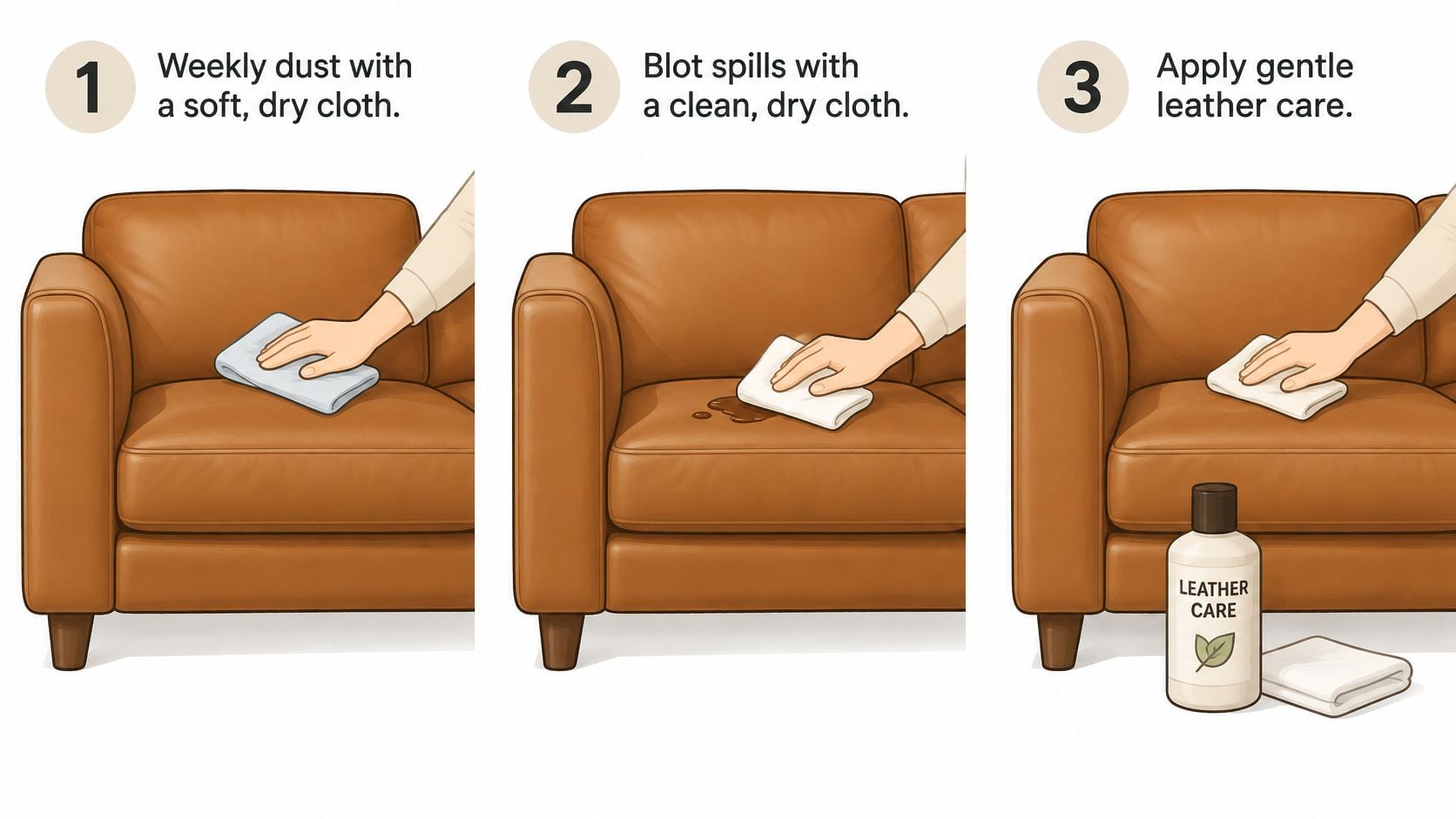
A practical maintenance routine
Dust weekly with a soft, dry cloth. Lift loose grit without pressing it into the surface. Pay attention to seams and cushion edges where particles collect.
Blot spills immediately. Press a clean, dry, absorbent cloth against the liquid, using fresh areas of cloth as needed. Rubbing spreads moisture and adds friction.
Use minimal moisture for light soil. If the manufacturer permits it, wipe with a barely damp cloth rather than a wet one. Stop if the area darkens unevenly instead of repeatedly wiping it.
Test the correct cleaner first. Choose a product formulated for uncoated aniline and approved for the specific upholstery. Apply it to the cloth, not directly to the sofa, after checking an inconspicuous area.
Leave household remedies out of the routine. Oils, saddle soap, abrasive products, bleach, solvents, and household sprays aren't appropriate unless the leather maker specifically approves them. A product suitable for another leather item may still damage this finish.
Condition according to the maker's instructions. More product isn't better. Excess conditioner can leave residue and change the surface instead of improving it.
Distribute wear where the design permits. Rotate interchangeable cushions without forcing fixed or shaped components into unsuitable positions. Use window treatments to manage recurring sunlight.
The guide to protecting leather furniture adds broader preventive-care context. For aniline, however, a dramatic before-and-after shine isn't the goal.
A well-maintained sofa should feel supple and clean, without tackiness or a heavy residue. Persistent stains, cracking, or sticky areas call for assessment rather than progressively stronger cleaning products.
What does an aniline leather sofa cost, and why is it an investment?
An aniline sofa's price moves with the hides, the finish work, the frame underneath, and how much of the piece is upholstered in leather. Configuration shifts the number as much as the grade does. Slone Brothers Furniture prices its Bassett Custom Two Seat Sofa #1912 at $999.00, and size, added features, and upholstery selections move a figure like that up from there.
Careful hide selection matters because the finishing process leaves so much visible. Even grain and thoughtful panel placement take skill, and natural markings should be read as character rather than a promise of identical panels.
What belongs in the quote
- Leather specification: Exact finish, color, and upholstery coverage.
- Frame and suspension: Materials, joinery, and support construction.
- Cushion package: Core composition, wrap, and available replacement components.
- Tailoring and configuration: Seam details, dimensions, and custom requirements.
The guide to American-made leather furniture gives useful context for weighing craftsmanship alongside upholstery choices. A domestic build is one variable on that list, and the frame, suspension, and tailoring still have to hold up on their own merits.
Cost per year of useful service beats sticker price as a comparison, so run the math on a hypothetical pair. A $4,800 aniline sofa that stays comfortable for 15 years works out to $320 a year, while a $2,400 sofa replaced after 6 years costs $400 a year. The lower sticker ends up more expensive annually, and the gap widens if the cheaper piece never develops a surface worth keeping.
That service period stays an assumption you control. In a Florida room, aniline pays back its premium when it sits out of direct sun and away from humidity swings, because the patina it develops is the thing you were paying for. An itemized quote shows where a higher-priced option adds real value and where it adds only a name.
What should you verify before buying, and how do you confirm it in Longwood?
A tag that reads "genuine leather," or even "aniline," tells a buyer almost nothing about how the sofa will behave in a specific living room. The safest purchase combines written specifications, a physical sample examined in the right light, and an honest assessment of where the piece will sit.
The sofa selection guide can help organize the broader decision before the finer leather questions begin. For aniline upholstery specifically, the following points belong in the order documentation.
Questions worth recording
Can you get the maker's written care sheet? A manufacturer confident enough to supply aniline upholstery should also supply written maintenance guidance for it. If the only answer is verbal, that is worth noting before committing.
What performance documentation is available? Request lightfastness and abrasion information, including the test method. A Martindale result can't be treated as an interchangeable Wyzenbeek result.
What lead time applies? The furniture industry's typical window for special-ordered pieces runs anywhere from 6-8 weeks, and that may not include delays such as out-of-stock fabrics or components. Knowing the timeline up front keeps a delivery surprise from souring an otherwise sound decision.
Which care instructions apply? Obtain guidance for the specified leather and approved maintenance products.
Can the sample be photographed under window light? Aniline reads differently beside glass than under showroom fixtures. A photo taken near the window where the sofa will sit gives a fairer preview than a swatch checked under a lamp.
Confirm the sample in the actual room
Request a representative sample of the specified leather and examine it in daylight at home, ideally in the same room and at the same hour the sofa will be used most. Slone Brothers Furniture notes that dye-lot variations may occur between floor samples and fabric sample swatches on upholstered and leather furniture, which is why the sample deserves that second look in real conditions.
Window exposure matters more in Central Florida homes than buyers often expect. Afternoon sun through a west-facing window and steady indoor humidity both register on an unprotected surface over time, so the sample check and the placement decision belong in the same conversation.
Room measurements, photographs, window orientation, and existing finish samples make an in-person consultation more productive. The Longwood showroom serves homeowners throughout Greater Orlando, including Lake Mary, Sanford, Winter Park, and Altamonte Springs.
Slone Brothers Furniture's design team offers complimentary services ranging from simple space planning to complete room makeovers, and an in-home visit can assess placement, traffic, and window exposure before a custom decision. That guidance carries extra weight with aniline, where room position shapes how the surface ages.
Most of the store's furniture can be customized for personal style and comfort. Customers can customize sofas, chairs, loveseats, sectionals, and other items through brand pages, an online design tool, in the store, or during a home visit.
The final quote should preserve every agreed choice, especially the leather identification and cushion specification. That written record helps ensure the factory order reflects the decision made in the showroom.
Slone Brothers Furniture offers face-to-face design guidance, complimentary in-home interior design services, and white-glove delivery to help bring a carefully considered room together. Visit Slone Brothers Furniture in Longwood, FL, with room photographs and measurements to compare leather samples and discuss whether an aniline sofa fits the home's light, routines, and expectations for aging.