

American Made Pine Furniture: Durability, Care and Value


The familiar advice to buy solid wood and look for an American-made label leaves an important question unanswered: how was the piece built? American made pine furniture can be a thoughtful investment for a Central Florida home, but domestic origin alone doesn't prevent dents, loose joints, or poorly fitted panels.
A discerning buyer needs to separate origin, species, construction, and finish. Each answers a different question, and together they reveal much more than a flag on a product tag.
What Does American-Made Pine Furniture Really Mean?
American-made pine furniture should have a country-of-origin claim that the manufacturer can substantiate, not merely an American brand name. An unqualified Made in USA claim means substantially more than final assembly in a domestic workshop, and neither claim is a durability guarantee.
The Federal Trade Commission's Made in USA guidance requires an unqualified claim to meet the all or virtually all standard, with final assembly or processing in the United States. The agency also considers the proportion of manufacturing costs attributable to domestic parts and processing, how remote foreign content is from the finished product, and its importance to the product's form or function.
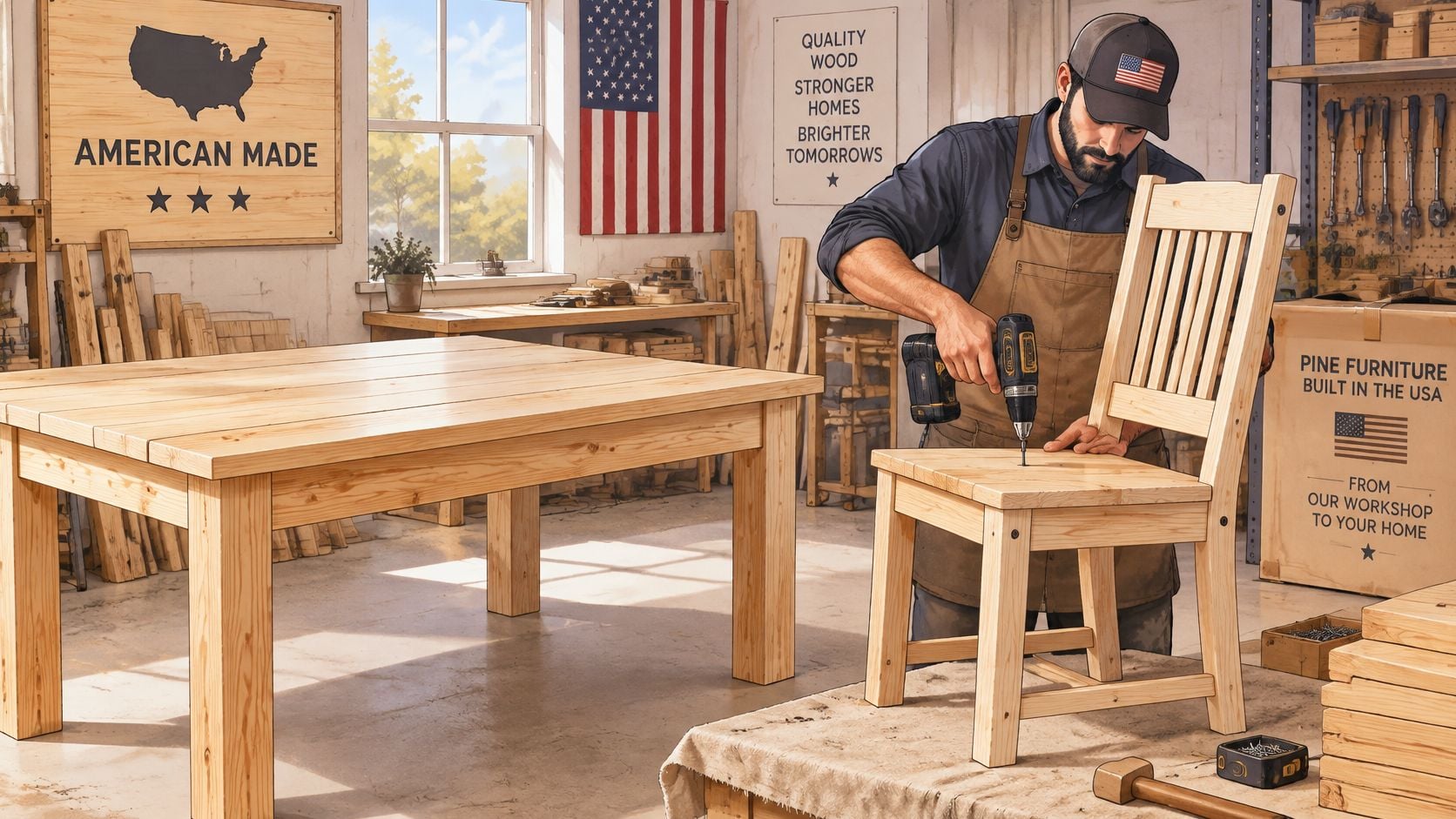
What the wording tells a buyer
- Made in USA: An unqualified origin claim covering the product broadly, not just its last manufacturing step.
- Assembled in USA: A narrower statement about assembly. It doesn't establish that the wood or components originated domestically.
- Made in USA with imported materials: A qualified claim that acknowledges foreign content. The details matter more than the reassuring phrase.
Consider a dresser made from pine harvested in one state, milled and joined in another, then finished domestically with imported drawer hardware. Those details help explain its manufacturing history, but they don't independently establish which label is appropriate. The manufacturer must assess the complete product.
Questions worth bringing to the showroom
A U.S. showroom address proves where furniture is sold, not where it was manufactured. American branding and domestic finishing alone are equally incomplete evidence.
Before selecting a piece, buyers should ask:
- Milling: Where was the pine milled?
- Assembly: Where did final assembly and finishing occur?
- Documentation: Is the manufacturer's country-of-origin policy available in writing?
For Greater Orlando homeowners, Slone Brothers Furniture's Longwood design consultants provide a face-to-face setting for reviewing those questions piece by piece. That distinction helps Central Florida buyers evaluate a specific dresser or table rather than relying on a broad impression of a brand.
What Are the Real Benefits of American-Made Pine Furniture?
Pine furniture can be easier to move and maintain than some heavier hardwood pieces, while its softness makes it more vulnerable to dents and scratches. American-made describes origin, not a guaranteed level of durability. The value comes from matching the wood and construction to the household.
A lighter piece may be practical when furniture needs occasional repositioning. For a tabletop or other surface that takes frequent impact, consider whether visible wear will suit the room over time.
Solid wood can often be refinished, but the finish and type of damage affect what repairs are possible. A 2024–2025 survey of 217 consumers reported mean ratings of 4.14 for repairability and 3.93 for ease of assembly and disassembly in its published consumer study.
Domestic production may connect furniture with regional forests and mills. Responsible sourcing still depends on details such as harvesting and milling; an American-made label alone does not certify environmental practices.
Craftsmanship also varies by piece. MAVIN furniture is American made and produced in Ohio's Amish country, using cherry, oak, maple, walnut, or hickory trees hand-selected by a third generation of lumber specialists. That example shows how origin and material selection can be described specifically, while the wood species and construction still need to be considered on their own.
Heirloom standard: Long-term value depends on construction that suits the household and wear that can be maintained.
For Central Florida homeowners, appearance is only one part of the decision. A piece's handling, repair options, and expected wear all help determine whether it fits everyday use.
Which Pine Styles Fit a Central Florida Home?
Farmhouse and coastal pine work particularly well with natural, painted, and softly washed finishes under Florida light. Clean-lined pine can also suit a transitional bedroom, provided the finish relates comfortably to the flooring and surrounding furnishings.
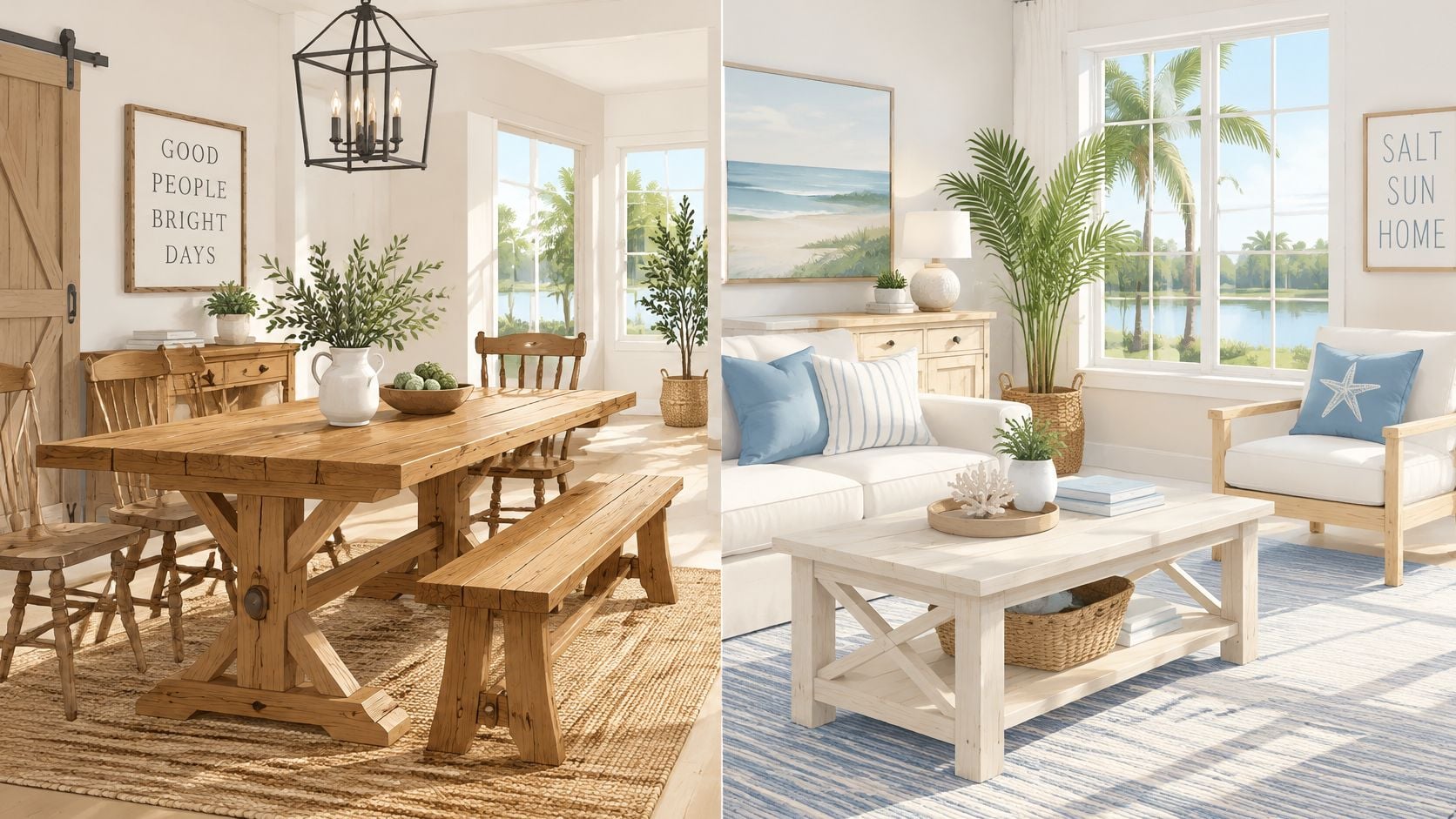
Match the style to the room's light
In a Lake Mary or Sanford dining room with strong daylight, farmhouse pine can introduce warmth without making the room formal. Visible grain, a plank-style top, and trestle or turned legs create a relaxed composition. A restrained finish usually coordinates more easily with upholstered seating than heavily exaggerated distressing.
For a bright coastal living space, painted or whitewashed pine pairs naturally with woven textures and lighter upholstery. The useful distinction is between a coastal palette and a themed room: pale wood, balanced proportions, and restrained accessories create the former. Slone Brothers Furniture's guide to coastal-look furniture offers context for that direction.
In a Winter Park or Altamonte Springs bedroom, simple case pieces can let the grain provide the decoration. A quieter silhouette is particularly helpful when patterned bedding, artwork, or an architectural headboard already supplies visual interest.
Compare the look without confusing the species
Pine's place in American interiors reflects an established material supply, not a passing decorating trend. The U.S. Forest Service's forest-industry records track U.S. softwood lumber production from 1965 onward, including commercially important pine categories.
Slone Brothers Furniture offers Amish bedroom and dining room furniture. MAVIN is American made in Ohio's Amish country, using cherry, oak, maple, walnut, or hickory trees hand-selected by a third generation of lumber specialists.
- For a pine aesthetic: Compare the actual grain and finish, not the collection name.
- For greater dent resistance: Consider a suitable hardwood alternative rather than expecting stain to change pine's physical properties.
- For visual harmony: View finish samples beside flooring, wall color, and upholstery.
The strongest choice fits both the room's light and its daily traffic. Similar-looking finishes can conceal very different materials.
How Does Pine Compare to Oak, Maple and Cherry?
Pine suits furniture where a lighter look, painted finish, or visible grain matters more than resistance to dents. Oak and hard maple are often better choices for heavily used surfaces. Cherry and walnut offer different grain patterns and color.
| Wood | Typical furniture use | Janka hardness |
|---|---|---|
| Eastern white pine | Painted casegoods, bedroom pieces, decorative furniture | Approximately 380 lbf |
| Black cherry | Dressers and case goods with a warm finish | , |
| Black walnut | Dining tables, desks and accent pieces | , |
| Red oak | Dining tables, chairs and heavy-use furniture | , |
| Hard maple | Tabletops, bench seats and high-wear surfaces | , |
The USDA Forest Products Laboratory's eastern white pine profile reports dry specific gravity of approximately 0.37, Janka hardness of approximately 380 pounds, modulus of elasticity near 1.24 million pounds per square inch, and modulus of rupture near 8,500 pounds per square inch.
These measurements describe separate properties. Janka hardness indicates resistance to indentation; specific gravity describes relative density, while elasticity and rupture measurements relate to bending. None is a complete quality score for a finished table.
The same profile describes eastern white pine as lightweight, moderately soft, moderately weak, not stiff, and low in shock resistance. That makes it a species suited to particular uses, rather than a poor choice across the board.
Where pine makes sense
Pine's straight grain, uniform texture, and workability make it suitable for painted cabinetry and natural-grain pieces. It accepts glue, stains, and finishes well.
A bedroom dresser and a dining table face different demands. Pine may suit a dresser beautifully, while a household that wants a surface to better resist dents from homework, meals, and entertaining may prefer a harder species.
Slone Brothers Furniture's guide to choosing the best wood for furniture offers more context for matching material to use. At the showroom, ask a consultant to show you the finish and surface on the floor model before deciding. Don't test softness with a fingernail without permission, even on an underside. A dent in the wood and a scratch through the protective coating are different kinds of damage, with different repair needs.
Why Does Solid Pine Move With Florida Humidity?
Solid pine exchanges moisture with surrounding air, swelling as it absorbs moisture and shrinking as it releases it. Good furniture construction allows that movement rather than attempting to lock every component rigidly in place.
A sponge offers a useful analogy, although wood moves much less dramatically. Wide boards generally change more across their width than along their length, which explains why a broad tabletop needs different fastening details from a narrow leg.
The USDA Forest Products Laboratory's drying guidance describes furniture, cabinet, and millwork softwoods commonly dried to approximately 6–8% moisture content, with material specified to be free of drying stresses. Kiln drying prepares the stock for service; it doesn't make wood dimensionally inert.
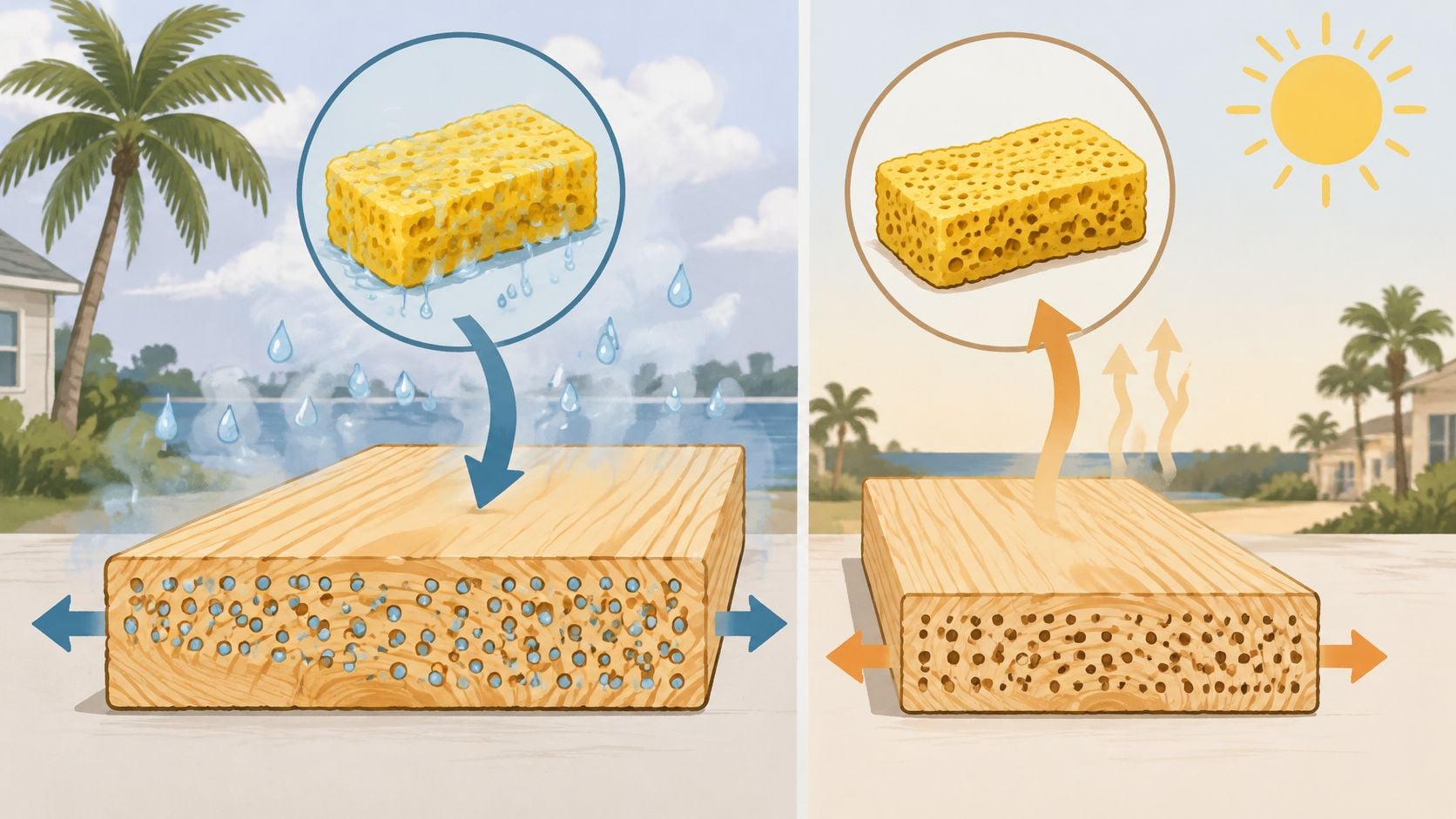
Why indoor conditions matter
Moisture-related dimensional change occurs below the fiber-saturation point, generally around 27–30% moisture content, as explained in Woodcraft's wood-movement guidance. That moisture-content measurement describes water in the wood, not relative humidity in the room.
In an Orlando home, air conditioning removes moisture from indoor air, while open doors, seasonal conditions, and changes in HVAC operation can alter the indoor environment. The important question is how stable the actual room remains, not whether Florida is humid outdoors.
Signs of trouble can include opened joints, cupped panels, irregular gaps, and finish cracking. A seasonal gap isn't automatically proof of poor workmanship, but persistent distortion deserves assessment.
Plan placement as carefully as construction
- Avoid concentrated airflow: Supply vents can expose part of a piece to different conditions from the rest.
- Separate wood from wet areas: Damp corners and frequently opened exterior doors create avoidable exposure.
- Allow settling time: New furniture should adjust in its intended indoor environment, following the manufacturer's placement guidance.
Wall-mounted accessories need their own attachment plan. When a large mirror accompanies a pine console, Colorado Art Services' guidance can help homeowners choose hardware for large mirrors, rather than assuming the furniture should support the mirror.
A well-designed solid-wood piece accommodates normal movement. Rigid attachment across a moving panel can create stress instead of stability.
What Should You Check Before Buying Pine Furniture?
Construction deserves inspection before color or sheen. The most useful details show how the maker manages loads, supports panels, and connects components that move differently.
A buyer doesn't need to identify every joint unaided. A consultant should be able to turn the piece, open a drawer, and explain what the visible details accomplish.
A practical showroom checklist
- Drying and acclimation: Request the maker's drying information and ask whether components were acclimated before assembly. A polished surface doesn't reveal the condition of the stock beneath it.
- Structural members: Inspect legs, rails, and frames for adequate material and secure connections. Large panels and drawer bottoms should use a construction system suited to their span and movement.
- Frame joints: Look for well-fitted connections rather than assuming that visible screws establish strength. Slone Brothers Furniture's explanation of mortise-and-tenon furniture joinery illustrates how interlocking parts support a frame.
- Drawer boxes: Examine corner fit, bottom support, and smooth operation under a realistic load. Dovetails are useful, but poorly fitted dovetails aren't a substitute for careful assembly.
- Table support: Inspect aprons, corner blocks, and top attachment. Substantial-looking legs won't compensate for a weak connection beneath the top.
- Movement allowance: Look for floating panels or suitable slotted attachment holes where broad solid-wood components need room to change dimension.
- Finish coverage: Inspect undersides, edges, and drawer interiors. Interior treatment should suit the manufacturer's system, without rough surfaces, lingering tackiness, or snagging edges.
Separate finish quality from wood character
A properly applied catalyzed or conversion finish can provide useful wear resistance for demanding surfaces. Buyers should request the finish-system name and care requirements rather than judging protection solely by gloss.
Thicker isn't automatically better. Poor adhesion, trapped contamination, or uneven application can undermine an impressive-looking coating.
Natural grain and color variation, knots, mineral streaks, pitch pockets, tiger striping, and insect markings aren't considered quality defects under Slone Brothers Furniture's wood-furniture policy. Their visual prominence still matters to a homeowner's preferences.
Distressing is different from accidental damage. Many pieces include simulated antique markings that buyers sometimes mistake for defects. A consultant can identify intentional markings on the display piece and explain the expected character of an ordered selection.
How Do You Care for Pine Furniture in Florida?
Pine benefits from regular dusting, prompt spill cleanup, stable indoor conditions, and care products compatible with its finish. The protective coating helps resist moisture and staining, but it doesn't make the underlying wood immune to dents.
A simple routine is preferable to repeatedly applying unfamiliar products. Slone Brothers Furniture's wood-furniture care guidance offers a useful companion to the manufacturer's finish instructions.
Care schedule for solid pine furniture
| Task | How often | Method |
|---|---|---|
| Dusting | Weekly | Soft, dry microfiber cloth, wiped along the grain |
| Spill cleanup | Immediately | Blot with a lightly damp cloth, then dry the surface at once |
| Humidity check | Daily | Read a room hygrometer and investigate persistent changes or condensation |
| Sunlight protection | Ongoing | Use suitable UV-filtering window film or reposition pieces away from direct sun |
| Finish refresh | At the finish maker's recommended interval | Use an approved polish or wax only when appropriate, tested in a hidden spot |
| Dent or scratch repair | As needed | Assess the finish first; use sheen-matched touch-up or professional repair |
Coasters and placemats help prevent rings and concentrated wear. Felt beneath decorative objects reduces scratching when accessories move, while a protective writing pad can prevent pressure marks from transferring through paper onto a tabletop.
Avoid creating a harder repair
Silicone-containing sprays can complicate later refinishing. Ammonia cleaners, abrasives, and heavy wax buildup can also create problems, so product compatibility matters more than a fresh scent or immediate shine.
Central Florida afternoon sun can alter color and heat exposed surfaces. Window protection and thoughtful placement are more dependable than trying to correct uneven fading afterward.
For an older painted piece being deliberately refinished, Neasden Hardware's wood painting preparation tips for DIY projects provide preparation context. They aren't a reason to sand an intact factory finish or attempt a repair that may affect warranty coverage.
Repair boundary: Deep finish damage, a cracked joint, or a loose load-bearing component deserves professional assessment.
Slone Brothers Furniture makes minor in-home repairs at no charge on merchandise it delivered when the customer notifies the business within 72 hours of delivery. That delivery-related policy shouldn't be confused with an unlimited lifetime repair promise.
What Does American-Made Pine Really Cost Over Time?
The useful comparison is cost per year of satisfactory service, not purchase price alone. A higher initial investment can represent better value when the piece remains functional, repairable, and appropriate for the room.
Price should have an explanation. Drying and milling, fitted joinery, substantial components, dependable hardware, and a suitable finish all require resources that may not be obvious in a photograph.
Calculate value without promising a lifespan
A simple framework is:
Purchase cost plus maintenance and repair costs, divided by years of useful service.
For a hypothetical comparison, consider a well-built table retained for decades alongside a lower-priced alternative repeatedly replaced after short periods. The longer-serving table may cost less per year even when its initial price is substantially higher. That's a calculation to perform with actual prices and realistic assumptions, not a guaranteed lifespan for pine.
Replacement also involves delivery arrangements, disposal, and another round of selection. Those inconveniences matter to homeowners furnishing an established home, even when they don't appear on a sales ticket.
Slone Brothers Furniture's guide to how long furniture should last helps frame questions about service expectations.
Recognize what the price includes
- Material where it matters: Adequate stock and support at loaded joints are more meaningful than visual bulk.
- Repair access: Replaceable hardware and accessible connections can make future service more practical.
- Appropriate panel construction: Furniture-grade plywood can be a sound engineering choice. Its presence shouldn't be confused with inadequately supported particleboard or a flimsy back.
- A suitable fit: Correct scale, finish, and configuration reduce the likelihood of replacing otherwise functional furniture.
Slone Brothers Furniture's Low Price Promise concerns pricing, not a promise that every piece performs identically. Clearance purchases deserve the same inspection as regular selections, including a clear understanding of condition and applicable terms.
Domestic production also represents an established skilled manufacturing base. The U.S. Census Bureau's manufacturing figures report 345,920 employees and approximately $125.95 billion in receipts for furniture and related-products manufacturing in 2015. Those historical sector-wide figures provide economic context, not evidence of any individual pine piece's quality.
Confirm Your American-Made Pine Pieces at Our Longwood Showroom
A useful showroom question is: “What would you recommend for this room, given how we use it and the space we have?” Bring room measurements, photos, and notes about daily routines. Those details give the design team a practical starting point for discussing furniture and layout.
Slone Brothers Furniture is a family-run business serving Central Florida since 1980. Its Longwood showroom offers American-made and Amish-crafted furniture, along with custom-order options and complimentary in-home design services.
During your visit, ask how a custom order can be adapted to your preferred materials, finishes, and configuration. The goal is to identify when pine's character, construction, and care requirements suit how a household lives.
Visit Slone Brothers Furniture in Longwood to review furniture options and discuss custom orders or design services.