
Sofa and Loveseat Combo Guide: Sizing, Style and Layout


The sofa looks right, the loveseat coordinates beautifully, and the room still feels awkward. Perhaps the route to the patio runs through the seating area, or the loveseat's generous arms leave less sitting space than expected. For a Central Florida homeowner choosing a sofa and loveseat combo, the important question isn't whether the pieces match. It's whether each person gets a comfortable seat without sacrificing the room's everyday function.
A successful pair balances usable seating, clear circulation, and future flexibility. That requires looking beyond upholstery photographs and considering the people, floor plan, and construction behind the purchase.
How Big Is a Sofa and Loveseat Combo, and How Much Seat Does It Give?
A three-seat sofa typically measures 72 to 96 inches wide, while common loveseat measurements fall around 55 to 71 inches wide, according to RoomSketch3D's sofa-and-loveseat dimension guide and SizeMarker's loveseat dimensions. Using representative widths of 84 inches and 60 inches, the pair occupies approximately 144 inches before allowing for tables, spacing, or angled placement.
Consider a hypothetical Longwood living room with a twelve-foot wall. Filling that entire wall with furniture would leave no allowance for the surrounding arrangement. The loveseat earns its place by occupying a shorter adjacent wall or sitting perpendicular to the sofa, not by squeezing alongside it.
Sofa and loveseat dimensions at a glance
| Piece | Typical width | Typical depth | Typical height | Planning note |
|---|---|---|---|---|
| Three-seat sofa | 72–96 in, representative midpoint about 84 in | Confirm the selected model's outside depth | Confirm floor-to-back height | Anchors the main seating area |
| Loveseat | 55–71 in, representative size about 60 in | 33–37 in | 30–35 in | Fits smaller walls and tight walkways |
| Combined wall span | About 144 in using representative widths | Use each piece's complete footprint | Check each back against windows and sightlines | Before spacing, tables, or angled placement |
These are planning references, not ordering specifications. The sofa's depth and height must come from the selected model rather than an assumed standard.
Outside width isn't sitting width
SizeMarker's measurements also indicate that arms can occupy approximately 4 to 8 inches on each side. That makes arm design a practical decision, not merely a stylistic one.
Consider loveseats with identical exterior widths. A slim track-arm version can leave room for adults to sit without crowding, while broad rolled arms consume more of that same footprint. Neither design is better by default, but a homeowner choosing rolled arms should verify that the remaining cushion space suits the household.
A short loveseat can also project surprisingly far into a room. Its back, cushions, and reclining mechanism deserve as much attention as its length.
Measure the complete piece
A tape measure and a marked floor outline reveal more than a photograph. Record:
- Outside width, including projecting arms.
- Back cushion thickness, particularly with loose cushions.
- Usable seat width, assessed for each regular occupant.
- Arm thickness, measured separately from the cushions.
- Reclining clearance, using the manufacturer's fully extended dimensions.
The room-measuring guide provides a useful starting process. Bring doorway, stairway, and delivery-route measurements to the Longwood showroom so a design consultant can review the complete fit, not just the destination wall.
How Should a Sofa and Loveseat Combo Be Arranged?
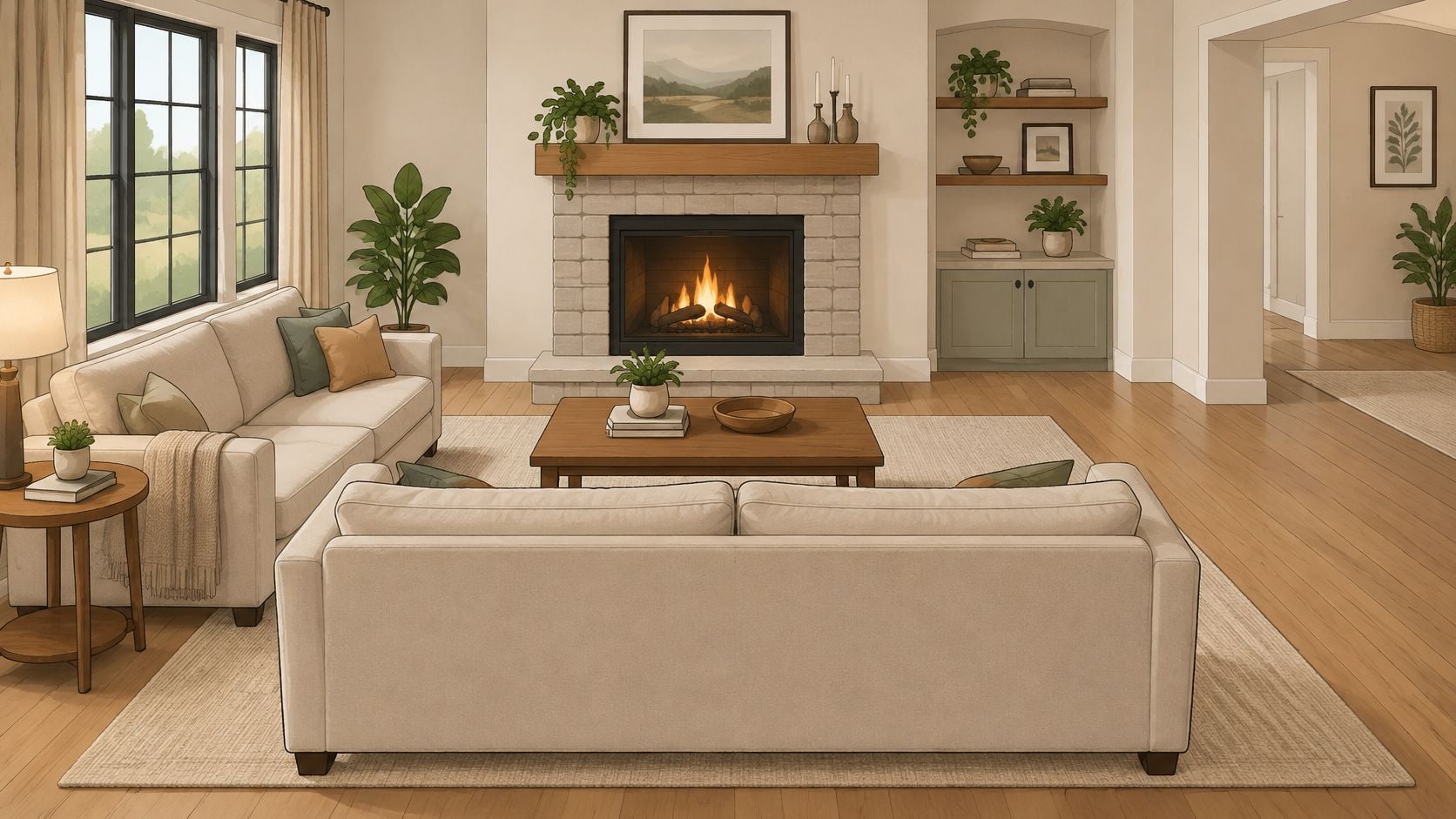
The most practical starting arrangement puts the sofa toward the room's focal point and the loveseat perpendicular to it, forming an L that defines the seating area while leaving one side open for traffic. Turning the loveseat to face the sofa favors conversation, though it only works when the room is deep enough to keep the main walking route outside the pair.
Depth decides which arrangement survives daily use. I judge a layout by the usable seat each person gets and the clearance left around it: a pairing that looks balanced on paper fails quickly when reaching a chair means stepping around someone's knees.
Establish the walking routes first
Homestyler's sofa-and-loveseat planning guidance recommends 16 to 18 inches between seating and a coffee table, 30 to 36 inches around major furniture, and approximately 42 to 48 inches for a busy passage. The living-room arrangement guide applies the same thinking to the 36-inch primary walkway, shared-rug placement, and the two-thirds proportional guidelines summarized below.
Clearance and proportion targets for a sofa and loveseat grouping
| Planning measure | Target | Why it matters |
|---|---|---|
| Seating to coffee table | 16–18 in | Keeps the table accessible without crowding knees |
| Primary walkway | 36 in | Provides a clear path through the room |
| High-traffic passage | 42–48 in | Allows more room for passing |
| Clearance around major furniture | 30–36 in | Preserves circulation around the grouping |
| Coffee table length | About two-thirds of sofa or loveseat length | Establishes proportional balance |
| Area rug | Front legs of both pieces on the rug | Visually unifies the grouping |
| Artwork above seating | About two-thirds of seating width | Keeps the wall composition balanced |
Treat these figures as planning targets. Mobility aids, door swings, and individual needs can call for more room, so measure the widest user of each route before settling on a gap.
Apply the layout to daily life
In a Lake Mary family room with a sliding glass door, the shortest wall can look like the obvious loveseat spot. If that placement narrows the route outside, pull the loveseat inward and angle it toward the sofa so the patio passage behind it stays clear.
Painter's tape on the floor lets you rehearse the arrangement before delivery. Walk from the kitchen to the patio carrying a tray, then check whether another person can remain seated while you pass. If the seated person has to tuck in their feet or shift sideways, the loveseat needs to move.
Practical rule: Protect the route people use every day, because a floor plan only marks where the furniture ends.
Interiors by DeX's overview of circulation and furniture planning offers a useful framework for weighing each route against the seats around it, and it explains why a clear path matters as much as the grouping itself.
Both extremes fail in a real room. Furniture pressed together interrupts movement, while pieces scattered too far apart stop working as a conversation group, so the right gap is the one that keeps every seat reachable without a detour.
Which Seat Height and Depth Keep Everyone Comfortable?
A couple in an Orlando showroom can sit on the same loveseat and reach opposite verdicts. The deeper seat that lets a taller person stretch out can leave a shorter partner perching with feet off the floor, which is why this pair should be fitted to its users rather than chosen on appearance. A practical starting point is 18 to 22 inches of usable seat depth, as outlined in The Decor Mag's functional living-room guidance.
Excess depth forces a shorter sitter into a bad choice: unsupported feet against the backrest, or an unsupported back at the cushion edge. A very low, compressible cushion raises a different problem. Standing up gets harder, especially when the sitter cannot reach a supportive armrest for support.
Treat dimensions as a fitting guide
The ergonomic sofa reference supplies technical benchmarks of approximately 37 centimeters for seat height, 57 centimeters for backrest height, a 105-degree seat-to-back angle, and at least 560 millimeters of individual seat width. Use these as starting points for the fitting, and expect the final numbers to shift toward the person who will sit there daily.
Ergonomic benchmarks for a comfortable sofa and loveseat
| Benchmark | Reference value | What it affects |
|---|---|---|
| Seat height | 16–18 in residential range; technical reference about 37 cm | Ease of sitting down and standing up |
| Usable seat depth | 18–22 in | Thigh support without pressure behind the knees |
| Backrest height | About 57 cm, approximately 22 in | Back support, depending on the sitter's proportions |
| Seat-to-back angle | Near 105 degrees | Supported sitting and the tendency to slide |
| Individual seat width | At least about 560 mm, approximately 22 in | Upright sitting without crowding |
A showroom test should include ordinary sitting, not just a brief reclined pose. The sitter should settle against the back, check foot contact, and stand without rocking forward repeatedly. If rising requires a hard push off the armrests, the seat height or cushion firmness needs adjusting.
A loveseat deserves particular attention because neighboring occupants share a smaller cushion area. Test it with the people who expect to sit together, rather than judging it while sitting alone in the middle.
A coordinated pair can offer different support
A multigenerational Orlando household may benefit from a softer sofa for reclining and a firmer loveseat for upright daily use. Matching the appearance doesn't require identical cushion behavior.
Seat height should answer to the sitter's knees and hips, and depth to their thigh length.
Keep the two seat heights close so the pair feels consistent in the room. When occupants need different support, depth, arm height, and cushion firmness do the work. Supportive arms, a stable cushion edge, and suitable depth matter more than uniform specifications.
An in-home consultation can establish the household's requirements using existing seating and actual room conditions. Final showroom testing should then confirm that the proposed furniture meets those needs.
What Makes One Sofa and Loveseat Combo Last Longer Than Another?
A longer-lasting pair generally earns its higher initial price through the frame, suspension, and cushion core, not upholstery alone. Fabric can conceal either carefully engineered construction or a structure that's difficult to repair.
A solid hardwood frame with well-fitted joints, corner reinforcement, and appropriate fasteners provides a different foundation from particleboard members relying heavily on staples. However, solid wood alone isn't a guarantee, and staples used to attach upholstery aren't evidence of poor structural construction.
Inspect the structure beneath the cover
Stickley's Arts & Crafts heritage emphasizes solid wood and handcrafted joinery. The relevant lesson for upholstered seating is that stable connections matter wherever occupants repeatedly load the frame and arms.
In Central Florida, indoor humidity control also belongs in the ownership plan. Avoid placing fine furniture beside persistently damp openings, and investigate moisture problems rather than expecting a premium frame to tolerate them indefinitely.
Cushion choices involve another trade-off. High-density foam can provide defined support, while down-wrapped cores soften the surface and usually require more dressing and fluffing. Density, firmness, and cushion construction are separate specifications.
Ask a consultant about:
- Frame material and joinery, including reinforcement at stress points.
- Suspension, including how the spring or support system attaches.
- Foam density and core type, not merely a description such as plush.
- Serviceability, including replacement cushion availability.
- Warranty coverage, separating frame, cushion, fabric, and labor provisions.
Investment test: A higher purchase price makes sense when the construction, repair options, and expected use justify it.
The furniture-longevity guide helps frame that discussion. Longer ownership can reduce annual replacement cost, but no material description guarantees decades of service without appropriate care.
How Durable Should Sofa and Loveseat Upholstery Be?
For a frequently used family-room pair, a practical specification is approximately 25,000 to 30,000 Wyzenbeek double rubs, a range that sits between the thresholds in the Association for Contract Textiles abrasion guidelines: 15,000 double rubs for low-traffic private spaces and 30,000 for high-traffic public spaces.
A residential living room does not need public-lobby ratings unless daily use demands them. Judge the specification against how the pair gets used: the sofa that seats three every evening wears faster than the loveseat reserved for guests.
Understand what the test measures
A Wyzenbeek double rub is one back-and-forth abrasion cycle. A higher rating means greater resistance under that test, and it cannot be converted into a service-life estimate.
Abrasion testing leaves other questions open. A fabric can resist rubbing yet develop visible pills, show seam movement, or respond poorly to an unsuitable cleaner.
Request more than the headline rating:
- Test method and result, so different fabrics are compared appropriately.
- Cleaning code, along with approved maintenance instructions.
- Pilling performance, especially where clothing repeatedly contacts the seat.
- Seam-slippage information, which helps evaluate woven fabric behavior at stressed seams.
- Fiber content and finish, including what any performance treatment covers.
A tight-looking weave is no substitute for those specifications. Equally, a soft hand should not disqualify a fabric whose documented performance fits the intended use.
Match the cover to the room
In a Sanford family room with strong afternoon light, discuss lightfastness separately from abrasion resistance. A high rub count says nothing about fading.
Humidity raises practical questions about indoor conditions and cleaning. Allow cleaned upholstery to dry thoroughly, avoid saturating cushions, and follow the manufacturer's approved method rather than household cleaning mixtures.
The upholstery-fabric selection guide can help organize swatches and specifications before an appointment. Weigh texture, maintenance demands, and suitability for each seating position alongside color.
The best specification is a cover the household will maintain. A beautiful fabric that demands care no one plans to give fails faster than a plainer one matched to the room.
How Do You Coordinate Style and Finish Across Two Pieces?
Anchor the pair with a shared element, such as wood tone, fabric undertone, leg finish, or a repeated accent color. The loveseat can then introduce a different texture or pattern without appearing unrelated.
Closely matched upholstery works well in a formal room where architectural details deserve attention. A shared fabric family feels less rigid, while a solid sofa and patterned loveseat can create a more individual composition.
Coordinate the undertones, not every detail
Warm oak legs and cool gray upholstery can work together, but their relationship should be deliberate. Check the seating against flooring, built-ins, and nearby tables rather than evaluating swatches in isolation.
Tiles Mate Pty Ltd's a Melbourne guide to living room tiles offers a useful flooring perspective when considering the permanent surface beneath a seating group. In a Florida home, existing tile often provides the clearest starting point for the palette.
An Arts & Crafts sofa and a contemporary loveseat can coexist when their scale, finish, and upholstery relate. A shared finish helps, but it can't correct radically mismatched proportions.
Test the combination in the actual light
Light upholstery may reveal marks readily, while fading depends on the textile and exposure rather than pale color alone. Humidity-related staining should prompt attention to moisture conditions, not just a darker fabric selection.
Homeowners can compare swatches with a Longwood design consultant and use the guide to mixing furniture styles to refine the relationship:
- Choose the anchor, usually the larger sofa or an existing architectural finish.
- Choose the contrast, keeping its scale and undertone compatible.
- Test in the room, checking samples during both daylight and evening lighting.
Will the Pair Still Work as Your Household Changes?
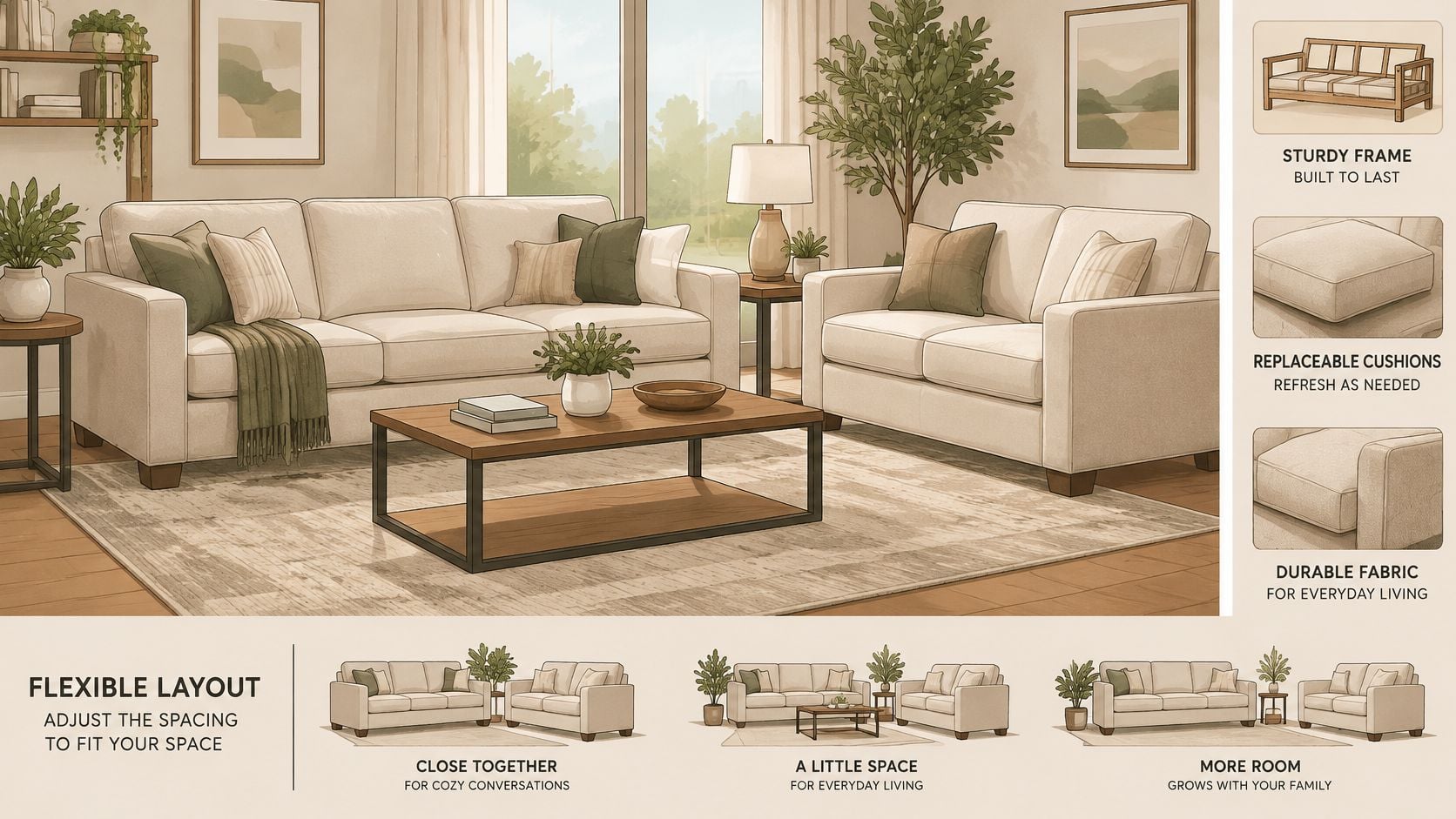
Prioritize configurable dimensions, durable construction, serviceable components, and enduring finishes over a perfectly identical appearance. Separately useful pieces are often easier to reposition or reuse than a grouping selected solely for its current photograph.
A loveseat should have a plausible future role outside its original arrangement. Its proportions and the usable seat it gives each person matter more than whether its silhouette exactly duplicates the sofa.
Buy for more than the current floor plan
A Winter Park condo, a relocation, and one loveseat that has to earn its place twice. It completes the main conversation area first, then moves to a Sanford guest room while the sofa remains in the primary living space.
That transition works only if the loveseat sits comfortably on its own and its cover coordinates beyond the original room. I favor a distinctive but restrained fabric for exactly this reason: it carries enough character to anchor a second space without depending on the sofa beside it.
Households change in body as well as address. The BioResources study of senior-friendly seating requirements found that 60% of respondents wanted influence over seat height and 56% over seat depth before purchasing. The survey asked about senior-friendly seating specifically, and its pattern applies broadly: the dimensions that fit today should be chosen with tomorrow's users in mind.
Specify adaptability before ordering
Custom ordering can preserve a coherent appearance while accommodating different users. Confirm the available choices within the selected collection rather than assuming them across every frame:
- Seat depth and cushion firmness, where the selected design permits.
- Fabric or leather, chosen for both present use and future placement.
- Leg finish, coordinated with furnishings likely to remain.
- Replacement components, with availability and ordering procedures clarified.
Slone Brothers runs its own custom-order program along these lines, pairing fabric and leather selections with cushion and finish options defined by each collection. Dimensions still need model-specific confirmation, since two frames in the same program can measure differently.
The in-house design team can evaluate the pair within the whole room, including adjacent dining spaces and future furniture purchases. That broader view keeps an expensive purchase from becoming an isolated piece with nowhere else to go.
What Should You Confirm Before Ordering the Combo?
The last appointment before ordering is where a pair gets approved or sent back for changes. Measurements, seat geometry, and walking clearances should already be settled by this point, so the final review belongs to the details that only exist on paper: what the warranty covers, how the furniture reaches the room, and which specifications end up on the order.
If a cushion still feels wrong or the delivery route remains unclear, that question gets answered before authorization. Rushing past it trades a ten-minute conversation for a permanent compromise.
Complete the order review
A useful checklist covers what has not already been confirmed:
- Warranty terms, including coverage for the frame, cushions, and upholstery, plus the steps for filing a claim.
- Delivery access, measured at doors, stair turns, and landings, with any removable components noted on the order.
- Upholstery specifications, including abrasion rating, cleaning code, and the exact cover selection.
- Rug placement, with both pieces visibly connected to the seating group.
- Order details, including finish names, cushion options, and the agreed delivery arrangements.
Keep a copy of the approved specifications. For custom upholstery, the selected fabric identification matters more than a general description such as warm beige, because a reorder or repair years later depends on that record.
Choose support that continues after delivery
Homeowners visiting from Lake Mary, Sanford, Winter Park, and Altamonte Springs can compare seating in person at the Slone Brothers showroom in Longwood, where sofas and loveseats sit on a real floor rather than in photographs. Sitting on the actual selected models settles questions that dimensions on a page cannot.
Complimentary in-home design services can address simple space planning or a complete room makeover. White-glove delivery and post-purchase assistance should also be discussed before ordering, including placement, inspection on arrival, and whom to contact if an issue arises.
The furniture earns its place after delivery, when it seats the household comfortably day after day.
A well-chosen pair leaves room to move, supports the people using it, and remains useful when the household changes. That is a stronger measure of value than matching upholstery alone.
Slone Brothers Furniture offers custom-order seating, complimentary design guidance, and personal assistance with planning a sofa and loveseat pair for a Central Florida home. Visit Slone Brothers Furniture in Longwood, FL to compare comfort, craftsmanship, and upholstery in person with an experienced design consultant.