
High Leg Recliners: Fit, Style and Comfort


A living room can be beautifully composed and still leave one person searching for a comfortable place to put their feet up. A high-leg recliner may solve the style problem, but the right choice depends on more than its silhouette: the sitter's proportions, strength, room layout, and preferred upholstery all matter. For homeowners furnishing in Longwood, Orlando, or elsewhere in Central Florida, the chair should work as part of the room and feel supportive in everyday use.
What makes high leg recliners different from other recliner styles?
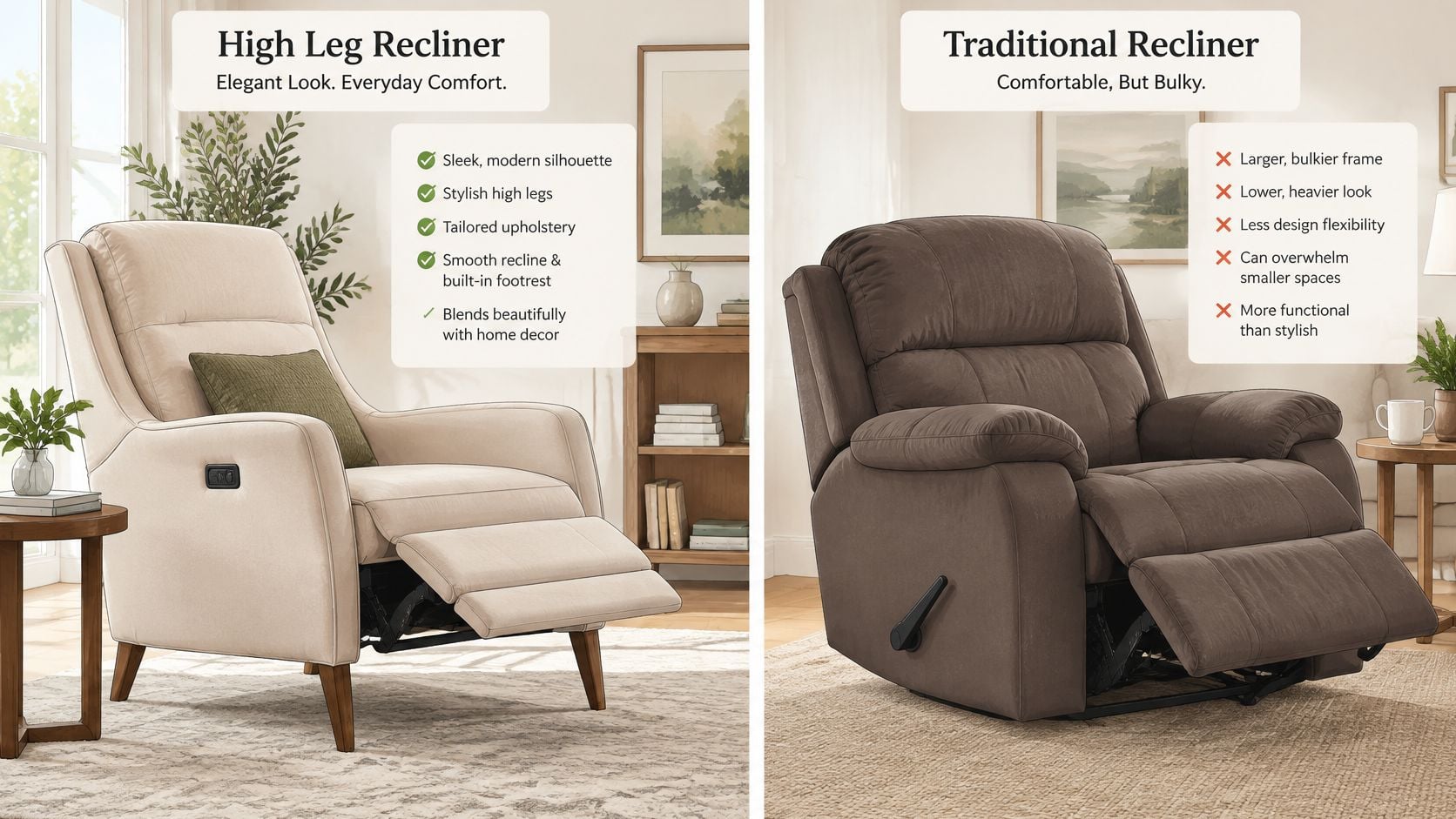
A formal sitting room may call for the shape of an accent chair, while its owner still wants a footrest by day's end. A high-leg recliner brings those functions together: it has visible legs and an integrated reclining mechanism, so it reads more like conventional upholstered seating than an enclosed recliner. That silhouette can suit a formal seating group in Winter Park, a library in Lake Mary, or a home office in Sanford.
The modern recliner's history reaches back to 1928, when Michigan cousins Edward M. Knabusch and Edwin J. Shoemaker developed a wooden, slatted porch chair that supported upright and reclining positions. The folding design established a principle that still applies: a conventional chair posture paired with an integrated way to recline, as described in the Chicago Tribune's account of the first recliner.
Movement pattern matters more than leg height. A high-leg chair may recline manually or with power, while an enclosed traditional recliner pivots backward and a wall-hugger slides forward. Those differences affect room layout and how the chair works alongside nearby furniture.
High leg recliners compared with other recliner styles
| Style | How it moves | Space and power | Choose it when |
|---|---|---|---|
| High-leg | Visible legs with manual or power recline | Clearance depends on the mechanism and model | You want a recliner with the appearance of formal seating |
| Enclosed traditional | Back travels rearward around a fixed pivot | Needs space behind the chair for its backward movement | A deeper lounge position matters more than a lighter silhouette |
| Wall-hugger | Seat and body slide forward | Designed to recline near a wall | The chair needs to sit close to a wall |
| Power lift | Motor tilts and raises the sitter | Requires an outlet and access to the motor | Assistance with standing is the main priority |
A conventional recliner moves backward around a fixed pivot; a wall-hugger uses a forward-sliding track. The different motion geometries are explained in this guide to recliner chair mechanisms.
A power-lift chair serves a different purpose from a high-leg recliner. Its lifting action can assist with standing, while the motor, controls, outlet, and service access become part of the room plan. Power recline can reduce the force needed to adjust the chair. A manual release avoids electrical components, though it may be difficult for someone with limited hand, shoulder, or leg strength.
Choose a high-leg recliner for its formal chair appearance when the sitter can get in and out safely. Choose a wall-hugger to preserve space near a wall, or a power-lift chair when standing is the central challenge. The recliner buying guide explains how movement types affect the choice.
Which measurements confirm high leg recliners fit your body and room?
A high-leg recliner may look like a formal living-room chair, but its fit depends on the same practical details as any recliner: seat height, depth, support, and room for the mechanism to move. Start with the intended user's measurements, then check how the chair feels upright and fully reclined.
| Check | Practical target | What fails if it's off |
|---|---|---|
| Seat height | The RICA guide to riser-recliner chairs gives 18–24 inches as a range for many high-seat chairs. Match the chair to the sitter's knee-crease height. | Feet dangle or standing becomes harder |
| Seat depth | Allow about two fingers of clearance behind the knees, as described in the RICA guide to riser-recliner chairs. | Front edge presses the knee crease |
| Supported backrest | Adjust until the back and lumbar area feel supported. | The sitter may strain to maintain a comfortable position |
| Footrest | Support the lower legs, not just the heels. | Calves or heels take pressure in a small area |
Use these targets as a starting point, not a substitute for sitting in the chair. Seat height should let the feet rest on the floor, while seat depth should allow the sitter to reach the backrest without the front edge pressing behind the knees.
Test the chair in a practical order
Measure while seated. Have the intended user sit comfortably with knees bent. Measure from the floor to the knee crease, then compare that measurement with the chair's seat height. Shoes and cushion compression can change the feel.
Check foot contact and leg position. Both feet should rest fully on the floor, with hips and knees near right angles. A seat that is too high can leave the feet unsupported; one that is too low can make standing harder.
Check knee clearance. Slide a hand behind each knee. About two fingers of space helps keep the seat edge from pressing into the knee crease while the sitter rests against the backrest.
Open the footrest fully. Check that support continues from the seat edge along the lower legs toward the heels. If the calf meets a hard edge, or only the heels are supported, the reclined position may feel uncomfortable.
Measure the chair's movement zone. Allow for the space behind a conventional pivot or the forward travel of a wall-hugger. For help recording the chair's footprint and position, use this room-measuring guide for furniture.
Finish by checking entry, exit, floor contact, thigh support, and lumbar contact together. A high-leg recliner is a formal chair with a mechanism, not an automatic accessibility solution. Its seat height, depth, support, and clearance determine whether it suits the person and the room.
Which frame and upholstery choices make high leg recliners last in Florida?
A fabric rated at 30,000 Wyzenbeek double rubs may suit a busy living room, but the number alone cannot predict how long a recliner will last. Frame construction, mechanism access, fabric characteristics, and care all matter.
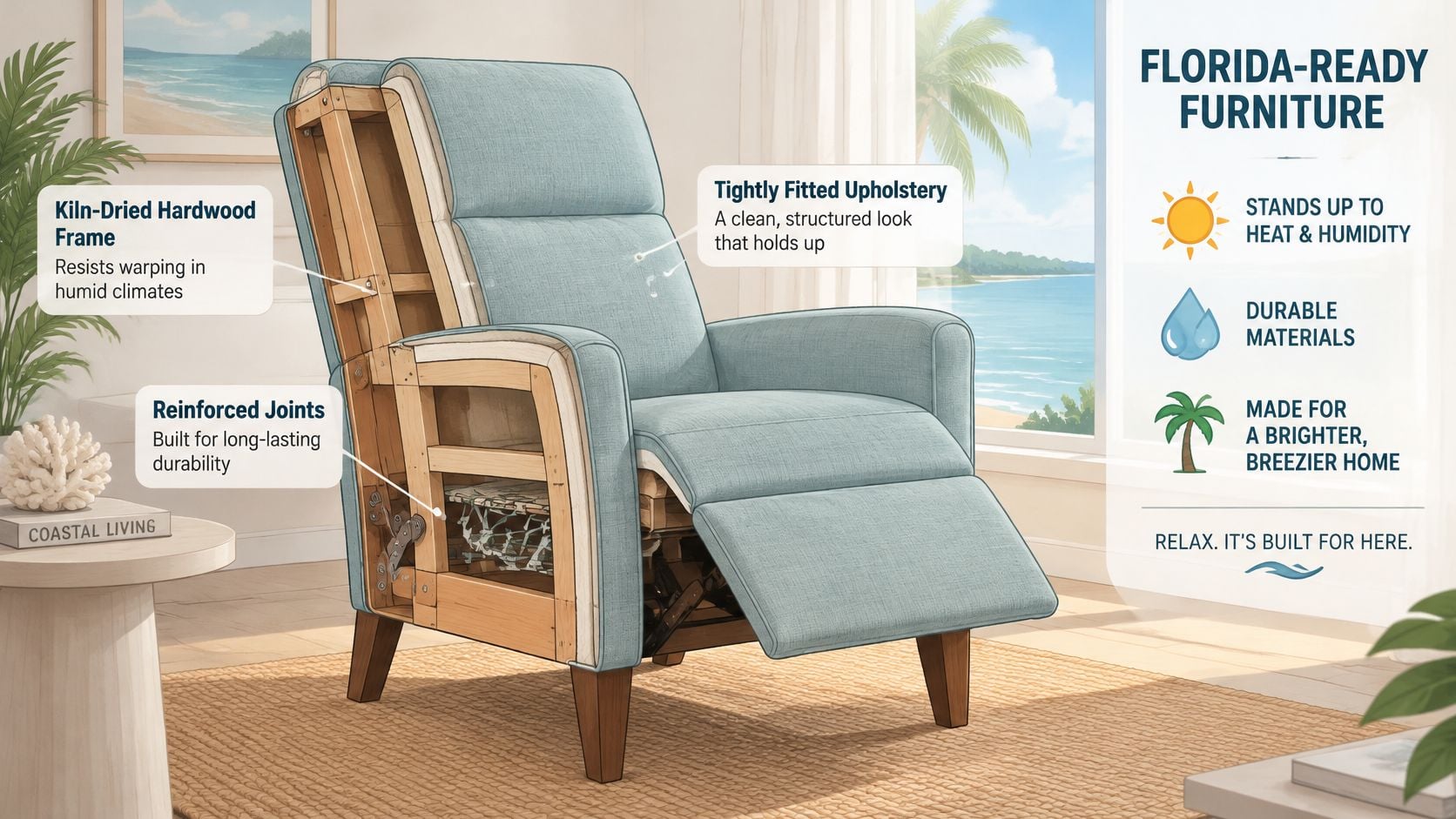
Ask how the frame is built and reinforced around the moving mechanism. A hardwood or engineered-hardwood frame with reinforced joints is suited to repeated use. Bench-made construction can allow close attention to fit and upholstery, while a power mechanism adds components that may need servicing.
Read fabric test results in context
| Intended use | Wyzenbeek | Martindale | How to read it |
|---|---|---|---|
| Low-traffic private seating | 15,000 double rubs | 20,000 cycles | A benchmark for lighter, occasional use |
| High-traffic seating | 30,000 double rubs | 40,000 cycles | A benchmark for frequent use |
| Advertised counts above 100,000 | Above 100,000 double rubs adds no meaningful value alone | A high count alone adds no meaningful value | Fiber, weave, finish, design, and care affect service life |
The Association for Contract Textiles identifies 15,000 Wyzenbeek double rubs and 20,000 Martindale cycles as benchmarks for low-traffic private spaces, and 30,000 double rubs and 40,000 cycles for high-traffic public upholstery. The ACT performance guidelines for abrasion also caution that results above 100,000 double rubs do not provide meaningful additional value by themselves.
For a living-room chair in Orlando or Lake Mary, ask about the test method, fiber content, weave, finish, and cleaning code. A high abrasion count does not show how a fabric will handle sunlight through a window, regular use, or a pet settling on the seat. A textured performance weave may suit a busy household; finished leather may suit someone who prefers a smooth surface and follows its care requirements. Bonded leather has a different construction from top-grain aniline or protected leather, so review the material details and care instructions. For more guidance, see how to choose upholstery fabric.
Check service details before ordering
- Mechanism access: Confirm that a technician can reach the mechanism, motor, and controls.
- Warranty and parts: Ask what the warranty covers and whether replacement parts are available.
- Power planning: Identify a nearby outlet and keep electrical components accessible.
- Cleaning instructions: Record the upholstery cleaning code and choose care products accordingly.
- Everyday use: Consider whether the frame, mechanism, and upholstery suit regular sitting.
A clear service plan helps you assess the chair beyond its appearance. Slone Brothers Furniture offers furniture and design services in Longwood, where you can ask about construction, upholstery, and care options.
Are high leg recliners comfortable and safe to get in and out of?
A parent in a Sanford living room may find a higher seat easier to rise from, provided their feet rest flat and the seat depth lets them sit securely. If the seat is too high or deep, their feet may not reach the floor comfortably, and standing can take more effort. A high-leg recliner is a formal chair with a mechanism; its style alone does not make it an accessibility aid.
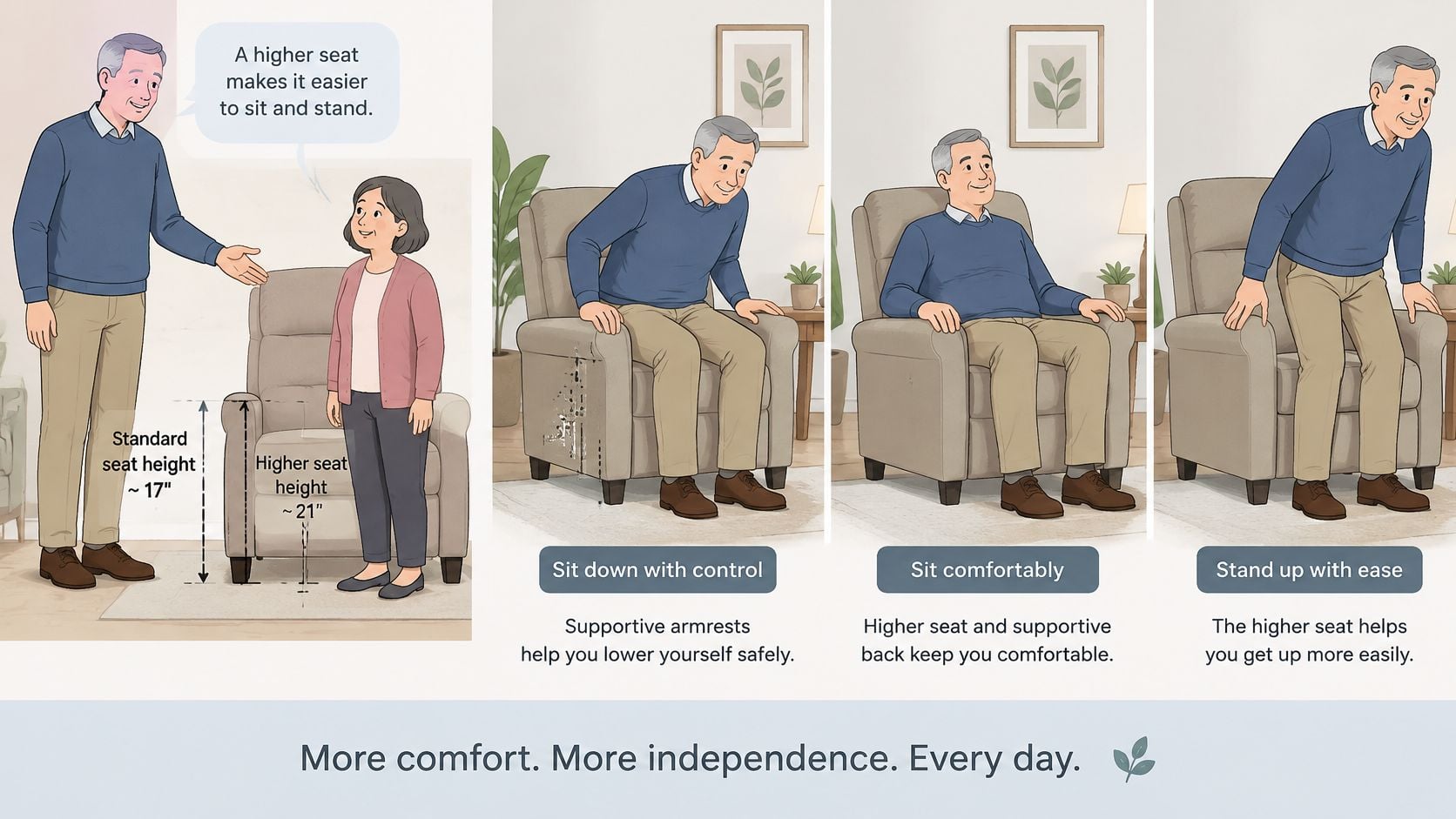
The systematic review of aging-in-place modifications supports considering seating as part of the home environment, alongside clear routes and access. For chair fit, use the measurement checks described in the previous section; the person's strength and balance matter alongside the chair's dimensions.
Match the mechanism to the person
A manual release can work well for someone with sufficient hand, shoulder, and leg strength. A power mechanism changes position with less physical effort, but the user still needs to reach and operate its controls.
For a parent in Sanford or Lake Mary, consider whether they can manage the footrest and rise with a steady transition. Lumbar support should remain comfortable as the backrest moves. If the lower back loses contact when the chair reclines, the chair may not suit the user's preferred resting position. The guide to recliners for back support offers questions to consider when assessing support.
Household rule: Return the recliner to its upright, closed position when it's unattended, especially in homes with children, pets, or narrow paths.
The chair's surroundings also affect safe use. Keep routes and door access clear, and account for placement and delivery when arranging the room. A design consultation can consider those details alongside the chair's mechanism and upholstery.
Which rooms and makers suit high leg recliners in Central Florida?
A Winter Park home office with a firm-back chair may benefit from a high-leg recliner for reading breaks. Its tailored shape can fit a room with a desk and bookcases, while the chair still needs enough space to recline without narrowing the walkway.
In a formal Orlando living room, a high-leg recliner can sit alongside a sofa and keep the seating arrangement cohesive. For a bedroom or guest room used by an older parent, choose the chair for the person's needs and the room's layout, with a clear route around it.
Customize in a useful order
Choose a leg finish that suits the room, then select fabric or leather and the tailoring details. Stressless offers recliners for reading areas and living rooms where ergonomic support is a priority. Stickley's solid-wood furniture and Arts and Crafts character can suit coordinated rooms with a traditional style. The chair still needs to fit the space and the person who will use it.
For another way to compare materials and construction, explore this guide to American-made furniture brands. Slone Brothers Furniture has served Central Florida since 1980. Its design consultants can help coordinate a custom order with a home's furnishings through the Longwood showroom and complimentary in-home planning.
How do I book a Longwood showroom fitting for high leg recliners?
A fitting is most useful when the intended user can try the specific chair and mechanism. Measurements help narrow the options, but sitting, reclining, and standing reveal how the chair feels in motion.
Before the visit, note the measurements and room details covered in the earlier sections. Bring a list of the sitter's comfort priorities and any upholstery preferences, so the consultant can focus the fitting on choices that matter.
At the showroom, try the exact mechanism you're considering. Check whether its controls are easy to reach, then compare upholstery samples and ask about their cleaning codes. A sample's code helps clarify which cleaning methods are suitable for the fabric.
The visit can also include a discussion of how the chair's scale and upholstery will work with the room. Slone Brothers Furniture offers complimentary in-home design services, home delivery, and planning for Greater Orlando homeowners, including those in Lake Mary, Sanford, Altamonte Springs, and Winter Park.
Visit Slone Brothers Furniture in Longwood to test high-leg recliners and compare upholstery with a design consultant. You can leave with a clearer choice of mechanism and fabric, along with a plan for coordinating the chair with your home.