

Sculptural Pendant Lighting for Your Florida Home


A homeowner in Longwood or Winter Park can stand in a finished room and still feel that one thing is missing. The furniture is chosen, the paint looks right in Central Florida daylight, and yet the space needs a focal point that feels intentional rather than decorative filler. Sculptural pendant lighting solves that problem by doing two jobs at once, it adds useful light and it gives the room a piece of visual art overhead.
In a well-appointed Florida home, that matters. A pendant can soften a kitchen island, anchor a dining table, or give an entry a stronger sense of arrival without crowding the room. For readers who want a statement piece that feels curated, not trendy, the most useful approach is the same one used in a good showroom conversation, start with proportion, material, and the way the fixture behaves in the room, then let style follow.
For homeowners who like to compare design ideas before making a move, expert tips for interior designers offer a helpful parallel, because statement art and statement lighting rely on the same basic discipline, restraint, scale, and a clear focal point. A related guide on putting your living room in the best light can also help frame where a sculptural fixture belongs in the overall composition of the room.
Why Consider Sculptural Pendant Lighting for Your Home
A homeowner usually starts with a room that feels finished but still lacks a clear focal point. Sculptural pendant lighting fills that gap because it works like functional art, giving the room light and changing how the space reads the moment someone walks in.
In Greater Orlando homes, that matters in open kitchens, dining rooms, and entry halls, where one ceiling fixture can carry a surprising amount of visual weight. The pendant becomes the room's punctuation mark. It also helps that the pendant-lighting market has grown into a significant part of interior design, and market guidance on pendant lighting shows how often these statement fixtures now appear in both homes and commercial interiors. That interest reflects a simple truth, more homeowners want lighting that does more than disappear into the ceiling.
Why the appeal feels different in Florida homes
Central Florida homes often balance bright daylight, indoor-outdoor living, and strong architectural lines. A sculptural pendant can add contrast without adding clutter, especially in rooms where a simple flush mount would disappear and a chandelier would feel too formal.
A few practical reasons homeowners gravitate toward this category stand out:
- It creates a focal point without filling the ceiling. The suspended form gives a room presence while keeping the visual field open.
- It works well in zone-based layouts. Kitchens, dining tables, and foyers benefit from a fixture that signals purpose.
- It pairs naturally with curated interiors. A well-chosen pendant can connect with furniture, finishes, and artwork rather than competing with them.
For homeowners comparing room plans before buying, putting your living room in the best light is a useful way to think about placement and balance, because a pendant needs to sit comfortably within the room's larger composition.
That is why many design conversations in Longwood and Orlando start with one question, not “What's trendy?” but “What will make the room feel intentional?” A sculptural pendant is often the answer when the homeowner wants one strong gesture instead of several small ones. For readers who want a useful parallel, expert tips for interior designers show the same discipline statement art requires, restraint, scale, and a clear focal point.
What Defines a Sculptural Pendant Light
A sculptural pendant light is a ceiling-hung fixture that does more than supply task lighting. It uses shape, material, and open space as part of the design, so the fixture reads like an object with presence, not just a light source. A standard pendant may disappear into the room's function. A sculptural pendant is meant to be seen.
In a Florida home, that difference matters. Bright daylight can flatten weaker fixtures, while a stronger form keeps its character from morning to night. During a consultation, I often point homeowners toward the same question they use for art or furniture. Does the piece still hold the room when nothing is turned on? That is usually the first sign you are looking at a true sculptural pendant.
The category also has a clear history. Its roots trace back to the late 19th century and the Industrial Revolution, when utilitarian hanging fixtures established the design language that later shaped today's sculptural pendants historical lighting context. That background helps explain why the form still feels practical even when it looks highly artistic. The function never disappears, it gets expressed with more intent.
What defines the category is not just the hanging format. It is the way the fixture resolves from every angle. A true sculptural pendant has a silhouette that feels complete in profile, from below, and across the room. In a well-appointed Longwood home, that is the difference between a light fixture and a statement piece.
A useful way to test the category is to separate it from nearby styles. Compared with chandeliers, sculptural pendants usually feel more concentrated and less ornate. Compared with basic pendants, they place far more weight on form, texture, and the quality of the outline. Compared with purely decorative ceiling objects, they still need to light the space well, because a pendant that cannot perform its job stops feeling intentional.
There is also a heritage detail that sometimes comes up in design conversations. Lighting fixtures classified as antique are generally at least 100 years old, so surviving pre-1923 hanging fixtures count as true antiques rather than merely vintage pieces historical lighting context. That context matters because sculptural pendant lighting sits between craftsmanship and contemporary design, which is one reason it feels at home in both older houses and newer builds.
A sculptural pendant should feel resolved in daylight and after dark.
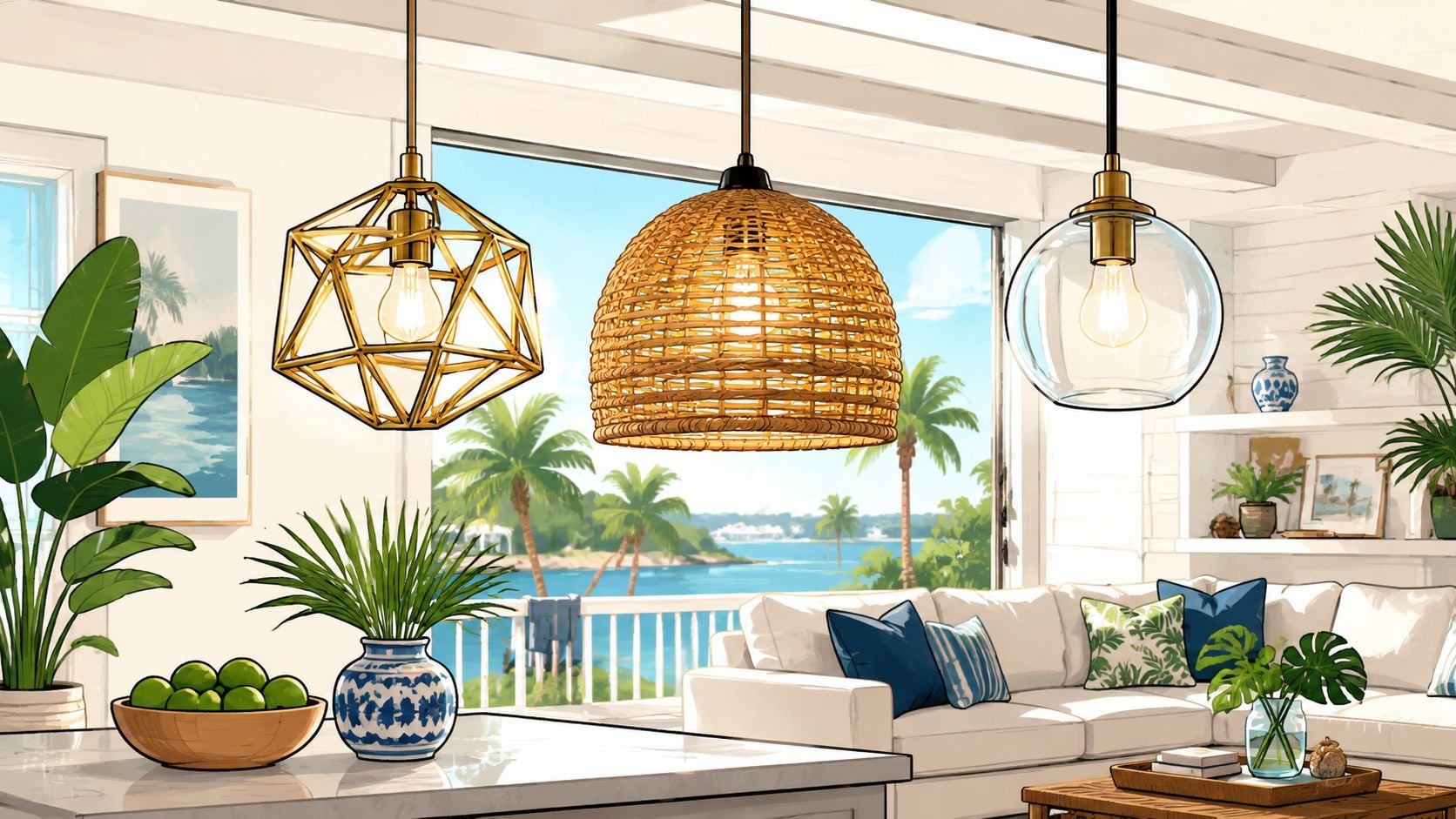
For homeowners refining a room before buying, decorating a Florida home with scale and balance is a helpful lens. It keeps the focus on how the fixture relates to furniture, ceiling height, and the rest of the composition, which is exactly how a good showroom conversation should begin.
Which Styles and Materials Work Best in Florida
A sculptural pendant in a Florida home has to do more than look striking at first glance. Humidity, bright daylight, and the easy flow between indoor and outdoor spaces reward materials that keep their shape and finish over time. In practice, that means the pendant should feel sturdy in the hand and calm in the room, not delicate or overworked.
The right style often follows the architecture. A coastal or transitional room can handle softer curves, woven texture, and natural finishes without making the ceiling feel crowded. A more modern interior, especially in a downtown Orlando condo, usually benefits from a cleaner profile, where geometry supplies the visual order and the pendant acts like a well-placed punctuation mark.
Style and material work together, so it helps to read them as one decision.
Organic forms bring warmth to light-filled spaces in Winter Park or Baldwin Park. Geometric pendants create a clearer rhythm in rooms that already rely on straight lines and a restrained palette. Minimalist metal and glass suit open-plan homes that want definition without heaviness, while industrial-influenced shapes can hold their own in rooms with taller ceilings and stronger architectural presence.
Material quality deserves the same attention as silhouette. High-grade metals, artisanal glass, and well-finished natural materials tend to age more gracefully than lightweight decorative substitutes, especially when the pendant sits near kitchen activity or receives direct afternoon light. A fixture with some physical substance usually feels more convincing once it is part of the room, because it does not read as an afterthought.
For a homeowner refining the whole room, the pendant should echo at least one other finish already present. Brushed metal can relate to cabinet hardware, glass can relate to a tabletop, and a natural texture can relate to upholstered seating. That repetition helps the fixture feel tied into the interior rather than floating apart from it, the same principle used in decorating a Florida home with a consistent material story.
In a Longwood showroom conversation, that is usually where the selection starts to make sense. The question is not only whether the pendant is beautiful on its own, but whether it fits the floor, walls, furniture, and light already in the home.
How Do You Choose the Right Size and Placement
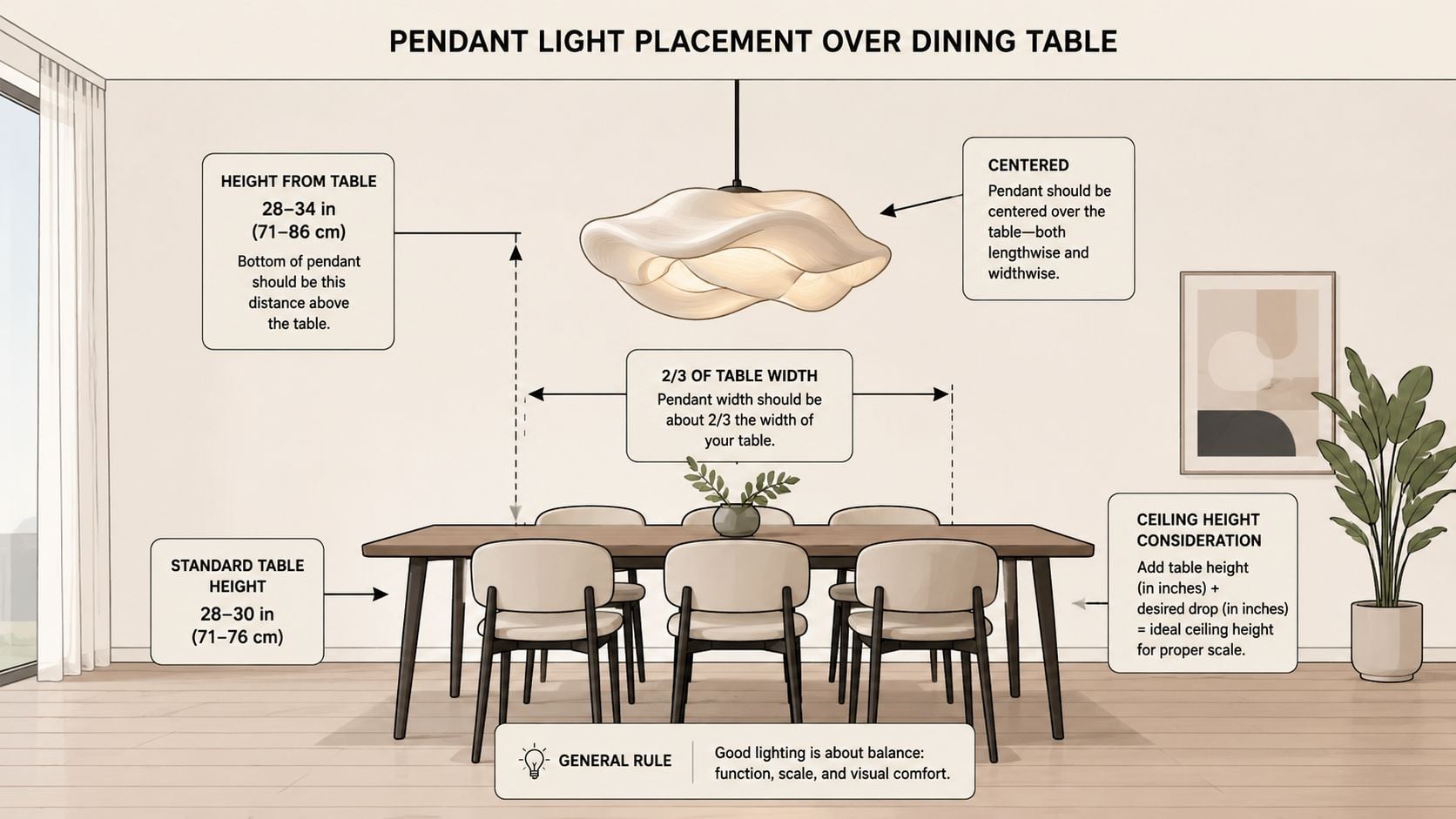
A sculptural pendant can look perfect in a showroom and still feel off in a real room if the proportions are wrong. Over an island, dining table, or entry console, the fixture should relate to the surface below and the surrounding architecture, not hover as if it were chosen in isolation. Scale and proportion in design gives the same basic lesson, the eye reads balance first, then detail.
For a statement pendant, the width usually needs to sit in relation to the furniture beneath it, with pendant sizing guidance commonly pointing to a fixture that is roughly one-half to two-thirds of the surface below. A single pendant used as a focal point can be narrower in some room-facing arrangements, but the visual weight still has to feel deliberate. Placement matters just as much. pendant spacing and hanging guidance is often paired with the advice to keep the fixture about 7 feet above the floor and around 30 inches above a work surface, so clearance and composition stay in balance.
The easiest way to judge fit is to read the room the way a designer would. First, measure the surface below, because a pendant should anchor the zone without swallowing it. Then check the ceiling height, since taller ceilings give a sculptural form room to breathe while lower ones call for restraint.
Sightlines matter too.
A pendant should look composed from the dining chairs, from the kitchen entry, and from the adjoining hall. If it crowds the view or interrupts movement, the size or hanging height needs adjustment. In older Sanford homes and certain Lake Mary layouts, that can mean choosing a different fixture family altogether, since low ceilings leave less room for a pendant to work comfortably. A 2026 buying guide also says that if ceiling height is below 7'6", semi-flush or recessed lighting is often the better choice lighting fit guidance.
One practical test is to stand back and ask whether the pendant reads as part of the room's architecture or as a separate object. That distinction is what separates a passing trend from a piece that feels settled in place. If you are comparing options in a showroom, the same method used for choosing the right art illumination helps here too, because both art lighting and sculptural pendants need scale, placement, and viewing distance to work together.
What Should You Know About Light Output and Bulbs
A sculptural pendant can be beautiful in daylight and still feel underpowered after dark if the bulb choice is off. That is where the room's use starts to matter. A fixture over a breakfast table may need a softer mood than one over a prep surface, and a statement piece in a foyer has its own job to do as people move through the space.
Light output is easier to judge once you separate decoration from function. Brightness, color quality, and glare control all shape how the pendant feels in the room, especially in homes where one fixture has to support dinner, reading, conversation, and kitchen work at different times. For a closer look at how decorative lighting should support a room's purpose, dining room lighting ideas can help homeowners think through the balance between atmosphere and usable light before they commit to a fixture.
Bulb choice changes the whole experience
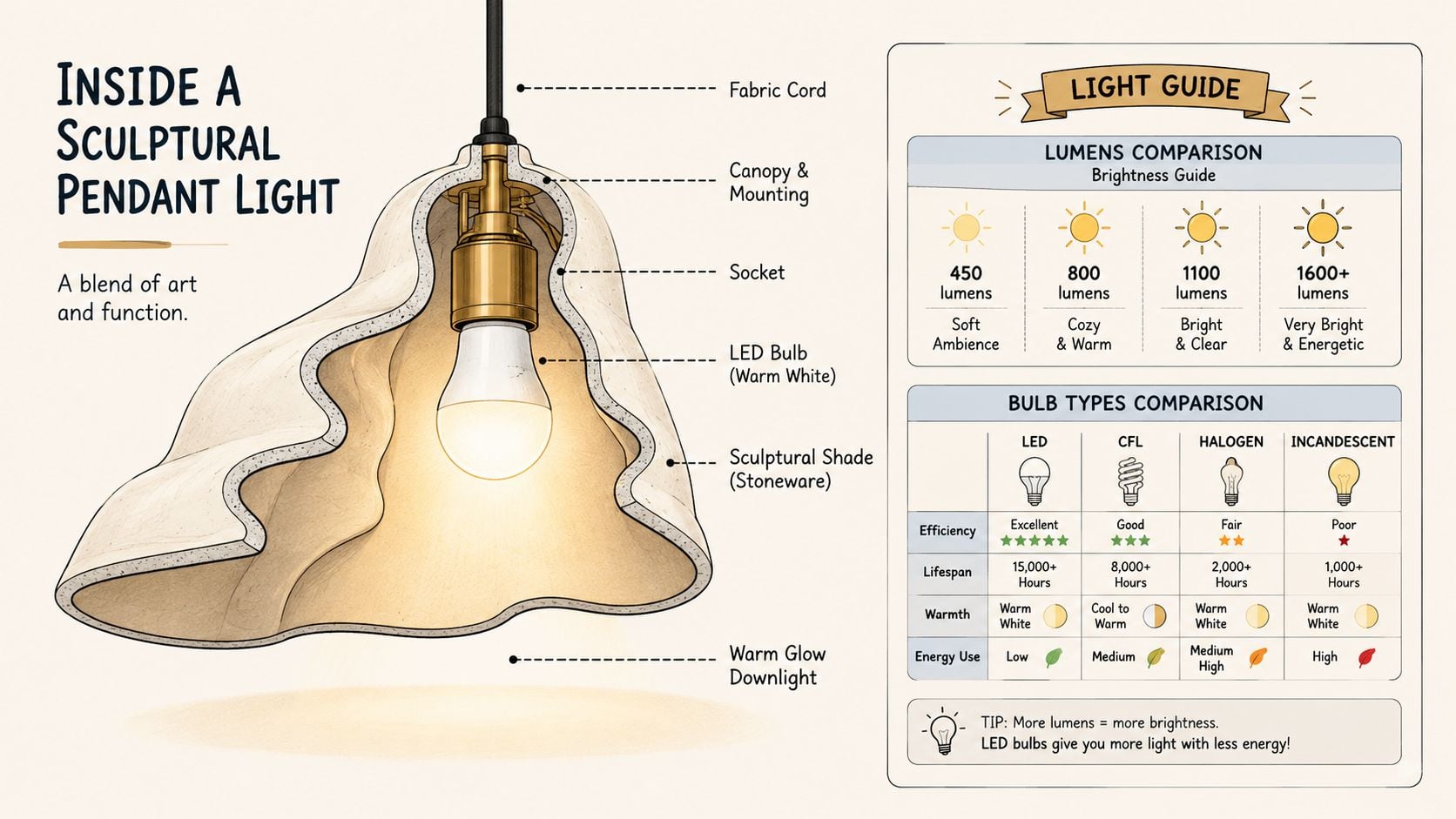
A few lighting terms deserve plain English:
- Lumens describe brightness, so they matter when a decorative shape encloses part of the lamp.
- Color rendering index, or CRI, affects how natural wood, fabric, and wall color look under the light.
- Integrated LED fixtures can work well in enclosed sculptural forms because the heat pathway is engineered into the product.
- Replaceable lamps offer flexibility, but in tightly enclosed designs they can create more heat concerns.
The shade or shell changes how those traits show up. Deep forms, opaque metals, and irregular surfaces can soften glare, yet they can also limit the light that reaches the table or counter below. That is why a sculptural pendant often needs a stronger source, more than one fixture, or a carefully chosen bulb type to perform as well as it looks.
Modern residential LEDs commonly reach a CRI above 80, and better-spec products go above 90 technical lighting guidance. That difference is easy to see in rooms with leather seating, wood grain, or woven upholstery, where low-quality light can flatten color and texture. ENERGY STAR criteria for decorative luminaires also emphasize efficiency and low standby power, which supports the case for a well-engineered LED fixture.
For homeowners comparing fixtures in person, choosing the right art illumination offers a useful parallel. Art lighting and sculptural pendant lighting both depend on beam spread, glare control, and how the eye reads color at night. A pendant that washes a room evenly can still fail if it throws harsh highlights onto the table or leaves the edges of the space feeling dim.
A good rule in a dining area is to let the pendant support the room, not fight it. The best result usually comes from pairing the fixture with dimming and, when needed, additional layers of light so the pendant can shift from task lighting to mood lighting without losing its character.
How to Ensure Safe Installation and Proper Care
A sculptural pendant can look light and effortless, yet the true work begins at the ceiling. These fixtures often carry more weight, more visual complexity, and more mounting demands than a standard ceiling light, so installation should be treated as a design and safety decision at the same time. In older Florida homes, or in newer homes with different ceiling conditions, that distinction matters.
Before ordering, lighting experts recommend checking volume, mounting strength, ceiling-box load, canopy and anchor compatibility, and dimming or LED specs because sculptural fixtures are often heavier, larger, and more sensitive to ceiling conditions than standard pendants installation guidance. In a Central Florida home, that check is not theoretical. A pendant that looks perfect in a showroom can still be a poor fit if the box, wiring, or support is not matched to the fixture.
Professional installation also protects the look of the piece. If the pendant hangs slightly off, sits too high, or is not anchored correctly, the silhouette no longer reads the way it was meant to. For a homeowner choosing a statement fixture for a dining room, foyer, or kitchen, that kind of mismatch can change the whole room.
Care should follow the material, not a one-method routine.
- Glass: Dust first, then clean gently so fingerprints do not build up.
- Metal: Wipe with a soft cloth and avoid harsh cleaners that can dull the finish.
- Wood: Keep moisture low and use a dry cloth, especially in humid rooms.
- Fabric or woven materials: Vacuum lightly or use a soft brush attachment to remove dust.
If the fixture has an exposed interior, regular cleaning keeps the sculptural form from looking dull or heavy. That matters in Central Florida, where dust and humidity can make neglected lighting age faster than it should. For homeowners planning related updates, a practical look at kitchen lighting projects helps separate simple upkeep from work that should stay with a professional.
A careful install and the right maintenance routine protect the investment. The pendant keeps its shape, the finish stays clearer, and the light quality holds up longer. For a statement piece that is meant to function as art and everyday lighting, that kind of care is part of the design.
Where to Find Custom Sculptural Pendant Lighting in Orlando
A major lighting purchase is hard to judge on a screen alone. The scale can look smaller online, finishes can read differently in artificial photos, and return logistics become a headache if the piece arrives and doesn't suit the ceiling height or table size. For a fixture this visible, the in-person route gives a homeowner something digital shopping can't, immediate context.
That's why a Longwood showroom matters. Slone Brothers Furniture offers a space where a homeowner can see how a pendant reads beside furniture, compare finishes in real light, and talk through whether the piece belongs in a dining room, foyer, or kitchen. Their interior design consultation services also make the process more precise, because the guidance can account for ceiling height, furniture scale, and the way the home functions.
Why the showroom experience is more reliable
The difference usually comes down to three things:
- Real scale, so the fixture isn't guessed at from a product photo.
- Real finishes, so metals, glass, and textures are seen in person.
- Real conversation, so the homeowner can ask practical questions before committing.
Slone Brothers has served Central Florida since 1980, and that local legacy matters when a design choice has to hold up in a real home, not just on a mood board. For homeowners in Orlando, Lake Mary, Sanford, Altamonte Springs, and Winter Park, a custom-order path can also help align the fixture with existing furniture and finishes instead of forcing the room to work around the light.
A sculptural pendant should feel collected, not guessed at. The right showroom visit makes that easier, because the fixture can be evaluated as part of a full room, not as an isolated object.
Ready to invest in furniture and lighting that lasts? Skip the online guesswork and automated digital chatbots. Visit Slone Brothers Furniture in Longwood, FL today, and connect face-to-face with experienced design consultants who can help you choose sculptural pendant lighting that feels right in your home and beautifully finished in person.