
Cradle vs Crib: The Complete Guide for 2026


A nursery in Longwood can look finished on paper and still be wrong in real life. The cradle vs crib decision usually happens right at that point, when the dresser is in, the walls are painted, and the parents are trying to decide whether they need a compact newborn sleeper or a real long-term nursery anchor. That choice affects safety, room layout, and whether the family buys once or buys twice.
| Criteria | Cradle | Crib |
|---|---|---|
| Primary use | Earliest months | Longer-term nursery sleep |
| Size | Smaller, more compact | Larger, fixed structure |
| Portability | Easier to move | Heavier, meant to stay put |
| Typical value | Short-window convenience | Long-life investment |
| Best fit | Tight space, bedside proximity | Dedicated nursery, multi-year use |
Families sorting through newborn essentials often start with a checklist and end up with a lifecycle question. For a useful outside perspective on what new parents tend to gather first, check out Little Venture Co 's baby, then compare it with a more furniture-focused lens, because the sleep space is the piece that changes daily life the most. For Central Florida homeowners, that's especially true when the nursery is part of a larger home plan, not a temporary setup.
A smart furniture purchase should feel deliberate, not improvised. That's the same reason high-consideration furniture purchases deserve more planning than a quick online click, especially when the piece touches sleep, safety, and room design all at once.
Why the Cradle vs Crib Decision Matters More Than You Think
A young family in Winter Park or Lake Mary usually doesn't need more stuff, it needs fewer wrong purchases. The cradle vs crib choice matters because one is a short-term sleep solution and the other is a nursery foundation, and those are not the same thing. A cradle can make sense for the first stretch, but a crib is the piece that carries a family through the toddler years.
Think in terms of lifecycle, not just footprint
The mistake many parents make is treating the cradle as a smaller crib. It isn't. A cradle is built for closeness, compactness, and early infancy, while a crib is built for sturdier long-term use and a more stable room layout.
That difference changes how a nursery functions. A cradle can tuck beside a bed in a smaller Orlando home and keep the baby close during the newborn stage, but a crib gives families a true nursery anchor that doesn't need to be replaced almost immediately. For homeowners who plan to stay put in Central Florida, that usually makes the crib the cleaner investment.
Practical rule: if the room is already dedicated to the baby, a crib usually makes more sense than buying a piece that will need to be swapped out soon.
The other reason this decision matters is value. Heirloom-quality nursery furniture costs more up front, but it's built to do real work over time, and that's the standard discerning families should apply to every bedroom purchase. In a showroom setting, that conversation looks a lot less like a sales pitch and a lot more like space planning, finish selection, and deciding whether the nursery should be temporary or lasting.
How Do Safety Standards Differ Between Cradles and Cribs
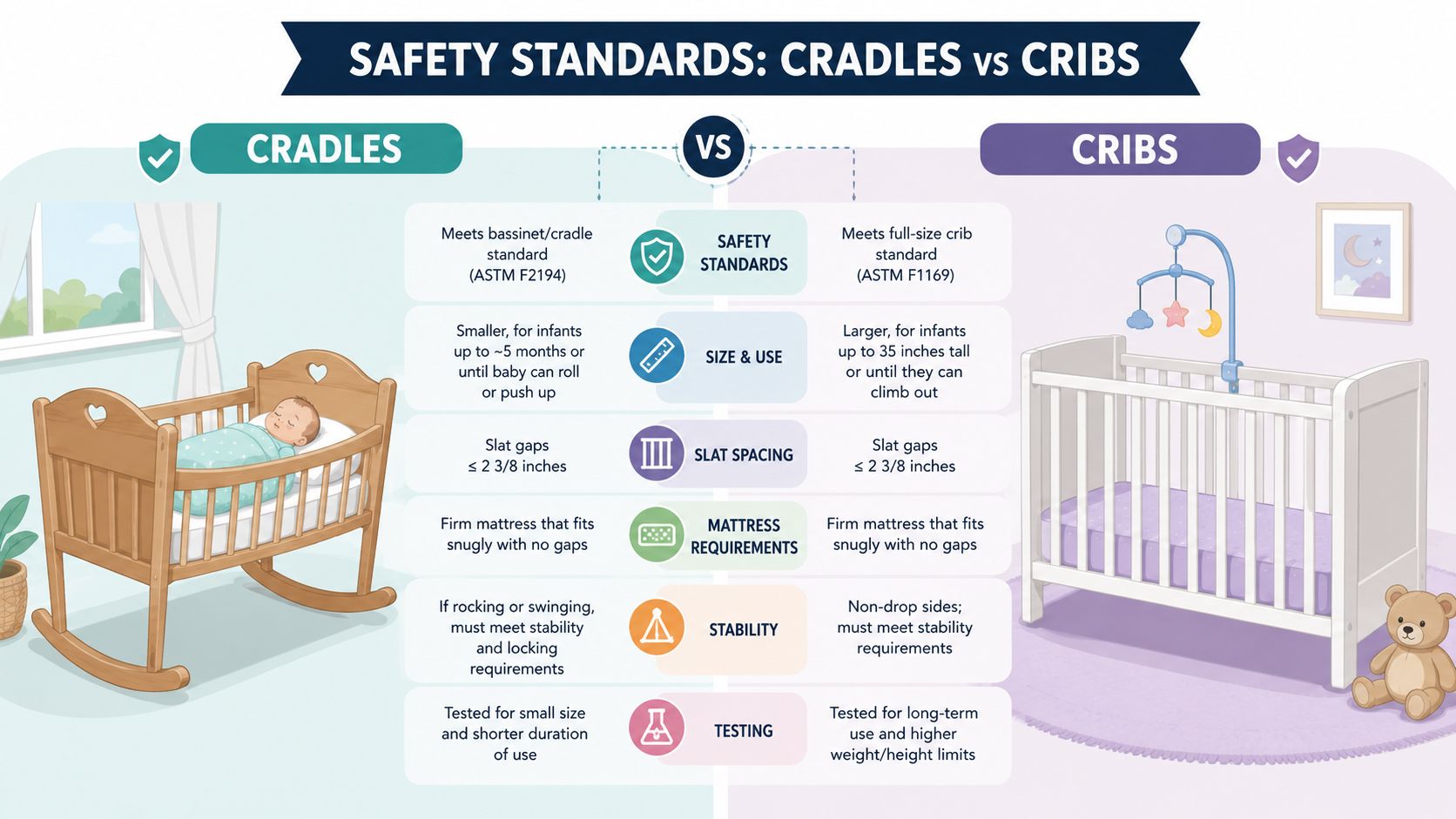
Cribs carry stricter safety expectations because they're built for longer use and more movement from an older infant or toddler. That means the crib is regulated more heavily than the cradle, and the details matter, not just the label. In plain terms, cribs are engineered with tighter structural rules because they have to stay safe longer.
What the regulations are trying to prevent
Health Canada's crib guidance sets specific structural limits, including maximum slat spacing of 6 cm, a mattress-support angle no greater than 7°, side-height requirements, and very limited corner-post protrusion. Those are not cosmetic rules. They're there to reduce entrapment risk, climbing risk, and instability as the child gets more mobile, as detailed in Health Canada's crib and cradle safety guidance and classification standards for sleep surface area. Health Canada's crib and cradle classification guidance makes clear that a cradle and a crib are separated by more than just size.
Cradle rules are narrower, because the product class is narrower. The U.S. CPSC states that a bassinet or cradle in the rest position must have a head-to-toe sleep surface no more than 10° from horizontal, which shows how closely sleep angle is controlled for infant products. Families who want to compare the broader sleep setup should read the guide on infant sleep safety and also review how to choose kid-friendly and pet-friendly furniture if the nursery shares space with the rest of the home.
The first federal crib safety standards arrived in 1973, and crib-related deaths fell from roughly 150 to 200 per year in the early 1970s to about 30 annually in recent years, according to the historical crib safety overview from Simply Nursery. At the same time, deaths tied specifically to infant beds were estimated at about 200 annually at one point and fell to about 50 annually by 2011, while injuries still sat around 8,000 annually in that history. That's the backdrop for why a properly built crib remains the benchmark product in the nursery.
A safe crib is not defined by marketing language. It's defined by structural rules, fit, and the way the piece holds up when the child starts moving.
One study cited in the research found suffocation risk was about 40 times higher for infants in adult beds than for those sleeping in cribs. That is a blunt reminder that “close enough” is not good enough in infant sleep. In a showroom consult, that difference usually becomes the deciding factor.
Cradle vs Crib Side-by-Side Comparison Across Key Criteria
For most families, the decision comes down to what the furniture needs to do in the room, not in a catalog. A cradle wins on compactness and short-term convenience. A crib wins on use length, structure, and long-term nursery planning.
| Criteria | Cradle | Crib |
|---|---|---|
| Regulatory size threshold | Sleeping surface area greater than 4,000 cm² and up to 5,500 cm² | Exceeds 5,500 cm² |
| Typical form | Smaller, lighter, often easier to place beside a bed | Fixed, sturdy structure, commonly about 28 x 52 inches |
| Intended use window | Earliest months only | Longer nursery stage, through toddler use |
| Mobility | Easier to move room to room | Meant to stay in place |
| Cost range | About $80 to $250 | About $150 to $1,000+ |
| Value pattern | Lower initial spend, shorter lifespan | Higher upfront spend, spread over years |
Size is a regulatory issue, not just a design preference
Health Canada's sleep-surface classification matters because it shows where a cradle ends and a crib begins. A cradle sits within the smaller sleep-surface band, while a crib exceeds 5,500 cm², which changes how the product is classified and tested. That's why the crib feels like a room piece and the cradle feels like a mobility piece.
The practical difference shows up quickly in a nursery. A standard crib takes up more visual and physical space, but it also gives the child more room to move and lasts much longer. A cradle is easier to keep close during the newborn stage, especially in tighter spaces around Orlando condos, townhomes, or guest-room nurseries.
Cost looks simple until the replacement cycle starts
A cradle's lower initial price is attractive, but it's also the reason families often end up buying again. Cribs cost more up front, yet the higher price is spread across years of use, which is the right way to think about nursery value. For a family planning one room, one child, or multiple children, that matters more than the first receipt.
The bigger picture is straightforward. If the room is temporary or tiny, the cradle can be a useful bridge. If the room is meant to serve as the core nursery, the crib is the better financial and functional move.
What Mattress and Bedding Setup Does Each Option Require
The mattress matters as much as the frame, and in many homes it matters more. A nursery setup is only as good as the fit, firmness, and breathability of the sleep surface, whether the family chooses a cradle or a crib. In Central Florida, humidity makes material quality even more important because cheap, poorly made components tend to feel their age fast.
Fit the mattress to the frame, not the other way around
A crib mattress should be firm and fit snugly with no meaningful gaps around the edges. That tight fit is what reduces the risk of unsafe spaces between the mattress and the frame. Cradle mattresses need their own exact sizing too, because a loose fit defeats the purpose of the smaller sleep space.
A premium mattress also supports the broader idea of orthopedic alignment. Infants don't need plush softness, they need stable, engineered support that holds its shape and matches the nursery frame. Families who buy a quality frame but skip the mattress are undermining their own investment.
Good nursery buying rule: spend for the mattress that fits properly first, then build the rest of the bedding plan around safety and breathability.
Keep the bedding simple and the materials breathable
Loose blankets, pillows, and bumper pads do not belong in either sleep setup. The safer approach is plain, fitted, and uncluttered. That's especially true in a humid climate like Central Florida, where breathable materials help the sleep space feel cleaner and easier to maintain.
For exact measurement and fit details, the crib mattress measurements guide is the practical starting point before ordering or committing to a frame. It's the kind of detail that prevents expensive mistakes and keeps the room from becoming a patchwork of almost-fitting parts.
The cleanest nursery setup is usually the least fussy one. A properly fitted mattress, a firm sleep surface, and minimal bedding will always beat decorative excess when safety and function are the priorities.
Why Heirloom-Quality American-Made Nursery Furniture Is the Smarter Investment
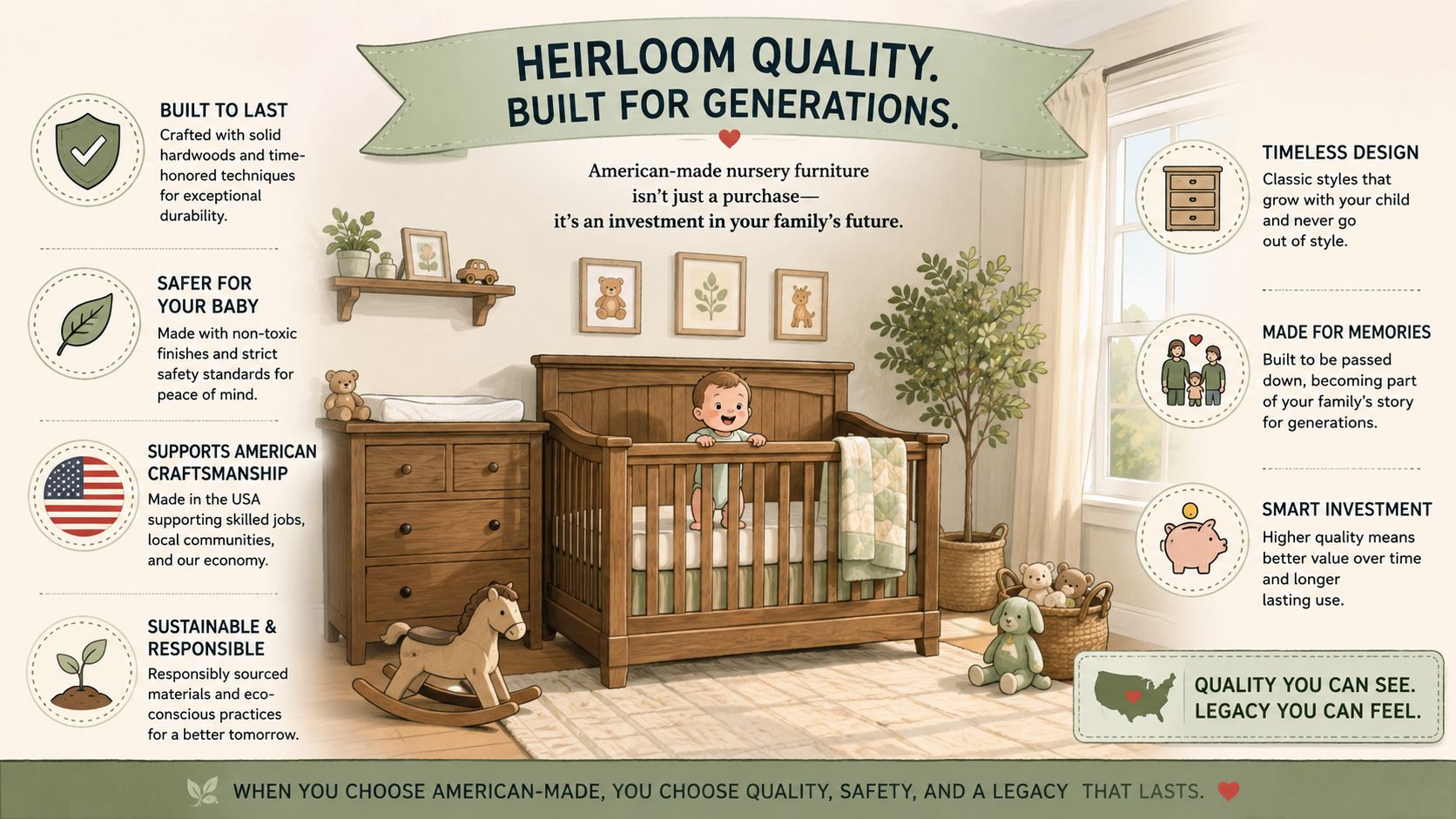
A nursery is one of the easiest rooms to cheap out on and one of the dumbest places to do it. Solid wood construction, careful joinery, and American-made craftsmanship give a crib real weight, real stability, and real staying power. That's why families who care about longevity should look past disposable options and think like homeowners, not temporary shoppers.
Solid wood changes the whole equation
Particle board and flimsy builds can look fine on a screen, but they don't carry the same structural confidence once a piece is assembled and used daily. Solid wood gives the nursery more weight, better stability, and a longer useful life. In humid Central Florida, that durability matters because furniture has to live in real conditions, not showroom conditions.
The case for heirloom-quality furniture gets even stronger with custom-order options. Families can choose finishes, materials, and configurations that fit the room instead of settling for whatever happens to be in stock. That matters when the nursery needs to coordinate with the rest of the house and not just the baby's first few months.
Slone Brothers Furniture carries American-made furniture that fits that investment mindset, and that's the right category to discuss when the question is lifespan, not just convenience. Amish-crafted furniture is another name that fits this conversation because it is built around the same idea, durable construction with a finish that ages gracefully.
Convertibility protects the investment
A crib that converts into later-stage use makes more sense than a piece that disappears from the house almost immediately. That's where lifecycle economics become clear. A family that buys one well-built crib can often avoid the churn of replacing a cradle quickly and then upgrading again.
Bottom line: if the family wants a nursery piece with staying power, heirloom-quality crib construction is the better buy than a quick-fix sleep station.
The nursery should feel like part of the home, not a temporary project. That's the difference between furniture that gets used and furniture that gets replaced.
Which Option Fits Your Family's Lifestyle and Nursery Plan
A family in Sanford with a dedicated nursery has different needs than a family in an Altamonte Springs guest room that's doubling as a baby space. The right answer depends on how long the room has to work, how much floor space exists, and whether the parents want one purchase to carry the child forward. For most homeowners, that points to a crib.
Choose the cradle if proximity is the priority
A cradle makes sense when the baby will sleep close to the parents and the room is tight. It's also the more obvious choice when the family wants a short-term newborn solution and doesn't want a full nursery footprint yet. The cradle gives gentle closeness without forcing the room into full nursery mode on day one.
That said, the cradle window is brief. Health Canada notes that crib use can continue until the child can climb out or reaches more than 90 cm in height, often around 18 to 24 months, while cradle use usually ends when the baby starts pushing up, often around 5 to 6 months. Families who hate transition shopping should take that gap seriously.
Choose the crib if the room is meant to last
A crib is the cleaner choice for new homeowners in Longwood, Lake Mary, or Winter Park who are furnishing a true nursery. It works better when the family wants a single sleep space with a longer useful life and a more complete room plan. It also makes sense for parents planning more than one child, because the piece can stay in service longer and often fit future nursery stages better.
For families worried about the eventual move from crib to bed, the big-bed transition guide is useful background, especially when planning the child's room timeline. The bigger point is simple, though. If the nursery is part of a long-term home, the crib is the better investment.
A cradle solves a narrow need. A crib solves the nursery.
Where to Shop for Premium Nursery Furniture in Greater Orlando
Central Florida families don't need another anonymous checkout page telling them a crib will be fine. They need to see the build, touch the finish, and compare real nursery pieces in a showroom where someone can answer questions. That's why local shopping still wins for high-consideration furniture, especially when the purchase affects sleep and room planning.
If the goal is heirloom-quality nursery furniture, where to buy Amish furniture is a smart place to start researching the construction side of the category. For families in Longwood and across Greater Orlando, Slone Brothers Furniture gives that conversation a physical place to happen, with a showroom that has served the area since 1980 and a team of experienced design consultants, not commission-driven order takers.
The practical advantage is obvious. Shoppers can review custom-order options, ask about home delivery, and make a better decision with actual guidance instead of guessing from a product page. That matters when the nursery needs to look polished, work safely, and hold value over time.
Ready to invest in nursery furniture that lasts beyond the newborn stage? Skip the online guesswork and see the build in person at Slone Brothers Furniture in Longwood, FL. Their experienced design consultants can help Central Florida families choose a crib, a cradle, or a complete nursery plan with real craftsmanship and human-to-human service.