
Throw Pillows for Sofas: A Local Stylist’s Buying Guide


A homeowner in Longwood can spend an afternoon moving the same tired accent pillows from one end of a beloved sofa to the other, hoping the room will finally look finished. The sofa itself may have a well-built frame, comfortable cushions, and upholstery worth keeping, yet the arrangement still feels flat, crowded, or disconnected from the rest of the room.
The right throw pillows for sofas can change that without replacing quality furniture. The decision isn't about copying a staged photograph. It's about reading the sofa's back height, seat depth, width, upholstery, and the way the room functions in a Central Florida home.
This guide treats pillow selection as a hands-on design consultation. It addresses proportion first, then fill, fabric, quantity, and arrangement, so every choice relates to the actual sofa in an Orlando, Lake Mary, Winter Park, Sanford, or Altamonte Springs living room.
Setting the Scene for a Sofa That Finally Feels Finished
A good sofa doesn't need decoration piled on top of it. It needs the right amount of softness, contrast, and structure to support its design.
That distinction matters in a Longwood home furnished around investment pieces. A sofa from a respected maker, whether it's paired with Stickley case goods, Stressless seating, Smith Brothers upholstery, or American-made furniture from Bassett, Craftmaster, Simply Amish, Canadel, Amisco, American Leather, Palasar, or Mavin, already carries visual authority. Pillows should refine that presence, not hide it.
Start with the sofa already in the room
The sofa's proportions determine the starting point. A low-profile frame needs a controlled arrangement that preserves its clean lines. A deep sectional can carry larger pillows, but only if the back height and chaise geometry support them. A compact loveseat needs fewer layers because every added piece consumes usable seating space.
The same pillow can look elegant on a deep sectional and oversized on a shallow apartment-style sofa. That's why generic shopping lists often disappoint. They describe the pillow, but not the furniture receiving it.
Practical rule: A pillow is successful when it improves the sofa's comfort and composition without making the sofa harder to use.
Quality begins before color
A well-made cover with a properly sized insert has a fuller edge, cleaner corners, and better recovery after use. The fill should suit the household's routine, while the fabric should respond to sunlight, humidity, pets, entertaining, and daily lounging.
Central Florida rooms also need a local reading of light. A sofa near a bright window in Winter Park has different demands from one placed in a shaded family room in Lake Mary. Humidity, air-conditioning cycles, and frequent use affect how a pillow feels and holds its shape.
The practical sequence is straightforward:
- Measure the sofa: Record back height, seat depth, and seating width.
- Choose the scale: Select square and lumbar sizes that respect those dimensions.
- Match the fill: Decide whether softness, structure, or low maintenance matters most.
- Select the fabric: Consider light, cleaning, touch, and upholstery harmony.
- Edit the arrangement: Remove anything that blocks comfort or overwhelms the frame.
Why Throw Pillows Became a Serious Design Category
A sofa in an Orlando living room can be well built and still look unfinished. The right throw pillow adds comfort, color, and proportion, but its value depends on the sofa receiving it. A tall back, deep seat, or wide seating span each calls for a different approach.
Decorative cushions have a long history. Surviving examples have been traced to ancient Egypt, China, and Mesopotamia, showing that people have used cushioned support and ornament for millennia, as described in this history of decorative throw pillows.
Modern manufacturing turned that tradition into a substantial home-decor category. The global throw pillows market was valued at about $14.8 billion in 2025 and is projected to reach $28.6 billion by 2034, representing roughly 93% growth over nine years at a projected 7.5% compound annual growth rate, according to Dataintelo's throw pillows market report.
Throw Pillow Category at a Glance
| Metric | Value |
|---|---|
| Global market value in 2025 | About $14.8 billion |
| Projected global market value in 2034 | $28.6 billion |
| Implied growth over nine years | Roughly 93% |
| Projected CAGR | 7.5% |
| Largest product share, polyester pillows | 34.2% |
| Asia Pacific revenue share in 2025 | 38.4% |
The same industry breakdown identifies polyester pillows as holding the largest product share at 34.2%, while Asia Pacific accounted for 38.4% of revenue in 2025. Those figures confirm that sofa accessories now operate as a global furnishing category, not a minor finishing detail.
A separate 2023 industry estimate cited 32.5 million annual decorative pillow imports into the United States, indicating how decorative pillows are tied to furniture and home-decor supply chains, according to the cited overview of decorative throw pillows.
Why scale changes the buying decision
A broad market offers variety, but it also produces plenty of poorly made options. An attractive pattern cannot compensate for a limp insert, distorted corners, weak seams, or a size that crowds the sofa.
For an Orlando homeowner, the sofa's geometry should lead the decision. A deep sectional can absorb fuller pillows without losing usable depth. A shallow sofa needs slimmer profiles. A tall back may support a substantial corner square, while a low modern back often looks cleaner with one restrained lumbar. A wide sofa can carry a balanced grouping, but a compact loveseat may look better with fewer pieces.
Quality deserves the same scrutiny as the sofa itself. Check the cover's construction, the insert's recovery, the fabric's suitability for the room, and the arrangement's effect on seating. Choose pillows that support the sofa's craftsmanship, then remove any piece that makes the room feel crowded.
Measure Your Sofa Before You Pick a Pillow
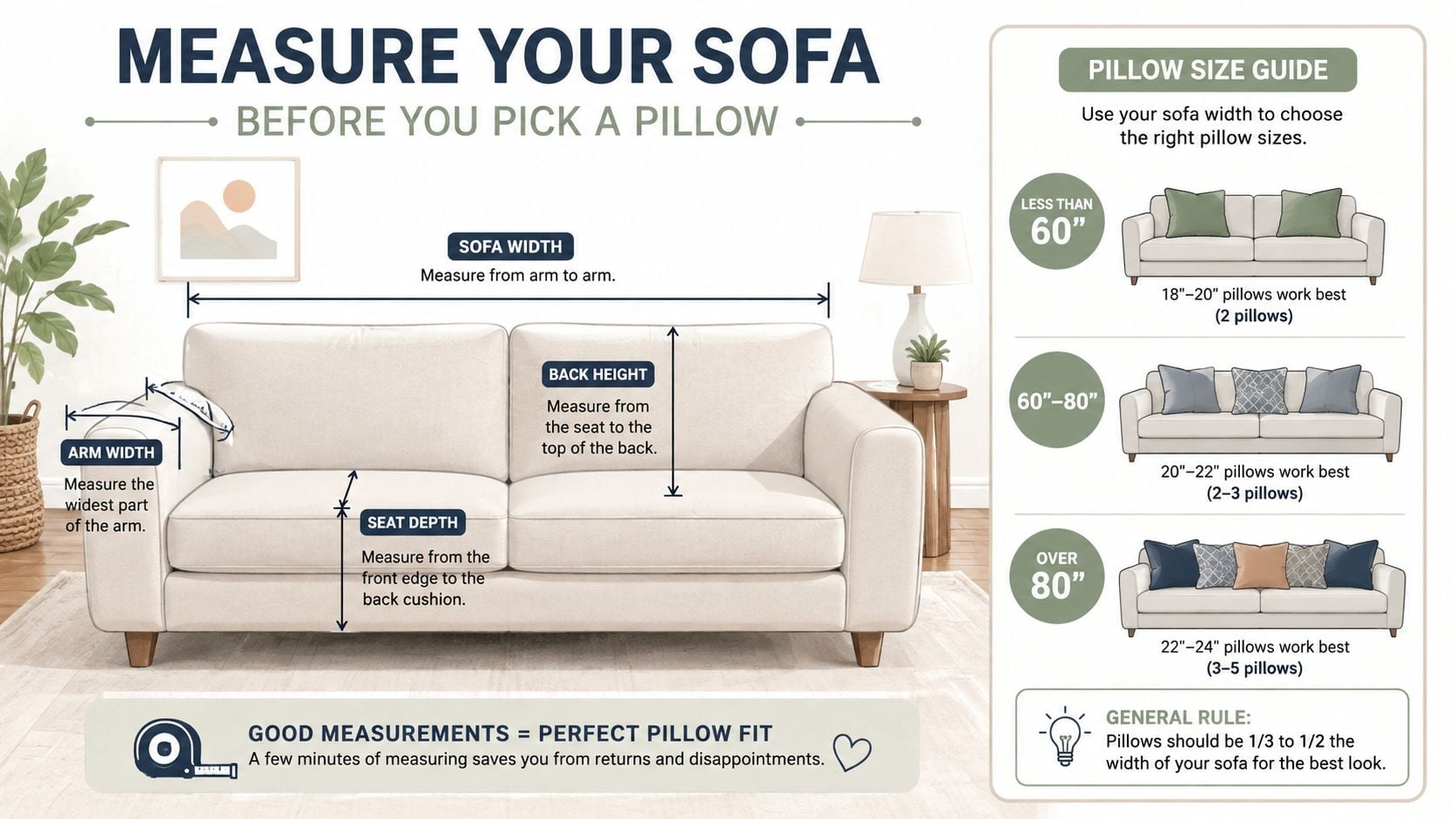
The correct pillow size starts with back height, seat depth, and seating width. These measurements tell a homeowner whether a 20-inch square will look supportive, whether a 24-inch pillow will overwhelm the back, and how much of the sofa should receive visual decoration.
Start with the sofa cleared of pillows, throws, and accessories. A standard household tape measure is enough, and the exercise can be completed in a few focused minutes.
Measure the back height
Measure from the top of the seat cushion to the top of the sofa back. The largest pillow should generally remain below the sofa's back height, and a practical guide recommends keeping the largest pillow at roughly half to two-thirds of the sofa back height, as discussed in this throw pillow size guide.
A tall traditional sofa can support a larger square at the corners. A low modern frame usually looks better with a lower lumbar or a restrained square that allows the upholstery line to remain visible.
Check seat depth before choosing fullness
Measure from the front edge of the seat cushion to the back cushion or inside back. Deep seating gives larger pillows room to sit without taking over the usable seat. Shallow seating needs more restraint because a large pillow can push the sitter forward and make the sofa feel smaller.
The measurement doesn't dictate one universal answer. It tells the design consultant whether a 20-inch pillow will provide comfortable support or whether a larger option will become an obstacle.
Record the total seating width
Measure the usable seating area, not the full outside width of the arms. The combined pillow grouping should occupy about 60% to 70% of the seating width, based on practical sofa-geometry guidance from Well Whisk.
Write the three measurements in a phone note, then photograph the sofa in natural light. Homeowners who want a more complete furniture-measuring reference can use Slone Brothers' guide to measuring furniture. Those measurements should guide every later decision, from insert size to pattern scale.
Choosing the Right Fill for Real Florida Living
There isn't one best pillow fill for every Central Florida household. Down offers the most relaxed luxury, down-alternative delivers a cleaner silhouette with less upkeep, and high-density foam provides the firmest structure.
The important question is how the fill behaves in the room. A formal sitting room that receives occasional use has different requirements from a family sofa exposed to afternoon humidity, air-conditioning cycles, children, pets, and daily lounging.
Down for softness and movement
Down has a soft hand and a supple, relaxed appearance. It compresses naturally, feels inviting against the back, and creates the informal luxury associated with a high-end living room.
The trade-off is maintenance. Down flattens quickly in humid conditions and needs regular fluffing to recover its loft. It can be the right selection for a homeowner who enjoys a lived-in look and doesn't mind reshaping the pillows as part of normal room care.
Down-alternative for controlled comfort
Quality down-alternative, especially gel microfiber, is the most balanced choice for many active Florida homes. It can maintain a cleaner silhouette, resist clumping, and reduce the daily maintenance associated with natural down.
The hand won't feel exactly the same. That difference matters to someone seeking the softest possible, sink-in experience, but it's often worthwhile for a sofa that must look composed after regular use.
High-density foam for support
High-density foam is the structured option. It holds its shape, provides firmer support, and works well when the pillow needs to act as a stable back cushion or a defined architectural accent.
Foam won't deliver the loose softness of down. It also requires attention to the cover's construction because a rigid insert can expose weak seams or make a poorly fitted cover look strained. For homeowners who prioritize order and easy upkeep, the firmness is a benefit rather than a defect.
Throw Pillow Fill Comparison
| Fill Type | Feel | Longevity | Florida Humidity Response |
|---|---|---|---|
| Down | Soft, relaxed, highly pliable | Maintains loft with care | Flattens more quickly and needs fluffing |
| Down-alternative | Plush with a cleaner silhouette | Resists clumping when well made | Well suited to regular household use |
| High-density foam | Firm and structured | Holds shape consistently | Stable, but less relaxed in feel |
For a deeper look at comfort priorities and pillow selection, Slone Brothers provides a guide to choosing the perfect pillow. The strongest recommendation for a busy Orlando living room is usually quality down-alternative, while down belongs in rooms where softness and ritual maintenance matter most.
Fabric Options That Hold Up in a Central Florida Home
Pillow fabric should be selected with the same care as sofa upholstery. The right choice depends on sun exposure, cleaning habits, pets, touch, and the visual relationship between the pillow and the sofa.
A fabric can be beautiful in a showroom and unsuitable beside a bright Orlando window. Central Florida homeowners need to evaluate how the textile will behave after repeated contact, cleaning, and exposure to changing indoor conditions.
Compare the fabric by lifestyle
| Fabric | Best For | Watch Out For |
|---|---|---|
| Performance fabric | Active households, pets, frequent entertaining | Some weaves can feel less natural to the touch |
| Linen | Breathable, relaxed, coastal or transitional rooms | Wrinkles and can fade near strong windows |
| Velvet | Formal sofas and rich accent moments | Retains heat and shows crush marks |
| Cotton | Everyday use and washable covers | Can lose shape over time |
| Leather | Tonal pairing with leather upholstery | Needs coordinated care and can feel visually heavy |
Performance fabric is the practical leader for a family room. A well-chosen performance weave can resist stains, handle pet claws, and manage daily wear without the pilling concerns associated with less resilient textiles. It still needs proper care, and the weave should coordinate with the sofa rather than announce its technical properties.
Linen breathes beautifully and brings a quiet, natural texture to a room. It wrinkles easily, however, and strong sunlight near a large window can fade it. Linen works best when a relaxed appearance is part of the design rather than a flaw to be corrected.
Velvet earns its place on a formal sofa or in a room that needs depth and glow. Its surface can retain heat in Florida and develop visible crush marks where people lean, so it isn't the first choice for a heavily used family sectional.
Cotton remains an approachable everyday workhorse. It washes easily in appropriate constructions, but repeated use can soften the structure and cause the cover to lose shape.
Leather makes a strong tonal partner for a leather sofa. It creates a composed, material-driven room, though homeowners should expect the pillows and sofa to require coordinated leather care. Slone Brothers' upholstery fabric guide offers a useful framework for weighing those trade-offs.
Less Really Can Be More on the Right Sofa
More pillows don't automatically create a more finished room. On many Orlando sofas, excess layers conceal the upholstery, reduce seating space, and make the arrangement look like an accessory display rather than a considered interior.
The strongest compositions use proportion before decoration. A pillow grouping should span roughly 60% to 70% of the seat width, while the largest pillow should sit between half and two-thirds of the sofa back height, according to practical sofa-styling guidance from Well Whisk.
Use negative space deliberately
A standard sofa may benefit from five pillows, but that doesn't mean five are always required. A low-profile contemporary sofa may look more polished with three pieces that leave the center or part of the seat open. The frame and upholstery become part of the composition.
A tight loveseat can be overwhelmed by a large collection. Three pillows, with one smaller lumbar or bolster, often provide enough softness and contrast without forcing everyone to move the pillows before sitting.
Negative space isn't an unfinished area. It gives the sofa room to breathe and preserves its purpose as seating.
Count before shopping
The safest approach is to determine the maximum grouping the sofa can hold, then remove one piece during editing. This prevents impulse purchases from dictating the room.
- Three pillows: A strong choice for loveseats, low-profile sofas, and restrained modern rooms.
- Four pillows: Useful when symmetry matters and the sofa has enough width for balanced pairs.
- Five pillows: A versatile arrangement for a standard three-seat sofa with adequate depth.
- More than five: Appropriate only when the sofa is broad or deep enough to support the added visual mass without sacrificing comfort.
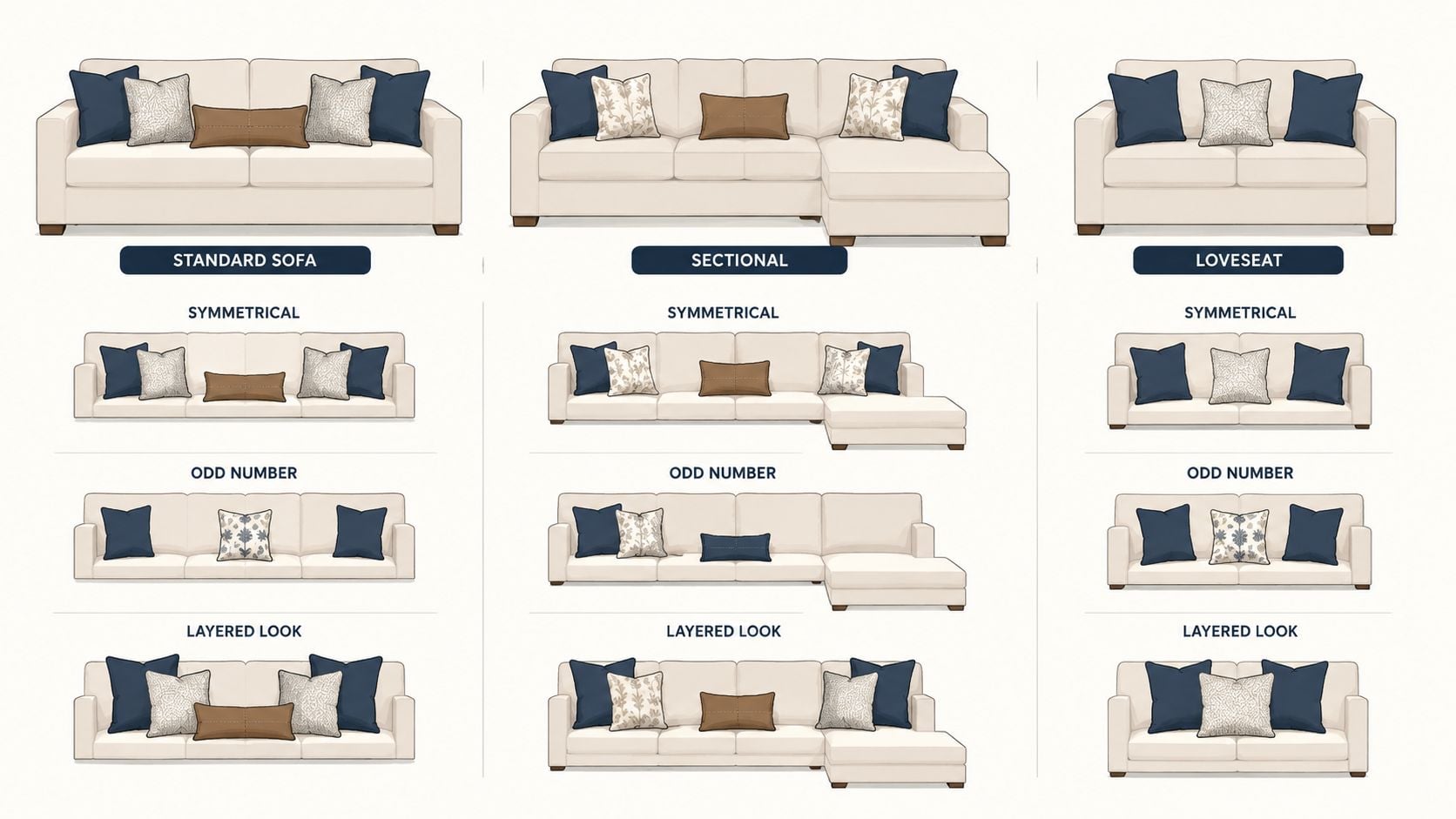
For natural, inviting arrangements, some designers prefer odd numbers such as one, three, or five, while even numbers support symmetry in more formal interiors. Common lumbar formats include 12 x 20, 12 x 22, 14 x 20, and 16 x 20 inches, as outlined in this decorative pillow size guide.
The best arrangement may be the one that leaves an intentional portion of the sofa untouched.
Arrangements That Work on a Standard Sofa, Sectional, or Loveseat
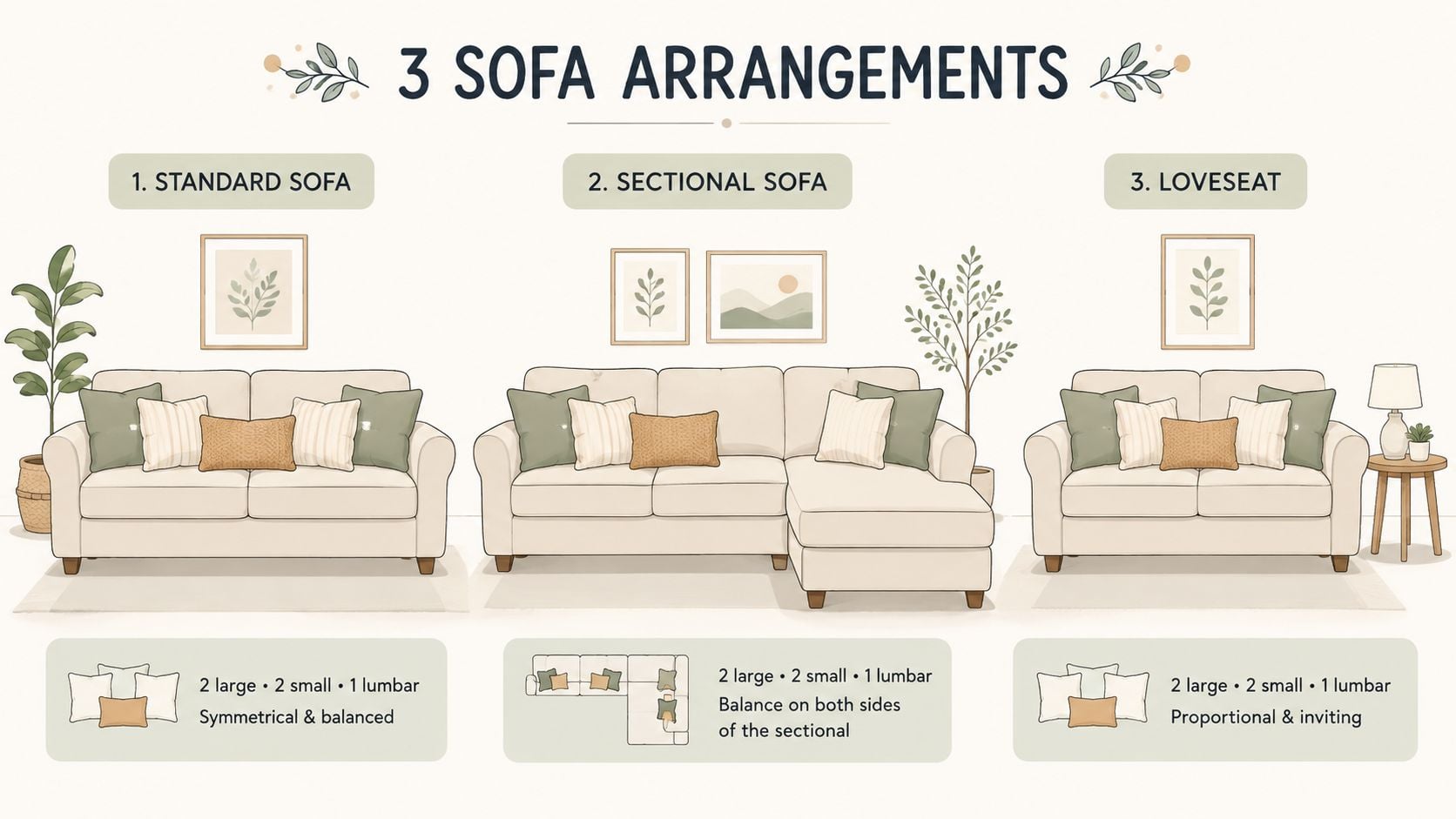
A pillow arrangement should follow the sofa's geometry rather than a universal count. Standard sofas, L-shaped sectionals, and loveseats each need a different balance of scale, open seating, and visual weight.
A standard three-seat sofa
For an 84 to 96-inch standard sofa, a five-pillow layout creates layered structure without making the sofa unusable:
- Place two 22 x 22-inch solid pillows at the rear corners.
- Add two 18 x 18-inch accent pillows in front, using one shared pattern or texture.
- Center a 20-inch lumbar or bolster to interrupt the square shapes.
The solids establish the foundation. The front accents provide pattern, while the lumbar gives the eye a horizontal line and creates a more finished look. A homeowner who prefers symmetry can mirror the two sides, while a more relaxed room can shift the center piece slightly.
An L-shaped sectional
A sectional should be counted by chaise length and usable seating run, not by the number of seats. Larger 24 x 24-inch pillows can soften the inside corner, where the two sofa directions meet. Smaller 18 x 18-inch pillows can then be distributed along the long run, leaving enough room for people to sit without moving an entire wall of cushions.
The inside corner can carry more visual weight because it isn't usually the most convenient sitting position. The long run should remain more open, especially in a family room where people stretch out.
For additional arrangement ideas that translate proportions into practical placement, homeowners can review styling throw pillows like a pro. Furniture placement also affects how the grouping reads, so Slone Brothers' living-room furniture arrangement guide is a useful companion.
A loveseat under 72 inches
A loveseat under 72 inches should carry no more than three pillows in most rooms. Two 16 x 16 or 18 x 18-inch squares can anchor the sides, with a single lumbar or bolster placed between them. If the seat is shallow, the central piece can replace one square instead of adding another layer.
The Longwood showroom can stage these arrangements beside different sofa geometries, allowing homeowners to compare the effect of scale in person rather than relying on a screen. That visual comparison is especially valuable when the existing sofa has a low back, deep seat, or unusually wide arms.
Bring Your Vision to the Longwood Showroom
The final decision is easier when the homeowner can test scale against real furniture. Slone Brothers Furniture's Longwood showroom functions as a working design environment, with living-room vignettes that help Orlando-area homeowners compare different sofa depths, back heights, seating widths, fabrics, and pillow proportions.
A productive consultation starts with information from the existing room. Homeowners should bring:
- Sofa measurements: Back height, seat depth, usable seat width, and overall frame dimensions.
- Fabric references: Swatches from the sofa, rug, drapery, or nearby accent chairs.
- A natural-light photograph: A phone image helps the design team understand wall color, window exposure, and surrounding finishes.
- A clear comfort preference: Soft and relaxed, clean and structured, or somewhere between the two.
Custom order or immediate selection
An in-house design team can help coordinate fabrics, fills, trims, and sizes for a custom-order pillow program. Custom orders typically run four to six weeks, so they suit homeowners planning a larger room refresh or seeking an exact match for an existing sofa.
Clearance offers a different advantage. Discontinued covers and overstocked sizes can provide meaningful savings for Orlando-area homeowners, and clearance selections can leave the showroom the same day. The right choice depends on whether the priority is exact customization or immediate placement.
Build around the entire room
Pillows shouldn't be selected in isolation. They need to relate to the sofa upholstery, wood finishes, rugs, lighting, art, and adjacent pieces. A neutral pillow with a rich weave may be more successful than a loud pattern if the room already contains strong architectural details.
That approach suits a home furnished with heirloom-quality pieces. A carefully made sofa should remain the anchor, while the pillows add comfort and seasonal flexibility. Covers can be changed later without forcing a new furniture purchase, provided the inserts and construction are sound.
For homeowners who want guidance beyond accessories, Slone Brothers offers complimentary in-home interior design consultation services. A consultant can evaluate the sofa in its actual room, help coordinate a broader living-room plan, and explain where craftsmanship justifies a higher upfront investment.
A visit should feel collaborative, not pressured. Homeowners can ask to see the standard-sofa, sectional, and loveseat arrangements described above, compare fill options by hand, and decide whether the room needs another pillow or fewer.
Ready to refine a sofa that already deserves to stay? Visit Slone Brothers Furniture in Longwood, FL, where experienced design consultants can help Central Florida homeowners select throw pillows that respect the sofa's geometry, comfort, and craftsmanship. Bring the sofa measurements and a room photograph, then explore custom-order options, in-stock selections, and personal guidance in a welcoming showroom.