

Living Room Furniture Near Me: The Greater Orlando Buyer’s


A homeowner in Lake Mary can spend an evening scrolling through sofas, sectionals, recliners, and accent chairs, then still have no confidence that the chosen piece will fit through the front door, clear a sliding glass door, or feel comfortable after the novelty wears off. That's the central problem behind searches for living room furniture near me. The options are plentiful, but reliable judgment about scale, construction, delivery, and long-term comfort is harder to find.
For Central Florida homeowners, the right purchase starts before the upholstery swatches come out. Room measurements, seating geometry, wood quality, fabric performance, production schedules, and post-purchase service all matter. A well-built sofa can be the anchor of a home for years, but only when its proportions and construction suit the people and the room using it.
Why Local Expertise Matters When Shopping for Living Room Furniture
The typical Greater Orlando furniture search begins with too many choices. A homeowner in Winter Park may find a low-profile sofa that looks elegant online, while a homeowner in Sanford may prefer a deep sectional for family gatherings. Neither buyer can judge scale, seat depth, fabric hand, or delivery access from a product photograph alone.
That's where a local showroom earns its place. A knowledgeable design consultant can ask questions an online product page can't. How does the room connect to the kitchen? Does the sectional need to leave a clear path to a lanai? Will the sofa face bright Central Florida windows? Does the household need upright support, generous lounging depth, or a combination of both?
A sofa should fit the way a household lives, not merely the way a photograph is staged.
Local homes create specific design challenges
Central Florida homes vary widely. A Winter Park bungalow may have tighter doorways and defined rooms, while a Lake Mary or Longwood new build may rely on open-concept circulation. Altamonte Springs homes can present another challenge, with living areas that need to accommodate entertainment, conversation, and transitions to adjoining spaces.
A local consultant recognizes those patterns and helps the buyer distinguish between a piece that technically fits and one that makes the room function well. That difference matters when selecting a deep sectional, a pair of lounge chairs, or a recliner that needs enough clearance to operate comfortably.
Slone Brothers Furniture has served Central Florida as a family-owned business since 1980, giving local homeowners access to a showroom-based process rather than an impersonal transaction. Its approach is grounded in face-to-face consultation, curated furnishings, custom-order capabilities, home delivery, and design guidance. Homeowners comparing nearby options can also use this guide to evaluate local furniture stores near you before committing to a major purchase.
The showroom visit protects the investment
A proper consultation reveals trade-offs early. A larger sectional may offer more seating but reduce walkway space. A firm, supportive cushion may suit daily reading better than a soft, sink-in style. A custom fabric may complement the room beautifully but require more planning than an in-stock selection.
That conversation is valuable because high-end furniture costs more for reasons that should be visible in the frame, suspension, cushions, finish, and service. The buyer isn't paying only for an attractive silhouette. The buyer is choosing how the room will feel and function over time.
How to Measure Your Living Room for Furniture That Fits
Before visiting a Longwood showroom, measure the room and the route a sofa or sectional must take to reach it. A few missed inches can leave a piece crowding the seating area, blocking a doorway, or creating an awkward path through the home. Accurate measurements also reduce delivery surprises after a custom order has been placed.
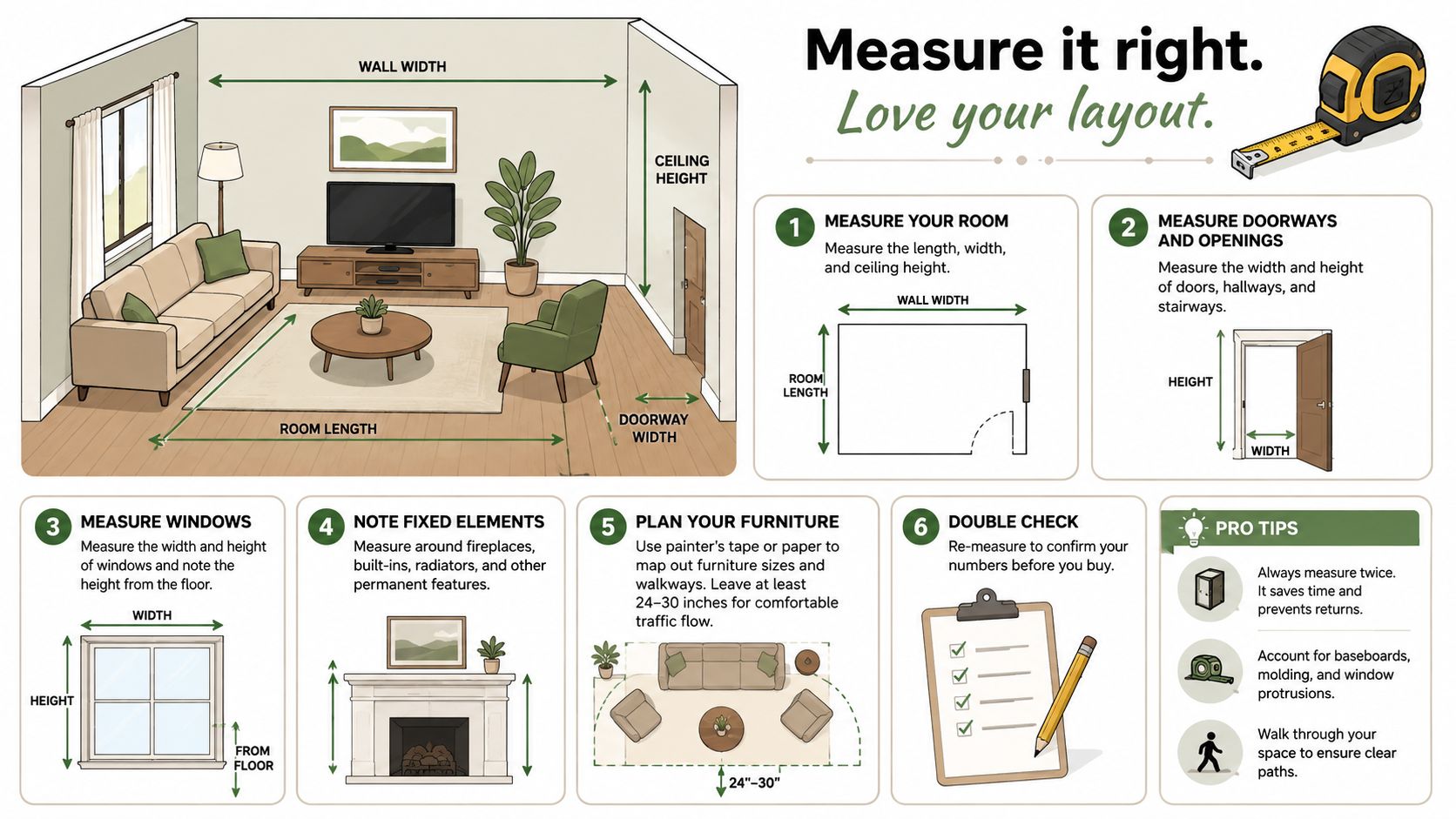
Start with the room envelope
Record the usable length and width, then mark ceiling height, windows, doors, built-ins, vents, outlets, baseboards, trim, and transitions to adjacent spaces. Sliding glass doors deserve close attention in Central Florida because they often connect the living room with a covered patio or Florida room. Keep that route open instead of turning it into a furniture bottleneck.
Measure every access point, including the front door, hallway turns, stair or elevator access where applicable, and the narrowest interior opening. Include door swing and trim in the clearance plan. A sectional can fit its intended wall and still fail at the entry, during delivery, or at a tight turn.
Irregular rooms need a measured plan rather than a rough rectangle. The guide to measuring L-shaped rooms for flooring explains how to divide an L-shaped footprint into workable areas. Apply the same method to identify seating zones, passageways, and areas that should remain open.
Use clearance benchmarks, not guesswork
Preserve 30 to 36 inches of circulation space between major furniture pieces, with 36 to 42 inches preferred on primary walkways, according to Houzz's furniture layout and ergonomics guide. Use the wider passage near the entrance, kitchen route, or path to outdoor living areas.
Leave about 14 to 18 inches between a sofa and coffee table. That spacing keeps drinks and books reachable while allowing comfortable legroom. Check the table's height as well. It should work with the seat height and remain proportionate to the entire seating group.
Use this measuring sequence:
- Sketch fixed features: Mark doors, windows, vents, outlets, built-ins, and architectural obstacles.
- Mark circulation: Draw walking paths first, especially around sliding doors and open-concept transitions.
- Place the largest piece: Test the sofa or sectional footprint before adding chairs and tables.
- Check proportion: A two-thirds rule can help assess the relationship between the coffee table and the principal furniture, as described in the linked layout guide.
- Test depth: A sofa may fit by width yet project too far into the room. Check space behind it and across the seating area.
- Bring the sketch: Show the plan to a consultant and ask for alternate configurations before ordering.
For a detailed reference, review Slone Brothers' guide to measuring a room for furniture. Bring the hand-drawn plan, phone photographs, and entry-path measurements to the showroom. A consultant can then test the scale in person, identify delivery risks, and help you avoid ordering a piece that looks right on paper but cannot enter the home.
What Makes a Sofa or Sectional Worth the Investment
A sofa deserves investment-level scrutiny because its frame and cushions absorb daily use, not occasional decorative attention. The strongest candidates combine a durable frame, dependable suspension, resilient cushion materials, and seat geometry that supports the people who use them.
Look inside the frame and cushions
A quality frame typically begins with kiln-dried hardwood and reinforced joints. Corner blocks, secure joinery, and properly attached suspension help distribute weight and reduce movement over time. Particle board and minimally reinforced construction may lower the initial price, but they offer a weaker foundation for a substantial seating piece.
Cushions require equal attention. High-density foam provides a resilient core, while a down or fiber wrap can soften the surface without eliminating support. The best choice depends on the household. A formal room may favor a cushion with a clean, disciplined shape, while a family room may benefit from a more relaxed cushion that still retains its structure.
A buyer should ask:
- What supports the frame? The consultant should be able to explain the wood, joinery, suspension, and reinforcement.
- What is inside the cushion? The answer should identify the core and the outer wrap, not just describe the piece as comfortable.
- Can the cushions be maintained? Removable covers, reversible cushions, and serviceable components can extend practical life.
- How does the upholstery handle Florida conditions? Sun exposure, humidity, pets, and everyday use all influence fabric selection.
Comfort is a measurement issue
Ergonomics can't be judged by appearance. Expert ergonomic guidance places comfortable seat height around 380 to 535 millimeters, seat depth adjustment at at least 75 millimeters, seat width at at least 450 millimeters, and lumbar support roughly 150 to 250 millimeters above the seat pan, according to Willis Furniture's ergonomic guidance. Those ranges help keep feet supported, reduce pressure behind the knees, and make standing easier.
The same source notes that a common three-seater sofa footprint is about 2100 by 750 millimeters, but overall dimensions don't tell the whole story. Two sofas with similar exterior measurements can feel completely different because their usable seat depth, cushion pitch, arm height, and back support differ.
Stressless is known for ergonomic innovation, making its seating worth testing rather than judging from a catalog image. Smith Brothers is a strong choice for buyers who want custom comfort, including custom upholstery and a seating feel selected around personal preferences. American Leather earns attention for engineered construction and configurable designs that can suit homeowners who want a refined appearance without sacrificing practical use.
The right showroom consultation involves sitting properly, standing up, testing recline mechanisms, and comparing support. A sofa that looks luxurious but forces the knees too high or leaves the lower back unsupported isn't a sound investment.
American-Made and Amish-Crafted Furniture vs Mass-Produced Alternatives
The distinction matters because it concerns sourcing, construction standards, repairability, and whether a piece remains useful as your home changes. American-made and Amish-crafted furniture suits homeowners who want visible substance behind the design, not just an attractive silhouette.
The “Made in the USA” claim has a specific standard. The FTC says final assembly and all significant processing must occur in the United States, with all or virtually all components made and sourced domestically. If foreign parts are used, the disclosure must appear next to the claim, as explained in guidance about what “Made in the USA” means for furniture.
Joinery reveals the difference
Amish furniture sources consistently emphasize solid hardwood and traditional joinery, including dovetail and mortise-and-tenon construction, rather than particle board or laminate. Common hardwoods include oak, cherry, maple, walnut, and hickory. These materials add weight, structural integrity, and a surface that can age well with proper care.
A trade profile of Amish builders describes 5/8-inch hardwood drawer box sides, dovetailed corners, dadoed and double-glued face frames, hand sanding, and consistent finishes in specific pieces, according to the Simply Amish craftsmanship profile. Those details give the heirloom claim a construction basis.
Mass-produced furniture can still suit a temporary furnishing plan, but inspect what carries the load. Particle board, laminate, thin components, and limited reinforcement may lower the initial cost while reducing repair options and long-term confidence. For a Central Florida homeowner furnishing a primary living room, that trade-off deserves careful consideration.
Heritage brands deserve close inspection
Historic American furniture traditions place design continuity and craftsmanship at the center of their appeal. Amish furniture directs attention to solid-wood construction and traditional woodworking. Other domestic makers offer living room pieces with American production, while coordinated furniture programs can help homeowners maintain a consistent finish and upholstery direction.
Ask for material details before accepting broad labels:
- Wood type: Is the piece solid hardwood, veneer over a stable core, or composite construction?
- Joinery: Are drawers dovetailed? Are structural joints mortise-and-tenon or reinforced through another method?
- Finish: Can the finish be maintained or repaired if the household moves or the room changes?
- Customization: Can dimensions, finish, or upholstery be adapted without weakening the construction?
The initial price can be higher for this level of work. The value is a piece that can remain in service, be repaired, and become part of the home's history instead of being replaced after a weak component fails. Review American-made furniture options before visiting a showroom, then inspect samples and construction in person. That visit also helps expose practical risks, including whether a large, heavy piece can reach the room without damage to walls, doorways, or flooring.
Understanding Custom-Order Lead Times and Planning Your Purchase
Custom furniture rewards patience, but poor planning turns patience into frustration. A buyer should decide early whether the priority is immediate delivery, a particular fabric and finish, or a precise configuration. Those goals don't always align.
Custom upholstered pieces commonly require 4 to 12 weeks, and complex orders can take longer, according to custom furniture market and lead-time coverage. Independent industry guidance places domestic custom furniture production at about 8 to 16 weeks, European imports at 12 to 24 or more weeks, and custom upholstery at 8 to 16 weeks, with custom finishes and configurations often adding time, according to furniture lead-time guidance.
Compare the purchase paths
| Order Type | Typical Lead Time | Best For |
|---|---|---|
| In-stock furniture | Available inventory timing | Homeowners furnishing a room immediately |
| Quick-ship upholstery | Shorter production schedule | Buyers who want selected personalization without a long wait |
| Custom upholstered piece | 4 to 12 weeks or longer | Buyers prioritizing fabric, dimensions, and comfort |
| Domestic custom production | 8 to 16 weeks | Heirloom-focused buyers who want American production |
| European import | 12 to 24+ weeks | Buyers willing to wait for a specific imported design |
The table reflects ranges from the cited custom furniture lead-time source and industry lead-time guidance. The ranges overlap because construction, upholstery, shipping, availability, and order complexity all affect the final schedule.
Build a plan around the actual room
A design consultant should identify which decisions control timing. A fabric substitution may require a different production path. A changed sectional orientation can affect both manufacturing and delivery planning. Imported materials, special finishes, and complex power or motion features can create additional coordination requirements.
Homeowners can avoid an empty-room problem by making decisions in order:
- Set the room deadline: Account for guests, a move-in date, renovation completion, or an existing sofa that must be removed.
- Separate essentials from preferences: Identify the configuration that must work, then rank fabrics, finishes, and secondary features.
- Compare inventory with custom options: An in-stock sofa may solve the immediate need, while custom accent chairs or tables follow later.
- Confirm delivery conditions: Discuss access, assembly, room-of-choice placement, packaging removal, and scheduling before the order is finalized.
- Get the timeline in writing: The estimate should distinguish production time from transit and final delivery coordination.
Homeowners considering a configuration can review how custom-order furniture gets started before meeting a consultant. The best process doesn't promise an unrealistic date. It explains what is known, what can change, and which decisions protect the schedule.
Why the In-Person Showroom Experience Beats Online Guesswork
Online furniture shopping compresses a complicated decision into photographs, dimensions, and a checkout button. That format can't reveal how a cushion rebounds, whether leather feels substantial, how a recliner supports the lower back, or whether a sectional overwhelms the room.
Furniture also carries unusual delivery risk. Industry trend coverage describes furniture as having one of the highest ecommerce return rates because buyers often discover size, color, and fit problems after delivery, while hybrid shopping behavior includes 45% of shoppers using both online and in-store touchpoints, online-only shopping rising 26%, 77% wanting digital decision tools, and 75% expecting online-plus-store options, according to furniture retail technology coverage. Those figures point to a practical reality. Buyers want digital convenience, but they still need physical confidence.
Touch and scale prevent expensive mistakes
A fabric sample can help, but it can't replace seeing the upholstery across a full sofa. A screen can show color, but it can't demonstrate how sunlight changes the impression of a textile or how a leather surface feels against the arm. A showroom lets the buyer test seat height, cushion firmness, recline action, arm support, and sightlines.
In-home design services add another layer of accuracy. A consultant who evaluates the room can consider wall color, flooring, existing pieces, window exposure, and circulation rather than selecting a sofa in isolation. Slone Brothers' furniture stores with design services support that kind of coordinated planning for Central Florida homeowners.
Service continues after the order
White-glove delivery matters because a large sofa needs more than a drop at the curb. Room-of-choice placement, assembly, packaging removal, and delivery coordination can reduce the physical and logistical burden on the homeowner. Buyers should confirm exactly what the service includes, especially for reclining pieces, sectionals, and rooms with tight access.
A family-owned showroom also creates accountability that an anonymous transaction can lack. Slone Brothers has served the region since 1980 and offers a Low Price Promise, home delivery with order tracking, custom-order furniture, mattresses, home décor, and complimentary in-house design services. The point isn't to remove every decision from the buyer. It's to make each decision with a person who can explain the consequences.
Your Next Steps for Furnishing a Living Room That Lasts
A successful living room purchase in Longwood, Orlando, or anywhere across Central Florida follows a disciplined sequence. Measure first, identify the room's traffic pattern, define the required comfort level, and then compare construction rather than shopping by silhouette alone.
The visit should produce answers to practical questions:
- Frame construction: What wood and joinery support the sofa or sectional?
- Cushion design: Does the piece use a resilient foam core, a down or fiber wrap, or another construction?
- Seat geometry: Do the height, depth, width, and lumbar support suit the people who will use it?
- Florida conditions: Which upholstery choices suit sunlight, humidity, pets, children, or frequent entertaining?
- Delivery logistics: Will the team handle assembly and room-of-choice placement, and how will access be managed?
- Order timing: Is the piece in stock, quick ship, or custom, and what could change the expected schedule?
- Future service: Can cushions, mechanisms, finishes, or upholstery be maintained if the home evolves?
Choose the room as a complete composition
A sofa shouldn't be selected without considering the coffee table, chairs, rug, lighting, and adjacent dining or entry areas. Palasar, Bassett, Craftmaster, American Leather, Mavin, and Canadel can serve different design directions, while Stressless, Smith Brothers, Stickley, and Amish address distinct priorities in comfort, heritage, customization, or craftsmanship. The right combination depends on the room, not on assembling a collection of unrelated labels.
The strongest local consultation also considers the rest of the home. A homeowner furnishing a new property in Lake Mary may need living, dining, bedroom, and home office pieces to share a coherent material and color language. A consultant can help the buyer make those decisions gradually without losing the character of the original room.
A lasting living room is measured by more than its first impression. It should remain comfortable, navigable, repairable, and visually relevant as the household changes. That outcome begins with accurate measurements, honest lead-time planning, and a showroom visit where the furniture can be experienced before the order is placed.
Ready to invest in living room furniture that fits the room and lasts for years? Visit Slone Brothers Furniture in Longwood, FL to review American-made, Amish-crafted, custom-order, and ergonomically focused options with experienced design consultants. Bring the room measurements, discuss delivery requirements, and receive face-to-face guidance for creating a beautifully curated Central Florida home.