

Chest for Living Room: Central Florida Buyer’s Guide


A living room in Central Florida has a habit of becoming everything at once. It's where guests gather, where kids drop backpacks, where chargers migrate, and where the day's clutter seems to settle if there's no proper place for it. A chest for living room use solves that problem with more restraint than a bulky wall unit and more polish than open shelving, which is why so many homeowners in Longwood, Orlando, Lake Mary, and Winter Park start seeing it as a serious investment piece rather than an afterthought.
That shift makes sense. Statista treats living-room storage pieces such as chests, TV stands, side tables, and cabinets as a dedicated global category, which shows the segment is large enough to stand on its own in consumer furnishings research Statista living-room storage category. In the same broad market, one 2026 industry summary cites $240.4 billion in global living-room furniture revenue and projects growth to $339.6 billion by 2035 at a 3.9% CAGR Statista living-room storage category. For a homeowner who wants the room to feel calmer, not fuller, that's the key insight, a well-made chest can hide the mess, hold the things that matter, and still look composed enough to anchor the room.
Why a Chest for Living Room Spaces Is the Smartest Storage Investment You Can Make
Walk into a Central Florida living room after a busy week and you usually find the same problem. Throws end up on one chair, board games spread across a table, remotes disappear between cushions, and spare cables settle wherever there is room. A chest for living room use solves that disorder with closed storage that does not ask for the wall span of a long cabinet or the visual bulk of a full entertainment center. It gives the room a place to store what needs to be hidden and a surface that still looks intentional.
That value shows up in the way the category is recognized in furniture planning. The living-room storage segment includes chests as a standard option, which confirms that this is a practical furnishing choice, not a decorative extra Statista living-room storage category. In Central Florida homes, where one room often has to handle guests, daily family traffic, and flexible layouts, that matters because the furniture has to work as hard as the room does.
A piece that earns its place
A well-made chest organizes a room instead of adding to the clutter. The top can hold a lamp, framed art, or a tray for daily items, while the drawers or doors keep the surface calm and the room easier to read at a glance. That is the difference between furniture that merely fills a corner and furniture that helps the room feel finished.
Practical rule: if a room needs storage but already feels visually busy, a chest is often the better choice than another open unit.
The long-term value is just as important. Living-room furniture gets used constantly, so the purchase deserves the same care a homeowner would give to any major furnishing decision. Before choosing a piece, it helps to study a living room essentials collection that shows how a chest fits into the whole room instead of behaving like a standalone afterthought.
What Exactly Is a Living Room Chest and How Does It Differ from a Dresser
A living room chest is usually taller and narrower than a dresser, and that shape changes how the room works around it. The vertical profile keeps more floor open, which helps in compact rooms and tighter layouts, while a dresser spreads outward and asks for more width. In a living room, that difference affects sightlines, traffic flow, and how comfortably the piece sits beside seating or a television wall.
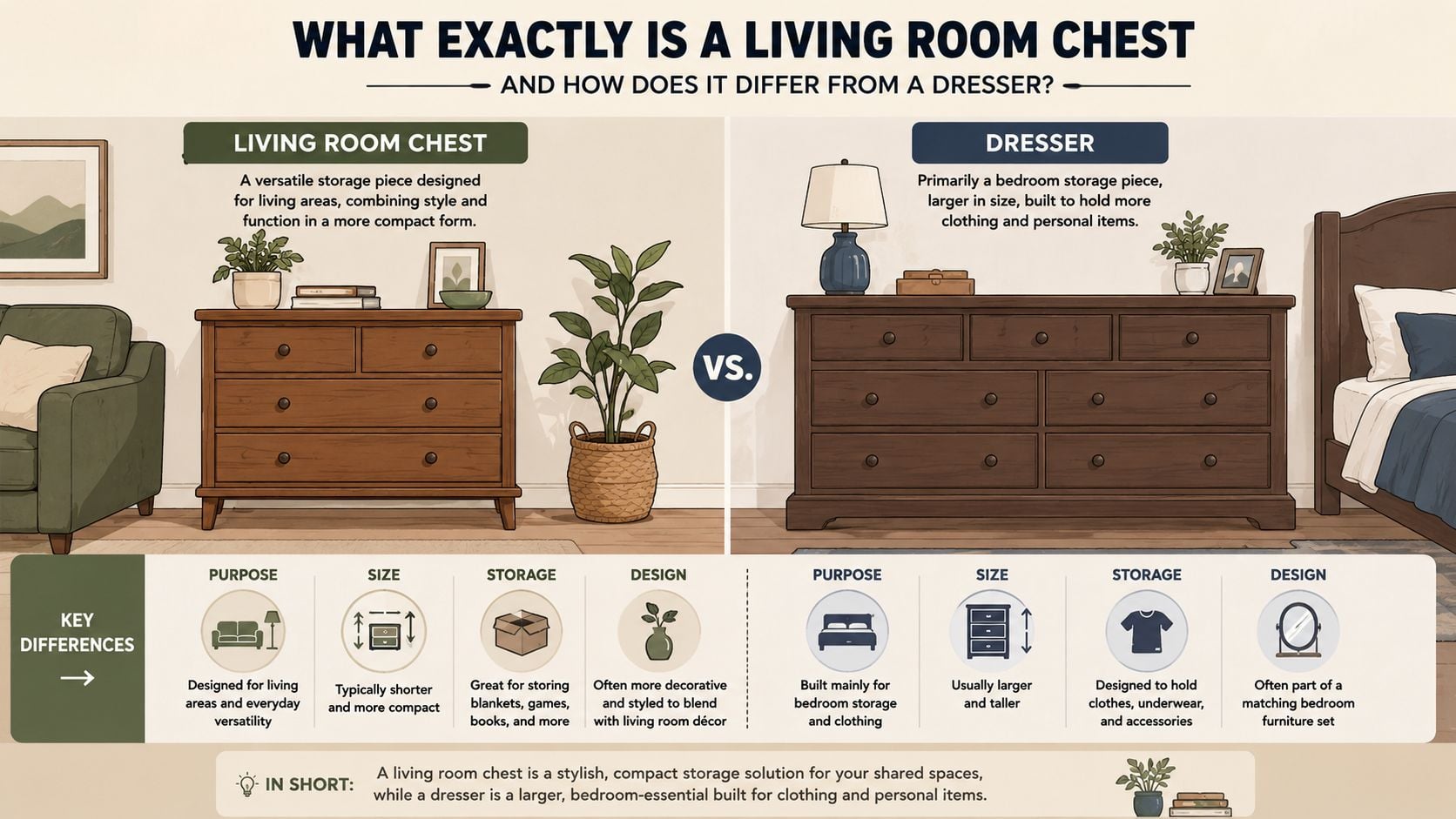
Chest, dresser, console, and cabinet
A tall chest is commonly described as about 36 inches wide, 18 inches deep, and 52 inches high, with roughly 36 inches of clear space in front so the drawers can open without crowding the room furniture dimension reference. Chest-of-drawers references also place chests around 60–100 cm wide and 120–150 cm tall, while dressers are usually broader and shorter at 120–180 cm wide and 75–90 cm high. That is the practical split. A chest keeps the room's width available, while a dresser claims more of it.
A console table usually serves the room's surface and display needs, so it gives you a place for lamps, decor, or a shallow catchall area rather than enclosed storage. A cabinet closes items away neatly, but it often reads more like fixed casework than a flexible furniture piece. A chest sits between those categories, which is why it can handle hidden storage without making a living room feel heavy.
The safety question belongs here too. The U.S. Consumer Product Safety Commission reported 34 deaths since 1996 involving children under 18 in incidents tied to storage and toy chests furniture dimension reference. That history is why modern chests are expected to have steady bases, secure construction, and safer hardware, especially in homes with children or in rooms that see constant use.
A chest should feel visually lighter than a dresser, even when it offers substantial storage.
For buyers comparing room-friendly shapes, a useful resource on layout thinking is TV cabinet ideas for South Jersey homes, because it reinforces the same principle. Width and visual mass matter as much as storage capacity.
Wood choice also changes how a chest performs over time. If you want a clearer way to compare species and their long-term character, oak vs maple vs cherry cabinets is a helpful reference point, and a wood furniture guide for lasting style can help you judge what the structure underneath the finish is doing.
How to Evaluate Wood Quality and Construction in a Premium Chest
A good chest begins with what sits under the finish. Solid wood gives the piece weight, structure, and the kind of long-term service that shortcuts in materials usually cannot match, while veneered or mixed-construction pieces can still be excellent if the core and joinery are well made. The real question is not which label sounds stronger, it is how the chest is assembled, because that is what determines how it will hold up in a living room over time.
For homeowners in Central Florida, that inspection matters even more than it does in a room that gets light use. Air conditioning cycles, humidity shifts, and everyday drawer use all test the same weak points, especially the joints, runners, and back panel. A chest can look refined on the outside and still wear out early if the drawers bind, the hardware flexes, or the frame loses its shape.
What to check in the showroom
Start with the drawers. Dovetail joints are stronger and longer-lasting than glued or stapled construction, and soft-close metal runners are a premium feature worth seeking because they support smoother motion and better durability than basic slides chest construction guide. In a quality chest, those details should feel intentional, not ornamental.
Then check the weight and safety hardware. Retail specifications show that some chests are built with anti-tip or anti-topple anchors, and one mainstream 4-drawer chest states compliance with ASTM F2057-19, the clothing-storage-unit safety standard intended to reduce tip-over hazards for children under 5 chest safety and construction reference. A well-made chest usually feels stable when drawers open and close, not front-heavy or hollow.
Wood species still affect how the piece looks and behaves over time, and the same logic used in oak vs maple vs cherry cabinets applies here as well. Grain pattern, hardness, and movement under changing indoor conditions all shape the chest's long-term character.
Here is the simplest showroom checklist:
- Frame strength: Press lightly at the corners and look for a case that feels rigid.
- Drawer motion: Open each drawer fully and listen for friction, drag, or wobble.
- Hardware quality: Favor metal runners and secure mounting over flimsy slides.
- Stability: Ask how the piece resists tipping and whether anchors are included.
- Finish integrity: Inspect edges and interior surfaces, not just the front face.
For a closer look at hardwood selection and long-term value, the wood furniture guide helps explain what sits beneath the finish and why that matters for a chest meant to stay in service.
Sizing and Placement Rules for Every Living Room Layout
A chest can keep a living room orderly only when its footprint matches the room's circulation. Height is the first number to check, because a living-room chest usually works best in the 75–100 cm range, or about 30–39 inches living-room chest height guidance. That range lets the top carry a lamp, artwork, or a mirror without making the piece feel like a wall in the room.
Depth needs just as much attention, and in tighter rooms it can matter even more than height. Sizing guidance for living-room chests commonly points to a depth of about 18–20 inches, with 10–12 inches of clearance in front when the drawers are fully open chest construction guide. Product examples from retail listings also show familiar living-room proportions around 32–36 inches wide and 15–18 inches deep, including pieces such as 32.25" × 15.75" × 34.5" and 36" × 17.5" × 34.25" living-room chest sizing reference.
A chest that is too deep can crowd a path before it ever looks oversized. A chest that is too shallow can feel unstable or undersized beside a sofa or media wall. The goal is a proportion that supports the room, the way a well-cut frame supports a picture without drawing attention to itself.
Placement rules that prevent mistakes
If the chest sits behind a sofa, leave enough space so the sofa does not look pressed against it. If it sits beside seating, keep the depth narrow enough that the walkway still feels open. If it sits in a corner, a rounded-front profile can soften the visual block and help the piece sit more comfortably in the room.
A practical layout guide also recommends at least 30 inches of clear walkway where possible small chest layout guidance. That matters in Orlando condos, Lake Mary family rooms, and Winter Park homes alike, because a chest that interrupts circulation will always feel awkward, no matter how refined the finish may be.
For homeowners measuring carefully before a showroom visit, the room measurement guide is the right companion to a floor plan and tape measure. It helps you translate the room's usable width, depth, and walk paths into a piece that fits the actual space, not the imagined one.
If a chest solves storage but narrows the room's main walking line, the size is wrong for that layout.
Placement also changes how the chest functions. Behind a sofa, it can work like a slim console. Under art, it becomes a display anchor. Near a media wall, it may serve as support storage instead of the focal point, so the proportions should follow that role. The same chest can feel calm, crowded, or out of place depending on where it lands.
Choosing the Right Storage Format for Your Daily Life
A chest is most useful when its storage format matches the way a household lives. Drawer chests are excellent for items that need to stay hidden and sorted, open-shelf chests work better when display is part of the brief, and media chests make sense when cords, remotes, and electronics need to stay managed. The right choice depends less on style preference than on what tends to collect in the room.
The functional range is broader than many shoppers expect. Interior-design references note that these pieces can be paired with shelves, glazed cabinets, mini-racks, pull-out mirrors, chairs, and small tables, and may include both open and closed compartments living-room chest function reference. That flexibility is why the chest can work as a storage-and-display anchor instead of acting like a bedroom piece moved into a new room.
Match the format to the clutter
A family with toys and blankets usually benefits from closed drawers or doors, because visual order matters as much as storage volume. A homeowner who wants to show books, pottery, or framed photos may prefer a piece with open sections or glazed fronts. A media setup needs cord access and ventilation more than decorative carving.
Open-plan homes in Central Florida make this decision even more important. When the living room is always visible from the kitchen or foyer, a bulky storage solution can make the whole home feel heavier. A chest with a softer silhouette, especially one with rounded edges, tends to read as more relaxed and less obstructive.
For homeowners thinking in terms of practical categories, the accent storage cabinets page is a useful way to compare the storage-first mindset with the more decorative side of the room.
A simple decision rule helps:
- Use drawers when the goal is to hide everyday clutter.
- Use open shelving when the objects themselves are part of the decor.
- Use a media format when electronics and cord control matter most.
- Use a rounded-front piece when the room feels tight or visually hard-edged.
The best living-room storage is usually the one that disappears into the rhythm of the household. That's the standard worth holding onto when the room has to be both beautiful and useful.
Why Heirloom-Quality and Custom Orders Outperform Mass-Market Alternatives
A premium chest costs more because it's built to do more, and to keep doing it for years. Heirloom-quality pieces from brands such as Stickley, Bassett, and Simply Amish are priced around craftsmanship, durable materials, and careful construction, not just around appearance. For discerning homeowners, that changes the math, because replacing a weak piece twice is rarely cheaper than buying a well-made one once.
Custom orders matter for the same reason. Living rooms rarely measure out in perfect, convenient rectangles, especially in newer Central Florida homes where traffic flow, windows, and open-plan transitions all compete for space. A piece that can be adapted in materials, finishes, and configurations solves the all-too-common problem of something that almost fits but still feels off.
Value is measured over time
A strong case for premium furniture starts with longevity. Quality construction resists racking, drawer problems, and finish fatigue far better than disposable alternatives, which means the chest keeps its form and function longer. That durability is the investment, because the room keeps working without the cycle of replacement.
The local advantage matters too. Slone Brothers Furniture has served Central Florida since 1980, and that long history shapes how design conversations happen, especially for homeowners who want a chest that belongs in the room rather than merely filling a gap. The store's Low Price Promise and custom-order approach are part of that value equation, but so is the ability to talk through the piece with a real consultant instead of making the decision alone.
Long-term value comes from fit, construction, and service, not from the lowest number on a tag.
For homeowners choosing between a nearly-right stock piece and a properly specified one, the custom-order route usually wins. It reduces compromises, and in a room as visible as the living room, fewer compromises mean a cleaner result.
Protecting Your Investment with Proper Care in the Florida Climate
Florida asks more of wood furniture than many climates do. Humidity swings, strong daylight, and constant temperature changes from air conditioning all influence how wood moves and how finishes age. A quality chest can handle those conditions well, but only if it's placed and maintained with care.
The first rule is position. Keep the chest out of direct sun where possible, because fading and surface stress tend to show up first on exposed tops and edges. The second rule is cleaning, which should stay gentle and finish-appropriate, since harsh products can strip protection or dull the sheen over time. Hardware should be checked occasionally so drawers keep sliding smoothly instead of grinding against the frame.
Routine care that protects the finish
Light dusting with a soft cloth is better than aggressive wiping. Spills should be removed quickly, and dampness should never be left to sit on the surface. If a room has persistent moisture concerns, the piece should be watched closely, because even well-made furniture benefits from early attention.
For more detailed guidance on moisture-related issues, the AMPM Restoration Services guide is a useful reference point for understanding what to look for when wood is exposed to unwanted dampness. The broader idea is simple, prevention is easier than repair.
A solid maintenance rhythm usually includes:
- Dust regularly: Keep grit from dulling the finish.
- Avoid direct sun: Reduce fading and uneven wear.
- Check runners: Make sure drawers stay smooth and aligned.
- Watch humidity: Respond early if the room feels damp or musty.
- Respect the finish: Use cleaners meant for finished wood, not all-purpose shortcuts.
For a fuller care routine, the wood furniture care guide offers a useful framework for keeping a living-room chest in good shape through Florida's seasonal shifts.
Experience the Difference at Slone Brothers Furniture in Longwood
A well-chosen chest should feel like it belongs in the room the moment it arrives. That's why many Central Florida homeowners prefer a showroom conversation, where they can compare construction, test drawers, and talk through layout with experienced design consultants instead of relying on guesswork. At Slone Brothers Furniture in Longwood, the process can include complimentary in-home interior design services, custom-order options, and white-glove delivery, all built around the way real families furnish real homes.
For a living room that needs storage without clutter, that kind of guidance matters. It helps separate what merely looks good online from what will work in a Lake Mary family room, an Altamonte Springs condo, or a Winter Park home that needs a cleaner visual line.
Ready to invest in furniture that lasts a lifetime? Skip the online guesswork and automated digital chatbots. Visit Slone Brothers Furniture in Longwood, FL today, and talk face-to-face with experienced design consultants who can help you choose a chest for living room storage that fits your space, your style, and your long-term value goals.