

Quality Assurance Processes for Heirloom Furniture


A homeowner in Longwood can spend an afternoon choosing the right dining silhouette, leather color, or mattress comfort level, then overlook the detail that determines whether the piece still feels solid years later. A drawer may glide beautifully in a showroom while its joinery remains hidden. A dining table may look perfect under display lighting while a finish mismatch appears beside a bright Central Florida window.
That's why quality assurance processes matter. They protect the purchase through every stage, from material selection and supplier qualification to inspection, packaging, white-glove delivery, and post-delivery service. For a discerning homeowner furnishing a residence in Orlando, Lake Mary, Sanford, Winter Park, or Altamonte Springs, quality isn't a label attached at the end. It's a chain of decisions made correctly from the beginning.
What Quality Assurance Processes Actually Mean for the Furniture You Bring Home
Inside a Longwood showroom, a design consultant runs a hand beneath a solid wood dining table. The table looks flawless from across the room, but one tenon sits slightly proud and a corner of the finish feels faintly uneven. A shopper focused on the leg profile might walk past without noticing. A trained consultant stops, records the issue, and makes sure the piece is corrected before it reaches a dining room.
That moment captures the meaning of quality assurance processes for furniture. Quality assurance, or QA, is a repeatable system of checks that protects a buyer from the moment lumber is milled until a white-glove crew places the finished piece inside the home. It isn't a single inspection sticker. It's a connected chain involving the maker, materials, construction, finish, packaging, transportation, installation, and follow-up.
The idea of formalized quality assurance expanded globally through the ISO 9000 family. Its modern origin traces to BS 5750, published in March 1979, followed by the ISO 9000 series launched in March 1987. ISO 9001 certificates grew from 409,421 in 2000 to 510,616 in 2001 and 1,138,155 by 2014, illustrating how documented quality systems moved into mainstream operations across major markets (historical ISO 9000 adoption data).
For furniture buyers, that framework becomes tangible through:
- Supplier vetting, which confirms who made the piece and how.
- Joinery and assembly checks, which reveal whether the structure is built for service rather than appearance.
- Material and finish verification, especially important for solid hardwood and custom orders.
- Transit controls, including protective wrapping and corner protection.
- Delivery inspection, which catches damage or alignment changes before the crew leaves.
- Service documentation, which gives the showroom a record when a correction is needed.
A well-made Stickley cabinet, a Stressless recliner, a Smith Brothers sofa, or an Amish dining table deserves that level of attention. Homeowners considering an investment piece can also explore how long quality furniture should last before comparing construction, warranty, and service expectations.
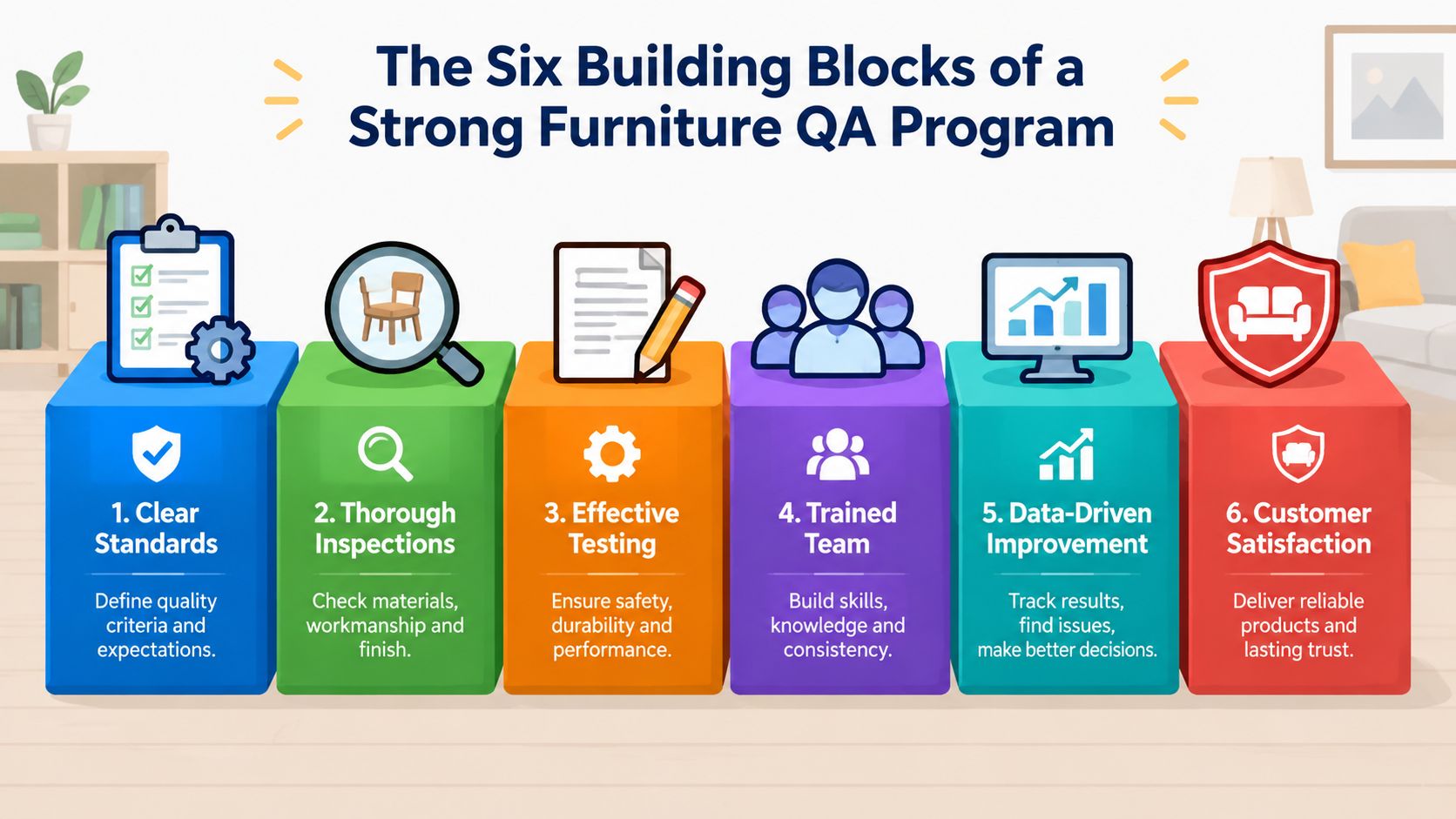
The Six Building Blocks of a Strong Furniture QA Program
A reliable furniture QA program uses six interlocking building blocks. Each one catches a different kind of risk. If a retailer skips one layer, the next layer has to absorb problems that should have been prevented earlier.
1. Supplier and maker qualification
The process begins before a table, sofa, or bedroom collection enters the showroom. A retailer should understand a maker's materials, construction standards, warranty practices, finishing methods, and ability to correct problems. For Amish and American-made furniture, that means looking beyond the country-of-origin label and examining how the workshop builds each piece.
2. In-process inspection
A finished product can hide a construction problem. Inspection during milling, joinery, assembly, and upholstery gives a trained person the opportunity to catch loose joints, uneven alignment, weak fastening, or inconsistent tension before the piece receives its final finish.
3. Finish and material verification
Solid wood responds to its environment, so finish inspection includes more than color. The process may involve checking moisture content, grain orientation, sheen, stain consistency, veneer placement where applicable, fabric grade, leather selection, and cushion materials. A finish sample should represent the actual hardwood and lighting conditions as closely as possible.
4. Functional testing
A drawer should travel smoothly. A cabinet door should align and close without force. A recliner should operate evenly. A sofa frame should feel stable when weight shifts across it. Functional checks translate visual craftsmanship into everyday performance.
5. Packaging and transit controls
A strong piece can still arrive damaged if the journey receives little attention. Corner guards, protective blankets, stable loading, careful handling, and route planning help preserve the finish and structure between the maker, showroom, and home.
6. Documentation and feedback
Quality improves when a retailer records what happened. Inspection notes, photographs, repair tickets, approved samples, and delivery observations create accountability and allow recurring issues to be traced back to their source. Statistical measurement also helps larger operations understand defects. A defect rate is calculated by dividing defective units by total units inspected and multiplying by 100. Traditional manufacturing may average 5% to 10% defects, while stronger automated systems can reduce defects to under 1%, according to manufacturing defect-rate guidance.
These principles apply to furniture as well as digital operations. Retailers and service teams looking to strengthen review controls can consult AI quality assurance tips from SupportGPT, especially when automated records or generated test material enters a workflow. For the homeowner, the practical question is simpler: can the retailer explain how a concern is recorded, corrected, and followed through?
A warranty should support that process, not replace it. Buyers can review furniture warranty information and ask which issues are handled by the maker, the retailer, or the delivery team.
Comparing QA Frameworks and Where a Family-Owned Showroom Fits
Furniture retailers can borrow useful practices from several quality frameworks, but no single model fits every showroom. A formal system brings consistency. A knowledgeable human brings context. The strongest approach combines both.
| Framework | Documentation Required | Inspection Style | Best Fit for Family Showroom |
|---|---|---|---|
| ISO 9001-style quality management | Supplier records, procedures, corrective actions, review history | Documented audits and process checks | Supplier qualification and service accountability |
| Six Sigma | Defect records, sampling plans, root-cause analysis | Statistical measurement and variation control | Repeated issues across product categories |
| Lean visual management | Visible work cues, status markers, standard work | Immediate floor-level identification | Receiving, staging, and delivery coordination |
| Family-business model | Maker notes, named contacts, repair history | Direct inspection and relationship-based escalation | Custom orders and personal customer follow-through |
ISO 9001-style documentation helps a Longwood showroom answer basic questions consistently. Who approved the maker? What construction standards apply? Which finish did the customer approve? What happened when a previous delivery required correction? The ISO 9000 family's growth reflects the value of structured quality systems, but paperwork alone doesn't make a dining table better.
Six Sigma contributes disciplined defect measurement. If a specific drawer mechanism repeatedly arrives misaligned, a retailer can record the pattern, identify where the variation begins, and decide whether the maker or receiving process needs attention. Statistical thinking is useful, but a small family showroom shouldn't turn every customer interaction into a form-filling exercise.
Lean visual management has a place in receiving and delivery. Clear status cues can show whether a piece is awaiting inspection, approved for staging, scheduled for delivery, or held for correction. That simple visibility prevents a rushed handoff.
The family-owned model adds something the frameworks can't fully formalize, named accountability. Direct supplier relationships, experienced design consultants, and a commitment to resolving concerns give the process a human owner. For an heirloom purchase in Central Florida, the blended model is the most practical: formal records where consistency matters, personal judgment where craftsmanship requires interpretation.
Supplier and Maker Quality Assurance for Amish and American-Made Pieces
Supplier QA starts long before a homeowner sits in a Longwood showroom. It begins with the question of whether a workshop's materials and construction methods match the standards represented to the buyer.
For an Amish dining table, the evaluation centers on the hardwood itself, the quality of the grain, the stability of the construction, and the joinery. Dovetail and mortise-and-tenon joints are widely recognized as stronger signs of careful furniture construction than visible staples, excessive glue, or simple nail fastening (furniture construction guidance). Reinforced corner blocks, dowels, and properly placed screws can add support where the design calls for them.
A retailer's supplier review may include workshop visits, sample-piece evaluation, finish comparison, and a record of how the maker handles corrections. A documentation binder for each maker can hold approved specifications, material notes, warranty information, photographs, and prior service records. The purpose isn't to burden the craftsman with administration. It's to ensure the retailer can answer a homeowner's questions with more than a sales description.
What gets checked by maker category
| Maker Category | Materials Verified | Joinery Standard | Documentation Required | Re-inspection Frequency |
|---|---|---|---|---|
| Amish hardwood furniture | Solid hardwood selection, grain, finish materials | Mortise-and-tenon, dovetail, dowel, or reinforced construction as specified | Build standards, finish approval, maker record | At receiving and when standards change |
| American-made upholstery | Frame materials, suspension, fabric or leather, cushion construction | Secure frame assembly and consistent upholstery tension | Frame warranty, material specifications, inspection notes | At receiving and during service review |
| Accent and occasional furniture | Wood, metal, glass, veneer, or composite components as specified | Stable assembly with secure hardware | Product specifications and finish record | At receiving and after transit concerns |
The same attention applies across the broader collection. Stickley carries a historical furniture legacy that makes joinery and finish integrity central to its identity. Stressless is associated with ergonomic innovation, while Smith Brothers emphasizes custom comfort through upholstery choices and cushion construction. Bassett, Craftmaster, American Leather, Canadel, Amisco, Simply Amish, Palasar, and Mavin each call for their own material and construction questions.
Homeowners can learn more about the traditions and characteristics of Amish furniture before visiting. The important distinction is that “American-made” and “Amish-crafted” should begin a conversation, not end the inspection. A family-owned retailer turns those supplier relationships into living accountability when a named person can follow a concern from the showroom floor back to the maker.
Overseeing Custom Orders From Finish Sample to Final Inspection
Custom furniture deserves a visible chain of approvals. A buyer shouldn't have to guess whether the finished table matches the piece that inspired the order.
A custom dining table often begins with a finish-sample board from the workshop. The customer should review the stain, sheen, distressing, and grain on the actual hardwood or a representative sample approved for the order. A printed image or small generic swatch can't fully communicate how a finish will respond to the table's grain or to the natural light found in a Central Florida dining room.
The checkpoints worth requesting
Design confirmation
The retailer records dimensions, leg style, edge profile, seating needs, finish selection, and room requirements. This prevents a beautiful table from becoming the wrong table for the space.Finish approval
The customer reviews the sample and confirms the desired color and sheen before production moves forward. Any alteration should be documented rather than handled casually by memory.Progress visibility
Photographs can show leg shaping, top glue-ups, edge work, and finish application. These images don't replace inspection, but they give the consultant an opportunity to identify a departure from the approved design while correction remains practical.Pre-shipment inspection
The table is checked for leveling, hardware tightness, finish consistency, surface smoothness, and visible construction concerns under natural or neutral light.Delivery confirmation
The final piece is compared with the approved order record before it leaves for the home.
A consultant should pay particular attention to differences that a production checklist may not interpret well. A slightly warmer stain can be acceptable in one room and visibly wrong beside existing cabinetry. A small change in edge shaping can alter the entire character of a table.
A homeowner can ask three direct questions before signing a custom-order contract:
- Which sample controls the final finish approval?
- Who inspects the piece before shipment, and what does that inspection include?
- How are mismatches or transit concerns documented and corrected?
For a clearer explanation of the process, buyers can review how to get started with a custom order.
The inspection stage should feel collaborative, not secretive. A careful retailer welcomes precise questions because custom furniture is an investment in proportion, comfort, and long-term use.
White-Glove Delivery and Installation QA in Central Florida
A piece of furniture isn't finished with QA when it leaves the showroom. Delivery is the final handoff, and it can expose problems that weren't visible during staging.
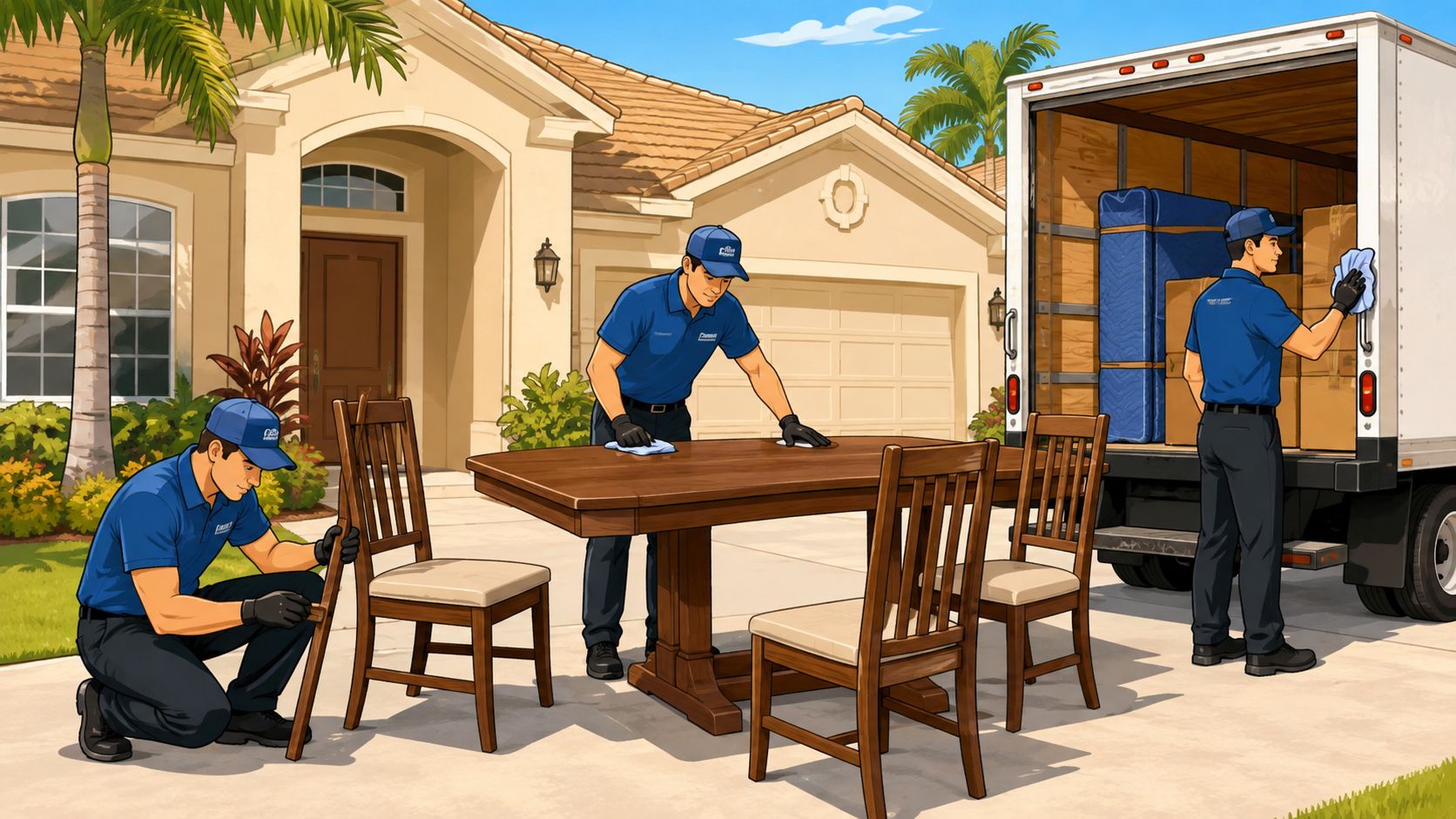
On a Central Florida driveway, the crew begins with a walkthrough. The delivery team confirms the entry route, checks doorway and stairway clearance, protects the home as needed, and reviews the placement plan developed during the design consultation. That preparation matters in older Winter Park homes, newer Lake Mary residences, and multi-level properties around Orlando where access conditions vary.
Inside the room, the crew should inspect the piece before asking for a signature. The process may include:
- Leveling, especially on uneven Florida subfloors.
- Drawer travel, to confirm smooth opening and closing.
- Door alignment, including hinges and closing pressure.
- Hardware tightness, with appropriate attention to handles, pulls, and fasteners.
- Surface review, using a careful wipe-down to identify transit marks or residue.
- Placement confirmation, so the furniture sits according to the agreed room plan.
A delivery concern shouldn't become a debate at the doorway. The crew should document the condition, record the location of the issue, and route the information back through the showroom. Clear photographs and a concise description give the service team a useful starting point, particularly when a repair or maker review is required.
Homeowners should keep the approved order details, finish sample if available, delivery paperwork, and a clear path to each room. A white-glove visit takes the time required for safe carrying, placement, assembly, leveling, inspection, and customer review. The exact duration depends on the number of pieces, access conditions, assembly needs, and room layout, so a realistic delivery window is more useful than a rushed promise.
A white-glove delivery service should feel like an extension of the showroom experience. The crew protects the home, treats the furniture carefully, and leaves the customer with a clear record of what was completed.

Why Human Oversight Still Beats Automation in Furniture Quality
A trained human can notice furniture qualities that a scanner or algorithm may flag poorly or miss entirely. During an in-home design consultation in Longwood, a consultant may kneel beside a sofa frame, feel a slight wobble, trace a seam with a fingertip, or listen for a drawer that catches near the end of its travel.
Those observations require interpretation. Wood grain, joint tolerance, finish depth, and upholstery tension don't exist in isolation. A small gap may be acceptable in one construction method and concerning in another. The meaning depends on the joint, the material, the intended movement of the wood, and the piece's overall stability.
Automation can help organize inspection records, compare measurements, identify repeated patterns, and route exceptions. It can't replace a person who understands why a solid wood panel needs room to respond to humidity or why a down-wrapped cushion feels different from a dense foam core.
That distinction is becoming more important as AI enters quality work. Recent coverage reports that 68% of surveyed teams use AI in critical QA activities, while 45% plan to expand its use within a year, and regression work still consumes 40% to 50% of QA resources (AI and QA survey coverage). Those figures point to a broader lesson. Automation can shift work toward review, calibration, exception handling, and accountability rather than eliminate human oversight.
Practical rule: Use automation to organize evidence. Use trained judgment to decide whether the furniture is right for the home.
That principle fits a family-owned showroom. The design consultant who helps a homeowner choose a dining set understands the room, the finish, the intended use, and the customer's expectations. That same continuity makes an in-home consultation more than decoration advice. It creates a practical human checkpoint between selection, delivery, and long-term service.
A Homeowner's QA Checklist and Your Next Step in Longwood
A homeowner doesn't need a manufacturing background to ask useful quality questions. The following checks can be used in a showroom or during delivery, whether the purchase comes from an Amish workshop, an American-made upholstery maker, or a custom furniture program.
- Inspect drawer corners: Look for clean dovetail joints, even spacing, and secure assembly. Dovetails indicate a more deliberate construction approach than exposed staples or excessive glue.
- Run a hand along tabletop seams: The surface should feel smooth and intentional. A raised edge, rough transition, or uneven glue line deserves an explanation before acceptance.
- Study grain direction: Solid wood moves with changes in its environment, so grain orientation and panel construction should make sense for the design. A consultant can explain how the top, legs, and aprons work together.
- Compare the finish under natural light: Confirm that the color, sheen, and distressing match the approved sample. Bright Florida daylight can reveal differences hidden under showroom lighting.
- Check hardware and level: Handles, pulls, hinges, and fasteners should feel secure. Tables, cabinets, and case pieces should sit firmly without rocking.
- Operate every drawer and door: Test the full range of movement before the delivery crew leaves. Listen for rubbing, sticking, uneven travel, or doors that fail to close properly.
- Record concerns immediately: A short description and clear photographs help the service team understand what needs attention. Businesses seeking administrative help with customer follow-through can also review virtual support for business owners, though furniture inspection itself still belongs with trained showroom and delivery professionals.
Slone Brothers Furniture is a family-owned Longwood showroom serving Central Florida since 1980, with American-made and Amish-crafted furniture, custom orders, mattresses, home décor, design guidance, and home delivery. Homeowners can visit to compare materials in person, examine construction details, and request complimentary in-home interior design assistance without pressure to make a rushed decision.
Ready to evaluate quality assurance processes in person? Visit Slone Brothers Furniture in Longwood, FL, where experienced design consultants can help Central Florida homeowners compare heirloom-quality dining, living, bedroom, and office furniture. Bring room measurements, finish ideas, or delivery questions, and let a real design professional help transform the house into a beautifully curated home.