

Fabric Swivel Chair: A Buyer Guide for Orlando Homes


A quality fabric swivel chair should combine a mechanically tested base with upholstery rated for its intended use. For commercial-style durability, ANSI/BIFMA X5.1 testing includes 120,000 full rotations on chairs with adjustable height, while Central Florida upholstery needs a fabric choice suited to humidity, sunlight, cleaning, and daily friction.
Why do so many buying guides treat a swivel chair as a color decision? A beautiful silhouette matters, but it doesn't tell a homeowner in Longwood, Orlando, or Winter Park whether the bearing system will remain smooth, whether the cushion will hold its shape, or whether the fabric will tolerate years of pivoting in a family room or home office.
A fabric swivel chair is a small piece of furniture with several working systems inside it: a stationary base, rotating hardware, frame, foam, upholstery, and sometimes a return or reclining mechanism. Each component affects long-term value. The right choice feels effortless because the engineering and materials are doing their work behind the scenes.
Understanding the Value of a Fabric Swivel Chair
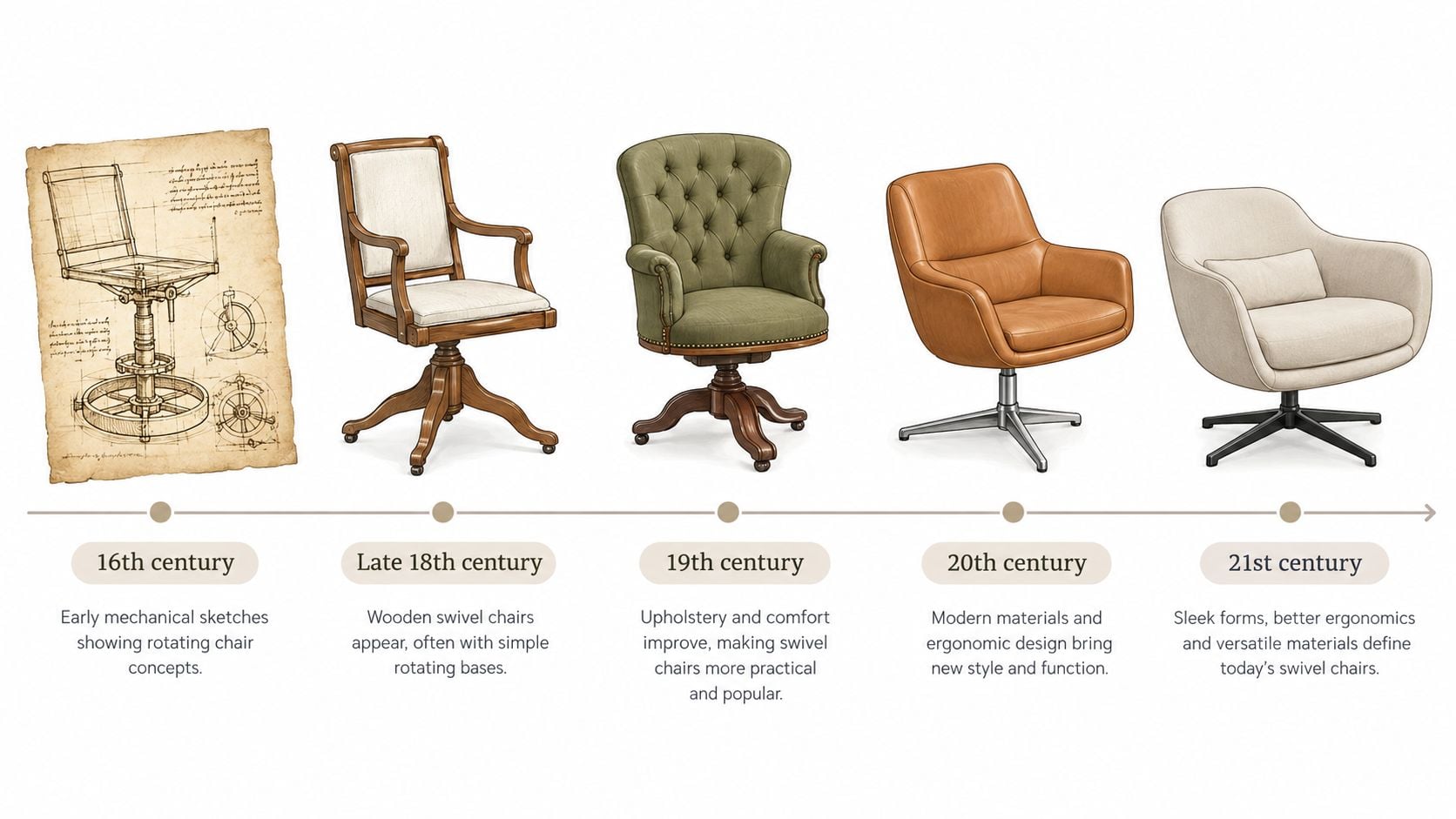
A fabric swivel chair isn't a passing decorating trend. Its central idea, a stable base supporting a rotating seat, has served practical work and conversation for centuries.
A rotating-chair concept appears in a 1505 German illustrated manuscript attributed to Martin Löffelholz von Kolberg. The drawing showed a chair that could twist and adjust in height. In 1775, Thomas Jefferson adapted an English-style Windsor chair by connecting its upper and lower sections with a central iron spindle and adding casters, creating a practical rotating chair for his workspace. The design let the seated user turn without standing, which mattered for reading, writing, and working. The historical patent record documents the broader development of the form.
Eighteenth-century manufacturers couldn't produce swivel chairs widely because reliable hardware strong enough to support a person while allowing controlled rotation wasn't readily available. Cast-iron improvements made broader nineteenth-century production more feasible, followed by a major American milestone in 1853, when Peter Ten Eyck patented a swivel-chair design using wooden construction and steel rockers. Modern upholstered versions add padding, textile covers, and refined mechanisms, but the basic engineering remains recognizable.
Function before decoration
The practical advantage is 360-degree access to nearby surfaces and people. In a living room, a chair can face a sofa for conversation, turn toward a television, or orient toward a window without being lifted and repositioned. At a desk, the user can reach an adjacent surface with less torso twisting.
That flexibility doesn't excuse weak construction. A chair that looks substantial but uses unsuitable hardware, thin padding, or upholstery poorly matched to its environment can become frustrating long before its style feels dated.
Before choosing a silhouette, buyers should review what to look for in a new sofa or chair, including frame quality, cushion construction, proportions, and intended use. Those same questions apply to a custom fabric swivel chair.
Practical rule: Rotation should make a well-fitted chair easier to use, not compensate for poor proportions or weak construction.
What Construction Standards Define Quality Seating
A fabric swivel chair should be judged by its complete construction, not by a polished base or an attractive weight rating. ANSI/BIFMA X5.1 evaluates structural adequacy, safety, and durability through repeated loading and movement, giving buyers a more meaningful reference point than appearance alone.
The swivel test is particularly relevant because each turn transfers torsional stress through several connected parts:
- Seat mounting plate: Connects the upper chair structure to the rotating mechanism.
- Bearing or bushing system: Allows controlled movement while carrying load.
- Fasteners: Keep the assembly secure as the user repeatedly pivots.
- Base: Distributes the load across the floor and supports the entire chair.
For chairs without adjustable height, the published procedure requires 360-degree rotation for 60,000 cycles. When the chair has adjustable height, another 60,000 cycles follow, bringing the total to 120,000 rotations, performed at approximately 5 to 15 rotations per minute. The chair must remain serviceable afterward. The ANSI/BIFMA test method summary explains why cyclic movement matters.
What buyers should ask
A custom-order or American-made chair deserves specific questions before purchase. A seller should be able to clarify:
- Whether the applicable ANSI/BIFMA X5.1 test level is identified.
- What occupant load the testing addresses.
- Whether the complete chair was tested, rather than only the swivel mechanism.
- Whether the frame, foam, fabric, and hardware carry warranties appropriate to residential or commercial use.
- Whether adjustable height, reclining, return, or gliding functions change the testing requirements.
A weight rating can be useful, but it describes only one aspect of performance. It doesn't reveal how a chair behaves after repeated turning, how the mounting plate handles stress, or whether the upholstery will remain presentable.
Construction that suits the room
A living-room chair used for reading and conversation has a different duty cycle from a reception chair or home-office seat used throughout the day. Commercial furnishings need documentation that matches higher traffic, while a residential chair still deserves sturdy engineering when a household pivots in and out of it repeatedly.
The strongest purchase decision combines documented mechanical testing with a hands-on assessment of smoothness, noise, balance, and return action. A mechanism can be durable and still feel wrong if it turns too freely, resists movement, or places the seat at an unsuitable height.
How to Read Fabric Durability and Abrasion Ratings
Abrasion ratings are useful screening tools, but they aren't a countdown clock for upholstery life. The test method, weave, cleaning requirements, sunlight exposure, and actual use all matter more than a single impressive number.
ACT guidance distinguishes two common methods. Wyzenbeek counts back-and-forth double rubs against cotton duck. Martindale counts rubbing cycles under approximately 12 kPa pressure with worsted wool. The scales aren't directly interchangeable, so a Martindale result shouldn't be treated as though it equals the same number of Wyzenbeek double rubs.
For general contract upholstery, commonly cited reference levels are 15,000 Wyzenbeek double rubs or 20,000 Martindale cycles. Heavy-duty contract upholstery is commonly benchmarked at 30,000 double rubs or 40,000 Martindale cycles. ACT performance guidance presents these as performance references, not guaranteed lifespans.
A practical reading method
Start by identifying the test method. A fabric listed at 30,000 Wyzenbeek double rubs and one listed at 30,000 Martindale cycles have not received equivalent testing, so the shared number doesn't make them comparable.
Next, consider the chair's location:
- Private living room: A moderate-use textile may be suitable when the chair is used for reading or conversation.
- Active family room: A tightly woven, cleanable performance textile can better handle repeated sitting, pivoting, and contact at the arms.
- Home office: Seat-edge friction, daily movement, and prolonged contact deserve closer attention than color alone.
- Commercial waiting area: Heavy-duty contract upholstery and documented testing become more important.
ACT-related guidance identifies 15,000 Wyzenbeek double rubs for low-traffic or private spaces and 30,000 for high-traffic or public spaces. It also explains that one complete back-and-forth motion counts as one double rub, with the endpoint reached when two breaks occur or appreciable wear becomes visible. The abrasion debate cautions that results above 100,000 double rubs haven't been shown to indicate proportionally longer fabric life.
What numbers leave out
A high rating doesn't guarantee resistance to Florida sunlight, pilling, stains, or improper cleaning. Buyers should also review fiber content, weave construction, colorfastness, pilling resistance, cleaning code, seams, and cushion design.
The fabric selection guidance at how to choose upholstery fabric can help organize those decisions before a custom order. For a Central Florida home, the most useful textile isn't necessarily the one with the largest abrasion number. It's the one whose performance characteristics match the room and whose care instructions the household can follow consistently.
Selecting the Right Chair for Comfort and Office Use
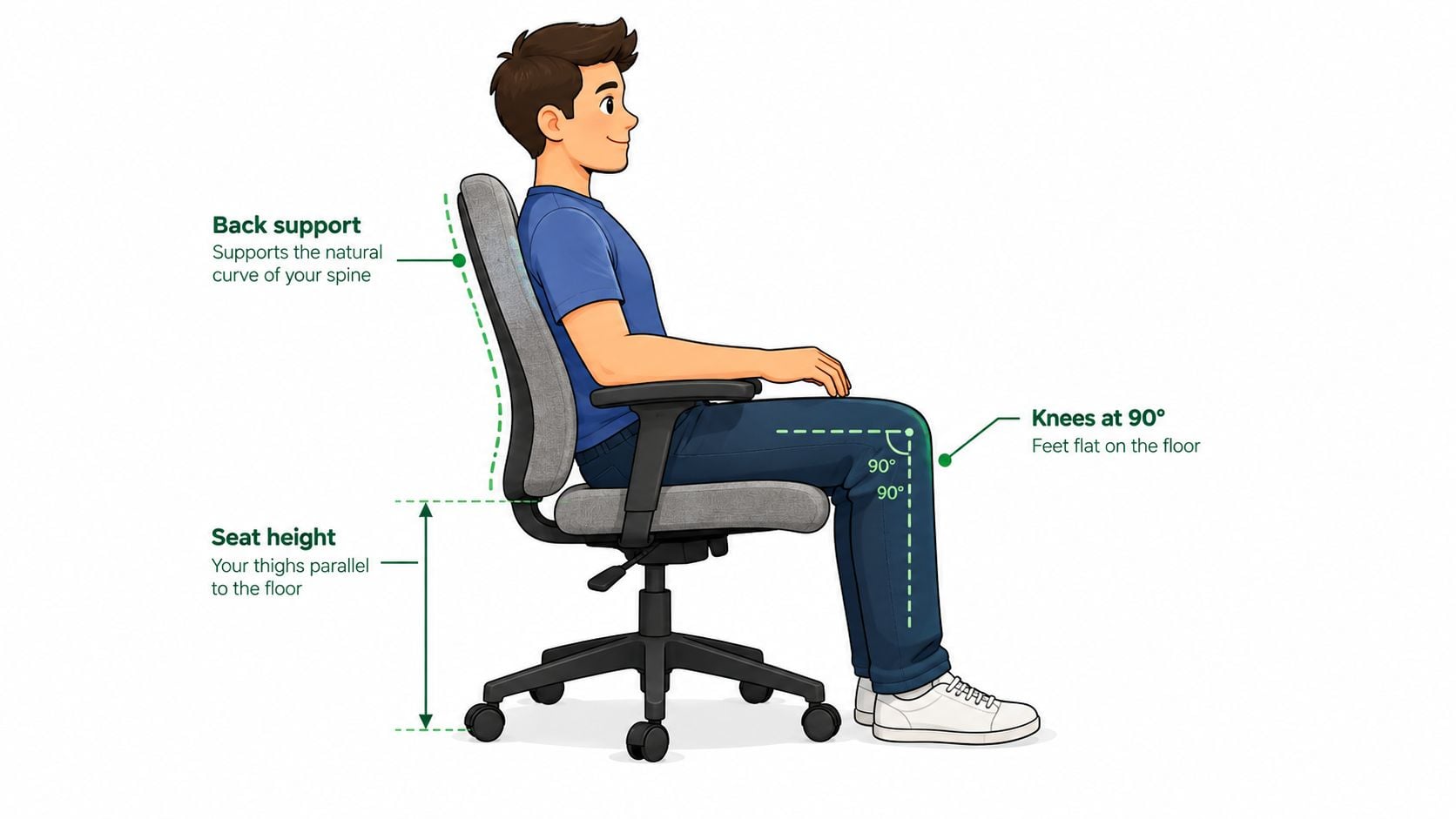
A fabric swivel chair can encourage movement, but it can't turn an unsuitable seat into an ergonomic workstation. Seat height, seat depth, back support, and movement breaks determine whether the chair feels supportive after an hour or merely pleasant during a brief showroom visit.
Cornell ergonomics material defines swivel as the ability to turn while seated and describes dynamic sitting, where the seat pan swivels, in contrast with static sitting. Its material reports that after one hour, static sitting was associated with spinal shrinkage, while dynamic sitting was associated with spinal expansion. It also identifies adjustable seat height as an ergonomic feature and gives an example adjustment range of 11.4 centimeters, from 38 to 56 centimeters. Cornell's ergonomic chair material supports the idea that movement has value, while fit remains essential.
Living room versus desk
The ideal living-room chair often prioritizes generous cushioning, a welcoming back, and an attractive profile from every angle. Its user may sit for shorter periods, change direction to speak with someone, and value a smooth swivel or glide more than precise adjustment.
A home-office chair has a stricter job. The user needs feet supported by the floor, a seat height that aligns with the desk, enough depth to support the thighs without pressing behind the knees, and a back that supports the intended posture. A soft, low lounge chair can look refined in an office but place the screen, keyboard, and elbows at awkward levels.
A 2025 office-chair study found that all tested chairs were associated with sitting-induced pain and concluded that interrupting prolonged sitting with short periods of standing may be more ergonomic than relying on an ergonomic chair alone. The study reinforces a practical point: no chair replaces regular position changes.
Fit the person and the room
Before ordering, measure the user, desk or counter height, clearance around the chair, and expected daily duration. A designer should also check whether the chair's arms can slide beneath the desk, whether the swivel needs a return function, and whether the back height suits the user's frame.
An office can benefit from restrained wall decor that supports concentration without creating visual noise. A curated selection of wall art for focus and style can help complete the room after the seating proportions are established.
For more guidance on matching support to a work setting, review the best office chairs for a home office. The key distinction is simple: a living-room swivel chair is part of a conversation group, while an office swivel chair is also a daily work tool.
Local Expertise and Custom Order Options in Longwood
A chair can meet a technical standard and still be the wrong chair for a particular home. Custom selection matters because Central Florida rooms vary widely, from compact home offices in Altamonte Springs to open living spaces in Lake Mary and larger entertaining areas in Winter Park.
A custom-order program allows the buyer to refine the parts that affect both appearance and use:
- Textile: Select a fabric whose cleaning code, weave, color, and performance suit the household.
- Configuration: Match arm height, back profile, cushion style, and swivel or glide function to the room.
- Scale: Confirm that the seat, arms, and overall footprint work with the user's body and available clearance.
- Finish and tailoring: Coordinate the chair with existing wood, lighting, rugs, and architectural details.
Custom furniture ordering is particularly valuable when a homeowner has a precise vision that standard floor samples can't satisfy. A fabric swivel chair may need to coordinate with a sofa, preserve a sightline, or fit an unusually shallow passage. Those details are difficult to judge from a product photograph.
The value of a local appointment
Slone Brothers Furniture has served Central Florida as a family-owned showroom since 1980, giving homeowners in Longwood and Greater Orlando access to face-to-face design guidance. Experienced design consultants can evaluate the room, ask about daily routines, and help compare American-made and Amish-crafted options without reducing the decision to a transaction.
The showroom's broader selection includes collections such as Stickley, Smith Brothers, Bassett, Craftmaster, Simply Amish, and Mavin, each representing a different approach to wood, upholstery, customization, or construction. Other collections bring specialized design traditions, including Norwegian ergonomic engineering, Canadian custom dining, and North American leather and fabric seating.
The important distinction is not just access to more fabric samples. It's the ability to connect a technical specification to a real room, a real body, and a real maintenance routine. Complimentary in-home interior design services can make that process more precise, especially when several rooms need to work together.
Essential Care and Maintenance for Central Florida Homes
Uphholstery care should begin before a fabric swivel chair arrives. Central Florida's humidity, active households, pets, children, and frequent indoor-outdoor movement make cleaning instructions part of the purchase decision, not an afterthought.
Upholstered furniture collects oils, perspiration, hair, skin cells, and dust-mite-related allergens. A Massachusetts indoor-air-quality assessment recommends frequent vacuuming and professional cleaning annually, or every six months in especially dusty conditions. Its upholstery maintenance guidance provides a useful baseline for households that want to protect both the textile and indoor cleanliness.
A workable care rhythm
Each week, vacuum the seat, back, arms, crevices, and the area around the swivel base using an upholstery attachment. Pay attention to the front edge and arms, where hands and legs create concentrated contact.
After spills, follow the manufacturer's cleaning code rather than improvising with a household product. Blotting is generally safer than aggressive rubbing, but the approved method depends on the fiber and finish.
Annually, arrange professional cleaning when the fabric and manufacturer allow it. In a particularly dusty home, more frequent professional care may be appropriate. A general guide to freshen a cloth couch can help explain the difference between routine surface care and deeper cleaning, but the chair's own care instructions take priority.
Keep the chair away from unnecessary direct sun when possible, and avoid placing it where wet clothing or damp outdoor items regularly contact the upholstery. A performance textile may resist certain marks, but no fabric is maintenance-free.
Fire performance and upholstery documentation
For furniture sold or reupholstered for U.S. consumers, fire performance involves more than a marketing label. Federal requirements under 16 C.F.R. part 1640 incorporate California Technical Bulletin 117-2013. Furniture manufactured, imported, or reupholstered on or after June 25, 2021, must use the prescribed smolder-resistance test methods. The U.S. Consumer Product Safety Commission explains the upholstered-furniture requirements.
TB 117-2013 evaluates four components: cover fabric, resilient filling, barrier material, and decking. Each is assessed for char length, smoldering, and transition to open flaming. Compliance can come through a passing barrier that completely surrounds the filling, or through passing cover fabric and filling materials.
Buyers should ask for the cleaning code, fiber composition, removable-cover options, testing documentation, and approved cleaning products. More chemical treatment isn't automatically better. Good documentation and a realistic maintenance plan are more useful than vague promises.
Why Shop Locally at Slone Brothers Furniture
A long-lasting fabric swivel chair is an investment in structure, comfort, and service. The purchase becomes more defensible when the buyer can inspect the chair in person, test the motion, compare fabrics under real showroom lighting, and discuss what happens after delivery.
Online photographs can't reveal whether a chair's swivel feels controlled, whether its seat depth suits a particular user, or whether its fabric has the hand and visual depth expected in a refined interior. They also can't show how a chair relates to a room's proportions. For homeowners furnishing in Longwood, Sanford, Orlando, or the surrounding Central Florida area, a local appointment turns those unknowns into observable decisions.
Value includes what happens afterward
The Low Price Promise addresses price confidence, but long-term value comes from more than the initial figure. A well-specified chair can avoid premature replacement, mismatched upholstery, and the cost of correcting an unsuitable scale. White-glove delivery and reliable home delivery with order tracking add practical support when a substantial chair must reach the correct room without damage or careless placement.
Slone Brothers also serves commercial customers who need professional office environments, making the distinction between residential comfort and higher-use seating familiar. Its showroom brings together living-room, bedroom, dining, home-office, entertainment, outdoor, mattress, and home décor collections, which helps a homeowner coordinate an entire home instead of purchasing isolated pieces.
A sound furniture investment has three parts: verified construction, appropriate materials, and guidance that accounts for the room and the people using it.
The benefits of shopping local are especially clear for custom-order furniture. A design consultant can measure clearances, review fabric samples, coordinate finishes, and identify whether a swivel, glider, return mechanism, or fixed chair makes the most sense. That consultative process is different from a faceless interaction focused only on completing an order.
Since 1980, Slone Brothers Furniture has built its Central Florida presence around family ownership, craftsmanship, design support, and repeat business. The result is a more deliberate buying experience for homeowners who want American-made, Amish-crafted, and custom furniture that can remain useful and beautiful as a home evolves.
Ready to invest in a fabric swivel chair built around your room, routine, and design goals? Visit Slone Brothers Furniture in Longwood, FL to test the movement, compare performance fabrics, and work face-to-face with experienced design consultants who can help coordinate a lasting Central Florida interior.