
Desk Ideas for Small Spaces: Expert Tips

A small room can still hold a proper workspace, but it has to be planned with more care than a standard office. In a Longwood home, a Winter Park guest room, or a Lake Mary condo, the right desk ideas for small spaces should protect walking room, preserve natural light, and still feel worthy of a beautifully finished home. That means choosing pieces with honest craftsmanship, sensible proportions, and storage that earns its keep, not just furniture that looks slim in a photo. For readers comparing practical layout options before they visit a showroom, a useful starting point is this home office desk setup guide, which reinforces the value of planning a room around how it's used.
1. Why does a wall-mounted floating desk work so well in a small room?
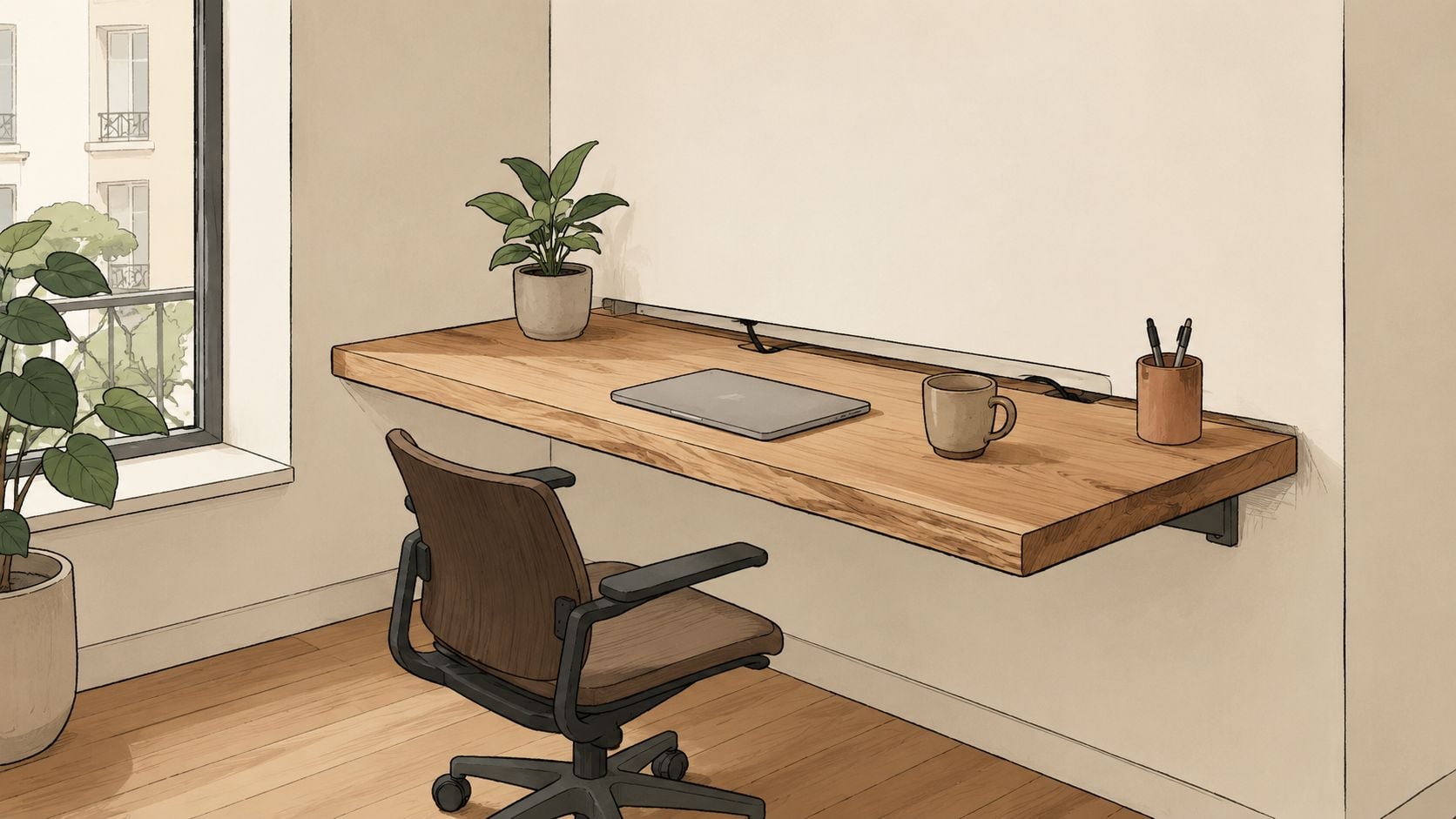
A wall-mounted floating desk gives a small room a real work zone without filling the floor with furniture. In compact Orlando-area homes, that lighter visual profile matters as much as the footprint, because the room still has to read as a bedroom, guest room, or den after work hours.
The strongest versions use solid hardwoods rather than thin composite panels, since the desk needs to carry daily weight without sagging or feeling temporary. A well-made floating desk also pairs naturally with a proper ergonomic chair, because compact should still mean comfortable.
Build it like a permanent fixture, not a temporary fix
A floating desk only works when it is installed with real support and planned around the room. That starts with stud placement, cable routing, and a finish that can handle daily use in Central Florida's humidity.
Practical rule: If the desk looks delicate but has to work every weekday, the structure has to be stronger than the style suggests.
- Choose solid wood first. Oak, maple, and walnut give the desk real substance, and they hold up better than flimsy substitutes in Florida homes.
- Keep the height usable. A desk around 28 to 30 inches high is a practical seated range for many setups, and it helps keep the chair and arms aligned comfortably.
- Plan the wires before installation. A desk-mounted power strip or discreet wall conduit keeps cords from turning the cleanest wall into visual clutter.
- Protect the finish. A desk pad helps with moisture, laptop heat, and daily wear, especially in homes where the room also serves other purposes.
For homeowners who want American-made or Amish-crafted construction, this style is worth seeing in person before ordering. A custom-made office furniture collection helps a homeowner compare build quality, proportions, and storage details instead of guessing from photos alone.
2. When is a Murphy desk the smartest choice for a multi-use room?
A Murphy desk makes the most sense when a room has to switch identities during the day. In a Longwood townhome guest room or a Sanford studio, the desk can disappear when company arrives, which keeps the space feeling calm rather than office-heavy.
Premium versions look like cabinetry when closed and open into a real work surface when needed. That's a much better outcome than forcing a permanent desk to compete with a bed, seating area, or craft zone.
Cabinetry that closes the room back up
The appeal here is not gimmickry, it's discipline. A well-built Murphy desk hides paper, chargers, and daily clutter inside the cabinet, so the room resets quickly after work.
A concealed desk only feels elegant when the hardware is quiet and the storage is genuinely useful.
- Look for soft-close hardware. Hinges and lift mechanisms should feel controlled, not shaky or noisy.
- Choose wood construction over lightweight panels. Solid cabinetry holds up better when the room changes use every day.
- Think about interior lighting. Built-in LEDs reduce shadows and make the interior easier to use in the evening.
- Organize by category. Chargers, files, notebooks, and office supplies need dedicated compartments so the system stays orderly.
- Keep the seat nearby. The chair should live outside the cabinet, because a real work session deserves a real chair, not a storage compromise.
The right solution here is often custom. That's where custom-made office furniture becomes relevant, because a made-to-fit cabinet can solve awkward walls, sloped ceilings, or narrow guest rooms that standard furniture never quite fits.
3. Are L-shaped and corner desks worth the footprint?
Yes, when the room has a corner that is being wasted or underused. An L-shaped desk can turn that dead zone into a real work area, which matters in bedrooms, second offices, and family rooms where every wall has to pull its weight.
The stronger versions give you separation without asking for a second desk. One side can hold a monitor, while the other works better for writing, sorting mail, or spreading out a project. That kind of division helps a small room stay calmer and keeps the desk from taking over the rest of the space.
Make the corner earn its keep
Corner desks work best when the measurements are exact. Before buying, account for baseboards, outlets, closet doors, and the path the chair needs to move in and out without scraping walls or trapping traffic.
For tight layouts, a corner area around 48 by 40 inches is a practical target for a small L-desk. Narrow apartment-style desks can also work with a 24-inch depth when the setup is mostly for a monitor and keyboard, and a wider run gives the body more room to spread out without crowding the room.
The corner junction should support the body, not force the chair into a twist.
Solid wood is the right call in Florida because the desk has to stay steady across two connected surfaces. A well-planned layout can also include overhead shelving or a wall shelf, which keeps floor clutter off the baseboards and makes the room feel deliberate instead of crowded. In a room that also needs to function as a media area, the layout should work with the rest of the furniture, not fight it, and a desk and TV stand combo can help that arrangement feel ordered.
For room planning before a custom purchase, the how to measure a room for furniture guide is a useful companion, especially for homeowners trying to balance circulation with function and still leave room for quality pieces that will last.
4. Why choose an expandable or convertible desk instead of a fixed one?
A fixed desk works only when the room and the workload stay the same. Many homeowners need a surface that can stay compact for daily use, then open up for bills, planning, craft work, or a larger monitor setup without bringing in a second piece of furniture.
That kind of flexibility matters in Central Florida homes where one room often has to serve as an office, guest room, or family space. A well-built expandable or convertible desk lets the layout stay calm most of the time, then adapt when the job asks for more surface area.
Flexibility should still feel solid
The moving parts have to be dependable. If the extension catches, sways, or feels loose at the joints, the desk stops being useful and starts creating frustration.
A small-space desk can still stay comfortable and practical. A good starting range is 36 to 48 inches wide and 18 to 24 inches deep, with 24 inches of depth often treated as the minimum for laptop-only use and a single-monitor setup feeling more comfortable around 48 inches wide. For planning the right proportions in a room that also has to look finished, the home office desk setup guide is a useful reference before placing a custom order.
- Test the action by hand. The extension should move smoothly and lock with confidence.
- Choose solid wood construction. Better material helps the desk stay steady instead of feeling lightweight.
- Measure the closed and open positions. The piece has to fit both ways without crowding doors or walkways.
- Protect the working surface. A pad or cover helps preserve the finish during heavier daily use.
- Match the chair to both modes. A quality swivel chair keeps the workspace usable whether the desk is compact or expanded.
This approach also makes sense for pieces that serve more than one purpose. A desk and TV stand combo shows how one footprint can support multiple uses when the construction is planned with care.
5. Is a compact standing desk a good fit for a small home office?
Yes, when the room has enough vertical openness and the desk needs to preserve as much floor area as possible. A compact adjustable-height desk lets the user alternate between sitting and standing without taking over the room, which makes sense in apartments, condos, and guest rooms that still need to work as flexible spaces.
Stability decides whether the piece earns its keep. If the desk wobbles at full height or feels tight in the seated position, it replaces one problem with another.
Health and comfort matter in a tight footprint
A well-built adjustable desk should move smoothly and hold its position without fuss. In many small-space layouts, a seated height around 28 to 30 inches and a standing height around 40 to 45 inches works within the practical ranges often listed for these workstations, giving the user a realistic setup for daily use.
A compact standing desk should make movement easier, not turn posture into a daily compromise.
The supporting pieces matter just as much as the frame. A premium, ergonomic task chair supports the sitting intervals, and an anti-fatigue mat makes the standing phase easier on the body. In a warm climate like Central Florida, where one room often has to serve more than one purpose, that comfort difference becomes part of the long-term value of the furniture.
- Choose electric if transitions are frequent. Convenience helps the desk get used instead of ignored.
- Check outlet placement early. A licensed electrician may be needed if the cord run is awkward.
- Keep cables flexible. Height changes can pull on cords if they are not managed well.
- Set height memory carefully. Comfort is easier to maintain when the desk returns to the right positions quickly.
- Treat the chair as part of the system. Sitting and standing both need support.
For readers setting up a new room or updating an old one, the home office desk setup page can help connect the desk choice to the rest of the space, including chair placement and workflow.
6. How can nesting or stackable desks help a family home?
Nesting desks are one of the most underestimated desk ideas for small spaces because they solve a real family problem. A room may need to serve a student, a remote worker, or a second adult who only needs a work surface part of the week, and modular pieces keep that room from feeling overbuilt.
The advantage is flexibility without sacrifice. A nested set can stay compact most of the time, then separate when a project expands or another household member needs to work.
Furniture that changes with the household
This is the right category for homes where life stages shift quickly. A teenager's study zone, a parent's consulting work, and a guest room can all ask different things from the same corner over time.
If the room has to change jobs, the furniture should be able to change with it.
- Prefer solid wood joinery. Repeated movement stresses the joints, so quality construction pays off.
- Measure both nested and open layouts. The room needs to handle the furniture in every configuration.
- Use smooth glides or wheels. Repositioning should be easy and floor-safe.
- Plan power access for each setup. Every possible position needs a realistic charging solution.
- Coordinate storage nearby. A cabinet or shelf system helps the group feel unified instead of scattered.
A family-owned showroom can be a useful place to compare these layouts because the pieces need to be handled, opened, and reconfigured. That's especially true for homeowners who value American-made or Amish-crafted construction and want furniture that will outlast the next room refresh.
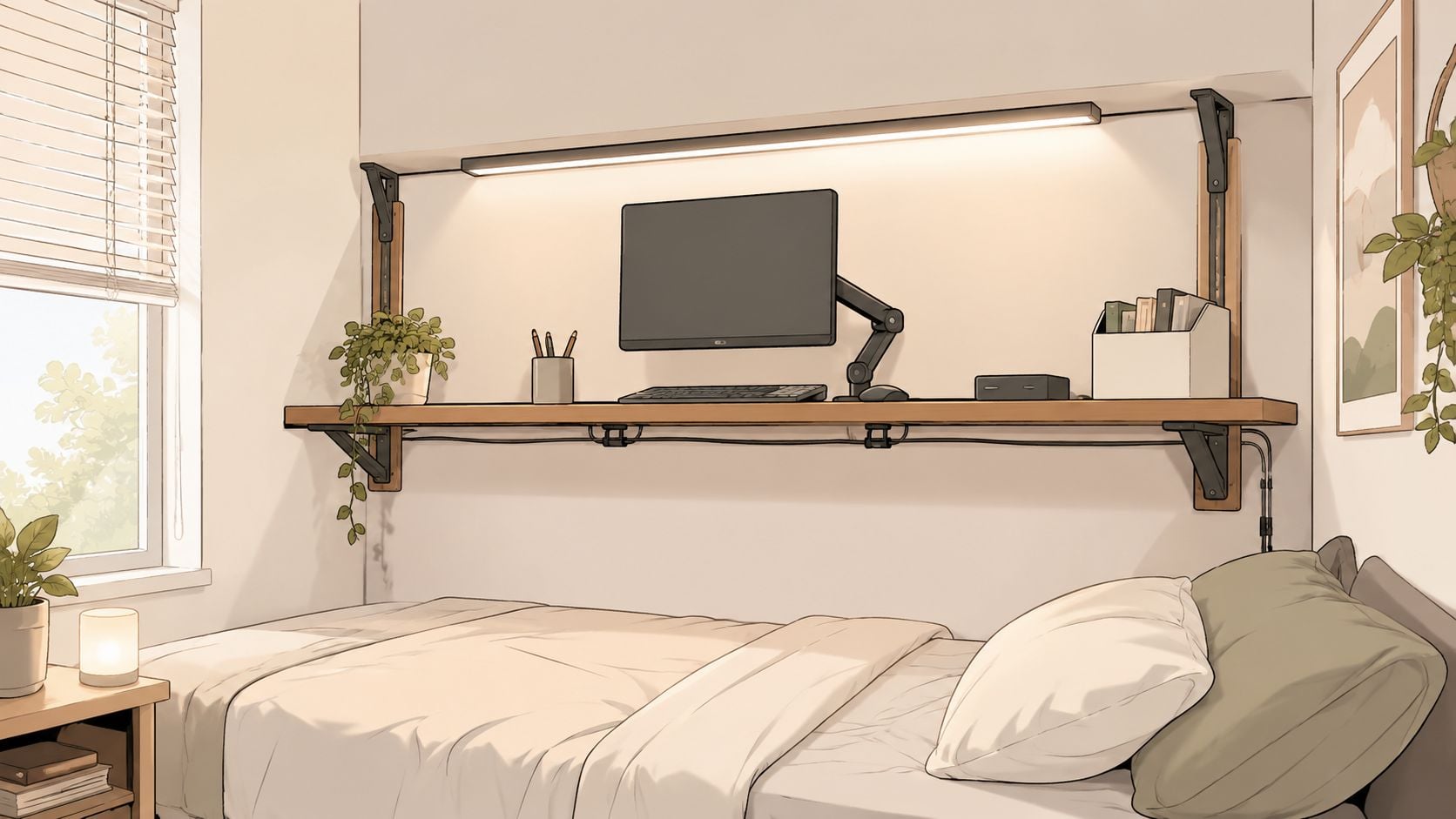
7. Can a desk shelf over the bed actually function as a real workstation?
Yes, if it is built with care and used for the right kind of work. In smaller bedrooms, especially in Lake Mary or Altamonte Springs homes where square footage is limited, an over-the-bed desk shelf can keep the room usable for sleep while still giving you a real place for a laptop, notes, or a compact monitor.
The trade-off is clear. The shelf has to stay light in appearance, but it also has to be mounted with real strength so the room does not feel crowded or makeshift.
Keep the profile light and the installation serious
A shelf above the bed should look like it belongs there, not like an afterthought. Solid wood, secure hardware, and proportions that fit the bed and wall correctly all matter if the piece is going to work day after day.
For a practical setup, mount the shelf 14 to 18 inches above the mattress, keep the workspace depth to 12 to 18 inches maximum, and anchor it with 75 to 100 pound rated hardware into studs. Those proportions keep the shelf usable without letting it dominate the room.
The goal is not to turn a bedroom into an office. The goal is to let the room do both jobs with grace.
Lighting matters just as much as the shelf itself. A slim LED strip under the work surface reduces shadows, and a monitor arm can keep the setup cleaner if a screen is part of the routine. If bedroom work happens often, a proper chair placed at the foot of the bed gives better posture than working from the mattress.
For homeowners who want heirloom-quality furniture, solid construction and custom sizing matter. An American-made or Amish-crafted shelf can be ordered to fit the room, the wall structure, and the way the bedroom gets used, which is a better long-term fit than a piece that only works on paper.
8. Why do built-in storage desks make small rooms feel calmer?
Built-in storage desks calm a small room because they reduce the number of separate pieces competing for space. A compact desk with drawers, shelves, or a hutch keeps daily essentials inside one footprint, which matters in a Longwood or Winter Park home where the office may share a bedroom or sitting area.
The strongest versions stay disciplined. They offer enough work surface for real use, plus storage that keeps paper, supplies, and accessories from spreading across the room.
One footprint, more order
A built-in desk becomes the anchor for the setup. It can replace the need for a filing cabinet, a shelf tower, and a side table, so the room reads as one planned space instead of a collection of add-ons.
A practical compact size for this category is often 36 to 42 inches wide, and that scale can still work well when the drawers and compartments are designed with care. The same general small-space guidance applies here, too, because good storage only helps if the proportions stay comfortable and the desk remains easy to use.
- Use drawers for daily items. Pens, chargers, notebooks, and paper belong where they can be reached quickly.
- Keep the desktop lean. A tray, pen holder, and one active file holder are usually enough.
- Take advantage of vertical storage. A hutch or shelf keeps paper off the work surface.
- Choose smooth slides. Drawer hardware should feel refined, not sticky.
- Let the wood finish do the visual work. A good cherry, oak, or maple desk should look like part of the room, not an afterthought.
That approach suits homeowners who want heirloom furniture instead of disposable office pieces. Solid wood construction, careful joinery, and custom sizing give the desk a longer useful life, and they help the room feel settled rather than crowded. For many Central Florida families, that quiet, ordered feeling is the value of a built-in storage desk.
8-Option Small-Space Desk Comparison
| Desk Type | Implementation Complexity | Resource Requirements | Expected Outcomes | Ideal Use Cases | Key Advantages |
|---|---|---|---|---|---|
| Wall-Mounted Floating Desks (Solid Wood) | Moderate, permanent stud-mounted installation | Solid hardwood top, heavy-duty brackets, mounting tools, cable management | Frees floor space, minimalist look, durable work surface | Small rooms, apartments, guest bedrooms used as offices | Space-saving, durable, customizable finishes |
| Murphy Desk (Wall-Bed Integration) | High, cabinetry, mechanisms, professional installation | Premium cabinetry, soft-close hinges/pneumatics, built-in lighting, higher budget | Concealable workspace with integrated storage; polished cabinet appearance | Multi-purpose rooms, guest rooms, compact homes needing hidden office | Hides workspace, maximizes storage, multi-functional |
| L‑Shaped / Corner Desks | Moderate, large footprint, precise measurements | Solid or engineered wood, pedestal drawers/cabinets, cable management | Two dedicated work zones, improved organization, supports two users | Corner offices, multitaskers, dual-user setups | Efficient corner use, abundant surface and storage |
| Expandable / Convertible Desks | Moderate–High, moving parts and locking systems | Sliding/hinge hardware, locking mechanisms, solid wood, periodic maintenance | Workspace that expands/contracts to match project needs | Evolving work needs, occasional large projects, flexible households | Adaptive footprint, avoids multiple desks, long-term flexibility |
| Compact Standing / Adjustable-Height Workstations | Moderate, lift mechanisms, electrical or manual setup | Electric motors or crank, stable frame, solid top, outlet for electric models | Sit‑stand flexibility, improved posture and circulation | Health-conscious users, small home offices, frequent sit-stand users | Ergonomic benefits, memory presets, versatile use heights |
| Nesting / Stackable Desks | Low–Moderate, modular joinery, alignment precision | Multiple solid wood units, glides/wheels, coordinated finishes | Scalable, reconfigurable workspace system | Growing families, collaborative spaces, multi-purpose rooms | Modular, space-saving when nested, flexible configurations |
| Over‑the‑Bed Desk Shelves / Bed‑Integrated Workstations | Moderate, precise, safety-focused mounting | Secure L‑brackets or integrated frame, solid shelving, lighting, stud anchoring | Vertical space use, compact bedroom workspace | Studio apartments, student rooms, guest bedrooms | Maximizes vertical space, preserves floor area, integrated lighting |
| Compact Desk with Built‑In Storage | Moderate, heavy cabinetry, precise leveling | Solid wood, quality drawer slides, hutch/cabinetry, custom joinery | All‑in‑one organized workspace, minimal additional furniture needed | Small home offices needing storage, single-user organized spaces | Unified storage, polished appearance, clutter concealed |
Invest in a Workspace That Works for You
The best desk ideas for small spaces aren't the ones that take up less room. They're the ones that support real work, protect circulation, and still respect the style of a Central Florida home. That's why solid wood, thoughtful joinery, and proportioned design matter so much, especially when a desk has to share space with guests, family life, or a quiet sitting area.
A compact desk should earn its place through daily use and long-term value. Whether the right answer is a floating wall desk, a Murphy desk, a corner workstation, or a built-in storage solution, the deciding factor is how well the piece fits the room and the way the homeowner lives. In a market like Longwood, Orlando, Lake Mary, Sanford, Winter Park, or Altamonte Springs, that usually means choosing furniture that feels permanent, not temporary.
It also helps to see these pieces in person. A showroom lets a homeowner compare wood grain, drawer action, surface depth, and chair clearance with real confidence, which is hard to do from a screen alone. For families who want one room to function beautifully without feeling overfilled, the right consultation can make the difference between a cramped corner and a workspace that feels fully integrated into the home.
Ready to invest in furniture that lasts a lifetime? Skip the online guesswork and automated digital chatbots. Visit Slone Brothers Furniture in Longwood, FL today, and meet with experienced design consultants who can help you choose or custom order a desk that fits your room, your routine, and your style. If you want to explore solid wood craftsmanship, American-made options, or a layout plan for a small office in Central Florida, stop by and let a real person help you get it right.