

Dining Room Table Styles: Find Your Perfect Heirloom

A homeowner in Winter Park finds the perfect dining table online. The photos look polished, the finish appears rich, and the dimensions seem right. Then it arrives. The top looks flatter than expected, the base has a slight wobble, and the color shifts completely in Florida sunlight. Returning a large piece becomes its own project.
That's why dining room table styles deserve more than a quick click and a hopeful checkout. For many homeowners in Lake Mary, Sanford, Altamonte Springs, and across Central Florida, the dining table isn't just another furnishing. It's the surface that hosts holidays, homework, quiet breakfasts, and years of gathered conversation.
Since 1980, Slone Brothers has served the Greater Orlando area with a showroom experience built around guidance, not pressure. That matters more now because buyers increasingly see dining sets as lasting assets. The global dining table market is projected to reach $16.01 billion by 2034, reflecting a shift toward investment-grade pieces and higher-quality materials like solid wood, according to Fortune Business Insights on projected dining table market growth.
A thoughtful table choice also starts with the right expectations. A useful benchmark appears in this guide on how long furniture should last, especially for homeowners who want to buy once and buy well.
Your Guide to Choosing an Enduring Dining Table in Central Florida
A homeowner in Orlando can like a table online in under five minutes. Living with that table for the next fifteen years is a different decision entirely.
In Central Florida, a dining table has to do more than photograph well. It has to sit level through humid seasons, keep its finish under strong window light, and feel substantial every time family gathers around it. That is why careful buyers start with permanence, not just appearance.
Why a legacy table matters
A legacy table works like a well-built front door. You notice the style first, but the long-term value comes from what supports it. The wood selection, the joinery, the finish, and the way the base carries weight all determine whether the piece matures gracefully or starts showing weakness early.
For many homeowners, the dining table also carries more meaning than almost any other casegood in the house. It hosts holidays, school projects, everyday meals, and the kind of ordinary routines that become family memory. That history explains why dining furniture still carries such emotional weight in a home.
A strong choice usually brings three qualities together:
- Style with staying power: The silhouette should still feel settled years from now.
- Construction that stays stable: The top, base, and joinery should handle regular use without looseness or sway.
- Materials suited to Florida conditions: Heat, humidity, and direct sun can expose shortcuts quickly.
One practical benchmark helps here. Homeowners who want a table that earns its place over time should start with realistic expectations about lifespan, materials, and daily wear in this guide on how long quality furniture should last.
Practical rule: If a table feels visually heavy but physically light, inspect it more closely.
What Central Florida homeowners usually need
The right answer depends on how the room functions every week, not just how it looks on installation day.
A formal dining room in Sanford may need a rectangular table with extension leaves for holiday gatherings. An open-plan home in Altamonte Springs may benefit from a round or softly shaped top that improves circulation. A Winter Park homeowner furnishing a long-term residence may place more value on hardwood species, finish depth, and base construction than on a trend-driven profile that looks dated in a few years.
Showroom experience matters. On a screen, many tables look similar. In person, the differences become obvious. You can see whether the finish has depth or looks sprayed on. You can feel whether the top has real substance. You can check whether the base is steady, whether the edges are refined, and whether the color stays consistent under light closer to what Florida homes receive.
That matters because online buying often hides the details that determine long-term satisfaction. Photos rarely show wood movement, joint quality, veneer thickness, or how a finish responds to daylight. A table can look impressive in a staged image and still disappoint once it is placed in a bright dining room in Lake Mary or a sunlit breakfast area in Longwood.
Discerning buyers usually make better decisions in this order:
- Start with use. Daily family meals, frequent entertaining, and occasional hosting each point to a different kind of table.
- Study construction next. A beautiful top cannot make up for weak joinery or an unstable base.
- Choose the style that fits the room. By this point, the table has already proved its long-term value.
That order keeps the process clear. It also helps you choose a table that feels right today and still feels right after years of Florida living.
What Are the Major Dining Room Table Styles
A homeowner walks into the showroom after narrowing the search online to three tables that looked nearly identical on a screen. In person, the differences are clear within minutes. One feels formal and established. Another feels casual and built for daily traffic. A third has the crisp profile that suits an open-concept Florida home. Style works that way. It is the visual shorthand that tells you how a table will live in the room before anyone even pulls out a chair.
The mistake is treating style as decoration alone. A better approach is to read style the way a design consultant reads architecture. Each category points to certain proportions, edge treatments, base forms, and wood choices. Those details affect more than appearance. They influence how timeless the table will feel, how easily it will pair with future updates, and whether it makes sense for a bright Central Florida home that gets strong daylight most of the year.
This visual comparison helps show the broad differences at a glance.
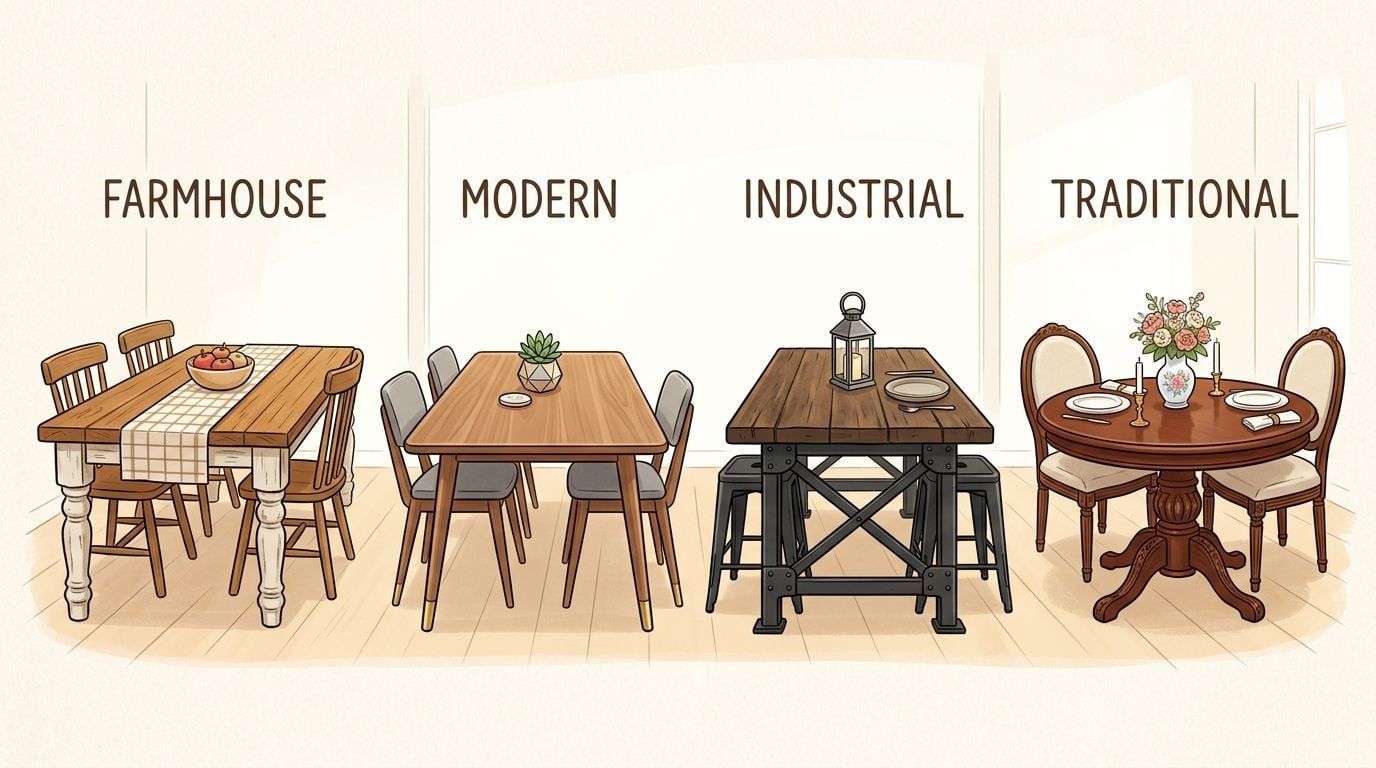
Traditional
Traditional tables feel settled. You will usually see richer wood tones, shaped legs, softened corners, and profiles that connect naturally with formal dining rooms, paneled spaces, or homes with more classic trim details.
For many Orlando-area homeowners, traditional style holds value because it resists dating itself. It also works well with heirloom case pieces, finely upholstered chairs, and rooms used for holiday hosting. A well-made traditional table can remain relevant for decades because its appeal comes from proportion and craftsmanship rather than novelty.
Leaves are common in this category, which makes traditional tables practical as well as refined. If you are comparing species and wood character within this look, this guide to types of wood for dining tables helps clarify why the same silhouette can feel very different in oak, cherry, or walnut.
Farmhouse
Farmhouse tables have a broader, more grounded presence. Thick legs, plank-style tops, trestle bases, and visible structure give them the feeling of a hardworking piece rather than a formal showpiece.
That makes farmhouse a strong fit for active households in Central Florida, especially where the dining area opens to the kitchen and serves as a true gathering point. The style is forgiving. Minor wear often blends into the character of the piece instead of looking like damage.
Quality matters here more than buyers often expect. A farmhouse table should feel substantial, not bulky. In a showroom, you can judge whether the top has convincing thickness, whether the base has proper scale, and whether the finish has depth rather than a flat, distressed effect that may look forced after a year or two.
Mission
Mission style appeals to homeowners who value discipline in design. Straight lines, squared forms, visible joinery, and sturdy proportions create a look that feels honest and well resolved.
This is often the right answer for buyers who want warmth without ornament. The style has enough presence to anchor a room, yet it avoids the decorative flourishes that can limit a table's long-term flexibility. Oak is a common match because its grain reinforces the handcrafted character that Mission furniture is known for.
A good Mission table works like a well-built home with clean trim details. Nothing is added for show. The strength of the piece is easy to read.
Modern
Modern tables reduce visual noise. Ornament drops away, and shape takes the lead. You may see a sculptural pedestal, a crisp rectangular slab top, or a restrained profile that depends on proportion more than decoration.
For Florida interiors with open sightlines, modern style can be especially effective because it keeps the room feeling clear and architectural. The concern some homeowners have is that modern might feel cold. In a well-chosen table, that problem is solved by warm wood, rounded edges, and a finish that softens the overall effect under natural light.
This is one of the categories where online shopping can mislead buyers. In photos, many modern tables look refined. In person, weak proportions and lower-grade materials show up fast.
Mid-Century Modern
Mid-century modern tables usually feel lighter on their feet. Tapered legs, thinner profiles, gentle curves, and balanced geometry give them an airy quality that suits homes where the dining room shares space with the kitchen or living area.
This style often performs well in Winter Park and similar neighborhoods where homeowners want the room to stay visually open. It is also useful in smaller dining areas because the table can hold its place without adding visual weight.
The best versions are disciplined. If the legs are too thin, the top too light, or the finish too flat, the table can cross from elegant to insubstantial. That distinction is easy to miss online and easy to spot in a showroom.
Industrial
Industrial style combines wood with heavier visual structure, often metal bases or exposed hardware. The appeal is contrast. Warmth from the top meets firmness from the base.
Used carefully, industrial can look elegant in an upscale Central Florida home. The key is restraint. Too much raw metal, distressing, or exaggerated mass can feel harsh against polished flooring, refined lighting, and the brighter atmosphere common in Florida interiors.
For long-term value, the strongest industrial tables balance texture with finish quality. They should feel intentional, not theatrical.
Rustic
Rustic tables celebrate the natural personality of wood. Grain variation, knots, thicker planks, and a more organic surface are part of the point.
That does not mean rustic should look unfinished. In a well-designed dining room, the best rustic tables keep the silhouette controlled so the material can provide the character. This style often appeals to homeowners who want warmth and authenticity but still expect the room to feel curated.
In Central Florida, rustic works best when the finish is carefully handled. Strong sunlight can make rough or uneven finishing look more exaggerated over time.
Transitional
Transitional style sits in the middle ground between classic and current. It keeps familiar forms and wood character, then pares back ornament so the table feels quieter and easier to live with over time.
For many discerning homeowners, this is the safest long-range choice. A transitional table can accept different chair styles, updated lighting, new wall colors, or a change in rug pattern without losing its footing. That flexibility is part of its investment value.
It is also one of the easiest styles to misjudge online. Photos can make many tables look transitional. In person, you can tell whether the restraint feels refined or generic. That difference often determines whether a table becomes a lasting part of the home or a piece that gets replaced once tastes mature.
Why Do Material and Construction Matter Most
Style gets attention first. Construction decides whether the table earns a permanent place in the home.
That difference is easiest to understand when the table is viewed as an object under stress. Chairs get pulled sideways. People lean on corners. Floors aren't perfectly level. Humidity rises and falls. A weak table may still photograph well, but it won't respond well to real life.
This comparison makes that contrast easier to see.
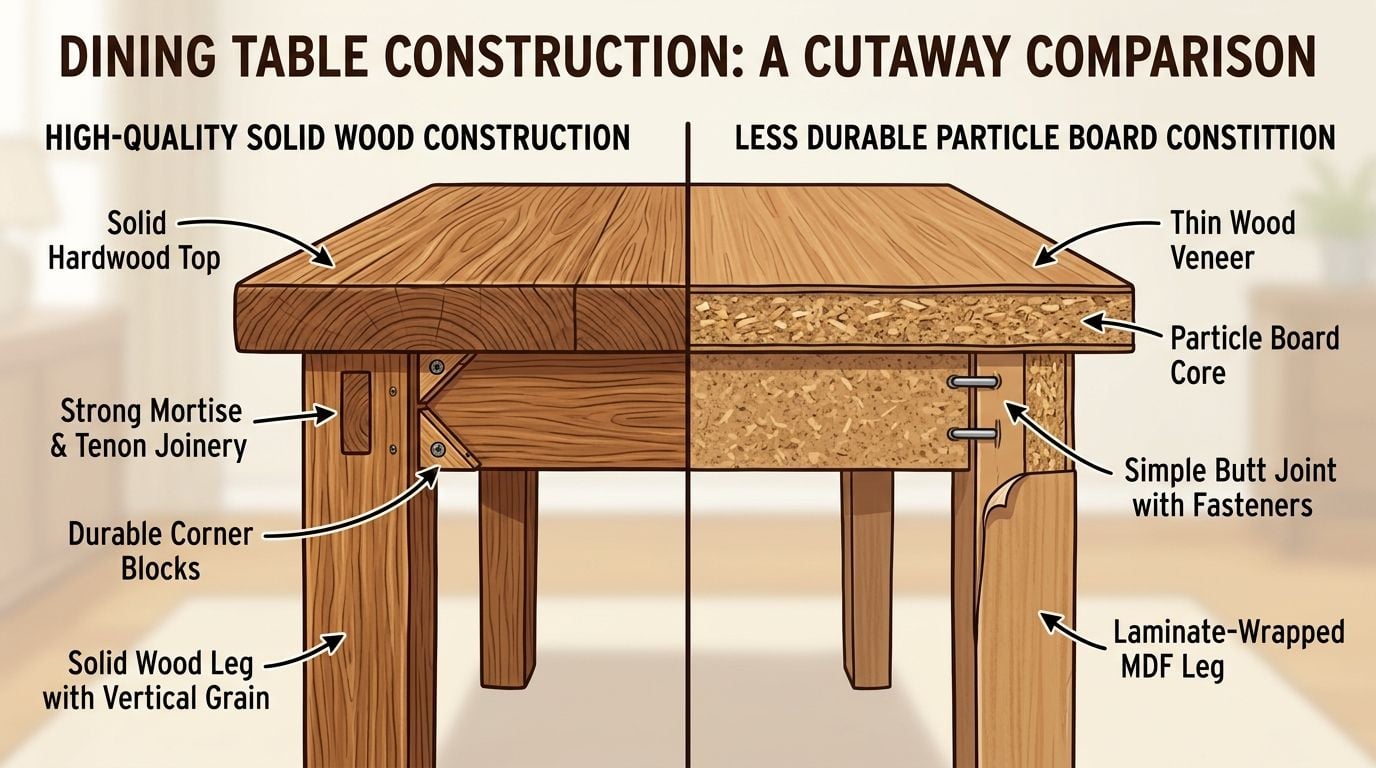
Solid wood versus imitation structure
A solid wood table brings weight, repairability, and long-term integrity. It can develop character over time and, when needed, can often be refinished rather than discarded.
By contrast, particle board and similar lower-grade materials may reduce initial cost, but they rarely offer the same stability or lifespan. For homeowners comparing options, this guide to types of wood for dining tables is a useful starting point for understanding what's being purchased.
A table built by makers such as Simply Amish or Mavin often feels different the moment a hand rests on it. The top has substance. The base doesn't shift. The finish has depth rather than surface shine.
The joinery question most shoppers miss
The strongest dining tables are engineered around the way their parts connect. That's where joinery matters.
High-performance dining tables often use mortise-and-tenon joints or reinforced dowels for exceptional shear strength. Solid wood tables built this way can endure 20+ years before major refinishing, while glue-only or stapled frames often degrade within 10–15 years, according to Povison's guide to high-quality dining table construction.
That's not a small detail. It's the difference between a table that grows steadier with ownership and one that starts to loosen under ordinary use.
Showroom check: Gently rock the table diagonally, press at the corners, and look for leg-independent movement. A strong table resists that motion.
Why this matters in Central Florida
Florida homes create their own test conditions. Air conditioning cycles, humidity, and sunlight through large windows all place demands on wood, finish, and joinery.
That doesn't mean homeowners should avoid wood. It means they should buy wood furniture built properly and finished thoughtfully. American-made brands such as Bassett, Canadel, and Simply Amish often appeal to buyers who want custom size and finish options with more confidence in the underlying build.
A lower upfront price can look attractive online. But replacing an unstable table, coordinating another delivery, and restarting the search usually costs more in time, disruption, and money than buying carefully the first time.
What Table Shape and Size Fits Your Florida Home
A dining table can look perfect in a photo and still feel wrong the first time you carry dinner from the kitchen, slide past a chair, or open the doors to the lanai for guests. In Central Florida, shape and size affect daily comfort as much as style does. Open floor plans, brighter rooms, and frequent indoor-outdoor movement all put pressure on a table to fit the room gracefully, not just fill it.
That is why experienced buyers start with circulation.
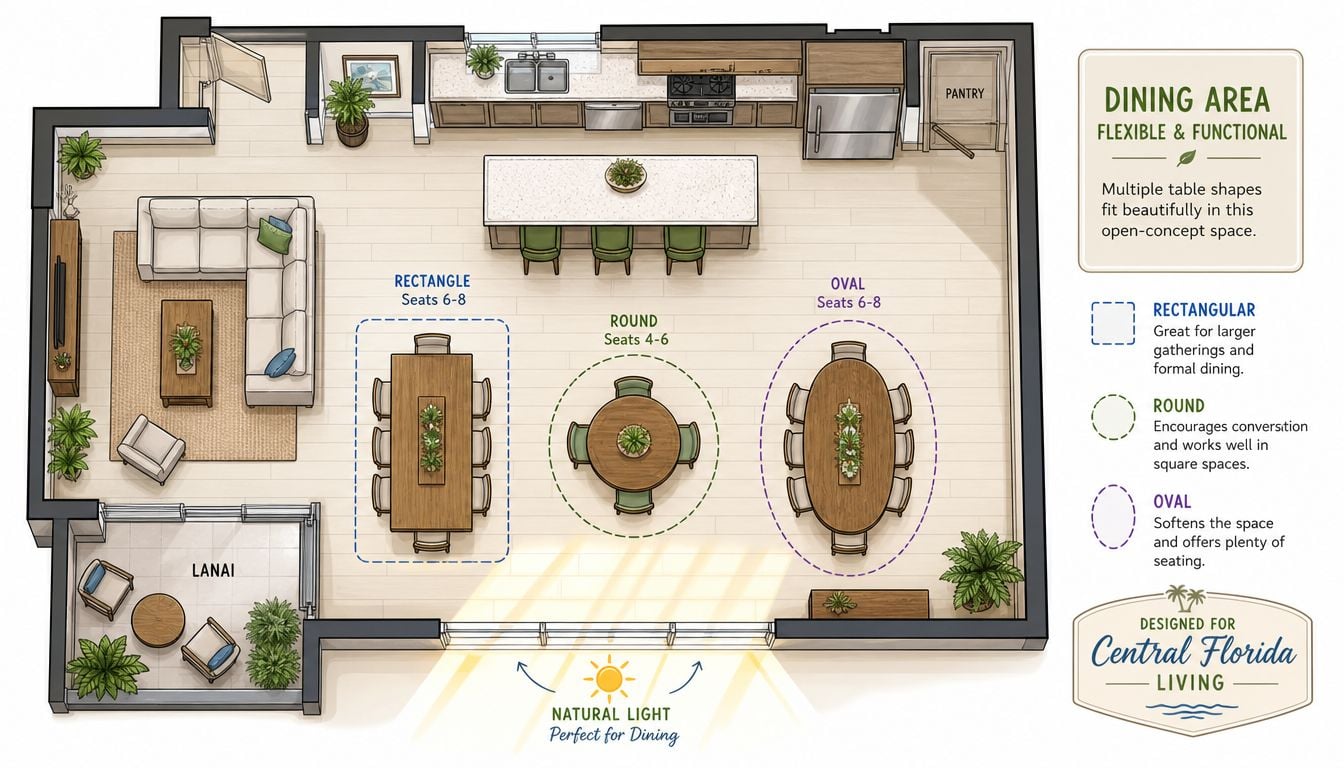
Rectangular, round, square, or oval
Each shape solves a different spatial problem, much like choosing the right rug changes how a room feels underfoot and in motion.
| Shape | Best use | Watch for |
|---|---|---|
| Rectangular | Formal rooms, long spaces, frequent hosting | Can tighten walkways if the room is narrow |
| Round | Conversation, smaller footprints, breakfast areas | Usually seats fewer people as guest counts grow |
| Square | Balanced rooms, intimate seating | Can feel heavy if the room is modest in size |
| Oval | Open-plan homes, softer movement, flexible sightlines | Needs strong proportions so it does not look stretched |
For homeowners comparing layouts before a showroom visit, this visual resource can help compare table seating options.
How shape changes the way a room works
Rectangular tables give a room structure. They suit dedicated dining rooms and longer spaces where you want the table to reinforce the architecture. They also tend to make the most sense for homeowners who host holidays and want extension leaves.
Round tables change the social feel of a room. Conversation flows more naturally because everyone faces inward, and the lack of corners helps in tighter areas. In a breakfast nook or a smaller Winter Park renovation, that can make the whole room feel easier to use.
Oval tables sit between those two ideas. They offer some of the hosting capacity and visual presence of a rectangle, but with softer edges that improve movement in open-concept homes. Many Orlando-area homeowners respond to that balance because the table needs to share space with kitchen islands, family rooms, and pathways to outdoor living areas.
A practical Orlando-area approach
A few local room types make the choice clearer:
- Open-concept home in Lake Mary: Oval or softened rectangular tables usually keep traffic flowing better between the kitchen, dining area, and living space.
- Formal dining room in Sanford: A rectangular table with leaves often matches the room's symmetry and gives you better flexibility for larger gatherings.
- Smaller renovation in Winter Park: A round pedestal table can reduce visual clutter and keep the room from feeling crowded with chair legs at the corners.
- Multipurpose dining area: A table with eased corners often feels more integrated into the home, especially when the space also handles homework, casual meals, or entertaining.
Size deserves the same attention as shape. A beautiful table that is too large will frustrate you every day. A table that is too small can leave the room feeling unfinished and limit how often you host. Our dining room table size guide for room planning and seating dimensions helps homeowners work through those measurements before they commit.
This is also where a showroom visit protects your investment. Online listings can make dimensions feel abstract, and camera angles often hide bulk, leg placement, or how far chairs sit out when occupied. In person, you can walk the perimeter, test the reach across the tabletop, and see whether the scale feels right for your home and your routines.
For homeowners who need unusual dimensions, extension options, or finish flexibility, custom programs from brands carried at Slone Brothers can be useful. That matters in Central Florida homes where room proportions vary widely and a legacy table often needs to serve both everyday family meals and larger seasonal gatherings.
How Do You Choose a Table for Your Lifestyle
It often becomes clear after the table arrives. The finish looked beautiful online, the size seemed right on paper, and then real life began. School bags slid across the top, friends stayed for dinner, sunlight hit the surface every afternoon, and the table either settled into the home or started to feel like a poor investment.
That is why lifestyle should guide the decision as much as style. A dining table is used like a workbench, a gathering place, and at times a stage for holidays. In Central Florida, it also has to live with strong light, humidity, and the constant movement between indoor and outdoor living.
For daily life and active households
A busy household usually does best with a forgiving surface. Sealed wood is often the strongest long-term choice because it can absorb daily wear with more grace than delicate finishes, and it can often be refreshed years later rather than replaced. For many Orlando-area families, that matters more than a pristine look on day one.
Honed stone and well-made composite tops can also make sense, but they serve a different kind of owner. Stone brings weight and permanence, though it can demand more care with spills and maintenance depending on the slab and finish. Composite materials offer easier upkeep, but quality varies widely, so construction and edge detailing deserve close inspection in person.
A good way to judge this is to ask one plain question. Will this table still look honest and attractive after ordinary use, not after a perfect week?
For homes with children, pets, and heavy daily traffic, this guide to kid-friendly and pet-friendly furniture materials for everyday living helps narrow the field.
For entertaining and flexible use
Some homeowners need a table that serves Tuesday dinner and Thanksgiving with equal confidence. In those cases, extension design matters as much as appearance. A well-built leaf system should open without strain, sit level when expanded, and preserve the table's balance rather than looking like an afterthought.
Hardwood tables often perform well here because the material has visual warmth in everyday use and enough presence for larger gatherings. The base design also matters. Pedestal and trestle bases usually give guests more legroom, while some four-leg designs can limit seating once the table is full.
This is also where showroom experience protects the investment more effectively than online shopping. On a screen, many extension tables look alike. In person, you can test how the mechanism moves, check whether the grain and finish remain consistent, and feel whether the table is built for years of opening and closing rather than occasional display.
For homeowners with specific design demands
Some rooms ask more of a table. Open-concept homes may need a finish that works with nearby flooring, cabinetry, and upholstery. Formal dining rooms may call for stronger architectural presence. Casual dining spaces may need softer edges and a lighter visual footprint.
In those cases, personalized guidance and made-to-order options can be worth the extra time. Slone Brothers Furniture offers custom creation options for dining tables, including choices in size, design, and finish. That added control helps homeowners choose a piece that belongs in the room instead of one that only approximates the room.
Good design advice should also account for the full setting, not only the tabletop. If you are also considering artwork and wall balance around the dining area, this article offers expert advice for dining room decor.
The right table should fit your routines so well that it feels settled from the start, then continue proving its value year after year.
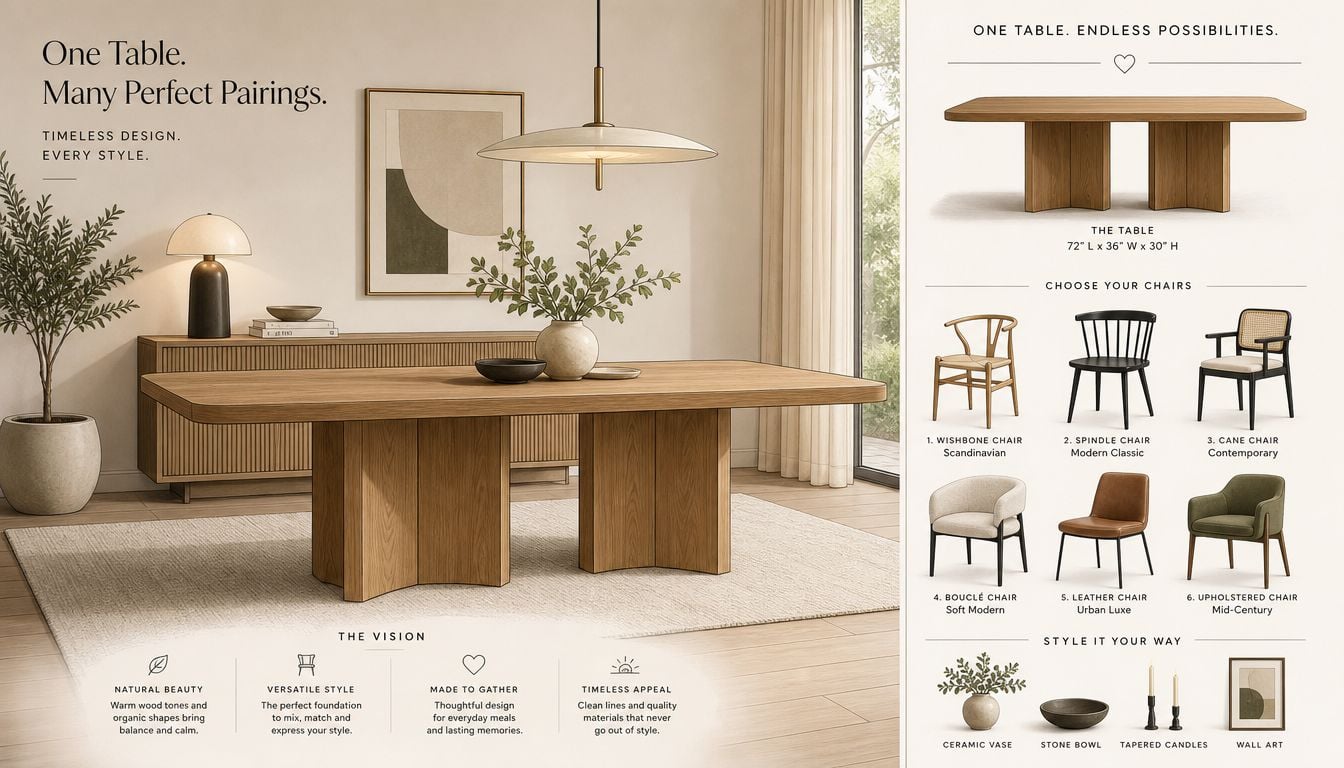
How Do You Pair Chairs and Decor with Your Table
A dining table rarely stands alone in a finished room. The chairs, lighting, rug, and storage pieces either support the table or compete with it. The strongest dining spaces feel connected, not matched for the sake of matching.
Many homeowners find themselves stuck. They choose a table confidently, then hesitate over whether every chair must be identical or whether the room needs more contrast.
Matching versus mixing
A matched set creates order. It's a natural fit for traditional rooms, formal dining areas, and homeowners who want a composed look without too much visual variation.
A mixed-chair approach can feel more collected and more current, especially with modern heritage, transitional, or sculptural tables. The key is to repeat at least one unifying element. That may be wood tone, seat height, fabric family, or silhouette.
Helpful rules include:
- Keep scale consistent: Different chairs can work together if their visual weight feels balanced.
- Repeat one finish: A shared tone prevents the room from looking accidental.
- Let the table lead: If the table is bold, the chairs should support rather than compete.
For readers gathering inspiration beyond furniture placement, this resource offers expert advice for dining room decor that can help with wall treatment and overall room balance.
The supporting pieces that matter most
A dining room becomes complete when the surrounding elements respect the table's proportions.
Consider these pairings:
- Lighting: A chandelier or pendant should visually anchor the table, not float too high or feel undersized.
- Rug choice: The rug should frame the full chair footprint, not just the tabletop.
- Storage: A sideboard or buffet adds function and reinforces the room's architecture.
- Wall decor: Art should support the table's mood, whether that mood is formal, modern, or softly transitional.
A thoughtful chair selection guide can save a great deal of trial and error. This article on how to choose dining room chairs is particularly helpful for understanding proportion, comfort, and style coordination.
A dining room feels elevated when every element shares the same level of intention, even if the pieces don't all come from one collection.
When professional guidance makes the room easier
This is often the point where complimentary in-home design support becomes useful. A trained design consultant can help evaluate chair scale, rug size, finish harmony, and lighting placement inside the actual room, not just under showroom lighting.
That matters in Central Florida homes, where tile flooring, bright sun, and open-plan layouts can make a room behave very differently than expected.
Experience True Craftsmanship at Our Longwood Showroom
A dining table is too important to judge by thumbnails alone. Photos can suggest proportion, but they can't show weight, finish depth, joinery, or how firmly the base stands when touched. Those details separate a temporary purchase from a legacy piece.
That's why showroom shopping still matters for high-intent buyers in Orlando, Longwood, Lake Mary, and Winter Park. In person, the wood species can be compared directly. Chair comfort can be tested. Finish tones can be seen under real light. The construction can be evaluated without guesswork.
Family-owned service matters too. Since 1980, Slone Brothers has served Central Florida with experienced design consultants, not commission-driven order takers and not faceless automated interactions. That creates a different kind of buying experience, one built around conversation, clarity, and long-term satisfaction.
For discerning homeowners, brands such as Stickley, Stressless, Smith Brothers, Palasar, Bassett, Craftmaster, Simply Amish, Canadel, Amisco, American Leather, and Mavin each offer different strengths in heritage, engineering, comfort, customization, or American-made construction. The value of an in-person visit is seeing which one suits the home.
Ready to invest in furniture that lasts a lifetime? Skip the online guesswork and automated digital chatbots. Visit the Slone Brothers Furniture showroom in Longwood, FL today. Connect face-to-face with experienced design consultants and let them help transform a house into a beautifully curated home. Want to experience the unmatched heritage of Stickley or explore complimentary in-home interior design services? Stop by the Central Florida showroom in Longwood today to collaborate with a real design expert and experience true craftsmanship in person.