

Dining Set with Glass Table Top Guide for Longwood Homes


A bright dining room in Longwood often asks for the same thing. It needs enough presence to feel finished, but not so much visual weight that the room starts to feel crowded. That's where a dining set with glass table top often enters the conversation. In homes across Central Florida, especially in open layouts near Orlando, Lake Mary, and Winter Park, glass can make a dining area feel lighter, more open, and more in line with the architecture.
That appeal is easy to understand. Florida homes tend to have abundant daylight, wide sightlines, and a strong connection between kitchen, dining, and living spaces. A glass top lets light travel through the room instead of stopping at a heavy surface. At the same time, many homeowners hesitate for good reasons. They wonder about fingerprints, breakage, daily family use, and whether glass still makes sense when children, pets, and frequent entertaining are part of the household rhythm.
A thoughtful answer starts with context. Glass tabletops have a long design history, with sources tracing their use as tabletop material to the 1780s, and the category became far more practical in the late 1950s after Alastair Pilkington's float-glass process boosted flat-glass production by 90%, helping make mass production possible (history of glass tabletops). That combination of old-world elegance and modern manufacturability still shapes how homeowners view glass today.
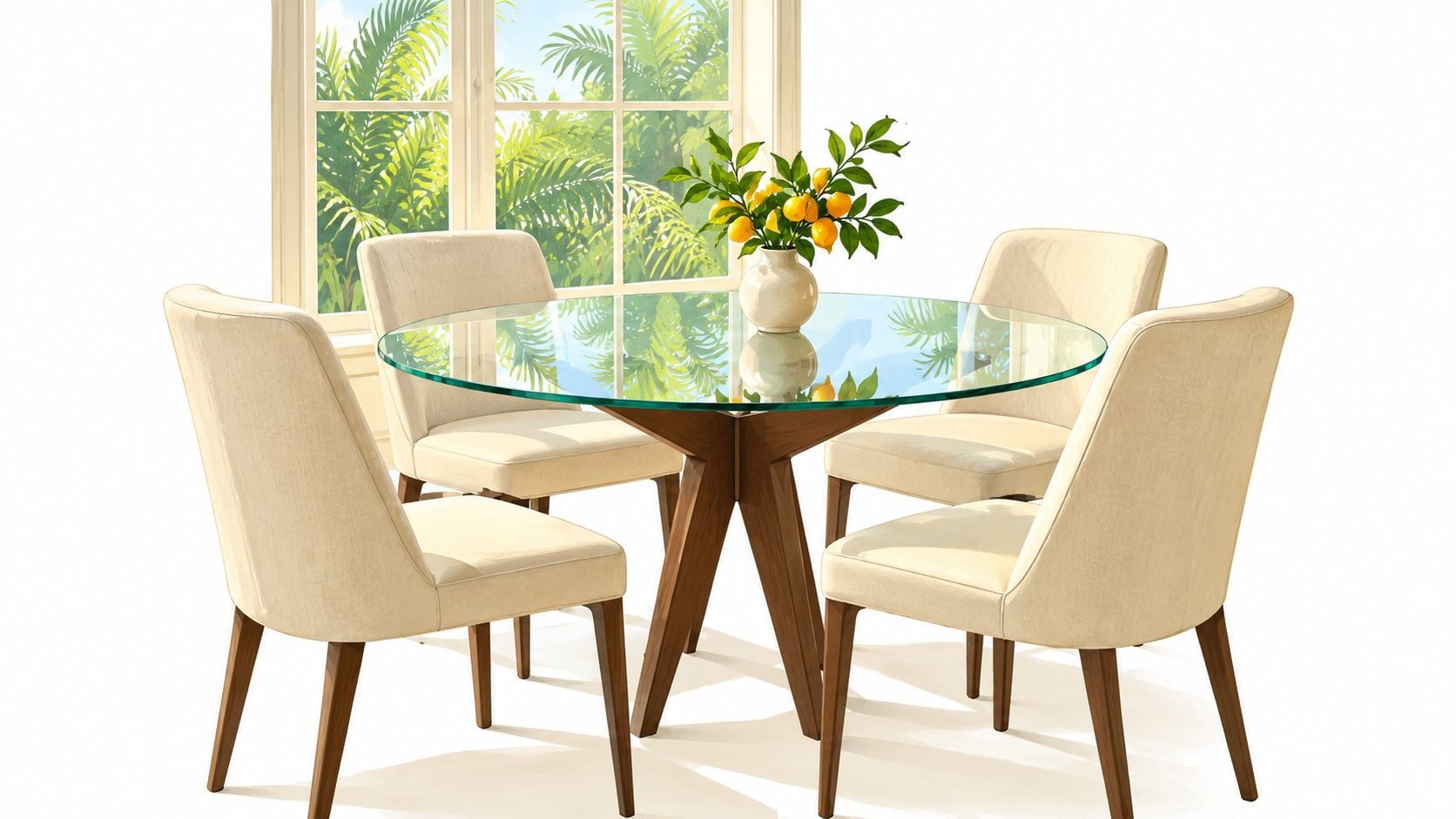
Homeowners planning a more complete dining room often benefit from starting with proportion, traffic flow, and chair scale before choosing materials. A practical reference is this guide to designing a dining room where to start, especially for Central Florida spaces that need to balance openness with comfort.
Introduction to Dining Sets With Glass Table Tops in Central Florida Homes
A dining set with glass table top is exactly what it sounds like. The tabletop is glass, while the structure beneath it is typically wood, metal, or a mixed-material base paired with coordinating dining chairs. That sounds simple, but the visual effect is distinct from a solid wood table. Glass reveals the base, preserves sightlines, and tends to feel more architectural than bulky.
For Longwood homeowners, that difference matters most in three situations:
- Open floor plans where a heavy dining table can interrupt visual flow between the kitchen and family room.
- Smaller dining areas where preserving an airy feel is more important than adding visual mass.
- Light-filled interiors where homeowners want the furniture to complement natural brightness rather than absorb it.
Glass works best when a room needs visual breathing room, not more furniture weight.
The right glass-top dining set also has a different kind of luxury. It isn't ornate for the sake of ornament. It feels crisp, edited, and intentional. In many Central Florida homes, that pairs beautifully with warm wood floors, soft upholstered dining chairs, and statement lighting above the table.
Why Central Florida homeowners keep considering glass
Climate influences material decisions, even indoors. In this region, homeowners often look for finishes that feel clean and composed in humid weather and under strong natural light. Glass doesn't compete with those conditions. It reflects light, stays visually cool, and works across multiple design languages, from transitional rooms in Winter Park to cleaner contemporary homes in Altamonte Springs.
That doesn't mean it suits every household. A family with young children may love the openness of glass but dislike the constant visibility of smudges and crumbs. A couple who entertains often may appreciate the polished look but want to be selective about edge finish, base stability, and chair upholstery.
The questions that matter most
Discerning buyers rarely stop at appearance alone. They usually want answers to practical questions:
- Is it safe enough for daily use
- How much maintenance does it really need
- Which base materials feel stable and age well
- Should the top be clear, smoked, or textured
- Does it make sense for a Florida family home
Those are the questions that turn a stylish choice into a confident one.
What Makes a Dining Set With Glass Table Top Different
A dining set with glass table top behaves differently from a wood table because the top itself is a different kind of material system. Wood has grain, flexibility, and warmth. Glass is rigid, smooth, and visually light, but it must be engineered correctly to perform well in a dining setting.
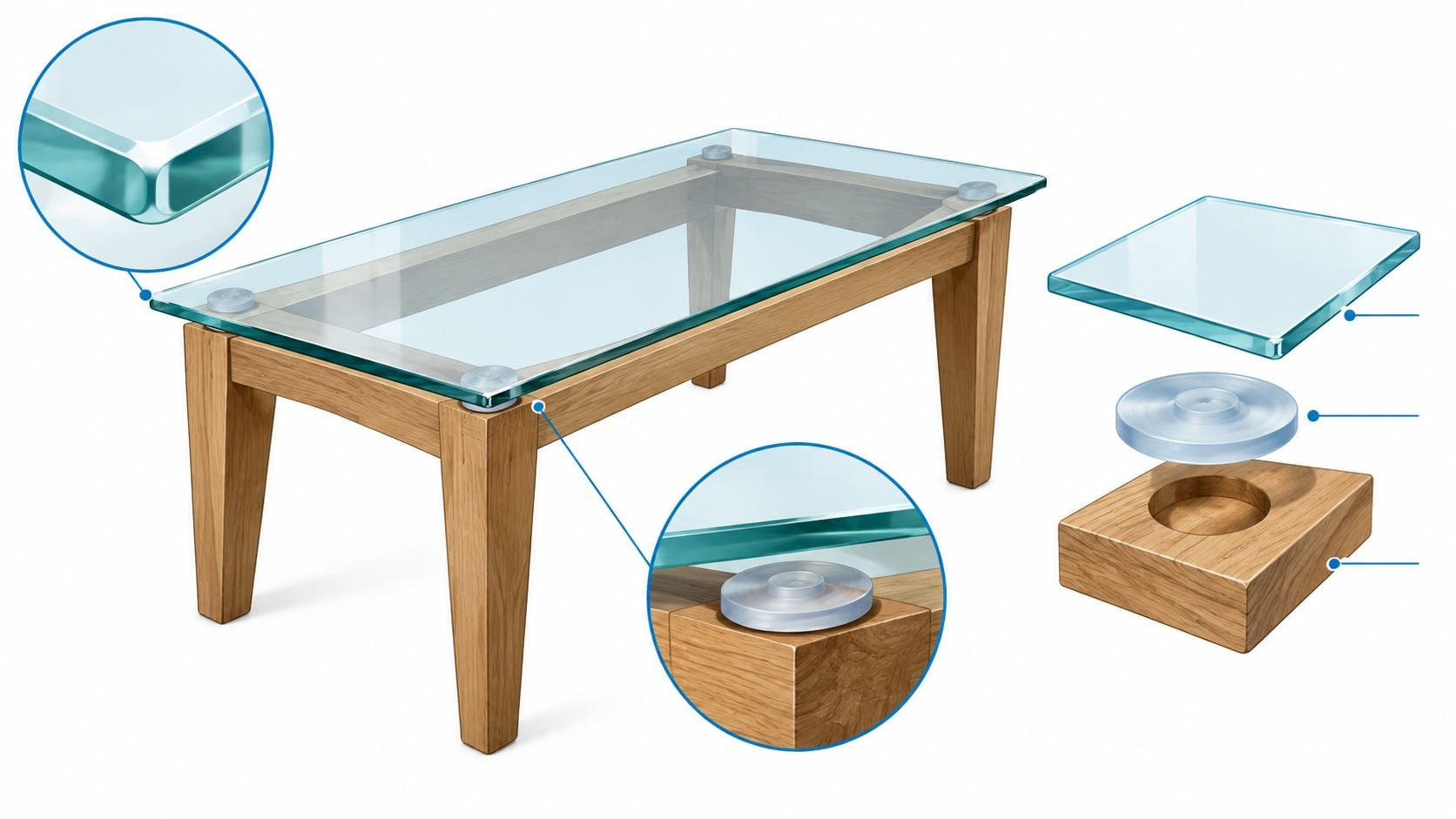
Homeowners comparing silhouettes and construction details often find it helpful to review common dining room table styles before narrowing in on glass. Shape and base design affect how the table looks, but also how the glass is supported.
It's not just glass on top of a base
A quality glass-top set depends on several parts working together:
- Safety glass rather than ordinary annealed glass
- Edge finishing that reduces sharpness and vulnerability at the perimeter
- Support geometry that distributes load properly
- A stable base that suits the span and shape of the top
A helpful way to think about glass is this. It can be strong, but it doesn't forgive poor support or edge damage. That's why a beautiful top alone isn't enough.
Why safety glass matters
The most defensible specification for a dining table is tempered safety glass or laminated safety glass. ASTM F2813 states that desks and tables must use laminated safety glass or tempered safety glass, and the standard applies to unenclosed horizontal glass surfaces less than 44 inches or 1118 mm above the floor for the purpose of reducing serious cutting and piercing injuries if the glass breaks (ASTM glass furniture standard overview).
The U.S. Consumer Product Safety Commission also says the voluntary ASTM standard requires tempered glass when glass is used as the horizontal surface of desks and tables, including dining tables (CPSC tempered glass safety alert).
That's the dividing line discerning homeowners should care about. Annealed glass isn't the same material choice as tempered safety glass.
Practical rule: If a dining table uses glass as the top surface, the buyer should verify a tempering mark or compliance documentation before purchase.
Construction changes the experience
Two glass-top tables can look similar in a photo and perform very differently in a home. One may have thoughtful perimeter support, polished edges, and a proportionate base. Another may rely on a more vulnerable mounting system or thinner-feeling construction.
That's one reason in-person evaluation matters. A Longwood showroom gives homeowners the chance to inspect the edge, feel the stability, and see how the base and top relate in scale. For a high-intent purchase, that's a more confident path than relying on a cropped product image and a short online spec list.
Benefits and Drawbacks You Should Weigh Before You Buy
A glass-top dining table isn't automatically a wise choice or a risky one. It's a lifestyle fit decision. For some Central Florida homes, it solves exactly the right problem. For others, it introduces a maintenance rhythm that doesn't suit the household.
Where glass excels
The advantages are mostly visual at first, but they're practical too.
- Visual openness helps smaller dining rooms feel less crowded.
- Light reflection works beautifully in homes with generous windows.
- Easy wipe-downs make ordinary spills straightforward to clean.
- A premium look gives the room a finished quality without heaviness.
In open-concept homes around Orlando and Sanford, that sense of lightness can be especially valuable. A solid wood table often becomes the dominant object in the room. A glass top lets the chairs, rug, lighting, and base do more of the design work.
Where homeowners get frustrated
Glass has trade-offs, and they're real.
- Fingerprints show quickly, especially on clear glass.
- Crumbs and water spots stay visible unless the table is wiped often.
- Scratches and chips matter, particularly along edges.
- The surface can feel unforgiving if someone drags ceramics or hard serving pieces.
Some households don't mind that at all. Others find the upkeep too fussy for everyday life, especially when school projects, pet traffic, and multiple daily meals all happen in the same room.
A glass dining table asks for more visual housekeeping than wood. It offers openness in return.
A quick household test
A dining set with glass table top usually works well when these conditions sound familiar:
- The room feels tight or visually heavy
- The household likes a clean, edited look
- Daily wipe-downs don't feel burdensome
- Meals are often served with placemats, chargers, or table linens
It may be the wrong fit when these statements ring truer:
- Children touch every surface
- The table gets used hard throughout the day
- The household dislikes visible smudges
- Furniture is moved often
The material question isn't only “Will this look good?” It's also “Will this live well in this particular home?”
That second question tends to produce the better long-term choice.
How to Judge Safety Thickness and Everyday Durability
A beautiful dining table doesn't earn a place in a home unless it also feels dependable. With glass, durability isn't judged by appearance alone. It comes from the type of glass, the way it's supported, the quality of the edges, and whether the table has been specified for the realities of daily use.
Safety data gives this topic real weight. A Rutgers-linked study reported 3,200 glass table-related injuries between 2009 and 2015 and estimated about 13,800 injuries linked to glass-top tables breaking each year across roughly 5,000 emergency care centers nationwide. The same research found that about half of injured patients had internal-organ, upper-torso, abdomen, or joint injuries that required surgery, and about 8% died within a month of injury (Rutgers-linked glass table injury findings).
Those numbers make one point clear. A glass-top dining table should be chosen like a performance product, not just a decorative surface.
What to verify before buying
The first checkpoint is the glass itself. Tempered glass is about four to five times stronger than standard annealed glass, and when it fails, it breaks into small regular-shaped fragments rather than long sharp shards (ASTM F2813 safety glass requirement). That break pattern materially lowers injury risk in a dining setting.
The second checkpoint is thickness and support. Industry guidance commonly treats 1/4 inch (6 mm) as a baseline for standard residential dining and coffee table applications up to roughly 36 inches in one direction, while larger spans and higher loads call for thicker builds and stronger support conditions.
For shoppers reviewing smaller-scale options, this overview of small glass dining sets is useful because scale and support are closely related.
Glass Dining Top Safety and Thickness Quick Check
| Feature | What to Look For | Why It Matters |
|---|---|---|
| Glass type | Tempered or laminated safety glass | Reduces serious cutting and piercing risk if breakage occurs |
| Tempering mark | Visible stamp or compliance paperwork | Confirms the glass was processed as safety glass |
| Thickness | At least the application-appropriate baseline, with more substance for larger spans | Thicker, better-supported tops handle daily use more confidently |
| Edge condition | Smooth finishing, no chips or hairline damage | Edge defects can propagate under repeated use |
| Base support | Stable frame and, where possible, full perimeter support | Support geometry affects performance more than looks alone |
| Everyday care | Microfiber cleaning, placemats, coasters, no dragging hard items | Reduces scratches, thermal stress, and damage accumulation |
Durability depends on habits too
Even a well-made top needs the right treatment. Best-practice care guidance warns against heavy concentrated loads, dragging hard objects, and ignoring chips or cracks at the edge because small defects can spread under repeated service loads.
A few habits make a meaningful difference:
- Use placemats and coasters to reduce scratch and thermal stress exposure.
- Clean with non-abrasive materials such as microfiber rather than harsh scrubbers.
- Avoid dragging serving pieces across the surface.
- Inspect the perimeter if the table has been bumped or moved.
The Furniture Retail Quality Group best-practice guide also says all glass table tops should be made from toughened glass and have a minimum thickness of 5 mm (FRQG glass best-practice guide).
That combination of verified safety glass, correct support, and disciplined daily care is what makes a glass-top dining table durable enough for serious residential use.
Choosing the Right Frame Base and Glass Finish for Your Home
Once safety and construction have been vetted, the decision becomes more nuanced. The base controls visual character and structural feel. The glass finish controls how much daily life the surface reveals.
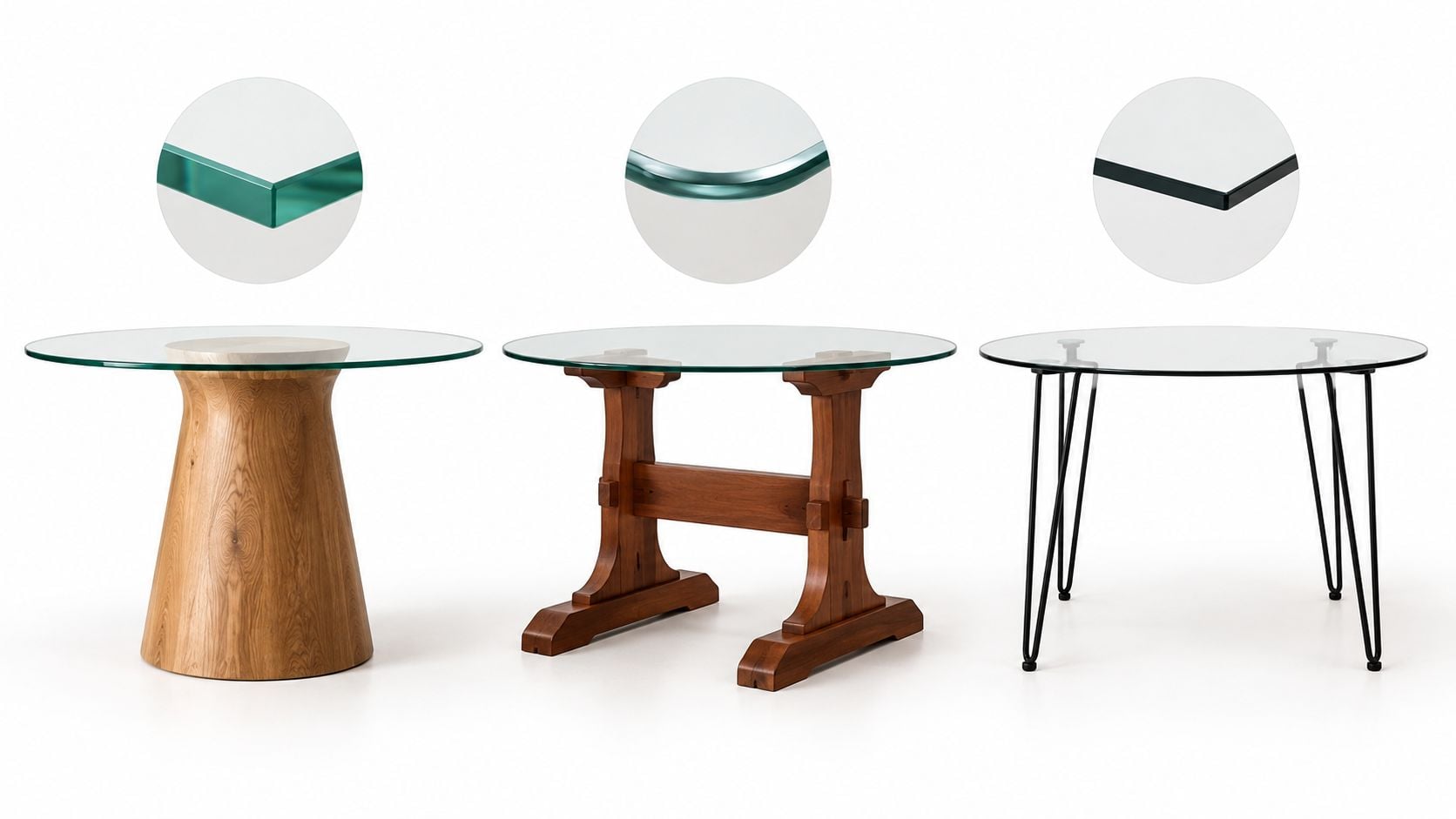
Material pairing matters here. A room can feel warm and grounded or sleek and architectural depending on whether the glass sits over wood, metal, or a mixed-material base. For homeowners evaluating metal details, this look at what you should know about metal accents helps clarify how metal changes the tone of a dining space.
Which base suits the home best
Solid wood bases bring warmth, visual substance, and a classic sense of permanence. They pair beautifully with transitional and timeless interiors, especially in Longwood and Lake Mary homes where dining rooms often connect to warmer millwork or wood flooring.
Amish-crafted hardwood bases appeal to buyers who care about joinery, species selection, and enduring craftsmanship. Amish is known for hand-selected solid hardwoods and traditional joinery. Mavin builds precision solid wood dining and bedroom collections through custom bench-carvers in Amish country. Both are strong options for homeowners who want custom character beneath the transparency of glass.
Metal bases tend to feel lighter, more refined, and often more contemporary. In a Winter Park condo or an Altamonte Springs home with cleaner lines, that can be the right balance.
Canadian custom makers bring another path. Canadel is known for hand-finished, solid birch custom dining furniture built to individual design specifications. Amisco offers modern, durable Canadian-made metal and wood dining and bar seating. Those lines are especially useful when a homeowner wants to coordinate finish, shape, and chair selection carefully.
Clear, smoked, or fluted glass
Many buyers get stuck, and generic style articles usually stop too early.
Recent style guidance notes that smoked glass and fluted glass are being favored in 2026 because they are more forgiving with fingerprints than clear glass, while care guidance continues to emphasize frequent cleaning, microfiber cloths, and avoiding abrasives (glass finish and care trend guidance).
A practical framework helps:
- Clear glass feels the lightest and most open. It also shows fingerprints, crumbs, and water spots most readily.
- Smoked glass softens glare and hides everyday marks more gracefully.
- Fluted or textured glass diffuses light and disguises wear well, though it changes the crisp transparency some buyers love.
Households don't choose only a color. They choose how much daily evidence of living they want the tabletop to reveal.
A simple decision matrix
| Home situation | Best glass finish | Base direction |
|---|---|---|
| Formal dining room with adults | Clear | Sculptural wood or refined metal |
| Busy family dining area | Smoked | Stable wood or mixed-material pedestal |
| Frequent entertaining | Smoked or fluted | Strong pedestal or full-support base |
| Smaller breakfast nook | Clear or lightly smoked | Compact pedestal for easier movement |
| Pet-friendly open plan | Fluted or smoked | Heavier, stable base with forgiving edges |
Round tops often work especially well in tighter Central Florida layouts because they soften circulation and reduce corner impact. Rectangular tops can feel more formal and often suit longer rooms, provided the base keeps the composition balanced.
Styling Placement and Custom Options at Slone Brothers in Longwood
A glass-top dining set looks best when the room around it is equally intentional. Placement, chair upholstery, rug scale, and light control all matter more with glass because the material reflects and reveals so much.
Place the table for comfort, not glare
In Central Florida homes, sunlight is a gift until it lands harshly across the dining surface at the wrong hour. A glass top near strong window exposure can create glare if the table sits directly in the path of low-angle light. That doesn't mean avoiding windows. It means planning around them with thoughtful orientation, layered window treatments, and lighting that complements rather than competes.
A few placement choices help immediately:
- Anchor the set with a rug so the transparent top still feels grounded in the room.
- Maintain generous chair clearance so movement around the table feels natural.
- Pair glass with textured upholstery to balance the smoothness of the top.
- Use wood tones strategically so the room doesn't become visually cold.
For homes that flow from indoor dining to patio hosting, curated outdoor entertaining accessories can help carry the same polished hospitality outdoors without making the spaces feel disconnected.
Customization matters more with glass
Glass exposes the base. That means customization at the base and chair level matters more than many buyers expect. The right pedestal shape, wood finish, seat fabric, and table diameter can completely change whether the set feels airy, grounded, formal, or family-friendly.
Canadel offers hand-finished solid birch custom dining furniture built to individual specifications. Amish focuses on traditional joinery and solid hardwood craftsmanship. Mavin brings precision-built solid wood dining collections from Amish country. Those options allow homeowners to fine-tune the proportions instead of settling for a one-size-fits-all silhouette.
A local showroom can also make coordination easier. Slone Brothers Furniture offers dining sets that include glass-top tables with solid birch pedestal bases, including Canadel options, which gives homeowners a way to review scale, finish, and chair pairing in person rather than relying on online guesswork.
Why local consultation changes the outcome
Design decisions become clearer when buyers can compare wood undertones, glass finishes, and chair fabrics in one room. Longwood homeowners furnishing a primary residence usually aren't looking for a quick transaction. They want confidence that the table will suit the home, the light, and the way the household lives.
That's why face-to-face planning still matters. A local design consultant can assess whether a clear top will feel too high-maintenance in a busy Sanford family home, or whether a smoked round top with a custom pedestal would better suit a Winter Park breakfast area.
Your Next Step to a Glass Top Dining Set That Lasts
A well-chosen glass-top dining set can be a lasting investment, but only when the purchase is approached with the same care as the rest of the home. Material verification, thoughtful support design, and finish selection all matter. So does the buying experience itself.
Why this is worth seeing in person
Glass is one of the hardest dining materials to judge from a screen. Photos rarely show edge finishing accurately. They don't communicate base stability well. They also can't tell a homeowner whether clear glass will feel elegant in the room or demanding.
That's where in-person guidance earns its place. A showroom visit allows buyers to compare silhouettes, inspect support details, test chair comfort, and decide whether a smoked or fluted top better fits daily life. For households furnishing multiple spaces at once, interior design consultation services can help connect the dining room to adjacent living and entertaining areas.
Value is more than the ticket price
Discerning homeowners usually understand that the least expensive route often becomes the most expensive over time. A dining table that feels unstable, lacks proper safety verification, or doesn't suit the household rhythm will rarely feel like a wise purchase later.
Long-term value comes from:
- Correct materials that hold up to real use
- Craftsmanship in the base and joinery
- Customization when standard sizing or finishes fall short
- Reliable delivery and follow-through after the order is placed
Since 1980, families across Longwood, Orlando, and Central Florida have continued to value those fundamentals. The Low Price Promise, flexible financing options, and a dedicated clearance outlet can all support different buying timelines, but the larger goal remains the same. Furnish the home with pieces that feel considered, comfortable, and lasting.
A glass dining table shouldn't feel like a leap of faith. It should feel like a well-informed decision.
Ready to invest in a dining set that looks refined and lives beautifully in a Central Florida home? Slone Brothers Furniture offers curated dining collections, custom-order options, white-glove delivery, and experienced design consultants who help homeowners evaluate glass thickness, base stability, finish selection, and room fit in person. Visit the Longwood showroom to compare a dining set with glass table top face-to-face and make a confident choice for the way the home is lived.