

10 Entryway Mirror Ideas to Elevate Your Home

Make a Lasting First Impression: Welcome to Your New Entryway
A front entry usually has one job and several realities. It needs to welcome guests, help the household get out the door, and hold up to daily traffic without feeling chaotic. A blank wall rarely helps. A crowded console table usually makes the space feel smaller. The right mirror can change both problems quickly.
That's why entryway mirror ideas stay relevant year after year. Mirrors have long been used to make compact or enclosed spaces feel larger by reflecting light and extending sightlines, and current design guidance still recommends oversized, full-length, round, arched, and rectangular options for foyers because they can widen narrow entries, brighten dark hallways, and strengthen the room's first impression. One design guide even notes that a floor-length mirror can make a small entryway feel “twice as large” in feel and effect, as shown in these entryway mirror ideas for stunning first impressions.
In Central Florida, that matters even more. Homes around Longwood, Lake Mary, Sanford, and Orlando often have strong natural light, open layouts, and entry spaces that need to work hard without looking busy. A thoughtfully placed mirror can bounce sunshine deeper into the room, but it can also reflect shoe piles, backpacks, and glare if the placement is wrong.
At Slone Brothers Furniture, serving Greater Orlando since 1980, the design approach stays practical. A mirror should look beautiful, but it should also fit the way the household lives. For inspiration beyond furniture, patterned surfaces can also shape a foyer's welcome. See how entryway tiles making a lasting impression can complement a mirror-centered design.
Table of Contents
- 1. Large Statement Mirrors with Ornate Wooden Frames
- 2. Arched and Rounded Top Mirrors
- 3. Floor-to-Ceiling Leaning Mirrors
- 4. Framed Mirrors with Decorative Accents and Molding
- 5. Horizontal Rectangular Mirrors Above Console Tables
- 6. Metal-Framed Industrial and Modern Mirrors
- 7. Circular and Round Mirrors
- 8. Vintage and Antique Mirrors with Character
- 9. Triptych and Multi-Panel Mirror Arrangements
- 10. Corner and Angle-Positioned Mirrors
- 10 Entryway Mirror Styles Comparison
- Find Your Perfect Entryway Mirror in Longwood, FL
1. Large Statement Mirrors with Ornate Wooden Frames
A substantial wood-framed mirror can do more than fill a wall. It can give the entryway a sense of permanence, especially in homes with traditional, farmhouse, mission, or transitional furnishings. In Central Florida homes with taller ceilings and open views into the living area, this style creates a strong visual stop right where the house begins.
Rich wood tones tend to feel more grounded than painted or metal frames. Walnut, oak, and cherry finishes work especially well when the entry already includes wood furniture, plank flooring, or a bench with visible grain. That's one reason these mirrors pair naturally with Amish-crafted and American-made furniture styles that focus on joinery, depth, and finish.
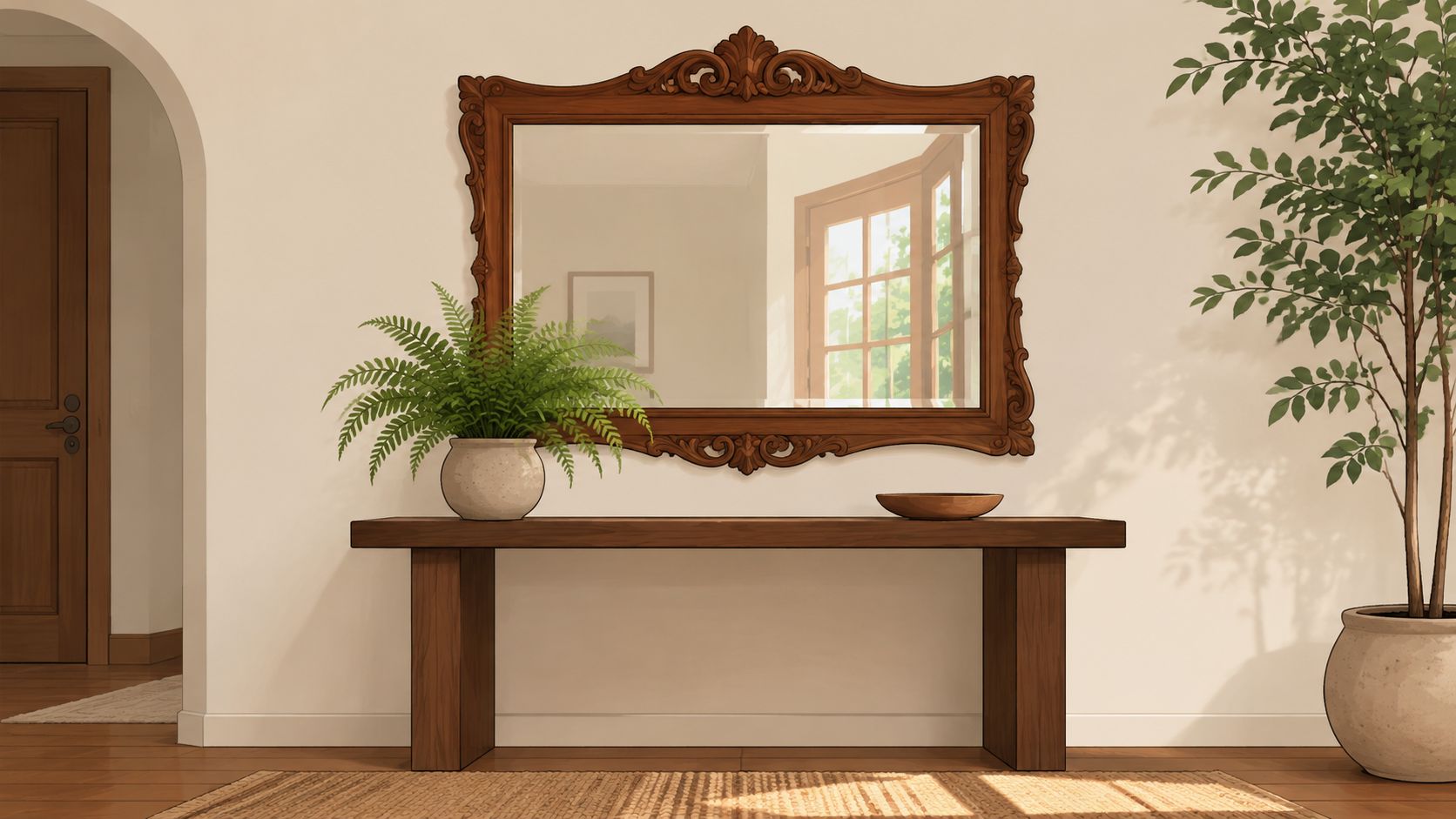
Use wood tone as the anchor
A carved frame only looks elegant when the rest of the vignette stays disciplined. If the mirror is elaborate, the console below should be simpler. A narrow table, a lamp, and one bowl for keys often look better than a full collection of small décor pieces.
Practical rule: Let the frame do the decorating. If the wood carving is busy, keep everything under it quiet.
A few placement notes make a big difference:
- Match undertones: Pair warm wood with warm wood. A reddish cherry frame beside cool gray oak furniture often feels accidental.
- Reflect light, not clutter: Position the mirror where it catches daylight or a lamp, not a pile of shoes by the door.
- Use furniture with substance: A thin metal console under a heavy carved frame can look top-heavy. A sturdier table or bench balances it better.
This look is especially good for homeowners in Longwood or Lake Mary who want the entryway to feel established rather than trendy.
2. Arched and Rounded Top Mirrors
Some entryways have too many hard lines. The front door is rectangular. The wall art is rectangular. The console table is rectangular. An arched mirror softens all of that without changing the furniture.
This shape works well in farmhouse, coastal, and updated traditional interiors because it introduces a subtle architectural note. It can echo a doorway, soften a squared-off foyer, or make a plain wall feel more finished. In homes with bright Central Florida light, that curved top also creates a gentler reflection than a sharp-cornered frame.
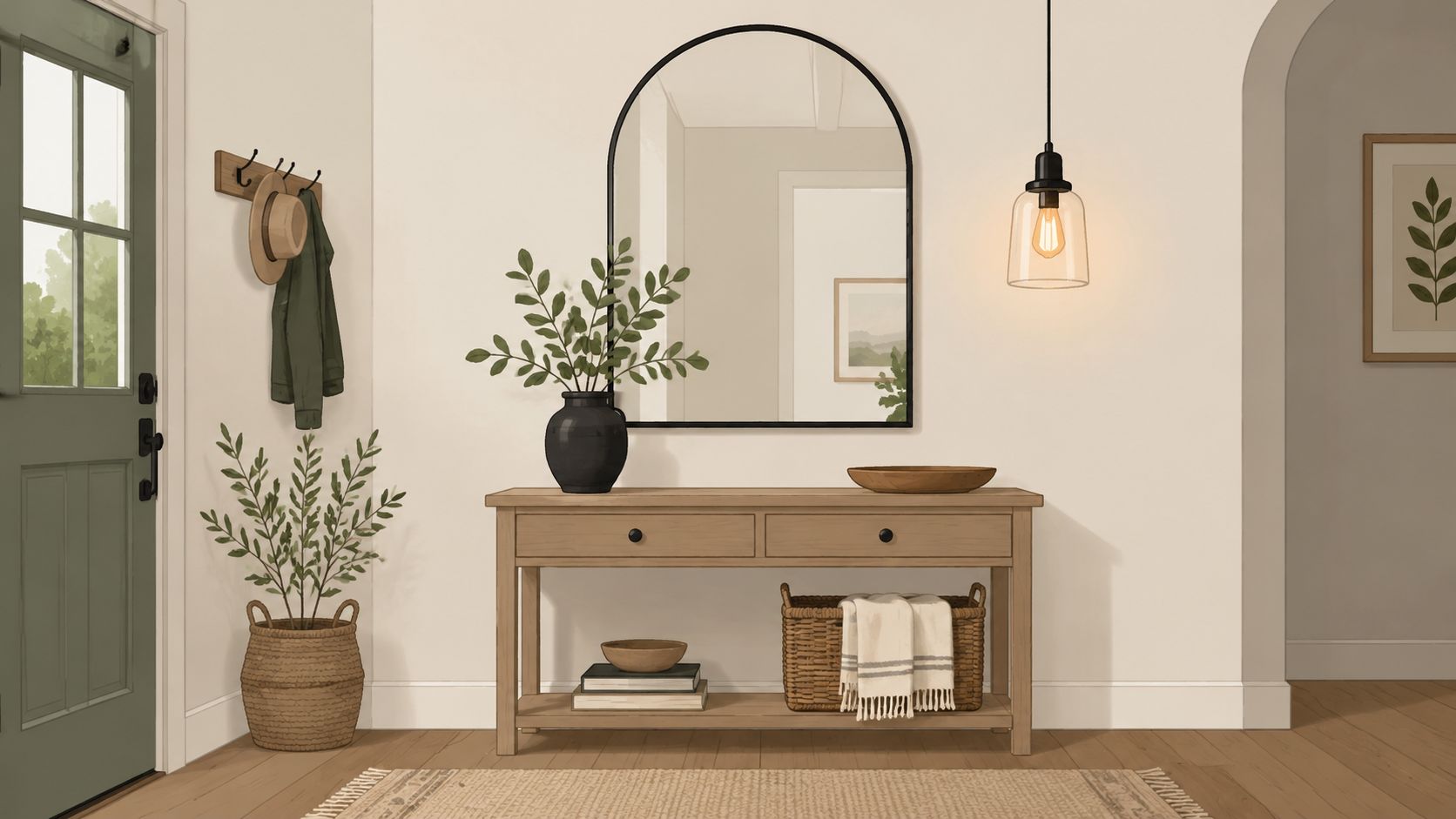
Where curved tops work best
Arched mirrors usually look best when there's a little breathing room above and around them. If the ceiling is low or a light fixture hangs close, a fully rectangular mirror may fit more cleanly. On the other hand, a tall arched shape can make a modest foyer feel more graceful.
Good pairings include:
- Black metal frames: Great for modern or transitional homes around Orlando.
- White or natural wood frames: Good for lighter, airy entryways with coastal or casual styling.
- Brass or aged finishes: Better when the foyer already includes warmer metals in lighting or hardware.
A common mistake is using an arch that's too small over a wide console. The mirror should feel related to the furniture below it. If the table is broad and grounded, the mirror needs enough visual weight to keep up.
A curved mirror can soften an entryway quickly, but it won't fix poor scale. If the furniture and mirror don't belong together, the wall still feels off.
3. Floor-to-Ceiling Leaning Mirrors
Leaning mirrors have an easy, modern look that many homeowners like because they don't feel stiff or overly formal. They're also practical in open-concept homes where the entry blends into a living space instead of standing alone. A full-height mirror adds depth, catches daylight, and gives the household a last look before heading out.
This style is especially appealing in smaller foyers because floor-length mirrors are often recommended to visually expand tight spaces, and some design guidance goes so far as to say a small entry can feel “twice as large” with one placed well. That visual effect is part of why decorative floor mirrors remain such a strong option for front entries.
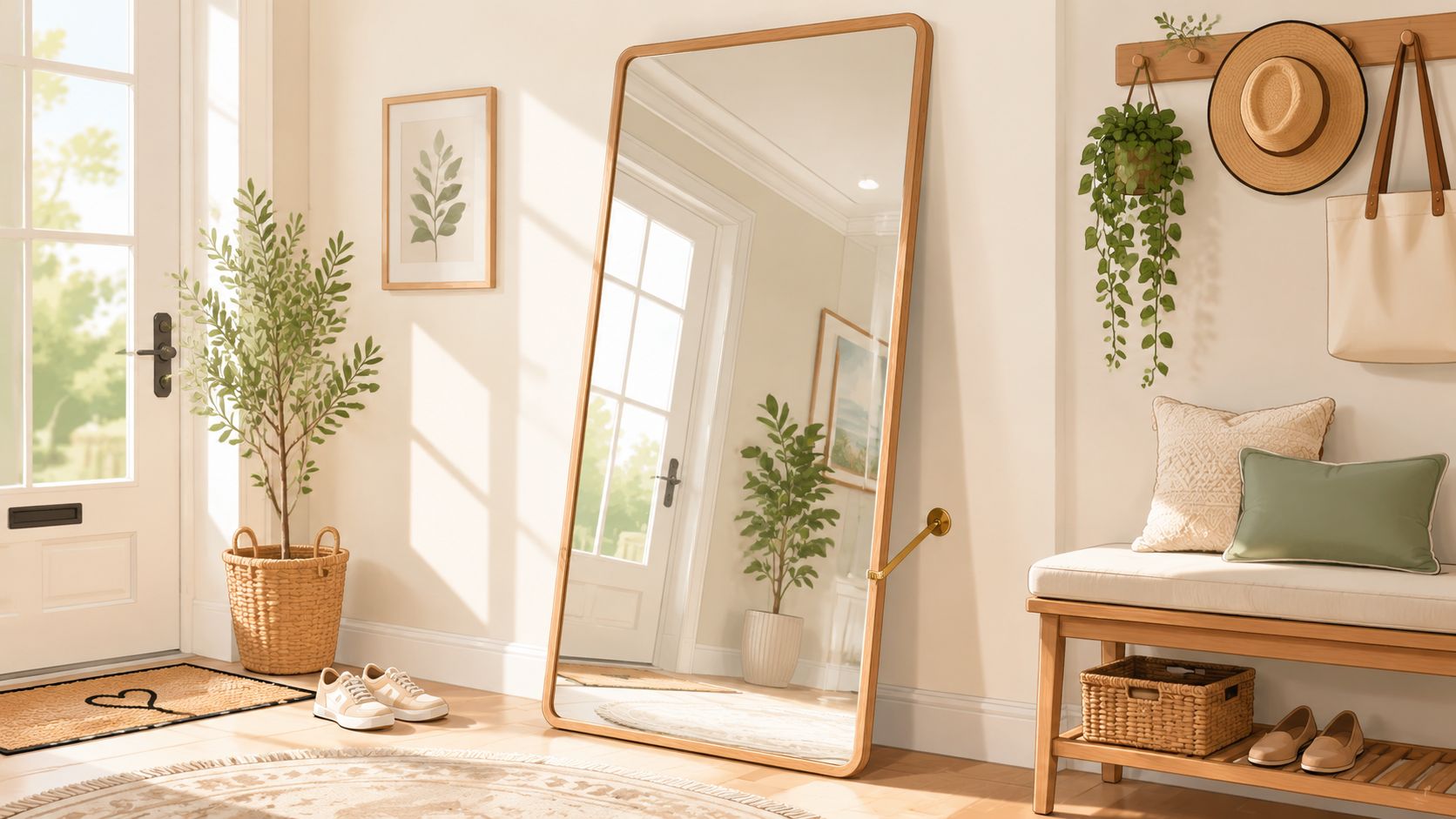
Safety matters more than style here
A leaning mirror shouldn't rest on the wall and hope for the best. In households with children, pets, or heavy daily traffic, it needs added security. A lean-stop device or anchor keeps the look casual while making the setup safer.
The best places for this style are usually:
- Along the longest clear wall: It has room to breathe and reflects more of the space.
- Near natural light: That's where the mirror earns its keep.
- Beside a bench, not behind one: The path in and out of the house should stay open.
This is one of the strongest entryway mirror ideas for homes in Sanford, Lake Mary, and Longwood with narrow halls or apartment-style entries. It's one of the weakest choices for busy family drop zones unless there's enough clearance and secure anchoring.
4. Framed Mirrors with Decorative Accents and Molding
Some mirrors read like architecture. That usually comes from molding, bevels, layered trim, or frame profiles with enough depth to cast a shadow. These details can make a plain entry wall feel custom, especially if the house already includes more traditional cabinetry, panel doors, or classic millwork.
Decorative frames also connect nicely with quality case goods. A well-made mirror with molding tends to look more at home above a substantial chest, sideboard, or narrow cabinet than above a very minimal table. In a showroom setting, this is often where craftsmanship shows up first. The frame tells the story before anyone notices what's reflected.
When detail helps and when it overwhelms
Detail helps when the entry feels flat. It overwhelms when every surface is already competing. A patterned runner, carved console, sculptural lamp, and highly decorative mirror all on one wall can start to feel crowded fast.
A better approach is selective layering:
- Use one dominant detail: Let the mirror be the ornate piece.
- Repeat one finish: Pick up the mirror's wood or metallic tone in lighting or hardware.
- Give the eye a place to rest: Keep wall color, tabletop styling, or nearby art restrained.
For Central Florida homes with light walls and bright natural sun, decorative molding can produce lovely dimension throughout the day. But if the frame has a lot of recesses and trim, it also needs more dusting than a cleaner-lined option. Beautiful pieces should still fit real life.
5. Horizontal Rectangular Mirrors Above Console Tables
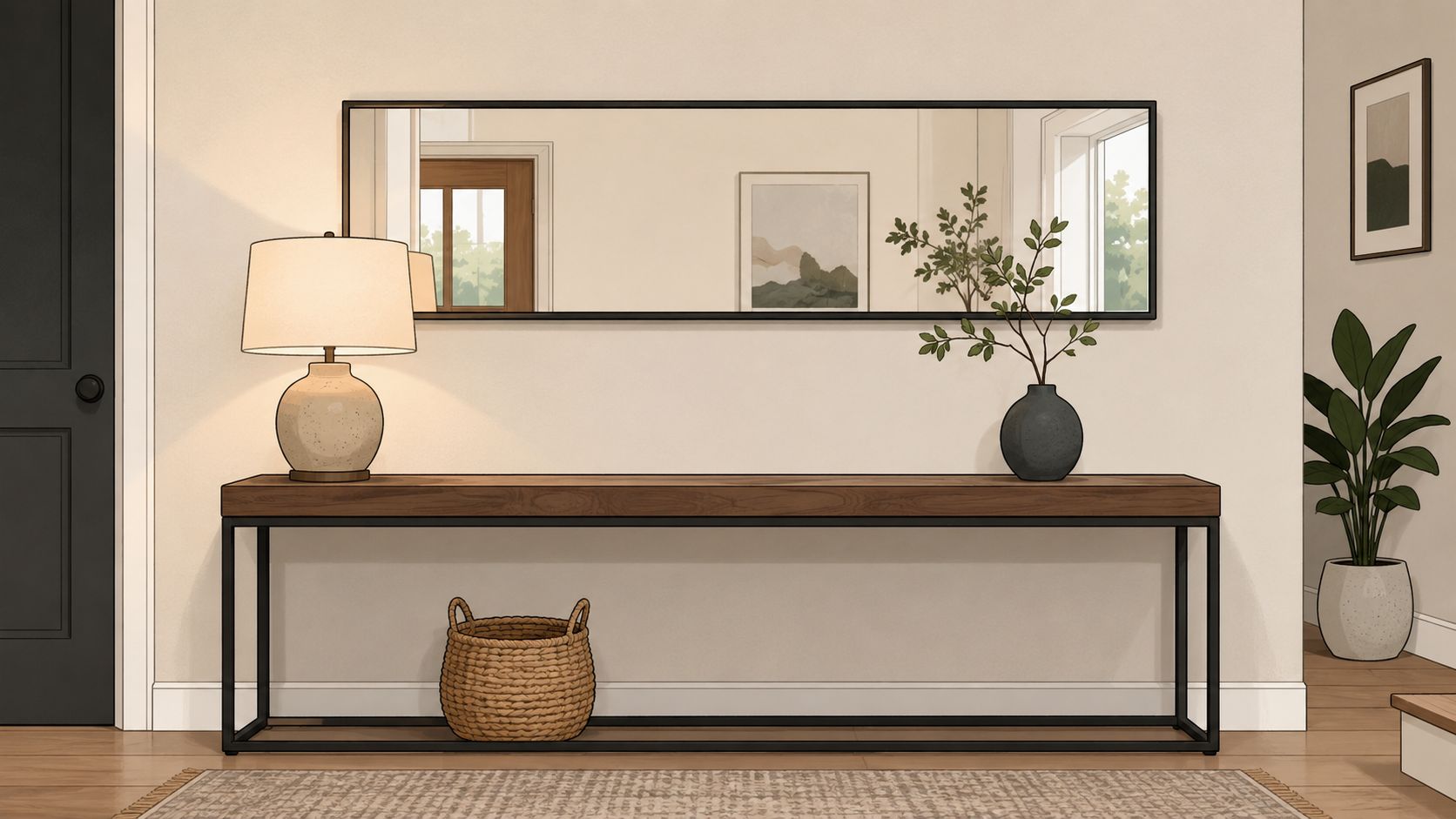
This is the classic entryway arrangement for a reason. A horizontal mirror widens the visual field, a console table grounds the wall, and the whole setup creates a practical landing spot for keys, mail, or a lamp. In many homes, this is the safest answer because it balances style and function without forcing either one too hard.
The biggest advantage is flexibility. A rectangular mirror can lean traditional, modern, farmhouse, or transitional depending on the frame. It also works in entryways that open directly into a dining room or living room because the horizontal line feels connected to nearby furniture.
The classic setup still works
A mirror over a console should feel composed, not accidental. The furniture below matters just as much as the frame above. For homeowners looking at proportions, storage, and styling together, these elements of the entry table are worth considering before picking the mirror.
A few design habits help this layout succeed:
- Keep the gap reasonable: Too much space between mirror and table makes the two pieces feel unrelated.
- Style in groups: A lamp on one side, a bowl or tray in the middle, and a plant or vase on the other side usually gives enough variation.
- Hide the mess: If the table collects daily clutter, choose drawers, baskets, or closed storage nearby.
The mirror can brighten the entry. It can also double whatever sits on the table below it. That's why a good console setup needs editing.
This arrangement is often the best fit for homes around Orlando where the foyer isn't a true separate room but still needs a polished first impression.
6. Metal-Framed Industrial and Modern Mirrors
A metal-framed mirror is often the right move when an entryway needs definition. In many Central Florida homes, especially newer builds with clean trim and open sightlines, a slim black or brass frame gives the wall structure without adding the visual bulk of heavy carving or deep molding.
This look fits modern spaces, but it also works in transitional homes that need a cleaner counterpoint to softer fabrics, wood tones, and curved furniture. I use metal frames most often in foyers that get strong natural light, because that crisp edge helps the mirror read clearly instead of fading into a pale wall.
Match the finish on purpose
Metal looks best when it relates to nearby hardware and furniture. A black frame can tie into a front door handle, sconces, or a console base. A warmer brass or bronze frame usually sits better with oak, cherry, or other wood finishes that already bring warmth into the entry.
The trade-off is mood. Black metal feels sharper and more architectural. Brass feels softer and a little more dressed. Grid-style mirrors add order and can fill a taller wall nicely, but the divided panes also break up the reflection, so they are better for making a style statement than for a quick last look before heading out.
That balance matters in Florida homes where the entry often opens straight into the main living area. A metal frame can keep the foyer current without making the whole house feel cold. Homeowners blending newer finishes with classic pieces can get useful context from this look at the traditional home in today's world.
At Slone Brothers, this is also one of the easier styles to tailor to the room. If the standard size feels too narrow or too tall for your wall, custom ordering can solve the proportion problem before installation. Placement matters just as much as the frame. Our in-house design team often helps homeowners choose a size and finish that connects with the flooring, lighting, and nearby case goods, so the mirror looks intentional instead of added at the end.
7. Circular and Round Mirrors
A round mirror changes the mood of an entryway faster than is typically expected. The shape feels less rigid than a rectangle, so it can soften a narrow hall, break up a wall of straight lines, or make a small vignette look less formal.
This is one of the strongest entryway mirror ideas for compact spaces that don't need a full outfit-check mirror but still need brightness and style. Over a slim console, a round mirror often feels balanced without looking heavy. Over a bench with hooks nearby, it can make a practical drop zone look more intentional.
Best uses for a round silhouette
Round mirrors usually perform best when the wall has some negative space. They need room around them to read as a shape, not just as a reflective surface. That's why they often look better on a simpler wall than inside a crowded gallery arrangement.
Good scenarios include:
- Small foyers: The lack of corners feels visually lighter.
- Boho or coastal styling: Rattan, woven, or natural wood frames work well here.
- Modern entries: A large black-framed circle can become the whole statement.
One thing to watch is scale. A mirror that's too small can look like an afterthought. A mirror that's too large for the furniture below it can feel top-heavy. In most entryways, the easiest success comes from choosing one round mirror with enough diameter to anchor the wall on its own.
8. Vintage and Antique Mirrors with Character
Vintage-style mirrors bring personality that newer pieces sometimes lack. A little patina, softened gilding, worn paint, or gently foxed glass can make an entryway feel layered and lived in. This style works especially well in farmhouse, cottage, eclectic, and traditional interiors where the goal isn't perfection. It's warmth.
Older mirrors also create contrast in newer Central Florida homes. A recently built foyer can feel more grounded when one piece has visible history or at least the look of history. That contrast keeps the entry from feeling too staged.
Patina should look intentional
Not every old mirror belongs in the entryway. The frame has to be structurally sound, the hanging method has to be secure, and the weathered details should look character-rich, not neglected. A distressed frame can be charming. A warped frame or loose backing isn't.
For homeowners drawn to classic looks, this perspective on the traditional home in today's world fits well with vintage mirror styling.
A good way to use this look is to mix old and new on purpose:
- Pair an aged mirror with a clean-lined console: The contrast keeps the wall from feeling theme-heavy.
- Use a quiet color palette: Let the patina stand out.
- Add only a few accessories: Too many nostalgic items can tip the entry into clutter.
An antique-style mirror should add soul to the foyer, not make it feel dusty. If the frame tells a story, the styling around it should stay simple.
9. Triptych and Multi-Panel Mirror Arrangements
A single mirror isn't always the best answer, especially in a wider foyer. Multi-panel arrangements can spread reflection across a longer wall and create a gallery-like effect without introducing artwork that competes with the entry's function. Three panels are often the easiest composition because they feel balanced but still have movement.
This approach works well in larger homes or open layouts where the entry needs more presence. In Central Florida, where daylight often enters from several directions, multiple panels can catch light from different angles and make the space feel more active.
Why multi-panel works in larger foyers
The layout has to be deliberate. If the spacing is uneven or the frames don't relate to each other, the whole arrangement can look like leftovers rather than a design choice. Paper templates on the wall help before any hardware goes in.
For a broader look at composition and visual balance, these ideas on how to create an eye-catching room apply well to grouped mirrors too.
The most successful versions tend to follow a few rules:
- Keep spacing consistent: That's what makes separate pieces read as one composition.
- Choose a unifying element: Same frame finish, same shape, or same overall proportion.
- Leave the furniture below calmer: The mirror grouping is already doing a lot visually.
This is a smart solution when one large custom mirror would be hard to source or difficult to install, but the wall still needs scale.
10. Corner and Angle-Positioned Mirrors
A lot of entryways in Central Florida are working around real architectural constraints. Stair openings cut into the wall, front doors need clearance, and some foyers only give you a narrow return wall or an angled corner to work with. In those layouts, a corner mirror often performs better than a centered mirror that feels squeezed in.
The main question is simple. What will the mirror reflect?
Angle-positioned mirrors succeed or fail based on that view. If the glass picks up daylight from a nearby window, a pendant, or even a bit of outdoor greenery, the entry feels brighter and more finished. If it reflects a laundry door, a pile of backpacks, or the side of a storage bin, the mirror adds visual noise instead of helping the space.
That is why I usually choose the location before I choose the frame. Tape off the mirror size on the wall, stand at the front door, and check the reflection from a few steps inside the house. This quick test prevents one of the most common mistakes. People buy a beautiful mirror first, then realize the angle highlights the messiest part of the room.
Corner placement also needs a little more discipline than a flat wall installation. The mirror has to feel intentional, not like a leftover piece that got tucked wherever it fit. In smaller foyers, I usually prefer a cleaner frame and a moderate size so the angle looks purposeful. If the home needs a specific dimension to fit a tight return wall, custom ordering can make the difference between a mirror that works and one that always feels off.
Wood-framed versions are especially strong in Florida homes that need warmth against tile, painted drywall, and bright natural light. Amish-crafted frames can bring that warmth without looking bulky, particularly in transitional or traditional entries. At Slone Brothers, we often help customers compare sizes in person because corner mirrors can read larger or smaller than expected once they are turned on an angle.
A final practical note. Keep glare and traffic flow in mind. A mirror that catches strong afternoon sun at the wrong angle can be uncomfortable near the front door, and a piece hung too close to a busy walkway can feel exposed to bumps and bag straps. Good corner placement solves a layout problem, but only if it also respects how the entry gets used every day.
10 Entryway Mirror Styles Comparison
| Item | Implementation complexity | Resource requirements | Expected outcomes | Ideal use cases | Key advantages |
|---|---|---|---|---|---|
| Large Statement Mirrors with Ornate Wooden Frames | Medium–High, large, secure mounting and precise placement | Significant wall space, skilled installation, higher budget for quality wood | Grand focal point; increased brightness and perceived space | Spacious entryways, traditional or Amish-crafted interiors | Anchors room, durable craftsmanship, complements quality furniture |
| Arched and Rounded Top Mirrors | Medium, specialized framing and balanced placement | Moderate wall space, careful sizing, variable budget | Soft, elegant architectural accent; subtle focal point | Modern, farmhouse, contemporary entryways; smaller walls | Softens angles, timeless silhouette, versatile materials |
| Floor-to-Ceiling Leaning Mirrors | Low–Medium, no permanent mount but requires safe positioning | Substantial floor length, heavy piece handling, optional anchor for safety | Dramatically expands perceived space and light; movable impact | Open plans, rentals, minimalist and modern spaces | No drilling, repositionable, strong visual expansion |
| Framed Mirrors with Decorative Accents and Molding | High, heavy pieces often need professional installation | Ample wall space, higher budget, ongoing maintenance for details | Art-like focal point with refined light effects and depth | Formal, traditional, or transitional entryways | High craftsmanship, sophisticated appearance, museum-quality feel |
| Horizontal Rectangular Mirrors Above Console Tables | Low, straightforward hanging with standard spacing rules | Wall space above console, coordinate with tabletop accessories | Balanced vignette; makes wall appear wider and more curated | Classic entryways paired with console or credenza | Timeless arrangement, easy to style, practical for daily use |
| Metal-Framed Industrial and Modern Mirrors | Low–Medium, generally simple mounting, lightweight frames | Moderate wall space, choice of metal finish, routine cleaning | Contemporary contrast and crisp architectural lines | Lofts, industrial or modern homes, mixed-style interiors | Durable, affordable options, strong material contrast |
| Circular and Round Mirrors | Low–Medium, standard mounting but requires careful sizing | Adequate clear wall area, proper anchors for large diameters | Soft geometric focal point; uplifts visual interest | Eclectic, bohemian, modern farmhouse, gallery walls | Distinctive shape, versatile materials, flattering visual flow |
| Vintage and Antique Mirrors with Character | High, sourcing, condition assessment, and cautious installation | Variable condition, possible restoration, professional hanging | Adds warmth, patina, and unique storytelling to entryways | Farmhouse, rustic, eclectic, or vintage-inspired homes | One-of-a-kind character, sustainable choice, rich history |
| Triptych and Multi-Panel Mirror Arrangements | High, precise planning, consistent spacing, professional install | Large wall area, higher cost, templates and measuring tools | Dramatic, gallery-like statement; increased reflected light | Large entryways, open-concept homes, statement walls | Flexible sizing, distributed visual weight, strong impact |
| Corner and Angle-Positioned Mirrors | Medium–High, requires angle planning and custom placement | Use of corner/odd spaces, precise measurement, possible pro install | Maximizes light in awkward areas; creates dynamic sightlines | Small or irregular entryways, odd floor plans | Solves layout challenges, creative light capture, curated placement |
Find Your Perfect Entryway Mirror in Longwood, FL
The best entryway mirror ideas don't start with trend lists. They start with the wall, the traffic flow, the light, and the habits of the household. A mirror that looks beautiful online may feel too small in person, too heavy over a narrow table, or too reflective for a busy family entry. Proportion matters. Placement matters. What the mirror reflects matters just as much as the frame itself.
For some homes, the right answer is a large wood-framed statement piece that adds warmth and craftsmanship. That can be an especially good fit when the foyer connects to dining or living furniture in rich wood tones. For others, a round or arched mirror softens the architecture and keeps a compact space from feeling boxed in. A metal frame may be the cleaner choice in a more modern Orlando-area home, while a vintage-style mirror may bring welcome character to a newer build in Longwood, Lake Mary, or Sanford.
Function should stay part of the decision. If the entry doubles as a drop zone, a mirror alone won't fix the space. It usually needs a bench, concealed storage, hooks, or a console with enough discipline to keep clutter from multiplying in the reflection. That's where many homeowners get stuck. The mirror is attractive, but the full wall composition still doesn't work. A thoughtful pairing of table, lighting, and scale is what makes the whole entry feel finished.
That's also where a local showroom can help. Slone Brothers Furniture in Longwood offers mirrors, home décor, and entry-friendly furnishings that can be combined into a practical setup, not just a pretty one-piece purchase. Homeowners who want warmer wood tones can explore American-made and Amish-crafted looks. Those who need a harder-to-find size or finish can ask about custom-order possibilities through brands such as Amisco. The in-house Design Team can help with measurements, placement, and selecting a mirror style that works with existing furniture instead of competing with it.
For value-minded shoppers, the Clearance Outlet can also be worth a stop, especially when the goal is to find a distinctive piece without sacrificing quality. That kind of flexibility matters when furnishing a whole home or finishing the final layer of a foyer.
Ready to find the perfect piece for your home? Visit the Slone Brothers Furniture showroom in Longwood, FL, and let our design experts help you get started!
Ready to refresh your entryway with a mirror that fits your space and your style? Visit Slone Brothers Furniture in Longwood, FL, and connect with a local team that's been helping Central Florida families furnish their homes since 1980.