

Living Room Furniture on a Budget That Lasts


The living room is empty, or nearly so, and the rest of the house still needs attention. A recent move to Longwood, Lake Mary, Winter Park, or Sanford often leaves a homeowner choosing a sofa while also paying for window treatments, bedroom pieces, and a dining table. Choosing living room furniture on a budget in that moment should not mean chasing the lowest ticket in a hurry.
A disciplined approach protects both the room and the checkbook. The homeowner measures first, buys the anchor piece well, stages the rest, and asks hard questions about frames, cushions, and finishes before signing anything. That sequence produces a room that looks finished sooner, even when every piece does not arrive on day one.
Why the Cheapest Sofa Usually Costs the Most
The cheapest sofa usually costs the most because purchase price is not ownership cost. A sofa that sags, twists, or pills early forces repair bills, a second delivery, disposal, and another search through the same limited budget. A disciplined buyer compares cost per year, expected service life, warranty coverage, repairability, and delivered price before judging value.
The arithmetic is plain. A sofa costing $2,000 and used for 10 years has a simple purchase-cost rate of $200 per year, while a $900 sofa replaced after four years costs $225 per year before delivery, disposal, repair, or moving expenses, according to the example in the review of furniture lifetimes and historical sofa service life. That calculation does not prove every higher-priced sofa is superior. It proves that durability changes the deal.
Budgets Are Getting Tighter, Not Larger
National spending data shows why that math matters now. Average annual spending on household furnishings and equipment moved from $2,701 in 2021 to $2,606 in 2022, $2,508 in 2023, and $2,414 in 2024, a 10.6% decrease over three years, in the Bureau of Labor Statistics consumer expenditure report. That category covers more than living-room furniture alone, so it is not a precise sofa allowance. It is a warning that most households spread finite money across several rooms.
Consumer caution also shows up in purchase planning. Recent consumer data indicates 31% of respondents planned to spend less on furniture because of higher prices and other financial pressures, while ready-to-assemble furniture, cited by 55%, was the category most frequently targeted by cost-cutting consumers, as reported in the 2025 AlixPartners home retail consumer sentiment index. Cutting back is sensible. Cutting construction quality without checking lifespan is not.
Screening standard: Reject the lowest price until it survives questions about frame, suspension, cushion recovery, fabric performance, and repair options.
For a Central Florida homeowner furnishing several rooms after closing, the better strategy is phased purchasing. Fund the highest-use seating first, then add tables, lighting, rugs, and décor in deliberate stages. Homeowners who want the fuller rationale behind pricing differences can read the explanation of why quality furniture costs more upfront, then apply that logic piece by piece. A smaller room done well, in the right order, beats a complete room that starts failing within a few seasons.
Measure the Room Before You Spend a Dollar
Accurate measurements protect a budget before a shopper sees a single fabric swatch. A living room plan needs wall lengths, ceiling height, window locations, door swings, outlets, built-ins, and the narrowest delivery route recorded on one sheet. Without that sheet, a clearance sectional can become an expensive object that fits the wall but cannot enter the house.
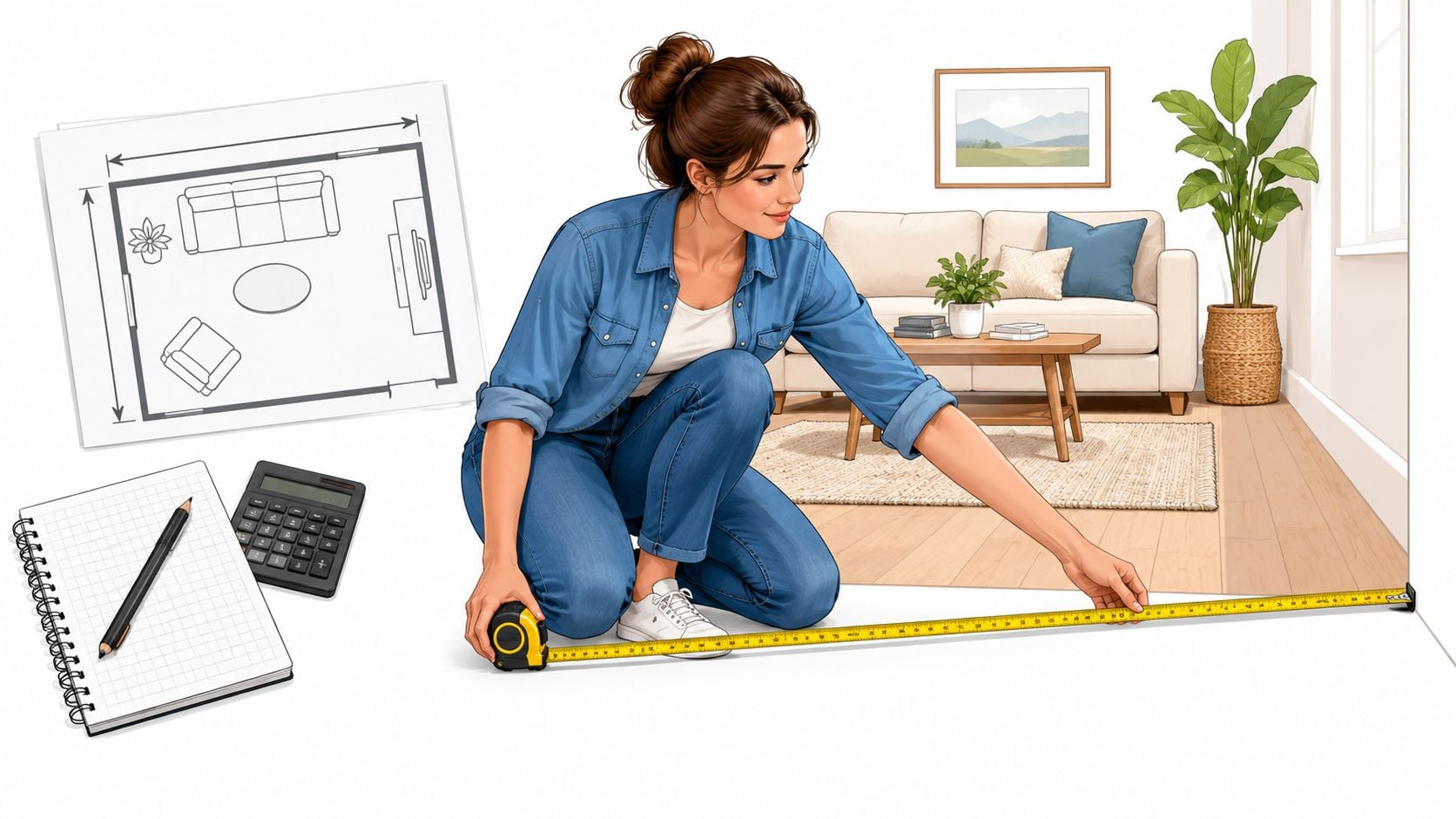
Build a One-Page Fit Specification
The workflow is straightforward and unforgiving in the right way. Measurements turn a vague wish list into a specification a design consultant can use.
- Measure the room first: Capture wall lengths, ceiling height, windows, doors, outlets, built-ins, and door swings before selecting any piece.
- Record the furniture envelope: Note a candidate sofa by overall width, depth, and height, not by seat width alone.
- Trace the delivery path: Measure entry doors, hallway turns, stairwells, and ceiling drops at the narrowest points.
- Sketch before shopping: Place existing pieces, end tables, and traffic routes on a scaled floor plan.
- Protect circulation: Preserve approximately 30 to 36 inches of circulation around primary furniture, with roughly 16 to 18 inches between seating and a coffee table, using the spacing guidance in the sofa size and room circulation guide.
The most common failure is measuring only the destination wall. A generous wall in a Lake Mary home means little if a tight turn at the foyer blocks the sofa. The same risk applies in older Winter Park homes, Sanford floor plans with narrow entries, and Longwood homes where a sectional must clear a formal doorway before it reaches the family room.
A practical rule is to reject any sofa that cannot preserve the planned walkway after end tables and existing pieces are counted. That rule matters even more for clearance purchases, custom orders, and online finds, because redelivery or replacement can erase the savings quickly. Homeowners who want the step-by-step version can follow the room measuring method for furniture planning and bring the finished sheet to the showroom. One page of honest numbers prevents impulse purchases, crowded corners, blocked registers, and the familiar mistake of buying seating that makes the room look smaller than it did when empty.
Which Piece to Buy First in a Living Room Refresh
Start with the anchor seating. In a Longwood living room, the sofa or sectional sets the scale and establishes the spending sequence for every piece around it. Choose tables or lamps first, and you risk buying pieces that suit the wrong seat depth, arm height, or layout.
After a move to Altamonte Springs, Longwood, or Greater Orlando, finishing the whole room at once can feel urgent. Resist that pressure. A phased plan lets you spread purchases over time and judge each addition against the furniture already in place.
A Four-Phase Purchase Sequence
Phase one covers anchor seating. Give the largest share of the budget to a well-built sofa or sectional with a kiln-dried hardwood frame, corner blocking, supportive cushions, and an upholstery choice suited to the room. These construction details matter more than decorative extras because seating gets used every day. Buy for lasting comfort and repairable quality, not the lowest sticker price.
Phase two adds foundational surfaces. Choose a coffee table and one end table to serve the seating you have already selected. Their height and scale should fit the sofa, so wait until its proportions are settled.
Phase three brings in lighting and a rug. Add lighting to address the flat feel overhead fixtures can leave in a Florida living room. Then use a rug to define the seating group, soften tile or wood, and reduce noise in an open plan.
Phase four finishes with secondary pieces. Add occasional chairs, an ottoman, art, and accessories after living with the room. Waiting shows whether extra seating will earn its place, and gives you time to find a suitable clearance piece or order a configuration that fits.
That slower sequence suits households keeping a close eye on spending. A 2025 U.S. consumer survey found that 70% of adults said they follow a budget and 65% preferred saving money over spending it, while 13% identified furniture or home décor as a top priority for the year, according to the 2025 consumer spending and saving research. Prioritize the pieces that see daily use, then add the rest as the room's needs become clear.
Use the core living room essentials checklist to organize the purchase order. A room does not need to be finished in one weekend. It needs a durable first purchase, pieces that work with its proportions, and a budget that leaves room for the next decision.
Sourcing That Protects the Budget Without Cutting Corners
For a Longwood homeowner, the lowest sticker price is rarely the lowest total cost. Choose each piece for its daily use, fit, and likely service life. Ready-to-assemble furniture, big-box stock, local clearance, and custom order each have a place, but relying on one source for the whole room can turn a low initial price into repeat purchases.
Ready-to-assemble furniture can suit a guest corner or a lightly used accent. Daily seating takes more wear, and weak hardware, flattening cushions, or upholstery that is hard to replace can shorten its useful life. Big-box stock offers speed, but limited sizes, fabrics, and configurations can leave an awkward fit in Central Florida's open-plan rooms. Measure and assess the room before accepting a sofa that nearly fits.
Where Clearance and Custom Order Earn Their Place
Clearance is a smart way to furnish secondary spaces when you have checked dimensions, condition, materials, and delivery access. A well-made occasional chair, lamp, or accent table can reduce spending without compromising the main seating. Skip a clearance sofa with the wrong depth or fabric for the sunlight coming through large sliders.
Custom order addresses a different need. It can match an unusual wall, preferred seat depth, performance fabric, leather grade, or sectional layout that stock options may not provide. Stickley, carried at the Longwood showroom, brings Arts and Crafts heritage and handcrafted joinery to case pieces built for long use. For upholstery, ask the showroom about custom configurations that match your fit and fabric priorities.
Buying fewer, longer-lasting pieces can also mean replacing furniture less often. Furniture and furnishings entering the municipal solid-waste stream rose from 2.2 million tons in 1960 to 12.1 million tons in 2018, and 80.1% of that material was landfilled in 2018, according to EPA durable goods waste data. The figures do not make every inexpensive item a poor choice. They do make frequent replacement a cost worth considering.
Slone Brothers Furniture is a local Longwood showroom with clearance opportunities, a Low Price Promise, custom-order options, flexible financing, and home delivery with order tracking. Before you commit, use this guidance on choosing quality furniture retailers to focus your questions on the pieces that matter most. For ideas that suit a phased refresh, find budget-friendly makeover inspiration, then check each choice against your room's measurements and intended use.
What to Ask Before You Sign for the Sofa
Ask for construction facts, not adjectives. A serious shopper should leave a Longwood showroom knowing the frame material and joinery, suspension type, cushion core, upholstery grade, warranty terms, delivery conditions, and applicable safety or emissions documentation. Vague words such as premium, green, or solid do not answer any of those points.
Materials language deserves particular skepticism. Wood species range from approximately 320 to 3,680 pounds-force on the Janka hardness scale across furniture woods, according to the technical reference on wood hardness and furniture standards. That wide range affects dent resistance on coffee tables and consoles, so the phrase solid wood alone is not a complete quality grade. Species, joinery, finish, and whether a surface can be refinished matter just as much.
For case goods containing composite wood, emissions compliance provides a measurable screen. EPA lists formaldehyde emission limits of 0.05 ppm for hardwood plywood, 0.09 ppm for particleboard, 0.11 ppm for MDF, and 0.13 ppm for thin MDF in its consumer guidance on TSCA Title VI formaldehyde standards. Compliance does not prove durability by itself. It gives the buyer documentation instead of a sales phrase.
Upholstery has parallel standards. EPA procurement recommendations state that upholstered products should meet California Technical Bulletin 117-2013, follow California Senate Bill 1019 labeling for added flame-retardant chemicals, and comply with ANSI/BIFMA X7.1 or an equivalent standard for formaldehyde and total volatile organic compound emissions, as set out in the EPA specifications and ecolabel recommendations. Those labels do not make every product identical. They give the homeowner objective questions that can be verified face to face, which is harder to do through a product page and automated chat.
Ten Questions to Ask Before You Buy Living Room Furniture
| Question to Ask | What to Listen For |
|---|---|
| Frame material and joinery? | Specific wood, corner blocking, and reinforced joints |
| Suspension system? | Named system and warranty coverage |
| Cushion core? | High-density foam or down-wrapped construction explained clearly |
| Leather grade, if leather? | Top-grain identified, not bonded material |
| Fabric performance? | Cleanability suited to sun, humidity, pets, and daily use |
| Composite wood documentation? | TSCA Title VI label or paperwork available |
| Flammability label? | TB 117-2013 and SB 1019 information available |
| Wood species on tables? | Species, hardness, finish, and refinish options |
| Warranty and repair path? | Covered parts, duration, and local service process |
| Delivered total cost? | Delivery, placement, and removal terms stated upfront |
Homeowners who want a shorter comfort-focused screen can consult the five checks for a new sofa or chair before the visit. A salesperson who cannot answer the questions should not receive the deposit. A design consultant who answers them plainly, explains tradeoffs, and refuses to rush the decision is protecting the budget better than any temporary markdown.
Putting the Plan Together in One Local Visit
One prepared visit can settle most of a living room plan. The homeowner arrives with the measurement sheet, delivery-path notes, photos of the room, existing pieces worth keeping, and a ranked list that puts anchor seating first. That preparation turns shopping from wandering into a working session.
Start with fit, then move to construction, then talk money. A consultant can test sofa depth against the floor plan, confirm whether a sectional clears the entry, and flag pieces that crowd walkways. The conversation should also cover Central Florida realities, including strong sun through sliders, humidity, tile floors that amplify sound, and open plans common in Longwood, Lake Mary, Sanford, and Winter Park homes.
Turn Priorities Into a Staged Order
A useful benchmark keeps expectations honest. A peer-reviewed study describes a 10-year expected functional lifespan as a durability benchmark associated with BIFMA standards for properly used wood furniture, while also noting that repair, reuse, and refurbishment can extend the life of moderately durable pieces, according to the peer-reviewed study of wood furniture durability and service life. That benchmark supports asking how long each candidate should serve, not assuming a premium look guarantees longevity.
Buy the piece that gets used every day as if replacement would be inconvenient and expensive, because it will be.
Financing and timing should serve the sequence, not override it. Flexible financing can make a well-built sofa possible now while tables, lighting, and accents arrive in later phases. Clearance can fill a secondary role when the dimensions and condition check out. Custom order can solve the main seating problem properly when stock sizes fail. The Low Price Promise then acts as a backstop on local comparisons, while scheduled delivery and order tracking reduce the uncertainty that pushes shoppers toward risky online gambles.
Complimentary design guidance ties the decisions together. Experienced design consultants, rather than commission-driven order takers, can coordinate living room choices with dining and bedroom plans so woods, metals, and fabrics do not fight room to room. That whole-home view matters for new homeowners furnishing several spaces after a move. It also prevents the common error of buying a beautiful living room piece that cannot coexist with the dining set planned for next season.
The finished plan is simple to execute. Measure, prioritize, screen construction, assign each piece to the right sourcing channel, and stage the spending. A Central Florida homeowner following that order gets a room that functions immediately, improves in phases, and avoids paying twice for the same seat.
Ready to invest in furniture that lasts a lifetime? Skip the online guesswork and visit Slone Brothers Furniture in Longwood, FL to work face to face with experienced design consultants on measurements, custom upholstery, clearance opportunities, and a phased living room plan. Bring the room dimensions and priority list, and leave with a coordinated path toward a beautifully curated Central Florida home.