
Home Office Furniture Near Me: Central Florida Guide


A homeowner in Longwood can spend an evening searching for “home office furniture near me,” compare beautiful desks, and still end up with the wrong room. The desk may be too shallow for two monitors, the chair may force raised shoulders, or a custom piece may not clear the doorway. In Central Florida, a home office deserves more thought than a quick online order because it often serves as a daily workplace, a study, a household command center, or a guest-room office.
The right question isn't where to buy a desk. It's what setup matches the way the household works, and which pieces will remain comfortable, useful, and attractive over time.
Why Your Local Search Really Starts With How You Work
A Lake Mary homeowner may work from a dedicated study during the day, then clear the surface for household paperwork at night. In Sanford, a bonus room may need to support video calls, schoolwork, and occasional guests. In Winter Park, a smaller room may need a refined desk that looks intentional rather than temporary. Each situation calls for a different arrangement.
Remote work has made this planning more important. In the first quarter of 2024, 35.5 million U.S. workers teleworked or worked from home for pay, representing 22.9% of people at work, according to the Bureau of Labor Statistics' telework analysis. Those teleworkers spent an average of 27.2 hours per week working from home, so a home office often functions as a regular work environment, not an occasional convenience.
That pattern changes the buying standard. A desk should accommodate equipment and posture. A chair should support sustained use. Storage should control papers, chargers, and office supplies without making the room feel commercial. Lighting should work with Central Florida's bright windows rather than create screen glare.
Practical rule: A home office purchase should begin with the workday, not the finish sample.
A useful planning resource for households coordinating flexible schedules is Kohru's guide to focus tips for remote teams. The furniture still has to fit the room and the person, but a clear understanding of meeting patterns, concentration needs, and shared use makes the layout far more practical.
Slone Brothers has served Central Florida since 1980, and that local history matters because home offices are rarely solved by one isolated product. A homeowner may need a desk, supportive seating, storage, lighting, and a delivery plan that works with the home's doors and stairs. The home office design guide offers a useful starting point, but an in-person conversation turns general advice into a room-specific decision.
Measuring the Room Before You Fall in Love With the Desk
Measure first. Style comes second.
A desk that looks elegant on a showroom floor may crowd a doorway, block a vent, or leave too little space for the chair. Before visiting a showroom in Longwood or comparing office furniture in Orlando, a homeowner should create a simple room file with dimensions, photographs, and equipment measurements.
Start with the room envelope
Measure the wall intended for the desk, then record the room's width and length. Include:
- Doorways and turns: Measure the entry door, hallway width, stair access, and any tight corner a large desk must pass through.
- Windows and glare: Note the window locations and the times when direct light reaches the work surface or monitor.
- Power and data: Photograph outlets, cable routes, and any area where a printer, charging station, or router may sit.
- Circulation: Leave enough room for the chair to move and for other household members to pass without striking the desk.
A custom configuration should never be ordered from a wall measurement alone. The delivery path matters just as much as the finished footprint.
Confirm desk clearance
OSHA recommends 20 to 28 inches of under-desk height clearance, at least 17.6 inches of knee-clearance depth, and 24 inches of foot clearance. Those figures appear in the OSHA guidance for computer workstation desks, and they provide a useful screening standard before comparing finishes or hardware.
Check whether drawers, modesty panels, or file pedestals intrude into the leg area. A common mistake is choosing a desk with attractive storage that prevents the user from sitting close enough to the keyboard. Another is selecting a surface that looks generous but is too shallow for the monitor and keyboard arrangement.
Bring the following to a consultation:
- Room dimensions and doorway widths.
- Monitor, laptop, keyboard, and printer measurements.
- Photos showing windows, outlets, trim, and existing furniture.
- The number of people who will use the workstation.
- A short description of a typical workday.
The home office desk setup guide can help organize those details before a showroom visit. A one-page plan gives a design consultant something concrete to solve, rather than leaving the conversation to guesswork.
What Investment-Grade Home Office Furniture Actually Looks Like
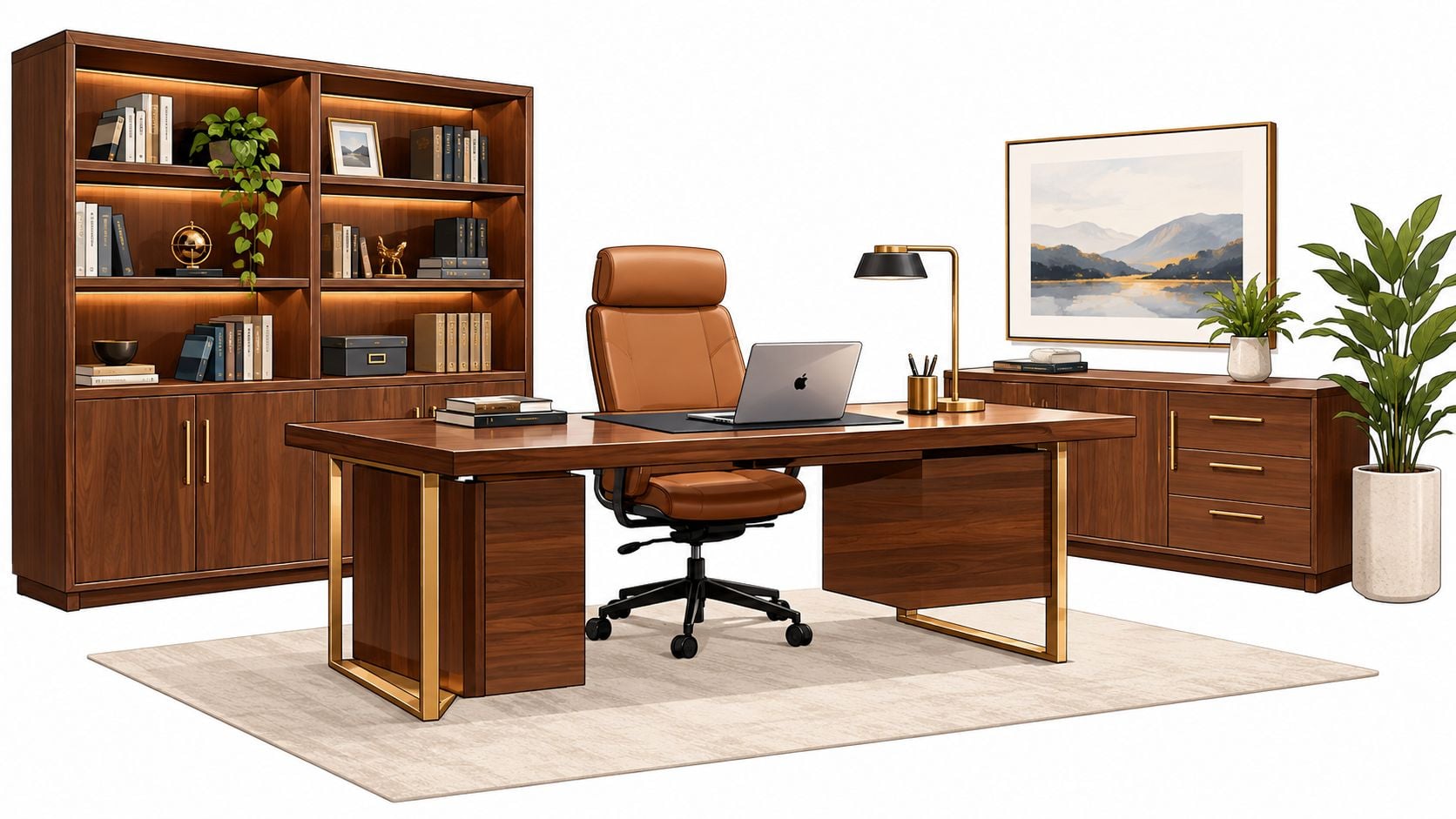
Investment-grade furniture reveals its quality in the places a quick photograph doesn't show. Look beneath the finish, open the drawers, examine the joinery, and ask what will happen after years of daily use.
Desk and storage construction
Solid hardwood brings structural integrity, substantial weight, and the ability to be repaired or refinished. That doesn't mean every component must be solid wood. Quality engineered panels can perform well when their construction and emissions compliance are documented, but vague claims about “eco-friendly” materials aren't enough.
The Environmental Protection Agency's composite-wood guidance explains that regulated products must meet formaldehyde-emission standards and carry TSCA Title VI labeling. For a smaller, enclosed office, asking about panel composition and compliance is a sensible indoor-air consideration.
Inspect drawers for dovetail or similarly durable joinery, smooth operation, and guides that support the drawer under load. A credenza or bookcase should feel stable when opened and closed. A desk shouldn't flex under ordinary equipment or develop a loose, rattling feel after routine use.
Collections from Stickley, Simply Amish, and Mavin represent different expressions of American and Amish craftsmanship. Stickley is known for Arts and Crafts heritage, solid wood construction, and handcrafted joinery. Simply Amish emphasizes hand-selected solid hardwoods and traditional joinery, while Mavin offers precision solid wood dining and bedroom collections built by custom bench-carvers in Amish country.
Seating that earns its space
Office seating deserves the same scrutiny as the desk. A beautiful executive chair isn't a good choice if its arms prevent the user from moving close enough to the work surface. A refined appearance matters, but body fit and adjustment range matter more.
Smith Brothers offers custom bench-made comfort, premium frame construction, and extensive fabric and leather customization. Stressless, from Norway, brings ergonomic engineering, patented Glide systems, and lumbar support. These options suit different interiors, but neither craftsmanship nor upholstery can compensate for a poor desk relationship.
Storage and lighting as part of the design
Storage should match the work pattern. A person handling paper files needs different support from someone whose office is primarily digital. Bookcases can provide a polished backdrop for video calls, while credenzas and filing cabinets keep equipment and documents out of sight.
Lighting also deserves a place in the plan. A well-made desk lamp or integrated lighting solution should illuminate paperwork without placing glare across a monitor. In bright Central Florida rooms, layered lighting gives the homeowner more control than relying on a single overhead fixture.
Choosing a Chair That Actually Supports Eight-Hour Days
A supportive chair should be selected by adjustment and body fit, not by padding alone. The wrong chair can make a well-built desk uncomfortable, while the right chair can make a modest workstation far easier to use.
OSHA's purchasing checklist identifies practical benchmarks, including seat-height adjustment of approximately 15 to 22 inches, a seat pan around 15 to 17 inches long, a stable five-legged base, 360-degree swivel, breathable resilient upholstery, and a backrest that can recline and lock at least 15 degrees. These specifications are detailed in the OSHA office-chair purchasing guide.
Test the chair as part of the workstation
A showroom test should be deliberate. Adjust the seat until both feet are supported, position the backrest so it supports the lumbar area, and check that there's a small gap behind the knees. The armrests shouldn't force the shoulders upward or stop the chair from moving close to the desk.
Then test the keyboard position. OSHA advises keeping the monitor directly in front of the user, placing the top at or just below eye level, and keeping the wrists aligned with the forearms. The keyboard should sit near elbow height, with relaxed shoulders and elbows close to the body.
A chair that fits one person perfectly may not work for a shared household. Couples who alternate between a home office and a guest room should prioritize broad adjustment ranges. A fixed-height chair paired with a fixed-height desk is usually an avoidable limitation.
The ergonomic office chair guide provides additional points for evaluating fit. Sit-stand workstations can also be considered where they suit the room and routine. A Cornell-supported investigation found that sit-stand workstations reduced sitting time, musculoskeletal discomfort, and fatigue without reducing productivity, although an adjustable desk isn't automatically ergonomic just because it moves.
Premium upholstery is valuable when it remains comfortable and resilient, but it should follow the fit test. A chair should support the user's actual posture, working hours, and equipment arrangement.
Custom Orders, Commercial-Grade Pieces, and the Setup You Can't Find Online
Some home offices need a standard desk. Others need a piece shaped around an awkward wall, a particular finish, or a room that must perform two jobs. Custom ordering makes sense when the room, work pattern, or design direction is too specific for an off-the-shelf configuration.
A homeowner may need an executive suite for a private practice, a compact desk for a guest room, or a storage wall that coordinates with the rest of the house. The decision isn't only about whether custom costs more. It's whether the additional control solves a problem that a stocked piece cannot.
When custom is worth the wait
Custom order furniture is especially useful when the homeowner needs to specify:
- Dimensions: A desk may need to fit an exact wall while preserving circulation and door clearance.
- Wood and finish: The office may need to coordinate with flooring, built-ins, or an existing bedroom suite.
- Hardware and storage: Drawers, file storage, bookcases, and credenzas can be planned around actual equipment.
- Upholstery: A chair or guest seating can be selected for durability, feel, and visual continuity.
- Configuration: A workspace can be designed to transition between full-time work, household administration, and guest use.
The custom-made office furniture collection is relevant for shoppers who need that degree of control. Simply Amish and Mavin suit solid-wood priorities. Canadel, known for hand-finished solid birch custom dining furniture, can inform a broader coordinated home design, while Palliser offers contemporary North American leather and fabric seating for home theater and sectional applications.
When a stocked piece is smarter
Custom isn't automatically better. If the room is ready, the dimensions are straightforward, and the homeowner needs a functional workstation quickly, a stocked floor model may be the more sensible decision. The best choice is the one that meets the room's requirements without adding unnecessary delay.
Slone Brothers also provides commercial furnishings for professionals building a home-based practice, a satellite office, or a multi-desk household. Commercial-grade requirements may call for different storage, durability, and cable-management decisions from a private study.
Local delivery adds practical value when a piece is large or unusually configured. A design team can review the delivery route before the order is finalized, reducing the risk that a beautiful desk cannot pass through the home's entry or stairwell.
How In-House Design Service Turns Measurements Into a Room
A design consultation should produce a workable room, not just a product recommendation. The consultant reviews the measurements, asks how the homeowner works, studies circulation, and coordinates the desk, chair, storage, lighting, and visual background.
The in-home design consultation service gives Central Florida homeowners a way to evaluate the actual room rather than relying solely on showroom dimensions. Complimentary in-house design services are particularly useful when the office shares space with a guest room, bedroom, loft, or family area.
The consultation follows the household's routine
A converted bonus room in Sanford may require a clear separation between work and family traffic, with storage that conceals office materials after the workday. A lakeside guest suite in Lake Mary may need a smaller desk, a polished video-call background, and furniture that doesn't make the room feel like a corporate office.
A consultant should ask practical questions:
- Does one person use the room, or do several household members share it?
- Are video calls frequent, and what will appear behind the chair?
- Does the room need to support paper files, multiple monitors, or creative work?
- Can the desk remain in place, or must it be cleared for guests?
- Where do cables, printers, and charging devices belong?
- Does the delivery path include narrow halls, stairs, or sharp turns?
The result should be a coordinated layout with room for adjustment. A homeowner who walks into a Longwood showroom “just looking for a desk” may discover that the chair, storage, and delivery route deserve equal attention.
Ownership includes more than the showroom visit
A local purchase also connects the design decision to delivery, order tracking, clearance review, financing discussions, and after-sale support. Those details matter more with custom or oversized furniture because the ownership experience continues after the order is placed.
Experienced design consultants can explain trade-offs without turning the visit into a pressured transaction. That human exchange is valuable for homeowners who want the room solved carefully and prefer to speak with someone who can answer questions about construction, fit, and service directly.
Local Delivery, Financing, and the Long-Term Value of Buying Close to Home
The cost of an office isn't limited to the desk. It includes whether the furniture fits through the home, arrives in suitable condition, works with the chair and equipment, and receives support if an adjustment is needed later.
That is where a local showroom has a clear advantage. A homeowner in Altamonte Springs, Orlando, or Winter Park can evaluate scale in person, discuss delivery access before ordering, and return to the same business with questions about the finished setup.
Consider the entire ownership equation
A durable piece may cost more initially than a disposable alternative because the buyer is paying for better materials, stronger construction, more careful finishing, and service. The relevant comparison is not just the first invoice. It is how often the furniture must be replaced, repaired, or adapted when the household's work needs change.
American-made and Amish-crafted furniture often appeals to homeowners who want a long-term foundation. Stickley brings timeless Arts and Crafts character and handcrafted joinery. Simply Amish offers traditional solid-wood construction and custom options. Smith Brothers provides bench-made seating with extensive upholstery choices. Stressless adds Norwegian ergonomic engineering for buyers who place comfort at the center of the room.
Other collections serve different design directions. American Leather focuses on high-performance luxury leather and precision engineering, including the Comfort Sleeper®. Bassett and Craftmaster offer classic American-made quality and custom upholstery. Canadel provides hand-finished solid birch custom dining furniture, while Amisco offers Canadian-made metal and wood dining and bar seating.
These brands don't all belong in the same office plan, and that's the point. The right choice depends on the room, the body, the workload, and the rest of the home.
Financing can protect the broader plan
Flexible financing can help a homeowner furnish the complete room rather than buying a desk first and postponing the chair or storage indefinitely. The decision should still begin with a clear budget range and a defined priority list.
A practical order of importance is:
- Fit and clearance: The desk and chair must work in the room.
- Daily comfort: Seating, monitor position, keyboard height, and lighting affect routine use.
- Construction: Materials, joinery, hardware, and upholstery determine long-term value.
- Storage: The room should support the work without becoming visually crowded.
- Finish and styling: The final appearance should belong to the home.
For a secondary workspace or guest-room office, a clearance outlet may be appropriate when the dimensions and finish already work. For a primary daily office, custom ordering or a carefully selected investment piece may better serve the household over time.
Local service changes the decision
Slone Brothers Furniture is family owned and operated in Longwood, with a showroom at 730 N Hwy 17-92 serving the Greater Orlando area. Its services include custom-order furniture, complimentary in-house design guidance, home delivery with order tracking, flexible financing, commercial furnishings, and a dedicated clearance outlet.
The company's Low Price Promise supports a value-driven approach, but the more important question is who remains available after the sale. A local team can address delivery questions, warranty concerns, finish decisions, or drawer adjustments without sending the homeowner into an anonymous support queue.
Before visiting, a homeowner should bring four decisions:
- Measurements: Room dimensions, doorway widths, and outlet photographs.
- Work pattern: Full-time remote work, hybrid use, household administration, or shared use.
- Budget range: A realistic amount for the desk, chair, storage, and delivery.
- Style direction: Traditional, Arts and Crafts, modern, transitional, or coordinated with existing rooms.
That preparation makes the showroom visit efficient without making it transactional. The purpose isn't to pressure a homeowner into the most elaborate office. It's to identify the setup that will remain useful, comfortable, and visually appropriate for the home.
For residents searching for home office furniture near me in Longwood, Lake Mary, Sanford, Winter Park, Altamonte Springs, or Orlando, the strongest next step is an in-person conversation. A room-specific plan prevents the expensive mistake of buying furniture that looks right online but fails in the actual home.
Ready to invest in a workspace built around lasting comfort, craftsmanship, and the way the household works? Visit Slone Brothers Furniture in Longwood, FL to explore custom-order office furniture, American-made and Amish-crafted pieces, complimentary design guidance, and face-to-face service from experienced consultants.