

Inventory Turnover Rates for Furniture Retailers


A sofa can look as though it has barely moved while doing important work on a Longwood showroom floor. It arrives, gets unwrapped and inspected, earns a carefully chosen position, welcomes browsers from Orlando, Lake Mary, and Winter Park, and waits until the right household finds it. That waiting period is the human story behind inventory turnover rates.
For a premium furniture retailer, a slower turn isn't automatically a problem. A solid-wood dining table, an American-made sofa, an Amish-crafted bedroom collection, or a custom sectional carries a different sales cycle from a grocery item. The meaningful question is whether the assortment, cash flow, customer service, and delivery cadence are working together.
Why Furniture Inventory Sits on the Floor Longer Than You Think
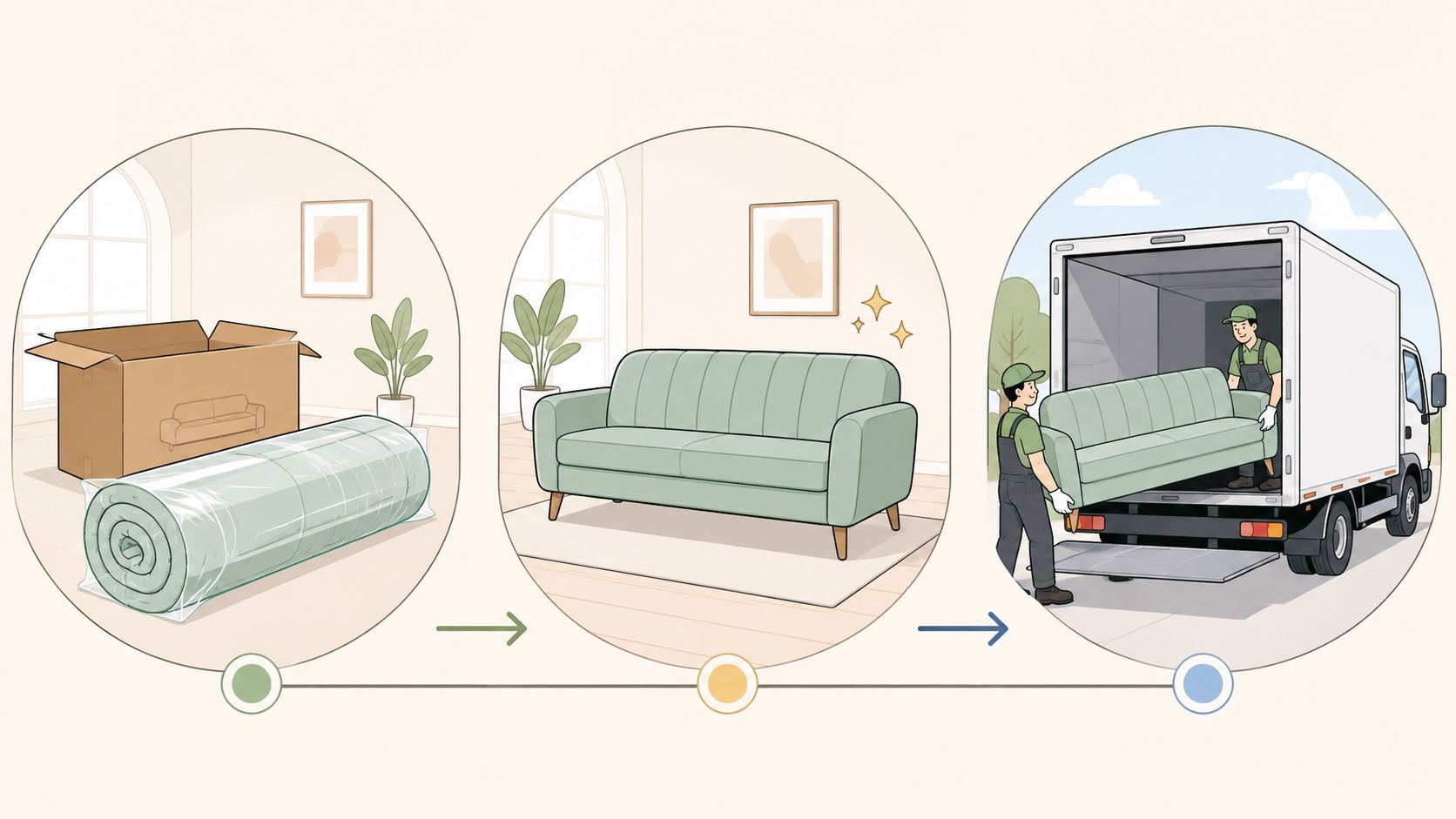
A sofa arrives at a Longwood showroom after a long journey. It may spend time in a container, then be uncrated, inspected, tagged, and placed where shoppers can see its frame, sit on its cushions, and compare its proportions with nearby living room furniture.
For the first several weeks, families may pause on it without buying. One customer likes the silhouette but wants another fabric. Another needs a larger sectional. A third is furnishing a new home in Sanford and is still measuring the room. The sofa runs through a holiday weekend, meets a new arrival, and waits for the buyer whose floor plan and taste finally align.
That four-month wait tells more of the truth than a ratio viewed without context. Inventory turnover measures movement, but furniture retail requires understanding why a piece moves at its pace. Longer decision cycles, larger ticket sizes, customization, and delivery planning naturally make furniture slower than fast-moving categories.
A furniture piece has more than one clock
A stocked sofa has a display clock, a selling clock, and a delivery clock. A custom piece has an ordering and production clock as well. Those clocks affect how a showroom plans floor space, warehouse capacity, fabric programs, and incoming containers.
A Longwood design consultant may spend time discussing posture, cushion construction, wood finish, and room scale before a customer commits. That consultative process isn't inefficiency. It protects the homeowner from choosing a piece that looks appealing online but doesn't support the room, the body, or the way the household lives.
Readers who want more context on why these purchases require thoughtful evaluation can explore this guide to high-consideration furniture decisions. For the operational side, a practical introduction to retail supply chain forecasting can help explain why arrival timing matters as much as sales velocity.
Practical rule: A slow-moving sofa isn't automatically unhealthy inventory. It becomes a concern when the showroom can't explain its purpose, expected buyer, or next decision point.
How to Calculate Inventory Turnover Rate Step by Step
The standard formula is straightforward:
Inventory turnover rate = Cost of Goods Sold ÷ Average Inventory at Cost.
Average inventory is usually calculated as beginning inventory plus ending inventory, divided by two. Using an average smooths seasonal movement and avoids allowing a single end-of-period snapshot to distort the result, as explained in this inventory turnover benchmarking guide.
The calculation in plain language
- Find COGS. Use the cost of the furniture sold during the chosen period, not the retail revenue.
- Find average inventory. Add beginning inventory at cost to ending inventory at cost, then divide by two.
- Divide COGS by average inventory. The result shows how many times the average inventory was sold and replaced.
- Translate the ratio into days. Divide 365 by the turnover ratio to estimate days of inventory on hand.
| Scenario | COGS | Average Inventory at Cost | Calculation | Turnover Ratio | Days on Hand |
|---|---|---|---|---|---|
| Higher-volume floor-stock model | $480,000 | $160,000 | $480,000 ÷ $160,000 | 3.0 | About 122 days |
| Custom-heavy mix | $600,000 | $240,000 | $600,000 ÷ $240,000 | 2.5 | 146 days |
The first example turns inventory 3.0 times. Dividing 365 by 3.0 gives about 122 days on hand. The second turns 2.5 times, which equals 146 days on hand.
Why the denominator matters
A revenue-based shortcut can make a retailer appear faster because selling prices include markup. Cost-based turnover gives a cleaner comparison between businesses with different margins and pricing structures. It also makes a custom-heavy showroom easier to evaluate against a comparable furniture operation.
The ratio shouldn't stand alone. A showroom should review it alongside aging inventory, stockouts, delivery timing, margin, and category performance. Readers comparing businesses across categories can use this resource on how to compare inventory turnover by industry, while keeping the comparison within a similar merchandise model.
Furniture Retail Benchmarks Compared to Other Categories
Furniture doesn't belong on the same benchmark ladder as grocery. A grocery aisle is built around frequent replenishment, modest unit prices, and routine purchases. A premium sofa or dining collection requires room measurements, aesthetic judgment, comfort testing, financing decisions, and delivery coordination.
| Retail Category | Typical Annual Turns | Days on Hand | Key Driver |
|---|---|---|---|
| Grocery | About 12 to 16 | Roughly 23 to 30 days | Frequent replenishment and routine demand |
| Apparel | About 4 to 6 | Roughly 61 to 91 days | Seasonal assortment and changing styles |
| Home improvement | About 3 to 5 | Roughly 73 to 122 days | Project timing and varied product sizes |
| Big-ticket furniture | About 2 to 4 | Roughly 91 to 183 days | Considered purchases, lead times, and bulky stock |
These category ranges reflect the planning differences between perishable or frequently purchased goods and long-life, high-consideration merchandise. Broader benchmark guidance places furniture and home décor around 3 to 4 turns, or approximately 91 to 122 days on hand, while home and furniture references also place the category around 2 to 4 turns, or about 91 to 183 days (retail turnover benchmarks, inventory turnover fundamentals).
The furniture band has its own internal logic
A premium, custom-heavy showroom may cluster toward the 2 to 3 turn end because it carries display pieces, offers more materials and finishes, and sells goods that aren't meant to be replenished like pantry staples. A mid-price floor-stock dealer may sit closer to the upper end when its assortment emphasizes readily available configurations.
Public-company comparisons reinforce the category difference. FY2025 reporting references list Williams Sonoma at 3.01, RH at 2.09, Lowe's at 3.31, and Home Depot at 4.46, while mass retail examples include Walmart at 9.29 and Target at 6.03 (cross-sector inventory statistics). These figures aren't universal targets for a Longwood showroom. They show why product mix and operating model matter.
A furniture retailer shouldn't chase grocery-style velocity if doing so removes the craftsmanship, choice, and service that made the assortment valuable.
What Turnover Means for Cash Flow and Markdown Risk
A turnover ratio becomes useful when it changes a decision. At 2.5 turns, inventory cycles through the business at a pace equivalent to about 146 days on hand, using the standard 365-day conversion. If average inventory is $2.4 million, that pace means a substantial amount of capital remains committed to merchandise for several months.
That capital can't simultaneously support custom fabric orders, showroom occupancy, design staff, delivery operations, or the everyday needs of a Longwood storefront. The issue isn't that every piece must leave quickly. The issue is that each piece needs a clear commercial role and a sensible path to a customer.
Aging needs a decision, not just a report
A useful review separates inventory into aging buckets:
- 0 to 30 days: New arrivals need proper placement, accurate tagging, and time for consultants to introduce them to shoppers.
- 31 to 60 days: The team can assess inquiries, comfort feedback, fabric interest, and whether the piece is earning its floor position.
- 61 to 90 days: A manager should decide whether to improve presentation, pair the item with complementary pieces, or adjust its role.
- 91 to 180 days: The item needs a documented action plan, especially if newer arrivals compete for the same space.
- Beyond 180 days: The piece may become a clearance candidate, depending on condition, category, season, and customer response.
The available data doesn't establish a universal markdown percentage for each bucket, so responsible management avoids pretending that every item follows the same schedule. A $4,500 dining set reduced to $2,700 would represent a specific $1,800 price reduction, but the correct action depends on original cost, margin, condition, and the reason it remained unsold.
The Home Goods benchmark associates carrying costs of 25% to 35% with inventory turnover of 2.5 to 5 turns, illustrating why longer-held stock deserves careful attention. Slone Brothers also provides furniture financing options that can help qualified buyers structure a purchase without turning the showroom into a constant markdown environment.
Showroom Levers That Move the Turnover Needle
A premium showroom can improve inventory movement without flattening its identity. The strongest levers affect how shoppers see pieces, how managers pace incoming goods, and how quickly a customer can move from selection to delivery.
Merchandising earns every square foot
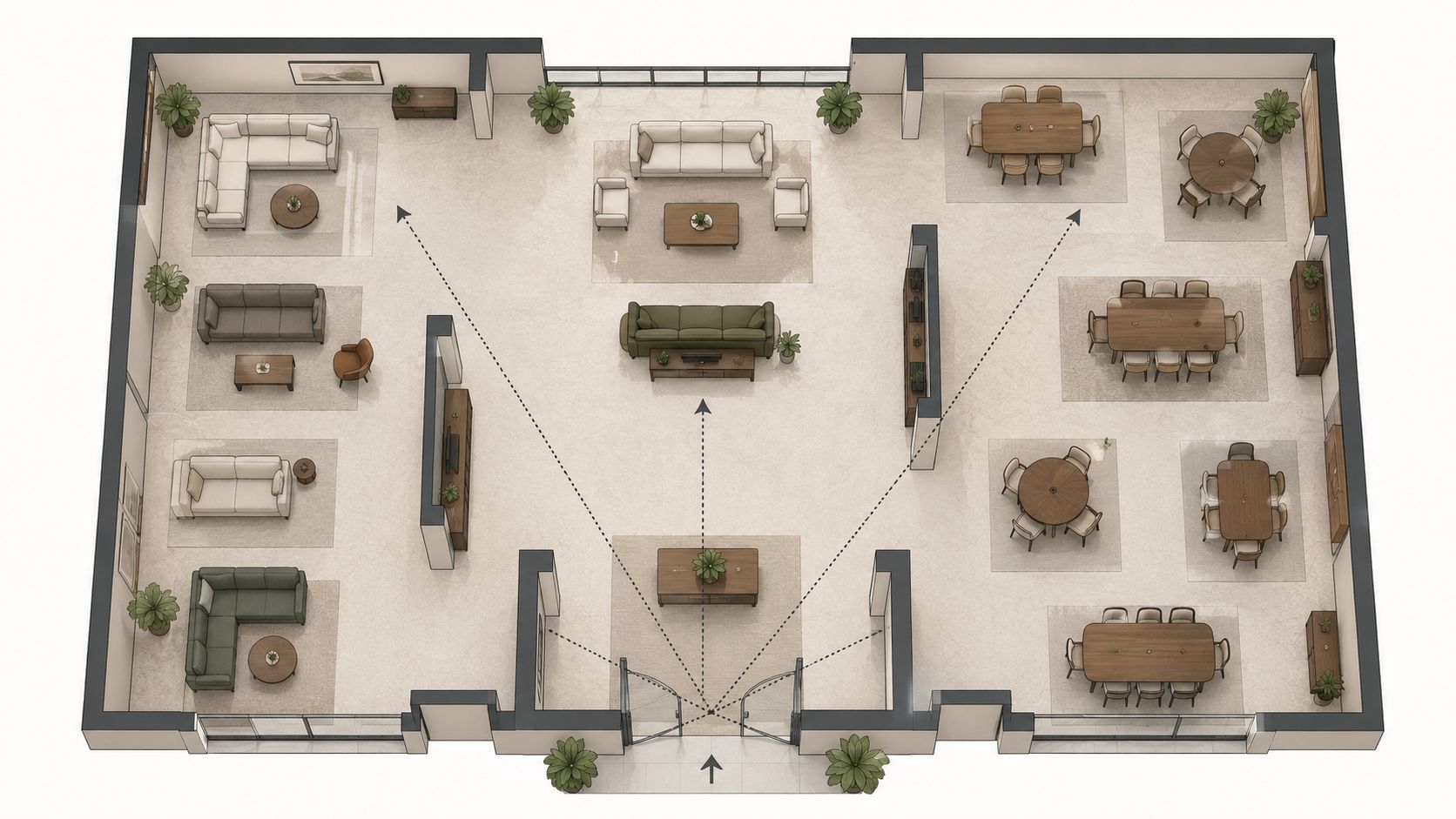
The front door, major sight lines, room groupings, and seating zones all influence which pieces receive attention. A high-margin sofa hidden behind a crowded display has a turnover problem that may begin with placement rather than demand.
Practical adjustments include:
- Clarify sight lines: Give important silhouettes enough visual space to read from the entrance.
- Rotate strategically: Move strong pieces into prominent positions while testing slower items in complete room settings.
- Build complete stories: Pair dining tables with chairs, lighting, and rugs so customers can understand proportion and use.
- Protect the floor: Avoid filling every opening just because space exists. Crowding can make a curated assortment feel difficult to move through.
A controlled clearance area can act as a release valve. The plan notes identify a 10% to 15% floor zone as a possible dedicated area for tagged-and-totalled pieces, but that range should be treated as a planning option rather than a universal rule. Separating clearance from the main presentation protects the showroom's design language while giving aging merchandise a clear destination.
Custom ordering requires restraint
A made-to-order program should expand choice without turning every fabric, finish, or configuration into deep stock. Managers can pace containers, set deposit thresholds, and avoid carrying slow fabric programs in depth until customer demand supports them.
Financing can shorten the distance between approval and possession, while clear white-glove delivery windows can make a longer wait feel intentional. A 12-week production wait, for example, can be presented as the time required to create the selected configuration rather than as an unexplained delay.
The buying journey also matters. A showroom that understands the furniture buying journey can match the right amount of floor stock to the right amount of consultation. Every lever should eventually appear in the numbers through healthier days of supply, fewer stale displays, or more productive use of available cash.
Forecasting and Promotion Tactics for Central Florida Shoppers
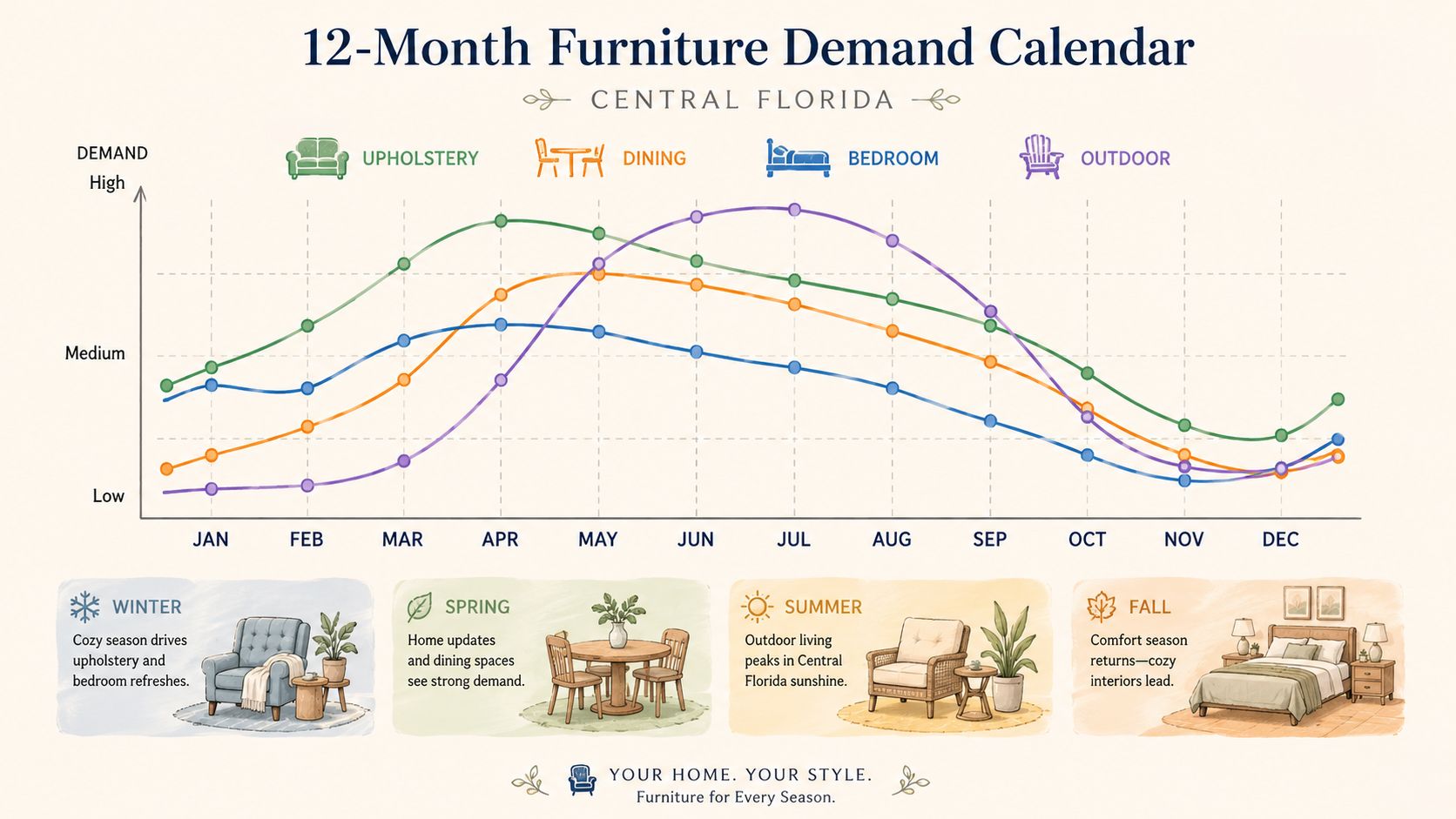
A Central Florida showroom needs a local demand calendar, not a generic national sales calendar. Homeowners in Longwood, Altamonte Springs, Lake Mary, Sanford, and Orlando respond to moving patterns, weather, school schedules, home projects, and the timing of local household decisions.
Build the view before planning the event
A rolling 12-month sales view should separate upholstery, dining, bedroom, and outdoor furniture. The separation matters because a strong bedroom month can hide weak outdoor movement when all categories are blended into one report.
A forecasting routine can follow this sequence:
- Review category velocity. Identify which categories moved steadily and which depended on specific seasons.
- Mark local demand windows. February can align with tax refund planning, August with back-to-school apartment refreshes, October with pre-holiday showroom events, and January with post-holiday clearance.
- Set an early trigger. A 60-day or 90-day sell-through review can flag an item before it becomes a serious aging concern.
- Plan arrivals backward. Patio and upholstered pieces should be ordered with prior-year weekly movement and supplier lead times in mind.
- Match financing to delivery capacity. A financing conversation has more value when the showroom can also offer a realistic delivery window.
Local signals improve judgment
Housing permits and Seminole County move-in data can serve as leading indicators for furniture demand. They won't identify the exact sofa fabric a household wants, but they can help a showroom anticipate when more residents may need bedroom furniture, dining room sets, office furniture, or complete-home planning.
Promotions should support the merchandise rather than train customers to wait for discounts. A well-timed January clearance can release a floor sample. A pre-holiday design event can help families select a dining setting with enough time for delivery planning. The right time to buy furniture depends on the customer's need, the product's availability, and the showroom's ability to serve the order well.
When Chasing Higher Turnover Actually Hurts a Premium Model
Higher turnover sounds attractive until the method becomes more important than the result. A premium showroom can raise the ratio by reducing choice, cancelling custom upholstery orders, stocking only the quickest fabric programs, or pushing floor samples that don't suit the customer's home.
Those shortcuts may release space, but they can also weaken the assortment. A homeowner in Winter Park who wants a particular finish, seat depth, or upholstery may leave without a purchase if the showroom has optimized only for immediately available pieces.
Speed can quietly erode value
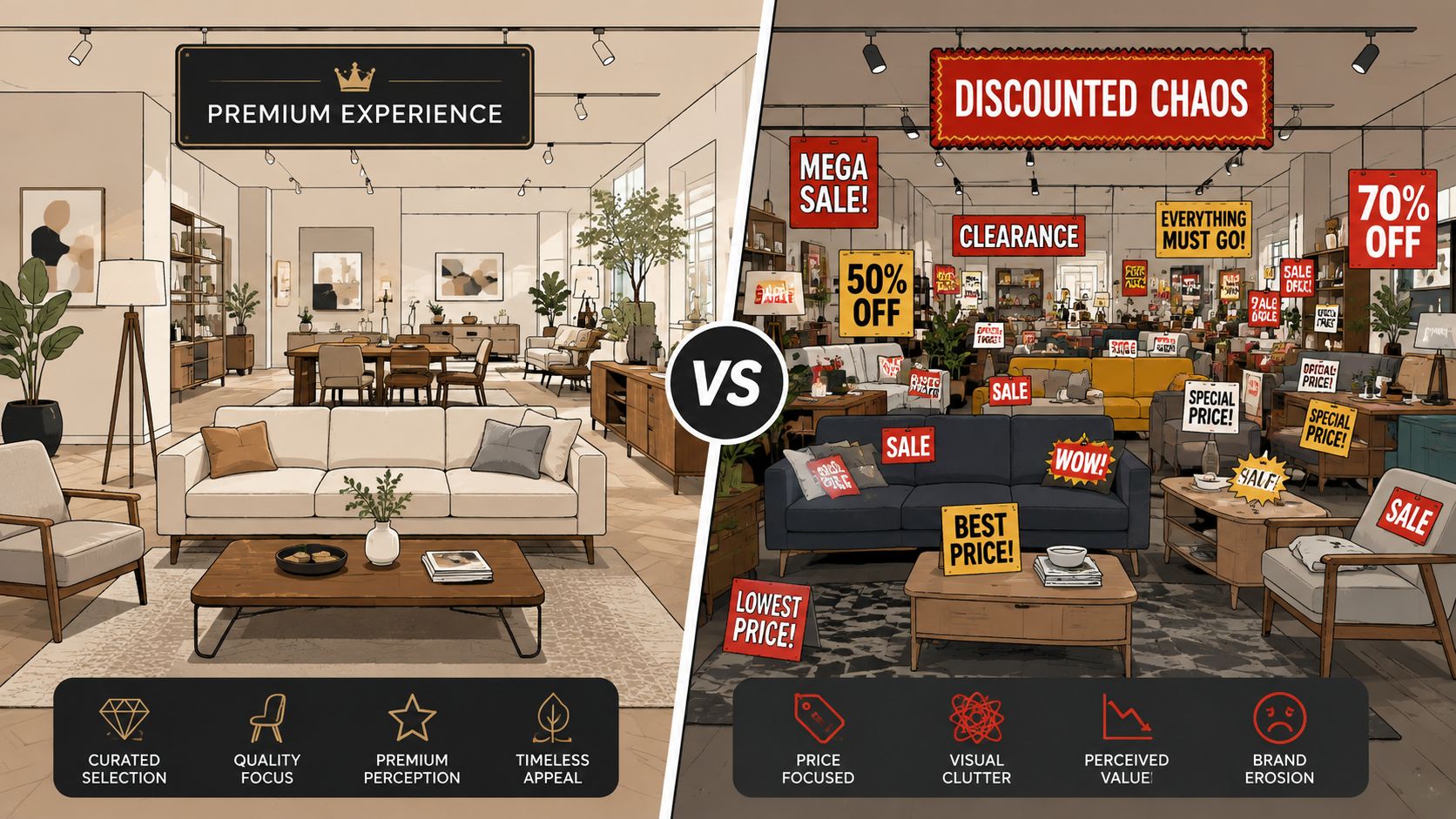
Constant discount events can create a second problem. They move merchandise, but they may also shift attention away from construction, material quality, ergonomic design, and long-term value. That isn't a strong trade when the business is built around Stickley's heritage, Stressless's ergonomic innovation, Smith Brothers' custom comfort, or the American-made quality associated with Bassett, Craftmaster, and American Leather.
A sales team pressured to maximize turns may show the easiest floor sample instead of helping a family choose the right made-to-order piece. The customer may receive furniture sooner, but not necessarily furniture that fits the room, supports the body, or complements existing heirloom pieces.
A healthy ratio serves the model
Industry references place conventional furniture retail around 2.1 to 3.3 turns annually, while broader home-and-furniture benchmarks center near 3 turns. For a custom-heavy showroom, a low-single-digit rate can be healthy when aging is controlled, displays remain purposeful, deposits support commitments, and delivery schedules match the assortment.
Warning signs include:
- Choice is shrinking: Customers see fewer meaningful materials, finishes, and configurations.
- Discounting is constant: Promotions become the primary sales explanation.
- Trust is weakening: Consultants recommend what needs to move instead of what fits.
- Service is sacrificed: Delivery, installation, or post-purchase support becomes an afterthought.
- Stockouts appear: The ratio rises because the showroom has too little of what customers want.
The right KPI isn't the highest number. It's the best balance between movement, margin, choice, service, and customer confidence. A deeper discussion of why quality furniture costs more helps explain why a premium model shouldn't measure itself like a commodity operation.
Putting It All Together at the Slone Brothers Showroom
Three pieces can share a showroom floor and require three different turnover strategies.
The stocked sofa arrives, gets inspected, and earns a position in a living room vignette. A design consultant watches how customers sit, asks which room sizes they mention, and uses those conversations to judge whether the display needs a new pairing or a different location. Once selected, the sofa moves through order confirmation and white-glove delivery, with the buyer receiving a piece that can be evaluated in person rather than guessed at from a screen.
The custom sectional follows another path. The consultant discusses configuration, fabric, finish, scale, and comfort. The customer may compare Smith Brothers, American Leather, Stressless, or other suitable options before choosing the combination that serves the household. Its inventory impact isn't measured only by how long a finished piece sits on the floor. The showroom also manages the fabric program, deposit, production timing, arrival inspection, and delivery appointment.
The clearance floor sample has a different job. It may have served as a visual anchor, allowed customers to test construction and comfort, and helped a family understand the proportions of a complete room. When it needs to leave, a dedicated clearance presentation can recover space and cash without making every new arrival feel promotional.
The human rhythm behind the metric
A consultant guiding a family through fabric swatches is influencing future demand. A delivery team protecting a buyer's walls and floors is completing the value promised on the sales floor. The back office is coordinating purchase orders, deposits, inventory records, and arrivals so the showroom stays fresh without constant markdowns.
That is why inventory turnover rates are most useful as a management conversation. They help a local business decide which pieces deserve more visibility, which custom programs need pacing, and which displays no longer earn their space. They don't replace judgment, craftsmanship, or face-to-face service.
A Longwood showroom serving Central Florida can carry Stickley, Stressless, Smith Brothers, Palasar, Bassett, Craftmaster, Simply Amish, Canadel, Amisco, American Leather, and Mavin with different expectations for construction, customization, lead time, and customer fit. The disciplined approach is to let each category move at a responsible pace while keeping the entire home furnishing experience coherent.
Slone Brothers Furniture offers curated living, dining, bedroom, office, mattress, outdoor, and home décor selections, along with custom-order furniture, complimentary in-home design services, financing options, and white-glove home delivery. Visit Slone Brothers Furniture in Longwood, Florida, to speak with experienced design consultants and see how thoughtful inventory planning can support a more personal, lasting furniture buying experience.