

Writing Desks for Bedroom: A Florida Buyer’s Guide


A homeowner in Winter Park has likely seen the same problem more than once. The bedroom feels like the only quiet room in the house, but adding a desk can make that peaceful space feel like a spillover office. The wrong piece looks temporary, bulky, and out of place by the end of the first week.
That's why writing desks for bedroom spaces deserve more thought than they usually get. A proper writing desk isn't just a surface for a laptop or a stack of mail. In a well-designed Central Florida home, it becomes a small architectural element inside the room. It supports reading, journaling, correspondence, estate planning, light laptop use, or a calm morning routine without changing the character of the bedroom.
For discerning homeowners in Longwood, Lake Mary, Sanford, and across Orlando, the right choice is rarely the flashiest one. It's the desk that fits the room correctly, respects traffic flow, holds up in Florida conditions, and still looks appropriate years from now. That usually points toward solid wood, careful proportions, and construction that rewards close inspection.
An Introduction to the Bedroom Writing Desk
A bedroom writing desk works best when it's treated as part of the sanctuary, not as an afterthought. That distinction matters. Bedrooms carry a different emotional weight than a family room or a full home office. The furniture placed there needs to feel quieter, lighter, and more intentional.
The market supports that shift in thinking. The global writing desk market was valued at US$ 10,540 million in 2025 and is projected to reach US$ 15,150 million by 2032, according to global writing desk market projections. That growth reflects how many homeowners now want dedicated, refined work surfaces in residential settings rather than makeshift setups.
Why a writing desk belongs in a bedroom
A writing desk is different from a standard office desk in both appearance and purpose. It usually has a slimmer footprint, lighter visual profile, and a more restrained approach to storage. In a bedroom, those traits matter because the piece has to support activity without dominating the room.
A few common bedroom uses include:
- Morning planning: A quiet place for calendars, personal notes, or devotional reading.
- Light digital tasks: Paying bills, answering email, or using a laptop for short sessions.
- Personal retreat: Writing letters, journaling, or reading in a corner that feels separate from the bed.
Why quality matters more in a bedroom
Low-grade furniture often looks acceptable from a distance. In a bedroom, it gets inspected up close every day. Homeowners notice drawer movement, rough backs, thin surfaces, and finishes that don't hold up.
Practical rule: The more intimate the room, the more obvious furniture quality becomes.
That's one reason a bedroom writing desk should be chosen like a long-term furnishing, not a temporary utility item. In a high-end Central Florida home, the desk should look settled, as though it was always meant to be there. That's also where in-person guidance becomes valuable. A local showroom can help homeowners judge scale, wood tone, and finish in a way online images can't.
How Do I Measure My Bedroom for a Writing Desk
The right way to measure a bedroom starts with traffic flow, not with the desk itself. A writing desk should fit the room without pinching circulation around the bed, nightstands, or windows. In most bedrooms, poor spacing is what makes a desk feel intrusive.
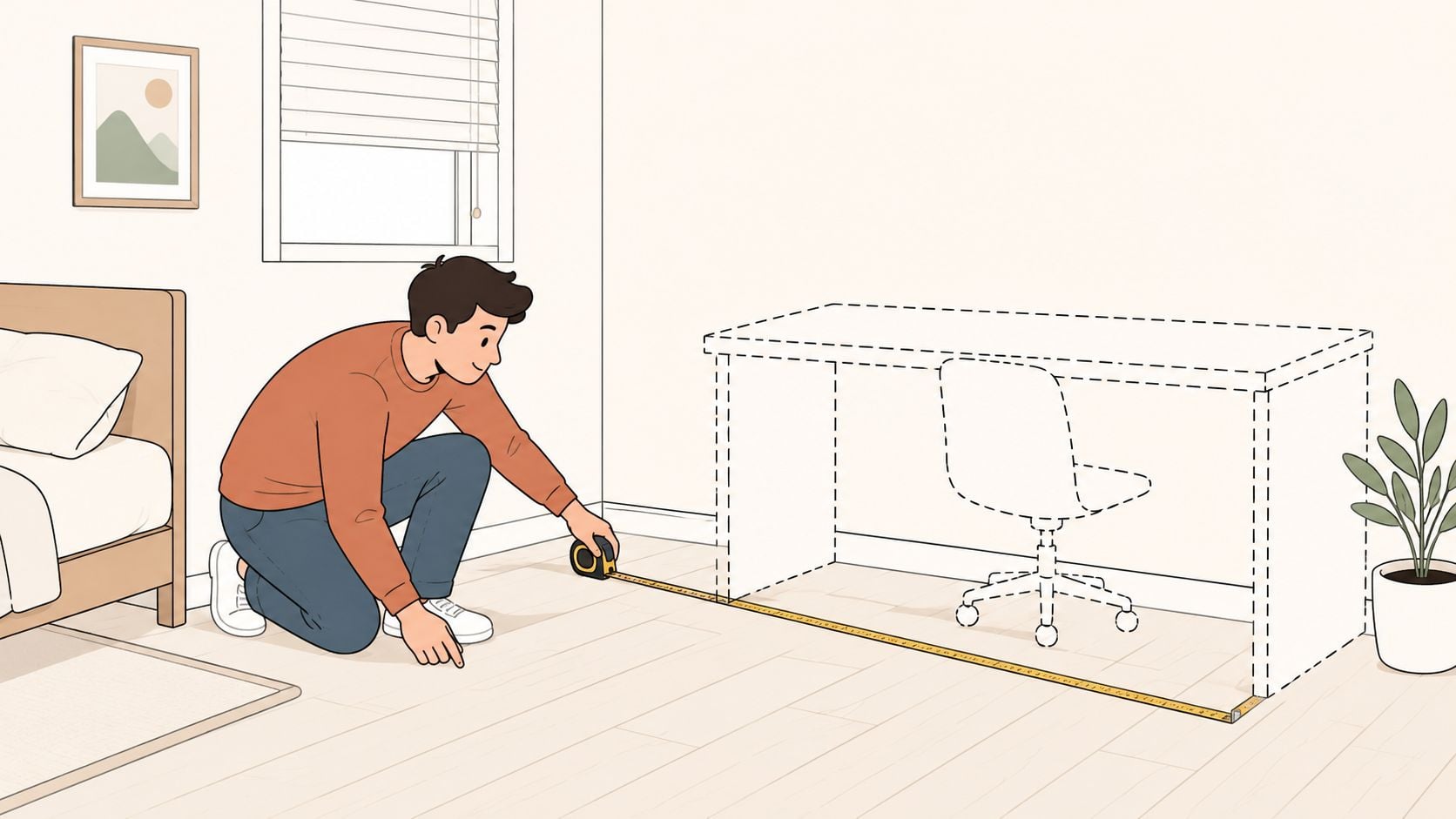
Writing desks are typically smaller than computer desks, with wooden models often measuring around 800mm, approximately 31.5 inches, in width rather than the 1200mm, or 47 inches, standard for larger computer tables. The recommended channel distance is 80 to 120cm from the bed, as noted in this writing desk sizing reference.
Start with the placement wall
Measure the section of wall where the desk may go. Include baseboards, window trim, outlets, and door swing. Bedrooms in Altamonte Springs and Winter Park often have one wall that seems available until trim, drapery stack-back, or a bedside table cuts into usable width.
A practical measuring sequence looks like this:
- Find the candidate location: Opposite the bed, beside a window, or in an unused corner.
- Measure clear width: Take the true usable span, not the full wall dimension.
- Measure depth into the room: This reveals whether the desk and chair will crowd the bed path.
- Check vertical space: Window sills, artwork, and mirrors can affect what feels balanced.
Protect the walking path
Most measuring mistakes happen because homeowners focus on whether the desk fits the wall, but not whether the room still works after the chair is added. The body needs room to move naturally. A desk that technically fits can still make the room feel cramped.
Leave enough open space so the desk area feels integrated, not wedged in.
That's where the distance from the bed becomes so important. If the desk sits too close, the room starts to feel chopped up. If it sits with a clear path, the space reads as intentional.
Bring real measurements to a showroom
Photos help, but dimensions are better. A simple sketch with wall widths, bed placement, windows, and swing clearances gives a design consultant something useful to work with. That's why many homeowners benefit from reviewing how to measure a room for furniture before shopping.
A bedroom writing desk should never feel like an emergency solution. Precise measuring prevents that. It also makes it much easier to choose a piece that complements the room instead of competing with it.
Why Is Solid Wood the Best Material for a Bedroom Desk
Solid wood is the right material for a bedroom desk because it offers better stability, better longevity, and a better response to Florida conditions than low-grade composite construction. In Central Florida, that's not a theoretical advantage. Humidity, seasonal shifts, and everyday use expose weak materials quickly.
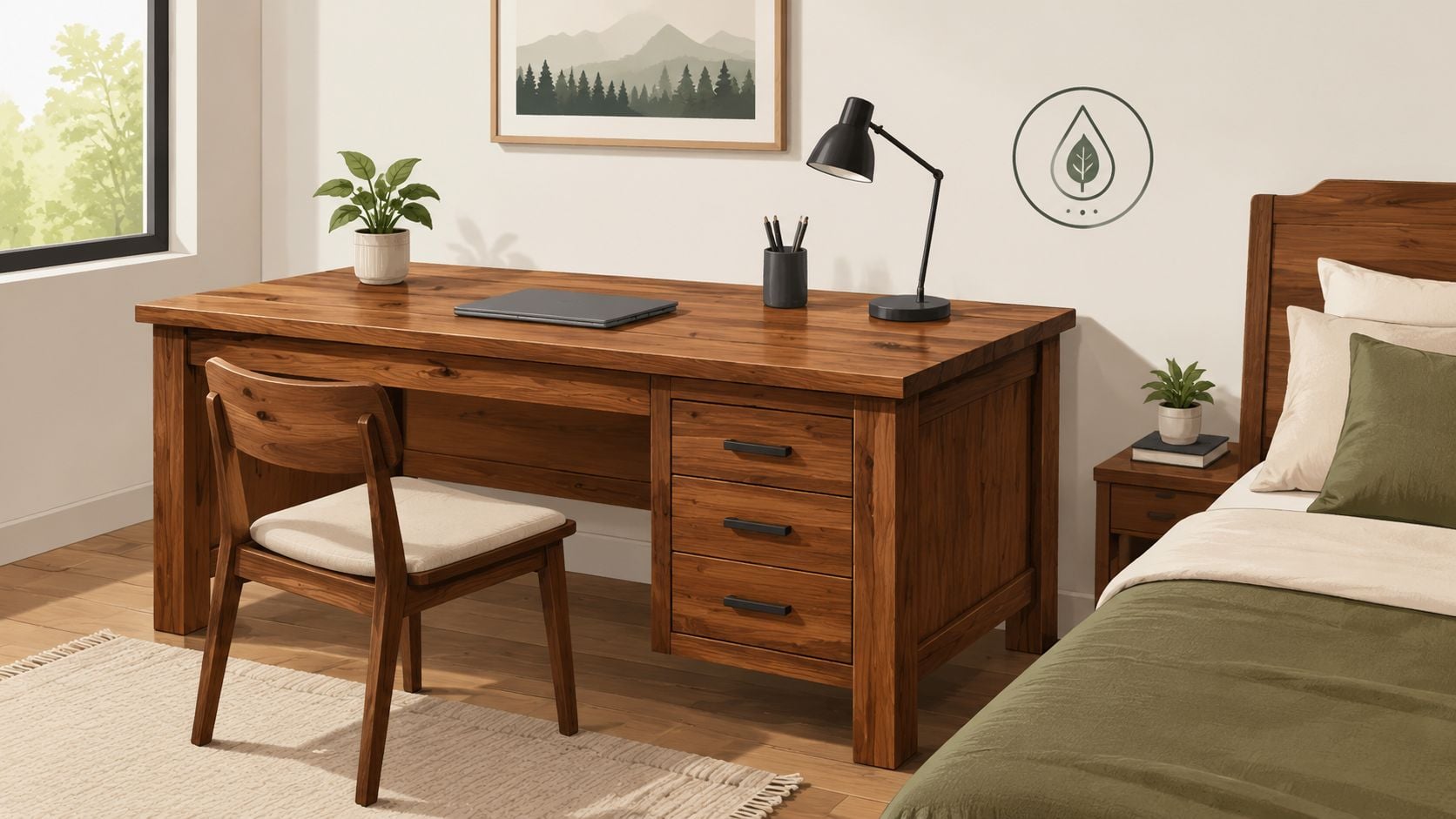
The distinction is especially clear in Amish construction. Authentic Amish writing desks are constructed entirely from solid hardwoods such as oak, cherry, maple, or walnut, deliberately excluding particleboard, MDF, or veneers. That makes the desk significantly heavier and more stable, with consistent grain patterns visible across all surfaces, according to this guide to Amish furniture construction techniques.
What solid wood changes in daily use
A bedroom desk doesn't absorb abuse the way a kitchen table might, but it does face constant close-range use. Hands rest on the edge. Drawers open repeatedly. Lamps, books, trays, and electronics stay on the surface for long periods. Inferior materials often reveal their weakness in subtle ways first.
Common differences homeowners notice include:
- Weight and steadiness: A heavier desk stays planted better during writing and daily handling.
- Edge quality: Solid wood edges tend to age with character rather than fray or chip.
- Surface integrity: A well-built top feels substantial, not hollow or thin.
Why Florida homeowners should care about materials
In Central Florida, furniture selection should always account for climate. Bedrooms may be conditioned, but they still live in a region known for humidity swings. That's why material quality matters as much as style.
Particleboard and similar materials can be serviceable in temporary settings. They're less persuasive in a primary bedroom where the expectation is longevity. A solid wood desk is the stronger fit for homeowners who want a piece that remains stable, attractive, and repairable over time.
A bedroom desk should age like cabinetry, not like packaging.
Why craftsmanship matters as much as wood species
A hardwood desk still needs proper construction and finishing to perform well. That's where brand standards and maker discipline come into focus. For homeowners comparing heirloom-grade options, the question isn't oak versus cherry. It's how the desk is built, how the joinery is executed, and whether every visible and hidden surface reflects the same level of care.
That's also why many Central Florida homeowners gravitate toward American-made collections and Amish-crafted pieces from makers such as Simply Amish and Mavin. In other areas of the home, brands like Stickley, Stressless, Smith Brothers, Palasar, Bassett, Craftmaster, Canadel, Amisco, and American Leather all illustrate the same larger point. Better furniture begins with engineering, materials, and disciplined construction.
Homeowners exploring American-made solid wood furniture often find that the premium makes sense once they compare weight, drawer feel, grain continuity, and finish quality in person. A bedroom writing desk isn't a place to hide shortcuts. It's a place where craftsmanship gets noticed every day.
How Can I Match a Desk to My Existing Bedroom Style
A bedroom writing desk should echo the room's design language, not mimic every piece exactly. The goal isn't to build a rigid furniture suite. The goal is to make the desk feel visually related to the bed, case pieces, lighting, and architecture already in the room.
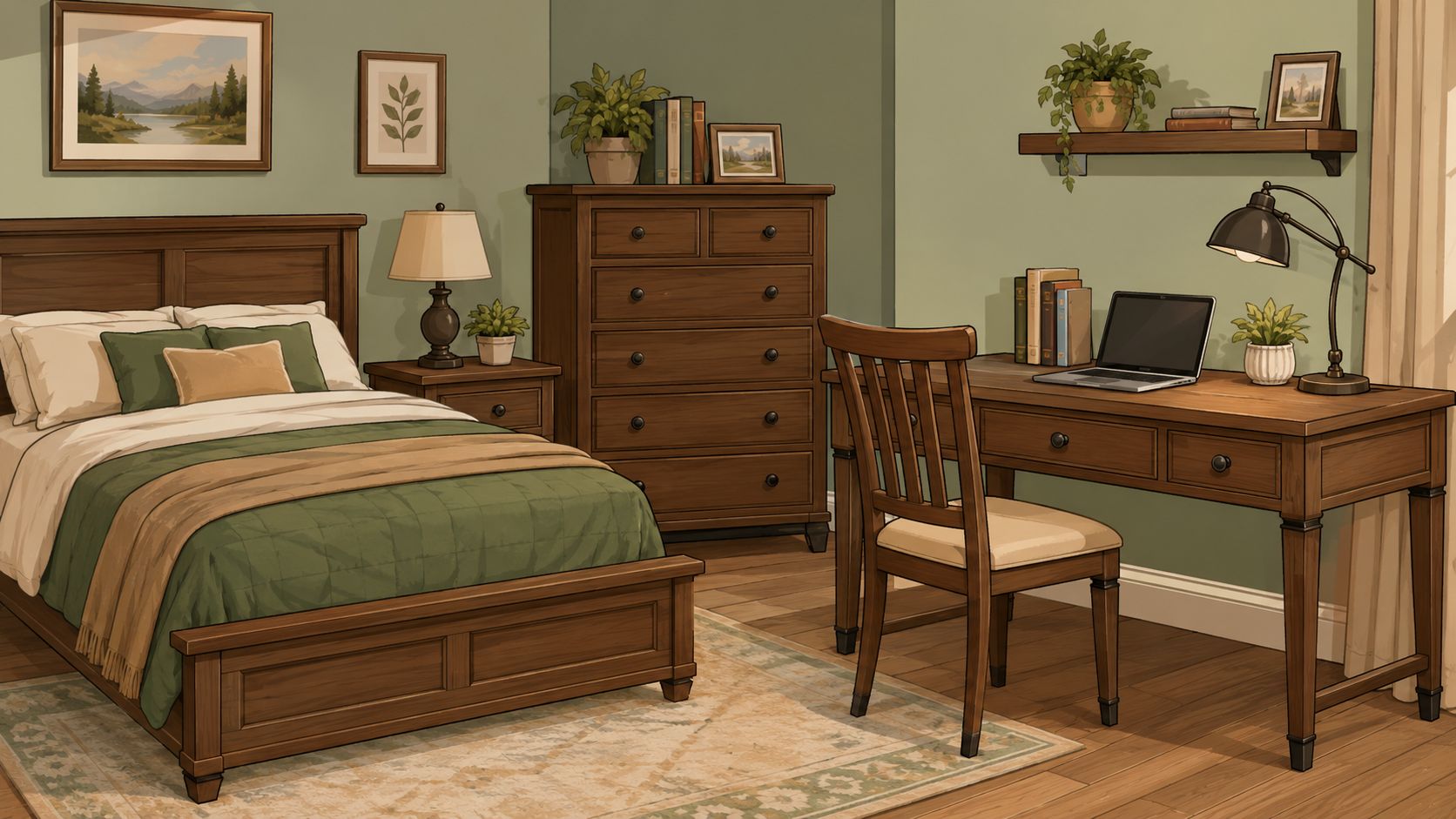
Construction details help here, not just color. Amish writing desks are finished with a catalyzed conversion varnish, and every drawer box plus the underside and back of the desk are completely finished. That thorough finish helps the piece resist moisture damage and preserve its appearance, as explained in this article on identifying Amish furniture.
Read the room before choosing the desk
The easiest place to start is with three visual cues.
- Wood tone: Is the bedroom built around warm cherry, medium oak, deep walnut, or a lighter painted look?
- Line and silhouette: Are the room's pieces formal and traditional, or cleaner and architectural?
- Hardware and finish character: Does the room lean refined, rustic, Arts and Crafts, or transitional?
A Stickley writing desk, for example, often fits naturally in a bedroom with Arts and Crafts influence because the lines feel grounded and historically coherent. A Simply Amish desk can suit a classic or transitional room where the homeowner wants warmth, visible wood character, and time-honored craftsmanship.
Don't force a perfect match
Many homeowners get stuck because they think the desk must duplicate the bedroom set. It doesn't. A complementary finish or a slightly contrasting silhouette often makes the room feel more layered and more collected.
That's especially true in established homes in Lake Mary or Sanford, where furnishings may have been acquired over time rather than purchased all at once. A thoughtfully chosen desk can bridge older and newer pieces beautifully.
The most convincing bedrooms rarely look bought in one afternoon. They look edited.
Use custom thinking, not just catalog thinking
The strongest interiors usually come from proportion, finish, and customization rather than from chasing a perfect label. For readers who want a useful outside perspective on custom design, Defining custom furniture craftsmanship offers a helpful overview of what custom-minded furniture selection really means.
Local guidance makes this process much easier. Homeowners comparing styles can review furniture styles explained to clarify whether their room leans traditional, modern, transitional, or craftsman-inspired. That kind of clarity prevents expensive mistakes and helps a bedroom writing desk look settled from day one.
What Ergonomic and Storage Features Should I Look For
The ideal bedroom writing desk should feel comfortable for light daily use and discreet enough to preserve the room's calm. That usually means better proportions, not more features. In a bedroom, oversized storage and office-style bulk can work against the atmosphere homeowners are trying to protect.
For bedroom writing desks, the optimal ergonomic height range is 27 to 29 inches, which is lower than standard computer desks. In compact rooms, a desk depth of 18 to 20 inches is the benchmark for preserving floor space without losing usability, according to this writing desk ergonomics guide.
Focus on the features that matter
A bedroom desk doesn't need to behave like a command center. It needs to support a few common tasks well.
Key features to prioritize include:
- Correct height: A lower writing height supports a relaxed seated posture for reading, correspondence, or laptop use.
- Slim depth: A shallower desk projects less into the room and keeps circulation cleaner.
- Contained storage: One drawer is often enough for pens, charging cords, stationery, and small personal items.
Keep storage visually quiet
The bedroom benefits from concealment more than abundance. Open shelves can collect clutter quickly, and multiple exposed cubbies tend to make the area feel more task-driven. A single drawer often does the job more elegantly.
That minimalist approach is also what separates many writing desks from office desks. The form stays lighter, and the room remains restful.
| Feature | Better for a bedroom | Why it works |
|---|---|---|
| Desk height | 27 to 29 inches | Supports light-task posture |
| Desk depth | 18 to 20 inches | Protects floor space |
| Storage | One modest drawer | Reduces visual clutter |
A homeowner who needs more utility can still look for smart flexibility, especially in pieces designed for compact living. That's where multifunctional home office furniture ideas can help clarify what belongs in a bedroom and what's better reserved for a dedicated office.
Where Should I Place a Writing Desk in My Bedroom
A desk can either calm the room or interrupt it. Placement decides which one happens. In many Central Florida bedrooms, the most successful layouts don't put the desk in the obvious spot. They put it in the spot that creates separation between sleeping and doing.
One common example appears in homes where the wall opposite the bed is technically available. A homeowner may assume the desk belongs there, centered like a dresser. Sometimes that works. Often it doesn't. If the desk becomes the first thing seen from bed, the room starts to feel mentally active even when the furniture itself is beautiful.
Better placement patterns
A more restful arrangement often places the desk:
- Perpendicular to the bed: This gives the desk its own orientation.
- Near a window: Natural light supports reading and writing and gives the eye a calmer focal point.
- In an underused corner: A niche or quiet side wall can create a separate zone without adding visual friction.
Bedrooms in Orlando and Winter Park frequently benefit from this kind of zoning because the room then keeps its primary identity as a retreat. The desk becomes part of the architecture of the space rather than an inserted workstation.
When the desk has its own corner, the bedroom keeps its own rhythm.
Use materials that support the setting
Placement and material work together. In Florida homes, bedroom-specific desks often prioritize solid pine or reclaimed wood over engineered wood composites for moisture resistance and durability in varying humidity conditions, particularly in regions like Florida, as noted in this bedroom desk material guide.
That matters because placement near windows, exterior walls, or changing light can expose weak materials over time. A well-made solid wood desk remains more convincing in these conditions.
Style the area lightly
The desk zone should be furnished, not crowded. A lamp, a chair with a comfortable profile, a tray, and one small decorative element are usually enough. The more desktop equipment that stays visible, the more the bedroom begins to lose its character.
A writing desk in a bedroom should invite quiet use. It shouldn't announce work from across the room.
Why Choose a Local Showroom Over Buying a Desk Online
A bedroom writing desk should be bought with the eyes and hands, not just with a scrolling finger. Online images can suggest proportion, but they can't show drawer action, finish depth, wood character, or how substantial a desk feels when someone stands in front of it.

A local showroom gives homeowners the ability to compare scale, comfort, and craftsmanship in real conditions. That's especially valuable when choosing among custom-order possibilities, solid wood species, and finishes that need to coordinate with an existing bedroom.
For Central Florida homeowners, there's also a service difference. A family-owned showroom in Longwood can offer human design guidance, in-person material review, and delivery support that a faceless transaction can't replicate. Slone Brothers Furniture is one local option for homeowners who want to evaluate writing desks, bedroom furniture, and custom-order pieces in person rather than guessing from photos.
What in-person shopping reveals quickly
- Drawer quality: Homeowners can feel whether the movement is smooth and confident.
- Finish authenticity: Wood tone reads differently in person than it does on a backlit screen.
- True scale: A desk may look slim online and still feel too heavy for the room.
That's why many local shoppers weigh the benefits of shopping local before making a decision on a piece they plan to live with for years.
Ready to invest in furniture that lasts a lifetime? Skip the online guesswork and automated digital chatbots. Visit the Slone Brothers Furniture showroom in Longwood, FL today. Connect face-to-face with experienced design consultants and let them help transform a house into a beautifully curated home. Want to experience the unmatched heritage of Stickley or explore complimentary in-home interior design services? Stop by the Central Florida showroom in Longwood today to collaborate with a real design expert and experience true craftsmanship in person.