
Tufted Headboards for King Beds: How to Choose


A new king mattress has arrived in a Lake Mary primary bedroom, but the wall behind it still looks unfinished. The bedding feels right, the nightstands are staying, and a soft upholstered headboard seems like the missing piece. Choosing tufted headboards for king beds, however, starts with more than a fabric swatch. The panel must suit the mattress format, connect safely to the bed or wall, and reach the room without an awkward delivery surprise.
Why Scale Comes Before Style on a King Bed
Scale determines whether a king headboard belongs in the room. Fabric and button details come afterward, once the bed's width, the panel's height, and its projection into the room are understood.
A tufted headboard is an upholstered panel shaped into recessed buttons, padded channels, or biscuit-like squares. Those details introduce softness, but they also change how substantial the bed appears. A heavily padded panel with wings can feel much larger than a flatter panel, even when both surround the same mattress.

In a Winter Park bedroom with substantial wood nightstands, a low, narrow headboard may appear undersized. In a taller Orlando room, a higher panel can create a more settled composition. Neither situation calls automatically for the largest available piece. The right relationship is between the bed, neighboring furniture, and usable wall, not only the ceiling height.
Judge the entire composition
The showroom's guidance on scale and proportion in design offers a useful starting point for comparing furniture as a group. For broader architectural planning, home design with Task Masters from Task Masters Inc. provides context for considering furnishings alongside the room itself.
Central Florida homeowners also have practical constraints:
- Room height: A tall panel should relate to lamps, artwork, and window trim.
- Delivery access: An older Longwood or Sanford home may have a hallway that limits a broad, rigid panel.
- Wall conditions: Humidity and an exterior wall deserve attention before upholstery is placed against them.
Custom American upholstery and Amish-crafted companion furniture can help resolve these relationships at a family-owned Longwood showroom. The first decision remains bed format and finished width, not button style.
What Size Tufted Headboard Fits a King Bed
A king headboard can fit the bedroom wall and still fail at the doorway, frame, or adjustable base. Start by identifying the mattress format: Eastern King and California King differ in both width and length, so their names are not interchangeable.
King formats and the headboard width to plan
| Bed format | Mattress size | Panel width to plan | What must match |
|---|---|---|---|
| Eastern King | 76 x 80 in (193 x 203 cm) | Often wider than the mattress to cover bedding overhang | Frame width and hole spacing, not the mattress alone |
| California King | 72 x 84 in | Often wider than its mattress, with less width needed for an equivalent border | Four fewer inches of mattress width and four more of length |
| Wall-mounted king panel | Same mattress as the chosen king | Width set by wall and bedding, not by frame rails | Wall structure, bracket height, and outlet clearance |
| Frame-mounted king panel | Same mattress as the chosen king | Face can extend past the rails | Bolt holes, washers, and the mattress-support frame |
The RoomSketch3D bed-size guide lists the Eastern King at 76 by 80 inches, about 6 feet 4 inches by 6 feet 8 inches. Its mattress surface is roughly 6,080 square inches.
Choose for the assembled bed system, not the label alone. The upholstered face may extend beyond the mattress, while the attachment legs still need to align with the support frame. Decorative width and structural attachment width are separate measurements.
The National Council on Aging mattress-size guide supports checking attachment points, mattress height, and assembled dimensions alongside mattress size. A shared “king” label does not guarantee compatible brackets.
Measure the bed before choosing the silhouette
A tape measure, notepad, and painter's tape make the process manageable. The guide to measuring furniture dimensions explains the difference between overall dimensions and the visible upholstered area.
Confirm the mattress format and finished frame.
Check the mattress label, then measure the frame across its outermost edges. Record the distance between attachment holes, their height above the floor, and any projecting brackets. A California King panel is not automatically suitable for an Eastern King just because both names include “king.”Record the complete assembled envelope.
Get the overall width, height, and depth, including wings, legs, brackets, and optional storage. Measure the desired visible height from the top of the mattress, then calculate the floor-to-top dimension using the installed mattress and base height. Record baseboard height and projection separately, since trim can affect how the panel sits.Walk the delivery route.
Measure the entry, hallway, stair landing, turn, and bedroom doorway. An Altamonte Springs bedroom may have room for a tall panel while the route to it does not. Ask whether the headboard ships assembled, whether its legs detach, and what turning space delivery requires.Mark working clearances.
Outline the panel and any wings on the wall and floor with painter's tape. Open nearby doors and nightstand drawers, reach the bedside outlets, and check access for changing sheets. The outline makes the headboard's footprint easier to judge before it arrives.
Check movement, anchoring, and the wall
A planned layout is useful only if the bed can move and the headboard can be secured. Check those conditions before delivery.
Confirm adjustable-base compatibility.
Provide the base manufacturer and model, along with photographs of its head-end brackets. Ask for written confirmation that the proposed headboard and hardware suit the base. The mattress, support deck, pillows, and panel must remain clear throughout the base's operating range.Identify the mounting method before delivery.
Establish whether the headboard attaches to the bed frame, the wall, or a manufacturer-approved combination. The installer should use the maker's specified bolts, washers, nuts, or wall brackets and should not improvise around incompatible hardware. An undersized mattress can leave a dangerous gap.Allow access behind the upholstery.
Leave a small, installation-appropriate cleaning gap rather than pressing the panel against an exterior wall. If the wall feels damp, shows staining, or smells musty, address the moisture before installing upholstered furniture. A headboard cannot remedy a damp wall.Check the mattress-to-frame fit.
Confirm that the mattress belongs in the selected bed system and fills it as intended. Decorative pillows and extra bedding do not correct a structural gap.
Practical rule: Approve the headboard only after the delivery route, attachment method, and moving-bed clearances are documented.
These checks protect everyday function as well as the furniture. They preserve outlet access, allow room for cleaning, and help ensure the headboard can be installed and used comfortably in its intended place.
Which Tuft Pattern Balances a King Width
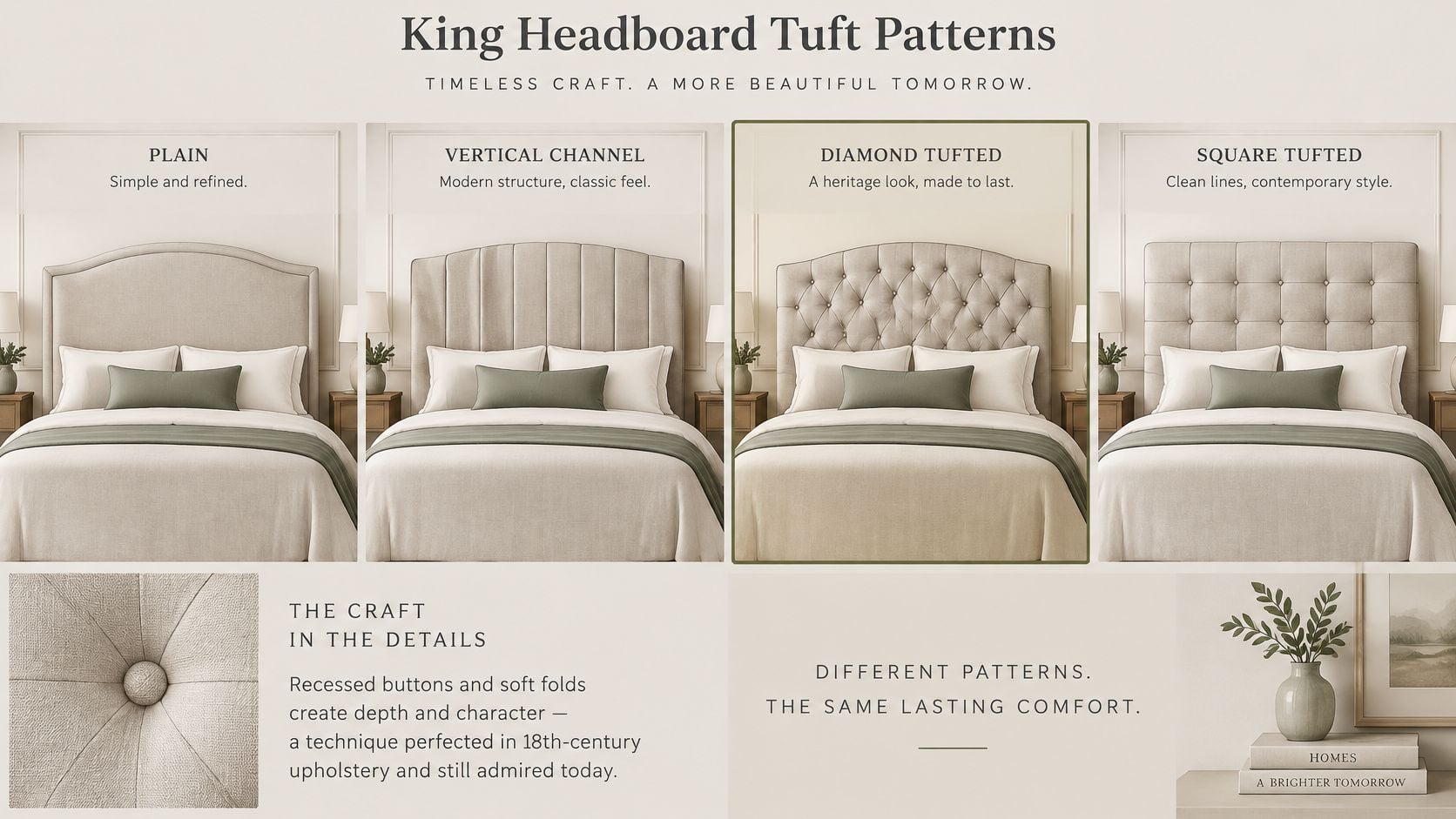
Tuft patterns for a king headboard
| Pattern | How it looks | Best king use | Layout risk |
|---|---|---|---|
| Diamond button | Deep buttons in a repeating grid | Traditional or transitional bedrooms | Uneven spacing becomes conspicuous across a broad panel |
| Channel | Vertical padded channels | Tall, quieter modern walls | Channels must remain straight and evenly spaced |
| Biscuit | Puffed squares | Soft, hotel-like comfort | Extra depth can reduce circulation |
| Wingback | Upholstered wings beside the pillows | Rooms that benefit from an enclosing silhouette | Wings add width beyond the mattress |
The most balanced pattern is one that repeats cleanly across the entire panel. Diamond, channel, and biscuit treatments describe the upholstered surface; wingback describes the surrounding silhouette and can accompany different tuft patterns.
Look closely at the repeat
Diamond button tufting suits a bedroom with coordinated casegoods, framed artwork, and a preference for traditional detail. The folds should look intentional, with consistent recesses and a balanced finish at both edges. A crowded partial diamond beside an expansive border on the opposite side deserves a closer look.
Vertical channels create a calmer rhythm for a newer Lake Mary bedroom with tall walls. Biscuit tufting offers a fuller, softer appearance, while wings frame pillows and create a sheltered feeling. Deep biscuits and projecting wings should be assessed from the bedroom doorway, where their effect on the room's apparent size is easiest to judge.
The showroom's guide to working with patterns in room design helps place that upholstered repeat alongside bedding, rugs, and window treatments. A patterned duvet doesn't require a plain headboard, but the patterns need different scales or a restrained shared palette.
Recognize the work behind the folds
The Pittsburgh Post-Gazette's account of tufting craftsmanship traces the technique to the 18th century, when wool or silk wads anchored upholstery folds before buttons became associated with the familiar recessed pattern. That history helps explain why genuine tufting should be judged as upholstery work, not surface decoration.
On a king panel, the maker must control fabric tension, padding, fold direction, and the ending of the repeat. A plain cloth often makes those decisions easier to inspect than a busy print.
Choose a clear primary pattern. Nailhead trim, flanges, and contrasting borders should support it rather than compete with it.
The most convincing headboard doesn't need every available detail. Consistent execution across a generous width is the stronger expression of craftsmanship.
Which Fabrics and Frames Earn the Investment
Fabric abrasion benchmarks for a headboard
| Use | Benchmark | What it measures | What to ask separately |
|---|---|---|---|
| Private bedroom | At least 15,000 Wyzenbeek double rubs | Controlled rubbing until wear or yarn break | Cleaning code, seam strength, colorfastness |
| Guest room or daily reclining | 30,000 or more Wyzenbeek double rubs | A larger abrasion margin | The same documents plus warranty terms |
| Martindale-rated cloth | Don't convert the score directly | A different test setup and reporting method | The named test method before comparing |
The Association for Contract Textiles abrasion guidelines identify 15,000 Wyzenbeek double rubs for low-traffic/private upholstery and 30,000 for high-traffic/public applications under ASTM D4157. Applied to a headboard, these are useful selection benchmarks, not guarantees of service life.
Fabric appearance doesn't establish durability, and fabric durability doesn't establish frame quality. A considered investment requires both a suitable cloth and a documented internal assembly.
Read the fabric specification
Hair, hands, clothing, and pillows contact a headboard repeatedly. Tufting also places tension around buttons and stitched points, so a delicate-looking cloth needs more scrutiny than its color alone suggests.
Abrasion results don't prove stain resistance, seam strength, cleaning compatibility, or resistance to fading. Wyzenbeek and Martindale scores aren't directly convertible, either.
A custom-order specification should include:
- Test information: The named abrasion method and reported result.
- Care information: Cleaning code and approved cleaning products.
- Exposure suitability: Colorfastness information for a room receiving afternoon light.
- Warranty terms: Coverage for upholstery, buttons, seams, and structural components.
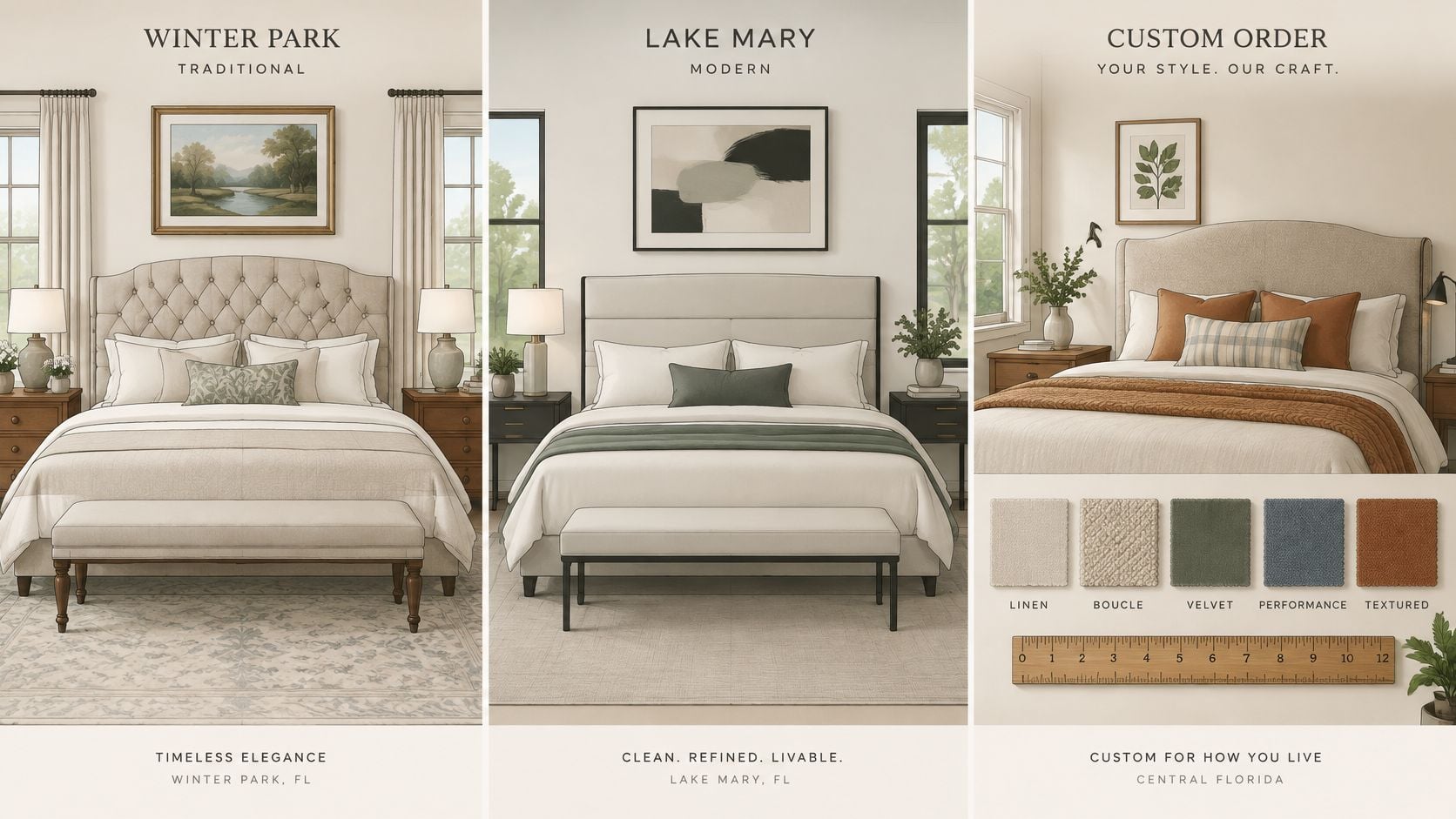
The showroom's guide to choosing upholstery fabric provides a useful framework for comparing these separate qualities. For an active Central Florida bedroom, a documented performance weave is a sensible starting point; unprotected light linen calls for a lower-contact setting. Leather offers another considered direction, but it needs its own material and care discussion.
Inspect what the fabric conceals
Ask for the frame material and joint construction. A well-designed kiln-dried hardwood or furniture-grade plywood structure with secure joinery is preferable to an unspecified lightweight particleboard shell, particularly where attachments and tufting place stress on the assembly.
Padding should feel even, without obvious hard spots or loose areas. The maker should also be able to explain whether buttons, upholstery, and mounting components can be repaired.
The Consumer Product Safety Commission's upholstered-furniture guidance explains that 16 C.F.R. Part 1640 relies on TB 117-2013 testing involving applicable cover, resilient filling, barrier, and decking materials, evaluated for char, smoldering, and transition to open flame. Ask which requirements apply to the selected product and how its complete construction complies, rather than assuming that a passing fabric establishes compliance for everything beneath it.
Indoor-air questions deserve equal transparency. The EPA's formaldehyde indoor-air exposure assessment identifies wood articles as contributors to indoor formaldehyde exposure and examines upholstered-furniture exposure under differing ventilation conditions.
Request documentation for composite wood, foam, adhesives, finishes, and any recognized emissions testing. A low-odor description isn't equivalent to testing, and no headboard should be presented as medically beneficial merely because it is upholstered.
How to Care for a Tufted Headboard in Florida
Regular gentle cleaning and stable indoor conditions help preserve tufted upholstery. The correct routine follows the chosen fabric's cleaning code and avoids saturating folds, buttons, and seams.
Use a restrained maintenance routine
- Remove dust monthly. Vacuum channels and button recesses with a soft upholstery brush and low suction. Avoid pulling the nozzle across loose threads.
- Blot spills promptly. Use a clean white cloth, working inward from the edge. Rubbing can spread the mark or disturb the fabric's surface.
- Manage direct light. Use suitable window treatments or UV-filtering film where afternoon sun reaches the panel. Performance labeling alone doesn't establish fade resistance.
- Control moisture. Maintain air conditioning or dehumidification as the room requires. Investigate dampness rather than concealing it behind furniture.
- Inspect tufting twice yearly. Check for loose buttons, uneven tension, and separating seams. A consultant or upholsterer should assess repairs before anyone pulls or reties a button.
Understand the cleaning code
W permits an appropriate water-based upholstery cleaner; S calls for an appropriate solvent-based cleaner. WS permits either approved approach, while X means vacuuming or brushing only, without liquid spot-cleaning products.
Test an inconspicuous area first and follow the manufacturer's directions. Wood components benefit from the same steady indoor conditions as neighboring casegoods, and the showroom's consultants can clarify care requirements for the selected cloth before ordering.
How to Style and Custom Order a King Headboard
Custom ordering works best when it resolves a specific room condition. Height, tuft arrangement, fabric, and exposed leg finish should be selected together, rather than treated as unrelated upgrades.
Start with a room-specific decision
Consider a Winter Park traditional bedroom where warm wood nightstands are already staying. A neutral diamond-tufted panel can introduce softness without changing the room's character. Keeping the diamond field within a defined central border, before any wings begin, gives the pattern a deliberate ending.
In a newer Lake Mary primary suite, the decision might already favor vertical channels. A lightly textured performance fabric can keep the composition quiet, provided its cleaning and light-exposure specifications suit daily use. The panel's top should relate to the lamps and nearby architectural lines, not float at an arbitrary height.
An Altamonte Springs guest room may have a sliding door beside the bed. A lower biscuit panel without projecting wings can provide a welcoming upholstered surface while preserving an easier route through the room.
These examples don't require matching every furniture piece. They require agreement among the important elements: upholstered texture, wood tone, lamp scale, and the amount of visual space around the bed.
Choose makers for the work they actually do
The showroom's American upholstery and solid-wood offerings serve different purposes:
- Smith Brothers: Bench-made custom upholstery, premium frame construction, and extensive fabric and leather choices.
- Bassett and Craftmaster: American-made custom upholstery with an accessible-luxury position.
- Stickley: Arts and Crafts heritage, heirloom solid-wood construction, and handcrafted joinery for companion bedroom furniture.
- Amish and Mavin: American hardwood craftsmanship and Amish-country construction for suitable beds and casegoods, not an assumption that every collection includes button-tufted upholstery.
Availability and customization must be confirmed for the specific piece. A maker's broad upholstery capability doesn't mean every tuft pattern or headboard-only configuration is offered.
The showroom's explanation of ordering custom furniture helps establish the sequence from material selection to order approval. Its bedroom collection and complimentary design services can be explored together so the headboard is considered alongside the mattress, nightstands, and lighting.
Investment perspective: A higher initial price is most useful when it purchases better construction, appropriate materials, and a realistic path to repair.
Complimentary in-home planning and white-glove delivery provide human checkpoints that a screen cannot supply. Before approval, the written order should identify the selected configuration, cloth, finish, attachment arrangement, and delivery requirements.
Confirm the Piece at the Longwood Showroom
An in-person visit allows the household and consultant to evaluate the headboard as furniture, not just as an image. Firmness, fabric texture, tuft depth, and the quality of the edges are easier to assess together.
The decision sequence is straightforward: confirm the king format, select a balanced tuft layout, document the fabric specification, and approve access and installation compatibility.
Bring the details that make advice useful
A productive showroom conversation starts with:
- Room photographs: The bed wall, adjoining windows, and nearby doors.
- Bed information: Mattress and base details, frame photographs, and mounting measurements.
- Material references: Existing bedding, wood-finish samples, or a rug swatch.
- Practical priorities: Reclining comfort, cleaning needs, delivery constraints, and plans for future changes.
At the family-owned Longwood showroom, experienced design consultants help Greater Orlando households consider the entire room rather than an isolated panel. For homeowners from Sanford, Winter Park, and Altamonte Springs, that conversation can resolve questions that photographs leave unanswered.
Approve the whole room
Complimentary design help can coordinate the headboard with bedside storage, mattress height, and lighting. In-home planning is especially useful when an architectural feature or tight approach complicates the choice.
Before the order is confirmed, the household should understand what is being supplied, how it will attach, and what delivery includes. White-glove delivery then becomes the final step in a considered furnishing decision, rather than the first opportunity to discover a mismatch.
Slone Brothers Furniture offers custom-order guidance, complimentary design services, and white-glove delivery to help coordinate a king tufted headboard with the room around it. Homeowners can bring measurements, room photographs, and bedding samples to Slone Brothers Furniture in Longwood, FL, for a face-to-face consultation with an experienced design consultant. An in-person visit replaces online guesswork with a clear discussion of scale, cloth, construction, and long-term care.