
Cocktail Storage Ottoman: Sizes, Storage and Styling


The sofa is comfortable, but the living room still feels unsettled. A remote sits beside a stack of throws, the coffee table is crowded, and there's nowhere convenient to set a drink. A cocktail storage ottoman can bring those everyday needs together, provided its top, storage compartment, and construction suit the household.
For homeowners in Longwood, Lake Mary, and Greater Orlando, the useful question isn't whether the piece looks right alone. It's whether the exterior fits the room, the interior holds what needs storing, and the lid safely supports its intended uses.
What Is a Cocktail Storage Ottoman and Why Does It Matter?
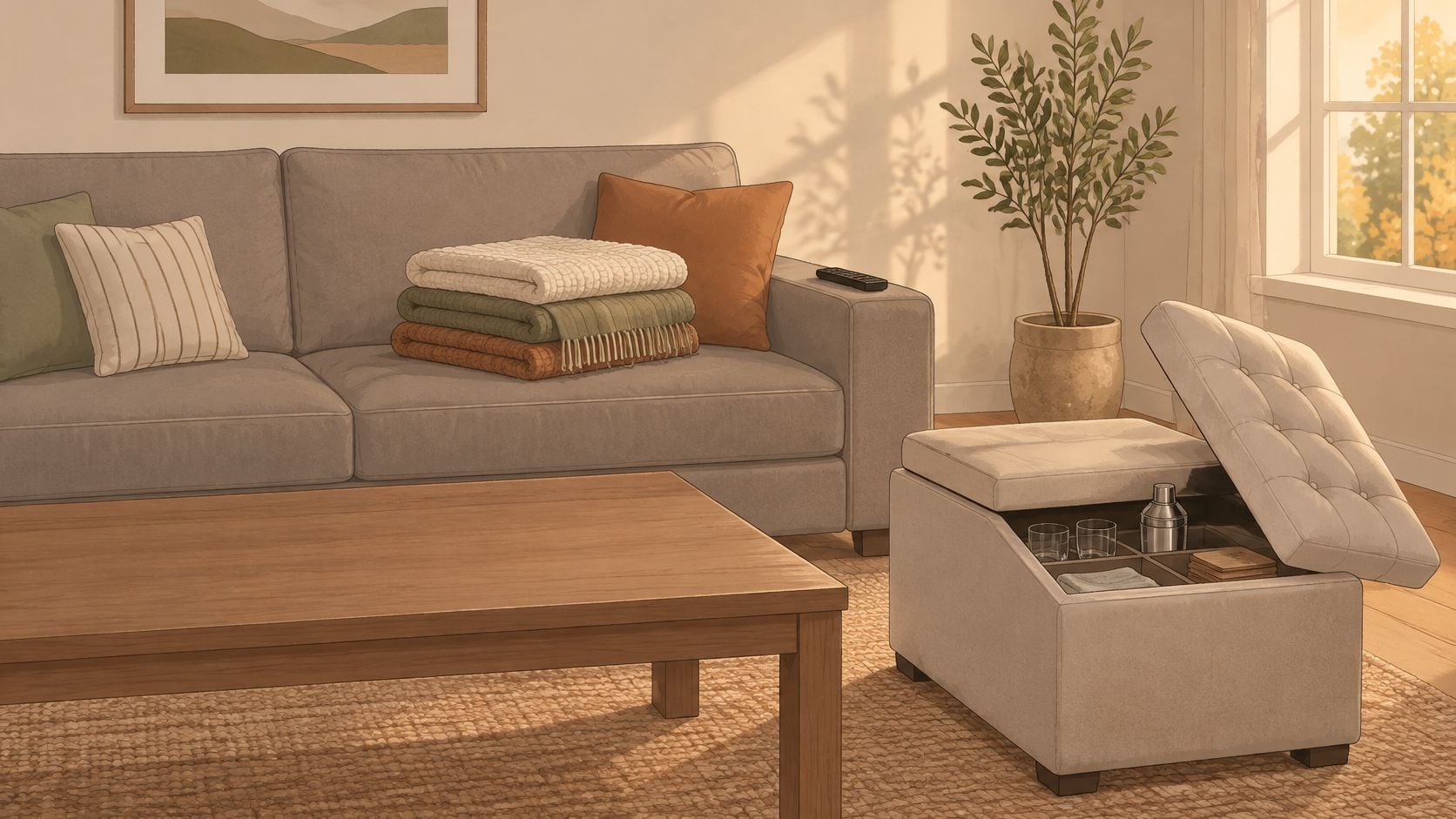
A cocktail storage ottoman is a low, upholstered furnishing with a broad top and concealed storage underneath. It occupies the place a coffee table would normally hold, while adding a cushioned surface for feet or manufacturer-approved occasional seating.
The cocktail version differs from a small footstool through its larger, wider proportions. Depending on the design, a lift-up lid, hinged top, or removable cushion provides access to blankets, games, toys, and other living-room belongings.
A familiar form with a practical purpose
Ottomans trace their origins to the Ottoman Empire in present-day Turkey, and built-in storage emerged during the 19th century, extending the form beyond seating and foot support. That progression helps explain the modern piece's combination of comfort and organization.
The important distinction is between a furnishing that offers several functions and one that performs every function equally well. A broad upholstered top may accommodate a serving tray, but its suitability depends on the actual design rather than its name.
Practical rule: Choose the ottoman around the household's daily routine, not the styled photograph.
In a Longwood family room, the priority might be keeping throws accessible without leaving them on the sofa. In an Orlando conversation area, the same format might provide a softer visual center while allowing a tray to be brought out for guests.
Custom-order programs can offer choices in dimensions, upholstery, finish, and storage configuration. Those selections should bring the piece into proportion with the room, rather than turn it into an isolated statement that competes with everything around it.
How Big Is a Cocktail Storage Ottoman, and How Much Can It Hold?
On a busy Central Florida evening, an ottoman may need to fit beside the sofa, store family belongings, and serve as a surface for a tray. Those jobs depend on different measurements and limits. The exterior footprint determines how it fits the room; the usable interior determines what it can store. Seating capacity and tabletop safety also need separate checks.
Cocktail storage ottoman sizes and interior capacity
| Format | Exterior (W x D x H) | Usable interior (W x D x H) | Best fit |
|---|---|---|---|
| Standard rectangular, 42 in wide | 42 x 25 x 18 in | 41 x 24.5 x 8.5 in, documented model specifications | Sofas, sectionals, and larger living rooms, subject to layout |
| Compact rectangular, 38 in wide | 38 x 17.25 x 18 in | 34 x 15 x 10 in, documented compartment specifications | Loveseats, compact rooms, and narrower layouts |
| Square | Varies by manufacturer | Request clear opening width, cavity depth, and lid clearance | Centered between chairs or a sofa pair |
| Round | Varies by manufacturer | Request clear opening width, cavity depth, and lid clearance | Open-plan arrangements with circulation around the piece |
These rectangular examples are individual product specifications, not universal size standards. Labels such as standard, compact, square, and round don't replace the measurements of the specific ottoman.
Read the interior as carefully as the exterior
The frame, padding, lid, and supports take up space, much like walls and fixtures reduce the usable area inside a room. A broad exterior can conceal a shallow cavity, so compare the interior dimensions with the belongings you plan to store.
The shallower example suits flatter items, such as folded throws, board games, and a small organizer for remotes. The compact example has a taller compartment, but its narrower floor area changes how those belongings fit. A blanket should close beneath the lid without being compressed; a game box shouldn't need to be wedged beneath a hinge. Include basket handles when checking clearance.
A storage compartment is useful when belongings can go in and come out without a struggle.
Separate sitting limits from tabletop safety
An ottoman may support someone sitting on it and still need specific guidance before it carries a tray or other tabletop items. Ask for the manufacturer's weight limits for each intended use. Check how the lid opens, whether its supports hold it in place, and whether the closed top remains stable. These are distinct questions, not one general measure of strength.
In a family room, repeated use can put added demands on the lid and hinges. Ask how the frame, joints, cushion support, and hardware work together in the exact piece under consideration. One documented construction profile combines fabric upholstery, foam and blown-fiber cushioning, a plywood frame, and steel supports; its lift-top material specification shows the value of checking what supports the top and lifting mechanism. Material names alone don't establish how the complete piece performs.
Map the footprint before choosing
A longer ottoman can sit comfortably in front of a sofa, yet still narrow a walking route or block nearby seating when its lid is open. Mark the proposed footprint on the floor, then walk the paths used each day and check the lid's opening space. The furniture measuring guide can help you record room and delivery-route measurements.
Before settling on a model, confirm the clear opening and cavity dimensions, including any hardware that takes up space. Test how the hinges and supports behave, request weight guidance for seating and tabletop use, and make sure nearby chairs won't obstruct the open lid. A complimentary in-home design consultation can help map an awkward Sanford or Altamonte Springs room before upholstery selections begin.
Which Upholstery Holds Up Best in a Busy Living Room?
A busy Central Florida home asks an ottoman's upholstery to handle two kinds of wear: everyday contact on the top and edges, and repeated handling around the storage lid. Choose fabric by looking at its test rating, construction, and care requirements together. One number cannot describe every part of the piece.
Upholstery abrasion benchmarks by use
| Use case | Wyzenbeek double rubs | Martindale cycles |
|---|---|---|
| Low-traffic or private spaces | 15,000 | 20,000 |
| High-traffic or public spaces | 30,000 | 40,000 |
| Active family living room | At least medium-to-heavy domestic suitability, with the stated rating verified | Verify the stated method and domestic-use recommendation |
The thresholds in the table are from the ACT abrasion guidelines for woven indoor upholstery. Abrasion resistance measures repeated friction, not guaranteed furniture lifespan. Ask which test method produced the rating, since the figures are meaningful only alongside that method.
Understand what a rating leaves unanswered
Fiber, weave, finish, furniture construction, cleaning, and household use all affect how upholstery holds up. In a family room where children climb onto the ottoman and adults lift its lid often, check how the fabric is applied at stress points as well as how its surface performs.
For a busy Central Florida living room, request fabric suited to medium-to-heavy domestic use and ask to see its test information. The label “performance fabric” is a starting point. Ask what performance was tested and whether the recommendation covers the intended use.
Check the details beyond the center of the top:
- Lid edges and welt: Ask whether the chosen fabric and trim are suited to frequent handling.
- Seams: Look at their placement where people may sit, pull, or grip.
- Hinge area: Check that fabric won't be pinched or strained during normal opening.
- Care requirements: Confirm the approved cleaning method before ordering.
Compare fabric and leather without guessing
Ask the showroom for fabric and leather samples, then compare them side by side in your room's light. Review written specifications and expected maintenance, too. With leather, the grain, sample edge, and feel can guide questions, but appearance alone does not establish its grade.
Ask whether the leather is top-grain or bonded, and request details about its finish and care. For fabric, the cleaning code indicates whether water-based products, solvent-based treatment, vacuum-only care, or professional attention is appropriate. The upholstery fabric selection guide can help organize questions before you compare colors.
Can a Cocktail Storage Ottoman Replace a Coffee Table?
Yes, but only when the manufacturer permits tabletop use and the chosen configuration provides a stable serving surface. A seating weight rating doesn't automatically establish a safe tabletop load, particularly where objects apply pressure over a small area.
That distinction matters with dishes, drinks, books, or a lamp. A person seated across a padded top and a heavy object resting on a narrow base don't place pressure on the lid in the same way.
Separate serving stability from seating comfort
A soft, tufted surface may feel inviting underfoot while remaining unsuitable for everyday serving. A tray can improve stability, but it can't correct an unsupported lid or override the manufacturer's restrictions.
A practical serving arrangement uses a rigid or properly supported tray, positioned centrally on an approved surface. The top should generally sit level with or slightly below the sofa seat, while the surrounding space must accommodate walking and any reclining furniture.
- Do check the exact arrangement: Test the proposed tray on the actual top, rather than judging from a photograph.
- Do protect the upholstery: Place hot mugs on an appropriate tray with coasters, not directly on the cushioned lid.
- Don't assume softness means serving safety: A heavily tufted top may be a poor choice for dishes or heavier objects.
- Don't confuse ratings: Obtain separate guidance for seating, serving, and any lift-top position.
Safety distinction: Multifunctional doesn't mean every function carries the same load capacity.
Consider the household, not just the surface
In an open-plan Orlando room, the ottoman may need to accommodate relaxed evenings and occasional entertaining without obstructing circulation. The showroom test should include reaching the tray, moving around the piece, and operating the lid.
Families with young children also need clear answers about hinges, lid supports, and the manufacturer's stated safety features. Padded edges alone don't make a storage ottoman childproof.
The final decision should follow the exact model's dimensions, hardware behavior, tray compatibility, and use restrictions. If those answers remain unclear, a conventional coffee table may be the more suitable central surface.
How Do You Style a Cocktail Storage Ottoman in a Living Room?
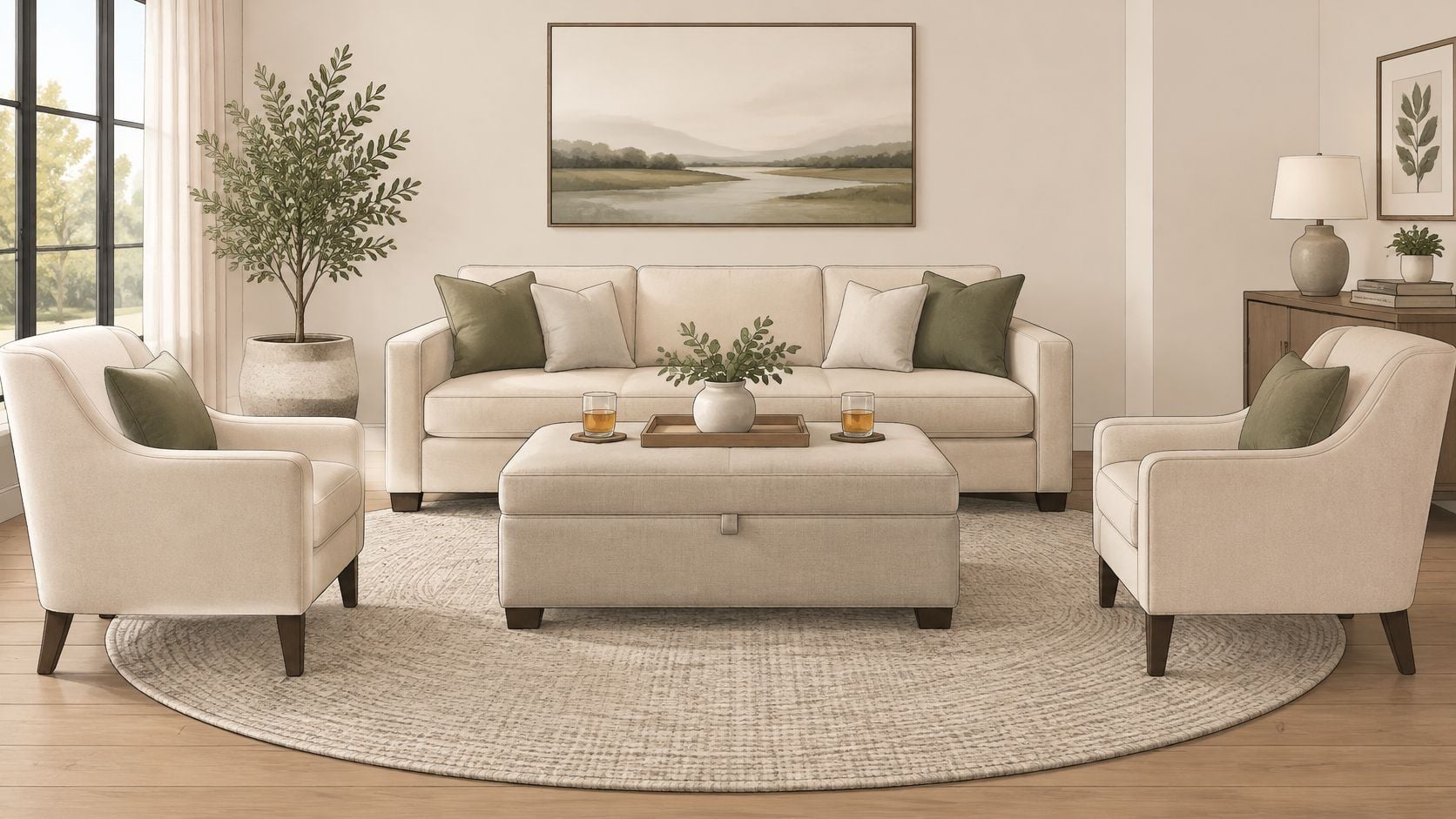
Successful styling starts with scale and visual relationships, not a collection of decorative rules. The ottoman should feel connected to the sofa, chairs, and rug while remaining available for its everyday purpose.
A rectangular shape often provides a calm counterpart to a long sofa. A square or round form can suit a more balanced conversation grouping, provided the surrounding furniture and walking routes support that arrangement.
Build a relationship rather than an exact match
Upholstery doesn't have to duplicate the sofa. A related undertone or a deliberate texture contrast can connect the furnishings without making the room look like a matching set.
- Start with a tonal foundation: A neutral or neighboring upholstery shade lets the ottoman sit comfortably beside the sofa.
- Add texture selectively: A woven throw on nearby seating or a wood serving tray can provide contrast without crowding the top.
- Keep the rug visible: Enough exposed rug around the piece helps the seating arrangement read as a complete group.
- Leave working space: Styling should never require clearing an elaborate display before a drink can be served.
Keep the top easy to use
For an approved serving surface, a removable tray might hold a short stack of books, a small bowl, and a glass carafe. The grouping should remain modest, stable, and easy to lift away before the storage compartment opens.
Wood furnishings elsewhere in the room can connect through complementary finish tones rather than identical finishes. An upholstered center piece can soften a room containing solid wood tables or dining furniture without competing with their craftsmanship.
The coffee-table styling guide offers further arrangement ideas, but an upholstered lid still needs the serving precautions described above.
In a bright Winter Park or Lake Mary home, fabric samples should be considered in the room's actual light, with fade-resistance information requested for the selection. An in-home design visit allows the consultant to assess upholstery, rug proportions, and neighboring finishes together.
How Do You Protect a Cocktail Storage Ottoman in Florida Humidity?
After a rainy-season week in a Central Florida home, check the ottoman's underside and the edges beneath its lid. Those sheltered areas can reveal dampness or condensation before it becomes obvious on the upholstery. The piece has two different jobs: its exterior must hold up to everyday family use, while its storage interior needs dry, stable conditions.
Wood absorbs and releases moisture as surrounding humidity changes, so steady indoor conditions matter. The Museum of Florida History's wood-care guidance identifies 35% to 65% as an accepted household relative-humidity range and explains that changes can affect wood, leather, textiles, and varnish. Swelling and shrinkage can stress joints and finishes. Aim for consistency rather than moving repeatedly between the range's extremes.
Keep conditions reasonably steady
Purdue Extension's wood-moisture guidance says interior lumber is typically conditioned to approximately 6% to 8% moisture content, compared with 15% to 20% for dry exterior lumber. These figures describe moisture inside wood, not the humidity in your living room. They are different measures, much like the ottoman's seating capacity and the load its lid can safely carry.
Florida care targets for a cocktail storage ottoman
| Factor | Target or benchmark | Practical action |
|---|---|---|
| Indoor relative humidity | The household range above, maintained consistently | Avoid direct HVAC discharge and rapid condition changes |
| Interior lumber moisture | The interior-conditioning benchmark above, distinct from exterior lumber | Keep the ottoman indoors, away from damp or unconditioned spaces |
Choose a position away from severe heat, direct sun, frequently open exterior doors, and areas where condensation forms. An exterior wall may behave differently from the center of the room, so check for signs of dampness there, too.
Pair climate control with simple care
Store only dry blankets and leather goods inside the ottoman, leaving space around them instead of packing the compartment tightly. This gives air room to circulate and makes it easier to notice moisture during a quick check.
For humid weather, set the thermostat fan to auto so the air handler does not run continuously. If dampness persists, use a dehumidifier as appropriate for the room. Check the upholstery care label and manufacturer's instructions before applying cleaner, and lift spills with a suitable cloth rather than rubbing them in. For a leather selection, consult this leather furniture protection guide. During a home visit, the design team can discuss placement alongside the room's layout.
Should You Choose a Custom Order or a Clearance Piece?
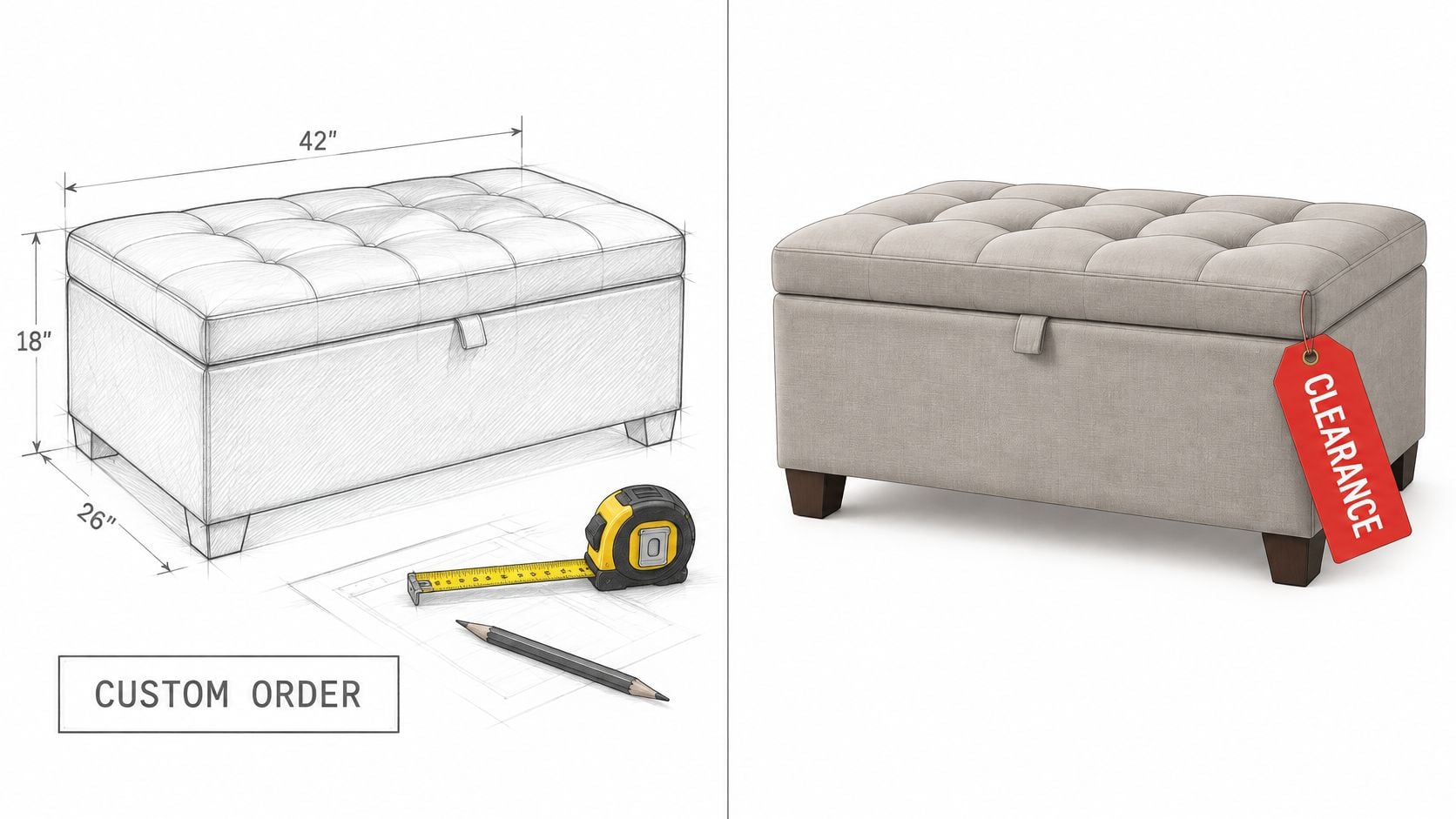
A custom order makes sense when the room requires a specific fit, upholstery, or finish that an available piece doesn't provide. A clearance piece can be equally appropriate when its actual specifications and condition already meet the household's needs.
Neither route establishes quality by itself. The stronger choice is the piece whose construction, proportions, and care requirements have been evaluated in person.
Choose custom for a defined requirement
Custom ordering is most useful when the homeowner can explain what needs to change. That might mean upholstery suitable for frequent family use, a finish related to nearby furniture, or a size better suited to an unusual seating arrangement.
Customization still has boundaries. Dimensions, interior layouts, and hardware configurations depend on the manufacturer's program, so those options shouldn't be assumed from the availability of fabric choices.
- Choose custom when fit drives the decision: The available footprint or required upholstery rules out otherwise suitable pieces.
- Choose an available piece when it already works: The exact dimensions, storage access, and material specifications meet the room's needs.
- Pause when information is missing: An appealing finish or immediate availability shouldn't replace a clear construction and care specification.
Evaluate value over the ownership period
A higher initial price is easier to assess when the buyer knows what it purchases: specified materials, thoughtful construction, appropriate upholstery, or a more precise fit. No price guarantees heirloom performance, and no clearance label proves a compromise.
The closeout and clearance selection is therefore worth considering through the same standards used for a custom order. In-person inspection allows the homeowner to assess condition and suitability rather than relying on a category label.
The local, family-owned showroom has served Central Florida since 1980, pairing custom-order options with experienced design consultants and complimentary design assistance. Space planning and room makeovers can place the ottoman within a coordinated home rather than treat it as a disconnected purchase.
Slone Brothers Furniture offers custom-order choices, complimentary design assistance, and face-to-face guidance for comparing an ottoman's size, storage, and construction. Homeowners from Longwood and Greater Orlando are invited to visit Slone Brothers Furniture with room measurements, sofa photographs, and storage priorities, then explore suitable pieces with an experienced design consultant.