

Bar Chairs Clearance: A Local Buyer’s Guide


A Central Florida homeowner can spend months refining a kitchen renovation, select a beautiful quartz island, coordinate the cabinetry, and then discover that the seating is the last unresolved detail. The island looks finished, but the room still lacks the comfortable, well-proportioned bar chairs that make breakfast, conversation, and entertaining feel natural.
That's where bar chairs clearance becomes more than a search for a reduced price. In a premium showroom, clearance can be the opportunity to acquire solid construction, American-made craftsmanship, and a refined finish without commissioning every detail from the factory. The right purchase still demands careful measuring, close inspection, and an honest conversation about how the chairs will function in a Longwood, Orlando, or Winter Park home.
What Bar Chairs Clearance Really Means for Discerning Buyers
Clearance furniture isn't automatically damaged furniture. In a quality showroom, it can include a floor model, a discontinued finish, overstock from an American manufacturer, or an upholstery fabric from a previous season. Those circumstances affect availability and presentation, but they don't necessarily affect the underlying frame, joinery, or comfort engineering.
A homeowner who has stretched the renovation budget shouldn't settle for disposable seating because the island is ready today. A well-chosen clearance bar chair can preserve the room's design standard while redirecting funds toward lighting, window treatments, or another important furnishing.
What a premium clearance piece may include
A curated clearance bar chair can still feature:
- A solid hardwood frame, selected for structural stability and long-term use.
- Durable upholstery, with properly finished seams and supportive cushioning.
- Quality suspension, including construction designed for sustained comfort.
- A finished showroom presence, allowing the buyer to evaluate the actual chair rather than rely on a photograph.
The term “clearance” should describe inventory status, not conceal a construction problem. A reputable showroom should identify whether a piece is a floor model, discontinued style, overstock item, or something with a cosmetic imperfection. Buyers should also ask whether the item has been inspected, whether all hardware is present, and what delivery or exchange terms apply.
Practical rule: A lower price is only meaningful when the chair still meets the household's standards for comfort, proportion, and construction.
The global bar stools market was valued at approximately USD 2.5 billion in 2023 and is projected to reach USD 3.7 billion by 2032, with a projected 4.5% CAGR, according to bar stool dimensions and market context. The same reporting identifies North America as the largest regional market, reflecting sustained demand for bar-height seating in homes and hospitality settings.
That demand explains why clearance assortments can be particularly worthwhile. Kitchen islands, breakfast bars, and entertainment spaces continue to require seating that is both attractive and practical. For homeowners comparing clearance furniture at Slone Brothers, the sensible approach is to treat each piece as an investment candidate, not an impulse purchase.
For outdoor entertaining, the evaluation changes because materials must tolerate exposure and movement. A resource on high-end outdoor bar seating can help clarify how outdoor proportions and construction differ from indoor kitchen seating, but indoor clearance chairs should still be judged primarily on fit, frame integrity, comfort, and finish quality.
How to Measure for the Perfect Bar Chair Fit
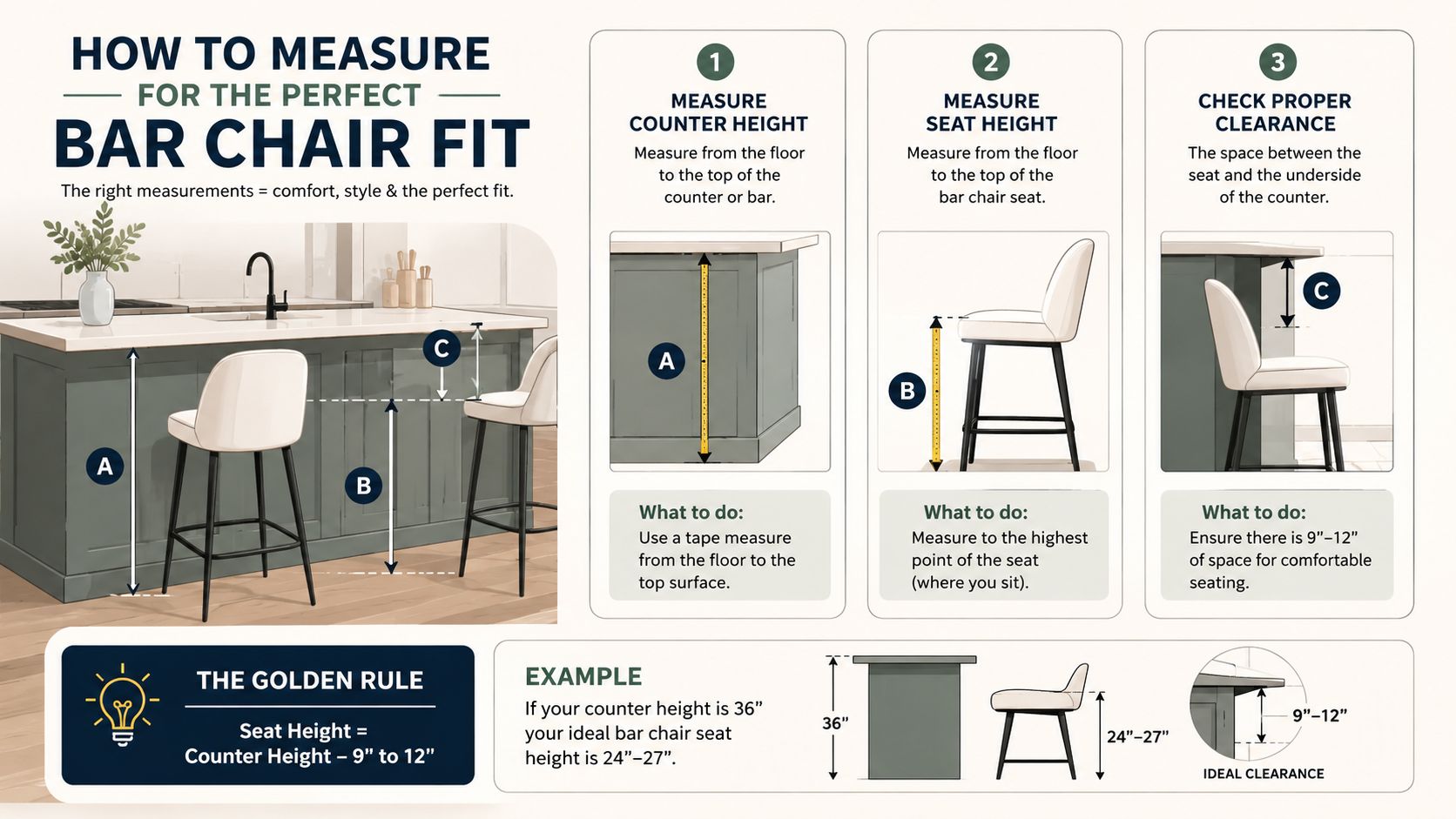
Start with the counter, not the chair. Counter-height and bar-height seating serve different surfaces, and the useful measurement runs from the seat top to the counter's underside. The finished countertop height alone cannot show whether knees and legs will have enough room.
A typical counter stands about 36 inches high, while a typical bar stands about 42 inches high. Counter stools commonly have seat heights from 24 to 27.5 inches, and bar stools usually measure 28 to 32 inches, according to this guide to standard bar stool dimensions. Confirm the actual dimensions at home before selecting a clearance chair.
The measurement sequence
Measure from the floor to the underside of the counter. Do not stop at the countertop surface. A thick apron, decorative edge, or shallow overhang can reduce usable knee room.
Allow the right legroom gap. Plan for approximately 10 to 12 inches between the seat top and the counter underside, following this bar and counter stool height guidance. That clearance supports posture changes and makes sitting down or standing up easier.
Measure the usable seating length. Remove decorative end panels, corners, sinks, cooktops, and any section where knees cannot tuck under the surface. The island's visible length is not always its seating length.
Measure the chair's widest point. Seat width can range from 16 to 26 inches, while the full footprint may run from approximately 17 by 16 inches to 28 by 24 inches, depending on style. Arms, flared backs, and swivel hardware can require more room than the seat itself.
Set the spacing between chairs. Leave approximately 6 to 10 inches between stools, with additional room for arms, deep backs, or swivel movement, as described in this bar stool comfort guidance. A row that fits on paper may feel cramped once people eat, turn, or stand.
Inspect the rear aisle. In a Lake Mary or Sanford kitchen, measure the circulation path behind the island, including drawers, appliances, and people passing through. Check the complete route, not only the chair row.
This sequence ensures the chair fits the room before price becomes the deciding factor. Bring a tape measure and the counter's underside dimensions to the Longwood showroom. Use this furniture measurement guide to organize the details, then test the actual chair for legroom, reach, and movement.
Evaluating Construction and Materials in Clearance Pieces
A clearance chair earns consideration only after its construction passes inspection. Look beyond the fabric color. Check the frame, joints, seat support, upholstery, and finish, then judge whether each can handle daily use in a Florida home.
Start with the frame and joints
A well-built frame feels stable without becoming uncomfortably rigid. Kiln-dried hardwoods such as maple, oak, or ash commonly indicate substantial furniture construction. Mortise-and-tenon joints, double dowels, and other reinforced connections provide more confidence than staple-only assembly or glue-only joints.
Traditional Amish furniture is closely associated with dovetail and mortise-and-tenon joinery. Dovetails commonly appear in drawer boxes, while mortise-and-tenon joints connect legs, rails, and frames through fitted wood components rather than relying on nails or screws alone. The distinction matters because a bar chair takes repeated stress whenever someone sits, turns, or stands.
Press the cushion firmly, then release it. It should recover without feeling hollow, collapsed, or permanently compressed. A high-resiliency foam core wrapped in down or Dacron can deliver a better balance of support and softness than a thin cushion with no defined structure.
Use hands, eyes, and ears
Lift the chair. Weight does not prove quality, but a substantial feel can indicate denser materials and a more serious frame. Set it down on the showroom floor, apply gentle pressure from several angles, and listen. A new chair should sit level without rocking, squeaking, or shifting at the joints.
Inspect the upholstery where daily use creates stress:
- Seams should track cleanly without puckering or loose threads.
- Patterns should align across visible panels when the design requires matching.
- Seat edges should feel finished, with smooth padding rather than sharp or exposed structure.
- The fabric specification matters, and a residential fabric rated at 30,000 or more double rubs is a useful durability benchmark when that information is available.
Review this upholstery materials guide for details on fibers, performance fabrics, leather, and woven upholstery before you approve a clearance piece.
| Component | Heirloom-Quality Standard | Red Flag |
|---|---|---|
| Frame | Substantial hardwood with stable construction | Thin material, visible splits, or excessive flex |
| Joinery | Mortise-and-tenon, double dowels, or comparable reinforced joints | Staples, glue-only assembly, or exposed fasteners |
| Seat support | Resilient cushion with properly engineered suspension | Hollow cushion, permanent sinking, or sharp edges |
| Upholstery | Aligned seams, clean stitching, suitable durability rating | Puckering, loose threads, or mismatched stress points |
| Metal frame | Smooth welds and an even protective finish | Rough welds, exposed corrosion, or uneven coating |
| Stability | Sits level and remains quiet under gentle pressure | Rocking, squeaking, or loose joints |
Florida humidity makes the finish worth close attention. Wood should show an even stain and protective topcoat. Metal should have smooth welds and a coating suited to indoor use in a humid climate. A chair that passes these checks can offer heirloom-level construction at an investment discount, regardless of its clearance price.
Clearance vs Custom-Order Bar Seating
Clearance is the stronger choice when quality is available immediately and the homeowner can accept limited finish options. Custom order is preferable when the room requires a precise fabric, leather, stain, configuration, or dimensional adjustment that cannot be found on the clearance floor.
A clearance piece may come from the same quality category as a custom-order chair. The difference is usually selection and timing, not necessarily the standard of construction. Custom seating gives the buyer control over the details, but that control comes with a longer production process and full retail pricing. A custom-order furniture overview can help clarify whether that route suits the room.
The practical trade-off
| Factor | Clearance Bar Chairs | Custom-Order Bar Chairs |
|---|---|---|
| Availability | Ready for immediate selection when in stock | Produced after specifications are confirmed |
| Pricing structure | Investment value on existing inventory | Full pricing for selected specifications |
| Materials and finish | Limited to available upholstery, wood, and metal finishes | Broad selection of fabric, leather, stain, and finish options |
| Design flexibility | Best for homeowners comfortable adapting around an excellent piece | Best for exact aesthetic or dimensional requirements |
| Long-term value | Strong when the frame and upholstery meet lasting standards | Strong when the selected construction and materials suit daily use |
A homeowner furnishing a new house in Sanford may prefer clearance if the kitchen is ready for seating before guests arrive. The same homeowner may choose custom order when the island has an unusual underside, a specific cabinet stain, or an architectural constraint that makes standard proportions unsuitable.
Clearance also lets the buyer allocate money across the room rather than concentrating every design decision on one item. Custom order earns its place when the visual relationship between cabinetry, countertops, lighting, and seating depends on exact coordination.
The wrong decision is choosing custom merely for status or clearance merely for price. The right decision follows the room's measurements, the desired timeline, and the importance of customization.
Why a Local Longwood Showroom Changes the Clearance Experience
A local showroom gives buyers something online clearance listings can't provide consistently, the ability to test the actual chair in person. Seat depth, lumbar support, footrest position, swivel motion, frame stability, and upholstery texture are physical qualities that photographs can't establish.
Slone Brothers Furniture operates in Longwood and has served Central Florida as a family-owned business since 1980, representing more than 46 years of local expertise. Its clearance offering gives homeowners a place to inspect available pieces while working with design consultants who can consider the rest of the room.
Why physical inspection protects the investment
At a Longwood showroom, a buyer can:
- Sit for several minutes, rather than judge comfort from a product description.
- Compare seat heights side by side, which helps reveal whether a counter or bar chair is appropriate.
- Examine wood grain and stitching under showroom light and from different angles.
- Test swivel travel, footrest placement, and the chair's return to center.
- Discuss coordination, including cabinetry, countertop color, dining furniture, and nearby living spaces.
Local service matters after the purchase, too. Delivery and placement across Central Florida can reduce the risk of a chair arriving in a condition the homeowner didn't anticipate, while design support can help integrate a clearance find with furnishings already in the home.
The case for shopping local isn't sentimental alone. It's practical. A local furniture shopping guide explains why direct evaluation, accountable service, and knowledgeable assistance matter when the purchase involves materials and proportions that affect daily comfort.
A substantial Central Florida market supports that in-person model. Longwood has an estimated 2026 population of 17,923 in one current demographic projection, while an official city demographic page lists 17,089 residents, according to Longwood population information. The city is a meaningful retail base for homeowners from Longwood, Altamonte Springs, Lake Mary, Winter Park, Orlando, and nearby communities.
Styling and Caring for Your Clearance Bar Chairs
A clearance bar chair should look intentional, even when its finish came from an earlier collection. The easiest way to achieve that is to coordinate undertones rather than demand an exact match.
Warm walnut-toned wood pairs naturally with brass hardware and linen upholstery in a transitional kitchen. Matte black metal frames with performance leather create a cleaner modern direction. A chair doesn't need to duplicate the island or dining table, but it should share a visual thread with the room.
Create continuity without forcing uniformity
Use one or two supporting elements to connect the chairs to existing furnishings:
- Repeat a metal tone in cabinet hardware, lighting, or nearby tables.
- Echo the upholstery color through a runner, accent textile, or artwork.
- Balance the silhouette with a rug pattern that includes the chair's dominant color.
- Keep the surrounding pieces quieter if the clearance chairs have a distinctive back or finish.
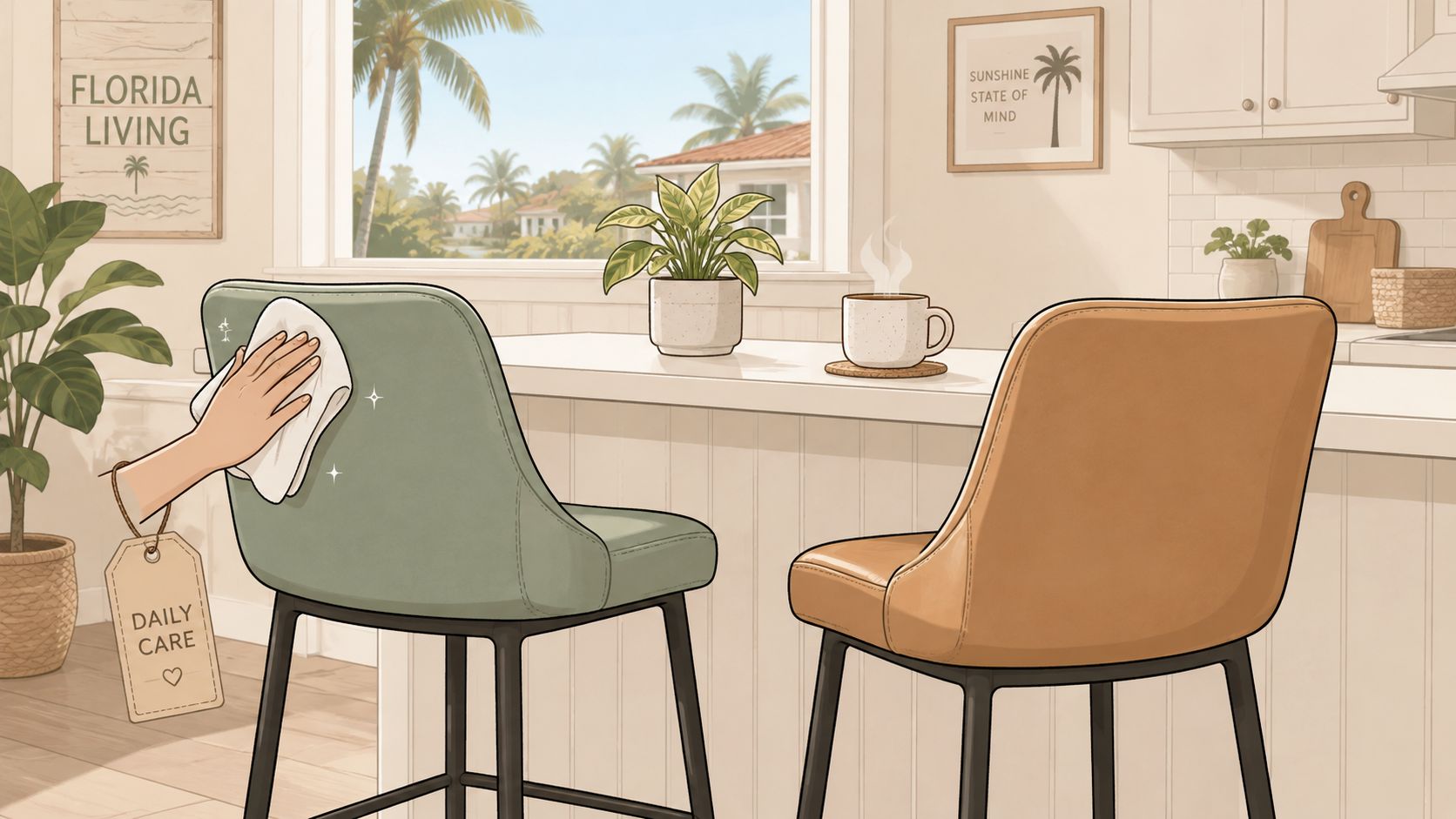
Florida care requires restraint. Keep upholstered seating away from direct, intense sunlight when possible, and use UV-protective window treatments to reduce fading. Dust wood with a soft cloth, clean woven or fabric seats with the manufacturer's recommended gentle method, and avoid saturating upholstery.
Leather benefits from products designed specifically for the leather type. Conditioning should follow the manufacturer's guidance rather than an aggressive routine, especially in rooms exposed to strong sun or climate-controlled air.
A seasonal inspection keeps small issues from becoming structural problems:
- Check and tighten accessible hardware.
- Inspect feet and glides for uneven wear.
- Rotate or reposition removable cushion inserts when the design permits.
- Look for loose threads, lifted finish, or early wobble.
- Keep cleaning products away from untested wood and leather surfaces.
Good care protects the original investment. Clearance status doesn't reduce the need for maintenance, and quality materials reward consistent attention.
Your Next Steps to Furnish a Beautiful Central Florida Home
The decision process is straightforward. First, measure the counter from the floor to the underside, then record the usable seating length, overhang, knee space, and rear circulation area. Next, compare those measurements with each chair's seat height, width, depth, arms, and swivel movement.
Construction deserves equal attention. A buyer should inspect frame stability, joint quality, cushion resilience, upholstery stitching, metal welds, and finish protection before committing. If a clearance piece fits beautifully but misses one essential comfort or durability requirement, it isn't the right investment.
The final decision is whether immediate availability outweighs exact customization. Clearance works well for a homeowner who can embrace an available finish and wants quality seating without waiting for a factory build. Custom order makes more sense when the room has unusual dimensions or requires a precise material and finish combination.
Longwood's showroom environment allows homeowners to test chairs rather than guess from online photographs. Design consultants can help coordinate bar seating with cabinetry, quartz or natural-stone countertops, dining sets, living room furnishings, and the broader character of a Central Florida home. Local delivery and room-planning assistance add practical value when several pieces must work together.
The most successful clearance purchase isn't the chair with the most dramatic reduction. It's the chair that feels right, fits correctly, complements the architecture, and has construction worth living with for years.
Slone Brothers Furniture offers curated clearance furniture, custom-order options, experienced design consultants, and local delivery for homeowners furnishing Central Florida homes. Visit Slone Brothers Furniture in Longwood, FL to test bar chairs in person and receive face-to-face guidance on fit, craftsmanship, and coordinated design.