

Supply Chain Optimization for Furniture Retailers


A customer in Winter Park has approved a custom Stickley dining table, selected a matching Amish-crafted sideboard from Simply Amish, and scheduled a room installation around both pieces. Then the sideboard goes on backorder, the table's production update arrives late, and the white-glove delivery team has a scheduling conflict. Meanwhile, the showroom still has inventory tying up capital because earlier buying decisions anticipated demand that never arrived.
That scenario is familiar to premium furniture retailers in Longwood, Orlando, Lake Mary, Sanford, and across Central Florida. Supply chain optimization in this market isn't about turning heirloom furniture into an anonymous commodity. It's about coordinating craftsmanship, documentation, inventory, customer communication, and delivery so the premium promise survives from order entry to final placement.
Why Furniture Retailers Struggle with Supply Chain Complexity
Furniture retailers face a supply chain that behaves differently from fast-moving retail. A custom dining table may require a specific wood selection and finish, while a Smith Brothers sofa or American Leather sectional may depend on configuration, upholstery, and production scheduling. Each choice creates a different path through the network.
The retailer must also manage two opposing demands. Customers want a carefully curated showroom with tangible pieces to sit on and inspect, but they also expect access to custom dimensions, fabrics, finishes, and configurations. Holding every variation is impossible. Holding too little display inventory makes consultation harder and can weaken the customer's confidence in the buying decision.
Craftsmanship adds responsibility
American-made and Amish-crafted furniture creates a valuable point of distinction, but origin claims require more than attractive showroom language. The Federal Trade Commission says an unqualified “Made in USA” claim must be supported by evidence that a product is “all or virtually all” made in the United States, including U.S. final assembly, significant processing, and sourcing of ingredients or components where applicable. FTC guidance on Made in USA claims makes documentation part of responsible merchandising.
That responsibility applies directly to furniture retailers selling lines such as Stickley, Simply Amish, Bassett, and Craftmaster. Supplier records, product descriptions, construction details, and origin language need to agree. The FTC's labeling rule applies to product labels, catalogs, and online marketing, and marketers can face civil penalties for unsupported unqualified claims. FTC compliance guidance for the Made in USA standard belongs in every retailer's sourcing and marketing process.
Practical rule: A long lead time can be explained. A vague order status cannot.
The retailer's challenge is therefore broader than purchasing. It includes production visibility, realistic promise dates, receiving capacity, warehouse handling, delivery routes, installation requirements, and post-purchase service. A clear explanation of why quality furniture costs more helps sales consultants set expectations before a customer commits.
What Supply Chain Optimization Actually Means for Your Business
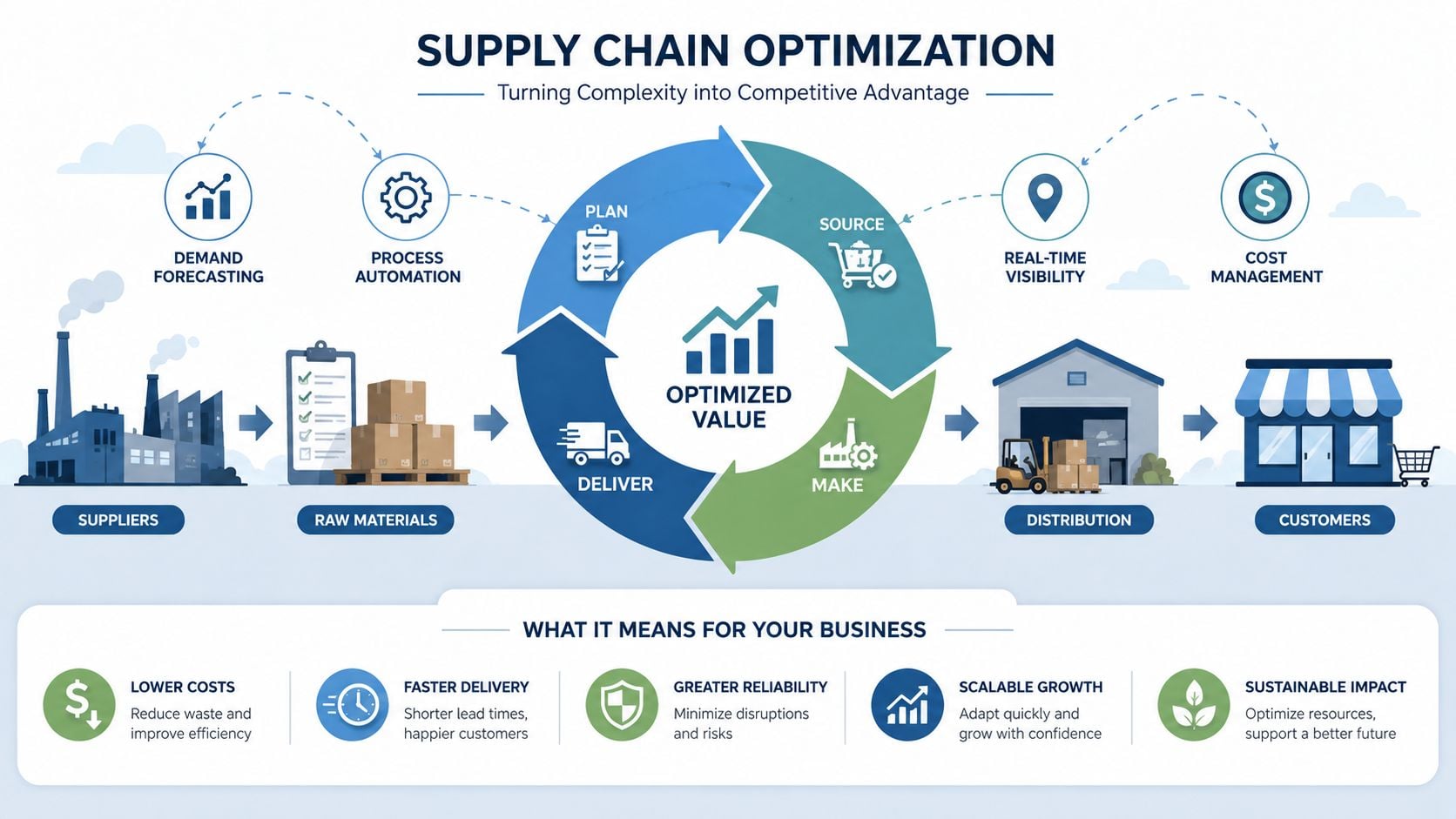
Supply chain optimization is the disciplined coordination of suppliers, inventory, information, transportation, and customer commitments. For a furniture retailer, it means knowing which pieces should be displayed, which should be ordered only after a sale, when a supplier update requires customer contact, and how a delivery promise affects warehouse and design-team capacity.
The financial case is substantial. Industry statistics compiled from supply chain research report that optimized supply chains can achieve 15% lower supply chain costs, hold less than 50% of the inventory, and run cash-to-cash cycles at least 3x faster than companies not focused on optimization. The same source reports that 79% of companies with high-performing supply chains outperform their industry's average revenue growth, while 81% of supply chain professionals say analytics will be important for reducing landed costs. Supply chain optimization statistics and operating benchmarks
The furniture translation
Those figures don't mean every retailer should chase the same inventory formula. They show that optimization affects more than the warehouse. Better forecasting can reduce display duplication. Better supplier communication can prevent avoidable customer-service calls. Better delivery planning can reduce rescheduling, handling, and storage pressure.
A Stressless recliner, for example, may occupy valuable showroom space because customers need to experience its ergonomic design in person. An American Leather sectional may need a configuration discussion before an order is placed. The right question isn't whether inventory should be minimized. It's whether each displayed piece has a clear role in selling, educating, or fulfilling demand.
U.S. business logistics costs rose from about $2.45 trillion in 2023 to nearly $2.59 trillion in 2024, an increase of roughly 6.0%, with transportation accounting for about 64%, or nearly $1.64 trillion. Overview of logistics and supply chain disciplines For furniture businesses, that reinforces the importance of delivery density, receiving discipline, and route planning.
End-to-end visibility remains difficult because 82% of supply chain leaders say data silos and fragmented systems make visibility difficult, according to EY reporting summarized in the same reference. A retailer doesn't need a complicated technology stack to respond. It needs one dependable order record, clear ownership for each milestone, and a warehouse process designed around actual product flow. Retailers considering physical improvements should also review guidance on how to optimize your warehouse layout before buying more storage equipment.
The Five Key Levers of Furniture Supply Chain Optimization
Furniture supply chain optimization improves when the retailer works five connected levers instead of treating purchasing, delivery, and sales as separate functions.
1. Inventory management
Separate display inventory, sellable stock, reserved product, customer orders, and damaged or incomplete pieces in the operating system and on the warehouse floor. A Canadel dining set may be displayed to demonstrate finish and proportion while the customer's chosen table size and chair fabric are ordered separately. That distinction prevents staff from promising a floor sample as though it were available for immediate delivery.
A useful inventory review asks:
- Display purpose: Does each floor piece demonstrate comfort, construction, scale, or finish?
- Order status: Is every sold item attached to a customer, supplier confirmation, and expected milestone?
- Aging: Which pieces have remained in the warehouse without a clear sales or service purpose?
- Condition: Can the item be delivered, or does it require inspection, repair, or missing components?
A basic strumento rotazione scorte can help teams think more clearly about stock movement, but the metric must be interpreted alongside showroom value and customer experience.
2. Supplier partnerships
Treat manufacturers as operating partners, not anonymous sources. Assign a standard information record for every key line, including order acknowledgment, approved specifications, production status, expected completion, freight handoff, and exception contact.
That structure is especially important for Stickley, Amish, Bassett, Craftmaster, and other American-made or Amish-crafted lines. Their value rests on material, construction, and provenance, so supplier communication must preserve the details that sales consultants use to educate customers.
3. Demand forecasting
Forecast by room, product role, finish family, customer profile, and local seasonality, not only by product code. Central Florida demand can vary by new-home activity, relocation patterns, design preferences, and periods when seasonal residents return. A retailer serving Longwood and Lake Mary should compare showroom inquiries with completed orders and canceled orders, then use those patterns to guide display decisions.
Forecasting shouldn't dictate every purchase. It should identify where a display earns its space and where custom ordering protects working capital.
4. Delivery and installation
White-glove delivery is part of the product experience. Build delivery planning around room readiness, access conditions, furniture dimensions, assembly needs, protection requirements, and customer availability.
A Smith Brothers sofa may need coordination with in-home design services, while a large dining table may require a different crew configuration or access check. Accurate milestone updates protect the customer relationship and reduce avoidable rescheduling. Retailers should make delivery status easy to understand through a dedicated delivery information page.
5. Custom-order flow
Custom orders need a visible chain of responsibility. The sales consultant confirms specifications, the customer approves the order, purchasing verifies the manufacturer acknowledgment, operations records production updates, and customer service communicates meaningful changes.
The best process doesn't send a customer a stream of vague updates. It explains what has happened, what remains outstanding, and what decision is needed next. That approach protects trust during a longer lead time and makes craftsmanship part of the experience rather than an excuse for silence.
Choosing the Right Optimization Approach for Your Retail Operation
The correct optimization approach depends on the retailer's operating model. A boutique showroom built around custom orders shouldn't copy the inventory strategy of a large warehouse operation. A retailer serving a concentrated Central Florida market can often gain more from disciplined local delivery planning than from a complex regional network model.
Match investment to the real constraint
A small showroom may need order-status discipline before it needs advanced forecasting. A larger retailer with substantial display and warehouse inventory may need integrated inventory visibility, receiving controls, and replenishment logic. A business focused on American-made heritage brands should prioritize supplier documentation and production communication, while a broader product mix may require stronger item-level classification.
| Retailer Profile | Primary Focus Areas | Technology Investment Level | Expected Timeline |
|---|---|---|---|
| Custom-order boutique showroom | Supplier updates, order documentation, customer communication, display selection | Low to moderate, centered on a shared order record | Begin with process changes, then expand gradually |
| Larger stocked showroom | Inventory accuracy, warehouse flow, receiving, delivery capacity | Moderate, with integrated inventory and delivery visibility | Stage improvements around operational priorities |
| American-made and Amish-focused retailer | Origin documentation, craftsmanship details, lead-time communication, supplier relationships | Moderate, with strong document and milestone control | Build supplier discipline before adding automation |
| Local Central Florida operation | Route density, access checks, installation scheduling, service recovery | Low to moderate, focused on delivery coordination | Improve within existing service territory first |
| Retailer serving commercial clients | Quote control, project milestones, purchasing coordination, installation planning | Moderate to high, based on project complexity | Introduce structured reporting and approvals in phases |
Don't automate confusion
Automation is useful when the underlying process is stable. It can route an approved order, flag a missed supplier update, or identify delivery conflicts. It can't decide whether a Stickley dining table should remain on display, whether a customer needs a design consultation, or whether a promised date is credible without dependable inputs.
Operations leaders evaluating advanced transportation planning may find AI strategies for haulage planners useful as general process context. Furniture retailers should still adapt any approach to white-glove handling, room access, installation, and the value of face-to-face service.
Commercial work adds another layer. A retailer coordinating office seating, conference tables, and workspace furnishings should use a structured project process rather than treat every item as an isolated sale. That's where commercial furnishings support becomes operationally relevant, because project timing and installation coordination affect the entire customer commitment.
Your Step-by-Step Implementation Roadmap
Supply chain optimization should begin with visibility, not a software overhaul. A mid-size furniture retailer can improve control by establishing reliable records and ownership before investing in advanced systems.
Phase one builds a single version of the order
Start by standardizing the custom-order record. Every order should show the approved specifications, supplier acknowledgment, latest production update, expected receiving milestone, customer communication history, and delivery readiness.
Create a short exception list for orders that need attention. Examples include an unconfirmed order, a changed production date, missing documentation, damaged freight, or a customer who hasn't completed a room-access requirement.
For key suppliers such as Bassett and Craftmaster, establish a consistent communication protocol. The objective is not more messages. It's a predictable rhythm in which staff know when to request an update, who owns the follow-up, and when the customer deserves a call.
Phase two improves decisions
Once order records are dependable, review demand by product category, room, finish, and local customer pattern. Use that review to decide which display pieces earn space and which products should remain primarily custom order.
Then map delivery activity across Longwood, Orlando, Altamonte Springs, Winter Park, Lake Mary, and Sanford. Grouping compatible deliveries can improve route efficiency, but only when access, installation, and customer availability remain realistic.
At this stage, track operational measures such as:
- Promise-date accuracy: Whether customer commitments reflect actual production and delivery conditions.
- Order-status completeness: Whether staff can answer customer questions from the central record.
- Receiving readiness: Whether incoming pieces have space, inspection ownership, and delivery instructions.
- Exception resolution: Whether problems have a named owner and documented next action.
Phase three adds targeted technology
Only after the process works manually should the retailer add automated reorder triggers, real-time inventory visibility, supplier dashboards, or delivery integrations. The system should remove repetitive work and expose exceptions. It shouldn't replace design consultants or turn customer communication into impersonal notifications.

A documented custom-order starting process gives sales and operations teams a useful foundation for the first phase. Review the roadmap regularly as supplier conditions, customer expectations, and Central Florida delivery patterns change.
Hidden Risks and Common Optimization Mistakes
More automation doesn't automatically produce better supply chain optimization. In premium furniture, a faster system can still create a worse customer experience if it sends an inaccurate promise date, overlooks a finish detail, or routes a delivery without considering a narrow entryway.
The bullwhip effect starts with weak information
The bullwhip effect measures the ratio of order variance to market-demand variance. A ratio above 1 signals amplification, meaning upstream orders fluctuate more than actual customer demand and can create excess inventory, distorted production plans, and inefficient capacity decisions. Research on bullwhip measurement and supply chain coordination
One multi-echelon study reported a 70% reduction in the bullwhip ratio at the supplier level and a 45% reduction in system-wide inventory holding costs after applying analytics-driven control. The same paper cites literature estimating that bullwhip dynamics can inflate inventory holdings by 30% to 60%, reduce service levels by 10% to 20%, and raise total supply chain costs by up to 25%. Multi-echelon research on analytics-driven bullwhip control
The lesson for a furniture retailer is direct. Don't place a large replenishment order solely because one inquiry looked promising. Separate confirmed demand from speculation, share clean information with suppliers, and synchronize replenishment decisions with actual customer commitments.
Technology can hide ownership problems
Data silos and fragmented systems already make end-to-end visibility difficult for many supply chain leaders. Adding another disconnected application can deepen the problem if sales, purchasing, warehouse staff, delivery teams, and design consultants still maintain separate records.
Common failures include:
- Local optimization: Purchasing secures a favorable unit cost while warehouse space and delivery congestion increase.
- False precision: A system displays a date that no supplier has confirmed.
- Exception neglect: Staff trust automated status fields and fail to call customers when a risk emerges.
- Origin shortcuts: Marketing uses domestic-origin language without the supplier evidence required by the FTC.
- Human-service erosion: Customers receive automated updates but lose access to a knowledgeable person who can explain materials, construction, and alternatives.
Customer promise: Automation should help a design consultant provide a better answer, not prevent the consultant from having a real conversation.
Leveraging Local Strengths and Brand Heritage in Your Supply Chain
A local furniture retailer shouldn't try to become a mass-market fulfillment machine. Its advantage lies in combining supplier relationships, material knowledge, design guidance, and controlled local delivery into one coherent customer experience.
Decades of relationship-building can improve the quality of communication with American-made and Amish-crafted manufacturers. A retailer that understands Stickley's heritage, Stressless's ergonomic design, Smith Brothers' custom comfort, and the construction priorities of Palasar, Bassett, Craftmaster, Amish, Canadel, Amisco, American Leather, and Mavin can ask better questions before an order is placed.
Set expectations around craftsmanship
Longer production timelines require precision in the sales conversation. Customers should understand which details are fixed, which can be customized, what the supplier has confirmed, and what events must occur before delivery can be scheduled.
Amish furniture is commonly described as being made primarily from solid hardwood boards, a concrete distinction from composite or veneer construction that supports conversations about craftsmanship and durability. Material information about solid-wood Amish furniture That difference matters operationally because the retailer must protect finish information, inspection standards, and customer expectations throughout the order.
Use Central Florida knowledge
Local demand patterns deserve local planning. New-home construction cycles in Lake Mary, Sanford, and surrounding communities can influence room-by-room demand. Seasonal residents can affect showroom traffic and scheduling. Central Florida's humidity, intense sunlight, and active household routines also make material education part of the sale, especially for solid wood, leather, mattresses, and performance-oriented upholstery.
Complimentary in-home design services create an operational advantage because a consultant can assess scale, access, layout, and the relationship between pieces before the order is finalized. White-glove delivery then completes the chain with careful placement and post-purchase support.
Customers who want to understand the broader benefits of shopping local should consider the value of that continuity. A local showroom can connect the initial consultation, custom specifications, supplier updates, delivery planning, and service conversation without reducing the experience to a tracking number.
Slone Brothers Furniture is a family-owned Longwood showroom serving Central Florida since 1980, with custom-order furniture, American-made and Amish-crafted selections, complimentary in-home design services, delivery tracking, and commercial furnishings. The model is practical: use supply chain discipline to preserve craftsmanship and human guidance rather than remove them.
Ready to furnish a home with pieces selected for lasting comfort, construction, and character? Visit Slone Brothers Furniture in Longwood, FL, where experienced design consultants can help coordinate custom-order furniture, complimentary in-home design, and white-glove delivery for homes across Greater Orlando. Stop by to discuss a complete room plan and experience the materials, finishes, and craftsmanship in person.