
Emerald Green Sectional Guide for Your Living Room


A homeowner in Longwood can stand in the middle of a living room, look at the light, the traffic pattern, and the rest of the furniture, then know a simple truth, an emerald green sectional is not a throwaway purchase. It changes how the room feels, how the family uses the room, and how long the room stays elegant. At Slone Brothers Furniture, that kind of decision gets treated like a meaningful investment, because the right sectional should serve Central Florida life, not just photograph well.
The color has range, but the wrong construction or the wrong layout can make even a beautiful piece feel awkward. The right one works with Orlando light, humidity, kids, pets, and daily movement without looking precious or fragile. That's why this guide stays focused on real materials, real room planning, and the questions a homeowner should ask before bringing one home.
Picture the Right Emerald Green Sectional in Your Home
A homeowner in Lake Mary or Winter Park usually isn't trying to buy a trend. The goal is to make the living room feel finished, comfortable, and polished enough to live with for years. An emerald green sectional can do that when it's chosen as a design anchor, not as a color impulse.
A sectional is a multi-piece upholstered seating arrangement with at least one L-shaped or U-shaped configuration, and that matters because the shape already tells the room how to function, not just how to look. Green sectionals are often used where style and function intersect, because they maximize lounging and seating while becoming the focal point in open-concept spaces. In a Central Florida home, that can be the difference between a room that feels loosely furnished and one that feels intentionally composed.
At Slone Brothers Furniture in Longwood, the conversation usually starts with the room, the light, and how the family uses the space. That's the right order. Color comes next, then fabric, then configuration, then the support structure under everything.
Practical rule: A sectional should solve a seating problem first, then deliver the look.
The best part of this approach is clarity. Once the homeowner knows the emerald green sectional is a serious anchor piece, the rest of the choices become easier. Fabric, size, and styling no longer feel like guesswork. They become part of a coordinated plan for a living room that can handle real life in Greater Orlando.
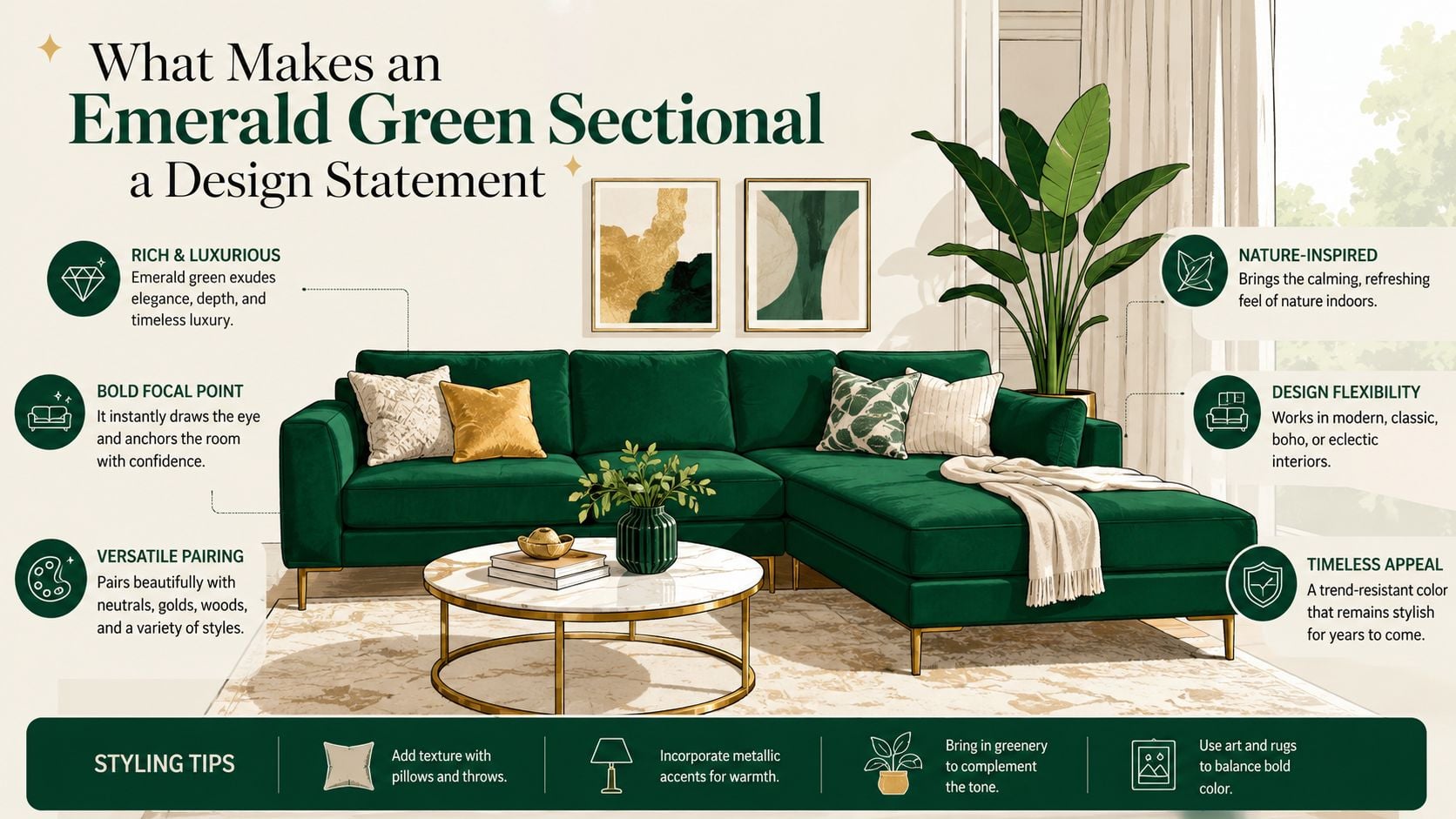
What Makes an Emerald Green Sectional a Design Statement
An emerald green sectional gets its authority from more than color alone. The pigment itself has history. Emerald green was first produced commercially in 1814 by Wilhelm Sattler's firm in Schweinfurt, Germany, after being developed in 1808 as an attempt to improve Scheele's green, and it was a copper acetoarsenite pigment, which helped explain both its brilliance and its later decline because of toxicity and instability, according to WebExhibits.
The color language matters
That history matters because emerald green has always read as a jewel tone, not a timid accent. In modern digital systems, it's commonly represented by hex #50C878 with 31.4% red, 78.4% green, and 47.1% blue in RGB terms, which is why designers can reproduce a consistent look across fabric swatches, finishes, and decor, according to Canva's emerald green reference. When a sofa color is this specific, it deserves the same precision in the rest of the room.
That precision also helps when a homeowner is pairing the sectional with tables, rugs, lighting, and wall color. If the green is too yellow, too blue, or too muted, the whole composition changes. A true emerald tone stays rich, confident, and visually steady.
Why the sectional shape amplifies the color
The sectional format gives that color more presence because the eye reads a larger upholstered field at once. That's why emerald green works so well as a focal point in a room with open sightlines. It isn't trying to disappear. It's meant to organize the space.
A jewel tone looks most expensive when the rest of the room doesn't fight it.
A homeowner should think of this as a vocabulary lesson before shopping. Sectional shape says how the room will function. Emerald green says how it should feel. Put those together and the design direction gets much sharper.
How Sectional Construction Determines Whether It Lasts
A bold color does not rescue weak construction. If the frame flexes, the cushions collapse, or the stitching fails early, the sectional becomes a disappointment no matter how good the emerald looks on day one. That is why the smartest shoppers in Longwood ask about what's inside first.
Start with the frame and support
A quality sectional should have a solid internal structure, not flimsy shortcuts. Kiln-dried hardwood frames are the standard homeowners should ask for when they want real longevity, because a sturdier frame holds shape and resists the soft wobble that cheaper builds develop. By contrast, particle board construction belongs in temporary furniture, not in an investment piece that anchors a living room.
Spring systems matter too. Some sectionals rely on eight-way hand-tied springs, while others use sinuous wire support. The right choice depends on the build, but the key is consistency and support under daily use. Cushion engineering matters just as much, and high-density foam or a down-wrapped cushion can make a sectional feel supportive without becoming flat too fast.
Upholstery and brand character change the outcome
Fabric and leather behave differently, so the upholstered shell has to match the household. Top-grain leather holds up differently than bonded leather, and the difference shows up in wear, feel, and long-term appearance. A strong emerald green sectional can sit on very different bones, which is why construction vocabulary matters as much as the color swatch.
That's also where heritage and engineering become relevant. Some builders are known for custom comfort, some for American-made craftsmanship, and some for a more refined legacy of joinery and finish. The point isn't to memorize brand names. The point is to recognize that the same emerald tone can be built for very different lifespans.
For a homeowner comparing options, this guide on how long furniture should last is a useful starting point for separating true value from cosmetic appeal.
Bottom line: If the showroom can't clearly explain the frame, springs, and cushion core, keep shopping.
Sizing and Room Layout That Actually Works in Florida Homes
A sectional can look perfect on paper and still fail in a real Orlando living room if the footprint is wrong. Florida homes often have open layouts, wide sightlines, and direct movement to patios, kitchens, and entertainment walls, so the sofa has to support circulation instead of blocking it. The right measurements keep the room calm.
Measure the room before judging the style
The most useful habit is simple. Measure the room dimensions, then compare them with the sectional's overall width and depth. Expert buying guidance recommends leaving at least 30 inches of walkway space around the piece to prevent traffic bottlenecks and maintain usable flow in living rooms, according to Povison's sectional buying guidance.
That matters even more in Central Florida, where families often move between indoor lounging and outdoor living. A sectional that crowds a patio door or narrows the path to the kitchen will feel irritating fast. A good design consultant helps prevent that mistake before delivery day.
Match configuration to the household
A reversible-chaise model is often the smartest move in smaller spaces, because flexibility matters more than a dramatic shape. L-shaped sectionals fit many everyday rooms well, while U-shaped designs need more breathing room and make sense when the room can support a larger seating zone. Modular arrangements are useful when the household wants future flexibility or expects the room to change.
| Sectional Configuration at a Glance | Best Room Size | Seating Capacity | Ideal Central Florida Space |
|---|---|---|---|
| L-shaped | Moderate to larger rooms | Good for everyday family seating | Open living rooms in Sanford or Altamonte Springs |
| U-shaped | Larger rooms | Strong lounging and gathering capacity | Bigger family rooms in Winter Park |
| Reversible chaise | Smaller to moderate rooms | Flexible everyday seating | Condos or tighter plans in Lake Mary |
Before heading to a Longwood showroom, a homeowner should bring a tape measure and look for these details:
- Overall wall lengths, not just the open floor area
- Door swings and traffic paths, especially toward patios and kitchens
- TV placement and sightlines, so the sectional doesn't fight the room
- Window positions, which affect both scale and sunlight exposure
- Whether the chaise needs to switch sides, now or later
For planning help, this room-measuring guide is worth reviewing before any sectional is ordered.
Choosing Fabrics and Finishes for Real Florida Living
An emerald green sectional in Central Florida has to survive bright sun, humidity, pets, and family traffic without losing its color story. That's why fabric choice matters as much as silhouette. The wrong upholstery can make a gorgeous piece feel high-maintenance; the right one makes the room easier to live in.
Performance fabric beats drama when the household is busy
For many homes, performance fabric is the practical choice. It handles daily use better, cleans more easily, and gives the homeowner a better shot at keeping the color looking intentional instead of tired. That doesn't mean the sectional has to look plain. It means the fabric works harder.
Top-grain leather brings a different kind of value. It feels substantial, it tends to look more refined over time, and it pairs beautifully with emerald green when the room leans toward a richer, more polished look. Bonded leather is a different story, and it shouldn't be treated as an equal substitute for a family investment piece.
Texture should match the way the room is used
The boldest emerald velvet can look stunning, but it isn't always the smartest answer in a busy household. A cleaner-lined profile with easier upkeep often outperforms a showpiece fabric over the long term, especially where kids, pets, or heavy daily use are part of the picture. That's the trade-off a good consultant should explain.
A homeowner exploring upholstery options can also use this Slone Brothers upholstery materials guide to compare what feels luxurious versus what lives well in a Florida home.
Use the showroom to test the real-life details
The advantage of a face-to-face consultation is simple. The homeowner can touch the weave, judge the sheen, compare cushion recovery, and see whether the finish supports the room's light instead of fighting it. That kind of comparison is harder to trust through a screen.
A practical shortlist helps:
- Near large windows, choose finishes that hold color well and aren't overly delicate
- With pets, prefer fabrics that are easier to vacuum and maintain
- For humid homes, avoid upholstery that feels fragile or overly fussy
- For daily family use, prioritize comfort and cleanability before novelty
Styling Emerald Green With Colors and Materials That Complement It
Emerald green does its best work when the rest of the room supports it with confidence. The color already has presence, so the surrounding palette should frame it, not compete with it. In a Longwood or Winter Park home, that usually means mixing softness, contrast, and a touch of warmth.
Build the room around contrast and calm
Cream and taupe keep the sectional grounded and give the room visual breathing space. Black accents sharpen the look and make the green feel more architectural, while brass hardware adds polish without overcomplicating the palette. Rust and terracotta bring warmth, which can be especially effective in Florida homes that already get plenty of natural light.
Light wood and natural rattan soften the formality of the sectional. That combination works well in homes that want a more relaxed, transitional feel. It also keeps the room from feeling too jewel-box or too severe.
For homeowners who want a broader color strategy for the room, Slone Brothers' living room color palette guide can help connect the sectional to wall color, rug choice, and accent pieces.
Let materials do the rest of the talking
A solid wood coffee table beside emerald upholstery gives the room structure. Metal occasional tables can push the look more modern. Upholstered chairs in a neutral tone keep the sectional from dominating every sightline. That's where brands with distinct material identities become useful, because wood and metal finishes can anchor the room in a modern, transitional, or classic direction.
Shoppers who follow color trends in other categories may also find useful perspective in Tiles Mate's green tile trends article. It reinforces a simple idea, green works best when it's treated as a lasting design language, not a fleeting novelty.
Design truth: The room feels more expensive when the sectional is matched with materials that quiet the boldness instead of echoing it loudly.
Care and Maintenance That Protects Your Investment
The best emerald green sectional still needs a routine. In a Central Florida home, care is not an afterthought, because sun, humidity, and everyday living all leave marks over time. A good maintenance habit keeps the color rich and the seating comfortable.
Keep the surface clean before problems build up
Regular vacuuming helps prevent lint, dust, and pet hair from settling into the fabric. Cushions should be rotated when the construction allows it, because wear patterns show up faster in a sectional than many homeowners expect. That small habit extends the life of the seating and keeps the surface looking balanced.
Spills need quick attention. The longer a spill sits, the more likely it is to leave a visible mark or change the texture of the upholstery. Pet accidents should be handled right away, and the cleaning approach should always follow the material type rather than a one-size-fits-all rule.
Protect it from Florida light and humidity
Sun fading is a real concern near large windows, especially in rooms with strong afternoon light. Window coverings, thoughtful placement, and fabric choice all help preserve the look. Humidity matters too, because a comfortable home environment is part of long-term furniture care, especially for wood-framed pieces and upholstered builds with more sensitive materials.
The upholstery guide mentioned earlier becomes useful here because maintenance depends on the material. Performance fabric, top-grain leather, and specialty weaves each need a different rhythm. A homeowner should not buy a sectional without understanding how it will be maintained for the next several years.
Warranty and post-purchase support also belong in the conversation. A real investment piece should come with real guidance after delivery, not silence once the sale is done. That's how heirloom-quality furniture saves money over time, because it keeps its function and appearance longer instead of getting replaced early.
Buying Locally in Longwood and Greater Orlando
Ordering a sectional online without seeing the fabric, the finish, or the frame in person is still a gamble. A Longwood showroom removes a lot of that uncertainty because the homeowner can compare color, feel, scale, and construction face to face with a design consultant, not a chatbot. That matters when the piece is meant to anchor an entire room.
Slone Brothers Furniture offers custom-order options, complimentary in-home interior design services, flexible financing, reliable home delivery with order tracking, and a clearance outlet for immediate value. The showroom environment also makes it easier to compare brands such as Stickley, Smith Brothers, Stressless, American Leather, Bassett, Craftmaster, Amish, Canadel, Amisco, Palasar, and Mavin in a single visit. For local searchers, furniture stores near me in Longwood usually means one thing, fewer guesses and better guidance.
If the home is in a flood-prone part of Central Florida or the homeowner is reviewing household risk planning more broadly, compare flood policies for 2026 is a practical resource to review alongside furniture decisions. That kind of planning belongs in the same conversation as durable home investment.
Ready to invest in furniture that lasts a lifetime? Skip the online guesswork and automated digital chatbots. Visit the Slone Brothers Furniture showroom in Longwood, FL today. Connect face-to-face with experienced design consultants and let them help turn a house into a beautifully curated home. Want to experience the craftsmanship and explore complimentary in-home interior design services? Stop by the Central Florida showroom in Longwood and see the right emerald green sectional in person.