
Wall Decor Ideas for Central Florida Homes: 10 Designs


The moving boxes are gone, the sofa has arrived, and a newly settled Lake Mary homeowner can finally sit down. Yet the wall above the sofa still looks bare, and the long hallway feels more like a passage than part of the home. Good wall decor ideas solve that unfinished feeling by connecting the furniture, architecture, and personal objects into a considered whole.
Wall decor is architecture for the eye. A substantial painting can anchor an open living room, a mirror can redirect daylight, and a carefully framed textile can soften a bedroom without adding more furniture. The right choice depends as much on what sits beneath it as on the empty space surrounding it.
Central Florida adds practical considerations. Strong sunlight affects placement, humidity influences material care, and block or stucco construction calls for mounting methods suited to the actual wall assembly. A decorative finish isn't necessarily a structural anchor.
- Start with the furniture. Use the sofa, buffet, bed, or console to establish scale and finish.
- Choose a lasting direction. Gallery arrangements, statement art, mirrors, wood, textiles, lighting, and upholstered panels offer distinct ways to complete a room.
- Plan before purchasing. Slone Brothers' in-house Design Team can coordinate wall treatments with furniture, fabrics, and room dimensions.
For homeowners defining an investment range, these wall art ideas for your budget provide another starting point. The strongest result comes from selecting fewer, better-related pieces rather than filling every available wall.
1. Curated Gallery Walls for Living Rooms and Hallways
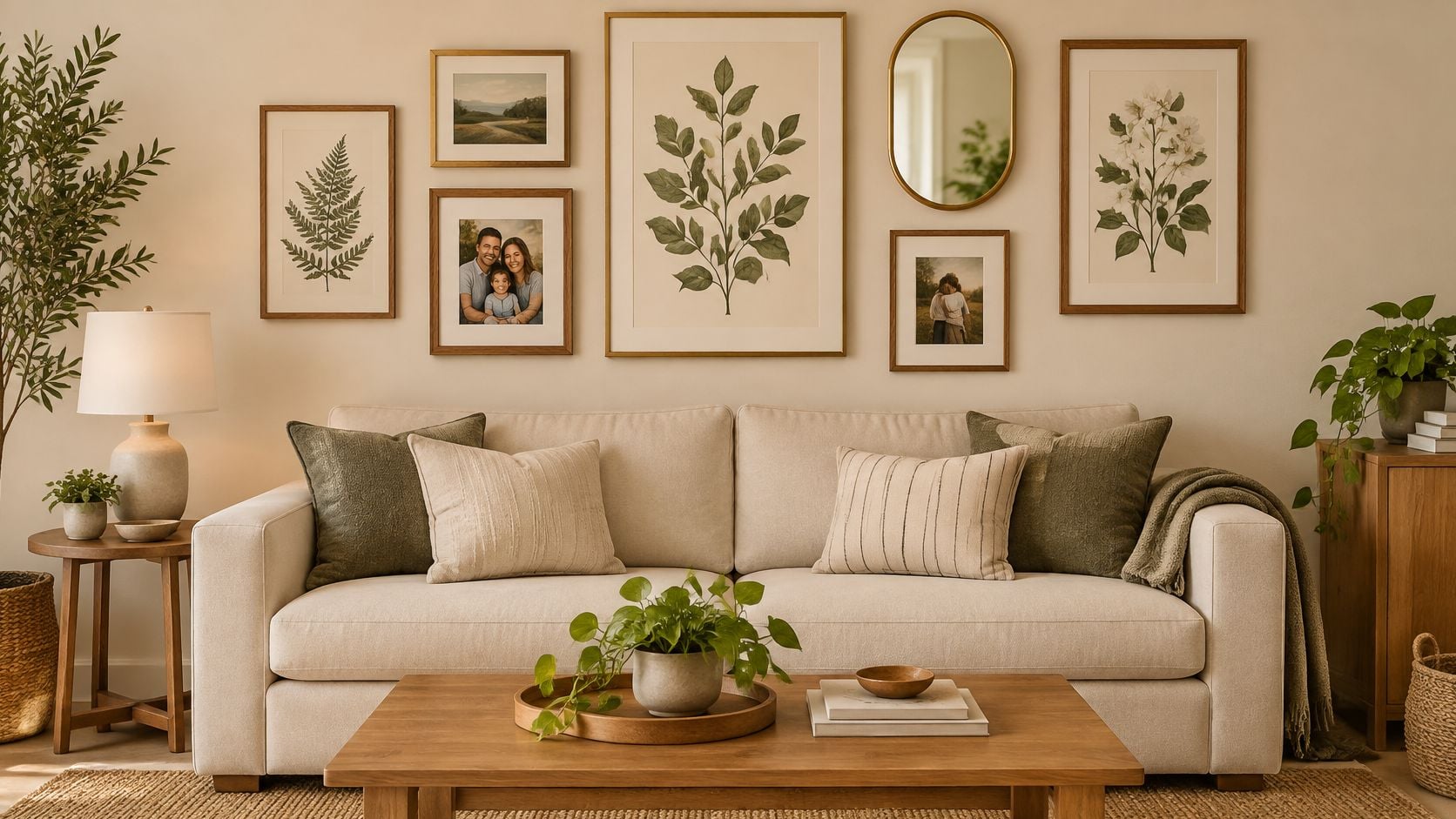
A curated gallery wall combines individual pieces into a single composition. It works especially well when a homeowner has meaningful photographs or smaller artworks that would look disconnected scattered throughout a room.
In a Lake Mary living room, a scenic print above a custom-fitted Smith Brothers sofa could anchor smaller botanical studies in complementary frames. A Winter Park hallway might call for family photographs in antique gold frames, with consistent matting providing the visual connection.
Build the arrangement before making holes
Lay the frames on the floor, then transfer their outlines to the wall with paper templates and painter's tape. For cohesive spacing, the Frame Calculator art-hanging guide recommends approximately 2–3 inches between frames and treating the entire arrangement as a visual unit.
- Control the finishes. Repeat a frame material or use complementary finishes with similar visual weight.
- Respect the furniture. Keep the composition visibly connected to the seating group rather than spreading across the entire wall.
- Protect circulation. Choose shallow frames along narrow hallways, especially where walkers or wheelchairs may pass.
Slone Brothers' guidance on choosing wall art for a living room helps connect arrangement decisions to furniture scale. For a farmhouse direction, these wall styling tips from Farmhouse World offer additional visual references without requiring every frame to match.
2. Oversized Statement Art as a Focal Point
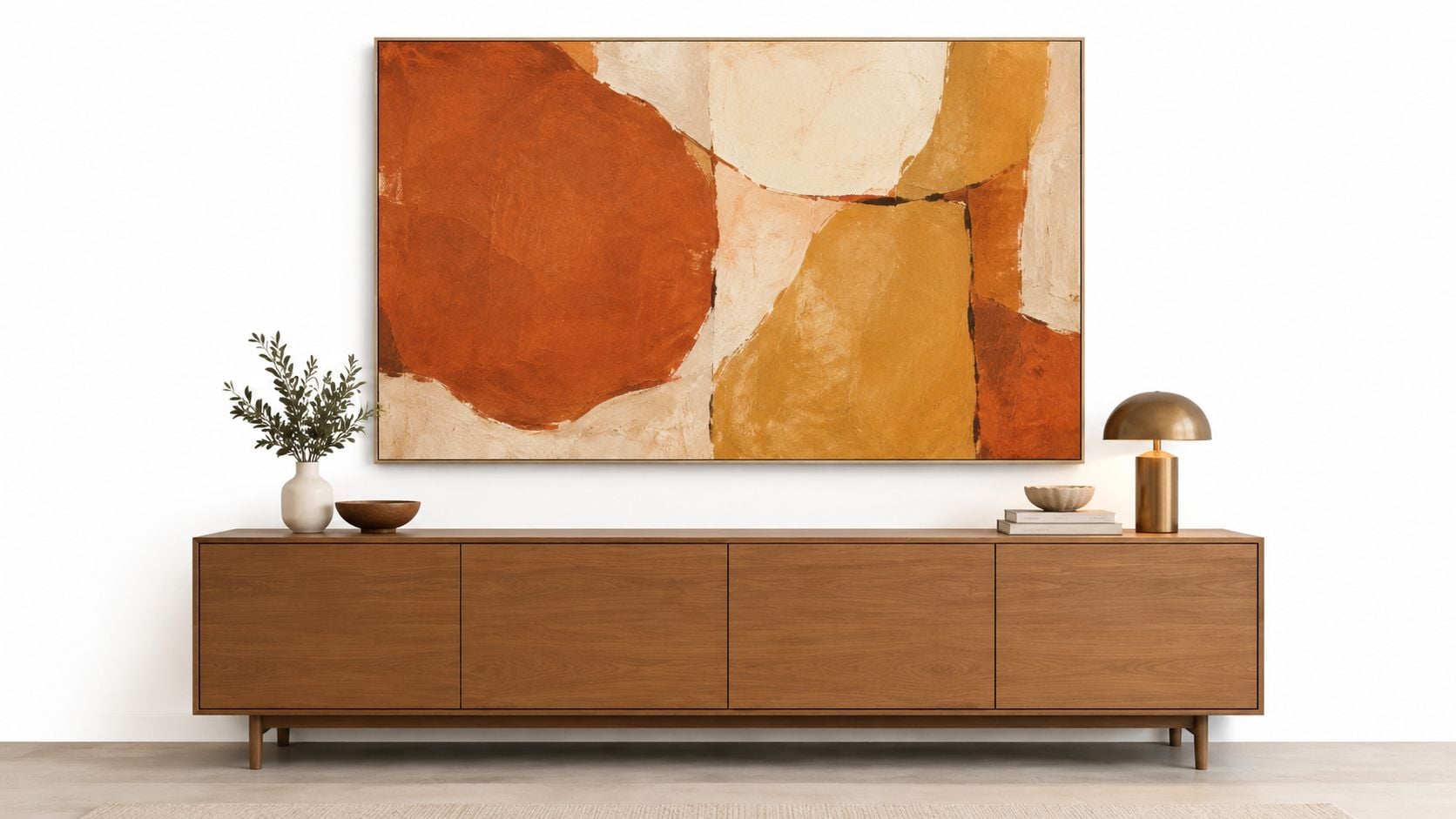
Oversized art gives an open room a clear focal point without the visual activity of a gallery wall. It's particularly effective above a substantial buffet, long sofa, or upholstered bed where smaller pieces would appear disconnected.
Consider an abstract canvas in terracotta and ochre above a Canadel solid birch buffet in a Sanford dining room. The painting can introduce warmth while the buffet's hand-finished surface provides a quieter foundation.
Placement principle
Scale the artwork to the furniture beneath it, not simply to the largest blank area.
The mounting point requires its own calculation. Colorado Art Services gives the example of a 57-inch artwork center, a 24-inch frame, and a 3-inch hardware drop, which places the hook 66 inches above the floor.
For furniture-anchored installations, the relationship to the buffet or headboard takes priority over an automatic eye-level formula. Templates help confirm that relationship before a heavy frame reaches the wall.
Near sliding glass doors, specify UV-filtering glazing where appropriate and move valuable art out of direct sunlight. Protective glazing isn't permission to leave sensitive materials in an intense sunbeam. Slone Brothers' big wall art ideas can help homeowners compare compositions before committing.
3. Statement Mirrors That Reflect Florida Light
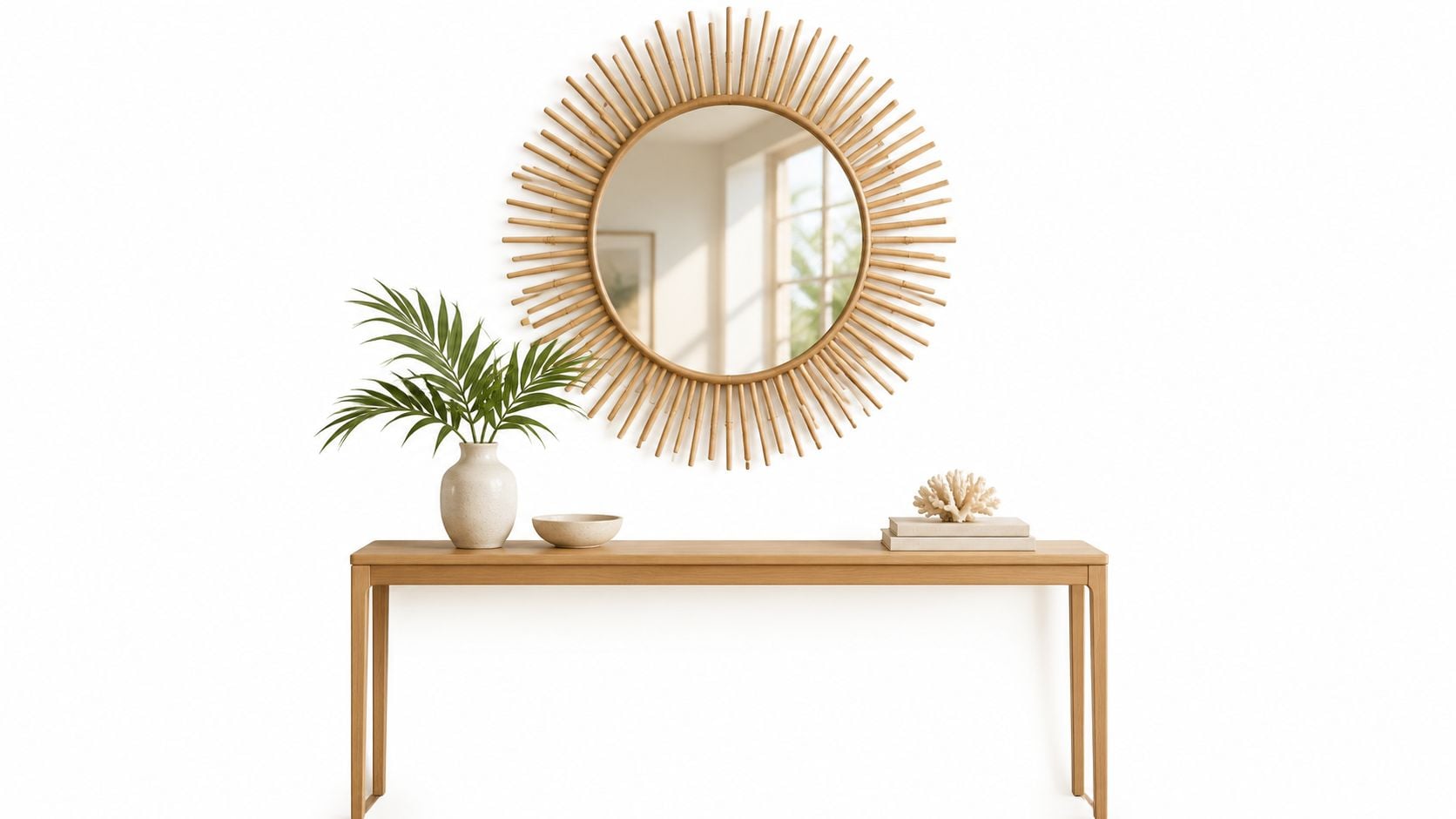
A statement mirror can brighten an interior corner and give an entry or dining room greater visual depth. Its success depends on the reflection, not merely the shape of the frame.
A round sunburst mirror above a Longwood entry console can capture soft morning light. An arched mirror above a Winter Park dining sideboard might reflect a chandelier and an attractive adjoining room rather than kitchen clutter.
Check the reflection from a seated position
A mirror opposite a window can redirect daylight, but it can also direct glare toward a sofa or dining chair. Test the location during the brightest part of the day and again with evening lighting.
- Inspect construction. Look for secure frame joints, sound backing, and hardware designed for the mirror's weight.
- Evaluate the finish. Sealed wood and appropriately finished metal still need stable indoor conditions; neither is automatically humidity-proof.
- Secure substantial pieces. A leaning floor mirror needs suitable restraint rather than relying on its weight to stay upright.
Accessibility deserves attention too. The American Institute of Architects' home design survey reported that 62% of respondents saw increased popularity for aging-in-place designs in 2025. Keeping projecting frames out of circulation paths makes decorative planning more inclusive.
Slone Brothers' decorative floor mirror guidance offers another way to consider mirrors alongside the furniture they'll accompany.
4. Stickley-Inspired Arts & Crafts Wall Decor
Arts & Crafts wall decor suits homeowners who value honest materials, visible craftsmanship, and a restrained connection to nature. Oak-framed scenic prints, hammered metal sconces, stained glass, and mission-style clocks complement the solid wood construction and handcrafted joinery of Stickley furniture.
A Longwood home office could pair a Stickley bookcase with a hammered copper sconce and a framed botanical study. In a Lake Mary living and dining space, a quartersawn oak clock could connect visually with a Stickley dining table without turning the room into a matching suite.
Coordinate character rather than copying finishes
Exact color matching isn't always necessary. A related undertone and compatible sheen often look more natural than several finishes that nearly, but don't quite, match.
- Repeat a material thoughtfully. Oak, copper, and warm glass can establish continuity without appearing on every wall.
- Leave breathing room. Distinctive joinery and figured wood deserve space rather than a dense surrounding collection.
- Control environmental exposure. Avoid mounting solid wood objects directly in the path of an air-conditioning vent.
The Florida Division of Library and Information Services explains that humidity changes can make paper swell and contract and that condensation creates preservation risks. Those concerns make stable interior locations preferable for framed works and mixed-material objects.
The trade-off is visual weight. Dark oak and hammered metal can feel substantial, so lighter upholstery and quieter surrounding walls often provide welcome balance.
5. Solid Wood Shelving and Wall-Mounted Display Pieces
Solid wood shelves combine storage with display, but their performance depends on the complete assembly. Wood species, shelf thickness, span, brackets, fasteners, and wall construction all matter more than the floating appearance alone.
In a Sanford home office, walnut shelves could display ceramics and art books above a desk. A Winter Park bedroom furnished with MAVIN solid wood pieces, crafted in Amish country, could use coordinated shelving selected for a compatible grain and finish.
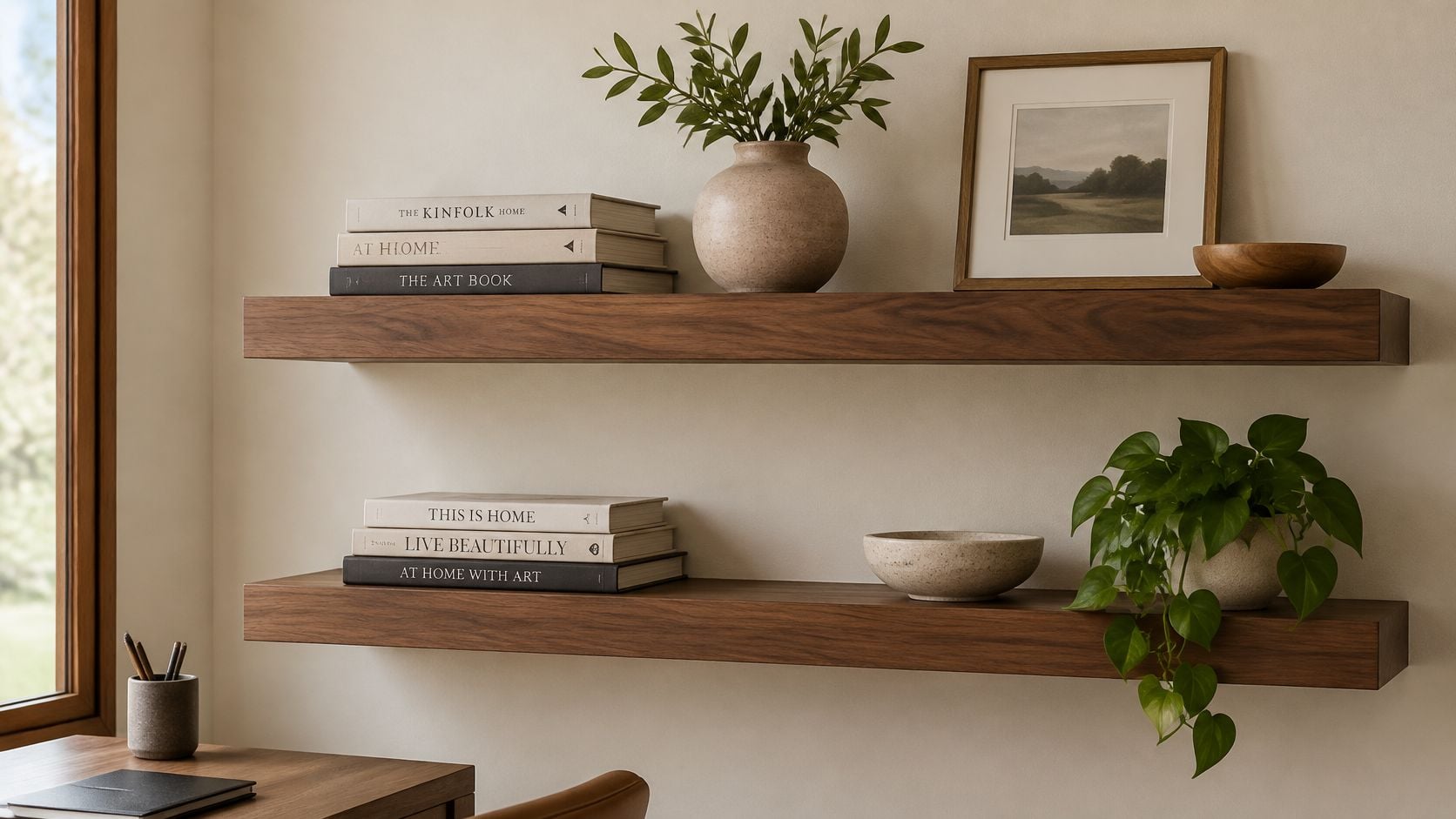
A beautiful shelf is only as dependable as its brackets, fasteners, and supporting wall.
Solid hardwood offers a repairable surface and natural character, but it isn't automatically stronger than every engineered alternative. Veneer describes a surface layer, not the quality of the entire structure; well-made veneered construction shouldn't be confused with poorly supported particleboard.
- Confirm the substrate. Drywall over framing, drywall over furring, and exposed masonry require different fastening strategies.
- Check the rated assembly. Account for the shelf itself as well as books, pottery, and framed objects.
- Clean conservatively. Dust with a soft cloth, then use a barely damp cloth followed by a dry one when the finish permits.
For block walls, an installer should identify hollow or solid areas and select the appropriate masonry anchor. Stucco alone shouldn't be treated as load-bearing support.
6. Coastal and Botanical Wall Art for Florida Homes
Coastal and botanical art feels most convincing when it reflects Florida's scenery rather than a collection of beach-themed accessories. Marsh grasses, inland waterways, palm studies, and atmospheric shorelines can feel local without making a room look themed.
A Lake Mary breakfast nook could pair botanical prints with a Simply Amish solid hardwood bench, allowing traditional joinery and natural grain to complement the artwork. In an Altamonte Springs bedroom, a quiet seascape can soften the visual weight of substantial wood case goods.
Choose atmosphere over novelty
A restrained coastal palette works with custom-fitted furniture as readily as with casual pieces. Soft greens, sand tones, and weathered blues can connect art to upholstery without repeating the same motif everywhere.
- Protect sensitive work. Request appropriate conservation materials and UV-filtering glazing for works on paper.
- Avoid direct exposure. Keep valuable pieces away from strong west-facing sun, even when protective glazing is specified.
- Verify fabric performance. When coordinating upholstered seating, check the actual fabric's lightfastness and cleaning guidance rather than relying on the word performance.
Slone Brothers' brass seagull wall decor illustrates a dimensional alternative to framed coastal imagery. A metal accent can work beside a scenic painting, but both need enough separation to remain distinct.
The strongest composition usually has a clear lead piece. Supporting accents should reinforce its palette or material, not compete to announce the coastal theme.
7. Solid Wood Paneling, Shiplap, and Board-and-Batten Accent Walls
Architectural wall treatments earn their keep in rooms that need structure more than another hanging object. A painted shiplap wall behind a Stressless recliner, with its Norwegian ergonomic engineering and Glide® system, gives a Longwood media room a composed backdrop, and board-and-batten behind a Winter Park bed can frame the furniture while keeping bedside walls calm.
Plan the construction around Florida conditions
Solid wood brings grain, depth, and the possibility of refinishing, and it also moves across its width as humidity shifts through the year. The wall has to be built to flex, fastened with movement allowances rather than locked edge to edge.
- Acclimate correctly. Let the installer judge readiness from the product requirements and site conditions rather than a fixed waiting period.
- Resolve moisture first. Never conceal staining, condensation, or a suspect exterior wall behind decorative paneling.
- Coordinate penetrations. Plan outlets, switches, sconces, and mounting blocks before installation.
A painted system can reasonably include engineered components where a smooth finish and dimensional stability matter most. Simple, shallow profiles handle Central Florida's humidity swings better than deep, intricate moldings, whose thin edges and tight recesses tend to swell, cup, and telegraph movement through the paint.
Use Slone Brothers' guidance on creating a perfectly balanced accent wall to relate panel spacing to the bed, recliner, or console. Leave a few inches of clear wall between the outer batten and the bed frame, and center each panel field on the furniture it frames rather than on the room's symmetry.
8. Woven Textile Wall Hangings and Amish-Inspired Quilts
Textile wall hangings add softness where framed glass, hard flooring, and wood furniture dominate. A well-chosen quilt or woven panel can introduce color and handwork without the reflective surface of another framed print.
A hand-stitched quilt in a Sanford guest room could complement an Amish-crafted chest. Above a Simply Amish bed in Longwood, a restrained woven hanging can provide a softer contrast to hand-selected hardwoods and traditional joinery.
Preservation priority
Display methods should support the textile's weight without concentrating strain on fragile corners or stitches.
Authentic craftsmanship deserves accurate description. A geometric quilt isn't necessarily Amish-made; provenance should establish the maker rather than the pattern alone.
Support the textile, not just its corners
For a sound contemporary quilt, a properly sewn hanging sleeve can distribute weight across a rod. Fragile antique textiles may need a conservator-designed support or a suitable conservation mount rather than a decorative clamp.
- Limit sunlight. Choose an interior wall with indirect light, particularly for strongly colored fabrics.
- Avoid damp locations. Don't hang valuable textiles against a wall with unresolved condensation.
- Clean cautiously. Delicate fibers may need low-suction vacuuming through a protective screen or professional conservation advice.
Textiles do collect dust and require more deliberate care than a sealed frame. That trade-off is worthwhile when the piece contributes meaningful craftsmanship, but a fragile heirloom shouldn't become an everyday experiment in cleaning or mounting.
9. Sculptural Wall Sconces and Lighting as Art
Sculptural sconces provide light while contributing shape, finish, and rhythm to a wall. They work best as part of a room's lighting plan, decided alongside the wiring rather than after the furniture is placed.
Hammered brass sconces flanking a Canadel buffet pick up its hand-finished birch and warm dining upholstery. Slim shaded fixtures beside a Winter Park bed create a quieter composition than oversized lamps crowding the nightstands.
Set height by the fixture and the viewer
For a dining sconce, set the shade so its center sits near a seated diner's eye level, keeping the bulb out of the direct sightline. From that starting point, shade position, bulb visibility, ceiling height, and nearby artwork determine whether a fixture feels comfortable in a specific room.
- Test glare. Check the bulb or light source from dining chairs, recliners, and the bed.
- Confirm compatibility. Select dimmers and lamps or integrated fixtures designed to work together.
- Coordinate finishes. Relate brass, bronze, or nickel to nearby furniture hardware without requiring an exact match throughout the house.
In Central Florida's humidity, solid brass and bronze age gracefully where thin plated coatings can pit, which matters on walls near exterior openings and lanais. In block construction, concealed wiring takes more planning than it does in a framed partition. Have a licensed electrician assess routing and mounting before the fixture is ordered.
Picture lights need similar care. Position them to illuminate the artwork without creating a bright reflection across the glazing, and avoid fixtures that place unnecessary heat close to sensitive materials.
10. Upholstered and Fabric-Wrapped Accent Walls
Upholstered panels extend the softness of fine furniture onto the wall. They're especially useful in a bedroom or media room where comfort, restrained texture, and reduced reflected sound matter.
A Longwood media room could combine a performance-fabric panel wall with Palliser sectional seating, selected from its contemporary North American leather and fabric offerings. In a Lake Mary guest suite, fabric panels could coordinate with an American Leather Comfort Sleeper® without requiring identical upholstery.
Specify the wall assembly as carefully as the sofa
A fabric sample doesn't reveal the whole installation. Substrate, padding, seams, edge treatment, attachment, and access to outlets all affect the finished result.
- Review the textile. Confirm lightfastness, cleaning instructions, pattern repeat, and suitability for the intended wall application.
- Check replacement access. Removable individual panels can make future repair more manageable than a continuous upholstered surface.
- Inspect the wall first. Fabric and padding shouldn't conceal moisture problems on an exterior wall.
Absorptive materials can soften room reverberation, but decorative upholstery isn't equivalent to a tested sound-isolation system. Media rooms with serious acoustic goals need an assembly designed for that purpose.
A related fabric often looks richer than an exact match. Pairing a quiet wall textile with more tactile seating creates depth, while strong pattern on both surfaces can make a restful room feel busy.
How the 10 Wall Decor Ideas Compare for Central Florida Homes
For a rental, prioritize framed art, mirrors, quilts, and other pieces that can be mounted with a small number of fasteners. In an owned block home, built-in paneling and shelving offer a longer-term finish, but masonry anchors or a suitable mounting system may be needed. The table compares typical installation effort and the practical decision each option raises in Central Florida.
| Item | Best Room | Installation Effort | Upfront Investment | Central Florida Decision |
|---|---|---|---|---|
| Curated Gallery Walls for Living Rooms and Hallways | Living rooms, hallways, staircases | Moderate; plan the layout and secure each frame | Moderate; varies with art and framing | For a rental, use a compact grouping that needs fewer wall penetrations |
| Oversized Statement Art as a Focal Point | Living rooms, dining rooms, bedrooms | Moderate; large pieces need secure mounting | High for quality original work | Confirm the piece can be safely mounted to the home's block or stucco wall |
| Statement Mirrors That Reflect Florida Light | Entryways, dining rooms, narrow rooms | Moderate; larger mirrors need secure mounting | Moderate; varies by size and frame | Check the reflection from the room's main seating or entry point |
| Stickley-Inspired Arts & Crafts Wall Decor | Living rooms, home offices | Moderate; solid pieces may need sturdy anchors | High for authentic handcrafted pieces | Suit this style to rooms with substantial wood furniture and trim |
| Solid Wood Shelving and Wall-Mounted Display Pieces | Home offices, bedrooms, living rooms | Moderate; anchor into studs or use rated anchors | High compared with engineered shelving | On block walls, confirm the mounting system is rated for the shelf and its contents |
| Coastal and Botanical Wall Art for Florida Homes | Bedrooms, breakfast nooks, living rooms | Low to moderate; depends on size and framing | Low to high, depending on artwork | Choose a scale that fits the room rather than relying on a coastal motif alone |
| Solid Wood Paneling, Shiplap, and Board-and-Batten Accent Walls | Living rooms, dining rooms, bedrooms | High; professional installation recommended | High; materials and labor add up | Best suited to an owned home where a permanent wall treatment makes sense |
| Woven Textile Wall Hangings and Amish-Inspired Quilts | Bedrooms, guest rooms | Low to moderate; use protective mounting | Moderate to high for handmade or heirloom textiles | Removable mounting makes seasonal rotation or cleaning more practical |
| Sculptural Wall Sconces and Lighting as Art | Dining rooms, bedrooms, living rooms | Moderate to high; may require electrical work | Moderate to high; varies by fixture and installation | In a block home, locate wiring and mounting needs before choosing the fixture |
| Upholstered and Fabric-Wrapped Accent Walls | Media rooms, primary bedrooms, home offices | High; careful fitting and installation needed | High compared with paint or wallpaper | A better fit for an owned home where the wall assembly can be planned as a lasting feature |
Bring Your Wall Vision Home to Longwood
The best wall treatment completes the furniture rather than competing with it. A gallery wall needs a clear relationship to the sofa, a mirror needs a worthwhile reflection, and wood or upholstered panels need construction details suited to the home.
For Central Florida homeowners, that means weighing beauty and practicality together. Sunlight, humidity, wall substrate, furniture placement, and daily circulation belong in the conversation before a frame, mirror, or panel system is ordered.
Bring the room into the conversation
A productive showroom visit begins with photographs of the room and its adjoining spaces. Wall dimensions, ceiling height, furniture measurements, and close-up images of existing finishes help a design consultant separate an appealing idea from one that will actually fit.
- Bring material references. Upholstery swatches, flooring samples, and cabinet-finish photographs make color decisions more reliable.
- Identify the difficult locations. Note intense afternoon sun, nearby air-conditioning vents, narrow passages, and exterior walls built from block or stucco.
- Explain what stays. An inherited chest, a favorite painting, or an existing dining table should guide the composition.
Family-owned and operated in Longwood since 1980, Slone Brothers Furniture pairs complimentary in-home interior design services with custom-order options for finishes, fabrics, and configurations, so Greater Orlando homeowners can plan entire rooms rather than isolated purchases.
That approach supports better investment decisions. A hand-finished Canadel dining piece, a Stickley cabinet, or an Amish-crafted bed has its own grain, proportions, and construction details. Coordinating wall decor with those qualities helps the room feel collected and intentional.
Invest in the parts worth keeping
Heirloom-quality furnishings cost more initially because materials, joinery, tailoring, and finishing require skilled work. Their long-term value depends on appropriate use and care, along with the ability to maintain or repair them rather than automatically replace them.
Wall decor deserves the same scrutiny. Sound framing, suitable mounting hardware, conservation materials where needed, and thoughtful placement protect both the object and the room around it. In a Florida home, that means confirming wood has acclimated before it goes up, keeping textiles and artwork out of direct sun, and anchoring heavier pieces into studs or rated anchors on masonry walls.
For homeowners in Lake Mary, Sanford, Winter Park, and Altamonte Springs, face-to-face planning offers something a product photograph cannot: the chance to compare actual finishes, discuss construction, and judge scale with an experienced person. Before the visit, gather photographs of the room from several angles, measurements of each wall and the furniture beneath it, and notes on where afternoon sun or air-conditioning airflow hits.
Ready to invest in furniture that lasts a lifetime? Schedule a complimentary in-home design consultation and visit Slone Brothers Furniture in Longwood, FL, for quality furnishings, custom-order options, and a design team that works with you in person. Bring your photographs, wall measurements, and finish samples, and leave with a plan that coordinates wall decor with the furniture, materials, and proportions of your room.