

Home Bar Shelf Guide for Central Florida Homes

A home bar shelf seems simple until the room is finished, the bottles arrive, and the layout has to work every night, not just look good in photos. In a Lake Mary new build, a Winter Park bungalow refresh, or a Sanford bonus room conversion, that shelf becomes part display, part storage, part structural decision. For Central Florida homeowners who care about finish quality and long-term value, it deserves the same attention as a dining room sideboard or a custom media cabinet.
The market confirms that this is no minor accessory. The global home bar furniture market was valued at $3.2 billion in 2025 and is projected to reach $4.9 billion by 2034, with a 5.8% CAGR from 2026 to 2034, and bar cabinets held the largest product share at 32.5% in 2025, about $1.04 billion. That scale matters in Longwood and across Greater Orlando because it means buyers are choosing real furniture categories, not decorative add-ons.
Why a Home Bar Shelf Deserves More Thought Than a Quick Online Order
A homeowner finishing a great room in Lake Mary or turning a Sanford den into an entertaining space usually starts with the same mistake, treating the home bar shelf like wall décor. That's the wrong lens. A shelf loaded with bottles and stemware is a working piece of furniture, and the finish, depth, bracket strength, and wall anchoring all matter more than the staged photo that sold it.
Consumer behavior backs up the shift toward at-home entertaining. In 2023, 26% of U.S. consumers said they were spending more on beverages at home rather than going out, a change tied to inflation and on-trade pricing (The Spirits Business). For a homeowner, that means the bar area has to function like a small service zone, not a decorative corner that only looks finished from across the room.
Practical rule: if a shelf can't safely carry heavy bottles, it isn't a bar shelf, it's a display strip.
A thoughtful homeowner also knows that a home bar shelf affects how the entire room reads. Open shelving can make a narrow wall feel lighter, while cabinet-based storage can pull visual clutter off the counter and hide backups cleanly. That's why a local showroom conversation matters, because a design consultant can look at the actual room proportions, ceiling height, and traffic flow rather than guessing from a product page.
For readers who want a visual starting point before they measure, designing a home bar is a useful way to see how layout and function work together. The takeaway is simpler, though. Buy the shelf as a furniture decision, not a spontaneous décor purchase.
Choosing the Right Home Bar Shelf Style for Your Space
The right style depends on how the room is used, not just how it looks on a mood board. In open-plan Central Florida homes, the shelf often needs to blend with dining and living zones. In condos or townhomes, it has to fit a smaller wall run and still feel intentional.
The main styles worth considering
A floating shelf is the cleanest visual choice, but it only works well when the bottle count stays modest and the wall support is strong. Built-in cabinetry gives the most presence and hides clutter, which suits homeowners who want the bar area to feel like a permanent part of the room. Open shelving keeps the space airy, but it demands discipline because every bottle and glass stays visible.
Modular systems are the smartest answer for a room that may evolve. They let the homeowner add storage, change spacing, or combine shelves with a base cabinet later. Standalone bar units are the least invasive option, and they work best when the room needs flexibility or when the homeowner wants a piece that can move with them.
| Home Bar Shelf Styles Compared | Best For | Typical Capacity | Custom-Order Friendly |
|---|---|---|---|
| Floating shelves | Tight walls, light display | Light to moderate | Yes |
| Built-in cabinetry | Dedicated bar walls | High | Yes |
| Open shelving | Airy entertaining spaces | Moderate | Yes |
| Modular systems | Changing layouts | Moderate to high | Yes |
| Standalone bar units | Flexible rooms | Moderate | Sometimes |
For style inspiration beyond the bar itself, style guides for Keurig setups show how compact stations rely on the same discipline, clear zones, visible access, and a controlled visual rhythm. That logic applies here too.
Slone Brothers commonly customizes bar-area pieces for Longwood and Orlando homes where the owner wants a shelf system that feels built in, not improvised. The best result is usually the one that fits the wall cleanly and leaves the rest of the room alone.
Materials and Finishes That Hold Up in Central Florida
Florida humidity changes the conversation. A shelf that looks flawless in a dry showroom can still disappoint if the core material swells, the finish weakens, or the hardware corrodes near a patio-adjacent entertaining area. That's why the safest choice is usually the one built from stable materials with honest joinery and a finish that can be maintained, not just admired.
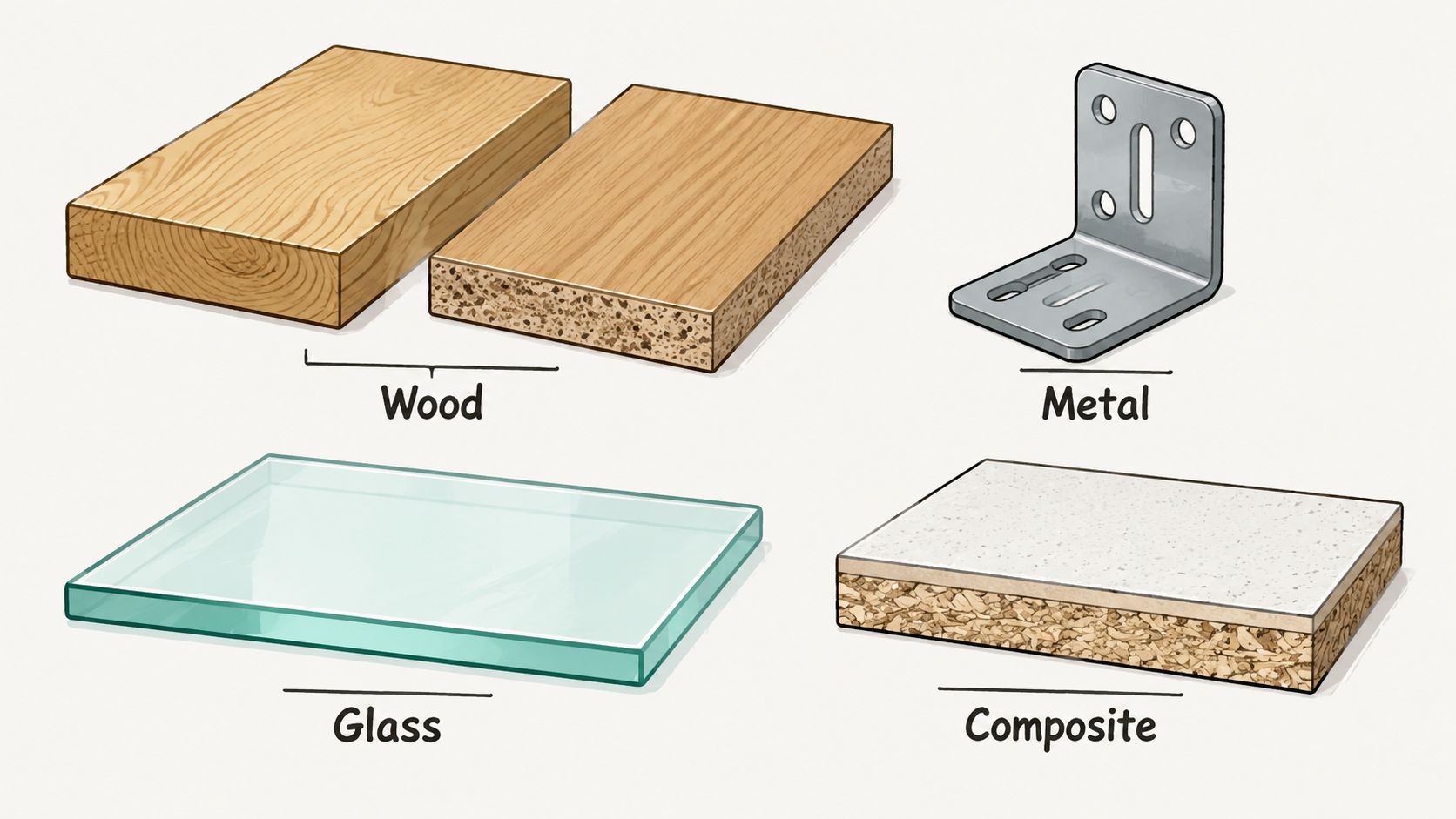
Wood, metal, and glass behave differently
Solid wood has real structural value because it can be refinished and tends to age more gracefully than thin composite construction. That said, it still needs proper sealing and sensible care in humid homes. A carefully built piece from a maker that specializes in hardwood furniture, such as Simply Amish or Stickley, makes sense when the homeowner wants the shelf to look like it belongs with heirloom dining or storage pieces.
Powder-coated metal and stainless hardware are smart where durability comes first. They resist wear well and suit homes where the bar area sits near a pool door, lanai, or high-traffic entertaining path. Stainless construction also pairs well with clean-lined, more contemporary interiors.
Glass brings polish, but it must be specified with restraint. It works best as an accent, not as the sole structural element, because bottles create concentrated point loads and can make all-glass solutions feel fragile.
Wood gives warmth, metal gives discipline, glass gives light, but none of them should be chosen without thinking about maintenance.
That maintenance question matters in real homes, especially in Central Florida where interior climate control is only part of the equation. For wood care specifics, a practical maintenance reference is how to care for wood furniture, which is worth reviewing before choosing a finish. At the seating edge of the bar area, collections from American Leather can help the whole space feel connected rather than pieced together from unrelated items.
The point is not to chase the hardest surface or the shiniest finish. The point is to choose a construction that stays attractive after years of use, cleaning, and seasonal humidity shifts.
Sizing Depth, Height, and Clearance Around Real Bottles and Glassware
Shelf dimensions should start with the tallest bottle, not the prettiest arrangement. A shelf that is too shallow or too tight above feels awkward on day one and irritating by the third use. The sensible move is to measure the actual bottles, decanters, and glassware that will live there, then size the shelf around them.
A simple measurement sequence
Begin with bottle depth. A practical shelf for standard bottles needs at least 12 inches of depth, and 14+ inches makes more sense for oversized spirits or decanters. Another buying guide puts standard bar shelves at 10 to 12 inches deep and notes that a quality shelf should support 40 to 50 pounds per linear foot. Use the deeper figure when the shelf will hold real bottles, not decorative objects.
Vertical clearance deserves the same attention. A sizing guide recommends at least 13 inches of vertical space for standard 750 ml bottles and 15 to 18 inches for oversized or specialty bottles, while barware such as decanters and cocktail shakers generally needs 10 to 12 inches of clearance (Soil and Oak). That same source notes typical bottle heights around 11.5 to 13 inches for standard wine bottles and about 13 inches for champagne or prosecco, which explains why a shelf can look fine in a sketch and still feel cramped in daily use.
Measure from the wall, not from memory. A local homeowner in a condo or townhome often has less wall run than expected, so every inch matters. Before you order anything, use a practical guide for how to measure furniture and mark the tallest item first on the wall plan. That simple step prevents the common mistake of building a layout that looks balanced but fails once full-size bottles go in.
Rule of thumb: size the shelf for the largest bottle or decanter first, then build the rest of the layout around that measurement.
Capacity depends on layout as much as width. A corner bar unit listing 10-bottle storage measures 47.24 inches wide, 35.43 inches deep, and 41.93 inches high (Soil and Oak). That is the lesson. Width alone never tells you whether the shelf will work.
Mounting, Anchoring, and Why Decorative Shelves Fail Under Bottle Loads
A shelf is only as reliable as the wall behind it. A decorative floating shelf may look fine for a plant, framed art, or a small stack of books, but bottles create concentrated loads that expose weak fasteners quickly. In a real bar area, mounting is not an afterthought, it is the part that protects the whole installation.
What the wall needs to do
For drywall installations, the safer choice is toggle bolts or stud-mounting for anything over 25 pounds. When studs line up, lag bolts are the stronger option, and masonry or concrete walls need anchors matched to the load. The shelf face does not carry weight. The wall assembly does.
A better shelf spec reflects that reality. Commercial-grade construction can call for type 304 stainless steel, 22-gauge shelf material, and 16-gauge concealed mounting brackets because repeated point loads from bottles and stemware need more than a decorative front edge. That is a very different build from a light shelf meant for minimal load.
For homeowners who want the install handled with care, a local showroom with design service and white-glove delivery is usually the safer route than guessing at anchors after the fact. A shelf is part furniture, part structure, and part finish work, so the handoff matters as much as the product.
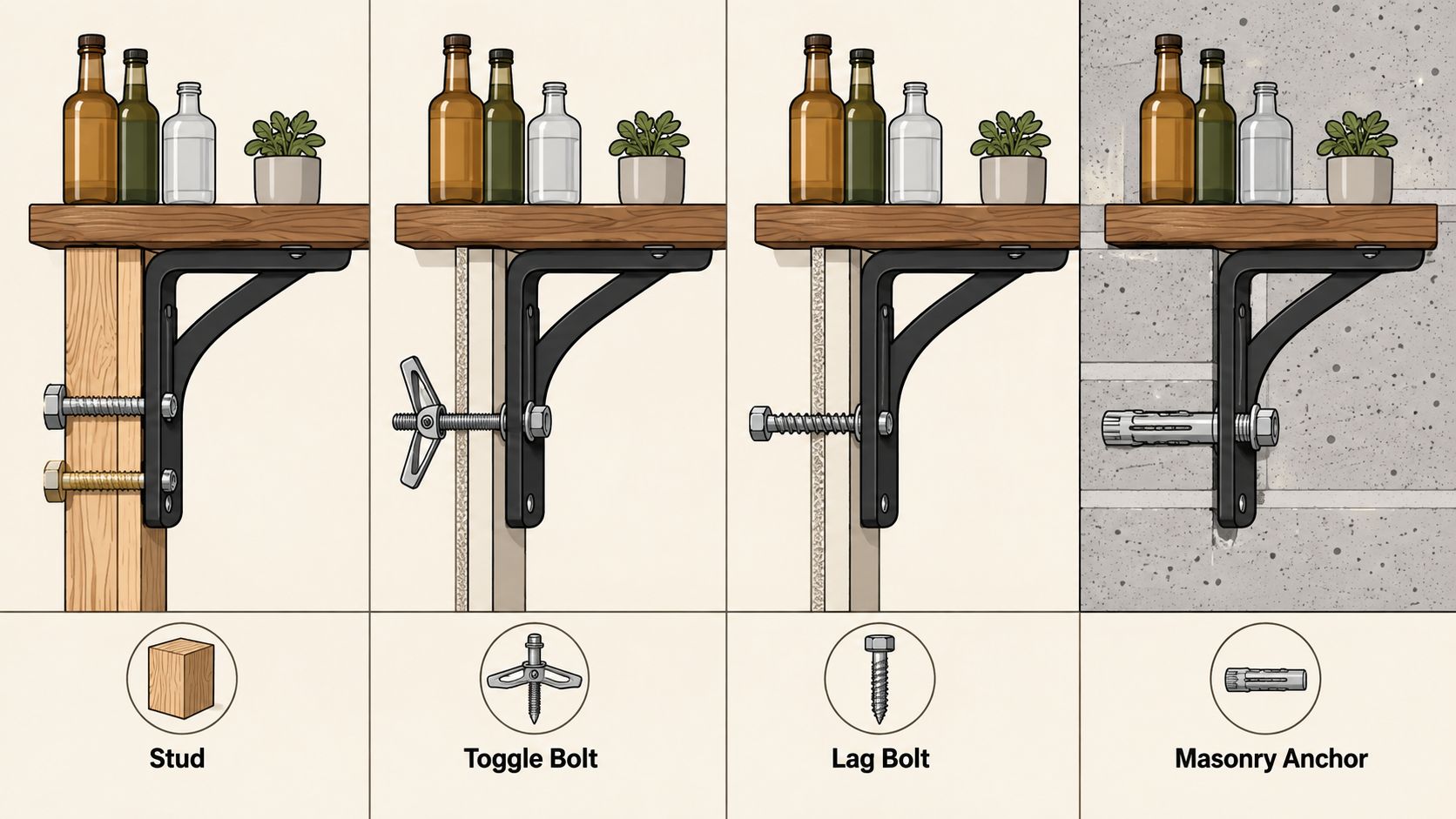
If the anchor choice is wrong, the shelf becomes a repair problem instead of a design feature.
For precise installation techniques, see our guide on hanging your picture with precision. The same discipline applies here. Good mounting protects the bottles, the wall, and the room around them. That is why the smartest buyers ask about wall type before they ask about finish color.
Styling and Storage Ideas That Match How You Actually Entertain
The prettiest home bar shelf is often the least livable one. Social photos love symmetry, open surfaces, and carefully spaced objects, but real households need quick access, safe storage, and a layout that doesn't collapse into clutter after one dinner party. A useful shelf respects how the family pours, cleans, and restocks.
Style should serve the routine
Heavier bottles belong lower, not up high where they're awkward to lift or more likely to slide. Glassware works better where it's easy to reach without stretching, and daily-use spirits should sit in the most accessible sightline. One organization guide also warns against keeping glassware on higher shelves, which is sensible in any active home.
The cleanest setups usually combine a few disciplined pieces, a low cabinet, one visible shelf, and under-bar storage for backups. In smaller homes, modular components make more sense than one oversized statement wall because the room might also need to support dining, work, or casual seating. That same logic is why homeowners in condos and open-plan spaces often benefit from shelving that can adapt instead of dominate.
For readers thinking in room-wide terms, how to decorate shelves in any room is helpful because the same visual rules apply here, group items with purpose, leave breathing room, and avoid overfilling the surface. A bar wall that can breathe looks more expensive and stays easier to use.
Slone Brothers' broader assortment supports that kind of planning, too, from Canadel dining pieces that coordinate with entertaining areas to Bassett entertainment walls that help the room feel unified. The strongest bar rooms don't look assembled from unrelated pieces, they look planned.
Design rule: if the shelf arrangement makes cleanup hard, it's the wrong arrangement.
That's the line most inspiration boards never cross. A well-edited bar area should still work after the guests leave.
Working With a Local Showroom Instead of an Algorithm
A home bar shelf is one of those purchases that benefits from seeing materials, lifting samples, and comparing proportions in person. In a Longwood showroom, a design consultant can look at the room, the finish palette, and the actual wall conditions, then turn the idea into a specified piece instead of an uncertain checkout decision. That's the difference between buying furniture and solving a room.
Custom-order options matter here because the right shelf often needs a specific width, depth, finish, hardware style, or glass insert to fit the house. A complimentary design appointment can also pull together the shelf, nearby seating, and any storage wall into one coordinated plan. For homeowners who value long-term value over short-term novelty, that kind of human guidance is the point.
The published category and service mix at benefits of shopping local reinforces the value of face-to-face decision-making, especially when the project involves custom furniture, delivery coordination, and finish matching. For shoppers who want immediate value on premium pieces, the clearance outlet can also be a practical place to find a fit without giving up quality.
Slone Brothers Furniture is one option for that process, because it combines a Longwood showroom, custom ordering, and in-house design support under one roof. That's useful when the project is more exacting than a standard accessory purchase.
Care, Maintenance, and Your Next Step in Longwood
A good home bar shelf should be easy to live with. In Central Florida humidity, that means dust it regularly, use non-abrasive cleaners, and check hardware seasonally so screws, brackets, and anchors stay tight. Quality finishes help protect wood and metal, but they still need simple care, especially in homes that open to patios, pools, or busy entertaining spaces.
Custom-order pieces also make sense when a homeowner wants finishes sealed and specified with the local climate in mind. That's a practical advantage, not a luxury extra.
Ready to invest in furniture that lasts a lifetime? Skip the online guesswork and automated digital chatbots. Visit the Slone Brothers Furniture showroom in Longwood, FL today. Connect face-to-face with experienced design consultants and let them help turn a home bar shelf into a polished, functional part of the room.

