

Memory Foam Mattress Cooling: What Really Keeps You Cool


Buying gel foam is often the first advice offered to someone who sleeps hot. It's incomplete advice. Memory foam mattress cooling deserves a closer examination of where body heat goes, how much a material can absorb, and whether that heat can escape into the bedroom.
For homeowners in Longwood, Orlando, and Lake Mary, the useful question isn't which mattress feels coldest under a hand. It's which construction remains comfortable under a sleeper, beneath everyday bedding, in a bedroom that may stay warm overnight. A cooling label can't answer that question, but a clear explanation of the materials can.
Which Memory Foam Mattress Cooling Features Actually Work?
Features that absorb body heat or help move it away have the strongest physical basis for cooling. A thin, breathable comfort layer paired with documented heat-storage technology is a more defensible starting point than a gel label alone.
The distinction is between heat capacity, meaning how much heat a material can absorb, and heat transfer, meaning how readily heat moves through or away from it. Neither should be confused with a surface that feels cool at first contact.
A controlled human study in Scientific Reports estimated the heat capacity of the cooling mattress's top 2 cm at approximately 94.0 kJ/°C, compared with about 10.8 kJ/°C for the regular memory-foam control, and found lower measured core and proximal-back temperatures. That's a construction-level difference, not merely a different fabric finish.
Memory foam cooling features ranked by mechanism
The comparison below moves from conventional foam toward more deliberate thermal management. It ranks mechanisms, not individual mattresses, because finished-product performance still requires testing.
| Feature | How it handles heat | What the evidence shows | Best fit |
|---|---|---|---|
| Standard memory foam | Limited heat movement; dense foam insulates | Heat-retaining baseline during prolonged contact | Shoppers prioritizing contouring over temperature |
| Gel-infused memory foam | Gel may improve surface conduction, depending on formulation and amount | A gel label alone doesn't establish cooling performance | Mild warmth concerns in a cooler room |
| Phase-change material layer | Absorbs heat within its transition range | Laboratory evidence supports temporary buffering, limited by storage capacity | Hot sleepers seeking documented buffering |
| Open-cell or perforated foam | Creates pathways for air movement | Useful as part of a construction, weaker alone in dense foam | Shoppers comparing less restrictive foam systems |
| High-heat-capacity comfort layer | Absorbs conducted body heat | Human testing supports temperature changes for a specifically engineered design | Sleepers seeking evidence beyond a cool-touch finish |
| Breathable cover | Supports surface airflow and moisture movement | Breathability isn't proof of substantial heat storage | Humid bedrooms, paired with suitable underlying materials |
| Active temperature-controlled cover | Regulates the sleep surface using a powered system | Controlled evidence is promising but not broadly conclusive | Persistent overheating after room and bedding changes |
Active cooling belongs in a separate category. A controlled study described in a Sleep conference abstract reported 17 additional minutes of slow-wave sleep in men using an active temperature-controlled cover while sleeping below 26°C. The sex-specific finding doesn't establish the same benefit for every sleeper.
Buying rule: A meaningful cooling explanation identifies where the heat goes, not just what the layer is called.
Balance cooling against the complete mattress
Gel and phase-change formulations may alter surface feel, while powered covers add electricity, maintenance, compatibility considerations, and cost. More ventilation also shouldn't become a reason to disregard support.
The difference between memory foam and hybrid mattresses is useful context when comparing the entire support system rather than selecting a mattress by its top layer alone.
Why does memory foam hold heat against the skin?
Memory foam can feel warm for a structural reason: it conforms closely as it responds to body warmth, reducing open space around the sleeper. Its polyurethane structure also transfers heat slowly, so warmth can remain near the contact surface instead of dispersing readily.
A materials study published in WJARR reports thermal conductivity of approximately 0.02–0.03 W·m⁻¹·K⁻¹ for the polyurethane foam examined. That result applies to the tested material, not every mattress. It helps explain why conventional foam can act partly as insulation.
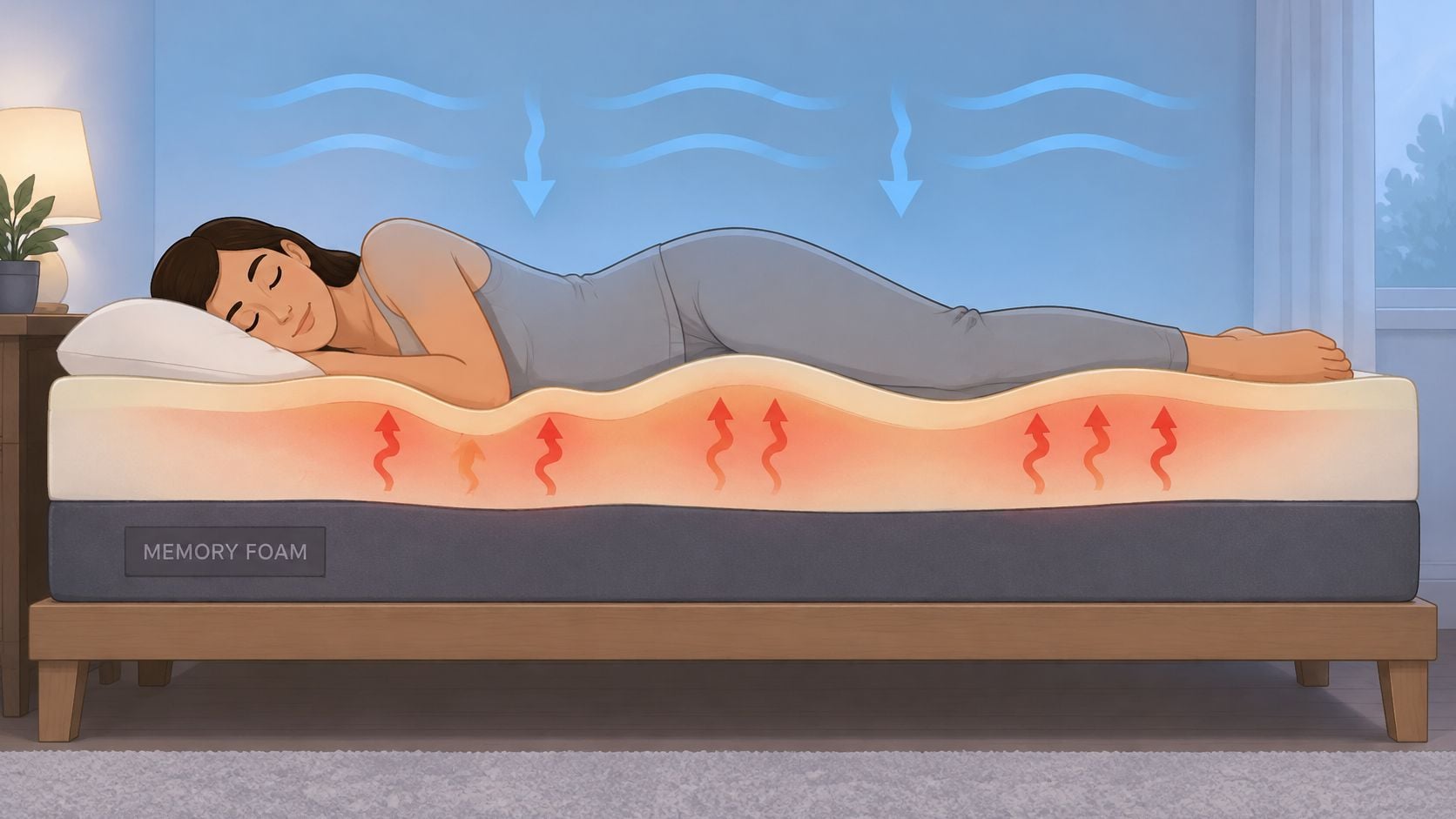
Why the contouring trade-off matters
On a humid August night in Central Florida, a side sleeper may settle into a dense comfort layer. The foam cushions the shoulder and hip, while its close fit surrounds more of the body with a material that releases heat slowly. A warm bedroom and humid air can make that trapped warmth more noticeable.
The original material was designed around cushioning, not bedroom cooling. NASA's account of Temper Foam describes its temperature-sensitive conformity and explains that later generations became less temperature-sensitive than the original formulation. That material history clarifies how the foam responds, but does not by itself establish how cool a particular mattress will feel overnight.
What a shopper should examine
Memory foam can still work. Contouring and thermal comfort need to be assessed together.
- Comfort-layer thickness: Check how much enveloping foam sits directly beneath the sleeper.
- Cell structure: Look for an open internal structure, rather than treating decorative grooves or a breathable-looking cover as proof of ventilation.
- Layer arrangement: Identify where any thermal material sits relative to the body. Its presence elsewhere in the mattress may not affect the contact surface.
- Surface enclosure: Notice how much the shoulder, hip, and torso settle in the usual sleeping position.
Density is one part of that assessment, not a complete measure of cooling. A Winter Park shopper comparing mattresses can ask for a layer-by-layer explanation. Neither plushness nor firmness alone reliably predicts nighttime temperature.
How Gel and Phase-Change Layers Store Heat
Gel changes surface conduction, while a phase-change material, or PCM, stores latent heat during a specific phase transition. The two mechanisms affect heat differently: gel may alter how warmth moves across the surface, while PCM absorbs heat as it changes phase.
A PCM's effect depends on its transition temperature and the bedroom conditions. In a Central Florida bedroom that stays warm through the night, a layer may begin absorbing heat only when the material reaches its specified transition range. If the room remains warm, the PCM may also have less opportunity to release that stored heat and recover its capacity.
Material quantity matters
In a polymer study published by Wiley, increasing microencapsulated n-tetradecane loading in polyurethane foam from 10% to 30% raised measured phase-change enthalpy from 22.43 to 55.46 J·g⁻¹, and the composite maintained thermal reliability through 100 thermal cycles. These measurements describe a tested composite, not a mattress lifespan or a guaranteed overnight result.
Enthalpy here describes heat absorbed during the phase change. The findings show why the ingredient name alone says little about thermal storage: the amount incorporated into the foam affects its measured capacity. Placement matters as well. A layer near the sleeper encounters body heat differently from an additive deeper beneath other materials.
The polyurethane mattress-configuration study in Discover Applied Sciences reported improved thermal regulation with PCM integration compared with systems relying only on ventilation. Its laboratory comparison supports the mechanism, but does not establish a particular temperature reduction in an Orlando bedroom.
A PCM layer buffers heat only while it has capacity to absorb it. Afterward, it must release that heat to recover. Warm, humid bedroom conditions can limit the practical benefit if the material cannot cool sufficiently between periods of heat exposure.
For a useful specification, look for the named material, its amount, transition behavior and the conditions under which the finished mattress was tested. A thin treatment may offer limited buffering, but thickness alone cannot establish how long that effect lasts. A gel label by itself also does not show whether the material stores heat through a phase change or changes surface conduction.
Does ventilation alone keep a memory foam mattress cool?
Ventilation channels can create pathways for air, but the effect depends on the foam around them and the room receiving that heat. In dense foam, holes alone may offer only a modest thermal improvement under controlled conditions.
A bench test summarized by Sleep Sanitation used a heat source approximating a resting person's output of 114 W. Low-density foam with salt-hydrate PCM showed an ambient-to-top-layer temperature difference of 7.310°C, compared with 1.905°C for ventilated high-density foam and 1.148°C for high-density foam without PCM. These are laboratory differences, not predictions of bedroom temperature.
What the comparison actually establishes
Perforated dense foam performed differently from plain dense foam, while the larger separation appeared in a construction that changed both density and thermal-storage material. The result therefore cannot be credited to airflow alone.
The test does not isolate how much of the strongest result came from lower density and how much from PCM. It supports investigating the combined construction, rather than treating any single feature as a universal solution.
| Construction detail | Useful interpretation |
|---|---|
| Holes in otherwise dense foam | An airflow pathway, not proof of strong cooling |
| Lower-density foam with PCM | A combined construction to assess through finished-product testing |
| Breathable textile above restrictive foam | Surface breathability may not represent the layers underneath |
| Airflow claims without test conditions | Too little information for a reliable temperature comparison |
Apply the result to a Florida bedroom
In a warm Sanford bedroom, a perforated mattress still needs somewhere to release accumulated heat. Channels can move air within the construction, but they do not cool the surrounding room.
Bedding affects how useful those pathways are. Assess the mattress with the protector and comfort layers normally used, since they can change the route air and heat take through the sleep surface. These mattress care tips for keeping cool and clean through summer offer a practical companion to comparing mattress construction.
Lower density can reduce support, so judge it against the whole construction. A showroom comparison can reveal the mattress's enclosure, ease of movement, and initial warmth, but it cannot reproduce a full night under ordinary sheets in a warm, humid room. Bench results help identify useful questions about density, PCM and airflow; they do not establish a precise bedroom temperature or overnight result.
Do cooler mattresses actually improve sleep?
A cooler mattress may improve thermal comfort without producing a measurable change in sleep outcomes. Those findings address different questions, so a temperature reduction alone does not establish a clinical sleep benefit.
A Sleepiverse evidence review describes a 2025 systematic review of nine randomized trials on cooling bedding. The review found no clear differences in sleep onset, total sleep time, sleep efficiency, awakenings, or sleep-stage proportions, and rated the evidence certainty very low to low. Because the studies covered different products, the result does not settle how a particular mattress will perform.
A 2024 pooled analysis reported by Biology Verdict involved 72 adults. A high-heat-capacity, polyurethane-coated foam mattress averaged 2.8°C cooler overnight than regular memory foam. That result applies to the specific engineered comparison. It does not establish the temperature reduction another cooling mattress will deliver.
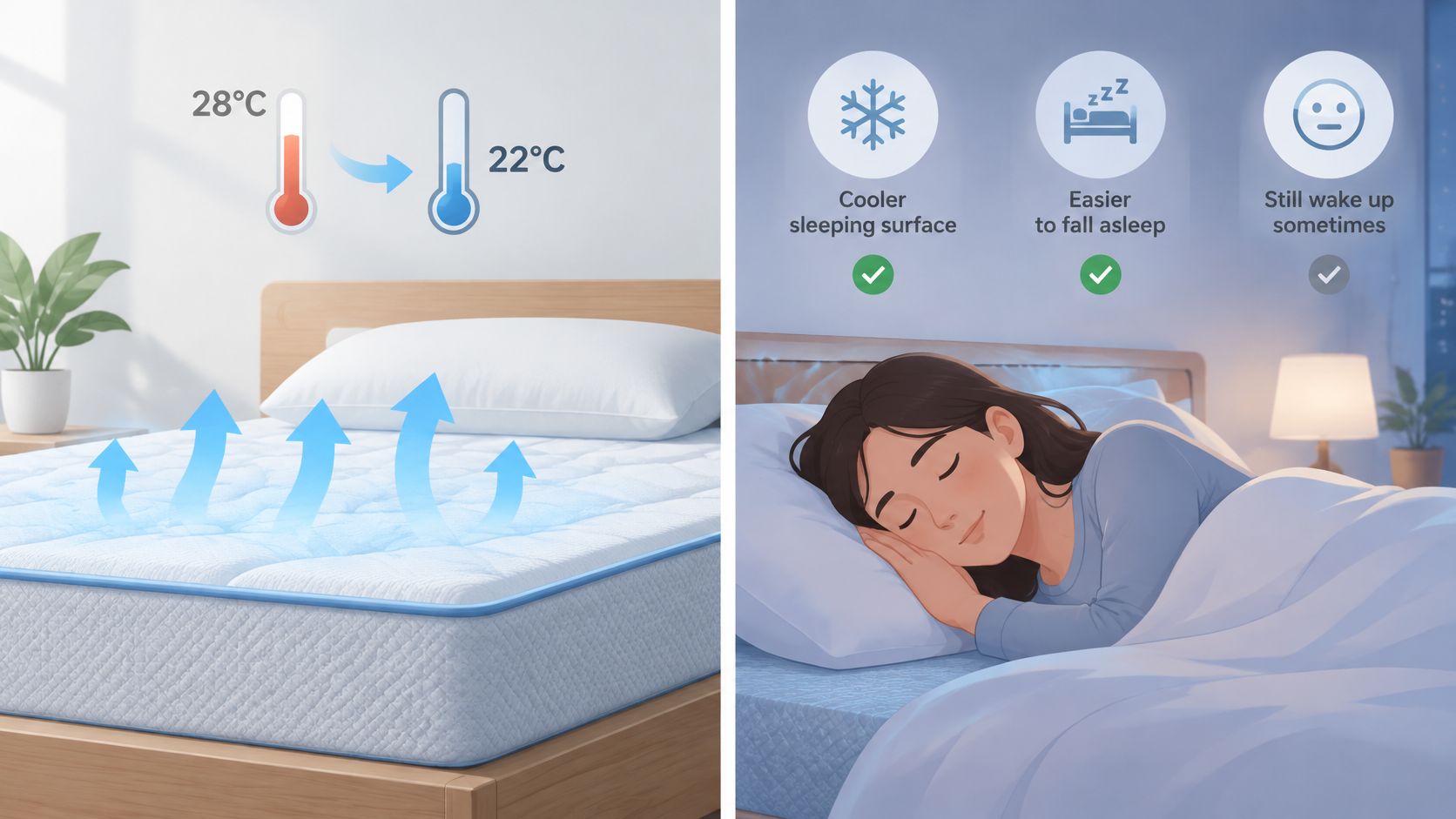
The illustration is conceptual, not a prediction of bedroom performance. Its displayed temperature difference is not a tested result for a mattress under consideration.
Separate temperature measurements from sleep promises
A surface-temperature test shows whether the surface changed under stated conditions. A sleep trial examines whether people slept differently. One result cannot stand in for the other.
The evidence supports a narrower conclusion: some engineered surfaces can reduce measured warmth, and people bothered by heat may find that improvement more comfortable. It does not establish that a cooler surface produces deeper or longer sleep.
Evidence boundary: A cooler measured surface is not, by itself, proof of better sleep.
Read the test description before the headline
Useful test descriptions identify the comparison mattress, bedding, room conditions, measurement location, and whether someone remained on the surface. A temperature recorded after a sleeper leaves measures recovery, not occupied-bed comfort.
For Central Florida bedrooms, room conditions matter. A warm, humid room can limit the practical benefit of a mattress that performs well in a controlled comparison. The mattress changes how heat moves or is stored at the sleep surface; it does not cool the surrounding air.
Independent testing is more informative than an unexplained cooling percentage. Reviews can reveal recurring comfort complaints, though they cannot control for differences between homes. A broader view of coordinating lighting, temperature, mattress, and bedding helps put a cooling feature alongside support, pressure comfort, and personal preference, without treating it as a guaranteed health outcome.
Which fix matches my hot-sleep symptom in a Central Florida bedroom?
The first change should match the pattern of discomfort, rather than defaulting to a new mattress. Damp bedding, a localized hot spot, and a bedroom that warms overnight suggest different starting points, though none alone proves a cause.
Hot-sleep symptoms, causes and first fixes
| Symptom | Likely cause | Fix to try first |
|---|---|---|
| Damp sheets by morning | Humidity trapped under a dense, sealed surface | Breathable cover and moisture-wicking sheets |
| Hot spot at hips or shoulders | Dense comfort layer holding body heat | Lower-density or thinner comfort layer |
| Warm after one or two hours | Heat building up in the foam core | Investigate a phase-change or high-heat-capacity layer |
| Cool at bedtime, hot by 3 a.m. | Bedroom temperature rising overnight | Lower the thermostat before bed, then consider an active cover |
These are troubleshooting leads, not diagnoses. For example, waking late in the night feeling hot doesn't establish that the thermostat is responsible; checking the room's actual behavior helps distinguish an environmental problem from a surface-comfort problem.
Make changes in a deliberate order
Start with the room and bedding. Check whether the bedroom becomes warmer overnight and whether the protector or sheets feel damp or restrictive. Where appropriate, lower the thermostat before bed and compare breathable bedding without adding another insulating topper.
Then assess the contact layers. A localized warm pocket calls for a closer look at how far the body settles. A thinner comfort layer or a more breathable cover may be worth comparing, provided pressure comfort and alignment remain satisfactory.
Reserve powered regulation for persistent problems. An active cover warrants consideration when the room and bedding changes don't provide adequate comfort. Its power requirements, upkeep, fit, and control arrangements should be evaluated alongside its thermal function.
Central Florida humidity complicates the distinction between feeling warm and feeling clammy. In an Altamonte Springs home, a dry-feeling surface and a lower-temperature surface may therefore represent separate goals.
Hot flashes also deserve a separate line of inquiry rather than an automatic mattress replacement. Lila's guide to ways to reduce nighttime hot flashes offers additional context for that symptom; persistent or unexplained night sweats warrant discussion with a healthcare professional.
The guide to choosing a mattress for hot sleepers can help organize construction comparisons once the likely source of discomfort is clearer. The strongest investment solves the actual complaint, rather than adding a cooling feature whose function doesn't match the bedroom.
Where should I test a cooling mattress before I buy?
An in-store test can show how a mattress feels under your body and in your usual sleep position. It cannot establish how that surface will feel through a warm, humid Central Florida night, so treat the visit as a fit comparison rather than proof of lasting cooling.
Slone Brothers Furniture is a family-owned business serving Central Florida since 1980, with a showroom in Longwood. Use the visit to compare how different mattress constructions support you, then weigh that feel against your bedroom conditions.
Make the comparison meaningful
Lie down in your normal sleep position and stay long enough for your shoulder, hip, and torso to settle into the surface. Sitting on the edge gives little insight into pressure or support while sleeping.
Repeat the test on each mattress you are considering, keeping your position consistent. A showroom impression is useful for judging comfort and support; it cannot reproduce your bedding, room temperature, or overnight humidity.
Slone Brothers Furniture carries Stearns & Foster, Tempur-Pedic, and Sealy mattresses. Its selection includes memory foam, foam gel, hybrid, innerspring, spring, euro top, cooling, tight top, and TEMPUR material mattresses, with comfort levels from extra soft and ultra soft to medium firm, ultra firm, and extra firm. The range gives shoppers options to compare by feel and construction.
The mattress selection guide can help you prepare for a showroom visit. Complimentary space planning and the in-house Design Team can also help with bedroom layout around your choice.
A comfortable showroom test is one useful part of the decision. For a warm bedroom, consider whether the mattress's feel and construction suit the conditions where you sleep.
Visit Slone Brothers Furniture in Longwood, FL, to compare mattress options in person and discuss your bedroom's needs.