
How to Choose a Mattress for Back Pain That Works


A lot of people in Longwood, Lake Mary, and Winter Park don't wake up thinking their mattress is the problem. They wake up stiff, blame the pillow, change positions for a few nights, and keep living with it. That's the wrong way to shop for a bed when back pain is part of the picture, because how to choose a mattress for back pain is really a systems question, not a label hunt.
The right mattress matters, but it doesn't work alone. Mattress firmness, pillow height, sleep position, and how long the bed is tested all interact, and showroom shopping only helps when those pieces are evaluated together. If pain has been persistent or is getting worse, a separate medical opinion is worth reading, and a practical place to start is the guide on when to see a doctor for back.
A good mattress should support the spine without creating new pressure points. That's why the old idea that harder is always better has been replaced by more balanced guidance, and why a medium-firm starting point keeps showing up in serious mattress advice for back pain as noted by the National Council on Aging and in Harvard Health's low-back-pain guidance. At Slone Brothers in Longwood, that's exactly how a real mattress conversation should begin, with the body, not the brochure, leading the way.
Why the Right Mattress Matters More Than You Think
A homeowner in Lake Mary can order a mattress online, wait for delivery, and still wake up tighter than before. That happens because a bed that feels pleasant for ten minutes can still be wrong after a full night, especially when the sleeper's posture, pillow, and pain pattern do not line up. A showroom label never tells the whole story.
Practical rule: stop treating a mattress like a standalone purchase. It belongs to a sleep system, and that system either supports spinal neutrality or it does not.
The best starting point for many people with low-back pain is still medium-firm support, not ultra-plush softness and not a rigid board. Clinical and expert guidance points in that direction because the goal is to keep the spine in a neutral position while still easing pressure on the hips and shoulders according to Harvard Health, Consumer Reports-style guidance summarized by the National Council on Aging, and broader sleep-medicine recommendations. That balance matters more than marketing words like “orthopedic” or “supportive.”
A useful example comes from a widely cited trial of 313 chronic low-back-pain patients, where people on a medium-firm mattress were about twice as likely to report improvement as those on a firm mattress after 90 days. This is a measurable difference in how the body responds over time. The same pattern shows up in guidance from why investing in a high-quality mattress is essential for your long-term health, because a mattress has to keep doing its job after the first week, not just the first night.
For a Longwood or Orlando homeowner, that changes the whole shopping mindset. The question is not, “Which mattress sounds best?” The question is, “Which sleep setup gives the spine the best chance to settle, recover, and stop fighting the bed every night?” A real showroom fitting answers that by looking at the mattress, the pillow, the sleeper's position, and how long the body is given to adjust.
That is the kind of conversation we have at Slone Brothers in Longwood. The body leads, the brochure follows.
Auditing Your Current Bed and Your Pain Pattern
Before anyone compares models, start with the bed already in the room. A mattress that sags, feels lopsided, or has clearly worn out can break down support even if it used to feel fine. A spine-care source advises not to delay replacement if a mattress is over nine years old, and that is a sensible checkpoint for older bedrooms in Central Florida homes. If you want a simple reference point, the age guide at how old is your mattress? helps you judge whether the bed itself has already crossed the line as noted by NY Spine.
Read the pain pattern, not just the complaint
“My back hurts when I wake up” points to a different problem than “my back hurts by 9 p.m.” Morning stiffness usually means the bed is failing to hold the body in a steady position overnight. Evening soreness often points more toward daytime strain, posture, or a setup that only becomes uncomfortable after hours of use.
That distinction matters in the showroom. A sleeper who wakes with lower-back tightness needs a different recommendation than someone whose shoulders ache after reading in bed. Pain location matters too, because low-back pressure, shoulder tension, and hip soreness do not all respond the same way to the same mattress. A consultant who listens for those details can narrow the field faster and steer the fitting in the right direction.
A quick self-audit helps:
- Check for visible sagging: Look for dips where the hips or torso normally rest.
- Feel for weak spots: If one side feels softer or less supportive, the core may be breaking down.
- Track the timing: Note whether pain appears on waking, after sitting up, or only late in the day.
- Mark the location: Low back, upper back, hips, and shoulders all tell different stories.
- Notice old-bed clues: If sleeping elsewhere feels better, the current bed may be part of the problem.
The point is simple. A shopper who walks into a Longwood showroom with a clear pain pattern gets a useful recommendation much faster than someone who just says, “Something's wrong with the bed.” Bring the mattress age, the pain timing, the sore spot, the pillow, and the sleep position into the same conversation. That is how a real fitting works, and it is why a careful in-person check beats guessing from a cart. Even an Aspen Falls Wellness back arch routine can only do so much if the bed underneath is already fighting the spine.
Matching Mattress Construction to a Back-Pain Sleeper
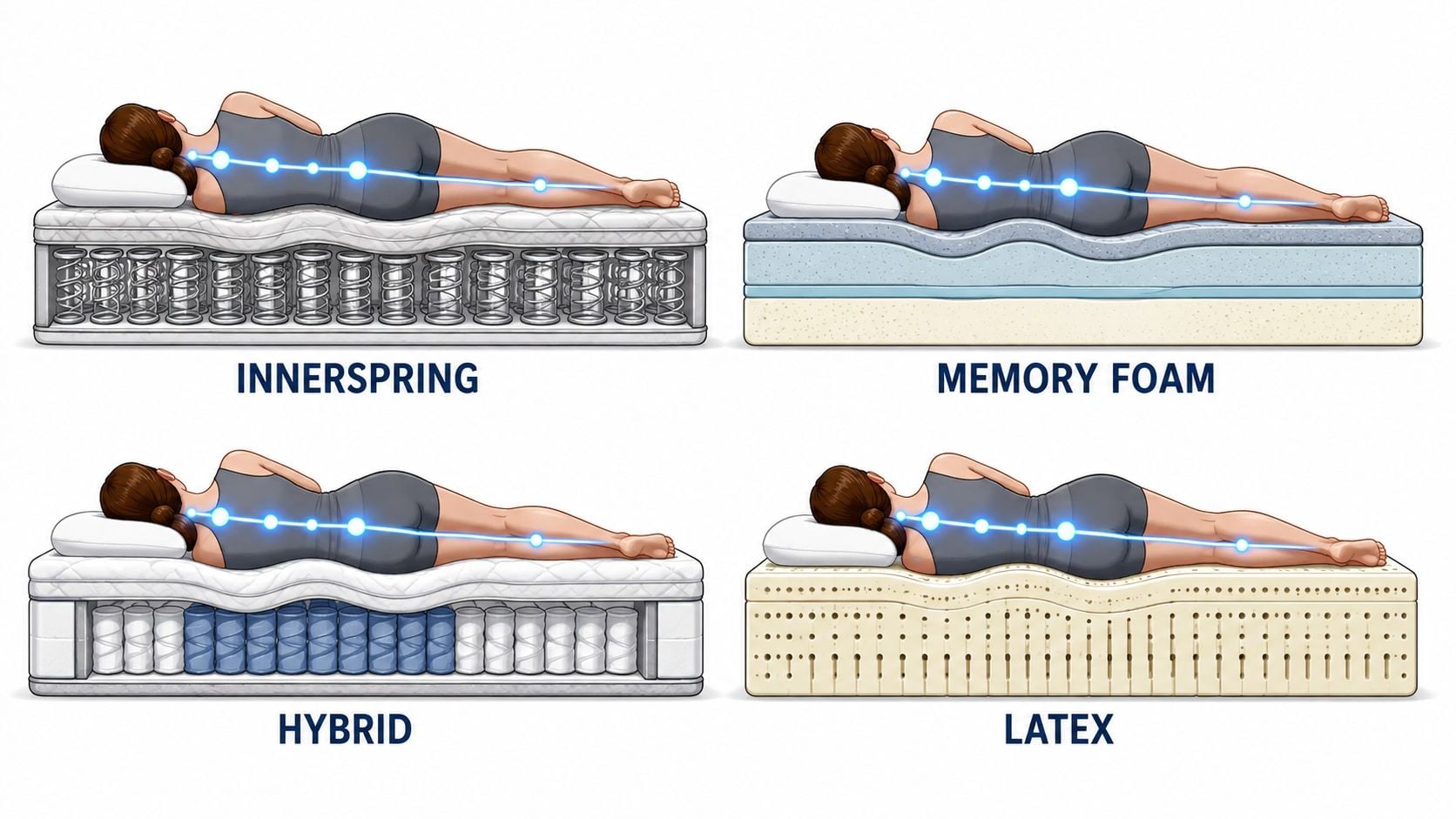
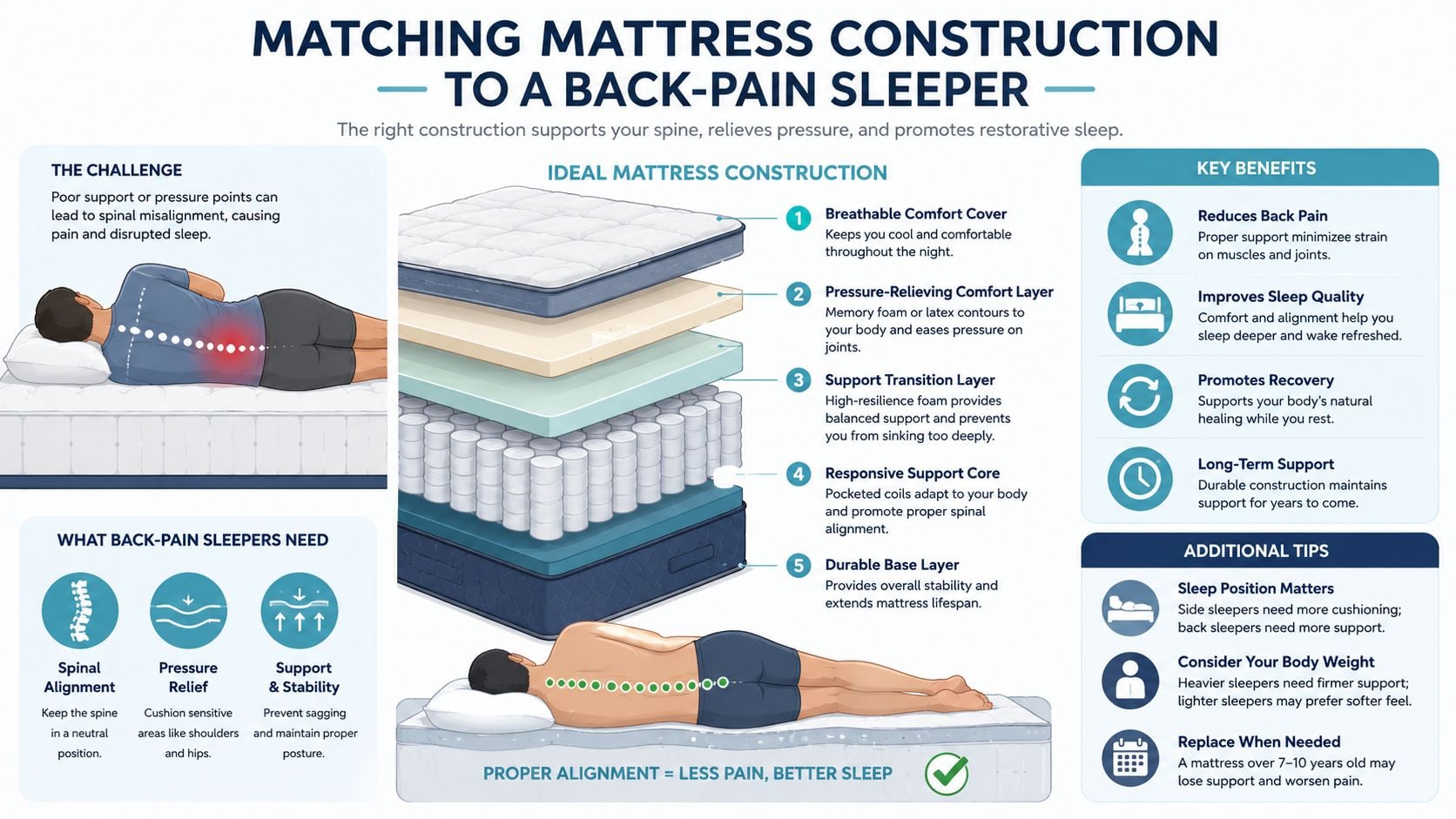
The construction choice should follow the body, not the buzzwords. Innerspring, memory foam, hybrid, and latex can all work for back pain, but each one creates a different mix of support, contour, temperature, and responsiveness. For Central Florida homes, that last part matters more than most shoppers expect, because a mattress that sleeps hot can make a bad night feel even worse.
Innerspring, foam, hybrid, and latex each solve a different problem
Traditional innerspring beds tend to feel more lifted and breathable, but they can be too reactive or uneven if the coil system and comfort layers are thin. That can leave the low back under-supported, especially for sleepers who need a steadier cradle through the lumbar area. They suit people who want a firmer, more open feel and who don't need deep contouring.
Memory foam gives the most obvious pressure relief. It can be a smart choice for side sleepers or anyone whose shoulders and hips need more give, but in a warm bedroom it may feel too enveloping if the foam is dense or heat retention is high. For a Florida sleeper who runs hot, that's a real comfort issue, not a minor detail.
Hybrid models often make the most practical sense for back pain because they combine a coil support core with contouring comfort layers. That structure can keep the spine more neutral while still easing pressure on the shoulders and hips. For many back sleepers and combination sleepers, hybrids are the most balanced starting point.
Latex is the responsive option. It tends to feel buoyant, springy, and easier to move on than deep foam, which helps sleepers who dislike the “stuck” feeling. It's often appealing to back sleepers and stomach sleepers who want more lift without losing cushioning.
For a useful movement reference, some readers also like the gentle mobility ideas in Aspen Falls Wellness back arch, especially if the lower back feels tight before bed. That kind of body awareness pairs well with mattress testing because it reminds shoppers that the bed and the body have to cooperate.
A mattress construction that works on paper can still fail in a real bedroom if it traps heat, lets the hips sink too far, or fights the sleeper's normal posture.
Slone Brothers' mattress types explained resource belongs in this conversation because construction is where comfort really starts. The right build isn't the one with the fanciest label, it's the one that matches spinal support, temperature comfort, and how the sleeper changes position at night.
Getting Firmness Right for Your Sleep Position and Body Type
Firmness is where a lot of shoppers go wrong. They pick what feels hard in the showroom, or what sounds “supportive” in a sales pitch, and ignore how their body settles on the surface. The better target is a medium to medium-firm feel, roughly 5 to 7 on a 10-point scale, with the exact spot changing by sleep position and body type.
Sleep position changes the answer
Side sleepers usually need more give at the shoulders and hips. If the surface is too firm, the shoulder gets jammed and the spine bends out of line.
Back sleepers generally do best with stronger lumbar support and only light contouring. The low back should feel held, not forced into a deep hammock.
Stomach sleepers usually need a firmer surface so the pelvis doesn't tip forward and strain the lower back. Too much sink is the enemy there.
Body weight shifts all of this. A lighter sleeper often perceives a mattress as firmer than a heavier sleeper does, and the same model can feel entirely different once a real person lies down on it. That is why the label on the showroom tag is never the whole answer.
Here's the blunt version:
- If the hips sink too far: the bed is too soft for that sleeper.
- If the low back arches or gaps: the bed is too firm or too flat.
- If the shoulders hurt on the side: the mattress isn't relieving pressure well enough.
- If repositioning feels hard: the surface may be too dense or too sticky.
A good consultant listens for the sleeper's usual position before talking about product categories. Slone Brothers' mattress firmness guide fits that approach, because firmness only makes sense when it is tied to alignment. The right bed does not just feel comfortable, it keeps the body neutral long enough for sleep to do its work, beyond the initial comfort of the first night.
Testing a Mattress in the Showroom and at Home
The showroom test should be slow, not rushed. Lie in the position you use at home, and stay there for a real stretch, long enough for your body to stop posing and tell the truth. Bring the pillow you sleep on every night, because pillow height can change the result as much as the mattress itself. If the mattress is old enough that you're wondering whether age is part of the problem, check how old is your mattress before you blame the wrong layer of the bed.
What to check before leaving the floor
A side-view check tells the truth fast. If the hips sink, the bed is too soft. If the low back arches or there's a wide gap under the lumbar area, the bed is too firm or not contouring enough. The head-to-pelvis line should stay neutral, and a consultant who knows alignment can spot the difference in seconds.
A useful showroom checklist looks like this:
- Lie in the usual sleep position. A back sleeper should test as a back sleeper, and a side sleeper should test as a side sleeper.
- Use the normal pillow. A different pillow can hide the problem or create a fake one.
- Check the alignment from the side. A companion or consultant can help spot sagging or arching.
- Stay long enough to settle. Short tests favor first impressions, not true comfort.
- Notice transitions. If turning over feels awkward, the surface may be fighting the body.
At home, the verdict takes longer. Mattress outcomes can change over sustained use, and guidance commonly points shoppers toward a real trial period of at least 100 nights or about 28 days minimum before deciding as summarized in expert buyer guidance. That timing matters because a body can need time to adapt, and a mattress can reveal problems only after repeated nights.
Use the trial to watch patterns, not isolated bad nights. If the bed still causes the same morning stiffness after the first several weeks, that means something. If pain eases after sustained use, the sleeper has more reason to keep it. A fit that works in a showroom and stays workable over weeks is the one worth keeping.
Red Flags, Pillow Mistakes, and When to Call a Professional
A mattress can feel wrong even when the build is fine, because the rest of the sleep setup is out of balance. A pillow that sits too high or too flat can tip the neck and shoulders enough to make the lower back do extra work. Shoppers who focus only on the mattress often blame the wrong part of the system.
Bottom line: a mattress does not get a free pass because the label sounds impressive. “Orthopedic,” “supportive,” and similar words do not replace real-world alignment.
The biggest red flag is pain that keeps showing up after a fair trial, especially when it gets worse instead of settling down. Another warning sign is pain that wakes the sleeper, or numbness and radiating pain that does not match a simple pressure problem. Those patterns call for medical input, not more mattress browsing.
For readers who need a posture reset, fix sleeping posture with AI can be a useful reference point for checking alignment habits, but the mattress still has to do its share of the work. A bed can only support the posture it is given.
A practical rule keeps the decision grounded, and it keeps the focus on the full setup:
- If one pillow change helps right away: the mattress may not be the main problem.
- If nothing improves after a proper trial: the bed deserves scrutiny.
- If symptoms worsen week over week: pause the shopping and speak with a clinician.
- If pain radiates or causes numbness: do not try to shop your way out of it.
That kind of skepticism helps in a showroom because it strips away the fantasy that one product will solve everything. The right mattress can help a great deal, but it cannot fix every pain pattern on its own. Good advice separates comfort from diagnosis.
If you are still comparing options and want a local starting point, use the local mattress store near me page, then bring those pain notes into a real fitting conversation. A consultant can sort out whether the issue is firmness, pillow height, sleep position, or a combination of all three.
Finding the Right Bed in Longwood with a Real Person
A Slone Brothers consultant works through the same logic a careful shopper should use at home. That means asking about the sleeper's pain pattern, sleep position, body type, and what happened during the trial, then narrowing the field across innerspring, memory foam, hybrid, and latex choices instead of pushing a one-size-fits-all answer. The goal is fit, not pressure.
The advantage of a Longwood showroom is simple. Real people can compare options, bring in the family pillow, and talk through what the body is doing on the mattress instead of guessing from a screen. That's also where services like the Low Price Promise, custom-order options, complimentary in-house design help, and white-glove delivery become part of the decision, because comfort and home fit should be solved together.
Shoppers who want a local starting point can use the local mattress store near me page as a first step, then visit in person with a clear shortlist. Premium American-made and Amish-crafted options make more sense when they're tested in the room, not imagined from a thumbnail.
The better move for a Central Florida homeowner is straightforward. Bring the pillow, spend real time on the mattress, and let an experienced consultant help separate support from marketing. That's how a lasting mattress decision gets made.
Ready to invest in a mattress that helps your back instead of arguing with it? Skip the online guesswork and the automated chat loop. Visit Slone Brothers Furniture in Longwood, FL, and talk face-to-face with a real design consultant who can help match your sleep position, comfort needs, and long-term value goals.