

Decorative Glass Jars with Lids: A Complete Styling Guide


The most popular advice about decorative glass jars with lids is to choose them for appearance first and figure out their purpose later. That approach produces attractive clutter, not lasting design. A discerning homeowner in Longwood, Orlando, or anywhere across Central Florida should evaluate the glass, closure, seal, and intended use before considering color or finish.
A well-made jar can conceal everyday items, protect contents from dust, organize a room, and contribute the visual rhythm of a carefully furnished interior. The lid isn't a minor accessory. It determines whether the jar functions as pantry storage, bathroom organization, gift packaging, or as a dust-resistant display vessel.
Why Decorative Glass Jars With Lids Deserve a Place in Your Home
Decorative jars are often dismissed as superficial styling props, but that judgment overlooks their most valuable quality. A lidded glass jar combines display and containment, giving homeowners a way to make practical objects look intentional without hiding them in opaque cabinets.
Open bowls and baskets collect dust quickly and expose their contents to room odors. A properly fitted lid creates a cleaner presentation and can help contain scents, although only a tested sealing system should be treated as genuinely airtight. For dry goods, pantry organization, bath salts, cotton rounds, candy, dried flowers, and gift presentation, decorative jars offer a more composed alternative to mismatched packaging. These uses are also reflected in examples of decorative glass jar applications, including bathroom storage, wedding décor, dried flowers, and display.
A familiar form with useful history
The household jar has a substantial design lineage. In 1806, Nicolas Appert demonstrated longer food preservation in glass containers sealed with cork, wire, wax, and boiling water. In 1858, John L. Mason patented the Mason jar, pairing a threaded metal lid with a matching glass body. The USDA timeline records Ball Corporation manufacturing glass jars for home canning in 1884, followed by closure innovations from Alexander Kerr in 1903 and a sealing-compound lid patent in 1915. These milestones are outlined in the history of jars for food preservation.
That history matters because the modern decorative jar still depends on the same principles: visibility, containment, reusability, and closure performance. The best pieces don't merely fill a shelf. They continue serving as a room's needs change.
Why glass remains a premium material
The wider packaging market helps explain why glass continues to hold a strong position in both practical and decorative applications. One 2026 industry estimate placed the worldwide packaging jars market at USD 29.43 billion in 2025, with a projection of USD 39.04 billion by 2032 and a 4.1% CAGR. In that estimate, glass jars represented USD 11.99 billion, or 40.7% of total market revenue. A separate outlook estimated the broader glass container market at USD 65.1 billion in 2025 and USD 101.0 billion by 2036. These figures are reported in the packaging jars market outlook.
For a Florida homeowner, the practical conclusion is straightforward. Choose jars that earn their space through repeated use, not pieces that depend on a short-lived decorative trend.
Understanding Glass Types and Material Quality
Premium glass isn't defined by sparkle alone. Glass composition, manufacturing method, wall consistency, rim quality, and thermal behavior determine whether a decorative jar feels heirloom-worthy or merely looks attractive on a shelf.
Most decorative jars use annealed soda-lime glass. It offers good clarity and familiar weight, but it has relatively low tolerance for sudden temperature changes. Independent technical guidance indicates that standard jars can crack with sudden temperature swings of about 40°C, while tempered soda-lime variants can improve tolerance to roughly 120 to 125°C. The technical discussion is available in this guidance on glass thermal shock.
Borosilicate glass is the more responsible specification for applications involving hot contents, freezer transitions, or repeated temperature changes. Generic decorative glass shouldn't be moved directly from a cold environment into hot water just because it appears thick or expensive.
Glass types compared
| Glass Type | Clarity | Durability | Thermal Resistance | Best Use Case |
|---|---|---|---|---|
| Annealed soda-lime | Clear and familiar | Suitable for ordinary display and storage | Lower tolerance for sudden changes | Dry goods, display, bathroom organization |
| Tempered soda-lime | Clear with a stronger structure | Better resistance than standard annealed glass | Improved tolerance for thermal change | More demanding household storage |
| Borosilicate | Typically very clear | Strong choice for repeated practical use | Higher thermal resilience | Hot fillings, freezer use, temperature-variable storage |
| Lead-free crystal | Highly clear with refined refraction | Decorative strength depends on construction | Not automatically designed for thermal shock | Formal display and gifting |
Hand-blown glass can offer subtle character, but variation should remain controlled. Machine-pressed glass generally delivers more consistent dimensions, while hand finishing can improve the feel of rims, bases, and decorative details. A quality inspection should look for even wall thickness, minimal distortion, a stable base, and a smoothly finished mouth.
How to read visual and tactile signals
Hold the jar at eye level and inspect straight lines behind it. Significant waviness or distortion can make contents look untidy. A polished base or pontil mark may indicate hand finishing, but it isn't proof of superior performance on its own. Weight should feel deliberate rather than excessively heavy, and the jar should sit flat without rocking.
Colored and frosted glass change the visual character of a collection. Frosting softens the view of contents and can make a bathroom or bedroom vignette feel calmer, while clear glass works best when the contents are part of the composition. Homeowners comparing vessels for a dining setting can also review these glass candle holder considerations because clarity, wall quality, and finish affect both candle vessels and decorative storage jars.
For a coordinated Central Florida interior, the small glass dining sets provide a useful point of reference for balancing transparent accessories with a broader dining-room palette.
How to Choose the Right Lid and Seal for Your Needs
The lid is the jar's working mechanism. A beautiful glass body with a weak closure is an incomplete product, particularly in humid Florida rooms where moisture can quickly affect dry contents and metal hardware.
Screw-top lids suit pantry storage because they close neatly and keep the exterior profile restrained. Clamp-lock and hinged bail lids create stronger visual character and can provide a dependable compression seal when the gasket and rim are correctly matched. Push-fit lids are convenient for frequent access, but they should be treated cautiously unless the manufacturer identifies the seal as tested for the intended use.
Matching the mechanism to the room
A bathroom jar benefits from a clamp or hinged closure when the gasket resists humidity and the hardware coordinates with existing fixtures. A pantry jar should prioritize a clean rim, easy refilling, and a closure that can be opened without excessive force. For a formal living room, the lid finish matters as much as the seal because brushed brass, matte black, wood, and polished metal establish different relationships with lamps, tables, and cabinet hardware.
A silicone gasket is the preferred choice for repeated use because it can create a reliable seal when properly seated. Natural rubber has a familiar flexibility but may require closer inspection over time. EVA foam can work for light-duty dust reduction, but it shouldn't automatically be described as hermetic.
Practical rule: If the rim is chipped, dirty, uneven, or warped, no lid mechanism can compensate for it.
What airtight really means
A properly seated lid may create a vacuum-style seal after contents cool and internal pressure drops. Dry-pack guidance recommends leaving approximately 1/4 to 1/2 inch of headspace, keeping the rim clean and undamaged, and allowing the lid to “ping” as the seal forms. For low-moisture foods, oxygen absorbers are commonly paired with glass jars to reduce oxidation and support longer storage, as explained in this dry-pack storage guidance.
A decorative lid without a tested seal is best understood as dust-resistant, not hermetic. That distinction protects both the contents and the homeowner's expectations.
Styling Decorative Glass Jars in Every Room
The strongest installations treat jars as part of a room's architecture rather than scattered accessories. A group of related forms can establish rhythm on open shelving, a vanity, or a dining console, especially when the glass, lid finish, and contents share a controlled palette.
Kitchen and dining spaces
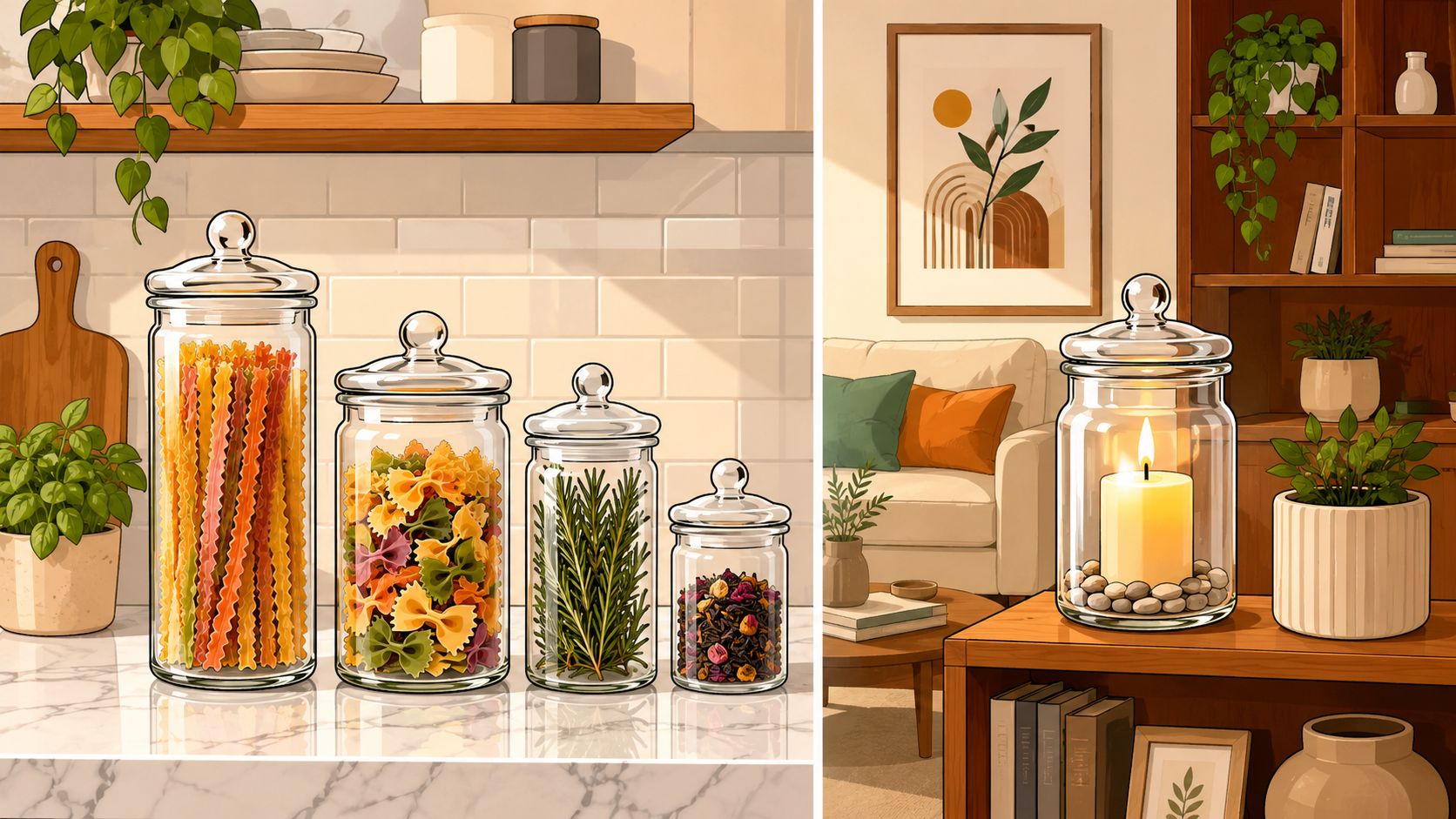
In a pantry or kitchen, matching apothecary-style jars can hold dry goods while making labels, textures, and colors part of the display. A disciplined collection avoids the visual noise of commercial packaging and lets open shelving feel designed rather than merely occupied. Labels can be placed discreetly so the contents remain identifiable without turning the arrangement into a retail wall.
Dining rooms call for larger vessels with restrained contents. Clear jars filled with citrus, pinecones, shells, or layered natural materials can become centerpieces, but the contents should relate to the room's season and finishes. A single oversized jar may suit a substantial dining table, while a grouped arrangement works better on a sideboard.
Bathroom and living areas
Bathrooms benefit from smaller jars with secure lids for cotton rounds, bath salts, handmade soaps, and other frequently used items. In a humid Central Florida home, the closure should be selected for moisture resistance rather than appearance alone. Glass also makes it easy to monitor supplies without opening every container.
Living rooms and entryways require more editing. A jar can display potpourri, decorative stones, or rolled linen napkins, but too many visible objects create clutter. The principles in this guide to decorating shelves in any room apply well here, especially the need to vary height while preserving visual balance.
Seasonal rotation without excess
Seasonal styling works best when the jar remains constant and the contents change. Spring can bring botanicals, summer can introduce a coastal palette, autumn can favor harvest tones, and winter can shift toward metallic accents or evergreen textures.
Group jars in odd-numbered arrangements with varied heights, but don't crowd every surface. One tall vessel, one medium jar, and one smaller piece usually creates more intention than a long row of nearly identical objects.
What to Look for When Buying Premium Glass Jars
A discerning buyer should inspect a jar in a fixed order. Appearance comes last because a polished finish can't correct a weak rim, unstable base, or poorly fitted lid.
Start with the glass body
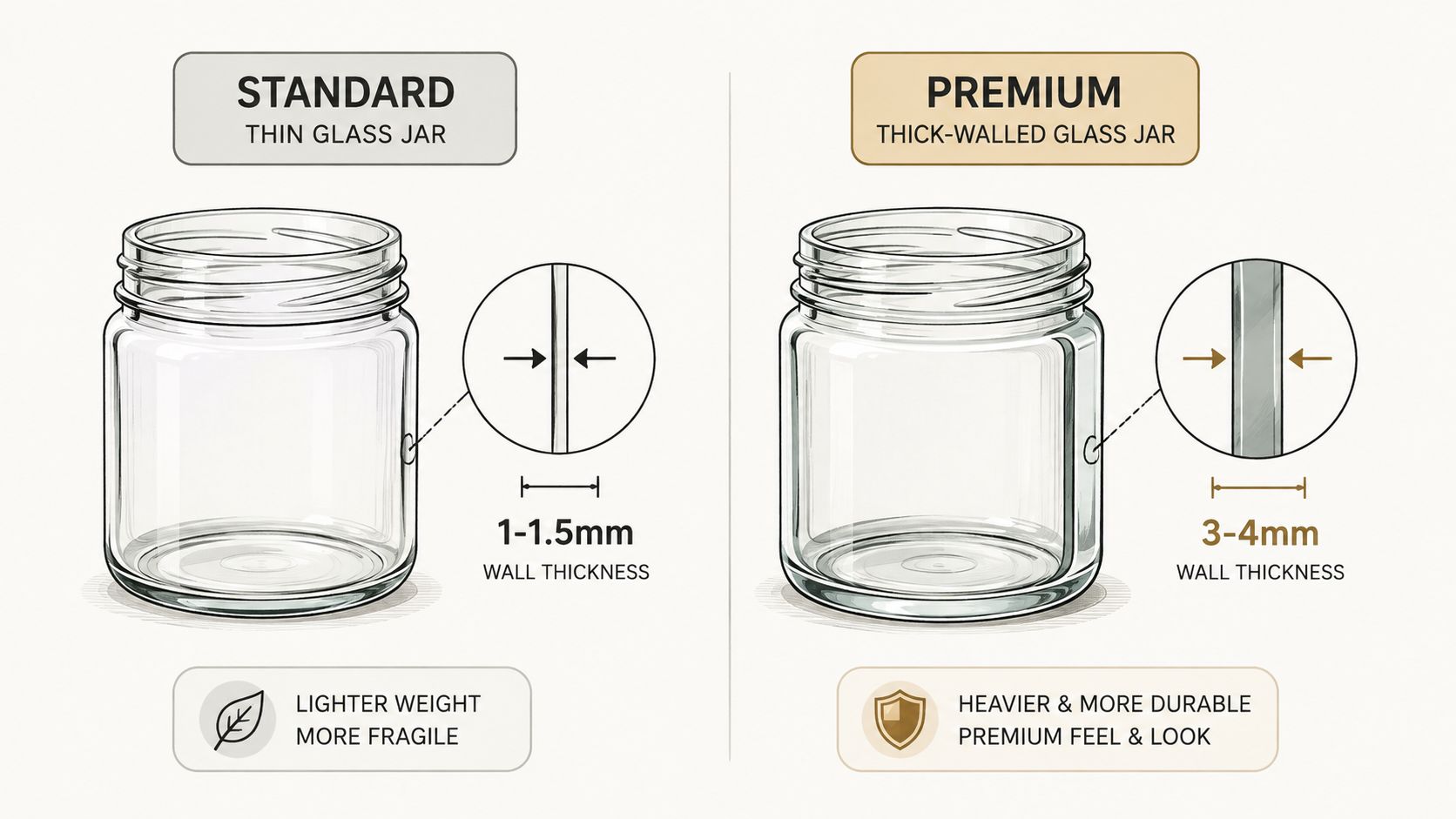
Premium jars should feel substantial in the hand, with walls commonly described by sellers as approximately 3 to 4 millimeters thick. That specification should be verified with the maker rather than assumed from weight alone. Look through the body for visible bubbles, pronounced seam lines, cloudy areas, and inconsistent color.
Run a finger carefully around the mouth. Chips, roughness, and uneven edges compromise closure performance because the gasket can't compress evenly against a damaged rim. The base should sit perfectly flat, and the jar shouldn't rock when placed on a hard surface.
Evaluate the closure separately
Remove and replace the lid several times. A screw-top should engage smoothly without cross-threading or wobble. A clamp should close with firm, controlled tension, not force that bends hardware or distorts the gasket. A hinged lid should align cleanly with the rim and remain stable when opened.
Inspect the gasket for gaps, curling, brittleness, or uneven seating. Silicone is generally the stronger choice for repeated household use, but its performance still depends on correct dimensions and maintenance.
Match the opening to the task
Wide-mouth jars are easier to fill, empty, and clean, especially when the contents are bulky. Narrower openings can create a more refined silhouette and may pair effectively with clamp closures, but they demand more care during cleaning and refilling.
For homeowners selecting accessories alongside a larger furnishing plan, high-quality home décor should be assessed with the same standards applied to furniture. Materials, finish, proportion, and serviceability matter more than a quick visual impression.
Caring for Your Glass Jars to Ensure They Last
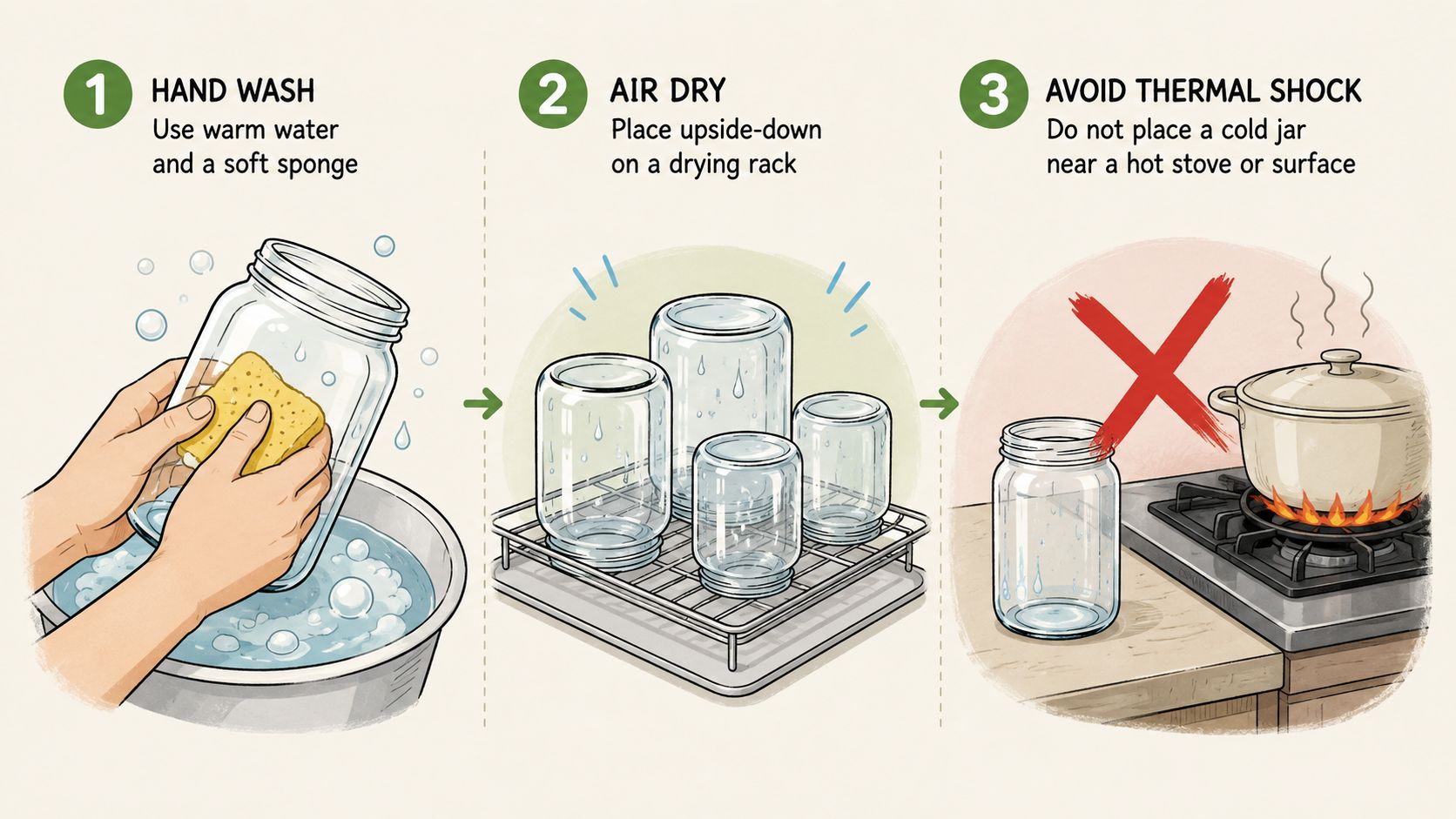
Glass rewards careful handling, but it doesn't forgive sudden temperature changes. A cold jar placed under hot water can develop stress fractures because the exterior expands faster than the interior. Annealed glass is particularly vulnerable, and even a thicker or more resilient glass type shouldn't be subjected to abrupt thermal shock.
Hand washing is the safest routine for most decorative jars. Mild detergent, lukewarm water, and a soft brush protect the glass and reduce wear on gaskets and metal hardware. Dishwasher cycles can expose closures to heat, agitation, and prolonged moisture that may shorten the useful life of seals or finishes.
A simple maintenance routine
- Clean the body gently. Wash the glass with mild detergent and avoid abrasive pads that can dull the surface.
- Remove the gasket periodically. Clean the seal separately, then let it air dry completely before reinstalling it.
- Inspect before reuse. Replace a gasket when it shows cracking, discoloration, flattening, or lost elasticity.
- Dry metal immediately. Moisture left on metal lids can encourage oxidation, especially in humid rooms.
- Treat wooden lids carefully. Food-safe mineral oil can maintain a wooden lid's finish when applied as appropriate for the material.
- Protect internal mechanisms. Don't submerge lids with concealed springs, hinges, or non-removable components.
Long-term care: Store an unused jar with its lid slightly loosened. This reduces gasket compression and helps prevent a vacuum lock.
The spring-cleaning guidance can help homeowners incorporate jar inspection into a broader seasonal reset. Proper care allows a decorative vessel to remain useful as a pantry container, vanity organizer, display object, or gift package through changing rooms and changing tastes.
Where to Find Quality Decorative Jars in Central Florida
Premium decorative jars are difficult to evaluate through a screen. Photographs rarely reveal wall consistency, actual color, rim finish, clasp tension, gasket uniformity, or whether a lid creates a working seal. Shipping also introduces the possibility of damage before the piece reaches the home.
A local showroom gives homeowners the tactile information that matters. In Longwood, a design consultant can help compare proportions, coordinate lid finishes with existing hardware, and determine whether a jar belongs on a kitchen shelf, dining sideboard, bathroom vanity, or entry console. That guidance becomes especially valuable when a homeowner is furnishing several rooms in Lake Mary, Sanford, Winter Park, or Altamonte Springs and wants accessories to feel connected rather than randomly collected.
Slone Brothers Furniture is a family-owned Longwood showroom serving Central Florida since 1980, with home décor alongside furniture and mattresses. Its design team offers complimentary in-home services, and the broader showroom experience supports decisions about scale, finish, and room coordination. Homeowners researching quality furniture stores in the area should look for the same qualities in an accessory source: knowledgeable people, clear product information, dependable delivery, and service after the purchase.
The right jar should feel considered in the hand and convincing in the room. A showroom visit turns that decision from online guesswork into a practical design investment.
Ready to select decorative glass jars with lids that complement a thoughtfully furnished home? Visit Slone Brothers Furniture in Longwood, FL, where experienced design consultants can help Central Florida homeowners coordinate durable glass accessories with their existing interiors and broader furnishing plans. Stop in for a face-to-face consultation and discover a welcoming showroom built around quality, craftsmanship, and human service.