
High Quality Home Decor: Your Guide to Lasting Style


A lot of Central Florida homeowners end up in the same cycle. A few quick decor buys look good in the cart, arrive looking smaller or flimsier than expected, and within a season the room still feels unfinished. The lamps don't give enough light, the rug looks undersized, and the accent pieces already feel dated.
That's usually the point where high quality home decor starts to make a lot more sense. Not because every item has to be expensive, but because a home feels better when the pieces are chosen for fit, texture, durability, and staying power. Good rooms rarely come from buying more. They come from buying with intention.
That matters in Longwood, Orlando, Lake Mary, Sanford, and across Central Florida, where homeowners often furnish several rooms at once and need decor that can handle real daily life. The home decor category is also far from niche. One market estimate places worldwide revenue at $133.60 billion in 2024, up from $101.22 billion in 2018, with projected growth to $161.68 billion by 2029 at a 3.89% annual rate. Another forecast places the market at about $139 billion in 2026, showing continued demand for furnishings, lighting, textiles, and decorative items across major markets, according to interior design market statistics.
High quality home decor also works best when it's planned in context. Before committing to a large mirror, rug, console, or accent chair, many homeowners find it helpful to visualize furniture before buying so scale problems are caught early.
For shoppers who want decor with stronger construction and longer-term value, American-made furniture is often a smart place to start.
Table of Contents
- Your Guide to Investing in High Quality Home Decor
- What Truly Defines High Quality Decor
- How to Evaluate Decor Like a Designer
- Styling Your Home for Timeless Appeal
- Where to Find Personalized Decor in the Orlando Area
- Create a Home That Lasts with Slone Brothers Furniture
Your Guide to Investing in High Quality Home Decor
High quality home decor is less about chasing a look and more about building rooms that still feel right years from now. The strongest spaces usually rely on a few pieces with real substance, then use restraint to keep the room calm and livable.
Luxury is often not about expensive decor items, but about proportion, texture, and restraint.
That idea matters when a family is furnishing a living room, bedroom, and dining area at the same time. A well-made rug, a substantial mirror, proper lighting, and a few durable accents often do more for a room than a collection of trendy accessories that compete for attention.
In practice, the biggest gap isn't taste. Most homeowners already know what they like when they see it. The gap is understanding why one room looks complete and another still feels temporary, even after money has been spent.
The investment mindset
A good decor purchase should answer more than one question.
- How does it look: Does it bring texture, scale, or contrast the room needs?
- How does it live: Will it be easy to clean, move, and maintain?
- How does it last: Will the material still look good after regular use and Florida conditions?
- How does it fit: Does it belong with the furnishings already in the room?
That last point gets overlooked all the time. Decor that's technically attractive can still look wrong if it's too small, too shiny, too delicate, or too visually busy for the rest of the space.
What usually works better
Homeowners tend to get a better result when they slow down and prioritize the pieces that make the room feel anchored. That often means larger-scale decor, stronger materials, and fewer filler items.
A finished room doesn't need constant replacement. It needs thoughtful editing.
What Truly Defines High Quality Decor
Price alone doesn't define quality. Plenty of expensive decor still disappoints once it's in a real home. The pieces that hold up tend to share three things. Better materials, sound construction, and finishes that protect the piece instead of just dressing it up for the showroom.
Materials that age well
Material performance matters as much as appearance. Guidance on interior materials consistently points to wood, stone, metal, and natural fabrics for authentic texture and durability, and recommends looking for the FSC label when wood is used because it signals responsible forest management, according to this material guidance on interior design materials.
That matters in Central Florida homes, where heavy use, humidity, and sunlight can expose weak materials quickly. Thin veneers, unstable finishes, and low-density textiles often show wear first at edges, seams, and touch points.
A simple comparison helps:
| Material choice | What tends to happen over time |
|---|---|
| Natural wood and wood-based pieces with credible sourcing | Develop character, hold visual warmth, and usually feel more substantial |
| Stone, metal, and weightier natural surfaces | Resist looking flimsy and bring lasting texture |
| Low-grade laminates and lightweight synthetics | Can look flat, sound hollow, or show wear faster |
Craftsmanship you can see and feel
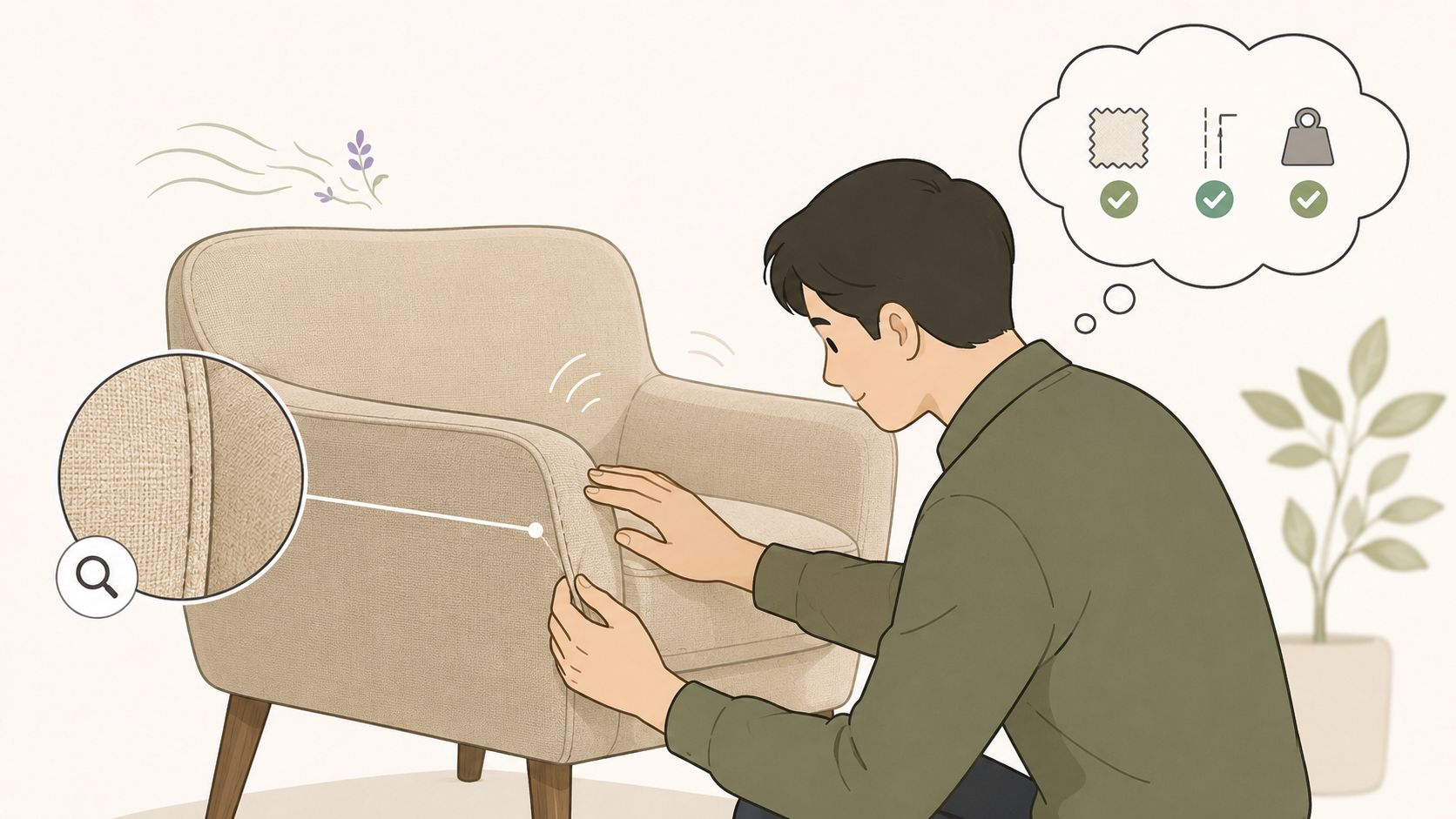
Construction tells the truth fast. A quality piece usually feels steady before it ever gets styled. Doors hang evenly. Drawers move smoothly. Upholstery looks neatly fitted rather than stretched. Seams line up.
Amish-crafted and American-made furnishings often stand apart. The value isn't just heritage. It's visible discipline in joinery, fit, balance, and detailing.
Practical rule: If a piece only looks good from the front, it probably wasn't built for long-term use.
The back panel, underside, drawer interior, and stitching lines all reveal whether the maker cared about the piece beyond the sales floor.
Finish is part of the quality
Finish isn't decoration alone. It's protection. A quality finish helps wood resist everyday wear, helps metal keep a richer appearance, and helps fabrics and surfaces remain easier to live with.
That's why two pieces in the same color can perform very differently. One finish may soften gracefully over time. Another may chip, haze, or show every fingerprint.
For high quality home decor, the safest approach is to judge the whole package together.
- Surface feel: It should feel intentional, not plastic or brittle.
- Color depth: Better finishes usually have more visual richness.
- Consistency: The sheen and tone should look controlled across the entire piece.
- Maintenance: Beautiful isn't enough if every touch leaves a mark.
The pieces worth keeping rarely rely on one flashy detail. They succeed because the material, craftsmanship, and finish all support one another.
How to Evaluate Decor Like a Designer
A designer's eye isn't magic. It's usually a trained habit of checking the details most shoppers rush past. In a showroom, the fastest way to spot quality is to stop looking only at color and silhouette.
Start with the first touch
Touch tells a lot. A side table should feel stable when lightly pressed. An upholstered chair should feel supportive, not loose or hollow. A lamp should have enough weight that it doesn't feel precarious on a console or nightstand.
For wood pieces, it also helps to understand the material itself. This guide to choosing the right hardwood for longevity and style gives shoppers a practical baseline for judging what they're seeing in person.
Listen, too. A drawer that rattles, a door that taps unevenly, or a frame that creaks under light pressure usually signals shortcuts somewhere in the build.
Look at the parts most shoppers miss
High quality home decor usually stays consistent in hidden areas. That's one of the easiest tests to use.
Check these spots before making a decision:
- Backs and undersides: A good piece is often cleanly finished even where casual shoppers won't look.
- Seams and corners: Piping, stitching, and pattern alignment should look deliberate.
- Edges and transitions: Rough joints, sharp corners, or abrupt material changes often point to lower build quality.
- Hardware and moving parts: Knobs, pulls, hinges, and glides should feel secure and proportional to the piece.
The underside of a piece often says more about quality than the front styling does.
Use a short showroom checklist
A long checklist usually gets ignored. A short one gets used.
- Stand back first. Does the piece have presence, or does it disappear?
- Touch the surface. Does it feel substantial, smooth, and finished?
- Test movement. Open drawers, shift the chair slightly, check stability.
- Inspect one hidden area. That's where shortcuts tend to show.
- Ask about upkeep. If the care routine sounds fussy, the piece may not suit daily life.
This approach works whether someone is shopping for a mirror, rug, cabinet, bench, or accent chair. The goal isn't perfection. The goal is to separate pieces that only photograph well from pieces that will still perform once they're home.
Styling Your Home for Timeless Appeal

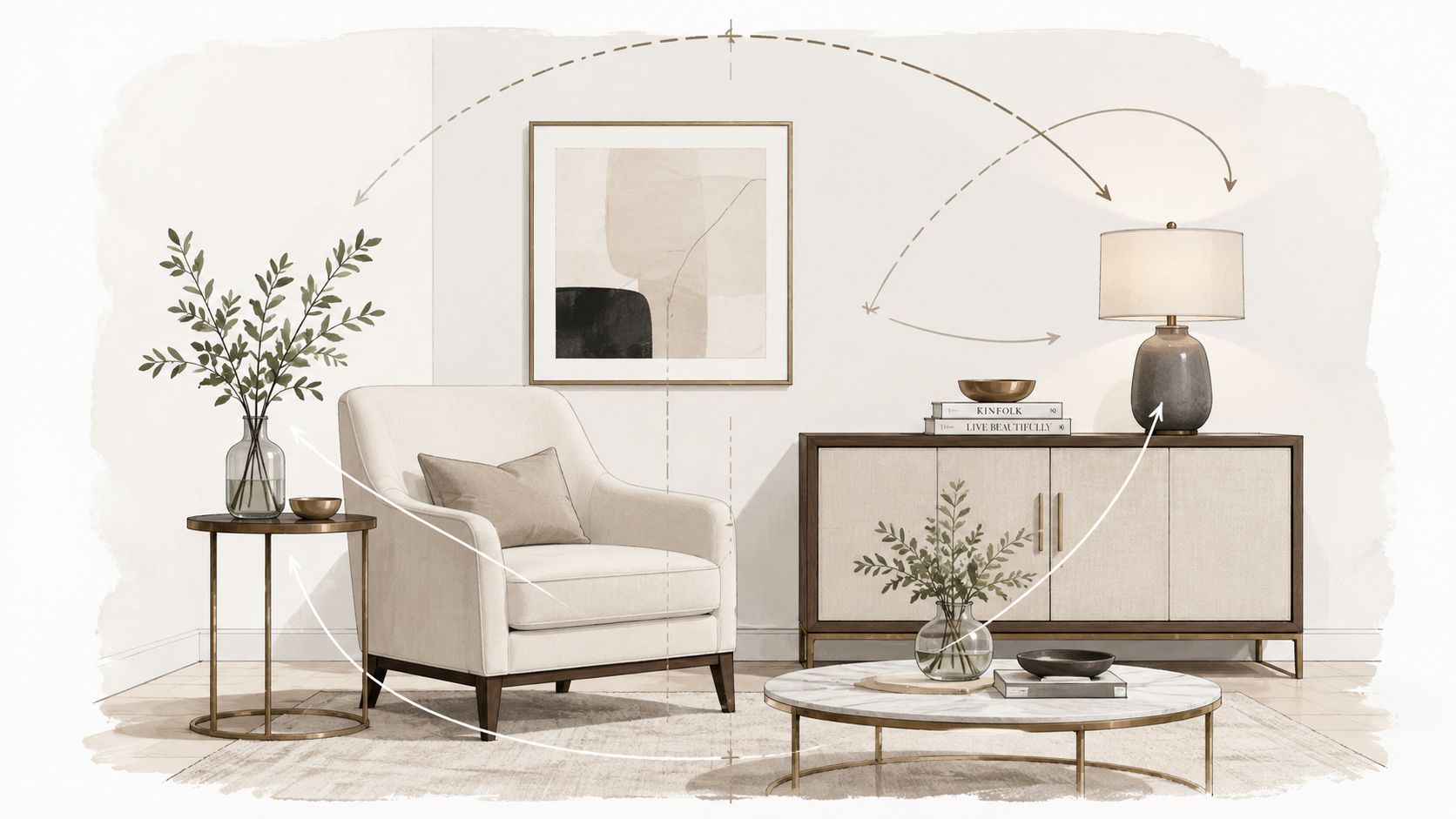
A room doesn't feel timeless because it's full. It feels timeless when the scale is right, the lighting is layered, and the finishes relate to each other. That's why a room with fewer pieces often feels more refined than one packed with decorative extras.
The room needs proportion before accessories
Design guidance shows that scale and proportion materially affect how finished a room feels. In living rooms, rugs should be large enough that major furniture legs sit on them, and curtain fabric should typically measure 1.5 to 2 times the window width for proper fullness, based on design guidance on scale, rugs, and curtains.
Those details sound small, but they change the entire room. A rug that floats in the middle of the seating area makes everything feel disconnected. Curtains that are too skimpy flatten the wall instead of framing it.
Layering creates the finished look
Good styling depends on layers with different jobs.
- Base layer: Rug, major furniture, and larger case pieces
- Functional layer: Table lamps, floor lamps, and practical surfaces
- Comfort layer: Pillows, throws, upholstered accents, and soft window treatments
- Character layer: Art, mirrors, ceramics, books, and personal objects
Rooms in Central Florida also benefit from decor that softens sound and adds comfort. Layered textiles, rugs, upholstered pieces, and heavier curtains can improve how a room looks while also helping absorb harsh echo and outside noise.
A room usually feels unfinished because it lacks scale or layering, not because it lacks stuff.
Design guidance also recommends three to five light sources per room for a more balanced, finished result. That's especially useful in open-concept homes where one overhead fixture leaves corners feeling dim and flat.
Personal rooms still need discipline
Personalized rooms work best when every item earns its place. That includes family-friendly spaces and homes with pets. For homeowners trying to make practical choices feel more integrated with the rest of the decor, resources on stylish dog beds can help show how utility items can blend into a room rather than interrupt it.
For broader room planning, these living room home decor ideas can help homeowners think through balance, placement, and a more collected look.
The common mistake isn't usually bad taste. It's adding small decor to solve a problem that really needs better scale, better lighting, or one stronger focal piece.
Where to Find Personalized Decor in the Orlando Area

Finding personalized decor in the Orlando area gets easier when shoppers can see materials in person, compare finishes side by side, and ask practical questions before ordering. That's hard to replace with a screen.
Why local shopping changes the decision
Central Florida homeowners often aren't furnishing just one corner of the house. They're working on living rooms, dining spaces, bedrooms, and entry areas at the same time. In that situation, consistency matters. One finish that reads warm online may clash with flooring in person. One fabric that looks soft in a photo may feel too slick or too formal once handled.
That's one reason local shopping still matters. The value isn't only convenience. It's better decision-making.
For a broader perspective on why communities benefit when buyers stay local, this article on how to support local businesses in Katy, TX makes a useful point that applies well beyond one town.
Customization matters more than labels
Current decor guidance increasingly points to fit and customization as more important than brand name alone, especially for homeowners in fast-growing areas like Central Florida who are furnishing several rooms at once, based on this discussion of customization and room-specific fit.
That's where custom-order options become valuable. A dining set may need a different wood tone to work with existing floors. Counter stools may need a specific seat height. A bedroom may need a dresser scale that fits the wall without crowding the walkway.
Custom choices are often what make a room feel settled instead of improvised.
One local option for that process is custom furniture ordering, where shoppers can tailor finishes, materials, and configurations to fit the room they have.
What to look for in a Longwood showroom
A strong local showroom should help with more than product selection. It should help with editing, coordination, and avoiding costly mismatches.
Useful signs include:
- Material guidance: Clear explanations of wood, upholstery, and finish trade-offs
- Customization support: Help narrowing choices so options don't become overwhelming
- Room-to-room coordination: Advice that keeps the whole home cohesive
- Local familiarity: An understanding of how Central Florida homes are used
Shoppers in Longwood, Lake Mary, Sanford, and the greater Orlando area often do best with stores that can support the full picture. Not just one transaction.
Create a Home That Lasts with Slone Brothers Furniture
High quality home decor pays off when each choice supports the way a home really lives. Better materials hold their look longer. Better construction feels different from day one. Better styling keeps a room from needing a reset every season.
That doesn't mean everything has to be done at once. Most lasting homes come together piece by piece, with attention to scale, texture, maintenance, and fit. The goal is a room that still feels settled after the trends shift.
For shoppers weighing long-term value, this guide on how long furniture should last is a useful next step.
Slone Brothers Furniture serves Central Florida homeowners who want quality furnishings, home decor, custom-order flexibility, and in-house design support in Longwood.
Ready to find the perfect piece for your home? Visit the Slone Brothers Furniture showroom in Longwood, FL, and let our design experts help you get started!