
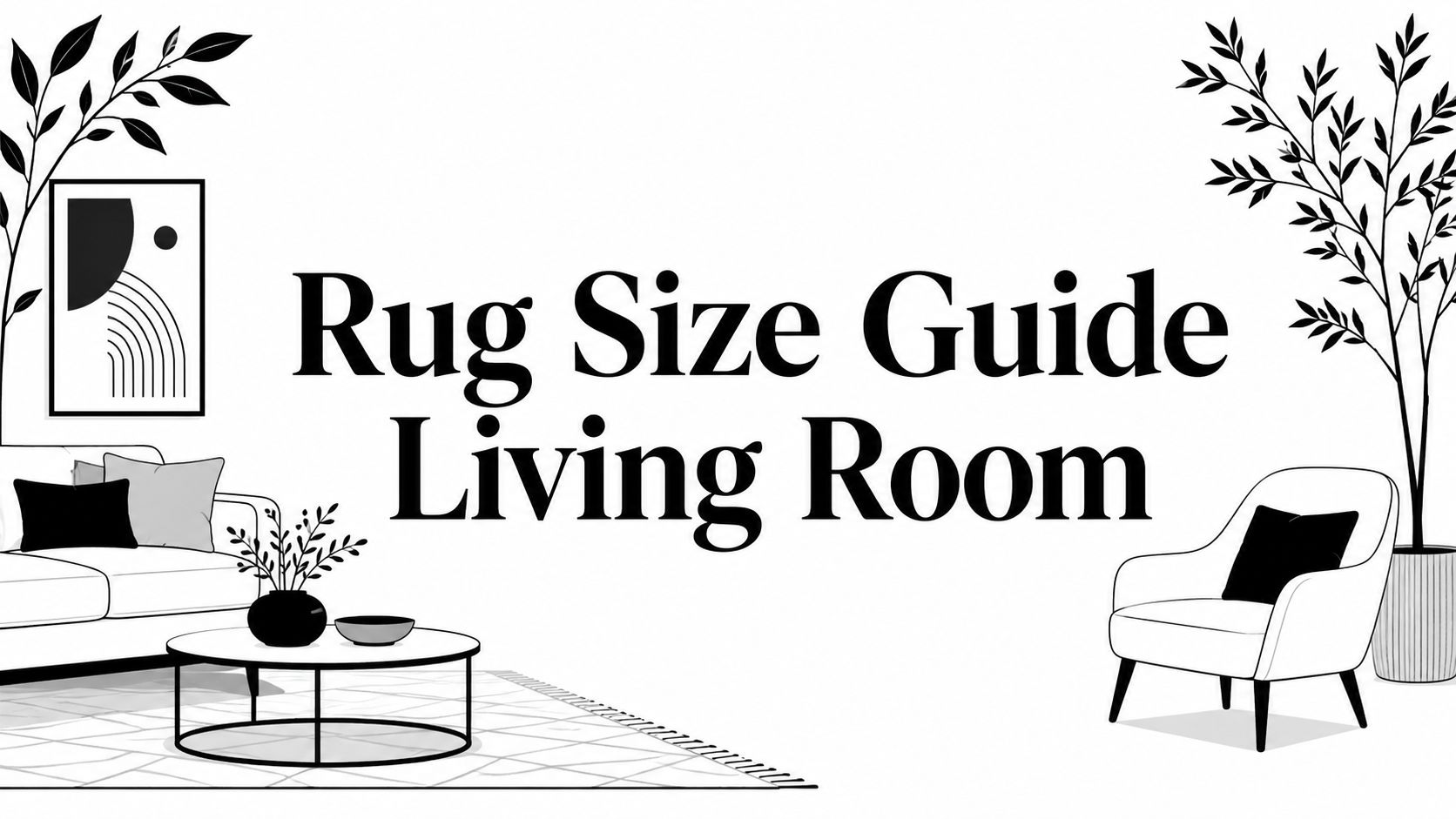
Rug Size Guide Living Room

A homeowner in Longwood, Lake Mary, or Winter Park often reaches the same frustrating point: the sofa is in place, the coffee table has been centered, and a rug that looked generous in a showroom suddenly appears too small in the living room. The problem usually isn't the rug's pattern. It's the relationship between the rug, furniture footprint, and walking paths.
A reliable rug size guide for the living room starts with furniture rather than a catalog photograph. In most homes, 8' x 10' and 9' x 12' provide the practical baseline, with the smaller size serving average rooms and the larger size supporting generous seating groups or open-plan layouts. Ruggable's rug sizing guidance reflects this distinction, including the common recommendation to keep visible floor around the perimeter rather than forcing the rug against the walls.
For a Central Florida home, sizing is only half the decision. Humidity, tracked-in sand, pets, pool traffic, hardwood floors, and the scale of a well-made sofa all affect the material and pile that will perform gracefully over time. A considered rug should make the room feel composed, not crowded, while supporting the quality of the living room furniture around it.
Measuring Your Living Room Before You Choose a Rug
A homeowner in Central Florida can measure the open floor and still order the wrong rug. The useful starting point is the entire room, followed by the furniture group the rug must hold together. This approach accounts for walls, circulation, and the actual footprint of the seating.
Start with the room, then the furniture
Measure the inside wall length and width, and record each result in inches. Mark fireplaces, hearth edges, built-ins, doorways, outlets, and any area where furniture cannot move freely. These fixed points show whether a standard rectangle can sit evenly or needs to shift toward the sofa, television, or main conversation area.
Next, measure the furniture footprint. Record the length and depth of the sofa, loveseat, or sectional. Add every accent chair, recliner, ottoman, and coffee table included in the arrangement. A rug may leave a balanced border at the walls yet fail to connect the seating if the furniture group extends beyond its edges.
For a repeatable room-measuring process, use the Slone Brothers guide to measuring a room for furniture. The same record is useful when choosing a rug because the rug must fit the furniture that will stay in the room, not an empty floor plan.
Record the clearances people use
Measure the space between the sofa and coffee table, between opposing armchairs, and along the main traffic lane from one entrance to another. Also record the route to the kitchen, patio, hallway, or foyer. A rug that narrows these paths will create a daily annoyance, even if its pattern and color suit the room.
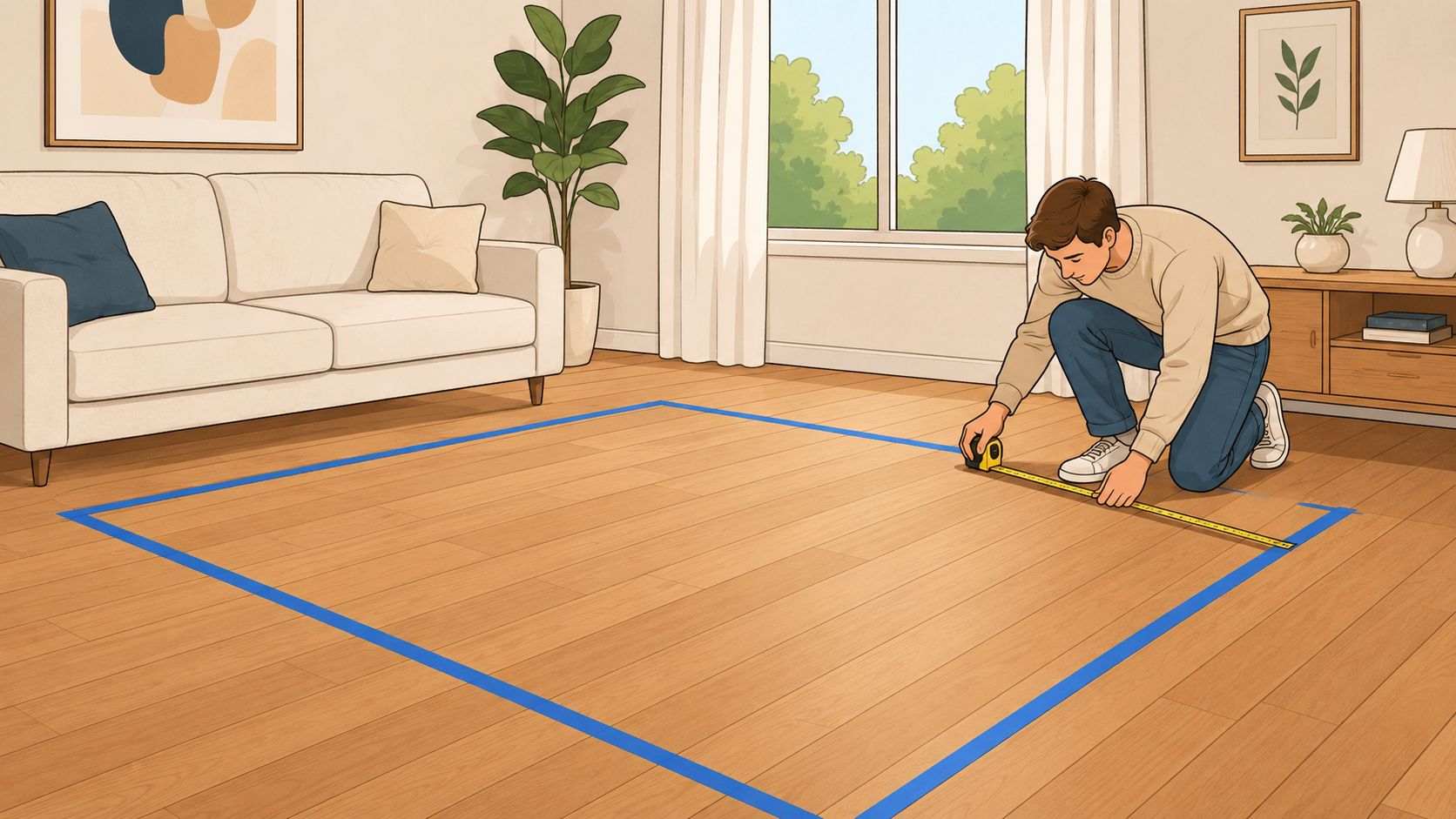
Use painter's tape to mark the furniture footprint on the floor. Tape the sofa, chairs, and coffee table positions, then outline each possible rug boundary. Photograph the arrangement from above, or from the highest practical point in the room. That view makes proportion easier to review before you visit a showroom or place an order.
Practical rule: Test the rug decision against written measurements and a taped floor plan before ordering.
Humid conditions make the post-installation plan part of the purchase. While reviewing area rug and carpet care, ask how the chosen fiber, backing, and pad can be cleaned without harming hardwood or finished surfaces. Accurate measurements protect the room layout, while the right construction helps the rug remain practical after it arrives.
Matching Rug Layouts to Your Seating Arrangement
The correct layout depends on what the rug is expected to hold together. All-legs-on creates the most anchored and formal composition, front-legs-on balances coverage with visible flooring, and floating defines a compact conversation area without attempting to carry the entire seating group.
Compare the three placement approaches
An all-legs-on arrangement places the sofa and chairs completely on the rug. It suits a spacious room, a generous seating group, and a homeowner who wants the rug to read as the foundation of the entire conversation area. An 8' x 10' can support a standard sofa and two chairs in a carefully proportioned room, while a 9' x 12' becomes the more comfortable choice when the chairs sit farther apart or the furniture has substantial depth.
Front-legs-on is the most adaptable option for many Central Florida living rooms. The sofa and chairs sit partly on the rug, allowing the front legs to connect the furniture visually while the back legs remain on the floor. This works particularly well when the room's width can't support an all-legs-on layout without narrowing the perimeter or blocking a doorway.
A floating rug sits beneath the coffee table, with seating around it. This is a deliberate solution for a smaller conversation zone, not a way to force an undersized rug into a large room. A 5' x 8' floating rug can work under a coffee table in a compact arrangement, provided the surrounding furniture still feels connected.
| Layout | Furniture on Rug | Best For | Typical Rug Size |
|---|---|---|---|
| All-legs-on | Sofa and chairs fully on the rug | Large rooms and formal, anchored seating groups | 8' x 10' or 9' x 12' |
| Front-legs-on | Front legs of sofa and chairs | Standard rooms and flexible seating zones | 8' x 10' or 9' x 12' |
| Floating | Coffee table only, with seating around it | Small conversation areas | 5' x 8' |
Let the taped footprint make the decision
The taped seating zone should determine the layout, not the other way around. If the tape shows that an all-legs-on arrangement would push the rug into a doorway or leave almost no perimeter floor, front-legs-on is the more disciplined choice. A larger 9' x 12' is appropriate when both the sofa and secondary chairs need to sit fully on the rug and the room can preserve a comfortable border.
For additional planning support, homeowners can review living room arrangement ideas before finalizing the rug orientation. The important trade-off is simple: an undersized rug separates the seating pieces, while an appropriately scaled rug gives the conversation area a clear visual center.
Standard Rug Sizes for Common Living Room Dimensions
Most living rooms don't require an unusual rug dimension. The strongest starting points are 8' x 10' for an average-sized room and 9' x 12' for a larger or open-plan space, with smaller or oversized formats reserved for specific furniture footprints.
Use the standard sizes as decision points
A 5' x 7' rug can suit a compact loveseat arrangement with a small coffee table, particularly when the surrounding chairs aren't part of the same seating group. A 5' x 8' offers slightly more length, but it still commonly functions as a floating coffee-table rug rather than a complete sofa-and-two-chairs solution.
The 8' x 10' remains the practical benchmark for many standard living rooms. Design guidance commonly places it in an average room around 11' x 13', where it can support front legs on the rug or, with carefully scaled furniture, an all-legs-on arrangement. The 9' x 12' is better for larger rooms, open-plan homes, and seating groups that need more width. One sizing guide notes that a 9' x 12' typically suits a 12' x 18' living room or larger. These dimensions are documented in Ruggable's rug size guide and The Spruce's area rug sizing guide.
| Rug Size | Seating It Fits | Room Footprint | Best Layout |
|---|---|---|---|
| 5' x 7' | Loveseat and compact coffee table | Small living area | Floating |
| 5' x 8' | Coffee table with surrounding seating | Small conversation zone | Floating |
| 8' x 10' | Sofa with chairs or a standard grouping | Average living room | Front-legs-on or all-legs-on |
| 9' x 12' | Sofa, chairs, and larger coffee table grouping | Medium-to-large or open-plan room | Front-legs-on or all-legs-on |
| 10' x 14' | Full sectional and generous seating zone | Large living room | All-legs-on |
Know when a rectangle isn't the answer
A runner can work better than a rectangle in a narrow passage beside a living room, especially where a full area rug would interfere with circulation. A round rug can soften a compact conversation area or complement a round coffee table, but it shouldn't be selected merely to avoid measuring the seating footprint.
Misorders happen when a homeowner chooses a 5' x 8' for a sofa-and-two-chairs arrangement that really needs an 8' x 10'. When the room can carry it, a larger rug usually provides better visual unity. Homeowners considering an oversized living room arrangement can use 11' x 14' area rugs as a reference point for how a larger format changes furniture placement and perimeter balance.
Mocking Up the Rug Placement Before You Buy
Painter's tape turns an uncertain purchase into a floor-level test. Before selecting a pattern or fiber, mark the proposed rug's width and length in the exact location where it will sit, then evaluate the room as if the tape were the rug edge.
Test the rectangle against movement
Tape the width first, then the length. Check the distance from the rug edge to the walls, hearth, built-ins, and doorways. In a defined living room, designers commonly look for roughly 12 to 18 inches of visible floor around the perimeter, while very large rooms may accommodate 18 to 36 inches. Style by Emily Henderson's rug sizing guidance also supports mapping the room and seating footprint before committing to a standard size.
Walk every route people use. Test the entry-to-sofa path, sofa-to-kitchen path, and sofa-to-television path. The plan notes for this room should preserve at least 30 inches of bare floor where people step, and the coffee table should leave 16 to 18 inches of walking space on the main path. These clearance figures are practical layout checks, not decorative preferences.
Open the front door, patio slider, and French doors through their full swing. A taped corner that catches a door arc will become a daily annoyance once the rug and pad are installed. If the corner interferes, shift the rectangle forward or back, rotate it, or change the intended layout.
Add the furniture footprint
Tape the sofa and chairs next, then test front-legs-on against all-legs-on. If the furniture seems to fight the rug, the rectangle is probably too small or incorrectly oriented. The seating should feel connected without forcing a chair into a traffic lane.
A rug pad adds comfort, reduces movement, and protects the floor, so the mock-up should account for the pad's final footprint. Homeowners working with hardwood can also consult guidance on best decor for wood flooring while considering how the rug, pad, and furniture legs will interact with the finish.
Before visiting a showroom, photograph and record:
- Room dimensions: Wall length, wall width, and irregular architectural features.
- Furniture footprint: Sofa, sectional, chairs, ottoman, and coffee table positions.
- Clearance points: Door swings, hearth edges, outlets, built-ins, and traffic lanes.
- Layout options: The taped boundary for front-legs-on and all-legs-on placement.
- Flooring details: Hardwood, tile, or another surface that may require a specific pad.
Homeowners comparing room images can also review how to use online furniture photos to make smarter buying decisions, but the taped floor remains the more reliable test because it shows the proposed dimensions at full scale.
Choosing Rug Materials and Pile for Real Florida Homes
Central Florida homes ask more of a rug than a showroom photograph reveals. Humidity, fine sand, pets, children, pool traffic, and heavy seating all influence whether a fiber remains comfortable, stable, and visually composed.
Match the fiber to the household
Wool is a strong choice for a refined living room. It breathes, resists crushing beneath a sofa, and brings a substantial hand underfoot. It still benefits from rotation and a quality pad, especially when heavy furniture creates repeated pressure points.
Polypropylene and solution-dyed synthetics are practical where moisture, spills, or pool traffic are part of daily life. They tend to tolerate active use well, though a synthetic pile can crush sooner beneath a very heavy sectional than a well-made wool construction.
Viscose and silk-look fibers create a luminous surface, but they require a more cautious placement strategy. In humid rooms, water marks and yellowing can make them a risky choice for a primary family seating area. Their visual delicacy is better reserved for low-traffic settings where spills aren't a regular concern.
For homeowners seeking texture with a natural character, natural fiber rugs can be evaluated alongside wool and performance constructions. The question isn't whether a material looks luxurious. It's whether its maintenance profile matches the household.
Select pile height by use
Low pile, under a quarter inch, is practical near dining areas and wherever furniture needs to roll easily. Medium pile, from a quarter to half inch, provides a more comfortable living room surface while remaining manageable when children, dogs, and tracked-in grit are part of the routine.
High or plush pile belongs in a lower-traffic formal room. It can feel inviting underfoot, but it creates more resistance for moving furniture and requires more attention around crumbs, sand, and chair legs.
| Traffic Level | Household | Material | Pile Height |
|---|---|---|---|
| High | Children, dogs, frequent indoor-outdoor movement | Solution-dyed synthetic or durable wool | Low to medium |
| Moderate | Active household with regular living room use | Wool or resilient synthetic | Medium |
| Low | Formal room with limited daily traffic | Wool, viscose-look, or refined specialty fiber | Medium to high |
| Transitional | Dining-adjacent living area or rolling furniture | Durable synthetic or tightly woven wool | Low |
A pad should protect both the rug and the hardwood floor while helping the rug stay stable. The pad's thickness and density need to be compatible with the door clearances, furniture weight, and flooring finish. A rug that feels luxurious but rocks a chair or catches a door isn't a successful selection.
Common Rug Sizing Mistakes That Ruin a Room
The most damaging rug errors are layout failures. They make well-chosen furniture look disconnected, crowded, or adrift, even when the rug's color and pattern suit the room.
The small rug problem
A rug centered beneath only the coffee table creates a visual island inside the seating group. Extend it far enough for the sofa's front legs and the major chairs to rest on the rug. Depending on the furniture footprint, that may mean moving from 5' x 8' to 8' x 10', or from 8' x 10' to 9' x 12'. These corrections follow the placement guidance in this rug placement and sizing reference.
The rug should usually run close to the sofa's length and connect the sofa, side chairs, and coffee table visually. If it ends before the chair legs, the seating loses a shared foundation. In an open Central Florida living room, that separation becomes more noticeable because the rug often defines the seating zone within a larger tiled or wood-floored area.
The blocked walkway
A rug that reaches wall to wall in a narrow room can squeeze circulation. Letting one corner enter a swinging door's path creates a more specific obstruction. Measure the door arc and primary walking route before committing to the rectangle.
Sometimes trimming 2 inches from each long side and rotating the layout restores movement without changing the furniture. If the remaining clearance still feels tight, choose a smaller format or a runner. A low-pile, tightly woven construction is easier to cross and less likely to catch beneath furniture or doors.
The floating furniture pattern
Pulling the sofa 6 inches off the rug to show more of its surface usually produces an unintended gap. Upsize the rug or place the furniture legs fully on it, then check the coffee table position and traffic lanes again. The furniture should look anchored, not carefully balanced at the edge.
| Symptom | Cause | Fix |
|---|---|---|
| Rug looks lost beneath the coffee table | Seating footprint is larger than the rug | Move to the next appropriate standard size |
| Walkway feels narrow | Rug crosses a primary route or door swing | Rotate, reposition, or reduce the rectangle |
| Sofa appears detached | Furniture sits outside the rug boundary | Use front-legs-on or place all relevant legs on the rug |
| Chairs feel unrelated | Rug does not extend beneath secondary seating | Choose a wider layout, often 8' x 10' or 9' x 12' |
Your Rug Buying Checklist and Local Next Steps
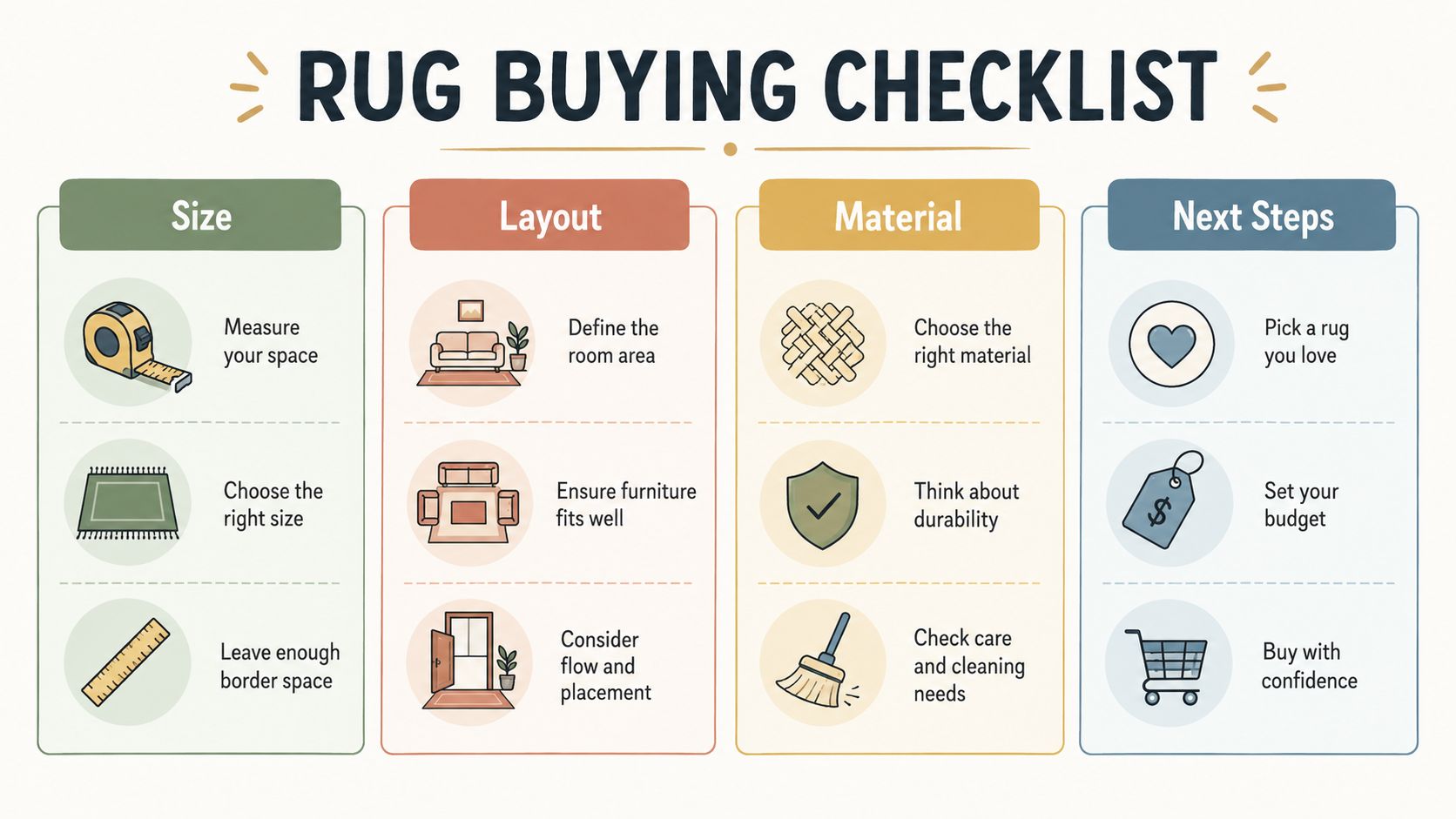
A well-chosen rug should pass four tests before purchase: the dimensions are verified, the layout matches the furniture, the material suits the household, and the pad and delivery details are understood.
Confirm the measurements
Write down the wall length and width, seating depth, sofa length, coffee table position, door swings, hearth edges, built-ins, outlets, and traffic lanes. Keep the taped footprint photographs with the notes so a design consultant can evaluate the actual room rather than relying on memory.
Match the layout
Choose all-legs-on, front-legs-on, or floating before selecting a pattern. The rug size follows the seating footprint. An 8' x 10' often serves a standard arrangement, while a 9' x 12' provides additional room for larger furniture groupings and open-plan zones.
Rate material and pile honestly
Record the fiber type, pile height, backing, pad requirements, and whether an indoor-outdoor construction makes sense for humidity and pool traffic. A refined wool rug may suit a formal room, while a resilient synthetic may be the more responsible choice for a busy family seating area.
Set practical budget guardrails
The rug is only one part of the installation. Account for the pad size, delivery timing, furniture moving, and any custom-cut runner requirement. Long-term value comes from choosing a construction that remains useful as the room evolves, not from selecting a surface that only looks impressive on delivery day.
Questions Longwood homeowners ask
How big should a rug be under a sectional?
An 8' x 10' or 9' x 12' commonly works, depending on whether the sectional uses a front-legs-on or all-legs-on layout. The taped footprint should decide whether the rug needs more width to connect the chaise and adjoining seating.
What size works under a coffee table?
A floating 5' x 8' can define a compact conversation area. In a larger seating group, the coffee table rug should extend far enough to include at least the front legs of the major seating pieces.
Can a 9' x 12' fit a standard living room?
It can, provided the room preserves a balanced visible-floor border and the rug doesn't interfere with doors or traffic. It is often more suitable for larger rooms or open-plan spaces, while an 8' x 10' is commonly more proportionate in an average living room.
How can two rugs be layered without creating a trip hazard?
Use a stable, low-profile base rug with a smaller top rug, keep both surfaces flat, and use a compatible pad that prevents shifting. Door swings and walking routes should be tested before the layered arrangement is finalized.
Central Florida homeowners can bring these measurements to the Longwood showroom to compare hand-knotted wool, indoor-outdoor performance rugs, and custom-cut runners in person. Slone Brothers Furniture offers living room furnishings, custom-order options, and complimentary in-home design services that can help coordinate the rug with a sofa, sectional, chairs, and coffee table.
Ready to invest in a living room that feels proportioned, comfortable, and built to last? Visit Slone Brothers Furniture in Longwood, FL, where experienced design consultants can review the measurements, compare rug materials and sizes, and help create a cohesive room without automated guesswork. Schedule a measuring consultation or stop by the Central Florida showroom to experience a more personal approach to furnishing the home.