
11×14 Area Rugs: The Complete Central Florida Design Guide


The sofa is in place, the dining table has arrived, and the open-plan room still feels disconnected. In many Central Florida homes, the problem isn't the furniture. It's the rug. A small rug floating beneath a coffee table can make a generous living area look fragmented, while the right 11×14 area rug can define the seating zone, soften hard flooring, and give the entire room a finished architectural feel.
An 11×14 rug isn't a casual decorative purchase. It changes how furniture relates to the room, how people move through the space, and how much of the floor remains visible. In Longwood, Orlando, Lake Mary, Winter Park, and surrounding communities, where open layouts are common, correct sizing matters even more. Florida humidity, strong sunlight, active households, and large furniture groupings also make material and construction decisions important.
What Makes 11×14 Area Rugs Different from Standard Sizes
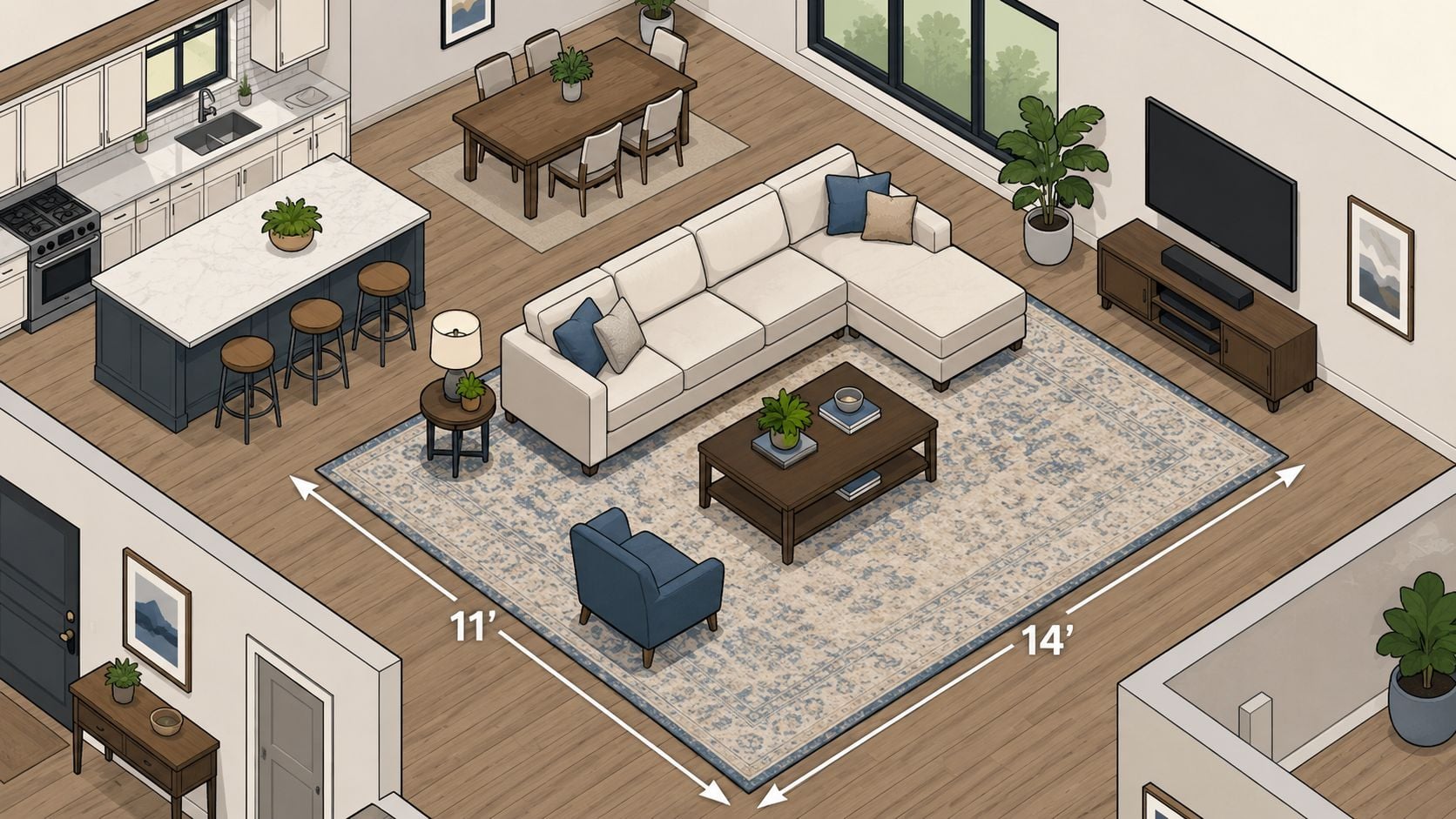
Many homeowners underestimate rug size because a rug is often viewed as an accessory rather than a zoning tool. The difference between a standard rug and a large-format rug becomes obvious once the furniture is placed. An 11×14 area rug covers 154 square feet, calculated by multiplying 11 feet by 14 feet, or approximately 14.3 square meters (size comparison and coverage reference).
That footprint is substantially larger than the common alternatives. An 8×10 rug covers 80 square feet, while a 9×12 rug covers 108 square feet (large-format rug sizing reference). Moving from 8×10 to 11×14 adds 54 square feet of coverage, and moving from 9×12 to 11×14 adds 46 square feet (large-format rug sizing reference).
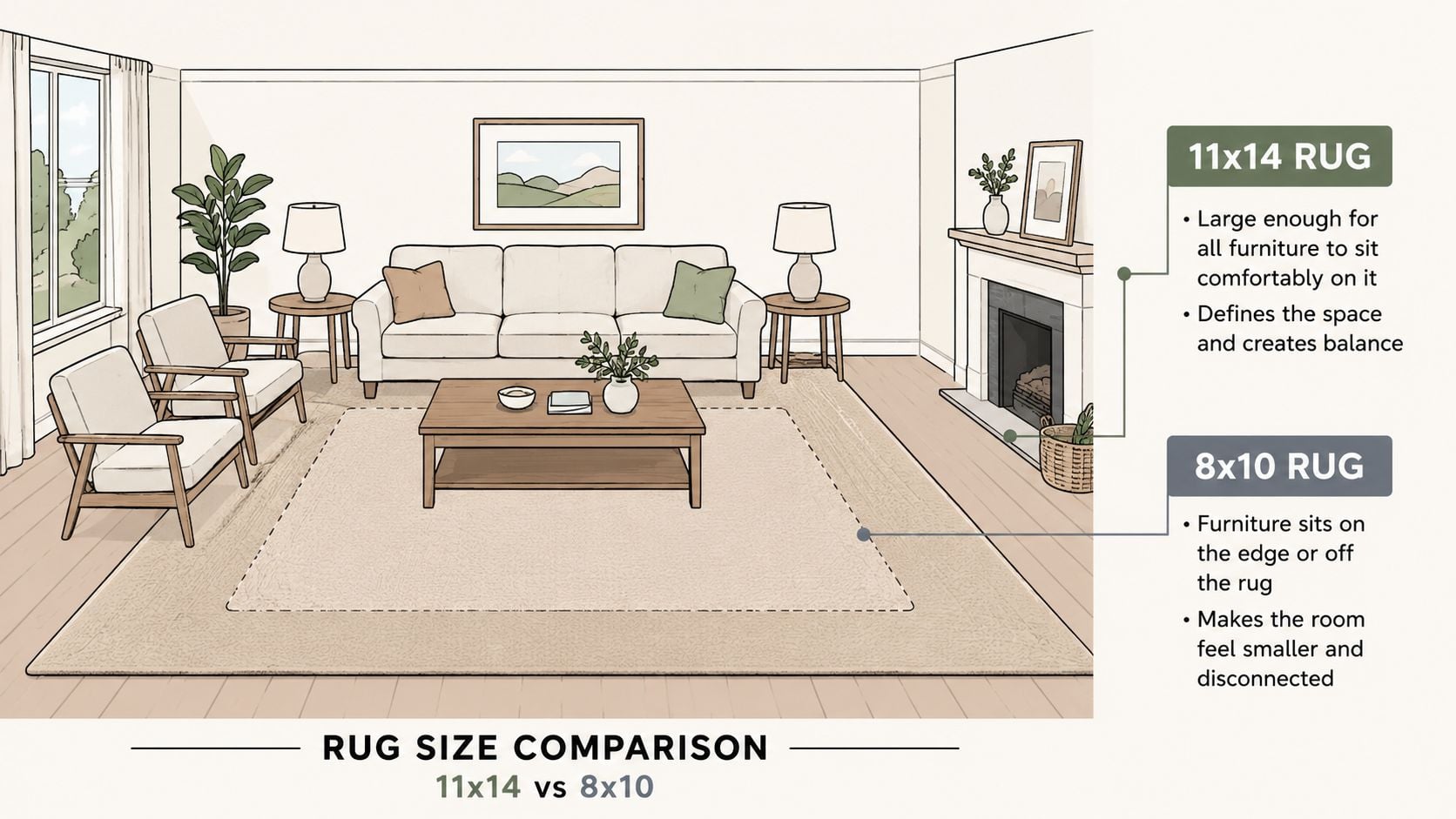
When the larger footprint earns its place
The right question isn't whether a larger rug costs more or occupies more floor. The right question is whether the room needs that additional coverage to make the furniture grouping feel intentional.
An 11×14 size is appropriate when:
- The seating group floats in an open plan: A sofa, chairs, and coffee table can sit partly or fully on the rug, creating a distinct conversation area without adding walls.
- The room has generous proportions: The rug can anchor the furnishings while leaving visible flooring around its perimeter.
- The floor feels overly exposed: Additional coverage can visually balance expansive tile, wood, or other hard surfaces.
- The furniture is substantial: Deep sofas, accent chairs, ottomans, and occasional tables often look undersized against a rug that barely reaches the front legs.
The size appears alongside other large mainstream options, including 9×12 and 10×14, in standard sizing charts (standard rug size reference). That makes it a practical residential format, not a niche custom dimension.
The mistake is buying 11×14 simply because the room is large. If the rug leaves no breathing room, blocks circulation, or crowds the walls, the extra square footage works against the design. Large-format rugs need room for their edges to remain visible and for the surrounding floor to frame the composition.
Room-by-Room Placement Strategies for Large Spaces
An 11×14 rug should be placed according to the room's furniture pattern, not just centered by wall measurements. In a living room, dining room, and primary bedroom, the same rug creates different functional requirements.
Practical rule: A large rug should define the furniture grouping while preserving visible floor around it and clear paths through the room.
Living rooms and open-plan layouts
In a large living room, the strongest arrangement usually places the sofa and accompanying chairs partly or fully on the rug. Keeping the front legs of the major seating pieces on the same surface creates visual continuity. In a generous room, the full seating group can sit on the rug, with the coffee table centered inside the arrangement.
Design guidance for large rugs commonly targets 18 to 24 inches of exposed floor around the perimeter to preserve proportion and allow the room to breathe. That clearance is especially important in Central Florida open-plan homes, where the rug may sit between a living area, kitchen, and dining zone.
A rug that ends just beyond the seating group can establish a comfortable boundary. A rug that reaches too close to the walls can make the room feel compressed, even when the room itself is spacious.
Dining areas
Dining placement demands more clearance than a living room because chairs move backward during use. The rug should extend at least 36 inches beyond the table edges, allowing chairs to remain on the rug when guests sit down or stand up (dining rug placement guidance).
For an 11×14 rug, the table must be positioned so the rug supports the full dining action, not just the tabletop. A low-profile, tightly woven surface is usually more practical than a deep pile because chair legs move more easily and crumbs or spills are simpler to address.
Primary bedrooms
In a primary bedroom, the rug should extend approximately 24 inches past the bed and beneath the nightstands (bedroom rug placement guidance). This creates a deliberate landing area on either side of the bed and gives the bed a stronger visual foundation.
The rug should support the bed's presence without disappearing beneath it. In a large bedroom in Lake Mary or Winter Park, an 11×14 rug can also unify a bed, nightstands, bench, and nearby occasional furniture when the floor plan allows the full grouping to sit comfortably within the rug's boundaries.
Material Selection for Florida's Climate and Lifestyle
Central Florida introduces conditions that generic rug advice often overlooks. Humidity, direct sunlight, tile flooring, pets, children, and frequent indoor-outdoor movement all influence whether a rug remains attractive and comfortable over time.
The strongest material choice depends on the room's exposure and use. No single fiber is ideal for every Orlando home.
Wool for depth and long-term value
Wool offers a refined hand, natural resilience, and visual depth that suits heirloom-quality interiors. It works particularly well in formal living rooms and primary bedrooms where texture, color variation, and craftsmanship matter more than quick replacement.
Wool still requires thoughtful placement. A sun-drenched room needs protection from prolonged direct exposure, and spills should be addressed promptly. A dense, well-constructed wool rug can justify a higher initial investment because it contributes material richness and a lasting presence rather than serving as disposable decoration.
Synthetic blends for active rooms
Synthetic blends can be practical in family rooms, media rooms, and spaces where staining is a realistic concern. Their appeal comes from easier routine care and broad design flexibility.
The tradeoff is tactile and visual. A synthetic rug may not offer the same depth or aging character as a carefully made natural-fiber piece. Buyers should judge the rug's construction, backing, pile behavior, and finish rather than treating fiber content as the only quality indicator.
Natural fibers for relaxed interiors
Natural fibers can complement coastal, transitional, and casual Central Florida interiors. Their organic texture works well with solid wood furniture, woven accents, and lighter architectural palettes.
They aren't automatically the best choice for every humid room. Moisture exposure, cleaning requirements, and the rug's placement should be considered before selecting a natural-fiber construction. A showroom consultation helps match the desired look with the actual demands of the household.
Pile and construction matter as much as fiber
A dining area and a high-traffic living room generally benefit from a lower, more stable pile. A bedroom can accommodate a softer surface because furniture movement and food spills are less central concerns.
Hand-knotted construction represents the strongest heirloom-oriented choice for buyers prioritizing artistry and longevity. Hand-tufted and machine-made constructions can serve different purposes, but the buyer should understand that construction affects resilience, maintenance, and long-term value. In a premium home, a rug should be evaluated as part of the furnishing investment, not selected only by color on a screen.
Measuring Your Space Accurately Before You Buy
An 11×14 rug should never be ordered from room dimensions alone. The rug has to fit the furniture grouping, walking paths, doors, architectural features, and visual balance at the same time.
Start with a simple floor plan. A tape measure, painter's tape, paper, and a pencil are enough to create a useful working layout.
Measure the room and the usable zone
Record the room's overall dimensions, then identify areas that can't be covered or obstructed. Mark built-in shelving, fireplaces, columns, bay windows, vents, and door swings. In Florida homes with open layouts, also mark the transition between the living area and adjacent kitchen or dining zones.
Next, measure the furniture footprint. Include the sofa, chairs, ottomans, coffee table, consoles, and any pieces intended to sit on the rug. A rug can be mathematically centered in a room and still look wrong if it doesn't center around the furniture.
Use painter's tape before delivery
Lay out an 11×14 rectangle with painter's tape on the floor. Walk around it from every entrance, pull dining chairs back if the rug will serve a dining area, and open nearby doors.
This test exposes problems that a product photograph won't reveal. It also shows whether the rug edge disappears under a cabinet, creates an awkward bottleneck, or leaves a seating group divided between rug and bare flooring.
The tape outline should be treated as a functional rehearsal, not a rough suggestion.
Before committing, check these points:
- Perimeter clearance: Confirm that the room retains balanced exposed flooring around the taped outline.
- Furniture contact: Decide which legs will sit on the rug and keep that treatment consistent.
- Circulation: Walk the natural routes between the entry, kitchen, hallway, and seating area.
- Door movement: Verify that doors won't catch on the rug or its pad.
- Delivery access: Measure the path from the entrance to the room, including turns and narrow passages.
The final check should include the rug pad, since the pad affects height and edge stability. Accurate preparation is less glamorous than choosing a pattern, but it prevents an expensive piece from arriving with nowhere to function properly.
Why Professional Design Consultation Beats Online Shopping
An online image can't show how a rug's color changes beside a particular sofa, how its texture feels underfoot, or whether its pattern competes with existing artwork. It also can't inspect the actual proportions of a Central Florida home.
Large-format rugs are especially difficult to purchase sight unseen because scale is unforgiving. A pattern that appears restrained on a screen may dominate an open-plan living room, while a subtle design may disappear beneath a large sectional. Lighting adds another variable, especially in rooms with strong Florida sun.
What experienced consultants evaluate
A professional design consultant considers the complete room rather than treating the rug as an isolated product. That evaluation includes:
- Furniture scale: Whether the rug can support the sofa, chairs, tables, and circulation pattern.
- Color relationships: How the rug interacts with upholstery, wood tones, wall finishes, and nearby rooms.
- Texture: Whether the surface suits bare feet, chair movement, pets, and daily use.
- Construction: Whether the rug's build matches the homeowner's expectations for longevity.
- Placement: Whether the rug will define the intended zone without crowding architectural features.
That advice has practical value. Avoiding an incorrect size, unsuitable pile, or disappointing color can matter more than finding a superficially attractive online price.
Slone Brothers Furniture provides area rugs through its home décor selection, along with furniture and complimentary in-house design services. A local Longwood showroom allows homeowners from Orlando, Sanford, Altamonte Springs, and nearby communities to discuss the room with experienced consultants and evaluate furnishings in person.
Rug Pad Selection and Installation Best Practices
An 11×14 rug needs a pad selected for stability, floor protection, load distribution, and edge support. A pad isn't merely an accessory beneath the rug. It influences how the rug feels, wears, and stays positioned.
Guidance cited by Houzz indicates that rugs 8×10 and larger often pair well with felt or felt-based pads, while a thickness of 1/4 inch to 3/8 inch is generally adequate (rug-pad selection guidance). A pad around 1/2 inch can become overly cushioned and may reduce stability (rug-pad selection guidance).
Match thickness to the rug
A heavier rug may need a pad that distributes weight effectively, while a lighter construction may need greater grip. Rug Pad USA's guidance also identifies 1/4 inch or more as a thick pad category and points to 1/4 to 3/8 inch as a preferred range for many residential uses (pad thickness guidance).
The pad should be cut slightly smaller than the rug. This lets the rug edges relax onto the floor, improves the finished appearance, and reduces the chance of a raised edge becoming a trip point.
Install with care
Clean and dry the floor before installation, especially during humid months. Lay the pad flat, remove wrinkles, position the rug gradually, and check every edge after furniture is returned.
A pad that's too thick can cause instability or edge lift. A pad that's too thin may fail to cushion impact or protect hard flooring adequately. The correct specification depends on rug weight, floor type, pile, and household use, so an in-person review is preferable to choosing by thickness alone.
Long-Term Care and Maintenance Protocols
A large rug in a Central Florida home needs preventive care, not occasional rescue. Sun exposure, humidity, tracked-in grit, and furniture weight can slowly change the surface even when the rug still looks clean.
A homeowner furnishing a living room in Longwood might notice the first warning signs near the sofa and main walkway. The rug may appear slightly flatter in those areas, while a sunlit edge may begin to look different from the portion protected by furniture. That isn't a reason to replace the rug. It is a reason to adjust the care routine.
A practical maintenance rhythm
- Vacuum carefully: Use a setting appropriate to the rug's construction and avoid aggressive treatment of delicate fringes or raised details.
- Address spills promptly: Blot rather than scrub, and use a cleaning method suited to the specific fiber and finish.
- Manage sunlight: Use window treatments or adjust furniture and rug orientation when direct exposure is persistent.
- Move heavy pieces thoughtfully: Small adjustments can prevent one area from bearing the same load indefinitely.
- Inspect during humid periods: Check the floor beneath the rug and pad for moisture concerns before problems become visible from above.
Professional cleaning should be chosen according to the rug's material and construction. Handcrafted or delicate pieces deserve specialized handling, while durable everyday rugs may follow a different maintenance plan. Harsh household chemicals are a poor substitute for fiber-specific care.
Storage also matters if the rug is removed during redecorating. It should be clean and completely dry before being rolled with the pile facing inward and protected from moisture, crushing, and prolonged heat.
The local advantage is access to people who can assess the rug, floor, furniture, and climate together. Slone Brothers Furniture has served Central Florida families from its Longwood showroom since 1980, offering furniture, mattresses, home décor, custom-order pieces, in-house design guidance, and home delivery. That kind of human service helps homeowners select a large rug that supports the room for years rather than solving only the immediate decorating problem.
Ready to invest in a large-format rug that fits your home properly and complements furniture built for lasting value? Visit Slone Brothers Furniture in Longwood, FL, where experienced design consultants can help Central Florida homeowners evaluate materials, placement, and room proportions in person. Bring a floor plan or schedule complimentary in-home design guidance, then experience the textures and craftsmanship before making the investment.