
Home Office Furniture Sets: How to Choose the Right One


35.5 million people in the United States teleworked or worked at home for pay in the first quarter of 2024, an increase of 5.1 million over the same period a year earlier, according to the U.S. Bureau of Labor Statistics. A room used at that pace is a workplace, and it earns the same planning as one.
The planning problem looks different in Central Florida than in a national buying guide. In many homes around Longwood, Lake Mary, Sanford, Winter Park and Altamonte Springs, a dedicated study is the exception, so the office usually lands in a spare bedroom, a corner of the living room or a wall in the primary suite. The best home office furniture sets start with that room and the household around it: measure first, choose a desk that leaves the doors and windows usable, and pick pieces that can return to family use when the laptop closes.
Buy for the second job, not only the workday. Storage should hold files now and linens later. A chair should support eight hours and still look right at dinner. That order runs through every choice: room, fit, then furniture.
How Much Room Does a Home Office Set Need?
A home office set fits when the desk, the chair pull-out and the walkway all clear the room's fixed elements. Measure the room first, mark the desk footprint in painter's tape at its full width and depth, and hold 36 inches of walkway behind the chair. If the taped outline blocks a doorway, a window or a walking path, the set is too large for the room, and no amount of styling fixes it.
Four room types cover most Central Florida homes. Match the desk to the room's real dimensions rather than to the widest surface in the showroom.
Desk footprint and walkway clearance by space
| Space | Typical room size | Desk width and depth | Clearance to plan |
|---|---|---|---|
| Corner nook | About 5 x 6 ft | 36-42 in wide, 22-24 in deep | 36 in walkway behind the chair |
| Spare bedroom | About 10 x 10 ft | 54-60 in wide, 24-30 in deep | 36 in walkway, room for the chair to pull out |
| Dedicated den | About 12 x 12 ft | 60-72 in wide, 30 in deep | 36 in walkway, space for a bookcase or filing storage |
| Shared living area | A wall in the main living space | 30-48 in wide, 24 in deep, closes to a cabinet | Path to the entry and seating kept clear |
Why depth matters more than width
In a 10 x 10 spare bedroom, a 60 inch wide desk with 24 inches of depth works. A 72 inch desk with 20 inches of depth doesn't, because the monitor ends up crowding the keyboard and the user leans in to compensate. Depth sets viewing distance. Width only sets how far you can spread out. In a small room, trade width for depth every time.
The four-step measuring routine
- Record every fixed element. Walls, windows, doors, outlets, vents and closet swing. A closet door that opens behind the chair rules out a corner desk faster than any dimension will.
- Tape the desk footprint. Full width, full depth, on the floor. Include a pedestal or return if the set has one.
- Sit in the taped chair space. Put a chair where it will live, sit down, push back and stand up. Keep those 36 inches clear behind it for the pull-out.
- Sketch the room to scale. Graph paper, one square per foot, drawn from your tape measurements rather than from the listing.
The tape test is the whole point. It costs twenty minutes and a roll of painter's tape, and it catches the mistake that no showroom photo can reveal. For corner placements, closets and awkward walls, the guide to office furniture for small spaces walks through layouts that keep a room usable.
Which Pieces Belong in a Coordinated Set?
A coordinated set needs three pieces doing the essential work: a desk sized to the room, a task chair with genuine adjustment, and closed storage for files and supplies. Lighting, cable management and accessories finish the room, but they come after the layout is settled. Buy them in that order and the set looks deliberate instead of assembled.
The market shows where the weight sits. Office chairs accounted for 28.55% of U.S. home office furniture category revenue in 2025, and wood accounted for 41.35% of the market, according to Mordor Intelligence's United States home office furniture market analysis. Chairs and wood construction carry the category because they're the two things a buyer physically feels every working day.
The worksheet below shows the fork in the road: a coordinated set on the left, individual pieces on the right.

The pieces, in priority order
- The desk. Sized from the tape outline, not the catalog. Depth first, then width.
- The task chair. Height, seat depth and arm height should all adjust, because the tallest and shortest people in the house will share it.
- Storage. A hutch, credenza or bookcase with doors, deep enough for files and tall enough for binders. Closed storage is what keeps a work room from reading as a work room at 6 pm.
- Task lighting. A lamp that throws light onto paper and away from the screen, with a shade that sits above eye level.
- Cable management. A tray or channel running behind the desk that keeps cords off the floor and out of the chair's casters.
- One or two accessories. A monitor riser or desk pad in the same finish family as the desk. Two is the ceiling.
For the hybrid households common in Central Florida, flexibility beats volume. A modular desk with a removable top, storage on casters that rolls into a dining room, and a cabinet that closes turns one room into two jobs without a remodeling project.
Buy in two trips. The desk, chair and storage depend on measurements. Lighting, cable routing and accessories depend on how you actually work once the desk is standing in the room.
Buy the first three pieces first, then return for the second layer once the set is in place and the cable run is visible.
How Should Desk, Chair and Monitor Fit Together?
Fit the body before matching the finish. The monitor sits directly in front of you, 20 to 40 inches from the eyes, with the top of the screen at or slightly below eye level. Elbows stay at 90 to 120 degrees, wrists straight, feet flat. Get those numbers right and the finish becomes a preference. Get them wrong and the most expensive set in the showroom still ends in a sore neck by Thursday.
Ergonomic targets for a home office set
| Element | Target | Why it matters |
|---|---|---|
| Monitor viewing distance | 20-40 in from the eyes | Keeps the screen readable without leaning in |
| Top of the screen | At or slightly below eye level | Reduces forward head tilt |
| Center of the screen | 15-20 degrees below horizontal eye level | Limits neck strain during long sessions |
| Desk depth | Enough for a 20 in viewing distance plus keyboard, mouse and lamp | Prevents the screen from crowding the work surface |
| Elbow angle while typing | 90-120 degrees | Supports relaxed shoulders and neutral wrists |
| Keyboard height | Near elbow height | Avoids raising the shoulders |
| Chair seat depth | Supports the thighs without blocking the lumbar backrest | Keeps the lower back supported |
| Feet | Flat on the floor or on a footrest | Stabilizes the pelvis and reduces pressure under the thighs |
| Multi-monitor layout | Primary screen centered, secondary screens beside it | Minimizes repeated neck rotation |
OSHA's computer workstation guidance on monitors places the monitor directly in front of the user at 20 to 40 inches, with the top of the screen at or slightly below eye level and the screen center typically 15 to 20 degrees below horizontal eye level. The arrangement reduces forward head tilt, neck rotation and the compensatory trunk movement that follows. The desk has to be deep enough to hold a 20 inch viewing distance while still leaving room for the keyboard, mouse, documents and a task lamp.
OSHA's guidance on workstation chairs specifies a chair that supports the lower back, lets the feet rest on the floor or a footrest, and provides a seat pan deep enough to support the thighs without preventing contact with the lumbar backrest. Armrests should hold the forearms with relaxed shoulders and elbows close to the body.
The mismatch that shows up by the second week
A fixed-height desk paired with a nonadjustable chair fits one household member and punishes the rest. The taller user raises the shoulders to reach the keyboard. The shorter user's feet dangle, which tilts the pelvis and loads the lower back. The durable answer is an adjustable chair plus either an adjustable-height work surface or a footrest, with enough clearance under the desk for thighs and feet.
This isn't a theoretical risk. A German survey completed in 2025 found that roughly three-quarters of home workstations were ergonomically favorable for musculoskeletal health, yet only about half were favorable for visual ergonomics. Inadequate setups were associated with more frequent back and neck complaints, while poor eye-oriented arrangements and infrequent breaks correlated with eye complaints, as reported in a 2025 study of home workstations. Most households solve the chair and skip the screen.
For multi-monitor work, center the primary screen and place secondary screens beside it. Off to the side is where repeated neck rotation starts.
Then test it properly. Set the chair, sit for ten minutes with real work open, and hand the setup to a second household member. If either person needs a footrest, an adjustable surface or a different chair, the set isn't finished. The ergonomic office chairs collection covers the adjustment ranges that make a shared setup workable.
Which Materials Hold Up Best in Florida Homes?
Solid hardwood, not engineered board, is what survives a Central Florida summer. Solid wood holds screws and joinery under load, can be sanded and refinished when the surface dulls, and keeps its shape through humidity swings that make composite panels swell at the edges. The question worth asking in a showroom isn't what the top looks like. It's what's underneath the veneer.
Pressboard is where budgets are made and where desks fail. A particleboard core lowers the price and raises the risk: moisture reaches an unsealed edge and the panel swells, a loaded drawer front sags, a screw removed once never grips again. None of that shows in the first year. All of it shows by year four.
What's under the finish
Indoor air quality is the other half of the material question, and it's measurable. The EPA's formaldehyde exposure assessment reports the emission standards for common pressed-wood articles under 40 CFR 770.3: 0.05 parts per million for hardwood plywood, 0.09 ppm for particleboard, and 0.11 ppm for medium-density fiberboard. Under the assessment's standard test conditions (25°C, one atmosphere, a 67-liter chamber, one air change per hour), those limits correspond to area-specific emission rates of 72, 130 and 257 micrograms per square meter per hour.
The point isn't that pressed wood is poison. It's that two hutches with identical walnut veneer can have completely different cores, and the paperwork is the only way to tell them apart before delivery. Ask for panel composition, certification and emissions documentation, not a finish sample.
Living with solid wood in Central Florida
- Keep it out of direct sun. A west-facing window in Winter Park or Sanford will bleach a finish and dry a top faster than anything else in the house.
- Hold indoor humidity steady. Wide seasonal swings move solid wood. Consistent indoor conditions do more for a desk than any product on a shelf.
- Wipe spills immediately. Water rings set into a finish within minutes in a humid room.
- Dust with a dry cloth. Weekly, before grit becomes sandpaper under a moving box or a keyboard.
- Pull it off the exterior wall. Leave a few inches of air gap where moisture collects behind drywall.
The test that matters most: a solid wood desk that's been in a family for twenty years will show a few marks. A particleboard desk that's been in a family for twenty years doesn't exist.
The full routine for caring for wood furniture covers seasonal checks, sun exposure and finish maintenance in detail.
What Durability Standards Should You Check?
Ask for a named standard and a revision year, not an adjective. A desk can look substantial in a showroom and still fail under daily load, and phrases like "commercial grade" or "heavy duty" carry no defined meaning. A standard does. It says the piece was tested against specific requirements, by a specific method, at a specific revision.
The BIFMA standards catalog lists three references worth knowing by name. ANSI/BIFMA X5.1-2017(R2022) covers general-purpose office chairs, including executive, guest, stacking, tablet-arm and stool seating. ANSI/BIFMA X5.5-2021 covers desks and tables, including products with drawers or storage, height-adjustable tables, keyboard tables and monitor arms. BIFMA X10.1-2024 addresses ergonomic requirements for furniture designed for computer use, applying measurable principles from ISO 9241-5, ISO 9241-302 and ISO 9241-303.
Testing standards for home office furniture
| Standard | What it covers | Question to ask |
|---|---|---|
| ANSI/BIFMA X5.1-2017(R2022) | General-purpose office chairs, including executive and guest seating | Has this chair been tested to X5.1? |
| ANSI/BIFMA X5.5-2021 | Desks and tables, including drawers, height-adjustable tables and keyboard tables | Are the desk's drawers and lift mechanism covered by X5.5 testing? |
| BIFMA X10.1-2024 | Ergonomic requirements for furniture designed for computer use | Does this workstation meet X10.1 for computer work? |
How to check a set in four questions
- Ask for the specification sheet. Not the marketing page, the sheet with the model number and the tested components.
- Look for the standard and the revision year. "Meets BIFMA" without a standard number and year is a slogan.
- Ask what was tested. A desk can pass X5.5 while its monitor arm and lift mechanism remain separate questions. Ask about the drawers, the lift and the arm individually.
- Request the documentation. A general claim isn't documentation, and a retailer who can't produce the sheet usually doesn't have it.
What a standard proves and what it doesn't
A standard confirms a tested minimum for durability or ergonomics. It doesn't confirm the chair fits a 5 foot 2 inch user and a 6 foot 4 inch user in the same household, and it doesn't confirm comfort at hour seven of a working day. That's still settled by sitting down, adjusting the chair and trying it with real work in front of you.
Start with the chair when you audit a set. It carries the most daily load and the most posture risk, and it's the piece most often chosen on looks alone.
How Do Custom and American-Made Sets Compare?
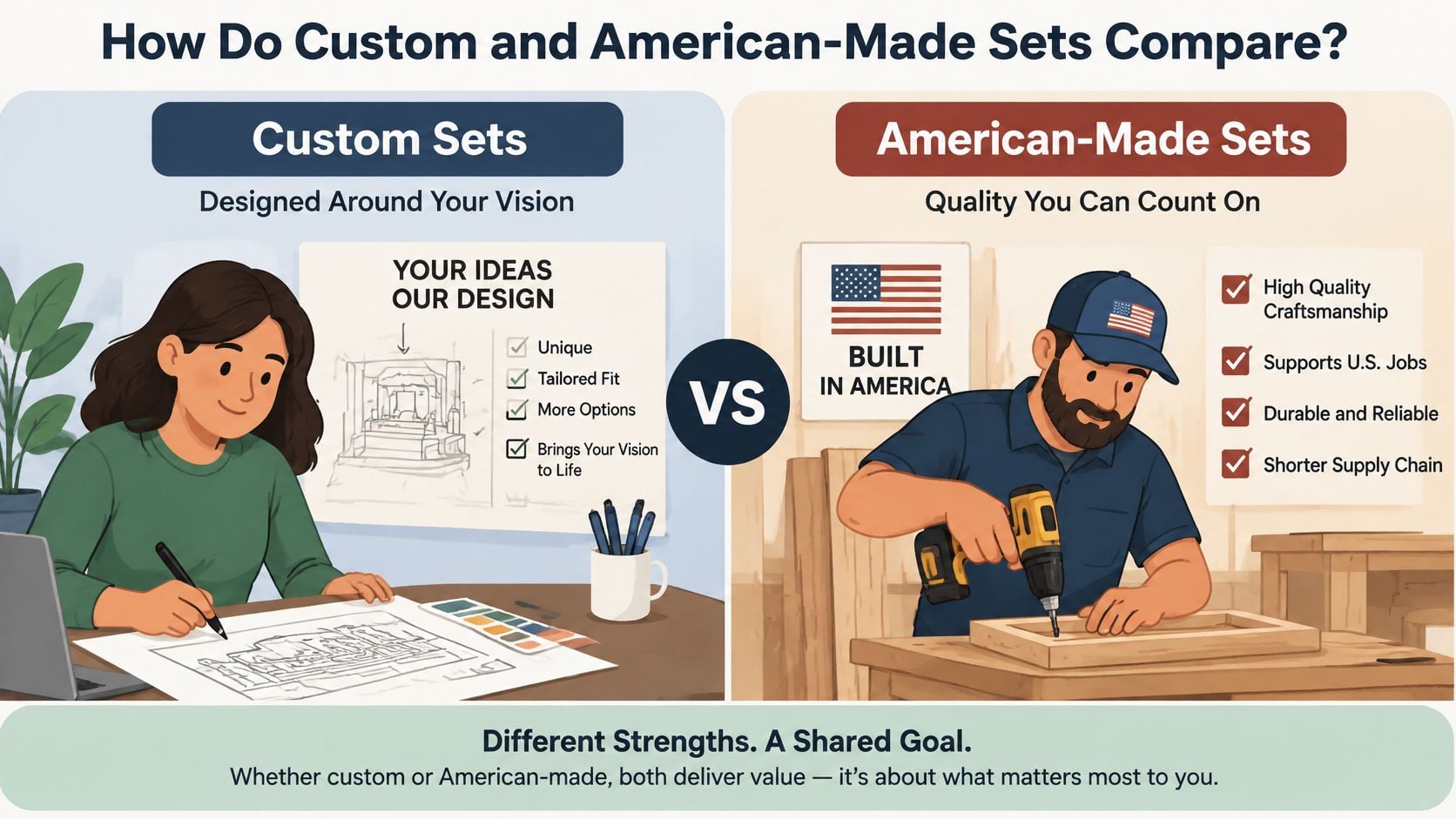
The useful comparison is price against years in service. A discount set replaced twice in a decade usually costs more than one well-built set bought once, and the difference shows up long before the receipt does: a wobble, a sag, a drawer that stops closing flush, a finish that lifts along an edge. Custom ordering then closes the gaps stock sizes leave, in desk height, depth, finish and storage configuration.
Two different buying paths, side by side.
Premium and custom office furniture makers compared
| Maker | Origin | Core strength | Best fit in a home office |
|---|---|---|---|
| Stickley | United States | Arts & Crafts heritage, heirloom solid wood, handcrafted joinery | Desk and storage meant to last for generations |
| Stressless | Norway | Patented Glide system and engineered lumbar support | Task seating for long workdays |
| Canadel | Canada | Hand-finished solid birch, custom design specs | Custom desk and matching storage |
| MAVIN | United States | Solid wood built in Ohio's Amish country from hand-selected cherry, oak, maple, walnut or hickory | Solid wood desk and bookcase |
What custom ordering adds
Materials, finishes, desk heights, configurations and fabrics matched to the room rather than to a warehouse plan. It matters most when the room is unusual, or when the office has to share walls with a guest room and return to family use on weekends. A standard 30 inch desk puts the keyboard at the wrong level for a shorter user, a deeper top solves a monitor problem no chair adjustment can fix, and a finish matched to existing millwork makes the office read as part of the house instead of an addition.
Custom has a cost in time, and pretending otherwise does nobody a favor. A typical special-order lead time runs six to eight weeks, and an out-of-stock fabric or component pushes the date further out. Set the timeline before the room has to be finished, and order early when the space serves two purposes.
What Florida asks of a finish
Heat, humidity and afternoon sun through a west-facing window in Longwood or Sanford put real demands on finishes and upholstery. Ask each maker how their finish handles humidity and how their fabric handles sustained sun, then compare the samples in person under daylight rather than on a screen.
For households that want the room measured first and the set planned around an existing wall, window or odd corner, custom-made office furniture is the route that closes those gaps.
Why Is an In-Person Showroom the Smarter Way to Buy a Home Office Set?
Product pages flatten the decisions that determine whether a set works: posture, reach, clearance and how a shared room functions after office hours. Sit at the desk. Place your hands where the keyboard goes, check the monitor against viewing-distance and eye-level targets, and let a consultant adjust the chair and armrests while you remain seated. A desktop that felt right online can sit too tall once your feet are flat.
Test the set against the household next. A desk that suits one person may force a taller partner into a poor chair height, and a spare bedroom may need the same surface to support guests or family use later. Complimentary space planning and in-home design turn those observations into a measured layout, with walkways, door swings and nearby furniture considered before the order.
The Design Team at Slone Brothers Furniture can work from the room itself, then coordinate the office pieces with the rest of the home. In Longwood, Central Florida shoppers can compare a Stickley desk, Canadel custom table and Stressless chair side by side, making scale and comfort easier to judge than separate product pages.
Delivery includes assembly and placement of only the items purchased, plus a one-time leveling of case pieces and doors at the time of original delivery. For a wider view of the difference between a showroom floor and a shopping cart, see where to buy quality furniture in Central Florida.
How Do You Confirm Your Set Before Visiting Longwood?
Preparation decides how much the visit tells you. Bring three things: the taped desk footprint with its walkway clearance marked, your measured monitor distance and eye height, and a scaled sketch or photo of the room. Add the wall paint color and a flooring sample. For the sketch, the free online room planner includes design templates, or you can measure your own room and lay it out to scale before you leave home. With that in hand, a showroom visit settles in an hour what weeks of browsing can't.
Treat the visit as a test, not a browse
A design consultant should sit at the desk with you, adjust the chair and armrests, and check that your feet rest flat on the floor or on a footrest. Ask for the chair to be set for the shortest and tallest person in the household, one after the other. If the desk can't serve both without a footrest or an adjustable surface, that's the answer you came for.
Give the storage pieces the same scrutiny. Open every drawer, check that the desk's cable run reaches your outlet position, and confirm the office storage fits inside the floor space your tape marks allow. Then take the finish decision slowly. Certain items can go home on approval for a 48 hour period, so a wood tone or a fabric can prove itself against your own walls and your own light before you commit.
Financing is also available, so settle the budget question on the same visit rather than after it.
That's the difference between ordering a set and furnishing a room.
Slone Brothers Furniture has furnished Central Florida homes from its Longwood showroom since 1980, with the desks, office chairs and office storage that let a set be planned as one room instead of bought piece by piece. Bring a tape measure, a photo of the space and the names of the people who'll share it, and the design team will work through footprint, finish and fit with you face to face. Visit Slone Brothers Furniture in Longwood to plan a home office that returns to family use the moment the workday ends.