

Memory Foam Mattress for Side Sleepers: A Buying Guide


A side sleeper with broad shoulders wakes with a numb arm. The mattress did not fail because it was cheap or old. It failed because firmness was never matched to the body lying on it.
Body weight, shoulder width, and how often a sleeper changes position all shape where the right firmness sits, so no single number fits every side sleeper. A lighter body needs more surface give at the shoulder. A heavier one needs firmer support layers underneath so the hips stay level with the spine.
For Longwood and Greater Orlando bedrooms, heat joins that equation. Memory foam contours well and holds warmth, and a Central Florida night gives that warmth nowhere to go. The mattress that fits has to relieve pressure, keep the spine supported, stay comfortable in a warm room, and still let a sleeper roll over without a fight.
Which Firmness Suits a Memory Foam Mattress for Side Sleepers?
Medium to medium-firm is the best starting point, not a universal prescription. The right surface cushions the shoulder and hip while keeping the sleeper's waist and pelvis supported.
The usual screening band extends from approximately 4 to 6.5 out of 10, according to the medical experts consulted by AARP's side-sleeper mattress guide. A sleeper's build determines where within that band a showroom comparison should begin.
Target firmness by side-sleeper profile
The following targets are practical starting points within that screening band, rather than independently tested prescriptions for each body type.
| Sleeper profile | Target firmness (1-10) | Layer focus | Showroom check |
|---|---|---|---|
| Lighter side sleeper | Lower end of the screening band | Deeper surface give over a firm base | Shoulder cushions and hip settles without bottoming out |
| Average build, mostly side sleeping | Middle of the screening band | Balanced contouring over a supportive core | Waist stays supported and spine stays level |
| Heavier side sleeper | Upper end of the screening band | Firmer transition and support layers | Hips don't drop below the line of the spine |
| Broad shoulders or wide hips | Middle of the band, adjusted for joint clearance | Enough comfort-layer depth to accommodate prominent joints | Shoulder pressure eases after several minutes |
| Combination sleeper who turns | Middle of the band with responsive cushioning | Quicker-response foam for easier turning | Rolling onto the back or stomach takes little effort |
Body weight and body shape aren't interchangeable. A broad-shouldered sleeper may need additional shoulder accommodation without needing a softer mattress everywhere. A heavier sleeper may enjoy a plush surface but still require substantial resistance beneath the pelvis.
A lighter person presents the opposite challenge. A surface that feels comfortably yielding to a larger partner may barely compress beneath a smaller body, leaving the shoulder insufficiently cushioned.
Fit principle: A comfortable surface and a supportive mattress aren't necessarily the same thing.
Firmness labels also aren't a substitute for construction details. A soft top can conceal inadequate support, while a firmer-feeling mattress can still provide useful joint cushioning through its comfort layers.
The Slone Brothers mattress firmness guide provides additional context for comparing those labels. During a Longwood showroom visit, the decisive question is whether the sleeper's body settles into a balanced position, not whether the tag says plush or firm.
Why does memory foam relieve pressure at the shoulder and hip?
Memory foam lets the shoulder and hip sink gradually, spreading body weight across a wider contact area so pressure stops concentrating at those prominent joints. Its value lies in controlled conformity: enough give to cradle the joint, enough resistance underneath to hold the spine level.
The material works like a well-fitted glove where a flat board cannot. Instead of meeting the body at a few heavily loaded points, it follows the contours and shares the load across a larger surface.
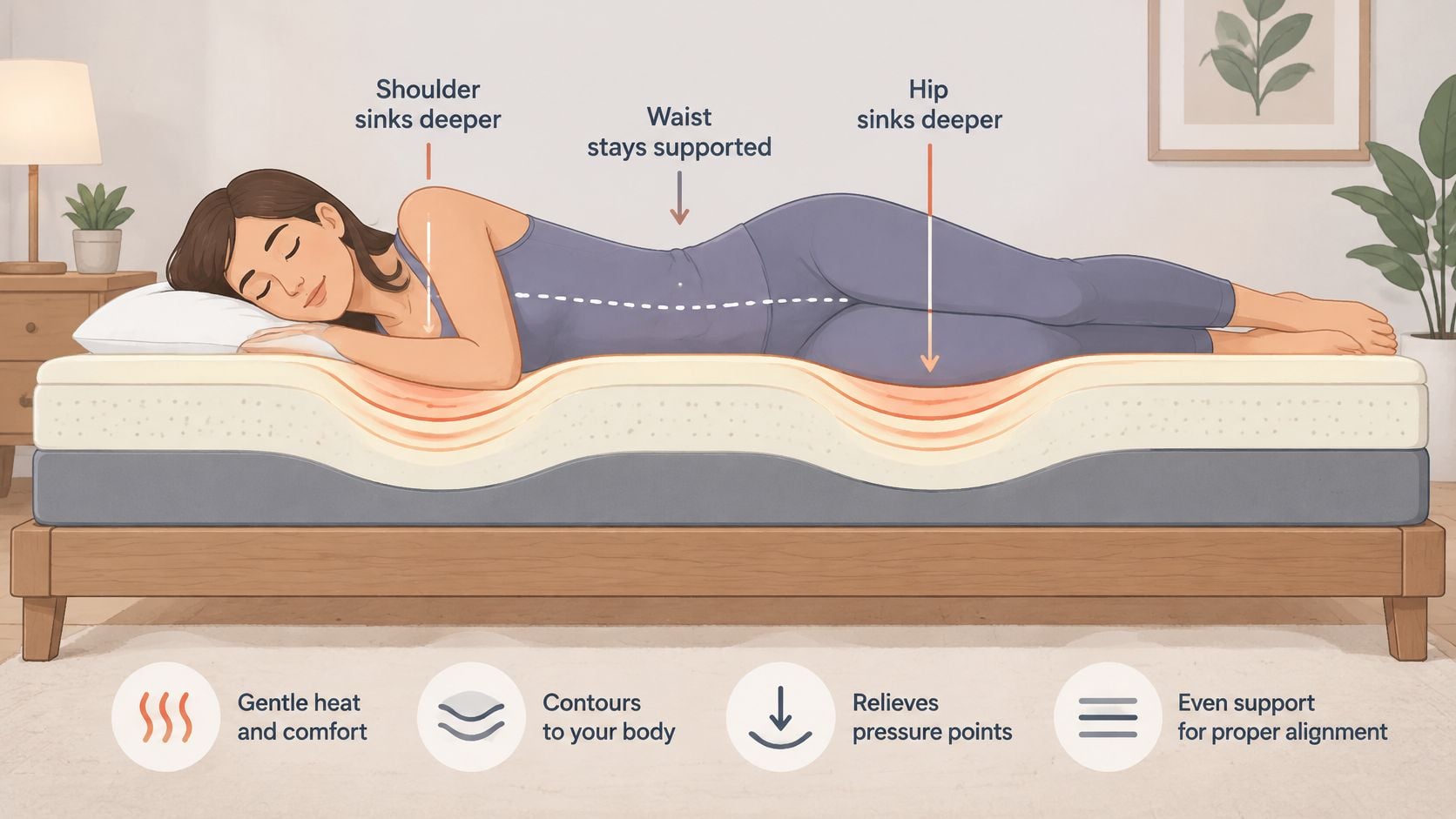
Take a side sleeper with prominent shoulders and a comparatively narrow waist. On an unyielding surface, the shoulder cannot descend far enough to keep the spine straight. On an excessively soft one, the pelvis keeps dropping after the shoulder already feels comfortable. Two different failure modes, one shared symptom: waking up stiff.
What the pressure measurements mean
A peer-reviewed comparison of soft, medium, and hard mattresses found the medium surface produced the lowest measured peak contact pressures in several regions, including approximately 4.5 kPa at the scapula and 5.9 kPa at the buttocks, while the soft surface increased intervertebral-disc peak loading by 49% relative to the medium surface and the hard surface raised contact pressure and reduced the lumbar curve.
Those results do not make any retail mattress a medical solution. They show why reaching for the softest surface on the floor can solve a comfort problem and create a support problem at the same time.
A solid fit check separates four sensations:
- Shoulder cushioning: The joint should feel cradled, with no upward push against the torso.
- Waist contact: The mattress should meet the torso and fill the gap at the waist.
- Pelvic stability: The hips should settle and stay settled.
- Relaxed posture: The sleeper should rest without twisting forward or backward to escape pressure.
For a heavier or broad-shouldered sleeper, the fix is usually a stronger support system beneath the cushioning instead of more soft foam on top. The guide to mattresses for pressure relief separates joint comfort from the deeper support that holds that position through the night. The showroom test method covers how a companion reads the resulting alignment from behind while the sleeper stays relaxed.
Pain that persists or worsens calls for a clinician. A mattress evaluation addresses comfort and posture, and that is a different question.
How do thickness and foam density change the feel of a memory foam mattress?
Comfort-layer thickness and foam density describe different aspects of performance. Thickness influences how far the body can travel into the cushioning, while density helps explain the foam's character and durability.
Total mattress height is less useful by itself. A tall mattress may contain extra quilting, additional transition layers, or a deeper support core, none of which automatically guarantees better shoulder accommodation.
Read the layers, not just the profile
| Feature | Typical range | Effect for side sleepers |
|---|---|---|
| Comfort-layer thickness | Model-specific; compare actual layer depth | Sets how far the shoulder can settle before firmer support engages |
| Total mattress height | Match the complete build to the sleeper and bed | Height alone doesn't establish resistance to bottoming out |
| Comfort-foam density | Request the actual specification | Higher-density foam generally provides more durable, stable contouring |
| Base-support density | Model-specific specification | Helps assess the structure intended to resist excessive pelvic drop |
As a hypothetical comparison, consider a taller mattress with a substantial memory-foam comfort section over a firm base and a shorter mattress with a shallow comfort section. Both could carry a medium label, yet the first may allow more shoulder travel before the sleeper encounters firm resistance.
That doesn't automatically make the taller model better. A sleeper who turns frequently might prefer less immersion, while a prominent shoulder may need greater cushioning depth.
Density isn't another word for firmness
The Sleep Foundation's mattress comfort guidance supports evaluating contouring and support together; higher-density memory foam generally offers greater durability and slower, steadier conformity, while lower-density foam may feel cooler and easier to move on but can develop impressions sooner.
Dense foam can still feel soft. Firmness describes resistance under the body; density describes how much material occupies a given volume.
For a Central Florida bedroom, the sensible investment is a layer system that fits the sleeper without relying on excessive depth. A substantial specification deserves consideration, but it still has to pass the movement and temperature checks.
Specification rule: Obtain the comfort-layer thickness and foam-density details, then verify the feel while lying down.
The base deserves equal attention. A luxurious comfort layer cannot compensate for a support system that allows the pelvis to settle beyond a stable position.
Is memory foam the right construction compared with hybrid, latex or coil mattresses?
Memory foam is a strong choice for deep shoulder and hip contouring, while a foam-topped hybrid can balance cushioning with a more responsive support structure. Latex and pillow-top coil mattresses deserve consideration when easy movement matters more than a pronounced body-hugging feel.
Construction should follow the sleeper's priorities. A preference for substantial pressure relief doesn't automatically require an all-foam mattress.
Mattress types compared for side sleeping
These are general construction tendencies, not guarantees for every model.
| Mattress type | Shoulder and hip pressure relief | Heat retention | Edge support | Ease of movement |
|---|---|---|---|---|
| Memory foam, all-foam | Strong, deep contouring | Can retain warmth; ventilation needs verification | Often softer at the perimeter | Slower to reposition |
| Hybrid, foam over coils | Balanced cushioning when the comfort layer fits | Coils provide an airflow pathway | Often firmer with perimeter reinforcement | Generally easier to turn |
| Latex | Responsive, moderate contouring | Breathability depends on the complete build | Moderate, construction-dependent | Responsive and easy to move on |
| Innerspring or coil with pillow top | Requires sufficient cushioning above the coils | Good airflow through the support unit | Construction-dependent | Usually easy to move on |
The National Council on Aging's side-sleeper mattress assessment identifies the shoulders and hips as important pressure areas and describes memory foam's ability to cushion them. That makes contouring a meaningful selection criterion, but not the only one.
Match the construction to the nightly problem
For a sleeper whose main complaint is a tender shoulder, begin with memory foam and a foam-topped hybrid. Compare whether either construction provides relief without requiring the person to curl tightly or rotate away from the sensitive area.
For someone who changes position frequently, prioritize responsive cushioning. Latex or a suitably designed hybrid may make turning less demanding than enveloping, slow-recovery foam.
A pillow top needs close inspection rather than an automatic rejection. If its cushioning adequately accommodates the shoulder and hip, an additional topper may be unnecessary; if it doesn't, adding one later introduces another variable into the fit.
The memory foam and hybrid comparison guide provides useful preparation for an in-person assessment. Long-term value comes from selecting the right construction at the outset, not paying for an impressive profile that requires corrective accessories afterward.
A premium mattress should earn its place through comfort, support, and usable construction details. Neither a higher price nor a more elaborate product name proves that it fits a particular sleeper.
Does memory foam trap heat, and how can side sleepers keep cool?
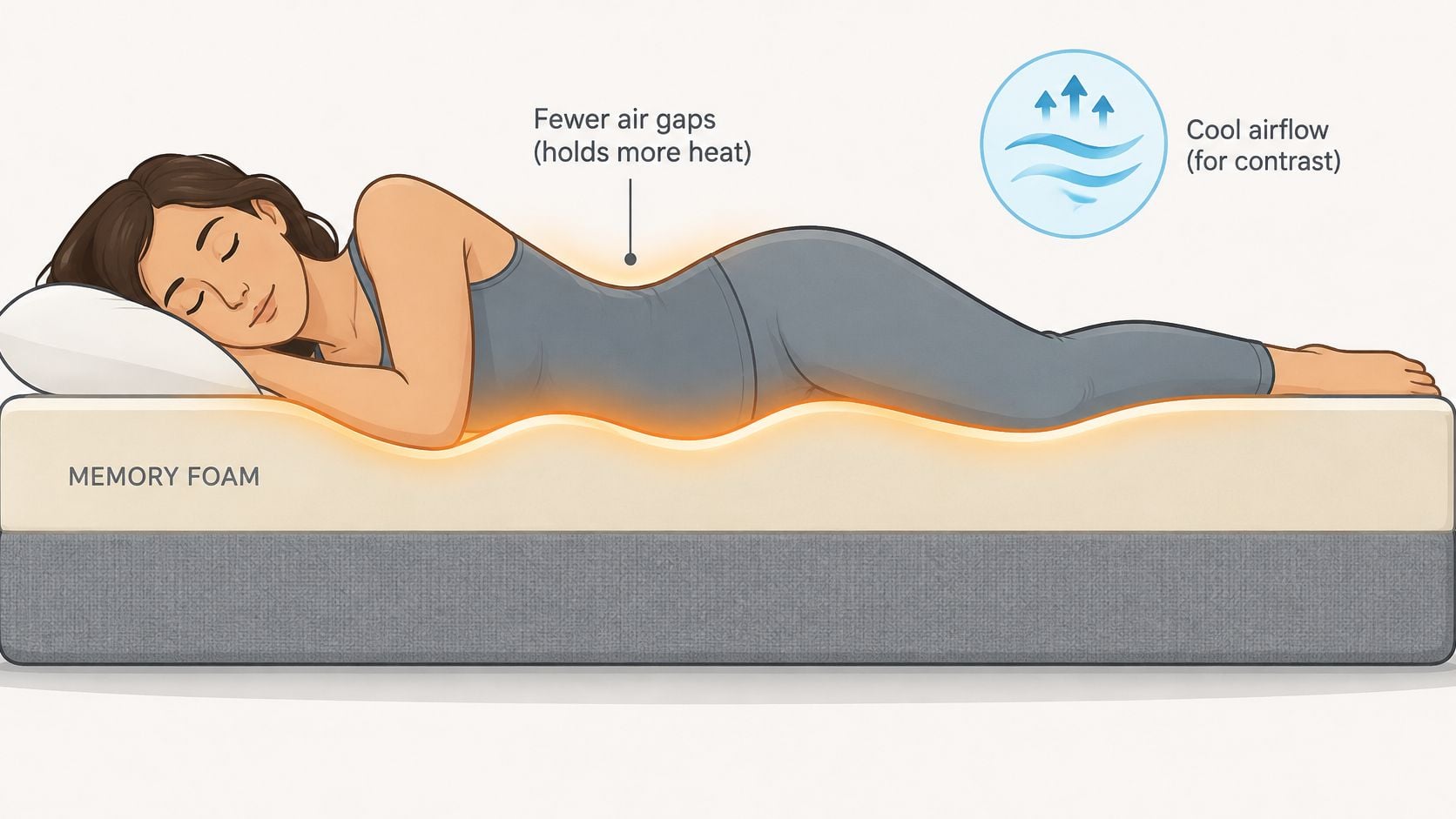
Yes, memory foam's close contouring can retain warmth by reducing open air space around the body. Breathable construction and appropriate bedding can help, but a cooling label doesn't establish comfortable overnight performance.
The Sleep Foundation's side-sleeper guidance identifies this trade-off directly: memory foam offers pressure relief but can trap heat. For an Orlando homeowner who already wakes warm, temperature management should be a selection requirement rather than an optional upgrade.
Verify the cooling construction
A cool initial touch and sustained heat management aren't the same thing. Shoppers should identify what a feature does within the mattress.
- Breathable cover: Check the fabric and quilting rather than relying on a cooling product name.
- Ventilated or open-cell foam: Look for a described airflow strategy within the comfort system.
- Gel or phase-change materials: Establish where the material sits and what function the manufacturer claims.
- Coil support core: Assess the complete build, since airflow beneath thick foam doesn't eliminate close-contact warmth.
Central Florida's humid conditions make the bedding surrounding the mattress especially relevant. A breathable sheet set can't change the foam underneath, but a heavy or restrictive bedding stack can work against an otherwise suitable mattress.
Protect the mattress without enclosing the surface
A protector should suit both the mattress and the sleeper's temperature sensitivity. Protect-A-Bed's memory foam protector guide is a useful resource when considering how protection fits into a memory-foam bedding setup.
Breathable sheets, an appropriate protector, and a comfortable bedroom thermostat setting should be considered together. A short showroom trial won't reproduce an entire humid night, so construction details and the sleeper's history of overheating remain important.
A cooling feature should support a comfortable sleep environment, not excuse a mattress that already feels too warm during testing.
The memory foam cooling guide offers further context for comparing options. Deeper contouring may suit sensitive shoulders, but a more responsive, ventilated build is the stronger candidate when warmth and difficult turning occur together.
How do I test a memory foam mattress in the showroom before I buy?
A mattress that feels right for thirty seconds can be wrong after ten minutes of lying still. Plan at least 20 minutes on each serious candidate, and use the same position on every bed so the comparisons mean something.
The right firmness is a fit question, not a label. Body weight, shoulder width, and how often you change position all change what the same mattress feels like, so the only scorecard that matters is the one you fill in yourself.
Follow a repeatable fit test
Set up your real sleeping position. Bring your usual pillow, take off your shoes, and settle into your habitual side-sleeping posture. An unfamiliar pillow changes your neck angle and can make a well-fitting mattress feel wrong.
Let the foam settle. Stay still for several minutes before judging. What matters is where your body ends up once the foam warms and conforms, since the first touch of the cover tells you very little.
Have alignment checked. Ask a companion or the consultant to look at your spine from behind while you stay relaxed. The neck should continue the line of the torso, and the waist should not hang unsupported.
Assess the pressure areas. Note how the shoulder and hip sit, then make a small position adjustment. Numbness, persistent compression, or continued sinking after several minutes means that model is off the list.
Change positions the way you do. Roll onto your back, and onto your stomach if you ever end up there. If turning takes real effort against the surface, that foam wraps you too tightly for easy repositioning.
Test the edge two ways. Sit on the perimeter, stand up, then lie near the side. Sitting stability and sleeping support near the edge are different checks, and a mattress can pass one while failing the other.
Notice warmth building. Stay long enough to feel whether heat starts collecting under the shoulder or torso. Early warmth counts even when a cooling label suggests otherwise.
Compare density while holding firmness steady. Ask the consultant to pull alternatives at a similar firmness with different foam specifications. That separates a preference for surface resistance from a preference for slower or quicker response.
Record the result before moving on
| Check | What to write down |
|---|---|
| Shoulder and hip | Settled feel, plus any compression or numbness |
| Spinal line | Whether the torso looked level from behind |
| Warmth | Heat building under the shoulder or torso |
| Movement | How easily you turned and got up |
Score each mattress before stepping onto the next one. A written scorecard stops the last bed on the floor from overshadowing the best fit, and couples should each record an independent assessment before comparing notes.
Mattress height and room layout deserve a minute too, since height changes how the bed sits against your frame and nightstands. Complimentary space planning can coordinate those furniture decisions, and a consultant can walk your scorecard and narrow the finalists with you in person.
What should I bring to a fit test in Longwood before I buy?
Provide a clear account of how you sleep: position, pain locations, turning habits, and sensitivity to warmth. The most useful preparation is an honest description of an ordinary night, not a predetermined firmness label.
A usual pillow, comfortable clothing, and measurements of the existing bed setup make the visit more productive. A photograph of the bedroom also helps the design team understand the surrounding furniture and access around the bed.
Bring a sleep profile, not just a preference
- Usual position: Note whether side sleeping lasts through the night or alternates with back or stomach sleeping.
- Discomfort location: Distinguish shoulder compression, hip tenderness, neck discomfort, and lower-back stiffness.
- Turning habits: Describe whether changing sides feels frequent or physically difficult.
- Temperature history: Identify whether warmth occurs regularly and what bedding is normally used.
- Bedroom constraints: Include bed-frame details, access needs, and any concerns about sitting or standing at the edge.
At the local mattress showroom in Longwood, Slone Brothers Furniture carries memory foam, foam gel, hybrid, innerspring, spring, euro top, cooling, tight top, and TEMPUR material mattresses from Stearns & Foster, Tempur-Pedic, and Sealy. Comfort descriptions run from extra soft, hybrid soft, ultra soft, and plush through medium firm, ultra firm, and extra firm.
That range makes direct comparison possible without assuming every label represents the same feel. The consultant's task is to connect the sleeper's observations with firmness, comfort-layer depth, density, perimeter stability, and temperature behavior, so arrive ready to describe each of the checklist items above in plain terms.
Plan the bedroom as a complete setting
Family-owned since 1980, the Longwood showroom serves Greater Orlando and the wider Central Florida area. Its in-house design team offers complimentary space planning, so arriving with wall lengths, doorway widths, and window placement turns a mattress decision into a workable bedroom layout.
Shoppers who want a head start can measure their room at home and lay it out to scale in the store's free online room planner, which includes design templates for common configurations. Bringing that plan to the fit check gives the design team a concrete starting point for coordinating the new mattress with the bed, nightstands, and surrounding furniture.
Slone Brothers Furniture offers face-to-face mattress guidance and complimentary design assistance to help homeowners coordinate comfort with a well-planned bedroom. Visit Slone Brothers Furniture in Longwood, FL, to compare side-sleeper options with an experienced design consultant and replace online guesswork with a personal fit check.